The Transformation of China's Public Service
System : Towards Citizen-Oriented Public
Service System
著者
曲 甜
学位授与機関
Tohoku University
学位授与番号
11301甲第15403号
0
The Transformation of China’s Public Service
System: Towards Citizen-Oriented Public
Service System
Legal and Political Studies Graduate School of Law
Tohoku University
B1JD1010 Qu Tian
1
The Transformation of China’s Public Service System:
Towards Citizen-Oriented Public Service System
Abstract: Public service seems to be one of the unavoidable issues in modern society. Since reform and opening- up in 1979, China has entered the speedway of modernization, and the issue of public service has been becoming increasingly significant in China. Especially, in 2004, service-oriented government reform was officially launched, and public service has attracted widespread attention of the whole society and active discussion among academic groups. Twelfth Five Plan of National
Basic Public Service System, issued by State Council in 2012, has generally
confirmed the responsibility of government to provide public service and the right of citizens to enjoy public service, which probably could be seen as a sign that Chinese public service reform has entered into a new era. In this context, it is required to give attention to the western government reform theories, to the institutional changes of public service system since the founding of People Republic of China, as well as to the public service reforms currently undertaken in local China.
Basically, according to the experiences of western government reforms, each governance transformation would bring new changes to public service model, thus public service seems to be reasonable to be employed as a certain indicator of government transformation. Deriving its origin from the critical examination of classical bureaucratic system, the “Reinventing Government”, however, suffered powerful criticism by “New Public Service”, which significantly enhanced and expanded the role of citizens in public service. Meanwhile, the history of welfare state probably has proven that facing the situation that supply of public service was always less than the need of that, and that support of citizens for welfare system will probably last for a long time, following market and social organization, the citizen as another public service subject has been integrated into multi-supply public service model.
2
With the great transformation from planned economy system to market economy system, China’s government reform has continued to be deepened. From economic development-oriented government in the initial period of reform and opening up, to public service-oriented government in new century, the function of public service was argued to be changed accordingly. Specifically, during the period with economic construction as its focus, the public service has not been given deserved attention, the function of which was mainly located on serving economic development. Until the arrival of service-oriented government reform, its function was then gradually developed into serving the citizen. In addition, with the development of market economy, citizens’ need for public service as well as their citizen consciousness seem to be increasingly growing, therefore, how the government will respond to the rapidly increasing citizens’ need and then establish modern public service system with citizens as its orientation, currently seems to be the key of public service system reform. This research argues that in the transformation of China’s public service system, it seems necessary to constrain and regulate government behavior, which still need great efforts, however, to discover citizen and to activate citizen seems more urgent, which, may be the vital step towards citizen-oriented public service system
I
Contents
Introduction ... 1
Chapter 1 Public Service Theory... 7
1.1 Government Reform Theory and Comparison of Public Services Model ... 7
1.1.1 Old Public Administration and State-Oriented Public Service Model ... 7
1.1.2 New Public Management Model and Market-Oriented Public Service Model ... 10
1.1.3 New Public Service and Citizen-Oriented Public Service Model ... 14
1.1.4 “Governance Theory” and Multi-Center Public Service Model... 18
1.1.5 Brief summary ... 26
1.2 The Transformation of Welfare State and Analysis on Public Service Mechanism ... 27
1.2.1 Origins of Welfare State ... 27
1.2.2 Crisis of Welfare State... 31
1.2.3 Welfare State Reform ... 35
1.2.4 Brief Summary ... 47
Chapter 2 Evolution of Contemporary China’s Public Service System and the Development of Citizen’s Role ... 49
2.1 Contents of Public Service ... 50
2.1.1 Concept of Public ... 50
2.1.2 Classification of Public Service ... 50
2.1.3 Public Service System ... 51
2.2 Public Service Model in Planned Economy Period: Citizen as Producer ... 52
2.2.1 Urban Areas: Workplace Welfare... 52
2.2.2 Rural Areas: “Collective Welfare”... 53
2.3 Public Service Model in Market Transition Period: Citizen as Purchaser ... 57
2.3.1 Government Reform under the Background of “Economy Leading The Way”... 57
2.3.2 Government Absent and the Self-Afforded Public Service ... 59
II
2.4.1 Service-Oriented Government Reform and Establishment of Government Public
Service Responsibility ... 64
2.4.2 Process of public service reform... 67
2.4.3 Satisfaction Evaluation for Public Service... 70
Chapter 3 The Government and Citizen Relationship in the System Change of Public Service: A Case of “New Healthcare Reform” ... 79
3.1 “Free” Healthcare and State-Dominated Public Healthcare Service Model ... 80
3.1.1 Free Healthcare in Urban Areas ... 80
3.1.2 Cooperative Healthcare in Rural Areas ... 80
3.2 Sky-High Price Healthcare and Market-Oriented Public Healthcare Service Model ... 82
3.2.1 The Marketization of Healthcare Service ... 82
3.2.2 Absence of Government and Self-Paid Healthcare... 83
3.3 “Universal Healthcare” And Public Healthcare Service Model with Citizen Participat ion . 88 3.3.1 Path Selection of “New Healthcare Reform”: Citizen Participation ... 89
3.3.2 Rural Areas: New Rural Cooperative Medical System ... 91
3.3.3 Urban Areas:Urban Employees Basic Medical Insurance and Urban Residents Basic Medical Insurance ... 93
3.4 Public Service Healthcare Model in Progress: Multi-Participated ... 96
3.4.1 Strengthen the Government Mechanism... 97
3.4.2 Rich Market Mechanism...101
3.4.3 Add Social Organization Mechanism...103
3.4.4 Expand Citizen Mechanism ...105
3.5 Conclusion...109
Chapter 4 Public Service Reform Dominated by the Government: Enlightenment of “Government-Community Interaction” Reform in Taicang City ... 112
4.1 Government and Community-Level Self-Governance Organization...112
4.1.1 Origin of “Government-Community Interaction”...112
4.1.2 Issue “Lists” of Rights ...113
4.1.3 Sign Assignment Agreement...122
III
4.2.1 “Party Member Official Business Discussion Group” of Donglin Village...133
4.2.2 “Sunshine Love Service Station” of Zhongqu Community ...142
4.2.3 “Government-Community Interaction” Contact Personnel of Fengzhong Village ...144
4.3 Government, Community-Level Self-Governance Organization and Citizen ...145
4.3.1 Local Level Government’s Evaluation on Community-Level Self-Governance Organization ...146
4.3.2 Community-Level Self-Governance Organization’s...149
Evaluation on Local Level Government ...149
4.3.3 Citizens’ Evaluation on Community-Level Self-Governance Organizations ...151
4.4 “Government-Community Interaction” And Citizens ...156
4.4.1 Citizens’ Recognition of the Importance of the “Government-Community Interaction” ...156
4.4.2 Citizens’ Objective Cognitive Level for The “Government-Community Interaction” ...158
4.4.3 Citizens’ Objective Evaluation of the “Government-Community Interaction” ....161
4.4.4 Citizens’ Actual Participation Level in “Government-Community Interaction” ..165
4.4.5 Citizens’ Subjective Evaluation for “Government-Community Interaction” Participation...168
4.4.6 Brief Summary ...172
4.5 The State-citizen Relationship in Public Service Supply...173
Chapter 5 Citizens-Participated Public Service Reform: Kunshan City’s Trial on “Create Modern Public Service System”... 177
5.1 The Public Service Reform and Government Transformation ...177
5.1.1 Western Experiences and China’s Problems...177
5.1.2 Public Service Reform: Performance Evaluation and Citizen Participation ...182
5.2 Citizen-participated Public Service System: Kunshan City’s Trial ...185
5.2.1 Design of Reform Plan ...185
5.2.2 Data Results Analysis of Pre-Survey in Small Samples ...188
5.3 An Analysis of Kunshan Citizens’ Public Service Needs ...197
IV
5.3.2 Citizens’ Needs for Public Service Projects in Residents Communities ...200
5.3.3 Citizens’ Choices for Public Service Supplying Ways ...203
Chapter 6 Diversified Public Service Evaluation Systems: Tongling City’s Reform... 207
6.1 Establishment of Grid-Based Public Service System...207
6.1.1 Cancellation of Sub-district offices...207
6.1.2 Establishment of Grid-Based Public Service System...208
6.2 Public Service Evaluation Reform...212
6.2.1 Government Examination on Public Services ...212
6.2.2 Citizen Evaluation on Public Service ...216
6.2.3 Result Comparison between Government Examination and Citizen Evaluation ..220
6.3 Satisfaction Evaluation on Grid Servicemen ...221
6.3.1 Evaluation methods ...221
6.3.2 Evaluation Results...224
6.4 Brief Summary ...226
Conclusion ... 231
1
Introduction
Public service provision could be considered as one of the natural responsibilities of all government. Because of profound theoretical significance and strong reality concern, for thousands of years, public service has never been out of the sight of political scientists and public administration scholars. It is expected that when humans gradually move towards modern society even post- modern society, the importance of public service will continue to grow.
Since reform and opening- up in 1979, China has entered the speedway of modernization, and the issue of public service has been becoming increasingly significant in China. Especially, in 2004, service-oriented government reform was officially launched, and public service has attracted widespread attention of the whole society and active discussion among academic groups. Twelfth Five Plan of National
Basic Public Service System, issued by State Council in 2012, has generally
confirmed the responsibility of government to provide public service and the right of citizens to enjoy public service, which probably could be seen as a sign that Chinese public service reform has entered into a new era. Under the background of modernization, how the Chinese government will respond to the needs of citizens for public service and then establish modern public service system with citizen as its orientation currently seems to be the key factor to the public service system transformation, and also the purpose of this research.
At present, a large number of public service works are available, which can be generally classified into three parts. First, theoretical research on government reform and public service. Traditional public administration theory generally focused on the role of government in public services supply, followed by the new public administration theory triggering reconsideration of public service values, such as equality, and then new public management theory opened a new chapter with
2
marketization as its main emphasis, which was largely changed by new public service theory highlighting the role of citizens in public services, and recently governance theory, by and large, led public service to a global overview. Similar to research conducted by western scholars, public service research has been put in the background of government reform by the Chinese scholars, and particularly, government functions of public service supply has attracted many scholars' attentions after proposing to establish service-oriented government. However, there is barely mature public service theory paradigm in China.
Second, research on public services mechanisms. International scholars tend to put mechanism research into public service case study. Among them, some of them selected a region ranging from community to global as the case, or a specific policy, for example healthcare policy, education policy, pension polic y and so on, and others compared the effectiveness and efficiency of various ways of public service provision, such as nationalization, privatization, and decentralization as well. Among Chinese scholars, it is widely believed that government, market and social organization are three major suppliers of public service, and both theoretical evidence and case analysis are rich in these three supply mechanisms. While few scholars have pointed out that, citizen shall be considered as another mechanism. The problems that what role of Chinese citizen should play in public service system have not been fully researched.
Last, empirical surveys on Chinese public service status. Since 2003, there is an increasingly number of empirical surveys, typically as questionnaire, regarding China public service status, both at national level and local level. Some of them refer to the supply level of public service, others refer to evaluation. However, the widely recognized evaluation index system still has not been established. In some chapters of this research, some discussion will be made concerning building scientific evaluation methods on public service.
On the whole, western research is better at theoretical analysis on public service. However, the problem is the western theoretical models are scarcely to meet Chinese public service reality and even government reform reality. Therefore, it is more urgent,
3
based on western relevant public service theories and lessons obtained from public service reforms in local China, to the western theoretical models, to propose some logic model appropriate for explaining China’s public service system.
The following three creative points are expected to be reached in this research, First, it is proposed that “government-citizen”, the basic relationship, shall be grasped in considering changes of Chinese public service system. There are many research perspectives on public service problems, but contradiction of government and citizen, supplier and receiver of public service, have been the fundamental problem in public service system. Chinese public service system has gone through three periods, i.e. planning economy period, market-oriented economy transformation period and service-oriented government building period, during which different public service systems and many public service policies have been introduced. However, relationship between government and citizen in public service is the essence, which stands behind these reforming measures. In other words, it is reasonable to analyze changes of Chinese public service system with the perspective of transformation of “government-citizen” relationship, and especially, change of citizen’s role in the transformation has been discussed and summarized in details by few domestic and foreign scholars.
Furthermore, it is beyond doubt that the government has responsibility in the public service supply, but, as the contradiction of supply and demand of public service increases, the government alone cannot solve public service supply problems. Therefore, how to share the responsibility and the cost with other subjects has become one of problems to be urgently solved. The research proposes four public service supply mechanisms, i.e. government, market, social organization and citizen mechanism, and it is hoped this proposal could give some suggestions to solving problems in public service supply. Particularly, China is different from western developed countries in history and system, but the diversified public service supply mechanisms may be the same system choice for them. However, how to absorb different public service mechanisms into the public service system, may need some sort of system design more suitable for China’s realities.
4
Finally, citizen mechanism may be of more significance for China’s public service system among the four mechanisms mentioned above. It is widely accepted that enjoying public service is both right and responsibility of citizen. Once citizen takes part into the public service system, a certain proportion of public service fee will be paid to reflect citizen responsibility, but the method and sense of citizen’s participation into public service should not be limited to be paid. The influence and significance of citizen’s participation for transformation of China public service system and even transformation of governance system are challenges for domestic and foreign public service reform. However, unfortunately, it is not optimistic for its current research. It is not ideal, seen from the reform practice of some local governments in China, for Chinese citizen’s participation into public service, and the citizen is absent in various links of the whole public service process. One of the mainly discussed problems in this research is to prompt transformation of citizen’s passive participation into active participation by further system reform and mechanism innovation, and then to deepen the transformation of public service system, which is also one of most distinguished features of the thesis.
Theoretical analysis method is employed in the Chapter 1 of this reseach. The section one of Chapter 1 summarizes evolution process of public service theories, and four periods are divided for the development of public administration, and then public service model in each period is summarized. The second part of Chapter 1 looks back the development of welfare states and traces their origin, crisis and reform trend. Theoretical review of the two parts offers theoretical support for analysis of problems in China’s public service.
Literature analysis method is adopted in Chapter 2. Academic books and policy documents with regard to China’s public service are referred to make an analysis of change of China’s public service system in the periods of planning economy, market-oriented economy and establishing service-oriented government. And then features of China’s public service system in each period are summarized. Some of representative satisfaction surveys for public service, done by domestic scholars in recent years, are quoted at the end part of Chapter 2, which could offer evidences for
5
analysis of China’s current public service system.
Case study method is used from Chapter 3 to Chapter 6, and questionnaire surveys are added in some cases. Chapter 3 is about changes of China’s healthcare system, which mainly based on statistics concerned in China Health Statistics Yearbook and China Statistics Yearbook, and the basic features of China’s public healthcare system in the periods of planning economy, market economy, and after “new healthcare reform” are analyzed. Meanwhile, the national or across-province survey data, especially some survey regarding citizen’s satisfaction for healthcare calculated by some scholars after 2003 (because the pilot reform of “new-type rural cooperative medical system” was launched in 2003), will be quoted in this chapter.
Case studies of “Government-Community Interaction” in Taicang city are analyzed in Chapter Four. I have visited in the past three years Taicang governments at different levels and village committees, and have a large number of first-hand materials after following this reform process. Firstly, key measures and basic steps of this reform are summarized with reference to policies of “government-community interaction” issued by Taicang government. Secondly, that, how a variety of public service mechanisms play their roles in community- level public service systems, is analyzed on the basis of many interview records. Thirdly, analysis is done for citizen’s participation into “government-community interaction” by making use of the survey data calculated from 859 questionnaires.
Case studies on “Create Modern Public Service System” reform in Kunshan city are done in Chapter 5. The research group, which I belong to, have visited and interviewed Kunshan many times before launching this reform, which was initiated in 2012. The research group talked with component authorities concerned and made on-site investigation, and the core idea, “citizen’s participation”, of this reform was determined and the preliminary reform program was designed. The research group, after launching pilot reform, made a small-sampled survey in order to find major problems faced in the current reform. The first step of public service, the participation model, is to set up public service demand co llection mechanism according to the reform schedule. Kunshan civil affairs bureau made a survey for public service needs
6
of citizens at the beginning of 2013 in 49 communities and 1000 residents, based on which, Kunshan citizens’ current public service need and major problems they face will be analyzed in this chapter.
Case studies on “grid-based public service system” reform in tongling city will be done in chapter 6. It is a branch of “community comprehensive system reform”, in which, the sub-street offices were canceled and new type of bigger communities were established. And 18 new communities adopted grid-based approaches to ensure the accessibility of community public service to citizens and generate a closer relationship between the grid servicemen and the citizen. By the collected data on the community public service evaluation of year 2011, which are inclusive of evaluation data both on communities and grid servicemen employed in the communities, the public service evaluation reform will be analyzed in this chapter, arguing that, besides government public service evaluation system, another set of citizen evaluation system is also required for transforming public service system.
In the last part, the conclusion of this research will be conclude, that is, the “strong government - weak citizens” public service model under China’s planned economy has to go through change and reform in the modernization process, and the combination of “strong government - strong citizen” model may represent the future orientation of China’s public service system. In such a model transformation, it seems necessary to constrain and regulate government behavior, which, admittedly, still need great efforts, however, to discover citizen, to initiate citizen, and to activate citizen seems more urgent, which, may be the vital step towards citizen-oriented public service system.
7
Chapter 1 Public Service Theory
This chapter will generalize public service theories from two perspectives. One is relevant government reform theory, attempting to explore the relations between the development of public administration and the evolution of public service model. The other one is welfare state related theories. Base on analysis of the history of welfare state, this section will be aimed at figuring out the characteristics of several public service mechanisms as well as the orientation of welfare state reform
1.1 Government Reform Theory and Comparison of Public
Services Model
Historically, providing public services could be considered as the primary duty of the government. Theorists, together with practitioners, have never ceased to explore how to effectively and efficiently supply public services. This section attempts to trace the evolution of these models, and to answer, first, what is the role of government in public service system? Second, who are supposed to be public service providers? Third, who are the receivers? Last, what is the institutional feature of public service?
1.1.1 Old Public Administration and State-Oriented Public Service
Model
Public administration as a self-conscious field of study and practice is generally thought to have begun at the end of the 19th century, with the well-known essay by Woodrow Wilson, the Study of Administration. This paper opened era of the “O ld Public Administration”, with the distinction between politics and administration at the
8
heart. Wilson said , “Administration lies outside the proper sphere of politics. Administrative questions are not political questions. Although politics sets the tasks
for administration, it should not be suffered to manipulate its offices.”①
Goodnow, another representative scholar of “Old Public Administration”, declared even more clearly, “Politics has to do with policies or expressions of the state will.
Administration has to do with the execution of these policies.”②
Since the date of its establishment, administration , aimed at effectively promoting the public welfare, which Wilson made clear, leading government “has been organized to subservice the general weal with the simplicity and effectiveness
vouchsafed only to the undertaking of a single will.”③
Such a government, in Wilson’s viewpoint, seems to have two features at least. One is efficiency-oriented. “It is the object of administrative study to discover, first, what government can properly and successfully do, and secondly, how it can do these proper things with the utmost
possible efficiency and at the least possible cost either of money or of energy.”④
The other is concentration of power. “Large powers and unhampered discretion seem to me the indispensable conditions of responsibility…there is no danger in power, if only it be not irresponsible. If it be divided, dealt out in share to many, it is obscured; and if it be obscured, it is made irresponsible. But if it be centered in heads of the service
and in heads of branches of the service, it is easily watched and brought to book.”⑤
Vincent Ostrom even call Wilson’s viewpoint as a sort of “paradigm”, building a science of administration, which can be summarized as follows: (1) a single dominant center of power; (2) unified power; (3) the center of power is defined and determined by the structure of a constitution; (4) the field of administration lies outside politics; (5) all modern governments will have a strong structural similarity; (6) hierarchical ordering of a professionally trained public service; (7) hierarchical organization will maximize efficiency; (8) good administration as defined above is a necessary
① Woodrow Wilson. “The Study of Administration.” Political Science, Quarterly 2, June, 1887, pp. 197-222. ② Frank J. Goodnow. Politics and Administration: A Study in Government. London: The M acmillan Company,
1900, p. 18.
③ Woodrow Wilson. “The Study of Administration.” Political Science, Quarterly 2, June, 1887, pp. 197-222. ④ Ibid, pp. 197-222.
9
condition for the advancement of human welfare.① Building upon the basic concepts
in the Wilson paradigm, other scholars of public administration gradually articulated several principles of administration. Such concepts as unity of command, span of control, chain of command, departmentalization by major functions, and direction by single heads of authority are assumed to have universal applicability in the perfection of administrative arrangement. In sum, general-authority agencies are preferred to limited-authority agencies. Large jurisdictions are preferred to small. Centralized
solutions are prefers to the disaggregation.②
The bureaucratic system seems to be the ideal and the typical form of government in the era of the “Old Public Administration.” Marx Weber, recognized as the most famous authority on bureaucracy study, pointed out that there were six characteristics of bureaucracy, namely, officialdom functions in the following specific manner: (1) Fixed and official jurisdictional areas ordered by rules; (2) A firmly ordered system of super- and subordination in which there is a supervision of the lower offices by the higher ones; (3) Office manage ment is based upon written document; (4) Specialized office management usually presupposes thorough and expert training; (5) Official activity demands the full working capacity of the official;
(6) The management of the office follows general rules.③ In summary, bureaucracy
described by Weber is by and large formal, hierarchical, professional, and in the era of the “Old Public Administration”, it is through such a bureaucratic system that a great many of public service can be provided.
White, in general, inherited the thought of dichotomy as well as the principle of efficiency-priority, and on this basis, he further proposed that public administration should play a more active role in the modern state. “The doctrine of the less government the better dominated the early years of our national life. It still persists in some quarters but has been fairly well submerged by popular willingness to turn to government and public officials for all kinds of aid.” Thus, it can be argued that in
①
Ostrom, Vincent. The Intellectual Crisis in American Public Administration. University of Alabama Press, 1989, pp. 24-5.
②
Ibid, p. 30.
③
M ax Weber. Essays in Sociology, translated, edited, and with an introduction by H. Gerth and C. Wright M ills. New York: Oxford University Press, 1946, pp. 196-198.
10
White’s opinion the state should occupy a dominating role to achieve public welfare.①
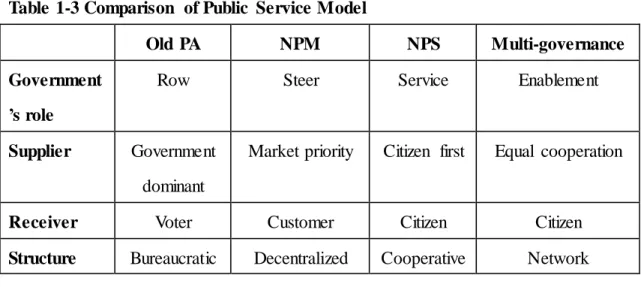
Based on the above viewpoints, several features of public service model could be concluded in the “Old Public Administration” period. First, driven by politics-administration dichotomy, the elected officials would be responsible for developing the plan of public services supply, and the administrators would be required faithfully execute the plan. Second, government, more often than not, was the main provider of public services. Third, administrato rs carrying out the plan of public services supply should be supposedly accountable to elected officials, and then to the voters. Last, efficiency seems to be the primary standard to measure the level of public service supply, and in order to keep efficiency, hierarchical bureaucracy was expected to conduct public service plan by the way of scale and unified provision.
1.1.2 New Public Management Model and Market-Oriented Public
Service Model
Here, one point must be clarified at the beginning. New Public Ma nagement (NPM for short) can be considered not only as a government reform movement but also as an intellectual perspective. As a trend of thought, it rebuked traditional public administration for having too little regard for the public manager as a strate gic political actor with their own personal interests; as a movement, it would be reasonable to ponder what might have caused this governmental reform movement sweeping the world. The answer is probably that it was directly inspired by the economic crisis of 1970s. In the 1970s, something “new” did come into the picture in both America and European countries. Economic crises, fiscal scarcity, and weariness with the liberal governance of preceding decades seemed to give impetus to more conservative political agendas wherein public- management-cum-private- management was viewed as a means, if not a panacea, for a more frugal, efficient and effective
government.②
①
Leonard D. White . Introduction to the Study of Public Administration. New York: M acmillan, 1939, pp. 23-4.
②
Lynn, L.E.J. “Public M anagement: Concise History of the Field.” In Ewan Ferlie, Laurence E.Lynn,JR., and Christopher Pollitt, eds., The Oxford Handbook of Public Management, Oxford: Oxford University Press, 2005, p.
11
(1) Pragmatic forces. When the cost of government activities is rising but the public's resistance to higher taxes is also rising, public officials seek any medicine that promises to relieve this fiscal stress. Privatization is a fundamental strategy to improve the productivity of government agencies. (2) Economic Forces. Now, however, with their growing economic capacity, a substantial number of citizens can manage for themselves. The welfare state is withering away. Economic factors are making people less dependent on government goods and services and more accepting of privatized approaches to their needs. (3) Philosophical Forces. Reduce the role of government and expand the role of the private sector, and this is privatization. (4) Commercial Forces. Some of Business groups advocate more privatization of such in- house government activities and support legislation that would prohibit using government employees to perform work that private, taxpaying businesses can perform. Another segment of the private sector sees substantial business opportunities in large capital projects for government. (5) The two elements of the populist position are that people should have greater choice in public services and they should be empowered to define their common needs and address them without undue reliance on cumbersome bureaucracies. In short, the five forces propelling privatization have an inviting target, that is, governments that are large and growing throughout the
world.①
The term NPM was coined by Christoper Hood in 1991, that later became a banner for the globalization of public management. There is no consensus on a precise definition of what NPM exactly represents. However, some doctrinal components, according to Hood, could be summed up: (1) Hands-on professional management in the public sector; (2) Explicit standards and measures of performance; (3) Greater emphasis on output controls; (4) Shift to disaggregation of units in the public sector; (5) Shift to greater competition in public sector; (6) Stress on private sector styles of
management practice; (7) Stress on greater discipline and parsimony in resource use.②
In addition, as Pollitt has put it, a number of typical approaches of NPM can be
41.
①
E. S. Savas. Privatization and Public-Private Partnerships, Seven Bridges Press, LLC, 2000, pp. 5-14.
②
12
highlighted: cost cutting, decentralized management within public agencies, establishing market and quasi- market mechanisms, emphasizing performance
management targets, and customer responsiveness etc.①
The core viewpoints of NPM are probably that: to introduce enterprise and private sector management tools into government sector, to adopt market instruments to overcome the drawbacks of the traditional way, and to impro ve government performance. It may break through the traditional thinking of previous administrative reforms taking government as the center, while advocate the concept of “customer-oriented” as Osborne and Gaebler put forward, obviously manifesting in the “reinventing government program”. Specifically, they offered the following ten principles for government reform: (1) Catalytic government: steering rather than rowing; (2) Community-Owned government: empowering rather than serving; (3) Competitive government: injecting competition into service delivery; (4)
Mission-Driven government: transforming rule driven organizations; (5)
Results-Oriented government: funding outcomes not inputs; (6) Customer-Driven government: meeting the needs of the customer, not the bureaucracy; (7) Enterprising government: earning rather than spending; (8) Anticipatory government: prevention rather than cure; (9) Market-Oriented government: leveraging change through the market; 10) Decentralized government: from hierarchy to participation and
teamwork.② It seems that the sort of reform plan apparently challenges the old
bureaucratic system and its public service approaches. According to Barzelay, the following paired statements indicate the main rhetorical battle lines:
Table 1-1 Bureaucratic Model vs. Customer Model③
Bureaucratic Model Customer Model
Focus on bureaucratic agencies needs Focus on customer needs
①
Pollitt, C. “Justification by Works or by Faith? Evaluating the New Public M anagement.” Evaluation 9(2), 1995, p. 134.
②
See David E. Osborne, and Ted Gaebler. Reinventing Government: How the Entrepreneurial Spirit Is
Transforming the Public Sector. Addison Wesley, 1993.
③
M ichael Barzelay. Breaking through Bureaucracy: A New Vision for Managing In Government, University of California Press, 1992, p. 8-9.
13
Focus on the roles and responsibilities of bureaucratic parts
Focus on enabling the whole organization to function as a whorl
Defines itself by the amount of resources it controls and by the tasks it performs
Defines itself by the results it achieves for its customers
Controls costs Creates value net of cost
Stick to routine Modifies its operation in response to
changing demands for its services
Fights for turf Competes for business
Insists on following standard procedures Builds choice into its operating system
when doing so serves a purpose
Announces policies and plans Engages in two-way communication with
its customers in order to assess and revise its operating strategy
Separate the work of thinking from that of doing
Empowers front-line employees to make judgments about how to improve
customers service
The NPM movement is argued to be a wave of government reform sweeping the globe. Comparing to old public administration model, NPM put forwards many new ideas, accompanied by many practical measures. As Guy Peters has noted, “perhaps the one defining feature of reinvention is a discard of some of the conventions associated with traditional public administration and an associated desire to rethink
government operation from the ground up.”①
Actually, it is argued that all kinds of governmental reforms are somewhat around a core question: how to provide public goods and public services in more plentiful, more efficient and more effective manners. It is noticeable that NPM indeed made some contribution to this question. Firstly, in the terms of public service supply, the government personnel, including elected officials and administrative bureaucrats, are argued to shift from the role of
①
Peters, B. G. “A North American Perspective on Administrative M odernisation in Europe.” In W. J.M ., Kickert, ed., Public Management and Administrative Reform in Western Europe, Cheltenham: Edward Elgar, 1997, p. 255.
14
front- line policy makers and implementers towards the coordinators and organizers, namely steering rather than rowing. Second, it is assumed that market, including enterprises, nonprofits, and civic groups increasingly becomes the main provider of public services, whereas the role of government appears to be weakened significantly. Thirdly, it may be expected that public service providers are required to improve responsiveness to customers and then to provide a variety of public service options for them. In other words, public service providers are expected to be accountable to the customer, rather than elected officials. Finally, in terms of public services supply, hierarchical bureaucracy comes to be replaced by decentralized government step by step, accompanied by the personalized and decentralized way instead of the scale and unified way in the past.
1.1.3 New Public Service and Citizen-Oriented Public Service Model
The introduction of market mechanisms seems to be conducive to overcoming the shortcomings of government failure, backed by management reform inside government, enhancing the level of public services supply effectively. However, NPM is unlikely to be free from criticism.
Two trends catalyzed by globalization, as Lucio suggested, are especially pertinent to government: the shift toward a market model of public management and, another model, to empower citizens at the local level. The first model approach to public service delivery limits the role of citizens to mere recipients of services, usually called customer, rather than active participants. It is somewhat problematic at the societal level in that it discourages a collective behavior to solving problems. One of the main goals of governmental reform movement seems to be breaking the hierarchical chains of the bureaucracy, however, it does not necessarily limit to those advocating for a market approach to public service delivery; there has been a movement to infuse creativity and imagination into public service delivery, namely
through collaborating with citizens.①
①
15
In fact, there is an increasingly awareness among scholars that the idea of “customer”, the key word of NPM theory, appears to be a bit inappropriate to describe the situation of the citizen in public management, therefore, an alternative statement, that is, “citizens as customers”, comes to be attractive. As Ayeni has pointed out, the term “customer” refers to the individual member of the public who is the re cipient of public services and who has little or no choice over the services provided to them. By contrast, a citizen is a member of a political community, which establishes a network of political relationships linking the individual with government. Focus ing on customer, unfortunately and fundamentally, misses the important dimension of the modern state and the role of public administration. As a result, customer
empowerment initiatives with the aim of a people-oriented program are essential.①
Kettle argued that the “customers in the contacting relationship tend to be contract managers more than citizens, even if citizens are the recipient of services. Involving citizens in the oversight process is possible, of course, but involving them in drawing up incentives is complex-substantially more complex, in fact, than the already difficult task of incorporating a citizen centered approach in direct service delivery.”②
According to Deleon, NPM reforms weaken democratic institution, in that citizens should be not merely passive customers but actively engaged in governance. Entrepreneurship is often associated with rule-bending or rule-breaking and markets can produce equilibria but not the public interest. It is estimated that reformers following this standpoint attempt to restore support and trust for government and to develop a closer relationship between citizens and government, through participative institutions such as citizen advisory boards, participatory policy analysis, and a
variety of forums for direct and deliberative democracy.③
Society, 41(7), 2009, pp. 878-99.
①
Ayeni, V . Empowering the Customer: The Citizen in Public Sector Reform. London: Commonwealth Secretariat, 2001, p. 7.
②
Donald F. Kettl. Sharing Power: Public Governance And Private Markets. The Brookings Institution, 1993, p. 207.
③
Deleon, L. “Public M anagement, Democracy, and Politics.” In Ewan Ferlie, Laurence E.Lynn, JR., and Christopher Pollitt., eds., The Oxford Handbook of Public Management, Oxford: Oxford University Press, 2005, p. 104.
16
Use of the market model, emphasis on customers rather than citizens, and glorification of entrepreneurial management, Deleon and Denhardt argued, could be viewed as three main elements of the theory of reinvention, which fo unded on a faith in individual self- interest as the engine that drives social good, however, appears to be a denial of citizenship. Specifically, due to its tendency to draw a sharp distinction between the public and the private spheres, market, merely as impersonal signals, tends to inhibits deliberative processes. Furthermore, the self- interested customer can never fill all the needs that seem to present themselves, in part because there is never enough money to buy everything that the consumer desires, a nd in part because, even if money were not an object, money cannot buy emotional or spiritual satisfaction, paired with mutual understanding among individuals, which may be essential aspects of citizenship. Finally, faith in entrepreneurship is a lack of faith in the ability of groups to be creative, flexible, and tenacious, and the implicit message of the faith is that the problems of today’s world can only be solved by an inspired and visionary leader, instead of ordinary people. Although leadership is necessary to accomplish the collective goals, mythologizing individual leadership is likely to foster dependency on
the part of group members.①
On the basis of introspection to NPM theories, well-known American administration scholars Janet Denhardt and Bob Denhardt put forward a kind of new of public administration theory, New Public Service theory. NPS is a series of theories and thoughts about the role of public administration in governance system placing public service, democratic governance and citizen participation at the center position
as they referred.② The slogan, “Serving, Not Steering”, proposed by the couple, could
be considered as the key viewpoint in NPS as well as direct opposition to NPM. The following seven principles were outlined by the couple to ventilate their nps theory:(1)serve citizens, not customers; (2)seek the public interest; (3)value citizenship over entrepreneurship; (4)think strategically, act democratically;
①
Deleon, L., and Denhardt, R. B. “The Political Theory of Reinvention.” Public Administration Review (2), 2000, pp. 89-96.
②
Denhardt, R. B. & Denhardt, J. V. “The New Public Service: an Approach to Reform.” International Review of
17
(5)recognize that accountability isn’t simple; (6)recognize that acco untability isn’t simple; (7)value people, not just productivity.①
There is no doubt that for Denhardt citizens is the first. The idea of “Citizens First!” starting with a distinction between customers and citizens, is to encourage more and more people to fulfill their responsibilities as citizens and for government to be especially sensitive to the voices of those citizens - not merely through elections
but through all aspects of the design and implementation of public policy.② He
continued, two trends, namely “inside-out” and “upside-down” probably represent the tendency of the public management in the future. Inside-out requires refocusing our attention on the world outside, particularly the world of citizens and citizenship, rather than what happens within the public bureaucracy. In the past, the top leader is the one who makes efforts secure a position of power and influence. Nevertheless, a new way, an upside-down way that is, of thinking about leadership requires a shift to clusters of
people working together and growing together.③
It is noticeable that based on the old public administration model and new public management model, the new public service model has proposed a lot of new ideas concerning public service delivery. First, it can be maintained that serving not steering probably means that in terms of public service provision, government and its public administrators should take the responsibility to help and lead citizens to identify their public service need, to expand channels for civic participation. Furthermore, besides government and market, the citizens themselves should assume the responsibility of public service supply. Furthermore, the administrative officials are likely to be accountable to citizens, members of the political community, instead of the voters or the customer. Finally, in organizational structures, the word “collaboration” has been given a higher status, which means that all public service providers are expected to share leadership equally.
①
See Janet V. Denhardt and Robert B. Denhardt. The New Public Service: Serving, Not Steering. M .E. Sharpe, 2007.
②
Denhardt, R. B. “The Future of Public Administration: Challenges to Democracy, Citizenship, and Ethics.”
Public Administration and Management: An Interactive Journal 4(2), 1999, pp. 279-92.
③
18
1.1.4 “Governance Theory” and Multi-Center Public Service Model
Ewalt joked that were Max Weber and Woodrow Wilson suddenly to appear on the landscape of modern public administration, normative theories in hand, they would be unable to recognize the field. The comprehensive, functionally uniform, hierarchical, and agencies governed by strong leaders are long gone. The organizational structure in the past that neutrally competent civil servants, responsible for elected officials, delivered public service to citizen has been replaced by a new “organizational society” in which many important services are provided through multi-organizational structure, which essentially are clusters of firms, governments,
and associations① and titled as “governance” by many scholars.
In fact, the concept “governance” is far from a totally new invention. The statements of “corporate governance” and “private governance” have a long history. Heinrich and his partners have made a distinction between “corporate governance” and “public governance”. The former one, as they referred, could be broadly defined as “the design of institutions that induce the internalization of the welfare of stakeholders,” such as corporate boards, structures that assign property rights and so on. Thus, “public governance” then might encompass institutions that induce public managers-agents-to internalize the interests of the publics-principals. Specifically, “public governance” could be defined as “regimes of laws, rules, judicial decisions, and administrative practices that constrain, prescribe, and enable the provision of publicly supported goods and services” through formal and informal agents in the
public and private sectors.②
Rosenau made a distinction between government and governance. He said: “Government suggests activities that are backed by formal authority, by police powers to insure the implementation of duly constituted policies, whereas governance refers
①
Jo Ann G. Ewalt. “Alternative Governance Structures for Welfare Provider Networks.” In Patricia W. Ingraham and Laurence E. Lynn, Jr., eds., The Art Of Governance: Analyzing Management And Administration. Washington, D.C.: Georgetown University Press, 2004, p. 49.
②
Carolyn J. Heinrich, Carolyn J. Hill and Laurence E. Lynn, Jr. “Governance as an Organizing Theme for Empirical Research.” In Patricia W. Ingraham and Laurence E. Lynn, Jr., eds., The Art Of Governance: Analyzing
19
to activities backed by shared goals that may or may not derive from legal and formally prescribed responsibilities and that do not necessarily rely on police powers to overcome defiance and attain compliance. Governance, in other words, is a more encompassing phenomenon than government. It embraces governmental institutions, but it also subsumes informal, non-governmental mechanisms whereby those persons and organizations within its purview move ahead, satisfy their needs, and fulfill their
wants.”①
According to Rhodes, the common use of “governance” at least includes the following six ones: governance as the minimal state, redefining the extent and form of public intervention; governance as corporate governance, referring to the system by which organization are directed and controlled; governance as the new public management, which is relevant to governance because steering, the center to the analysis of public management, is a synonym for governance; governance as “good governance”. as World Bank defined in 1992, governance is the exercise of political power to manage a nation’s affairs’, and several standards were given to judge whether a governance good or not; governance as a socio-cybernetic system, which can be seen as a common outcome of interacting efforts of all involved actors, and all the actors need one another, especially in a particular policy areas; governance as self-organizing networks, here, governance is used as a term with several interdependent actors involved in delivering services. Then Rhodes lists four shared characteristics of “governance”: (1) interdependence between organizations; (2) continuing interactions between network members, caused by the need to exchange resources; (3) game- like interactions, rooted in trust and regulated by rules of the
game; (4) a significant degree of autonomy from the state. ②
In order to answer how the rise of governance challenges many of the traditional notions of public administration, Stoker drew the following five propositions: (1) Governance refers to a complex set of institutions and actors that are drawn from but
①
James N. Rosenau, “Governance, Order, and Change in World Politics.” In James N. Rosenau and Ernst -Otto Czempiel, eds., Governance Without Government: Order And Change In World Politics, Cambridge University Press, 1992, P.4.
②
R. A. W. Rhodes. Understanding Governance: Policy Networks, Governance, Reflexivity and Accountability. Buckingham·Philadelphia: Open University Press, 1997, pp. 47-53.
20
also beyond government. A complicated institutional system includes local, regional, national and supranational agency, as well as the involvement of the private and voluntary sectors. (2) Governance recognizes the blurring of boundaries and responsibilities for tackling social and economic issues, which means a stepping back of the state and a concern to push responsibilities onto the private and voluntary sectors and, more broadly, the citizen. (3) Governance identifies the power dependence involved in the relationships between institutions involved in collective action. Power dependence refers to interdependence, resource exchange, purposes sharing, and rules following among various organizations. (4) Governance is about autonomous self- governing networks of actors, networks involving not only influencing government policy but also taking over the business of government. (5) Governance recognizes the capacity to get things done that does not rest on the power of government to command or use its authority. It sees government as able to use new tools and techniques to steer and guide. The task government taking involves defining
a situation, coordinating relationships and conducting system management.①
Table 1-2 Classical Public Administration Model Vs. New Governance Model②
Classical public administration New governance
Program/agency Tool
Hierarchy Network
Public vs. private Public+private
Command and control Negotiation and persuasion
Management skills Enablement skills
Specifically, (1) a shift from Program to Tool in policy analysis and public administration altered the nature of public management and the pattern of public problem solving in rather fundamental ways. (2) Network system demands: first,
①
Stoker, G. “Governance as Theory: Five Propositions.” International Social Science, Journal 50, 1998, pp. 17-28.
②
Lester M . Salamon. “The New Governance and the Tools of Public Action: An Introduction.” In Lester M . Salamon, ed., The Tools Of Government: A Guide To The New Governance. New York: Oxford University Press, 2002, p. 9.
21
plurifomity. A diverse range of organizations engage into management, many of which have limited experience cooperating with each other and limited knowledge of each other’s operating styles; second, self-referentiality. Each actor has its own interest and therefore approaches the relationship with a different set of perspectives and incentives; third, asymmetric interdependencies. All the actors in a network are dependent on each other but rarely in a fully symmetrical way; Finally, dynamism. All of these features change over time even as the network seeks to carry out its mission. (3) Rather than a sharp divide between the public and private sectors, the new governance replaces competition by collaboration as the defining feature of sectoral relationships. (4) A shift from command and control to negotiation and persuasion suggests no entity, including the state, is in a position to enforce its will on the others over the long run. (5) Enablement skills are employed to engage partners arrayed horizontally in networks, to bring multiple stakeholders together for a common end in a situation of interdependence, as a consequence, three different skills move into the
attention, activation skills, orchestration skills and modulation skills. ①
In addition to the professionals in public administration, the professionals in public choice from the perspective of public economics make an argument of the “multi-centric” idea. Ostrom in her Patterns of metropolitan policing, proposed “some political economists don’t assume there are only two orders- market and government. They have come to realize that order and high- level performance in local public economics can be realized, based on which government and non-governmental enterprises with large, medium and small scale compete and cooperate with each other.” “Multi-centric assumption” Ostrom proposed consists of the following seven points: (1) The difference of production functions of urban public goods and service, and of the amount of person influenced by them is too large. Public services, such as education and police service, urge the citizen (consumers) to provide positive cooperation for production to compensate investment by the producer. (2) People sharing similar preference in public goods and service (although the preference
①
Lester M . Salamon. “The New Governance and the Tools of Public Action: An Introduction.” In Lester M . Salamon, ed., The Tools Of Government: A Guide To The New Governance. New York: Oxford University Press, 2002, pp. 9-18.
22
changes gradually) are apt to live together. (3) The citizen, living in the city administered by several units, is more familiar with performance of any administrative unit by observing or hearing how to solve problems in other administrative units. (4) The several administrative units, which are different in scope of organization and scale, shall make the citizen choose effectively a package of services which are most important for himself/herself, so as to make him/her efficiently express the preference and worries. If necessary, it is more efficient to choose immigrants in other regions. (5) It is beneficial to realize fiscal balance with several administrative units as the beneficiary bears the cost. It is better for the large governmental authority such as state or national government to be in charge of redistribution. (6) The big cities may have lots of potential producers of urban public goods and service, and thus the elected official may choose from them producers effectively for the citizen, and could by signing contract with other producers to constrain the producers with low performance. (7)The producers, who tried to strive for contract extension, may seek for innovative technology, manage business on the nearly-optimal production scale and encourage the effective team production and
cooperative production to improve their performance.①
It could be further summarized from the seven sections above: firstly, multi-centric governance seeks for the citizen’s positive participation and cooperation with other public service suppliers; secondly, multi-centric governance crates advantageous conditions for the citizen’s choice, which can be reflected in autonomous gather of citizens with similar preference in public service, in knowing relatively sufficient public service information and in favor of expressing the citizen’s preference; thirdly, competitive pressure is conductive to improving constantly the public service, and pressure here refers not only to the private department but also to the public department.
In terms of promoting universal welfare, Vincent Ostrom suggested that “self-interested individuals who pursue optimizing strategies will require reference to
①
Elinor Ostrom, Roger B. Parks, Gordon P. Whitaker, Patterns of Metropolitan Policing, Ballinger Pub. Co., 1978, Preface for Chinese edition.
23
appropriate sets of decision rules or decision- making arrangements in dealing with different structures….No single form of organization us presumed to be ‘good’ for all
circumstances.”① Then he added, this position stands in contrasts to Wilson’s
presumption that there is but one rule of “good” administration for all governments alike, or Weber’s presumption regarding the superiority of bureaucracy over any other
form of organization.② For this reason, he compared four types of institutional
arrangement:
a. Individualistic choice. “Individualistic choice occurs whenever each person is free to decide for oneself in the pursuit of one’s own interest…in the case of a public good, the cost minimizer would have no incentive to pay his or her share of the costs for provision. Most public goods would not be provided if funds were collected
strictly on a voluntary basis.”③
b. Bureaucratic organization. “The exercise of governmental prerogative by public officials capable of central direction and control implies that effective sanctions can be mobilized to preclude the holdout strategy and to undertake management programs to develop a common-property resource or produce a public good. ” Bureaucratic organization will contribute significant to the control of externalities, however, it is also subject to serious institutional weakness: (1) become increasingly indiscriminating in its response to diverse demands, (2) impose increasingly high costs on those who are presumed to be beneficiaries, (3) fail to proportion supply to demand, (4) allow public goods to erode by failing to take actions to prevent one use from impairing other uses, (5) become increasingly error-prone and uncontrollable to the point that public actions deviate radically from rhetoric about public purposes and objectives, and (6) eventually lead to the point remedial actions exacerbate rather than
ameliorate problems.④
c. Self-governing public enterprise. To overcome the weaknesses of bureaucratic system, individuals have design some different kinds of institutional arrangement for
①
Ostrom, Vincent. The Intellectual Crisis in American Public Administration. University of Alabama Press, 1989, p. 48. ② Ibid, p. 176. ③ Ibid, pp. 49-50. ④ Ibid, p. 42, p. 56.
24
their communities. “if some form of joint action is available that would leave each individual better off, provided that all members of the community were required to contribute proportionately to that activity, each person will be motivated to devise and agree to a set of decision rules authorizing action on behalf of that community of
individuals.” ①
This sort of institutional arrangement from which each person could share part of authorities to achieve his needs is called self- governing public enterprise, however, several problems remain: (1) generate externalities that impinge upon other beyond its borders, (2) common properties or public goods may come in many different shapes and sizes with significant elements of interdependency, however, provision of a particular service will require separate consideration on its own merit, (3) when conflicts arise, institutional facilities need to be available for processing conflict.②
d. Multi-organizational arrangements. Multi- level organizations featuring overlapping jurisdictions and fragmentation of authority function jointly in public service provision. “the first-level agencies may operate as a small-scale producer and retailer in providing some public good or service to an immediate community of users. A second level of public agencies may function as intermediate producers and as wholesalers supplementing the operation of the first- level agencies. The third- and fourth- level agencies may become large-scale producers providing a complement of
services relevant to a much larger public domain.”③
Undoubtedly, Ostrom advocated the multi-organization model most, he clearly pointed out that “overlapping jurisdictions and fragmentation of authority are necessary conditions for public service industries, other than fully integrated monopolies, to exist. Centralization cannot be conceived as the converse of decentralization in the sense that we speak of centralization versus decentralization. In responding to problems of diverse economies of scale, elements of centralization and decentralization must exist simultaneously among several jurisdictions with
① Ibid, p. 57. ② Ibid, pp. 60-1. ③ Ibid, p. 62.
25
concurrent authority.”①
Multi-center governance model, the newly-developed public service supply model, is not complete, but it has realized breakthroughs in many respects. Firstly, “governance without government” seems to be a little extreme, but the fact is government will not dominate absolutely in public se rvice supply any more. No subject in polycentric governance model, regardless of government or market, will be the dominator of the whole public service system. Secondly, the scope of public service suppliers will become larger. Government (inclusive of ce ntral government, local government, regional government, and super-state government), market (enterprises and companies), social organizations (non-profit organization, charitable organization, volunteer organization, citizen group and individual etc) are included. What is more important is cooperation between suppliers is more stressed. Thirdly, the citizen is self-responsible in public service supply. The citizen will not accept order, regulation and control passively, and not make limited choice in the market, but participate in each link of public service such as design, organization, implementation, supervision and evaluation etc. However, it does not mean the public administrators will reduce the responsibility to supply public service a little. Fourthly, informal public service organizational structure. The concept of “informal” has not been clearly defined, and it may mean loosely, webbed, fuzzy in boundary, and spontaneous, but it certainly does not mean hierarchical, ordered, government-depended traditional structure.
It is important to note that four kinds of typical government reform and public service models are summarized according to the time sequence, but it does not mean historical development is to substitute one model by another. On the contrary, different models crossed with each other all the time, therefore, different models are highly praised in different times.
Guy Peters proposed four models to reform bureaucracy in his book The Future
of governing: Four Emerging Models, Firstly, market model. It is believed to
introduce external competitiveness as for government monopoly and to adopt
①