A general review of China’s fruit import
status
著者
Lei Lei
権利
Copyrights 日本貿易振興機構(ジェトロ)アジア
経済研究所 / Institute of Developing
Economies, Japan External Trade Organization
(IDE-JETRO) http://www.ide.go.jp
journal or
publication title
IDE Discussion Paper
volume
726
year
2018-10
1
INSTITUTE OF DEVELOPING ECONOMIES
IDE Discussion Papers are preliminary materials circulated to stimulate discussions and critical comments
Keywords: Fruit trade, China-ASEAN FTA, Belt Road Initiative JEL classification: F13, Q17
* Research Fellow, Global Value Chains Studies Group, Inter-disciplinary Studies Center, IDE ([email protected])
Acknowledgement: this research is partially funded by the JSPS Kakenhi project 17K18383
IDE DISCUSSION PAPER No. 726
A General Review of China’s Fruit
Import Status
Lei LEI*
October 2018
Abstract
This study provides a general review of China’s fruit import status based on literature review, governmental reports, and trade data from China customs department, and international organizations. The study first reviewed the general trend of China’s fruit import, discussing the imported product compositions and origins, factors affecting the imports, and related administrative procedures. Secondly, the study focuses on China’s fruit imports from ASEAN countries, one of the largest trade partners of China, analyzing the characteristics of fruit trade between the two economies. This section also covers a discussion of the trade impact of Belt Road Initiative. The last part of the study offers policy implications and suggestions.
2
The Institute of Developing Economies (IDE) is a semigovernmental, nonpartisan, nonprofit research institute, founded in 1958. The Institute merged with the Japan External Trade Organization (JETRO) on July 1, 1998. The Institute conducts basic and comprehensive studies on economic and related affairs in all developing countries and regions, including Asia, the Middle East, Africa, Latin America, Oceania, and Eastern Europe.
The views expressed in this publication are those of the author(s). Publication does not imply endorsement by the Institute of Developing Economies of any of the views expressed within.
INSTITUTE OF DEVELOPING ECONOMIES (IDE), JETRO 3-2-2, WAKABA,MIHAMA-KU,CHIBA-SHI
CHIBA 261-8545, JAPAN
©2018 by Institute of Developing Economies, JETRO
No part of this publication may be reproduced without the prior permission of the IDE-JETRO.
3 Overview
This report is a desktop study of China’s fruit imports based on literature,
governmental reports, and news reports. The report has three sections. The first section
studies the general information about China’s fruit imports from the perspective of
potential markets, products, import procedures, and ports' information. The second
section focuses on the largest fruit trade partners in China, providing a review of fruit
imports by the Association of Southeast Asian Nations (ASEAN). This section analyzes
fruit imports from both the importers' and exporters’ perspective, and paying special
attention to the impact of China’s trade policy on such imports. The last section is a
summary of the report with relevant policy implications and suggestions.
China’s fruit imports
As one of the largest economies in the world, China has been the top importer of
many commodifies in international trade including fruit. According to the FAOSTAT
records, China has been a top ten fruit importing country (taking about 60% of world
total fruit imports) during the past five years. Due to rapid economic growth, the
population's increasing income and awareness of food safety and s healthy lifestyle,
fruit import by China have been steadily growing since 2001 after China joined the
World Trade Organization (WTO). Figure 1 plots the fruit import value using China’s
4
have been growing at a rate of 20% per year. The import of both tropical fruit and
temperate fruit types has been increasing (Joseph 2016).
The steady increase of China’s fruit imports has followed a series of trade related
activities. China joined the WTO in 2001; the China ASEAN agreement on
comprehensive economic cooperation was started in 2002 with the Early Harvest
Program (EHP)1; The EHP implemented a zero-tariff regime for all fruit products in
2004; the China-ASEAN free trade agreement (CAFTA) was signed in January 2010;
China promoted the Belt Road Initiative (BRI) in 2013. Literature has studied the
impact of these developments as they refer to China’s fruit imports, and this will be
discussed into more detail in the next section, as most policies are ASEAN related.
1.1 Product composition and import origin
According to China’s agricultural market report using data from the Chinese
General Administration, the top 5 imported fruits with a steadily increasing trend in the
market were banana, cherry, dragon fruit, grape, and durian in 2015. These five fruits
1 The “Early Harvest Program" is a free trade arrangement under the framework of CAFTA that is designed to accelerate the implementation of the China-ASEAN Economic Cooperation Framework Agreement. By reducing the tariffs on some products, agricultural products in particular, and including livestock, meat, fish, dairy products, living plants, vegetables, fruit, and nuts, the ASEAN countries can achieve early access to China’s huge domestic market prior to establishment of the FTA.” – Chinese Embassy in the Philippines.
5
comprised 55.6% of China’s total fruit imports for that year. Particularly, banana
counted for 13.2%, cherry 11.4%, dragon fruit 11.3%, grape 10%, and durian 9.7%
respectively.
Since 2012, these five fruits have played a significant role in China’s fruit imports.
Particularly the share by banana and cherry have increased rapidly from 9.7% to 8.2%
and 13.2% to 11.4% respectively to 2015. Cherry’s import value grew the largest from
0.31 billion USD to 0.67 billion USD at an average annual growth rate of 29.9%.
Banana’s import value increased from 0.37 billion USD to 0.77 billion USD, an annual
growth rate at 28.3%. Similarly, dragon fruit, grape, and durian achieved an annual
growth rate for the imported value of 26.6%, 15.2%, and 12.4% respectively. The
change in import value is shown in Figure 2.
Most of China’s fruit imports are from other Asian countries, comprising 70%,
mostly tropical fruit (Vietnam, the Philippines, and Thailand are the three major
exporting countries). South America comprises about 20.5% (mainly from Chile, Peru,
and Brazil), and North America 4.5% (mostly from the United States) on average in the
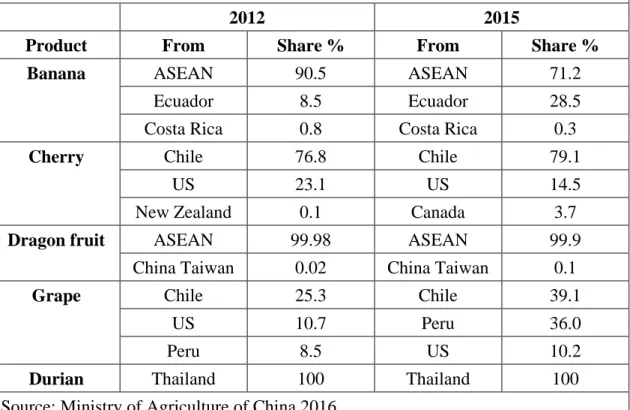
past five years from 2012 (Wu and Zhao 2015) (Figure 3). Table 1 shows the specific
change of import origin of the top five imported fruit types from 2012 to 2015. Import
6
still in the top position). The market share has been taken away by Ecuador that once
obtained market access to China, the share of Ecuador’s banana in China’s total banana
imports increased from 8.5% to 28.5%. Cherry from Chile has increased from 76.8% to
79.1% market share, and the United States’ cherry share in China dropped from 23.1%
to 14.5%. Chile and Peru are two grape exporting countries taking a large share in the
Chinese market. The market share has increased from 25.3% and 8.5% to 39.1% and
36% respectively. In addition, in 2012 and 2015, all of China’s dragon fruit and durian
imports were from ASEAN countries, mainly Vietnam and Thailand.
Throughout the year, prices for the top five imported fruit types changed, with a
generally increasing trend. The price for cherry increased the most from 0.76 USD/kg in
2001 to 7.34 USD/kg in 2015, 8.6 times, a yearly average increase of 17.6%. Compared
to the cherry price, grape, durian, banana, and dragon fruit all showed a smaller increase,
as indicated in Figure 4.
1.2 Factors affecting fruit imports
Due to the rapid economic growth, the Chinese people have enjoyed a higher
income. They are more aware of eating healthier food and a healthy life style.
Consuming fresh fruit is one of the ways to enjoy a healthier diet being promoted by the
7
been under-consuming fruit according to these guidelines (Lei and Shimokawa 2017).
For a healthier dietary habit, people are consuming more fruit varieties and volume from
different sources, especially the younger generation (Joseph 2016). After a series of
food safety scandals (cooking oil, milk powder, fast food, etc.) in China, consumers
prefer to buy imported food, including fruit, more for food safety concerns (Ministry of
Agriculture of China 2016). 65% of China’s national fruit consumption growth depends
on the generation under 35 years old. They are more aware of various brands and the
country of origin and consider that imported produce is premium quality (Joseph
2016). To reflect the increasing concern regarding health and food safety, China’s fruit
imports structure has gradually changed from low price fruit to premium fruit with
higher prices. In addition, appreciation of the Chinese Yuan since 2014 makes imported
fruit appear “cheaper” than before (Wu and Zhao 2015).
There is a general global trend to consume more fresh fruit than processed fruit.
According to the United States Department of Agricultural information, the main fruit
consuming countries such as Turkey, China, Russia, and the European Union have
maintained the consumption of fresh fruit in the total of fruit consumption above 70%
from 2010 to 2015. In particular Turkey and China’s fresh fruit consumption rates have
8
the United States has also increased from 3.3% to 45.7%. Detailed trends are shown in
Figure 5, as the fresh fruit consumption share changes in the selected major fruit
consumption countries from 2010 to 2015.
The cold chain transportation system has assured the increasing consumption of
fresh fruit. While affecting consumption patterns, technological innovation has created
new comparative advantages in the international fruit trade. Geographical proximity is
no longer the dominant constraint for the fruit trade, particularly for fresh fruit. Fruit
exporting countries with advanced cold chain transportation logistics can expect more
trading opportunities. Regarding China’s fruits imports and its largest neighboring trade
partners – ASEAN countries. Technological advancements may be a challenge for
small- and medium-sized enterprises, although they do have the significant advantage of
geographical location. Thanks to the cold chain transportation system, recently China’s
banana imports have switched increasingly to Ecuador, a distant country in South
America from the neighboring Philippines. Chile’s cherry “flew” to China in 2016, and
accounting for 80% of China’s total cherry imports. Chile has surpassed the ASEAN
countries to become the largest fruit exporting country to China by value in 2016 at
9
The development of e-commerce for fruit distribution makes imported fruit more
available to the consumers (Wu and Zhao 2015). The main fruit retailers in China are
now online. The fresh food e-commerce sales value is expected to reach 14 billion USD
in 2017, with a penetration rate of 7% (Joseph 2016). The advantage of trading fresh
food online is because it provides a direct and prompt service that saves transportation
and storage time. Online fresh food sales have been increasing by more than 50% every
year according to the Chinese Ministry of Commerce. The leading e-commerce
company, Alibaba, has entered the online fresh produce business. Together with
national fruit exporters’ organizations they have signed a Memorandum of
Understanding with New Zealand's Trade and Enterprises Board for kiwi fruit and other
local fruit types, and have promoted Chilean blueberries and cherries in China in 2015
and 2016 (Joseph 2016). The e-commerce market for fresh fruit is also a competitive
distribution channel. For example, JD.com, the second largest e-commerce company in
China, has a well-developed logistical distribution channel, and in January 2016's
Chinese New Year, sales of imported fresh food by JD.com rose by more than 300%.
Last but not least, China’s more open trading policy is also having a positive
impact on fruit imports. In addition to the series of FTA, China has signed with ASEAN,
10
opened its fruit market to many other countries around the world. In the Appendix, there
is a list of fruit types and the origin country/region that are now permitted to enter China,
the data was obtained from website of the General Administration of Quality
Supervision, Inspection and Quarantine of the People’s Republic of China (AQSIQ).
This particular office is the authority in charge of imports to China. They are updating
the list of commodities that have obtained import permission every month. From the
Appendix table, we can see that China is now importing more varieties of fruit from
various countries around the world. The Government is endeavored to provide a greater
variety and source of fruit for the Chinese consumers. The ongoing BRI is another
important policy initiative, showing that China is devoted to a more open collaboration
with other countries for mutual benefit, including the fruit trade. In general, the import
demand for tropical fruit from the ASEAN countries and middle Asia, and temperate
fruits from Europe will keep growing.
1.3 Import procedures and important ports
In order to export fruit to China, exporters require to comply with the following
official requirements: first, check that the fruit is permitted to enter China. If so, through
11
commodity from the AQSIQ. The business procedure follows for contract signing,
applying for import clearance at the Customs Dept., and finally Customs clearance.
Guangxi used to be the major channel for fruit imports to China, due to its
geographical location neighboring Vietnam, and the railway and new road construction
will access Vietnam directly. The fruit traded through Guangxi comes mainly from the
ASEAN countries. There was three major ports in Guangxi, Pingxiang Puzhai,
Fangchenggang, and Guilin. Imported fruit through Guangxi has increased from
510,000 tons in 2012 to over 1 million tons in 2015. In the first half year of 2016, the
fruit from ASEAN countries, such as banana, mangosteen, watermelon, and durian
totaled about 649,300 tons entering China through these three ports. To share the
logistical pressure of the three ports, AQSIQ authorized three more ports to open for
imports in Guangxi in April 2016. The three new ports are Longbang, Dongxing, and
Qinzhu. These six ports in Guangxi cover land, sea, and air transportation with efficient
distribution by better logistical and transportation arrangements for the fruit trade with
the ASEAN countries (Chinanews 2016).
Another major access point for the ASEAN countries to China, Shenzhen, also has
a large share of the fruit imports from the ASEAN countries to China. Wenjindu, a land
12
the increasing imports of premium fruits to China from other countries, such as the
United States, Chile, and New Zealand, Shenzhen exceeded Guangxi in 2016, and
handled 1.03 million tons of fruit imports, with a value of 15.2 billion CNY. This is the
highest for China in both volume and value terms (Shenzhen Customs, 2017).
Commodities imported to China through Shenzhen include cherry, grape, and citrus
fruit. Many fruit types are being imported to China for first time, such as cherry through
Shekou Port.
China’s largest fruit trading partner – ASEAN countries
With a series of trade agreements between China and ASEAN from 2000 to 2014,
the fruit trade between these two regions has increase from 0.56 billion USD to 2.72
billion USD. Since 2002, more than 90% of China’s tropical fruit imports came from
ASEAN countries.
2.1 General analysis
Figure 6 shows the share of China’s fruit imports from ASEAN countries, and the
total fruit imports from 2001 to 2014. The timeline covers all the important policy
changes China implemented mentioned in the last section of the report. From the data
we see a clearly increasing trend of fruit imports by China, and the increased share by
13
more stable than the total value. This is due to strong governmental support from both
sides. After 2002, 2004, 2010 and 2013, when the policies were implemented, there was
always a slightly bigger increase of fruit imported from ASEAN countries in the
following year. The policies and agreements negotiated by these two economic regions
have guaranteed stable growth of China’s fruit imports from the ASEAN countries in
the period of this being reviewed.
To further analyze China’s tropical fruit imports from the ASEAN countries, six
major countries with more data availability were selected; the Philippines, Malaysia,
Thailand, Singapore, Indonesia, and Vietnam. These six countries in total account for
more than 90% of China's and ASEAN’s total tropical fruit trade value. Other countries,
such as Laos, Myanmar, Cambodia, and Brunei have either too much missing data or a
lower tropical fruit trade with China and are not discussed here (Zhuang and Zheng
2016). Zhuang and Zheng (2016) combined the HS 6 digit and 4 digit trade data from
the UN Comtrade website, and conducted a series of analyses of the tropical fruit trade
between China and the ASEAN countries. Based on their analyses, this report mainly
focuses on China’s import activity.
Firstly, observe the importance of the ASEAN countries for China’s tropical fruit
14
ASEAN countries handled from 2002 to 2014. In 2000, only 58.25% of China’s tropical
fruit imports were from the ASEAN countries. After the China ASEAN agreement on
comprehensive economic cooperation in 2002 (start of the EHP), this share increased
rapidly and reached a peak in 2004 (zero-tariff fully implemented) of 96.21%. Until
2014 the share has fluctuated, but on average has achieved over 90% of China’s total
tropical fruit imports. Therefore, the EHP has indeed provided a market access
advantage for the ASEAN countries, and made the ASEAN countries the most
important import resource of tropical fruit for China, with Thailand and Vietnam taking
the most advantage of these polices negotiated between China and ASEAN. China
imported most tropical fruit from Thailand in 2004 at 58.88%. After that the share
Thailand is taking has remained at about 40%. Vietnam’s tropical fruit market share in
China has been growing steadily since 2004, but a little bit up and down in certain years,
and achieving about 20% on average. Indonesia’s share has also increased while the
share by the Philippines and Malaysia has decreased steadily.
On the other hand, how important is the Chinese market for the ASEAN countries'
tropical fruit exports? Figure 8 describes the share that China took as the total tropical
fruit export by the selected ASEAN countries respectively from 2002 to 2014. As for
15
2004 to 27.45% in 2014. Among the six countries, the Chinese market has always been
important for Vietnam, with its share at 30% on average, no matter the change of time
or policies. The Philippines took the good opportunity to export to China, with the most
rapid growth rate from 14.06% in 2004 to 33.76% in 2014. The exports share China
took has also increased for Thailand and Indonesia, by 8.15% and 4.77% from 2004 to
2014 respectively. Hence, after application of the EHP, the export of tropical fruit to
China has been taking a greater share by these countries. Malaysia’s tropical fruit export
to China experienced a big increase to 6.70%, followed by a drop to 2.05%. The
Malaysian Government is committed to boost the country's tropical fruit exports to
China since the BRI summit forum held in Beijing in May 2017. The Malaysian
Government presented 43 fresh durian to the Chinese governmental representatives as a
gift, representing the 43 years of diplomatic relations between the two countries, and
promoting the country's determination to break the monopoly export of Thai durian to
China, and the expectation of a growing market share in the future (Li and Liu 2017).
2.2 Features of the trade
Given the importance of the tropical fruit trade between China and the ASEAN
countries, more analyses on the current trading characteristics have been conducted by
16
tropical fruit trade between the two regions is considered as inter-industry according to
the Grubel-Lloyd index calculation. The fruit products traded between the two regions
are complementary to each other. China imports tropical fruit that is either not produced
domestically or the domestic supply is limited, and with a different quality and variety;
ASEAN imports China’s temperate fruit such as apple, pear, and citrus, which are not
grown in the tropical or semi-tropical regions where ASEAN countries are located.
In addition, the Trade Intensity Index is calculated to study whether CAFTA leads
to trade expansion between/within member states, or trade diversion out to non-member
states. Zhuang and Zheng (2016) calculated the index from 2000 to 2014, and found
that the EHP under the CAFTA framework has promoted expansion of the tropical fruit
trade, i.e. an increasing trade volume between the ASEAN countries and China in the
short-term. Particularly, the trade expansion between China and Vietnam achieved the
highest level. However as time goes by, in the long run the trade expansion effect
reduced. The paper also calculated the index between China and non-CAFTA member
states, such as Japan and the United States, during the same period to analyze the trade
diversion effect. They found that in the long-run there has been an increasing volume of
17
supported by the actual trading records. China has been importing tropical fruit from
more sources in increasing varieties (Zhan, Xu, and Li 2016; Zhang et al. 2016).
2.3 Policy impact of BRI
The Chinese BRI negotiated in 2013, is considered a great opportunity for the
agricultural sector to explore more business opportunities and collaboration with
countries included in the BRI, and should have a significant impact on the future
development of the sector. The specific development strategy the BRI offers the
agricultural sector promotes the agricultural trade, removes the trade barriers, and
achieves a multi-dimensional development of the agricultural sector (Li 2016; Tan et al.
2016).
Specifically, the BRI continues to foster the fruit trade between China and the
ASEAN countries combined with CAFTA. Meanwhile, it offers new opportunities for
future trade development between the two regions. With the BRI, the Asian
Infrastructure Investment Bank proposed development of improved transportation infrastructure to connect China with the ASEAN countries covering Thailand, Vietnam, Myanmar, and Indonesia, where there have been land transportation difficulties for the
18
and railways from China to these neighboring countries. Better transportation will
benefit the fruit trade.
The BRI enhances the establishment and expansion of e-commerce and its
increasing application to the cross-border business (including fruit) between China and
the neighboring countries, including the ASEAN countries. The information and
communication technology in Vietnam, Thailand, the Philippines, and the other
ASEAN countries have a limited capacity that has hindered the fruit and agricultural
trade in particular, given the fact that most farmers and dealers in these developing
countries are small- and medium-sized enterprises (SMEs). Through the BRI, the
Chinese Government is committed to foster e-commerce facilities, including e-payment,
Internet ordering, off-Internet logistics, and a series related steps.
The BRI creates more opportunities and provides a greater platform for China and
the ASEAN countries to achieve more effective and efficient communications.
Specifically, under the BRI framework, China and the ASEAN countries can seek
further collaboration opportunities, discuss trade policies, collect feedback, and monitor
future policy implementation more effectively. This is beneficial for a sustainable fruit
19 Summary
This reports reviews the literature and related news regarding China’s fruit imports,
with the focus on China’s fruit from one of its major trade partners, the ASEAN
countries. When reviewing the information, some problems with China’s current fruit
imports were identified along with potential policy suggestions.
Despite the increasing access to the Chinese market, whereby a greater variety of
fruit types from different sources have been allowed to enter China, it is still difficult
for fruit to be exported to China. For example, banana and watermelon from Laos have
passed the quality inspection certification and obtained permission to enter China since
AQSIP. However, the actual import volume from Laos is limited due to Customs
clearance inefficiency and other communication barriers. In spite of lowering the tariff
rate and removing trade barriers, other domestic regulations still hinder fruit exports to
China. For example, it is difficult for fruit traders in Vietnam to obtain the appropriate
visa to visit China for business purposes.
To really facilitate China’s fruit imports, improved Customs procedures,
strengthened port inspection and quality control, and the establishment of common
standards for the sanitary and phytosanitary measures are required (Zhan, Xu, and Li
2016; Zhang et al. 2016). With continuous effort ant potential friction caused by various
21 References
Chinanews. “广西进境水果指定口岸增至 6 个成东盟水果输华最大通道”. (2016) Available at: http://www.chinanews.com/life/2016/07-01/7924912.shtml
Manuel Joseph 2016 “Chinese imports still growing, with healthier and tastier fruit” Eurofresh. 2016. Available at:
https://www.eurofresh-distribution.com/news/chinese-imports-still-growing-healthi er-and-tastier-fruit
Lei, Lei, and Satoru Shimokawa. "Promoting dietary guidelines and environmental sustainability in China." China Economic Review (2017).
Min Li and Yang Liu. “中国—东盟水果贸易,从一颗榴莲说起” 2017 Available at:
http://www.sohu.com/a/206690974_402008
李义伦 Yilun Li. "基于“一带一路”农产品国际贸易未来发展趋势研究." 经济研究 导刊 No. 299.18 (2016):154-155.
Ministry of Agriculture of China. “China Agricultural Trade Development Report 2016.” Beijing (2016 中国农产品贸易发展报告 农业部农产品贸易办公室, 农 业部农业贸易促进中心 编)
Shenzhen Customs. “深圳受零关税利好影响进口水果大增”. (2017) Available at:
http://www2.customs.gov.cn/tabid/1686/ctl/InfoDetail/InfoID/218461/mid/8194/De fault.aspx?ContainerSrc=%5BG%5DContainers%2F_default%2FNo+Container
谭晶荣 Jingrong Tan, 王丝丝 Sisi Wang, and 陈生杰 Shengjie Chen. "“一带一路” 背景下中国与中亚五国主要农产品贸易潜力研究." 商业经济与管
理 1(2016):90-96.
武婕 Ji Wu, and 赵俊晔 Junye Zhao. "当前中国水果市场分析及展望." 农业展 望 10 (2015):18-21.
詹柴 Chai Zhan, 徐志豪 Zhihao Xu, and 李佳丹 Jiadan Li. "“一带一路”背景下中 国—东盟水果贸易结构与发展机遇分析." 台湾农业探索 6(2016):28-33.
张艳玲等 Yanling Zhang et al. "中国-东盟自由贸易区建立对我国热带水果产业影
响研究." 中国热带农业 5(2016):5-8.
庄丽娟 Lijuan Zhuang, and 郑旭芸 Xuyuan Zheng. "中国-东盟热带水果贸易强度 及潜力分析." 华南农业大学学报(社会科学版) 15.1(2016):82-91.
周艳 Yan Zhou. "我国水果进出口贸易分析." 农村经济与科技 10(2015):100-101. Zhiyan Consulting data available from:
22 Figure 1
23 Figure 2
Source: Ministry of Agriculture of China, 2016 0.1 Billion
24 Figure 3
25
Table 1: Import destination share in 2011 and 2015 (China’s top 5 imported fruit types)
2012 2015
Product From Share % From Share %
Banana ASEAN 90.5 ASEAN 71.2
Ecuador 8.5 Ecuador 28.5
Costa Rica 0.8 Costa Rica 0.3
Cherry Chile 76.8 Chile 79.1
US 23.1 US 14.5
New Zealand 0.1 Canada 3.7
Dragon fruit ASEAN 99.98 ASEAN 99.9
China Taiwan 0.02 China Taiwan 0.1
Grape Chile 25.3 Chile 39.1
US 10.7 Peru 36.0
Peru 8.5 US 10.2
Durian Thailand 100 Thailand 100
26 Figure 4
Source: Ministry of Agriculture of China 2016 USD/Kg
27 Figure5
Source: Ministry of Agriculture of China 2016
28 Figure 6
29 Figure 7
30 Figure 8
31 Appendix
获得我国检验检疫准入的新鲜水果种类及输出国家/地区名录(2018 年 01 月 29 日更新) Fruits and origin country/region that have obtained inspection certification and
permission to enter China (updated Jan/29/2018)
输出国家/地区 Exporting country/region 水 果 种 类 Fruit 泰国 Thailand
罗望子(Tamarindus indica;Tamarind)、番荔枝(Annona squamosa; Sugarapple)、番木瓜(Carica papaya;Papaya)、杨桃(Averrhoa carambola; Carambola)、番石榴(Psidium guajava;Guava)、红毛丹(Nephelium lappaceum;Rambutan)莲雾(Syzygium samarangense;Rose apple)、菠 萝蜜(Artocarpus heterophyllus;Jackfruit)、椰色果(Lansium parasiticum; Long kong)、菠萝(Ananas comosus;Pineapple)、人心果(Manilkara zapota;Sapodilla)、香蕉(Musa sp.;Banana)、西番莲(Passiflora caerulea; Passion fruit)、椰子(Cocos nucifera;Coconut)、龙眼(Dimocarpus longan;Longan)、榴莲(Durio zibethinus;Durian)、芒果(Mangifera indica;
Mango)、荔枝(Litchi chinensis;Litchi)、山竹(Garcinia mangostana; Mangosteen)、柑橘[桔(Citrus reticulata;Mandarin orange)、橙(Citrus sinensis;Orange)、柚(Citrus maxima;Pomelo)]
马来西亚 Malaysia
32
Mangosteen)、荔枝(Litchi chinensis;Litchi)、椰子(Cocos nucifera; Coconut)、西瓜(Citrullus lanatus;Watermelon)、木瓜(Chaenomeles sinensis;Pawpaw)、红毛丹(Nephelium lappaceum;Rambutan)、菠萝 (Ananas comosus;Pineapple)
印度尼西亚 Indonesia
香蕉(Musa nana;Banana)、龙眼(Dimocarpus longan;longan)、山竹 (Garcinia mangostana;Mangosteen)、蛇皮果(Salacca zalacca;Salacca)
菲律宾 Philippines
菠萝(Ananas comosus;Pineapple)、香蕉(Musa sp.;Banana)、芒果 (Mangifera indica; Mango)、番木瓜(Carica papaya;Papaya)
越南 Vietnam
芒果(Mangifera indica; Mango)、龙眼(Dimocarpus longan;longan)、 香蕉(Musa sp.;Banana)、荔枝(Litchi chinensis;Litchi)、西瓜(Citrullus lanatus;Watermelon)、红毛丹(Nephelium lappaceum;Rambutan)、菠 萝蜜(Artocarpus heterophyllus;Jackfruit)、火龙果(Hylocereus
undulatus;Pitaya)
缅甸 Myanmar
龙眼(Dimocarpus longan;Longan)、山竹(Garcinia mangostana; Mangosteen)、红毛丹(Nephelium lappaceum;Rambutan)、荔枝(Litchi chinensis;Litchi)、芒果(Mangifera indica;Mango)、西瓜(Citrullus lanatus;Watermelon)、甜瓜(Cucumis melo;Melon)、毛叶枣(Zizyphus mauritiana;lndian jujube)(后四种水果限定从云南瑞丽、打洛口岸入境)
33 老挝
Laos
西瓜*(Citrullus lanatus;Watermelon)、香蕉*(Musa supientum;Banana)
尼泊尔 Nepal
柑橘*[橙(Citrus sinensis;Orange)、桔(Citrus reticulata;Mandarin)、 柠檬(Citrus limon;Lemon)]
印度 India
芒果(Mangifera indica;Mango)、葡萄(Vitis vinifera;Grape)
巴基斯坦 Pakistan
芒果(Mangifera indica; Mango)、柑橘类[桔(Citrus reticulata;Mandarin)、 橙(Citrus sinensis;Orange)]
斯里兰卡 Sri Lanka
香蕉*(Musa supientum;Banana)
土耳其 Turkey
樱桃(Prunus avium;Cherry)
以色列 Israel
柑橘[橙(Citrus sinensis;Orange)、柚(Citrus maxima;Pomelo(= Citrus grandis,议定书异名))、桔子(Citrus reticulata;Mandarin)、柠檬(Citrus limon;Lemon)、葡萄柚(Citrus paradisi;Grapefruit (= Citrus paradise,
议定书异名))](均为试进口)
塔吉克斯坦 Turkmenistan
樱桃(Prunus avium;Cherry)
吉尔吉斯斯坦 Kyrgyzstan
樱桃(Prunus avium;Cherry)
34 Uzbekistan
日本 Japan
苹果(Malus domestica;Apple)、梨(Pyrus pyrifolia;Pear)
朝鲜
North korea
蓝靛果(Lonicera caerulea L.var. edulis Turcz. ex Herd.;Sweetberry honeysuckle)、越橘(Vaccinium sp.;Lingonberry)(仅限加工使用) 韩国
South korea
葡萄(Vitis vinifera;Grape)
中国台湾 China Taiwan
菠萝(Ananas comosus;Pineapple)、香蕉(Musa sp.;Banana)、椰子(Cocos nucifera;Coconut)、番荔枝(Annona squamosa;Sugar apple,Sweet sop;
Annona cherimola × Annonasquamosa; Atemoya)、木瓜(Chaenomeles sinensis;Pawpaw)、番木瓜(Carica papaya;Papaya)、杨桃(Averrhoa carambola;Fruit of Carambola)、芒果(Mangifera indica;Mango)、番 石榴(Psidium guajava;Guava)、莲雾(Syzygium samarangense;Rose
apple)、槟榔(Areca catechu;Betel nut)、李(Prunus salicina;Plum)、
枇杷(Eriobotrya japonica;Loguat)、柿子(Diospyros kaki;Persimmon)、 桃(Prunus persica;Peach)、毛叶枣(Zizyphus mauritiana;Indian jujube)、 梅(Prunus mume;Japanese apricot,Mei)、火龙果(Hylocereus undulatus、 Hylocereus polyrhizus、Hylocereus costaricensis;Pitaya)、哈密瓜
35
萄(Vitis vinifera、Vitis labrusca及其杂交种,主要是巨峰葡萄Vitis vinifera
× Vitis labrusca na Bailey cv. Kyoho;Grape)、柑橘[(桔(Citrus reticulata; Mandarin)及其杂交种、柚(Citrus maxima;Pomelo)、葡萄柚(Citrus paradisi;Grapefruit)、柠檬(Citrus limon;Lemon)、橙(Citrus sinensis; Orange)]
美国 USA
李(Prunus salicina、Prunus domestica;Plum。加利福尼亚州),樱桃(Prunus avium;Cherry。华盛顿州、俄勒冈州、加利福尼亚州、爱达荷州),葡萄(Vitis vinifera;Grape。加利福尼亚州),苹果(Malus domestica;Apple),柑橘 类(Citrus spp.;加利福尼亚州、佛罗里达州、亚利桑那州、德克萨斯州), 梨(Pyrus communis;Pear。加利福尼亚州、华盛顿州、俄勒冈州),草莓 (Fragaria ananassa;Strawberry。加利福尼亚州)
加拿大 Canada
樱桃(Prunus avium;Cherry。不列颠哥伦比亚省)、蓝莓(Vaccinium spp.; Blueberry;不列颠哥伦比亚省)
墨西哥 Mexcio
鳄梨(Persea americana Var. Hass;Avocado)、葡萄(Vitis vinifera;Grape)、 黑莓(Rubus ulmifo-lius;Blackberry)和树莓(Rubus idaeus;Raspberry)、 蓝莓(Vaccinium spp.;Blueberry)
巴拿马 Panama
36 厄瓜多尔
Ecuador
香蕉(Musa sp.;Banana)、芒果(Mangifera indica;Mango)
哥伦比亚 Colombia
香蕉(Musa sp.;Banana)
哥斯达黎加 Cost rica
香蕉(Musa AAA;Banana)、菠萝(Ananas comosus;Pineapple)
乌拉圭 Uruguay
柑橘类(Citrus spp.,柠檬除外)、蓝莓(Vaccinium spp.;Blueberry)
阿根廷 Argentina
柑橘[橙(Citrus sinensis;Orange)、葡萄柚(Citrus paradisi;Grapefruit)、 桔(Citrus reticulata;Mandarin)及其杂交种)]、苹果(Malus domestica; Apple)、梨(Pyrus communis;Pear)、葡萄*(Vitis vinifera;Grape)、 蓝莓*(Vaccinium spp.;Blueberry)
智利 Chile
猕猴桃(Actinidia chinensis、Actinidia deliciosa;Kiwi fruit)、苹果(Malus domestica;Apple)、葡萄(Vitis vinifera;Grape)、李(Prunus salicina,
Prunus domoestica;Plum)、樱桃(Prunus avium;Cherry)、蓝莓(Vaccinium
spp.;Blueberry)、鳄梨(Persea americana;Avocado)、油桃(Prunus persica
var. nectarine;Nectarine)
秘鲁 Peru
葡萄(Vitis vinifera;Grape)、芒果(Mangifera indica;Mango)、柑橘[葡 萄柚(Citrus paradisi;Grapefruit (= Citrus × paradisii,议定书异名)), 桔(Citrus reticulata;Mandarin(= Citrus reticulate,议定书异名))及其
37
杂交种,橙(Citrus sinensis),莱檬(Citrus aurantifolia)和塔西提莱檬(Citrus latifolia)]、鳄梨(Persea americana;Avocado)、蓝莓(Vaccinium spp.; Blueberry)
法国 France
苹果(Malus domestica;Apple)、猕猴桃(Actinidia chinensis, Actinidia deliciosa;Kiwi fruit)
西班牙 Spain
柑橘[桔(Citrus reticulata;Mandarin)、橙(Citrus sinensis;Orange)、 葡萄柚(Citrus paradisi;Grapefruit)、柠檬(Citrus limon;Lemon)]、 桃(Prunus persica;Peach)、李(Prunus salicina, Prunus domoestica; Plum)
意大利 Italy
猕猴桃(Actinidia chinensis, Actinidia deliciosa;Kiwi fruit);柑橘[橙(Citrus sinensis cv. Tarocco,cv. Sanguinello,cv. Moro);Orange)、柠檬(Citrus limon cv. Femminello comune;Lemon)]
塞浦路斯 Cyprus
柑橘[橙(Citrus sinensis;Orange)、柠檬(Citrus limon;Lemon)、葡萄 柚(Citrus paradisi;Grapefruit)、桔橙(Citrus sinensis × Citrus reticulata; Mandora)]
比利时 Belgium
梨(Pyrus communis;Pear)
希腊 Greece
38 荷兰
Holland
梨(Pyrus communis;Pear)
波兰 Poland
苹果(Malus domestica;Apple)
南非
South Africa
柑橘[桔(Citrus reticulata;Mandarin)、橙(Citrus sinensis;Orange)、 葡萄柚(Citrus paradisi;Grapefruit)、柠檬(Citrus limon;Lemon)]、 葡萄(Vitis vinifera;Grape)、苹果(Malus domestica;Apple)
埃及 Egypt
柑橘类(Citrus spp.);葡萄(Vitis vinifera;Grape)
摩洛哥 Morocco
柑橘[橙(Citrus sinensis;Orange)、桔(Citrus reticulata;Mandarin)、 克里曼丁桔(Citrus clementina;Clementine)、葡萄柚(Citrus paradisi; Grapefruit)]
澳大利亚 Australia
柑橘[橙(Citrus sinensis;Orange)、桔(Citrus reticulata;Mandarin)、 柠檬(Citrus limon; Lemon)、葡萄柚(Citrus paradisi;Grapefruit)、酸橙 (Citrus aurantifolia、Citrus latifolia、Citrus limonia;Lime)、橘柚(Citrus tangelo)、甜葡萄柚(Citrus grandis × Citrus paradisi)]、芒果(Mangifera indica; Mango)、苹果(Malus domestica;Apple,塔斯马尼亚州)、葡萄(Vitis vinifera;Grape)、樱桃(Prunus avium;Cherry)、核果[油桃(Prunus persica
39
domestica、Prunus salicina;Plum)、杏(Prunus armeniaca;Apricot)]
新西兰 New Zealand
柑橘[桔(Citrus reticulata、Citrus deliciosa、Citrus unshiu;Mandarin)、 橙(Citrus sinensis;Orange)、柠檬(Citrus limon、Citrus meyeri;Lemon)]、 苹果(Malus domestica;Apple)、樱桃(Prunus avium;Cherry)、葡萄(Vitis vinifera;Grape)、猕猴桃(Actinidia chinensis、Actinidia deliciosa、Actinidia deliciosa×Actinidia chinensis;Kiwi fruit)、李(Prunus salicina、Prunus domestica;Plum)、梨(Pyrus pyrifolia、Pyrus communis;Pear)、梅(Prunus mume;Japanese apricot,Mei)、柿子(Diospyros kaki;Persimmon)、鳄 梨(Persea americana;Avocado)
备注:(1) 水果名称按照中文名、拉丁学名和英文名顺序表示,拉丁学名为斜体。
(2) * 已签订议定书,但未完成准入程序,目前暂不能进口。 (3) 本次更新了新西兰鳄梨一种水果品种。