Effectiveness and Challenges of Three Economic
Corridors of the Greater Mekong Sub-region
著者
Ishida Masami
権利
Copyrights 日本貿易振興機構(ジェトロ)アジア
経済研究所 / Institute of Developing
Economies, Japan External Trade Organization
(IDE-JETRO) http://www.ide.go.jp
journal or
publication title
IDE Discussion Paper
volume
35
year
2005-08-01
INSTITUTE OF DEVELOPING ECONOMIES
Discussion Papers are preliminary materials circulated
to stimulate discussions and critical comments
Keywords: GMS, Mekong, Population, Trade, Human Resource
JEL classification: R12, J60, O22, F10
* Director, in Charge of International Exchange, development Studies Center, IDE
([email protected])
DISCUSSION PAPER No. 35
Effectiveness and Challenges of
Three Economic Corridors of the
Greater Mekong Sub-region
Masami Ishida
August 31, 2005
Abstract
Since the Greater Mekong Sub-region (GMS) program began in 1992, activities have expanded and flourished. The three economic corridors are composed of the East-West, North-South, and Southern; these are the most important parts of the flagship program. This article presents an evaluation of these economic corridors and their challenges in accordance with the regional distribution of population and income, population pyramids of member countries, and trade relations of member economies.
The Institute of Developing Economies (IDE) is a semigovernmental,
nonpartisan, nonprofit research institute, founded in 1958. The Institute
merged with the Japan External Trade Organization (JETRO) on July 1, 1998.
The Institute conducts basic and comprehensive studies on economic and
related affairs in all developing countries and regions, including Asia, Middle
East, Africa, Latin America, Oceania, and East Europe.
The views expressed in this publication are those of the author(s). Publication does not imply endorsement by the Institute of Developing Economies of any of the views expressed.
INSTITUTE OF DEVELOPING ECONOMIES (IDE), JETRO 3-2-2, WAKABA,MIHAMA-KU,CHIBA-SHI
CHIBA 261-8545, JAPAN
Effectiveness and Challenges of Three
Economic Corridors of the Greater Mekong Sub-region
Masami IshidaI. Introduction
The Mekong River, which originates in Qinghai Province of the People’s Republic of China (PRC), flows through Tibet’s Autonomous Region and Yunnan province. It follows the border of Myanmar and Laos and then that of Thailand and Laos (partly in the area of Laos). It penetrates Cambodia, and by way of the Mekong Delta in Vietnam, flows into the South China Sea. The Asian Development Bank (ADB) started the Greater Mekong Sub-region (GMS) program in 1992 and included all of Yunnan in the PRC, Myanmar, Laos, Thailand, Cambodia, and Vietnam.
Among the members of GMS, Cambodia, Laos, and Myanmar (CLM) are defined as “least developed countries” (LDC) by the United Nations and the Development Assistance Committee (DAC) of the Organization of Economic Cooperation and Development (OECD). GDP per capita of these countries are US $371, $315, and $168 respectively. The GDP per capita of Vietnam is US $483, and this is slightly larger than those of CLM. However, Vietnam is defined as another low income country by the OECD-DAC. The gross regional product (GRP) per capita of Yunnan is US $695, and the GDP per capita of Thailand is US $2,239. Thus, the three economies are relatively
wealthy members of the GMS1.
The purpose of this paper is to analyze ways of promoting the development of CLM countries with the linkages of Thailand, Vietnam and Yunnan of the PRC. Challenges in the development of trade and investment relations between two member economies are also examined.
Two primary viewpoints are presented in this article. First, the effectiveness of the East-West, North-South, and Southern Economic Corridors is analyzed with regional
1 GDP per Capita figures are those from 2003 except for Myanmar. For Myanmar, the figure is from
2001, and the exchange rate is based on that of the official foreign exchange. Data for the exchange rate is based on the IMF [2004]. That for Myanmar is based on data provided by Tokyo-Mitsubishi Bank. Except for Yunnan, GDP and population data are based on ADB [2004]. Population and GDP data for Yunnan come from the Statistical Office of China.
distribution of population and income. Development of transportation infrastructures in these three economic corridors is one of the major parts of the GMS program. The transportation infrastructure is what connects production points to the market. If two production points are connected, then in accordance with the gravity model, if the population of each one increases, or their income level rises, or the distance between the two points becomes closer in both space and time, then the transportation infrastructure will become more effective. Thus the regional distribution of population and income is an important factor in locating the transportation infrastructure as well as the distance between points. Of course, qualitative analysis is also necessary as the examination of regional distribution of population and income is not sufficient in and of itself.
The second viewpoint involves prospects for supply and demand of the labor force in the member economies. For analysis of the supply side, demographic pyramids of the five member economies (except Yunnan) are presented. For analysis of the demand side, developments of member economies such as indicators related to education are analyzed. Next, bilateral trade relations are analyzed relative to trade statistics of Thailand and China. Last, given the results of the above analysis, challenges for GMS economies are presented.
II. Effectiveness of GMS Three Economic Corridors
Table 1 shows the regional distribution of population and income level. Income level and population in a specific region are important values representing the scale of market and the potential for production bases. However, there is no guarantee that every city on the economic corridor that has a large population can flourish in the future. Areas of provinces, states, and prefectures are not equal. For example, the area of Shan State in Myanmar is about 1.7 billion square kilometers; Bangkok is only about 0.51 million square kilometers.
Estimated populations are all for 2002 except the case of Cambodia which is based on the census of 1998. The income level of Thailand is based on gross regional products (GRP) per capita transformed into a $US base. That of Vietnam is based on monthly income per capita transformed into annual and $US bases.
The Thailand and the Vietnam economies have all parts of the three economic corridors. The populations (out of the total population) of provinces along the economic corridors in Thailand and Vietnam are 40.7% and 35.6%, respectively. Thus, the benefit
Table 1 Population and Income Level of Provinces and Prefectures along Three Economic Corridors
(Thousand Persons/$US/%) Thailand Cambodia Lao PDR Myanmar Vietnam Yunnan GMS Population Income Population Population Population Population Income Population Population East-West Corridor 7,843 ( 12.4) 799 834 ( 14.7) 4,247 ( 8.1) 2,412 ( 3.0) 258 15,336 ( 6.3) North-South Corridor Kunming-Bangkok 16,123 ( 25.7) 3,668 283 ( 5.0) 5,061 ( 9.7) 8,935 ( 20.6) Kunming-Hai Phong 11,209 ( 14.1) 288 10,192 ( 23.5) Sub-Total 16,323 ( 25.7) 3,668 283 ( 5.0) 5,061 ( 9.7) 11,209 ( 14.1) 288 14,179 ( 32.7) 47,055 ( 19.3) Southern Corridor Vung Tau-Bangkok 9,717 ( 15.3) 4,932 5, 648 ( 49.4) 9,432 ( 11.8) 563 Phnom Penh-Banteay M1). 5,527 ( 48.3) Kampong Cham-Sihanoukvile 2) 4,571 (40.0) Ca Mau-Trat. 204 ( 0.3) 1,434 845 ( 7.4) 2,742 ( 3.4) 678 Quy Nhon-Stung Treng 175( 1.5) 2,578 ( 3.2) 573
Sub-Total 9,921( 15.6) 4,860 10,142 ( 88.7) 14,752 ( 18.5) 586 34,815 ( 22.5) Economic Corridors Total 25,812 ( 40.7) 3,355 10,142 ( 88.7) 1,117 ( 19.7) 9,308 ( 17.8) 28,373 ( 35.6) 440 14,179 ( 32.7) 88,932 ( 34.8) Total 63,430 (100.0) 2,008 11,438 (100.0) 5,679 (100.0) 52,171 (100.0) 79, 727 (100.0) 440 43,331 (100.0) 255,776 (100.0)
1) Phnom Penh-Banteay Meanchov Route by way of Kampong Cham and Siem Reap. 2) Kampong Cahm-Sihanoukvile Route is a part of Route 6 (Lao PDR-Cambodia).. 3) Details are shown in Tables A-1 and A-2 in the Appendix.
from the development of the three economic corridors is considered to be large for Thailand and Vietnam. The population (again out of total population) of Cambodia along the economic corridors is 88.7%. However, Cambodia depends only on the Southern economic corridors and provinces that have waves of industrialization. Some are still limited such as Phnom Penh City, Kandal, Sihanoukville and Kohkong. In addition, it takes more time to construct bridges over the Basak and Mekong Rivers in Kandal and at the border between Kandal and Prey Veng, respectively. On the other hand, the populations of states along the economic corridors in Myanmar and the Lao People’s Democratic Republic (PDR) are only less than 20%. However, they hold part of two economic corridors. Especially, for the Lao PDR, a land-locked country, an East-West economic corridor makes its distances to the harbors much closer. Also relative to this, the North-South economic corridor will give the Yunnan province better access to harbors, and it will be a window to Southeast Asian countries even though it depends only on the economic corridor.
Among the economic corridors, the one that possess the largest population is the North-South. Its population is about 47,055 thousand persons and accounts for 19. 3%. Looking at income level, provinces along the Southern economic corridor are more abundant in Thailand and in Vietnam. The economic effects caused by links between Ho Chi Minh City and Bangkok will be larger despite delays in constructing bridges over the Mekong and Basak Rivers. Actually, Bangkok is closer than Hanoi in relation to Ho Chi Minh City, and Guangdong is closer than Ho Chi Minh City relative to Hanoi. On the other hand, the population in the provinces and states along the East-West economic corridors is only 15,336 thousand persons, 6.3% of the population of the GMS, and the income levels are the lowest both in Thailand and Vietnam. Income level in Vietnam is less than half of the Southern economic corridors; in Thailand, it is less than one-seventh. Thus, the East-West economic corridor can be said to be a “Poverty Corridor.”
Value, however, should not be assessed only by regional distribution of population and income level. Considering location, the East-West Economic corridor connects Danang on the Pacific Ocean and Mawlamyine on the Indian Ocean; this saves time needed for passage by way of the Malacca Strait. It can thus be an important route between China and India, the large parts of BRICs (Brazil, Russia, India and China). In addition to the three economic corridors, the development of the route between Hanoi and Guangdong by way of Gaungxi, and the route between Dali in Yunnan and Mandalay, are also important from a strategic point of view.
III. Supply and Demand of Labor Forces in GMS Economies
1. Population Pyramids
Figure 1 shows population pyramids of Thailand, Cambodia, Laos, Myanmar and Vietnam. First, the population pyramid of the Lao PDR is mountain shaped, and the composition of children is larger as shown by how broad the foot of the pyramid is. The Cambodian pyramid is also mountain shaped, but it suggests that the demographic transition had already begun as of 1998; this is because the composition of the 0-4 year old age group is smaller than that of 5-10 year olds. It is still suspicious, however, considering that the total fertility ratio (TFR) is 4.8, and the number is higher than those of other Southeast Asian countries (Hirohata and Takeuchi [2005]). The smaller 0-4 year old age group reflects the smaller size of the 20-24 year old age group, for many in this age group are parents of children in the 0-4 year old age group. This shows the apparent influence of the Khmer Rouge in that historic era (1975-78). On the other hand, the composition of the 5-9 year old age group is larger than 20%.
Figure 1-1. Demographic Pyramid of Thailand in 2000 (60.6 Million Persons)
Source: http://web.nso.go.th/pop2000/tables_e.htm
Male
0.0% 5.0% 10.0% PercentFemale
0.0%
5.0%
10.0%
0-4 5-9 10-14 15-19 20-24 25-29 30-34 35-39 40-44 45-49 50-54 55-59 60-64 65-69 70-74 75-79 80-84 85-Age
PercentFigure 1-2. Demographic Pyramid of Cambodia in 1998 (11.4 Million Persons)
Source: National Institute of Statistics, Ministry of Planning, Cambodia [2004]
Figure 1-3. Demographic Pyramid of Laos in 2003 (5.7 Million Persons)
Source: National Statistical Center, Committee for Planning and Cooperation, Laos [2004]
Male 0.0% 5.0% 10.0% Percent Female 0.0% 5.0% 10.0% 0-4 5-9 10-14 15-19 20-24 25-29 30-34 35-39 40-44 45-49 50-54 55-59 60-64 65-69 70-74 75-Age Percent Male 0.0% 5.0% 10.0% Percent Female 0.0% 5.0% 10.0% 0-4 5-9 10-14 15-19 20-24 25-29 30-34 35-39 40-44 45-49 50-54 55-59 60-64 65-69 70-74 75- Age Percent
Figure 1-3. Demographic Pyramid of Myanmar in 2002 (52.2 Million Persons)
Source: Central Statistical Organization, Myanmar [2002].
Figure 1-3. Demographic Pyramid of Vietnam in 2002 (52.2 Million Persons)
Source: http://www.gso.gov.vn/default_en.aspx?tabid=476&idmid=4&ItemID=1841. Male 0.0% 5.0% 10.0% Percent Female 0.0% 5.0% 10.0% 0-4 5-9 10-14 15-19 20-24 25-29 30-34 35-39 40-44 45-49 50-54 55-59 60-64 65-69 70-74 75- Age Percent Male 0.0% 5.0% 10.0% Percent Femal 0.0% 5.0% 10.0% 0-4 5-9 10-14 15-19 20-24 25-29 30-34 35-39 40-44 45-49 50-54 55-59 60-64 65- Age Percent
The foot of the population pyramid of Myanmar shows a mountain shape, but it is not broader than those of Laos and Cambodia. Thus, while the population of Myanmar is still increasing, its growth rate is not faster than that of Laos or Cambodia. However, data regarding the population in Myanmar mat not be credible since a census has not been taken since 1983. Like Myanmar, the foot of the population pyramid of Vietnam is also not broader, but the composition of the 0-4 year old age group is smaller than that of 5-9 year olds. Considering the level of industrialization and urbanization, it is proper that the demographic transition of Vietnam began in 1999 (Ishizuka [2004]). The shape of the population pyramid of Thailand is totally different; it is spindle-shaped. It did have a mountain-shap in 1970, but the success of family planning and economic growth has made it more spindle-shaped. The 30-34 year old age group is the largest.
2. Education
Table 2 shows the adult literacy and net enrollment ratios of primary and secondary education in the GMS member economies.
Education indicators of countries in Indochina improved, especially in Cambodia in the 1990’s, because of the end of wartime. For example, the adult literacy ratio in Cambodia improved from 35.2% in 1999 to 68.7%. It can be seen in Table 2 that the net enrollment ratio of primary education in Cambodia is 93%, and it is higher than that of
Table 2 Adult Literacy and Net Enrollment Ratios in GMS Countries
(%)
Adult Literacy Ratio Net Enrollment Ratio
Primary Education Secondary Education
Thailand 95.7 86 n.a. Cambodia 68.7 93 18 Lao PDR 65.6 85 35 Myanmar 85.0 84 35 Vietnam 92.7 94 65 China 85.8 95 n.a.
Source: Adult Literacy Ratio: UNDP [2004] (as of 2001).
Thailand. However, the net enrollment ratio of secondary education is only 18 %, and it is the lowest value of all GMS Members. This gap suggests that the dropout problem is in primary education. As of 2001-02 (Hirohata and Takeuchi [2005]), the drop out ratio was estimated to be 13.5% in the first year of primary education. In the Lao PDR, the net enrollment ratio of primary education is lower, but secondary education is higher than in Cambodia. The problem in the Lao PDR is due to the difference between city and rural accessibility to schools. According to data of Ministry of Education in the Lao PDR, the enrollment ratio in city areas is 89% while that in rural areas is 53% (Koyama [2005]). It has been said that among least developed countries, public education in Myanmar is better. Yet the net enrollment ratios are close to those of the Lao PDR. For example, the adult literacy ratio of Myanmar has improved only 4.4 points since 1990; those of the Lao PDR and Cambodia improved 11.6 and 33.5 points, respectively.
Compared with Cambodia, Laos and Myanmar, the adult literacy and net enrollment ratios of Vietnam are higher. Among CLMV countries, Vietnam has already attracted a lot of foreign investment and achieved outstanding economic growth. It is difficult to deny the correlation between this good performance and education indicators. The adult literacy ratio of Thailand is highest, while the level of the net enrollment ratio is almost the same as that of Myanmar and Laos. While the labor force ratio that depends on secondary education is high, it is lower than Indonesia. The labor force ratio that depends on tertiary education is higher than Indonesia. Thailand has already received a lot of foreign investment.
It can be inferred that the younger generation of Cambodia, the Lao PDR, and Myanmar has not been well educated, and unlike Thailand and Vietnam, foreign companies have not invested in these countries. This suggests that the manufacturing sector will not be able to absorb a growing younger generation drawn from the population pyramids in CLM countries. Demand for a labor force in CLM countries depends on foreign direct investment (FDI), and this makes lower wages and the education level of the labor force very important. More concretely, Cambodia depends heavily on the garment industry, but it has been faced with a big challenge because of the end of the Multi-Fiber Arrangement (MFA) at the beginning of 2005 (Hatsukano [2005]). For political reasons, Myanmar has not received FDI for a long time.
On the other hand, Thailand is already short of young labor, and Vietnam will experience the same kind of shortage twenty years in the future. In other words, an oversupply of labor, rather than a demand, will be a challenge in Thailand and in Vietnam. Better education for the younger generation in CLM countries will
complement the shortage of young labor in Thailand and in Vietnam. Enhancing the quantity and quality of human resources in CLM countries is one of the most important challenges for sustainable development in the GMS area. Differences in shapes of pyramids suggest the importance of GMS economic cooperation.
IV. Bilateral Trade Relations of GMS Economies
As shown in section II, a number of economic effects can be expected from the three economic corridors. These corridors will connect several cities that have high population and income levels such as Bangkok, Ho Chi Minh City, Kunming, Hanoi, and Phnom Penh. At the same time, new economic demand will awaken as the Pacific and Indian Oceans are connected. Trade and investment among the GMS member economies will be activated by the development of the three economic corridors. In order to see trade relations in the future, focus is given here to current bilateral trade relations in 2003.
The composition of imports from Thailand (out of total imports) is 27.0% in Cambodia, 59.4% in the Lao PDR, and 14.3% in Myanmar. Thailand is the largest import partner of both Cambodia and the Lao PDR. It is the third largest import partner of Myanmar, and it follows China (29.5%) and Singapore (21.1%). Out of total exports of CLM economies, Thailand accounts for 30.7% (No. 1) with Myanmar and 21.4% with Lao PDR (No.1), and only 0.6% for Cambodia where its rank is over No. 10. Focusing on the trade balance, however, the amount of imports from Thailand is 55.4 times that from Cambodia and 4.4 times that from the Lao PDR. For Myanmar, the amount of export to Thailand is 2.1 times that from Thailand because of the higher composition of natural gas exports. For Thailand, exports to GMS economies account for 3.5% and are slightly smaller than the sixth export partner, Malaysia. However, imports from GMS economies account only for 1.9% relative to total imports from Thailand. Vietnam is an important trade partner for the Lao PDR and Cambodia. It is not so important for Myanmar. The amount of exports to Vietnam accounts for 17.3%, and Vietnam is the second largest export partner for the Lao PDR. It accounts for only 1.5% and is the fifth largest export partner for Cambodia. The amount of imports to the Lao PDR and Cambodia from Vietnam accounts for 10.4% and 4.7% respectively. Vietnam is the second and sixth largest import partner, respectively. Looking at the trade balance, the amount of imports from Vietnam is 4.5 times that of exports from Cambodia; the ratio is just 1.1 times that for the Lao PDR.
Using trade statistics from customs of Kunming, exports to Myanmar, Vietnam, the Lao PDR, and Thailand account for 48.9%, 17.8%, 9.2% and 5.8%, respectively, and these sum to 81.7%. The four member countries are fourth largest export partners for Yunnan. The amount of imports from the four countries accounts for 39.4% and while less than the amount of exports is still very important. Imports from Myanmar, Vietnam, the Lao PDR, and Thailand are 29.7%, 6.4%, 1.9% and 1.4%. They are the first, fifth, twelfth, and thirteenth import partner respectively. Focusing on the trade balance, however, exports from Yunnan to Myanmar are 3.3 times the number of exports from Myanmar to Yunnan; exports from Yunnan to Vietnam 5.6 times those from Vietnam to Yunnan; exports fromYunnan to Thailand 6.3 times those from Thailand to Yunnan; and exports from Yunnan to the Lao PDR are 12.9 times the number of exports from the Lao PDR to Yunnan. These countries show an obvious trade surplus with Yunnan.
Summarizing trade balances, CLM countries show trade deficits with Thailand, Vietnam, and Yunnan. An exception is the case of Myanmar with Thailand and Vietnam. Looking at specific items of CLM countries, the export base of Cambodia is composed of a Generalized System of Preferences (GSP) consisting of garments (79.1%), rubber (4.7%), and rice (4.3%) (Hatsukano). Garments, electric power, wood, and coffee account for 33.6%, 33.2%, 23.6% and 5.5% out of total exports, respectively for the Lao PDR. Export items of Myanmar include natural gas (24.6%), teak and oak woods (14.5%), garments (14.0%), beans (12.2%), and shrimp, and fishes (6.7%) (Ida [2005]). These countries depend on natural resources and primary products (except for woods and garments), and the items are not diverse. On the other hand, because they are more industrialized, export items of Thailand, Vietnam, and Yunnan are more diverse.
In consequence, trade deficits of CLM countries will increase as a result of the development of the economic corridors. Such increases in trade deficits are not logistically effective; full containers going one way can be vacant on the way back. Further, trade relations are not sustainable when there is a shortage of foreign currencies. Development of three economic corridors will activate trade relations among Thailand, Vietnam, and Yunnan without incurring the problem of trade deficits. For CLM countries, however, industrialization and diversification of export items will have to be promoted. Of course, this does not mean that the development of economic corridors is unnecessary for CLM countries.
V. Conclusion and Challenges for GMS Development Program
An oversupply of labor in CLM countries and a shortage of young labor in Thailand, combined with a difference of income level, lead people in CLM countries to migrate into Thailand. This migration, however, results in the expansion of informal sectors in Bangkok and at least in part to a hotbed of crime and drugs. On the other hand, the Northeastern and Northern parts of Thailand are relatively poor, and the development of these areas is one of the most important challenges for the government of Thailand. Given this, the development of border areas such as the Chaing Rai, Mukudahan-Savannakett, Trat-Koh Kon, and Myanmar Border Economic Zones solve the problem of poverty in the Northeast and Northern areas of Thailand. The problem of illegal immigrants from CLM countries is solved by giving opportunities for legal employment in the border areas to workers in Cambodia (Tsuneishi [2005]). Workers can send foreign currency in Baht to home countries. The shortage of foreign currency will be solved, but the problem of trade deficits will not be solved.
Attracting foreign direct investment (FDI) will solve trade deficit problems of CLM countries when the FDI is export-oriented. It will also solve the oversupply of labor in CLM countries. FDI from Thailand will especially solve the likely problem of labor shortages in the near future. Improvement in access to harbors for the Lao PDR and Cambodia may enable export-oriented FDI. In order to make use of cheaper wages, the education level of workers must be enhanced. Thus, improvement in primary and secondary education as well as vocational training and expanded opportunities for reeducation of uneducated adults will be an important challenge for CLM countries. In addition to improvement of education, keeping public order, eradicating corruption, and establishing legal certainty will be important for attracting FDI.
Projects and programs related to the improvement of the investment climate in CLM countries as well as the development of industrial estates at border areas will solve problems of unbalanced labor force supply and demand in the GMS and trade deficit problems in CLM countries. This may then lead to sustainable growth of the GMS area.
Acknowledgement
The contents of this paper are primarily based on results of the “Research Project Contributing to Japan's Economic Cooperation: the case of Mekong Region.” I would like to thank the following members of the project: Nobuo Hirohata (Development Bank of Japan), Kim Kwangmoon (Toyohashi University of Technology), Masahisa Koyama (Development Bank of Japan), Takayuki Ogasawara (Yamanashi Gakuin University), Junko Takeuchi (Development Bank of Japan), Tsuneaki Yoshida (Tokyo University), Koji Ida (JETRO), Tomohiro Ando (JETRO), Akie Ishida (IDE-JETRO), Naomi Hatsukano (IDE-JETRO), Takao Tsuneishi (IDE-JETRO) and Nanae Yamada (IDE-JETRO). For any errors or defects in this paper, I bear sole responsibility.
References
Asian Development Bank [2004] Key Indicators of Developing Asian and Pacific
Countries 2004.
―― Building on Success: A Strategic Framework for the Next Ten Years of the Greatee Mekong Subregion Economic Cooperation Program.
Central Statistical Organization, Myanmar [2002] Statistical Yearbook 2002.
General Statistics Office, Social Republic of Vietnam [2003] Statistical Year Book 2002. General Statistics Office, Social Republic of Vietnam [2004] Statistical Year Book 2003. Hatsukano, Naomi [2005] “Kanbojia no Sangyo no Genjo: Hoseigyou wo Cyushin To
shite [Current Situation of Industries in Cambodia, Mainly on Garment
Indistry],” Ishida Ed. Mekon Chiiki Kaihatsu [Mekong Region Development].
Hirohata, Nobuo & Junko Takeuchi [2005] “Kanbojia no Jinteki Shigen Kaihatsu: Genjo to Kadai [Human Resource Development in Cambodia: Current Situation
and Challenges],” Ishida Ed. Mekon Chiiki Kaihatsu [Mekong Region
Development ].
Ida, Koji [2005] “Myanma no Sangyo Hattenn to Kadai [Possibilities and Challenges for Development of Industries in Myanmar],” Ishida Ed. Mekon Chiiki Kaihatsu [Mekong Region Development ].
Ishizuka, Futaba [2004] “Betonamu Jinko Sensas ni Miru Doimoi Seisaku no Seika to Atarashii Kadai [Vietnam: Outcomes of “Doimoi” Policy and New Challenges Reflected in Population Census].” (in Japanese), Ajiken World Trend, No.111,
December, 2004.
Masahisa Koyama [2005] “Raos no Keizai Shakai Gaikyo to Jinzai Kaihatsu Mondai [Social and Economic Situation and Human Resource Development in Lao
PDR],” Ishida Ed. Mekon Chiiki Kaihatsu [Mekong Region Development].
National Institute of Statistics, Ministry of Planning, Cambodia [2004] Statistical Year Book 2004 (CD Rom).
National Statistical Center, Committee for Planning and Cooperation [2003]
Statistical Year Book 2003.
The World Bank [2005] 2005 World Development Indicators.
Tsuneishi, Takao [2005] “The Regional Development Policy of Thailand and Its
Economic Cooperation with Neighboring Countries,” IDE Discussion Paper,
No.32.
UNDP [2003] Human Development Report 2003.
<Web Sites>
General Statistics Office of Vietnam: http://www.gso.gov.vn/
National Statistical office, Thailand: http://web.nso.go.th/pop2000/tables_e.htm. National Economic and Social Development Board of Thailand:
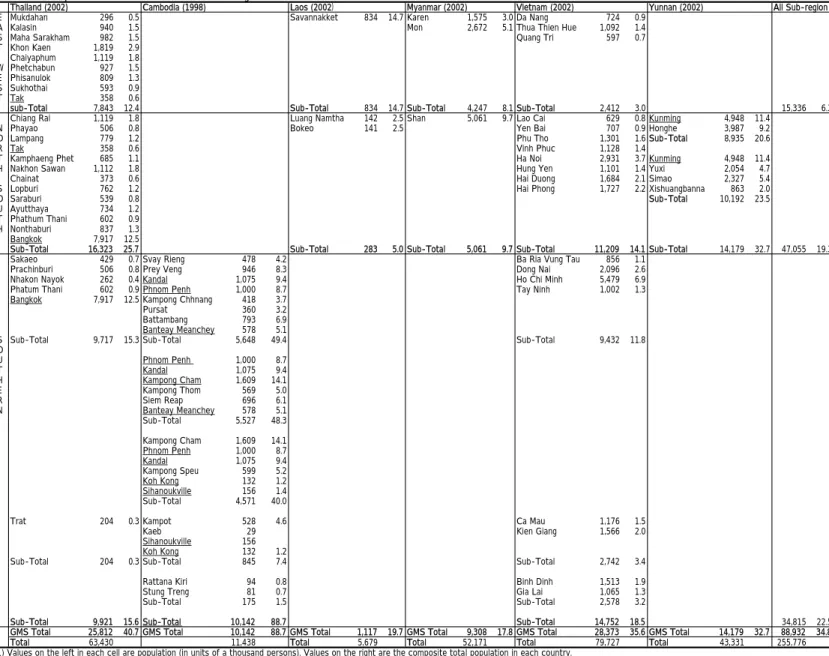
Table A-1. Population of Provinces and States along Three GMS Economic Corridors
Thailand (2002) Cambodia (1998) Laos (2002) Myanmar (2002) Vietnam (2002) Yunnan (2002) All Sub-region E Mukdahan 296 0.5 Savannakket 834 14.7 Karen 1,575 3.0 Da Nang 724 0.9
A Kalasin 940 1.5 Mon 2,672 5.1 Thua Thien Hue 1,092 1.4
S Maha Sarakham 982 1.5 Quang Tri 597 0.7
T Khon Kaen 1,819 2.9 ・ Chaiyaphum 1,119 1.8 W Phetchabun 927 1.5 E Phisanulok 809 1.3 S Sukhothai 593 0.9 T Tak 358 0.6
sub-Total 7,843 12.4 Sub-Total 834 14.7 Sub-Total 4,247 8.1 Sub-Total 2,412 3.0 15,336 6.3 Chiang Rai 1,119 1.8 Luang Namtha 142 2.5 Shan 5,061 9.7 Lao Cai 629 0.8 Kunming 4,948 11.4
N Phayao 506 0.8 Bokeo 141 2.5 Yen Bai 707 0.9 Honghe 3,987 9.2
O Lampang 779 1.2 Phu Tho 1,301 1.6 Sub-Total 8,935 20.6
R Tak 358 0.6 Vinh Phuc 1,128 1.4
T Kamphaeng Phet 685 1.1 Ha Noi 2,931 3.7 Kunming 4,948 11.4
H Nakhon Sawan 1,112 1.8 Hung Yen 1,101 1.4 Yuxi 2,054 4.7
・ Chainat 373 0.6 Hai Duong 1,684 2.1 Simao 2,327 5.4
S Lopburi 762 1.2 Hai Phong 1,727 2.2 Xishuangbanna 863 2.0
O Saraburi 539 0.8 Sub-Total 10,192 23.5
U Ayutthaya 734 1.2 T Phathum Thani 602 0.9 H Nonthaburi 837 1.3 Bangkok 7,917 12.5
Sub-Total 16,323 25.7 Sub-Total 283 5.0 Sub-Total 5,061 9.7 Sub-Total 11,209 14.1 Sub-Total 14,179 32.7 47,055 19.3
Sakaeo 429 0.7 Svay Rieng 478 4.2 Ba Ria Vung Tau 856 1.1
Prachinburi 506 0.8 Prey Veng 946 8.3 Dong Nai 2,096 2.6
Nhakon Nayok 262 0.4 Kandal 1,075 9.4 Ho Chi Minh 5,479 6.9
Phatum Thani 602 0.9 Phnom Penh 1,000 8.7 Tay Ninh 1,002 1.3
Bangkok 7,917 12.5 Kampong Chhnang 418 3.7
Pursat 360 3.2
Battambang 793 6.9 Banteay Meanchey 578 5.1
S Sub-Total 9,717 15.3 Sub-Total 5,648 49.4 Sub-Total 9,432 11.8
O U Phnom Penh 1,000 8.7 T Kandal 1,075 9.4 H Kampong Cham 1,609 14.1 E Kampong Thom 569 5.0 R Siem Reap 696 6.1 N Banteay Meanchey 578 5.1 Sub-Total 5,527 48.3 Kampong Cham 1,609 14.1 Phnom Penh 1,000 8.7 Kandal 1,075 9.4 Kampong Speu 599 5.2 Koh Kong 132 1.2 Sihanoukville 156 1.4 Sub-Total 4,571 40.0
Trat 204 0.3 Kampot 528 4.6 Ca Mau 1,176 1.5
Kaeb 29 Kien Giang 1,566 2.0
Sihanoukville 156 Koh Kong 132 1.2
Sub-Total 204 0.3 Sub-Total 845 7.4 Sub-Total 2,742 3.4
Rattana Kiri 94 0.8 Binh Dinh 1,513 1.9
Stung Treng 81 0.7 Gia Lai 1,065 1.3
Sub-Total 175 1.5 Sub-Total 2,578 3.2
Sub-Total 9,921 15.6 Sub-Total 10,142 88.7 Sub-Total 14,752 18.5 34,815 22.5
GMS Total 25,812 40.7 GMS Total 10,142 88.7 GMS Total 1,117 19.7 GMS Total 9,308 17.8 GMS Total 28,373 35.6 GMS Total 14,179 32.7 88,932 34.8
Total 63,430 11,438 Total 5,679 Total 52,171 Total 79,727 Total 43,331 255,776
1) Values on the left in each cell are population (in units of a thousand persons). Values on the right are the composite total population in each country. 2) Underlined provinces and states are counted twice.
Table A-2. Income Level of Provinces and States along Three GMS Economic Corridors in US dollars
Thailand (2002) Cambodia (1998) Laos (2002) Myanmar (2002) Vietnam (2003) Yunnan (2002) All Sub-region
E Mukdahan 596 Savannakket Karen Da Nang 363
A Kalasin 614 Mon Thua Thien Hue 232
S Maha Sarakham 560 Quang Tri 179
T Khon Kaen 1,055 ・ Chaiyaphum 617 W Phetchabun 743 E Phisanulok 1,105 S Sukhothai 758 T Tak 906
sub-Total 799 Sub-Total Sub-Total Sub-Total 258
Chiang Rai 722 Luang Namtha Shan Lao Cai 162
N Phayao 732 Bokeo Yen Bai 199
O Lampang 1,105 Phu Tho 201
R Tak 906 Vinh Phuc 488
T Kamphaeng Phet 1,286 Ha Noi 233
H Nakhon Sawan 1,086 Hung Yen 488
・ Chainat 1,304 Hai Duong 233
S Lopburi 1,730 Hai Phong 322
O Saraburi 3,015 U Ayutthaya 6,269 T Phathum Thani 4,041 H Nonthaburi 1,940 Bangkok 5,473
Sub-Total 3,668 Sub-Total Sub-Total Sub-Total 288
Sakaeo 808 Svay Rieng Ba Ria Vung Tau 373
Prachinburi 2,932 Prey Veng Dong Nai 401
Nhakon Nayok 1,269 Kandal Ho Chi Minh 710
Phatum Thani 4,041 Phnom Penh Tay Ninh 259
Bangkok 5,473 Kampong Chhnang Pursat Battambang Banteay Meanchey
S Sub-Total 4,932 Sub-Total Sub-Total 563
O U Phnom Penh T Kandal H Kampong Cham E Kampong Thom R Siem Reap N Banteay Meanchey Sub-Total Trat 1,434 Kampong Cham
Phnom Penh Kandal Kampong Speu Koh Kong Sihanoukville Sub-Total 1,434 Sub-Total Kampot Ca Mau 618
Kaeb Kien Giang 723
Sihanoukville Koh Kong
Sub-Total Sub-Total 678
Rattana Kiri Binh Dinh 637
Stung Treng Gia Lai 484
Sub-Total Sub-Total 573
Sub-Total 4,860 Sub-Total Sub-Total 586
GMS Total 3,355 GMS Total GMS Total GMS Total GMS Total 440
Ex. Rate 42.960 Ex. Rate 15,280 Total
1) Underlined provinces or prefectures are counted twice..


![Figure 1-2. Demographic Pyramid of Cambodia in 1998 (11.4 Million Persons) Source: National Institute of Statistics, Ministry of Planning, Cambodia [2004]](https://thumb-ap.123doks.com/thumbv2/123deta/9910954.1378496/9.892.141.694.101.540/demographic-cambodia-national-institute-statistics-ministry-planning-cambodia.webp)
![Figure 1-3. Demographic Pyramid of Myanmar in 2002 (52.2 Million Persons) Source: Central Statistical Organization, Myanmar [2002]](https://thumb-ap.123doks.com/thumbv2/123deta/9910954.1378496/10.892.140.695.125.515/demographic-pyramid-myanmar-million-persons-central-statistical-organization.webp)