Family Business in Mexico: Responses to Human
Resource Limitations and Management Succession
著者
Hoshino Taeko
権利
Copyrights 日本貿易振興機構(ジェトロ)アジア
経済研究所 / Institute of Developing
Economies, Japan External Trade Organization
(IDE-JETRO) http://www.ide.go.jp
journal or
publication title
IDE Discussion Paper
volume
12
year
2004-11-01
INSTITUTE OF DEVELOPING ECONOMIES
Discussion Papers are preliminary materials circulated to stimulate discussions and critical comments
DISCUSSION PAPER No. 12
Family Business in Mexico:
Responses to Human Resource
Limitations and Management
Succession
Taeko HOSHINO*
Abstract
Indigenous firms in Mexico, as in most developing countries, take the shape of family businesses. Regardless of size, the most predominant ones are those owned and managed by one or more families or descendent families of the founders. From the point of view of economics and business administration, family business is considered to have variety of limitations when it seeks to grow. One of the serious limitations is concerning human resource, which is revealed at the time of management succession. Big family businesses in Mexico deal with human resource limitations adopting measures such as the education and training of the successors, the establishment of management structure that makes control by the owner family possible and divisions of roles among the owner family members, and between the owner family members and the salaried managers. Institutionalization is a strategy that considerable number of family businesses have adopted in order to undergo the succession process without committing serious errors. Institutionalization is observed in such aspects as the establishment of the requisite condition to be met by the candidate of future successor and the screening by an institution which is independent of the owner family. At present these measures allow for the continuation of family businesses in an extremely competitive environment.
Keywords: family business, ownership, management, succession, Mexico JEL classification: K22, L22, M12, M13
Deputy Director-General, Area Studies Center, IDE ([email protected])
The Institute of Developing Economies (IDE) is a semigovernmental, nonpartisan, nonprofit research institute, founded in 1958. The Institute merged with the Japan External Trade Organization (JETRO) on July 1, 1998. The Institute conducts basic and comprehensive studies on economic and related affairs in all developing countries and regions, including Asia, Middle East, Africa, Latin America, Oceania, and East Europe.
The views expressed in this publication are those of the author(s). Publication does not imply endorsement by the Institute of Developing Economies of any of the views expressed.
INSTITUTE OF DEVELOPING ECONOMIES (IDE), JETRO
3-2-2, WAKABA,MIHAMA-KU,CHIBA-SHI
CHIBA 261-8545, JAPAN
FAMILY BUSINESS IN MEXICO
―Responses to Human Resource Limitations and
Management Succession―
Introduction
Indigenous firms in Mexico, as in most developing countries, take the shape of family businesses. Regardless of size, the most predominant ones are those owned and managed by one or more families or descendent families of the founders1. After 1982, under continued economic crisis and advancing economic liberalization, many uncompetitive firms were eliminated, and many new firms taking advantage of the situation emerged. However, there are no differences between firms that have survived competition and newly emerging ones in that both are family businesses. The fact that family businesses in such a country develop into large scale firms after having survived in an unprecedented competitive environment, constitutes a very interesting phenomenon from the point of view of economics and business administration.
From the point of view of economics and business administration, family business is considered to have a variety of limitations. If the objective of such a business is to grow, it is necessary that it overcome these limitations. In this way, it can be transformed into a managerial firm. H. Morikawa explains the limitation of family firms from the perspective of “human resources” (Morikawa [1996]). He points out that the human resources from which a family can choose top managers are limited. The administration of modern business enterprises, which is characterized by mass production and mass distribution, is made possible by a managerial hierarchy. A founder’s family simply cannot fill all posts of such a hierarchy. Though it is possible to find administrators who can occupy the top of the hierarchy, the number of talented persons within the family who are able to occupy such positions is extremely low. Morikawa indicates that it is difficult to replace the natural emergence of administrators by specific training. He points out that where prospective successors have been educated in the wake of successful experiences of the founder, pressure is often placed on the successor, and this hinders the ability to
1
There is no official data referring to family owned companies in the statistics provided by the Mexican Government. As far as the author knows, the only statistical data related to family owned companies is that developed in research conducted jointly by COPARMEX Nuevo León and the Family Business Center of the University of Monterrey in the State of Nuevo Leon. (Coparmex Nuevo Leon & Centro de Empresas Familiares, Universidad de Monterrey [2001]).
conduct expansion of the firm. According to Morikawa, there are two dimensions in a managerial hierarchy: (1) a bureaucratic management organization and (2) a human network formed by personnel with specific skills. He argues that founder family members cannot easily enter this skilled network, thus creating a problem in developing management(Morikawa[1996:13-15,23,37-38]).
Limitations in family business are revealed at the moment of succession. Remarks of Morikawa are mainly related to the problems appearing at the time of management succession. However, there are other problems. There are two features to consider in succession: (1) ownership and (2) management. Succession of assets usually follows social tradition. According to the inheritance system, this is regulated by law. Succession of firm ownership is carried out in a similar way. In the case of Mexico, where inheritance by equal distribution applies, the property is divided each time succession takes place. On the other hand, it is necessary to unify the chain of command in order to control the managerial hierarchy that is a part of the bureaucratic management organization. When a family business undergoes succession, it faces a difficult task in determining how to reach agreement between ownership and management. This often happens with the diffusion of ownership and concentration of managerial control. La Porta, Lopez de Silanes and Shleifer [1999: 476] collected data from 540 firms in 27 countries and areas. Their analysis indicates that family firms are more common than managerial firms. Though they assume that shares are owned collectively by the family, this does not appear true in all cases. The composition and relationship of shareholders and managers belonging to the family seem to change through succession. Thus, there appears a need to coordinate the interests of family members. As it has been noted in recent years that the issue of corporate governance of family business firms is present in the controlling family and minority shareholders (Burkart, Gromb Panunzi [1997], Claessens, Dijakow, Fan, Lang [1999], Johson, La Porta, Lopez-de-Sinales, Shleifer [2000], Burkart, Panunzi, Shleifer[2002]), but it also present in the relationship between controlling family shareholders and those in charge of management.
The purpose of this research was to investigate the continuation and development of family business by empirically studying the ways in which representative family businesses in Mexico deal or do not deal with two issues: (1) limitations with regard to recruitment of talented persons that allow expansion of the family business, and (2) coordination of interests within the family when succession is to occur. Previous research dealing with management and succession of family business in Mexico was carried out by Lomniz and Perez-Liaur [1987]. Using case study methods, they investigated the path pursued by a medium-scale closed family business, given the anonymous family name of Gomez
through 1820 to 19802. According to this research, management in the Gomez family was based on the idea that family and management are joined harmoniously. In this system, the head of the firm is the patron, and it was considered an obligation to offer employment to relatives of the patron. With one patron, descendents inherited the firm as a whole unit. In the case of multiple descendants, the firm was divided into small scale firms, taking into account future successions. Besides, succession became an opportunity for employed members of non-lineal families to start their own business.
Breaking up of the capital accumulation process with each generational change is a problem that comes with management and succession. In fact, until 1980, the relative position of the Gomez Family in the economy was declining. Lomniz and Perez-Lizaur point out that from the 1960s, family firms that changed their closed ownership and management became conglomerates and managed to raise their position. However, she did not conduct independent research on this. This research concentrates on family businesses that have chosen a path of development different from the one followed by the Gomez Family.
There are various studies highlighting changes in family business management in Mexico. Derossi [1977:128,137] conducted a survey on 336 Mexican entrepreneurs. She found that the more recent the establishment of a firm, the bigger it is, and the more modern the activity it deals with, and observed a tendency of a decrease in participation of family members and an increase in importance given to salaried managers. Greater emphasis is also be placed on education of family members. These findings were particularly prominent in large-sized firms within the industrial city of Monterrey in the northern region of Mexico. In support of these findings, Andrews [1976:30-31], in his analysis of Who’s Who, argues that large-sized firms in Monterrey recruit salaried managers in increasing numbers, and there are large numbers of owner family members who do not work for the firm owned by their family. Gersic, Davis, Hampton and Lansberg [1997:218] report an example of the institutionalization of third generation firms in the Northern region of Mexico. They indicate that such firms establish a committee at the moment of succession from the second generation to the third. They conduct an evaluation of capability in order to make selection. The results, however, seem fragmentary, obsolete, and at the least restricted geographically to the Monterrey area.
This research examines the characteristics of managerial participation of owner families in the 28 most important Mexican family businesses as found in the annual reports3 submitted to the Mexican
2
For an outline, see Hoshino’s review of this book (Hoshino [1990]).
3
Stock Exchange (Bolsa Mexicana de Valores). Section 1 provides a description of the characteristics of these 28 target family businesses. Section 2 includes a discussion of the board of directors (consejo de
administración) and execution of business as well as how owner family members participate in these
two activities. Section 3 concerns characteristics of participation in management of the owner family dealt with in Section 2 using the viewpoint of human resources limitation and succession. Finally, a synthesis of the above analysis and perspectives on continuation and development of family business is discussed in the conclusion.
1. Large-sized family business in Mexico
The term “family business” is defined as a group of firms that are owned and controlled by families or descendent families of the founders. The expression “families or descendent family of the founders” will hereafter be shortened to “owner family”. At present, family branch controlling management is referred to as the “business leader’s family”. Depending on age of the business, there are cases where a business leader’s family overlaps with the owner family, and there are cases where a business leader’s family is only one part of the owner family. As family business is an ever-changing entity, the scope of the owner family differs relative to when it was founded. For purposes of this research, the time of foundation will be understood as the time of the establishment of the modern business enterprise. This is related to the present enterprise or to the time when such business was placed under its control. As mentioned in the introduction, Morikawa defines the family firm as one that has undergone succession. However, in defining “family business”, this paper does not take into account, whether it is prior or post succession. In this paper, the characteristic of family business succession is one of the issues to be examined. Succession is generally considered a process that follows certain steps (Handler [1994: 134-137]). Even before succession, activities related to future succession have already started. Because succession is considered as a process, the condition of post-succession has not been taken into account in this research.
Banking and Securities Commission”. In 2002, its name was: Informe anual que se presenta de acuerdo con la circular
11-33. In 2003, the expression “Informe anual” was changed into “Reporte Anual”). Unless it is expressly mentioned,
this research is based on data appearing in annual reports for the years 2002 and 2003 of the listed companies that are the objects of this study. When information belongs to an annual report, the source has been left out for onvenience of description. When changes were detected between 2002 and 2003 data, the most recent information was used.
1-1. Object of analysis: 28 family businesses
Table 1 shows a summary of the 28 family businesses that form the basic data of this study. Data in Table 1 includes is the year 2000 ranking of the largest 500 firms by sales as they appear in the Mexican economics magazine Expansión. As this ranking treats parent and subsidiary companies separately, subsidiaries were excluded relative to information available, and a ranking of the largest 100 firms was made thereafter (Hoshino [2002:11-13]). In the second stage, from the list of 100 firms, foreign firms and public firms (totaling 47 firms)4 and non-listed national private firms with limited available information (12 firms)5 were excluded. From the remaining 41 national private firms, those in bankruptcy (4 firms)6 and those that can hardly be regarded as family businesses (4 firms)7 were also excluded. From the remaining 33 firms, those owned or under the management control of a same owner family are considered as one unit, and they have been re-listed according to total sales as owner family units. In cases where there are important firms not included in the largest 100 list but considered to be under the control of the same family business, they have been added in the column of the principal listed firms.
Table 2 shows the composition of the largest 100 firms according to the origin of their capital. 53 firms out of the 100 account for 41.9% of the total sales and are national private firms. Sales of 33 firms out of the 53 total 81.2%. Thus, they account for 34% of the 100 firms.
It is difficult to see changes in the relative weight of the national private firms included in the 100
4
The author has used the same documentation and method used by Hoshino [2003b] to select the firms which are objects of this analysis. However, changes are introduced in this paper, and a new classification is needed. In previous research, the total of foreign capital firms and state-owned -companies was 49. According to new information, two firms (Corporativo Mabe and Nadro) have been reclassified as indigenous private firms. However, the 47 firms include two indigenous financial groups that have been purchased by foreign banks in 2000 and 2001.
5
In Hoshino [2003], there were 13 firms. In 2003 a new firm (Corporación Geo) was listed.
6
This refers to the following firms: Savia (19th), Cintra (20th), Altos Hornos de México (42nd), and Grupo Sidek (88th).
7
It is questionable whether or not ICA (47th), Corporación Geo (84th), Corporación Argos (85th) (in 2001 they joined to
form Corporación Arca) and CEI (89th) are to be considered as family businesses.The shareholding is diffused. They
are left out of this research, and it seems necessary to conduct a separate study regarding the characteristics of these firms.
firms list because of a lack of continuous data. Table 3 shows the change in the composition of total sales according to the origin of capital for the top 100 firms in 1986, 1998 and 2000. Considering changes occurring from 1986 to 1998, there seems to be a great decrease in public firms (– 23.5%) and an equal increase in (private) national firms (+ 12.2%) and foreign firms (+ 12.2%). This change is due to the privatization of public firms that took place around 1990. Special care should be taken in considering the period 1998 – 2000. Since 2000, Expansión magazine changed its editing policy. First, it began to include firms in the financial and service sector which were not been previously included in the ranking. Figures for public firms in 2000 include electric power companies (4.0% out of 100 firms) that were not included in the lists of 1986 and 1998. Two indigenous finance groups (2.1%) acquired by foreign banks have been included under the foreign firms column for practical reasons, although acquisition took place in 2001 and 2002.
Second, a great number of foreign firms that had been excluded began to be listed in this ranking. Though the proportion of foreign firms in 2000 appears to have increased, it would be better to consider the figures of foreign firms in 1986 and 1998 to have been underestimated. In short, it can be said that there have not been major changes in the relative weight of public firms in the period 1998 – 2000. On the other hand, there has been a comparatively large change in the case of national and foreign firms. The relative weight of foreign firms has increased through the acquisition of financial groups, and national firms have proportionally reduced their relative weight.
Due to restrictions in the availability of data, non-listed firms have not been included as objects of analysis. There is thus a possibility of a bias. However, a great number of growing firms became listed during the investment boom of emerging stock markets in the first half of the nineties. Thus, this research is based on a fairly representative sample of large-sized family business. CEMEX (3rd) and MODELO (7th) cannot exactly be considered family businesses8. They are included in this analysis, however, because management control by the owner family has been continuous up to the present.
8
CEMEX (3rd) was formed by the merger of two cement firms in 1930. Though management has been controlled by
both founder families and their descendants, the Zambrano Family holds the principal role. MODELO (7th) was
founded by several investors. One of them bought the majority of shares. As he had no offspring at the time of his retirement, he transferred his shares to various salaried managers. The founder’s nieces hold the post of president of the board, and his son is now the CEO. This son married the daughter of one of the salaried managers to whom part of the
shares had been transferred. In the end, the founder families came to own the shares and now hold the principal
Further explanation of Table 1 is necessary. The expression “denomination of family business” was chosen for practical descriptive reasons, and there is no established denomination for it. In most cases, they are denominated by the media using individual names or family names. However, because there are cases of identical family names such as González, abbreviations of core firms or the family names of the business leaders are used.
Many family businesses form a firm group with the holding company at the top, and this holding company is thus listed. In Table 1, the case of a core firm appearing after its business leader’s name provides a good example. The scope of a family business will fundamentally include the core firm and the firms under its control9. However, there are cases such as CARSO (1st), BAL (9th), SALINAS (14th), and GRUMA (15th) where ownership and management of a number of listed firms is under direct control of the same family or a non-listed holding company. MONTERREY (2nd) is an example of one family business that was divided into four. However, after the division each business, each leader family has ownership and holds control of management of its own part. Still there is a loose connection among these family businesses, and this can be seen in cross-shareholding and the exchange of directors. Even if they are considered as independent family businesses, they are still grouped as one family business. It is certainly an interesting case relative to succession problems.
Some explanation is also necessary concerning the denomination of the family of the business leader. In Table 1, the family tree may be considered. When family lineages are involved in business ownership and management, the first family name of husband and wife are given as the name of the present business leader’s family 10. In most cases, a business leader’s family reflects a family lineage below the president of the board of directors of the principal firm. In Figure 1, the case of the Slim-Domit family of CARSO (1st) is given as an example. The founder of CARSO is Carlos Slim
9
Apart from the cases of holding company and subsidiaries, there are probably non-listed firms that are owned and controlled directly by a family. , As a result of consulting information in publications such as the ranking of 500 firms in Expansión and Large-sized enterprises Yearbook (Mercamétrica Ediciones, Empresas grandes, all editions appearing annually), it is possible to say that the important companies are included in holding companies and subsidiaries. If companies are not included, they are probably small and medium-sized firms.
10
In Mexico, the first name of the person is followed by the family name of the father, and the latter is followed by the mother’s family name. In the case of married women, the mother’s family name is replaced by the husband’s family name and preceded by the preposition “de”. For practical reasons, the family name of the mother and the husband are omitted in some parts of this article.
Helú. His sons are holding the posts of president of the board in some of the subsidiary firms, so it can be considered that succession is in process at present. In the case of CARSO, the owner family overlaps with business leader’s family. When looking at family businesses with a long tradition, it is necessary in some cases to trace family lineage back to earlier stages owing to the division of ownership. In the case of MONTERREY (2nd) (Figure 2), the five founders of the original company Cuauhtémoc Brewery (Cervecería Cuauhtémoc) are represented in the shaded name of the Figure, and the whole family tree corresponds to the owner family. In the case of ALFA, formerly a divided four family business, tracing the business leader’s family shows that the main shareholders (appearing with “A” in the Figure) are concentrated in the family lineage starting with Roberto Garza and Margarita Sada. They belong to the second generation. The previous and the present president of the board of directors (Bernardo Garza Sada and Dionisio Garza Medina) also come from this family lineage. Thus, Garza-Sada is considered the business leader’s family; this is indicated with dotted lines. It should be noted that there are also shareholders not belonging to this family lineage. The remaining three business leaders’ families representing three formerly divided family businesses are shown with dotted lines.
1-2. Characteristics of the large-sized family business
Four points regarding the basic characteristics of the 28 family businesses found in Table 1 are discussed below. First, in all cases considered, the main firm is not closed in the sense that it is listed on the stock exchange. There are a great number of cases where investors who did not belong to the family were invited to join the company from the beginning. Table 4 shows the composition of investors of the principal firm in the 28 family businesses considered in this research. If MONTERREY (2nd) were considered to be four independent family businesses, the number would be 31. As shown in this Table, there are 20 cases11 in which an individual or one family started the business. There are 11 cases where the business was started by a number of individuals or by different families through a joint venture. During the subsequent development process, the original composition of investors changed due to an increase in capital, an increase in the number of investors due to mergers, a transaction of shares among investors, and listing of firms on the stock exchange. However, ownership and management control is still maintained by the same family; this includes cases of firms established through the investment of
11
When a member of a family business starts a new business, as in the cases of SALINAS (14th) and POSADAS (26th),
founders of the minority share.
Second, many family businesses have a relatively short history. Table 4 shows which generation of the founding family, starting from the original founder, actually holds the post of president of the board of directors in the principal firm. Among the 28 family businesses considered, MONTERREY (2nd) is the oldest, founded in 1890. The president of the board of directors belongs to the fourth generation. However, most family businesses were established after the Second World War, during the Mexican import substitution industrialization period. Thus, the presidency of the board is mainly occupied by the second and third generation. Since few generations have been involved in the business, there has been little experience with succession. MONTERREY has undergone three successions, but most family businesses have undergone two or less.
Third, there is a concentration of shareholding in owner families. In order to prevent the diffusion of shares outside the family, and preserve the unification of the voting rights of shares held by the family, it is usual to resort to the constitution of a holding company or a trust (Hoshino [2003:159-161]). Table 5 shows data from the 28 family businesses that shows the composition of shareholders and the proportion of shares held by the owner family. It is evident that in most firms, shares with voting rights are concentrated in the owner family in a proportion that easily surpasses 50%. One of the reasons for the high proportion of shares owned by the owner family is that the listing of shares is recent. From the 38 principal firms appearing in Table 1, 18 firms have been listed since the 1990’s. Another reason is that issuing shares is not considered a normal means of financing. During the period when share values were steeply rising due to the worldwide investment boom in emerging stock markets, the aim of becoming a listed company consisted in gaining a premium income just once. Babatz [1997:103-105] did an analysis of the reasons that led Mexican firms to become listed. He argues that becoming a listed company on the Mexican stock exchange is pursued as a step toward becoming a listed company on the New York Stock Exchange rather than as a means to increase capital through the issue of shares. However, the final objectives are: (1) to produce an announcement effect by showing that the firm has succeeded in becoming a listed company after passing the strict check of the Security Market, and (2) to issue bonds and reduce the cost of fund raising from financing institutions.
It would be logical to suppose that the smaller the proportion of inicial capital contributed, and the more times the firm has undergone successions, the higher the probability that the firm will undergo a diffusion of shares to non-family members or to a division of shares among the owner family members. However, according to Table 5, division of share ownership has rarely taken place. The fact that there is no inheritance tax in Mexico may be given as the main reason (Díaz [1994:71]), but the transaction of
shares among investors constitutes another factor to be considered. For example, in the case of TMM (27th), the Serrano-Segovia family, which joined the firm as a minority investor at its establishment in 1952, purchased the majority of shares in 1991. In the case of VITRO and CYDSA, both branches of MONTERREY (2nd), business leaders’ families of both companies exchanged shares and increased the proportion of shares held in each principal firm. In the case of CEMEX (3rd), the proportion of shares held by the business leader’s family is extremely low, but the ownership structure allows this family to hold control of management through a skillful use of shares of limited voting rights and through various systems limiting the enforcement of voting rights of shares (Hoshino [2003a:157]).
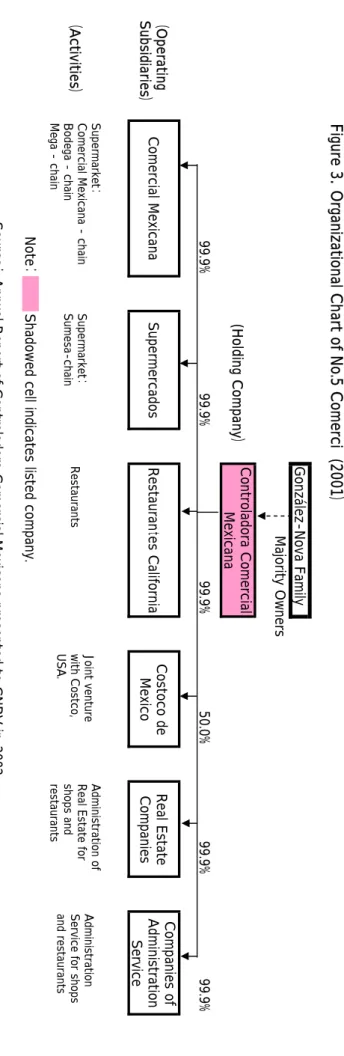
Fourth, the group of firms under the control of the business leader’s family constitutes a firm group organization with a pyramidal ownership structure. The firm occupying the top of the pyramid is the genuine listed holding company, and the word “Grupo” is currently included in its denomination. There are some cases where this word does not appear. There are variations in the pyramidal structure: (1) a two layered structure formed by a genuine holding company and several operating companies, (2) a three layered structure having an additional intermediate layer occupied by a holding cum operating company, a company which has function of both holding and operation, and (3) other complex structures with various layers of holding cum operating companies with a genuine holding company at the top and operating companies at the bottom. Figure 3 shows the organizational chart of COMERCI (5th). This is an example of a two-layered structure. This is the case of a genuine holding company with a number of operating subsidiaries under its control. It is organized in business division by sectors or chains of stores, which are almost 100% owned by the holding company. This excludes the case of joint ventures with foreign companies, the proportion of which is 50%. Within this structure, only the holding company is listed. Figure 4 shows the case of IMSA, an example of a three-layered structure. Under the control of the genuine listed holding company, a holding cum operating company is placed for each business sector. Under each of these companies are a number of operating companies dealing with different products. The operating companies with 50 to 51% of the shareholdings are in all cases joint ventures with foreign capital. Figure 7 shows the organizational chart of CARSO (1st). This is an example of a complex structure. In this case, there is no listed holding company unifying the firms under its control. The majority of the shares of the four genuine listed and non-listed holding companies are owned directly or through a trust by the Slim-Domit family. Under each of these holding companies, there are genuine listed and non-listed holding companies or holding cum operating companies. Further, under these companies, a large number of operating companies are placed according to the type of business.
The following points can be given as reasons that led to the adoption of an ownership structure such as that mentioned above. The first point to consider is why, for example, the pyramidal structure is more common than the complex circular ownership structure as observed in Korea. This can be explained by the fact that cross-shareholding among firms is prohibited. The second point is why a group organization of firms is adopted instead of a multi-divisional organization of one firm. This is due to the need to restrain the scale of the company in order to elude progressive taxation. When there was a plan to expand into a new business, the formation of subsidiary companies was preferred. Further, from 1982, the restructuring of family businesses took place in an extremely competitive environment. Newly emerged family businesses and surviving family businesses expanded or faced restructuring by taking new business sectors under their control. COMERCI (see Figure 3) was originally a supermarket chain of Comercial Mexicana. In 1981, it acquired the SUMESA affiliate supermarkets, and in 1982, it expanded into the family restaurant business sector. In 1991, it formed a joint venture with COSTCO of USA, and it developed into the present business structure. IMSA’s (Figure 4) original business was to manufacture steel processed products and construction products. In 1987 it expanded into the business of automotive batteries, and in 1989, into aluminum and other related products. CARSO’s (Figure 5) principal business until the seventies, under its founder Carlos Slim, was restricted to the financial sector. This occurred through Inversora Bursatil, a brokerage company occupying the lowest position in the financial sector of Figure 5. After the eighties, it advanced into different business sectors through the merger and acquisition of firms and the acquisition of public companies by a privatization policy. In a mere 20 years, it formed an enormous business group organization. Finally, among the controlled firms there is a great number of firms that are forming joint ventures with foreign companies. Most controlled firms that are not fully owned subsidiaries (see Figures 3, 4, and 5) are firms receiving the investment of foreign firms. In order to contain the presence of foreign partner in individual business, a subsidiary is formed for each joint venture. The third point is why the principal genuine holding companies that occupy the key position of the pyramidal structure, rather than the firms under their control, are the ones which become listed. This is related to the ‘motivation to become listed’ as described by Babatz. As mentioned, the listing of firms on the Mexican Stock Exchange increased in the 1990’s. It is worth adding that during the same period, most firms were also listed on the New York Stock Exchange. In this connection, COMERCI and IMSA listed their holding company on the New York Stock Exchange in 1996. CARSO listed TELMEX in 1991 and AMX in 2001. Among other requirements, listing on the New York Stock Exchange requires a minimum standard of some financial records. In the case of subsidiaries, they could not reach this minimum standard.
2. Participation in management by the owner family
Table 6 shows: (1) the name of the president of the board of directors, (2) the number of the owner family members on the board of directors, (3) the number of the owner family members on the committee in the board of directors, (4) the name of the CEO (Chief Executive Officer) and his family relationship with the president of the board of directors, and (5) the number of the owner family members (excluding the CEO) involved in the execution and their family relationship with the president of the board of directors. Management posts where the owner family members are involved are presented in the shaded column. In this section, the characteristics of the participation in management of the owner family are examined based on the Table 6.
2-1. The owner family’s control on the Board of Directors
Though Mexican Company Law (Ley General de Sociedades Mercantiles) was derived from the French Law system, it has moved closer to the American system in recent times. The general meeting of shareholders is the supreme voting organ of the joint stock company (sociedad anónima). The director (consejero), who is entrusted by shareholders with the management of the firm, is designated by the ordinary general meeting of shareholders (asamblea general ordinaria de accionistas). In the case where there are two or more directors, a board of directors (consejo de administración) is established. Either shareholders in the general meeting or members of the board of directors designate the general manager. Execution is delegated to this manager. A quorum for the ordinary meeting of shareholders requires 50% of the capital, and the adoption of a resolution requires the presence of the majority of shares with voting rights. In short, this means that the one having the ownership of the majority of shares with voting rights can control the designation of the directors and the general manager. Most firms included in the research of this Chapter meet these conditions.
Listed companies must comply with both the Company Law and the Law of the Securities Market (Ley del Mercado de Valores). The Law of the Securites Market was influenced by worldwide reforms in corporate governance, and it was amended in 2001. Under the amended law, the number of directors is established with a minimum of 5and a maximum of 20. To protect minority shareholders’ interests,
those shareholders who represent 10% of the corporate capital 12are granted the right to designate one director. If this right is not exercised, a right to designate two or more directors is granted to those minority shareholders as a whole. Under the amended law, 25% of the total number of directors must be independent director.
Table 6 shows characteristics of the participation of the owner family on the board of directors. The first characteristic is that the owner family holds the post of president of the board, the representative of the firm. In all 38 firms, the owner family presides over the board of directors. Second, if the ratio of owner family members belonging to the board of directors is considered, there is no correspondence between the percentage of ownership of shares with voting rights and the percentage of owner family members belonging to the board. Cases where owner family members hold 50% of the voting rights necessary when voting a board’s resolution (50% for ordinary voting; in the case of a tie, the president shall decide) amount to 9 out of 38. However, this does not mean that the board is free from the control of the owner family. Though most non-owner family directors are independent directors, it is evident that a person serving the purposes of the owner family will be selected. This is because the owner family holds the majority of shares with voting rights, and thus can control the decisions concerning the designation of directors at the general meeting of shareholders. There is another issue regarding the ‘independence’ of the independent directors. Although one of the conditions to be met by an independent director is not being a relative of a shareholder, the definition of relative applied in this case refers to a blood relative or to a relative in law within second degree. The Table includes relatives within third degree and further. However, if the number of relatives is counted according to the definition of relatives given above, the percentage of relatives holding a post on the board will be less than indicated in the figures appearing in the Table. An extreme example is the case of CYDSA (2nd). According to the Table, 7 out of 11 directors belong to the owner family. From 9 directors classified as independent in the annual report, 5 are relatives of third degree or more. It can be concluded that the independent director system does not operate to make management control by the owner family weaker.
Under the provisions of the company statute, the board of directors usually meets at least once every three months or at least four times a year. The board is not expected to hold meetings frequently.
12
According to the Securities Market Law of 2001, the shares of limited voting rights can represent up to 25% of the corporate capital. However, under the condition that these shares will be converted into shares with voting rights within 5 years, a further 25% of shares with limited voting rights can be issued.
Considering the large number of directors on the board, it is difficult to argue that this organization is practical. At present, functions of different committees13 established in a large number of firms substitute for those of the board. Within these committees, the executive committee (comité ejecutivo, in some cases the finance and planning committee −comité de finanzas y planeación−) is considered the most important one. Some of the duties explained in the annual report as being delegated to the executive committee by the board of directors are: (1) resolution of the major framework of corporate strategy, (2) evaluation and approval of investment and financial policies submitted by executives, and (3) instructions to execute business projects or risk management. The Table indicates the number of owner family members in the executive committees. Unlike the board of directors, the ratio of owner family members is high. The center of management control is generally located with this executive committee14.
2-2. Participation in execution
The expression ‘top management executives’ refers to those whose names appear in the annual report as executives (funcionario), and concretely, the Chief Executive Officer (CEO) of the firms concerned. It also includes the officers responsible for the different function of the firm (for example, the Chief Financial Officer –director de finanzas–) and the CEO of the principal subsidiaries15.
13
There is an executive committee, a financing and planning committee, an audit committee (comité de auditoria), and an evaluation and compensation committee (comité de evaluación y compensación). Among these, only the audit
committee is obliged by the Securities Market Law to be listed. Further,the president and the majority of members of
the audit committee must be independent directors. The law does not regulate conditions for the other committees.
14
The fact that the executive committee has a principal role as the center of management was also verified through an
interview survey carried out by the author with Bimbo (6th)(July 8th, 2003) and Desc (11th) (July 7th, 2003).
15
In Corporation Law, the term ”general manager” (gerente genera,l in Spanish) is used for the CEO.In large-sized
firms, the term ”general director” (director general) is used in most cases. The latter term is translated into English as CEO (chief executive officer) in the annual report of the firm, and the term CEO is used in this paper. There are cases where there is an executive president (presidente ejecutivo) post above the CEO. In such cases, the name of the one holding the former post has been registered. Regarding the participation of the controlling family in the execution, the yearbook of large-sized firms has also been consulted in order to make up for omissions in the Annual report.. However,
Functions of the above mentioned executive committee indicate that there is a division of roles between the board of directors and the executives. Relative to execution, the board of directors gives instructions, and the top managers follow and execute them. Regarding planning of corporate strategy, investment, and financial policy, the board of directors defines the major framework, and the executives design the plan following the major framework set up. Finally, the board evaluates and approves the plan. Bearing this point in mind, an examination of the characteristics of the participation of the owner family in the execution is presented relative to Table 6.
By classifying the 38 firms appearing in the Table according to the degree in which the owner family is involved in executive posts, roughly three groups can be seen.
The first group includes cases where CEO posts including top of executives are held by salaried managers, not by the owner family. There are 10 cases in this group (11, if the firm appearing in 17th place is included). This group can be further divided into three sub-groups according to the degree of involvement of the owner family in top management posts (other than the CEO). The first sub-group consists of cases where there is no involvement of the owner family at all in the execution. This is the case of BACHOCO (20th), CONTAL (21st) and CAMESA (28th). LIVEPOL (17th) has also been included in this sub-group. Here there is no participation of the owner family because there are no CEO posts in this firm. Although the owner family members are passive compared with executives, their lack of capability for planning and execution lead them to secure their participation by holding the right to appoint executives. The second sub-group consists of cases where a firm owns a number of principal businesses, and one or several of them entrust top management posts (including the CEO) entirely to salaried managers. This includes GPH and PE&ONES (9th), TVAZTCA (14th) and GFNORTE (15th). TVAZTCA (14th) and GNORTE (15th) are two firms that became controlled firms through privatization, the former in 1993 and the latter in 1992. The third sub-group consists of cases where CEO posts are held by salaried managers, and the remaining executive posts are held by the owner family (especially by the business leader’s family). As mentioned before, CARSO (1st) is a family business belonging to the founder’s generation, and it has experienced rapid growth in the last 20 years. The eldest son was born in 1966, so the second generation is still very young. The executive posts of TELMEX and GCARSO are held by the son and the son-in-law. Though they are in a training stage at present, they are expected to be the successors to the CEO in the future. This is also the case of GNP (9th).
The second group includes firms where involvement of the owner family in executive posts (including the CEO) is restricted to an extremely limited sphere. Cases where only the owner family holds the CEO are 11. These include AMX and GFINBUR (1st), FEMSA, VITRO and CYDSA (2nd),
BIMBO (6th), SORIANA (10th), DESC (11th), TELEVISA (13th), ELEKTRA (14th), TMM (27th). There are 12 cases where CEO posts and only one executive post are held by the owner family. These include ALFA (2nd), CEMEX (3rd), GMEXICO (4th), GMODELO (7th), GIGANTE (8th), GRUMA (15th), SAB (18th), NADRO (19th), GISSA (23rd), SANLUIS (24th), HERDEZ (26th), and POSADAS (26th). Among the latter group, the 8th, 15th and 24th firms are cases where top management posts other than CEO are held by the son of the President of the board or CEO. In these cases, it is likely that the son will succeed the father in the future. On the other hand, firms in 4th, 25th and 26th places are cases where brothers of the business leader hold the executive posts. Here, brothers probably succeeded their fathers. These two groups comprise 34 out of 36 cases.
The third group consists of firms where the owner family holds a wide range of top management posts., This number is limited. In one case, two members of the owner family hold posts other than CEO (COMERCI, 5th). There is also one case where three members are involved (CODUSA, 16th) and two cases where four members are involved (IMSA, 12th and GCORVI, 20th). Among these firms, CODUSA (16th) is a family business founded by siblings, and it is still in its founders’ generation. Thus, it is natural that there are numerous members involved in executive posts. Participation of owner family in the management of IMSA (12th) can be seen using the organizational chart in Figure 4. In this case, five members belonging to the third generation of two families participate in execution. In the case of the genuine holding company (Grupo Imsa), the business leader holds both the post of President of the Board of Directors and CEO. One of his siblings is the Planning and Financial Director, and another brother is the Director of E-Business. In firms under its control, another brother is the CEO of subsidiaries of the steel processed products division (Imsa Acero), and another is the CEO of subsidiaries of the construction products division (Imsatec). The owner family holds the most important executive posts, and it is deeply involved in executive matters. However, this analysis indicates that this is an exceptional case within the 38 cases examined. It is remarkable that the businesses where the owner family holds CEO posts are in those sectors with a certain tradition in the family. This is not the case for newly advanced sectors. In these cases, such as automotive battery (Enermex in 1987), aluminum and related products (Imsalum in 1989), CEO positions are held by salaried managers similar to the case of other family businesses.
This analysis shows that the holding of executive posts by the owner family is extremely limited. The board of directors only appoints a limited number of owner family members, and in these cases, the appointment of salaried managers is practiced extensively. This is due to the limitation of human resources and to succession in the owner family, two main concerns of the next section.
3. Limitation of Human Resources and Succession
3-1. Limitation of Human Resources
Limitation of human resources is one reason for the extremely limited appointment of the owner family members to executive posts. This can be considered in both quantity and quality. The history of family business in Mexico is recent. This explains the small scale of both the owner family and the pool of human resources available. It can be seen in Table 4 that the fewer the number of generations that have passed, and the fewer the members of the family who have participated in the foundation of the firm (the more upper-left they appear in the matrix), the smaller the scale of the pool of human resources. In the case of the business leaders belonging to the founder’s generation, the pool of human resources from which leaders can be recruited is limited to that of their offspring. In the case of CARSO (1st), which appears in the upper-left side of the matrix, the founder’s three sons and two sons-in-law participate in executive posts, but they do not manage to cover all of the important posts (see Table 6). The training of human resources cannot meet the demand brought on by the rapid expansion of business. Similarly, in the case of GRUMA (15th), one of the two sons of the founder participates as an executive of one of the two principal firms. In the other firm, a salaried manager has been appointed. In the case of business leaders belonging to the second generation, the pool of human resources expands to the leader’s offspring, siblings and children of siblings. However, there are particular cases where the pool of human resources does not expand. In the column showing the second generation in Figure 3, two cases may be seen where the sons of the founders died young in accidents. One of these is BAL (9th) where one of the three sons died. The other is DESC (11th) where two of the three sons of the founder died [Desc 1998:88]. In these two cases, the second generation did not expand the pool of human resources, so it remained unchanged. In general, with regard to quantity, the more in the lower-right of the matrix, the smaller the limitation of human resources. If the pool of human resources is large, there are still problems in coordinating selection of the heirs. Such issues of succession are examined below.
Regarding the aspect of quality, capabilities required of a CEO have recently become greater and greater. This is first of all due to changes in the economic environment since the 1980’s,which have included violent ups and downs as well as keen competition. In this environment the demand for quality judgment, decision-making, and leadership among managers has become very strong. The
second reason is related to the extensive appointment of salaried managers. The CEO must direct these salaried managers. The level of education among these salaried managers has become higher, and if CEO’s do not possess equivalent levels, they cannot lead the salaried managers. It is unlikely that the pool of human resources of the owner family is full of highly qualified members, so the quantity of human resources qualified to hold CEO posts is very low.
Table 7 shows the career background of owner family members belonging to the second and following generations who at present hold CEO posts. Most members have studied business administration either at a university in Mexico or at some well-known foreign business schools. Thus, they have a high level of knowledge about business management. Through their experience in studying abroad, most are skillful in several languages, something necessary to expand business abroad. Most of them have at least a 10-years of experience working in the company, and they reach CEO posts after having filled other posts in the company. They have had plenty of opportunities to acquire a good understanding of the network of human skills in the company. Thus, the quality of owner managers is high for the second or following generation holding a CEO post. It is worth mentioning results of a survey on The World’s Most Respected Business Leaders of the year 2003 carried out to more than 1000 CEO members in 20 countries by the British newspaper the Financial Times and Price Waterhouse Coopers. Included are three Mexican entrepreneurs among the 63 chosen world leaders: Carlos Slim of CARSO (1st) (ranked 26), Lorenzo Zambrano from CEMEX (3rd) and Daniel Servitje of BIMBO (6th), both ranked 52nd.
That there is a pool of human resources in which individuals have a background suitable for CEO posts can be attributed to conscious and programmed training of successors. The probability that there will be a member of the owner family who has necessary education and training is higher than average. Because of the pressing need of the owner family, they have higher economic capacity and a higher motivation to become educated and trained. However, even in cases where there is a large pool of qualified human resources, owner family members do not usually dominate executive posts. This fact is concerned with a succession problem.
3-2. Succession of Management
Several patterns of succession of management may be seen in large-sized family businesses in Mexico. First, succession is basically limited to male sons. Though women can hold posts as director of the board and executive posts other than CEO, there are no cases in this study where a female holds
a presidency of the board or a CEO post. When there are no sons, the son-in-law is often appointed. For example, in the case of CARSO (1st), the CEO of AMX is a son-in-law (See Figure 1 and Table 6). The previous business leader of FEMSA of MONTERREY (Eugenio Garza Lagüera) had five daughters (See Figure 2). In this case, both the presidency of the board of directors and the CEO have been held by a sons-in-law since 1995. Previously, salaried managers held these posts.
Second, succession is usually gradual. In a situation where the business leader holds the presidency of the board of directors and is also the CEO, the most common pattern of succession is to hand over the CEO post to a successor and then hand over the presidency of the board to the successor.
Third, when succession moves from the founder’s to the second generation, disputes rarely take places because the founder has decision-making authority, he holds a high proportion of shares and authority, and participation of the owner family members is small. However, disputes are common when succession moves from the second generation onwards. In this case, shareholding becomes diffused, minority shareholders engage in collusion, and the power of decision-making easily changes its location. It is at such times that female shareholders of the owner family who are not executives may participate more. Even when a direct male descendant of the founder is to succeed, the process cannot be carried out smoothly without the support of these women 16. Disputes on succession have led some family businesses to become divided. An example is MONTERREY (2nd)17.
Fourth, there are many cases where the owner family member who has competed for succession and the previous business leader leavethe business upon filling of the business leader’s post18. Research
16
There are autobiographies and biographies of the second generation of family members of TELEVISA (13th) and
SALINAS (14th). where conflicts among the owner family shareholders are described (Fernández & Paxman [2000:
306,356],Salinas[1999: 95]).
17
Detailed information can be found in Proceso [April 21, 1986, pp.20-22], Expansión [October 26, 1988, p.40] concerning the division of the Monterrey Group, which took place in 1973, and the conflicts that followed among the family members.
18
This traditional practice has also been verified through an interview survey conducted by the author with
MONTERREY ALFA (2nd) (July 1st, 2003) and BIMBO (6th)(July 8th, 2003). Following the succession process, GISSA
(22nd) announced the retirement of members of the previous generation from the presidency of the board and from the
post of CEO. (See the report submitted by the firm on March 6th, 2003to the Securities Market. This was taken from:
Main Event of Saltillo Industrial Group, Evento Relevante del Grupo Industrial Saltillo, and consulted on July 24th,
conducted by Lomnitz and Perez-Lizaur show that this characteristic is also applicable to succession in small and medium sized firms where there is one male leader. According to these researchers, the reason for such behavior is due to the need for a unification of the chain of command as required by the managerial hierarchy. In such cases, the number of owner family members participating in execution becomes even smaller.
If the training of successors is considered to be a conscious measure taken by the owner family to overcome limitations in human resources, it is reasonable to assume that some kind of measures related to succession are being considered. One of these measures may be the institutionalization of the participation in the executive posts of the owner family members. There are two important aspects of institutionalization. One is the establishment of the requisite condition to be met by the owner family members who can participate in the executive posts. The other consists of the screening of the CEO by an institution which is independent of the owner family. Only those who meet the requisite conditions and succeed in passing the screening can enter the company. The requisite conditions that are common to a large number of cases include: (1) holding at least a masters degree from a well-known local or foreign university, and (2) being master of least two languages. There are also cases where employment in a different firm is also required 19. Only those who have been allowed to enter the company and who have accumulated necessary experience can be candidates for consideration as CEO. Requisite conditions overlap with the background of the CEO of the second or following generations, as shown in Table 6. It can be said that the system is a consequence of the real situation.
With respect to screening, organizations that are independent from the owner family that has followed the above mentioned steps might suggest candidates for the position of CEO from among the owner family who have entered the company and have accumulated experience in it. After receiving the suggestions of this independent organization, the board of directors has the last word on selection. There are cases where the organization in charge of the selection is a consulting firm. In other cases, it is a Succession Committee (Comité de Sucesión) formed by independent directors established within the Board of Directors 20.
19
The existence of requisites to enter a firm was verified through an interview survey carried out by the author with
ALFA (2nd) (July 1st, 2003), BIMBO (6th) (July 8th, 2003) and IMSA (12th) (June 30th , 2003).
20
The existence of a screening institution was verified through an interview survey carried out by the author with
ALFA (2nd) (July 1st, 2003) and IMSA (12th) (July 8th, 2003). The existence of such body in the case of GISSA (22nd)
The institutionalization of participation by the owner family on the executive level undoubtedly overlaps with institutionalization of the succession of management. One advantage of this system is that when the selection is delegated to an outsider, ill will among family members can be eliminated. This is essential for the unification of the voting rights of the owner family as well as holding the right to control the Board of Directors. Another advantage is that by establishing requisite conditions at the moment of the selection, there is a guarantee that the management right will be handed to a talented person. The fact that the appointment of the successor is not the result of an authoritarian decision of the business leader improves the reputation of the firm. The institutionalization of succession is consistent with the continuation and expansion of the family business. The business leaders of large-sized family businesses are constantly exchanging information by holding posts as independent directors in different firms or through activities in business circles. For example, 21 out of 36 members (based on data from 1998) of the Mexican Council of Businessmen (Consejo Mexicano de Hombres de
Negocio), are at present, business leaders or have been business leaders of one of the 28 family
businesses that are the object of this research [Ortiz: 2000, 18]. This council is politically and economically the most powerful organization in Mexico, famous for being closed and for conducting a very severe selection process in order to accept a new members. Besides, since the 1990’s, a movement for innovation of the family business by management consultants and training has been expanding worldwide, and a branch of the Family Business Network established in Switzerland in 1990 was opened in Mexico21. Information is conveyed through a widespread network among business leaders of family businesses, and it is possible that the movement towards institutionalization of succession will be expanded.
Conclusion
The fact that limitation of human resources constitutes a great restriction for family business growth is certainly applicable to the case of Mexico. The scale of human resources of most family businesses
Saltillo Industrial Group, Evento Relevante del Grupo Industrial Saltillo, http://www.bmv.com.mx/BMV/JSP)
21
The promoter of the foundation, Bruce E. Grossman, is the son of the founder of CONTAL (21st), and is at present, a
director. In 1999, he promoted the opening of a Family Business Center (Centro de Empresas Familiares) at Monterrey University (Universidad de Monterrey), where he is a member of the board. This board has two objectives: the training of young managers of family businesses and the development of management consultants.
in Mexico is small because their existence in Mexico is relatively new. Non-participation of women on the executive level makes the scale even smaller. The loss of human resources due to accidents is also a factor that must be taken into account. Not all members of the pool of human resources have the capacity to hold an executive post. If Mexican family business is to expand, human resource limitations must be overcome.
At present, the capability of owner family members to hold executive posts is high. Most cases reviewed in this paper indicate high educational backgrounds, specialized knowledge, and fluency in languages. All of these are indispensable requisites for top management in a large-sized firm. So far, family businesses have at least succeeded in planned training. Judging from employment experience within the firm, there are plenty of opportunities to be in contact with a skilled human network. It can be seen that planned training is effective to a certain degree in Mexico. That training is possible can be explained by the factors of economic capacity and necessity. It can also be explained by the fact that the unity of the owner family is strong, and by the fact that family business history in Mexico is new. Memories of the foundation period are still vivid. If this last factor is too strong, success in further training cannot be guaranteed.
Another important measure to overcome human resource limitations is the establishment of management structure that makes control by the owner family possible. This can be attained through division of roles among the owner family members and between the owner family members and the salaried managers. With respect to the division of roles among the owner members, owner family members hold posts on the board, but few participate as CEO or in other executive positions. The former may give directions concerning execution of business matters. They may also designate those to be in charge of execution, and they will probably be involved evaluation and decision-making regarding strategy proposals. The latter may be in charge of the execution and design of the strategy proposals.
With respect to the division of roles between family members and salaried managers, some owner family members may hold top executive positions and give directions to salaried managers who execute the decisions taken by the owner family. The pyramidal management structure is very important when considering the function of the division of roles. The structure consists of a holding company and subsidiaries which means that the number of the owner family members participating on the executive level can be small. Owner family members with qualified management capacity are placed in the CEO post of the holding company; the CEO of the subsidiaries are then mostly held by salaried managers. Efficient use of limited human resources within the family may be obtained by
placing owner family members in key executive positions.
The pyramidal management structure has been suitable for business restructuring of family businesses that has taken place since the 1980s. In this period, family businesses began restructuring by acquiring privatized companies, purchasing bankrupt firms, and by selling non-core businesses. By incorporating subsidiary firms in the second or third layer of the pyramid, they could easily start new businesses. However, because there were no owner family members with experience, executive positions in the new business sectors were wholly delegated to salaried managers.
Analysis shows that there is a wide variety of ways that owner families can control management. Owner family members may participate widely and deeply on the executive level in different business sectors. In other cases, they may only hold the right to appoint top managers and must delegate management wholly to salaried managers. The degree of participation is decided according to the size and the characteristics of the pool of human resources available. Considering the pattern of development since the 1980’s, areas where the owner family members hold executive posts seem to have decreased. Previous research highlights the importance given by the owner family to salaried managers and to the improvement of management capability through education and training. Results of this research indicate that this trend is becoming widespread in family businesses.
The importance of an organization of a management structure based on the existence of human resources limitation will only be perceived when talented persons are placed in the key positions in the pyramidal management structure. The decision as to which owner family member is to hold a key position becomes very important. That a talented person becomes the successor and that no complications arise in the succession process are two necessary conditions that allow continuation of a family business. In order to stop the division of family owned shares, the owner family forms a trust or holding company. In this way, the owner family can control the board of directors and management as well. The control of management depends on the unification of voting rights, so it is necessary to avoid conflicts within the family at the moment of succession. The institutionalization of succession is a strategy that considerable number of family businesses have adopted in order to undergo the succession process without committing serious errors. Through the institutionalization of succession, it is possible to avoid internal conflicts and select talented successors. Institutionalization of succession and the organization of the firm structure go hand in hand. The ownership and the management control in family business depend on the conscious involvement of family members. This involvement includes adoption of measures such as the education and training of the successors, the organization of the firm structure taking into account human resources limitation, the appointment of salaried managers, the
institutionalization of the succession process, and the unification of voting rights. At present, these measures allow for the continuation of family businesses in an extremely competitive environment. There are limits to ownership and management control. First, if measures discussed above depend on the consciousness of being part of the owner family, then as generations pass, and this consciousness becomes diluted, the system may start to encounter operative problems. In these circumstances, unification of voting rights can most easily be broken. In this case, it is necessary to closely observe the development of events. Even if this kind of measure is suitable from the point of view of profit for the family, it does not always support expansion of the business. While this research deals with the appointment of owner managers and salaried managers, it does not deal with the issues of management mechanisms or efficiency. It cannot be denied that when the ownership and management control is in the hands of the owner family, the opportunity for acquiring valuable human resources is reduced. These issues await further research.
References
Andrews, George Reid, 1976. “Toward a Re-evaluation of the Latin American Family
Firm: The Industry Executives of Monterrey”, Inter-American Economic Affairs 30 (Winter) pp.23-40.
Babatz Torres, Guillermo 1997. Ownership Structure, Capital Structure, and
Investment in Emerging Market: The Case of Mexico.” Ph.D. dissertation, Harvard University.
Burkart, Mike, Denib Gromb and Fausto Panunzi 1997. “Large Shareholders, Monitoring and the Value of the Firm”, The Quarterly Journal of Economics, Vol. 112, No.3, pp.693-728. Burkart, Mike, Fausto Panunzi, and Andrei Shleifer 2002. “Family Firms”, NBER Working Paper
8776.
Claessens, Stign, Simeon Djankow, Joseph P. H. Fan and Larry Lang 1999. “Expropriation of Minority Shareholders”, The World Bank Policy Research Working Paper 2088.
COPARMEX Nuevo León and Centro de Empresas Familiares, Universidad de
Monterrey, 2001. “Empresas familiares en el Noroeste de México realizada por el Centro de Empresas Familiares UDEM y Coparmex Nuevo León”, Febrero 2001 (mimeo).
Derossi, Flavia, 1977.El empresario mexicano. México, Universidad Nacional Autónoma de México. (Original : The Mexican Entrepreneur, Paris,