Activities to Improve The Oral Ability of
Young English Learners
著者(英)
Robert NORMILE
journal or
publication title
Shoin ELTC Forum
number
8
page range
42-47
year
2019-03
Activities to Improve The Oral Ability of Young
English Learners
Robert Normile Shoin English Language Teaching Center
Introduction
It could be argued that English language learning in Japan overly focuses on the “theoretical” aspect of the language, namely grammar and the analysis of sentence structure, along with reading comprehension and writing composition; and less so on the oral application. With ever advancing globalization, the command of an international language such as English has become more important than before, and yet a country as technologically advanced as Japan ranks only 35th out of 72
countries according to the most recent EF English Proficiency Index (The Japan Times).
This paper will discuss two lesson ideas to promote oral skills and communication of junior high school students in lessons that are “team taught” i.e. by a native English teacher and a Japanese teacher of English.
The introduction of “Gaikoku-go Katsudo” or “Foreign language activities” was made compulsory from the 4th grade of elementary school in Japan from 2011.
However, English as a mandatory subject (for elementary school 5th and 6th grades)
will not be introduced until 2020; the same year the Olympic Games is set to be held in Japan. The benefits of exposing students to English from as young an age as possible will surely create a foundation on which to develop a strong command of the language. This can be seen from observing students who attend international kindergartens where children are cared for and participate in activities conducted entirely in English by native speakers. In many cases, students of these kindergartens achieve an almost native level of English, with natural-sounding pronunciation and intonation; a stark difference from their counterparts who are first exposed to English in the 4th grade of elementary school by Japanese teachers. Taking advantage of the
sponge-like brain of children and its ability to absorb information through interactive oral-based activities could be the key to improving the English proficiency level in Japan.
At Shoin, regular English lessons with native speakers are taught from the first grade of junior high school, therefore it is here the lesson ideas to promote oral skills will be implemented.
Activity 1 – Interview and Report
In this activity, students are asked to think about their daily routine; a topic that doesn’t require students to give their opinion about something and therefore focus more on the simple oral application of the language and less on thinking of answers and reasons. The activity consists of several simple questions:
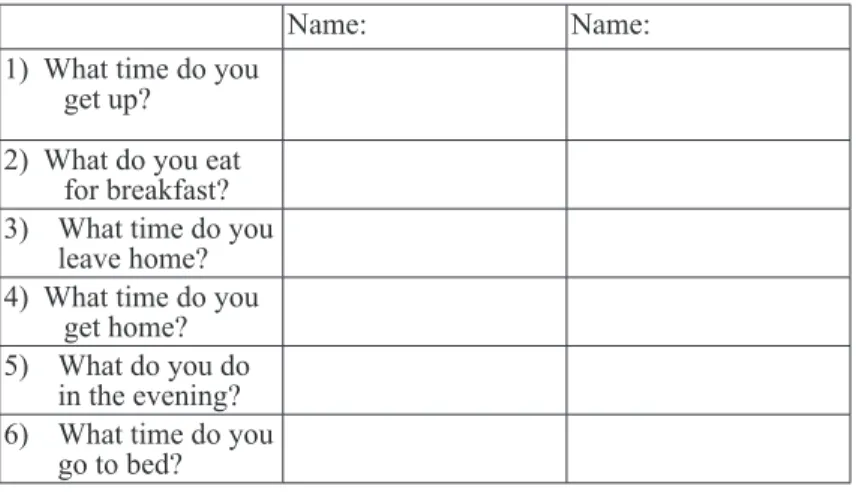
1) What time do you get up? 2) What do you eat for breakfast? 3) What time do you leave home? 4) What time do you get home? 5) What do you do in the evening? 6) What time do you go to bed?
Before beginning the activity, the teacher reviews telling the time with the students, brainstorms some possible activities to help answer question 5, such as “watch TV, take a bath, do my homework, etc.,” and demonstrates some model answers on the board, e.g. “I get up at 6:30.” “I eat eggs and bacon for breakfast.” and so on.
The worksheet depicted in figure 1 is then distributed to each student.
Name:
Name:
1) What time do you
get up?
2) What do you eat
for breakfast?
3) What time do you
leave home?
4) What time do you
get home?
5) What do you do
in the evening?
6) What time do you
go to bed?
Figure 1. Activity handout for students.
Students are encouraged to stand, freely circulate the class and choose two people they would like to interview. Upon asking the questions, students simply input the time or the activity in the corresponding box, as opposed to a full sentence which may prove too time-consuming at junior high level. For higher level students, the teacher can recommend using the word “usually” before the verb in the sentence, “I usually get up at 6:30.” Similar treatment could be paid to the words “around” or “about” before saying the time of the activity, e.g. “I usually get up around 6:30.” The intention here is to improve students’ fluency and make the conversation sound more natural and less like an interrogation. Once all the boxes have been completed and order has been returned to the class, students are then asked to “report” on the people they interviewed, reinforcing the use of third person grammar. The teacher selects one student from each row to come to the front and announce to the class the daily routine of a student they interviewed. Ideally, presentations would proceed as follows:
“Miyuki gets up at 6:30. She eats toast for breakfast. She leaves home at 7:15, etc…”
recommend connecting two sentences together using “and” thus further improving the oral fluency of the speech, e.g. “She leaves home at 7:15 and gets home at 5 o’clock.”
This activity allows the teacher to play a passive, observing role and hands control over to the students encouraging independence while also maintaining an element of peer pressure in the class, forcing students to actively participate. The prospect of having to present their results to the class is intended to motivate students to focus more carefully on their speech and produce an accurate and respectable presentation in front of their peers, should they be chosen to do so.
To date, this activity has been implemented in several lessons covering all three grades of Shoin junior high school and has been received warmly by the students and Japanese teachers alike. Requests from the students for similar such interactive activities are frequent as are encouraging feedback remarks from the Japanese teachers claiming they are “happy to see the students using English in class.”
Activity 2 - Introduce a Famous Person
In this activity, students are encouraged to do their own research into a well-known or influential person, Japanese or foreign, from any profession. Students are instructed to create a short speech, at least 30 seconds in duration, covering a number of important points, including where and when the person was born, what the person does, why the student likes/respects the person, plus any additional information about the person.
The activity is best introduced in the final 10 minutes of a regular lesson, giving the students time to make use of the Internet, books, or any other available resources to gather information about the person. The activity spans two consecutive weeks (one 50-minute period each week), in the first of which the students use the information they have researched to produce sentences, forming the basis of their speech. At this point in the activity, it is important the native English teacher and the Japanese teacher circulate the class checking and correcting any incorrect sentences and suggesting any words or phrases to improve the speeches. Students should then be encouraged to form small groups of three or four, and practice saying their
speeches to each other, in preparation for the following lesson where all students give their speech to the class. A “look, cover, say” policy should be adopted in the class, encouraging students to remember and “say” their speeches as opposed to just reading them.
In the following week’s lesson, before the final speeches, students should be reminded that a positive attitude is essential for successful oral communication. An audible, clear voice along with eye contact with the listener, body language and facial expression should all be encouraged. Students should also be urged to make efforts to avoid Japanese-like pronunciation and include an element of modulation in their voice.
In a similar fashion to the Interview and report lesson, this activity promotes independence among the students, prompting them to take the initiative to create a speech that will hold the interest of their peers, and gain confidence when speaking English in front of others.
In an effort to continually improve students’ ability to deliver a speech in English, this style of lesson could be implemented once per semester covering a variety of topics, such as “Introduce your hometown,” “Talk about your ideal job,” and “Explain your hobby” as some possible candidates.
Conclusion
Gaining confidence and proficiency in the oral application of English is an ongoing endeavor which requires constant attention and commitment. We could apply the analogy of driving a car or playing a musical instrument. One may know the workings of a car engine or the position of the keys on a piano, yet this does not equate to driving or musical competency. Regardless of the theory behind driving, or understanding the notes on a musical score, it is essential one physically engages in the act of driving or playing the instrument if one is to acquire any skill whatsoever.
Regular activities that allow students to interact orally in English from a young age are fundamental in developing proficiency that can be applied in today’s global society. Accordingly, teachers of English, native or Japanese, must strive to create interactive, entertaining and stimulating lessons with an oral-based element wherever possible.
References
Tsuboya-Newell,Ⅰ. (2017, October 29).Why do Japanese have trouble learning English? The Japan Times. Retrieved from https://www.japantimes.co.jp/ opinion/2017/10/29/commentary/japan-commentary/japanese-trouble-learning-english/