論 説
Some Evidences of Group Accounting Practices
in the United Kingdom 1927-1951
Eri Kanamori
1. Rational Choice or Hierarchical Surveillance? 2. Periods Investigated
3. Companies Investigated 4. Findings
5. Conclusion
1. Rational Choice or Hierarchical Surveillance?
Accounting change has been often perceived today either as a result of rational choice or as an event which should be interpreted through archaeological discourses1). Researchers who see accounting history from the standpoint of economic rationality are labelled as ‘traditionalist’, ‘neoclassicist’ and ‘economic rationalist’ interchangeably (Fleischman, 2006: xxiii). Their focus is mainly on the use of accounting methods to measure the efficiency and to achieve the further performance of large business enterprises, with a framework founded upon the economic history of Alfred Chandler (1962, 1977) and transaction-cost theory by Oliver Williamson (1985) (Johnson & Kaplan, 1987; Watts, 1977; Watts and Zimmerman, 1977). On the other hand, Foucauldians refuse the traditional accounting historiography. Their discomfort about the rational choice approach lies in the exclusive attention to economic elements and the lack of recognition about the limitation of archival information. They insist upon ‘a new accounting history’ by applying the disciplinary paradigm established by Michel Foucault. They seek for socio-political rather than economic elements as a driver of accounting change and they explore a large amount of archaeological discourses in order to compensate a bias inhered in
1) There are plethora of paradigms in accounting historiography today, such as economic rationalism (neoclassicism), Foucauldian, Marxist (labour process), Habermasian, deconstructionism (Derrida), structuration theory (Giddens), hegemony theory (Gramsci) for instances. However, it seems accepted to assume three schools (neoclassicism, Foucauldian and Marxist) as principal accounting thoughts (Loft, 1991; Boyns et al., 1997; Fleischman and Parker, 1997; Fleischman and Radcliffe, 2003). In this paper, the neoclassicism and Foucauldian are particularly focused upon on the ground that ‘the Neoclassical and Foucauldian views of accounting history are well known and discussed, but the Marxist view is not’ (Bryer, Fleischman & Macve, 2006: 2).
primary-source materials which are often written by people in power. The disciplinary paradigm on which Foucauldians construct their story relates to an accounting technique of hierarchical surveillance that rendered persons in labour calculable and governable within the business enterprises (Hopwood, 1987; Miller & O’Leary, 1987; Hoskin and Macve, 1986, 1988).
The purpose of this paper is to track group accounting practices adopted by British companies between 1927 and 1951, as a starting point of understanding the development of group accounting either within the framework of economic rationality or within Foucauldian paradigm. In the United Kingdom, financial reporting has been legally required since nineteenth century. From the beginning of the twentieth century, there emerged holding companies which held other companies’ issued shares and control them as their subsidiaries2). The groups consisted of plural legal companies, but economically operated as if they were single business units. Under this situation, several holding companies started to publish ‘group accounts’ in addition to or instead of their own
legal-entity based accounts3). Group accounts were prepared by increasing number of holding
companies, taking various forms of presentation of group information. The Companies Act of 1948 authorised consolidated accounts as the principal form of group accounts,
permitting other methods in exceptional cases4). Accounting for holding companies has
changed in the above short story: no group accounting, various forms of group accounting, and legal authorisation to consolidated accounts. Which paradigm can explain the story more effectively, economic rationality or disciplinary technique?
Using more than fifteen hundreds sets of accounts published by British holding companies, this paper reveals three main facts. First, it shows that group accounting was adopted by more companies in later years than in earlier years. Second, publication of consolidated accounts together with legal entity-based accounts has become increasingly popular, particularly after RoAP7 and CA48. Third, it is shown that a fairly constant percentage of holding companies adopted the equity method, the most popular method in early years, throughout the period investigated. This paper has particular emphasis placed on use of the equity method of accounting, i.e. the third finding. The reason is that
2) For the emergence and development of British/European holding companies, see Liefmann (1932). 3) Edwards (1991) examines the first example of consolidated accounts published by British holding
company.
the first two findings are consistent with previous literatures. The preceding researches have already provided a plenty of evidences for the first and second findings, the main focus of this paper is dedicated to an examination of the use of equity method by British holding company directors.
The next two sections (2 and 3) will explain the periods and companies investigated in this study. The forth section (4) presents the findings from the investigation of company accounts between 1927 and 1951, and this section comprises the main part of the paper. The last section (5) presents a conclusion.
2. Periods Investigated
The accounting periods investigated for the purpose of this study were 1927/285), 1930/316), 1942/437), 1946/478) and 1950/519). The choice of dates may be explained as follows. The company annual reports filed in 1927/28 and in 1930/31 reflect, respectively, group accounting practice before and after the Companies Acts of 1928/29 (CA29) took effect10). The accounts in 1942/43 are used to examine practice after the effects of the Royal Mail case and the ‘trail-blazing’ accounts of the Dunlop Rubber company should have become fully apparent, but before Recommendations on Accounting Principles No.7 of the Institute of Chartered Accountants in England and Wales (RoAP7) took effect. Similarly, the 1946/47 accounts would reflect the practice after RoAP7 and before the Companies Act of 1947/48 (CA48)11), and the accounts of 1950/51 the practice after the relevant provisions of CA48 became statutory requirements. Table 1 illustrates this historical sequencing of events.
5) In 1927/28, the selected companies’ financial year ended between 30 September 1927 and 31 August 1928.
6) In 1930/31, the selected companies’ financial year ended between 27 July 1930 and 31 August 1931. 7) In 1942/43, the selected companies’ financial year ended between 30 September 1942 and 31 July 1943. 8) In 1946/47, the selected companies’ financial year ended between 30 September 1946 and 31 July 1947 9) In 1950/51, the selected companies’ financial year ended between 30 June 1950 and 31 August 1951. 10) The Companies Act 1928/29 took effect from 7th February 1929 (except that Section 92 came into
operation only from 1st November 1929) (The Statutory Rules & Orders and Statutory Instruments Revised to December 31, 1948, Volume IV, 1950: 738).
11) The Companies Act 1947/48 took general effect from 1st July 1948 (some Sections including the Section 18, which provides the meaning of “holding company” and “subsidiary”, came into operation from 1st December 1947, “so far as applicable to Sections 42 to 49 inclusive of the Companies Act, 1947, and Sections 135 to 138 inclusive of the Companies Act, 1929”) (The Statutory Rules & Orders and Statutory Instruments Revised to December 31, 1948, Volume IV, 1950: 739-40). Some companies adopted the Act earlier with the accounts filed for 1947/48 already prepared in compliance with Companies Act 1947/48.
3. Companies Investigated
The collection from which the study sample has been selected - the sets of published accounts filed with the London Stock Exchange and now located at the Guildhall Library, Corporation of London - represents a first class archive for the purpose of this investigation. The sample sets of accounts, used for this study, fall into two categories; one general and one which is industry based. The holding companies within these categories were identified through the following process. First, all Iron, Coal & Steel companies (IC&S companies) and the Commercial & Industrial companies (those companies whose names start with A, B, C and D) (C&I companies) listed in the Stock Exchange Year Books12) of
1926, 1933, 1942, 1946 were selected13). For 1950/51, the companies whose names start
with A and B, only, provided a comparable-sized sample. Second, from amongst these companies were identified those where information about their auditors, their issued capitals and the stock exchanges on which they were listed are all given14). This produced:
12) Stock Exchange Year Books of 1926, 1933 and 1952 were used instead of 1927, 1930 and 1950 because the latter were unavailable to the author.
13) Company accounts are stored at Guildhall Library in alphabetical order. In other words, published accounts of those companies whose names start with A, B, C and D are filed together. This is why this study selects the companies data in this manner, rather than at random. When the sample is gathered at random, it is necessary to consult 86 volumes, which would make this investigation impractical (Commercial & Industrial, 1927/28 – 12 vols, 1930/31 – 12 vols, 1942/43 – 12 vols, 1946/47 – 18 vols, 1950/51 – 24 vols; Iron, Coal & Steel, 1927/28 – 2 vols, 1930/31 – 2 vols, 1942/43 – 1 vol, 1946/47 – 1 vol, 1950/51 – 2 vols). However, 31 volumes are enough when following the manner this study adopted; Commercial & Industrial, A to D, 1928/28 – 5 vols. (A, B-BritC, BritD-Ch, Ci-Dr, Du-Gi), 1930/31 – 4 vols. (A, B-Bri, Bro-Cl, Co-D), 1942/43 – 4 vols. (A, B-BritR, BritS-Cl, Co-D), 1946/47 – 5 vols. (A, B-Bo, Bra-By, C-Co, Cr-D), Commercial & Industrial, A to B, 1950/51 – 5 vols. (A-Am, An-Ay, B-Be, Bi-Bre, Bri-By); Iron, Coal & Steel, 1927/28 – 2 vols. (A-K, L-Z), 1930/31 – 2 vols. (A-K, L-Z), 1942/43 – 1 vol, 1946/47 – 1 vol, 1950/51 – 2 vols. (A-K, L-Z). The consultation is limited to 10 items in any one day at Guildhall Library.
14) There are some companies who lack all three types of information, mainly because of being founded abroad or any other reasons.
1929 Companies Act 1931 Royal Mail case 1944 RoAP7 1948 Companies Act 1933 Dunlop Rubber's accounts
1927/28 1930/31 1942/43 1946/47 1950/51
investigated investigated investigated investigated investigated
Table 1 Key events and periods investigated in this study
223 IC&S companies and 308 C&I companies for 1927/28; 188 IC&S companies and 333 C&I companies for 1930/31; 183 IC&S companies and 381 C&I companies for 1942/43; 197 IC&S companies and 407 C&I companies for 1946/47; and 184 IC&S companies and 539 C&I companies for 1950/51.
From these sets, companies are classified as holding companies for the purpose of this study where one or more of the listed conditions are satisfied:
For 1927/28,
• any type of group accounts is submitted;
• the legal entity-based balance sheet identifies the existence of a ‘subsidiary’ or ‘associated company’ through entries such as ‘shares in subsidiary (associated
company)’ and ‘loans to subsidiary (associated company)’;
• the legal entity-based balance sheet itemizes ‘shares in the other companies’15); • the legal entity-based balance sheet shows name(s) of other company(ies)16) among
the list of assets17). For 1930/31, 1942/43, 1946/47,
• any type of group accounts is submitted;
• the legal entity-based balance sheet identifies the existence of a ‘subsidiary’
15) It is, of course, unknown if ‘the other companies’ are subsidiaries or not. However, the reasons of selecting those companies as holding companies in this study are following. First, in 1927/28, the term ‘subsidiary’ was not uniformally adopted. Some companies use the term ‘associated company’ and some companies specify the names of subsidiaries (see footnote 13 below). Second, in 1920s assets are only classified in balance sheets, often in very broad terms, and it is not unusual to find some companies listing assets under only a couple of headings. Under these circumstances, the relatively specific item of ‘shares in the other companies’ makes it clear that the investment has different characteristics from investments such as government securities. Third, at the time of Greene Committee, a witness (the London Chamber of Commerce) used the term ‘investments in other companies which are subsidiary to or associated with the Company in question’ (cited in Walker, 1978: 65) (emphasis added). Therefore it seems plausible to infer that ‘shares in the other companies’ is an abbreviation of ‘shares in the other companies which are subsidiary to or associated with the company’. [**it might also be worth making the point that where shares were held in other companies at this time, it was common practice to hold all the shares. I think this was the case.]
16) Banks at which cash was held were naturally excluded.
17) It is, of course, unknown if the companies whose names are shown in balance sheets are subsidiaries or not. However, there are cases where holding company accounts show a company’s name and add the company’s profit to holding company’s profit. In this study the treatment is classified as the equity method. For example, see the accounts of The British Automatic Company Limited, dated at 30th September, 1927, which will be reproduced later.
through entries such as ‘shares in subsidiary’ and ‘loans to subsidiary’18); • the legal entity-based balance sheet is accompanied by a statement from the
directors in compliance with Section 126 of CA29 concerning how a subsidiary has been accounted for19).
For 1950/51,
• any type of group accounts is submitted;
• the legal entity-based balance sheet identifies the existence of a ‘subsidiary’ through entries such as ‘shares in subsidiary’ and ‘loans to subsidiary’;
• the legal entity-based balance sheet is accompanied by a statement from the directors in compliance with Schedule to the CA48 concerning why no group accounts are submitted20).
For all years, the mere appearance of the item ‘investment’ in the balance sheet does not result in an entity being treated as a holding company due to the inability to attach any particular significance, in terms of the level of share ownership, to that label. Also, where subsidiaries have not been trading during the year or where holding company directors state that all subsidiaries’ accounts were not be available for them (usually the explanation is that they were operating abroad), the holding company is excluded from the sample.
18) The Companies Act of 1929 defined the term ‘subsidiary’ for legal purposes. (check later*) 19) The legislative requirement for the statement is reproduced in the Appendix *.
20) The legislative requirement for the statement is reproduced in the Appendix *.
Table 2 Holding Companies Investigated
Source: derived from an analysis of company accounts
all cos A-, B-, C-,
& D-cos* 1927/28 223 81 36.3% 308 87 28.2% 168 1930/31 188 96 51.1% 333 168 50.5% 264 1942/43 183 100 54.6% 381 223 58.5% 323 1946/47 197 111 56.3% 407 253 62.2% 364 1950/51 184 91 49.5% 539 335 62.2% 426
* A- and B- company for 1950/51
examined holding cos
(a+b) Commercial & Industrial
cos judged to be holding cos (a)
cos judged to be holding cos (b)
As a result, 168 companies in 1927/28, 264 companies in 1930/31, 323 companies in 1942/43, 364 companies for 1946/47 and 426 companies for 1950/51 have been extracted as a data for this study. Table 2 summarises the findings.
4. Findings
4.1 Finding 1- Group Accounting Growing in NumberThis study recognises and distinguishes between six methods of group accounting. This categorization is based on a previous literature (Edwards and Webb, 1984), except for modification of the definition of method 121).
Method 1: The inclusion of profits and losses of subsidiary companies in the holding company’s statutory (legal entity-based) accounts irrespective of dividends actually declared or paid.
Method 2: Balance sheets of subsidiaries published in addition to the holding company’s statutory accounts.
Method 3: Combined statement of assets and liabilities of subsidiaries published in addition to the holding company’s statutory accounts.
Method 4: Combined statement of assets and liabilities of group published in addition to the holding company’s statutory accounts
Method 5: Consolidated balance sheet published instead of the holding company’s statutory accounts
Method 6: Consolidated balance sheet published in addition to the holding company’s statutory accounts.
The method 1 is not always the same as today’s equity method. This is partly because, in the first half of twentieth century, the inclusion of profits and losses of subsidiary companies did not always clearly related to the valuation of asset items such as ‘shares in subsidiaries’, although the profits and losses are reflected in the amount of the holding company’s own capital. Moreover, it occurred quite often that a full amount of, rather than a proportionate amount of, losses incurred by subsidiary companies was provided for
21) Edwards & Webb (1984) describe method 1 as ‘Profits earned by subsidiaries accounted for on the accruals basis in the holding company’s statutory accounts’, but this has been changed as above since the original definition cannot handle cases where subsidiary companies incur losses.
by the holding company. In this study the term ‘equity method’ is used for indicating the method 1, but the above difference from today’s usage should be kept in mind.
Table 3 shows the number and proportion of holding companies which were judged to be employing group accounting methods 1-6.
;;
The first finding is that group accounting is employed more in later years than in earlier years. The percentage of companies with group accounting within the whole holding companies examined grows from 7.7% in 1927/28 to 20.1% in 1930/31, to 29.1% in 1942/43, to 52.2% in 1946/47 and to 100.5% in 1950/5122).
However, it seems fair to say that publishing subsidiary balance sheets (method 2), publishing combined accounts of subsidiary companies (method 3), publishing combined accounts of group without consolidation procedures (method 4) and publishing consolidated accounts without holding company’s individual accounts (method 5) have been the relatively less popular methods throughout the entire study period.
4.2 Finding 2 – Rate of Adoption of Consolidated Accounts
22) The reason why more than 100% of holding companies appear to employ group accounting methods in 1950/51 is that 31 companies are counted twice because they adopt two methods at the same time. The same explanation applies for other years.
Table 3 Companies Employing Group Accounting Methods 1-6
Source: derived from an analysis of company accounts
method method method method method method other** total*
168 7 1 2 3 13 100.0% 4.2% 0.6% 1.2% 0.0% 0.0% 1.8% 7.7% 264 36 3 2 1 2 9 53 100.0% 13.6% 1.1% 0.8% 0.4% 0.8% 3.4% 20.1% 323 41 9 1 1 1 41 94 100.0% 12.7% 2.8% 0.3% 0.3% 0.3% 12.7% 29.1% 364 49 8 3 1 2 127 190 100.0% 13.5% 2.2% 0.8% 0.3% 0.5% 34.9% 52.2% 426 34 16 1 2 371 4 428 100.0% 8.0% 3.8% 0.2% 0.5% 87.1% 0.9% 100.5%
** other 1950/51 2&3&6 1 company
parent B/S + consolidated P/L 2 companies new type 1 company
1946/47 1950/51
companies employing group accounts
1930/31 1942/43
sample holding cos 1927/28
* 1 company in 1927/28 (1&6), 4 companies in 1930/31 (1 company adopting 1&2 and 3 companies adopting 1&6), 12 companies in 1942/43 (1 company adopting 1&2, 1 company adopting 1&4, 11 companies adopting 1&6), 29 companies in 1946/47 (1 company adopting 1&3, 28 companies adopting 1&6, 1 company adopting 2&6) and 31 companies in 1950/51 (29 companies adopting 1&6, 1 company adopting 2&3, 1 company adopting 2&6) are counted twice.
The second finding is that presenting consolidated accounts together with legal entity-based accounts (method 6) has become increasingly popular, particularly in the periods of 1946/47 and 1950/51, which means after RoAP7 and CA48 each took effect. Consolidated accounts are used by 1.8% companies in 1927/28, 3.4% in 1930/31, 12.7% in 1942/43, 34.9% in 1947/48, and 87.1% in 1950/51.
This finding is consistent with Bircher (1988) and Arnold and Matthews (2002). Bircher (1988) and Arnold and Matthews (2002) found relatively low adoption of consolidated accounts by British holding companies before the Companies Act of 1948. Table 4 shows the comparative figures of the three studies concerning proportion of companies adopting consolidated accounts.
4.3 Finding 3- Relative Popularity of the Equity Method
Finding 3 is that the equity method (method 1) has been used by a fairly constant percentage of holding companies from 1930/31 onwards. For the purpose of this study, companies have been judged to be users of the equity method where either of the following conditions is satisfied.
Condition 1. Profits are exactly the same amount in legal entity-based accounts and
in consolidated accounts;
Condition 2. There is a clear statement that profits of subsidiary companies included
in holding company’s legal entity-based accounts are ‘undistributed’ or ‘accrued’ profits23);
Condition 3. For the years of 1927/28, it is possible to deduce from the wording used
that profits and losses of the subsidiary companies have been included
23) A well-known example is the published accounts of Lever Brothers, Limited for the year ended on 31 December 1925. The ‘shares in subsidiary companies’ item in legal entity-based balance sheet include ‘undistributed’ profits of subsidiary companies. See Appendix *.
Table 4 Proportion of companies adopting consolidated accounts
Source: Arnold & Matthews, 2002; Bircher, 1988.
20 27/28 30/31 33 35 38/39 42/43 44/45 46/47 47/48 50 50/51 numbersample
Bircher 1988 22.5% 32.5% 74.0% 40
Arnold & Matthews
2002 0.0% 14.0% 100% 50
in the legal entity-based profit and loss account;
Condition 4. For the years of 1930/31, 1942/43 and 1946/47, a statement from the
directors in compliance with Section 126 of CA29 explains that profits and losses of the subsidiary companies have been included in the legal entity-based accounts;
Condition 5. For the year of 1950/51, a statement from the directors in compliance
with Schedule to the CA48 explains that profits and losses of the subsidiary companies have been included in the legal entity-based accounts.
It is acknowledged that the presence of one of the last three conditions (Conditions 3-5) sometimes signals company directors’ use of the equity method with a lesser degree of certainty than the first two (Conditions 1-2).
The finding that the equity method was used by British holding companies is consistent with Edwards and Webb (1984). Edwards and Webb (1984) revealed that various methods of group accounting were used by British holding companies and that the equity method was fairly popular among them especially in early years. It is the case that the rate of adoption was then higher than in the 1920s when, for much of the time, it was the method of group accounting most commonly used in Britain (Edwards and Webb, 1984: 56).
We now turn to a detailed examination of the adoption of equity accounting in each of the five periods selected for study. As noted earlier, the sets of accounts on which these assessments are based are all available for examination at Guildhall Library, Corporation of London. As mentioned in the first section of this paper, the first two findings have already been revealed by previous literatures24). At the same time, we are able to draw attention to the existence of more robust evidence in support of findings 1 and 2, given
24) For example, Garnsey (1923, 1926) have already revealed with some evidences of consolidated accounts published by British holding companies, that consolidation accounting was seldom employed but gradually increasing in number. But he did not pay much attention to the use of the equity method except for short statements as follows. ‘It might be that the directors would wish to take up any undistributed profits of subsidiaries as an asset in Holding Company’s Balance Sheet and credit the amount to the Profit and Loss Account. If, as is assumed, the undertakings are not merely owned but effectively controlled, and the amount is properly disclosed on the face of the accounts, then no objection could be raised to this course provided always that any losses of other subsidiaries are reserved for’ (Garnsey, 1923: 36).
the far larger sample of companies contained in the present study compared with those examined by Bircher (1988) and by Arnold and Matthews (2002).
Given that findings 1 and 2 are consistent with previous literatures concerning British holding companies’ adoption of consolidated accounts, the rest of this paper is dedicated to the presentation of evidence concerning the use of the equity method by British holding company directors.
4.3.1 Evidences for 1927-28
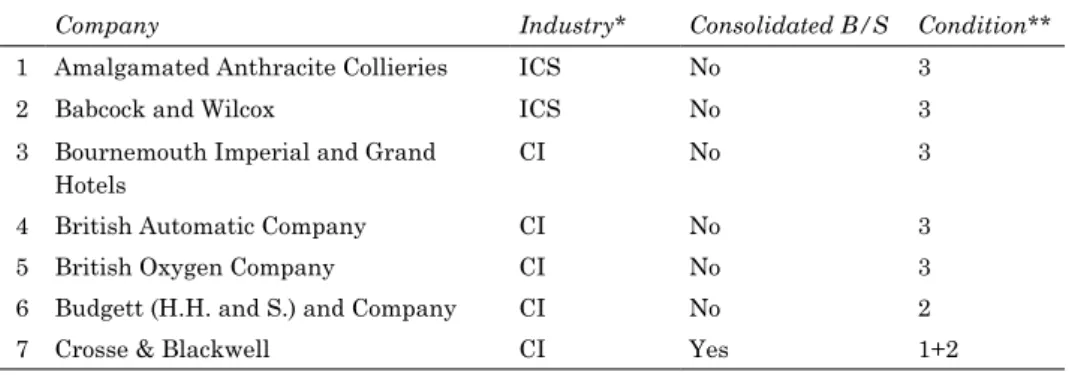
In the accounting year of 1927/28, seven British holding companies contained in the data set for this study are judged to be using the equity method (Table 3). Table 5 is a list of names of the companies. One company (Crosse & Blackwell) satisfied Conditions 1 and 2, one company (H. H. and S. Budgett and Company) satisfied Condition 2 and five companies satisfied Condition 3.
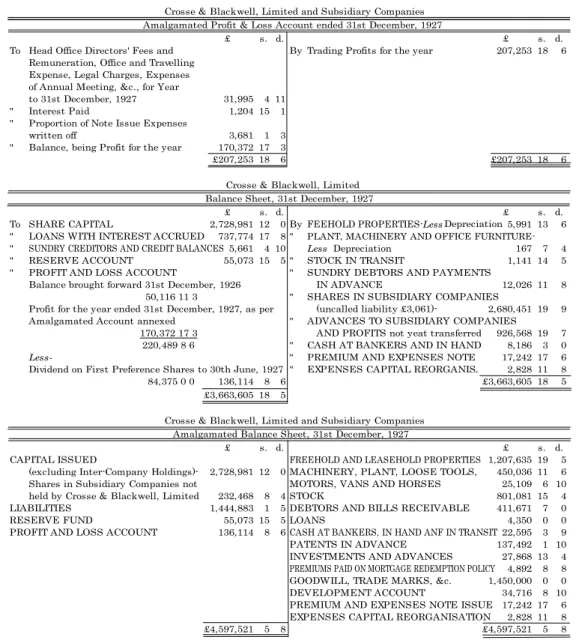
Below are reproduced illustrative examples taken from the published accounts demonstrating the adoption of the equity method through compliance with Conditions 1-3. Figure 1 is an extract from annual reports of Crosse & Blackwell, Limited. The company is the only one who satisfied the Condition 1, i.e. profits are exactly the same amount in legal entity-based accounts and in consolidated accounts. The company’ s ‘Amalgamated Profit & Loss Account’, ‘Balance Sheet’ and ‘Amalgamated Balance Sheet’ are reproduced below. The company did not publish its legal entity-based profit and loss account. The balances of ‘Profit and Loss Account’ in the balance sheet and in the amalgamated balance sheet show the same amount (£136,114 8 4). This indicates
Company Industry* Consolidated B/S Condition**
1 Amalgamated Anthracite Collieries ICS No 3
2 Babcock and Wilcox ICS No 3
3 Bournemouth Imperial and Grand Hotels
CI No 3
4 British Automatic Company CI No 3
5 British Oxygen Company CI No 3
6 Budgett (H.H. and S.) and Company CI No 2
7 Crosse & Blackwell CI Yes 1+2
Table 5 Companies adopting the equity method 1927/28
* ICS for Iron, Coal & Steel industry; CI for Commercial & Industrial ** the conditions introduced in 4.4.2
that the Condition 1 is satisfied. Moreover, on the credit side of balance sheet, there is an item worded ‘Advances to Subsidiary Companies and Profits not yet transferred’ (emphasis added). This proves that the company satisfies also the Condition 2 (There is a clear statement that profits of subsidiary companies included in holding company’s legal entity-based accounts are ‘undistributed’ or ‘accrued’ profits).
Figure 1 Crosse & Blackwell, 1927/28
Source: Annual Report of Crosse & Blackwell, Limited, 31st December, 1927.
£ s. d. £ s. d.
To Head Office Directors' Fees and By Trading Profits for the year 207,253 18 6 Remuneration, Office and Travelling
Expense, Legal Charges, Expenses of Annual Meeting, &c., for Year
to 31st December, 1927 31,995 4 11
" Interest Paid 1,204 15 1
" Proportion of Note Issue Expenses
written off 3,681 1 3
" Balance, being Profit for the year 170,372 17 3
£207,253 18 6 £207,253 18 6
£ s. d. £ s. d.
To SHARE CAPITAL 2,728,981 12 0 By FEEHOLD PROPERTIES-Less Depreciation 5,991 13 6 " LOANS WITH INTEREST ACCRUED 737,774 17 8 " PLANT, MACHINERY AND OFFICE FURNITURE-" SUNDRY CREDITORS AND CREDIT BALANCES 5,661 4 10 Less Depreciation 167 7 4 " RESERVE ACCOUNT 55,073 15 5 " STOCK IN TRANSIT 1,141 14 5 " PROFIT AND LOSS ACCOUNT " SUNDRY DEBTORS AND PAYMENTS
Balance brought forward 31st December, 1926 IN ADVANCE 12,026 11 8 50,116 11 3 " SHARES IN SUBSIDIARY COMPANIES
Profit for the year ended 31st December, 1927, as per (uncalled liability £3,061)- 2,680,451 19 9 Amalgamated Account annexed " ADVANCES TO SUBSIDIARY COMPANIES
170,372 17 3 AND PROFITS not yeat transferred 926,568 19 7 220,489 8 6 " CASH AT BANKERS AND IN HAND 8,186 3 0
Less- " PREMIUM AND EXPENSES NOTE I 17,242 17 6
Dividend on First Preference Shares to 30th June, 1927 " EXPENSES CAPITAL REORGANISA 2,828 11 8
84,375 0 0 136,114 8 6 £3,663,605 18 5
£3,663,605 18 5
£ s. d. £ s. d.
CAPITAL ISSUED FREEHOLD AND LEASEHOLD PROPERTIES 1,207,635 19 5
(excluding Inter-Company Holdings)- 2,728,981 12 0 MACHINERY, PLANT, LOOSE TOOLS, 450,036 11 6 Shares in Subsidiary Companies not MOTORS, VANS AND HORSES 25,109 6 10 held by Crosse & Blackwell, Limited 232,468 8 4 STOCK 801,081 15 4
LIABILITIES 1,444,883 1 5 DEBTORS AND BILLS RECEIVABLE 411,671 7 0
RESERVE FUND 55,073 15 5 LOANS 4,350 0 0
PROFIT AND LOSS ACCOUNT 136,114 8 6 CASH AT BANKERS, IN HAND ANF IN TRANSIT 22,595 3 9
PATENTS IN ADVANCE 137,492 1 10
INVESTMENTS AND ADVANCES 27,868 13 4 PREMIUMS PAID ON MORTGAGE REDEMPTION POLICY 4,892 8 8 GOODWILL, TRADE MARKS, &c. 1,450,000 0 0
DEVELOPMENT ACCOUNT 34,716 8 10
PREMIUM AND EXPENSES NOTE ISSUE 17,242 17 6 EXPENSES CAPITAL REORGANISATION 2,828 11 8
£4,597,521 5 8 £4,597,521 5 8
Crosse & Blackwell, Limited and Subsidiary Companies Amalgamated Balance Sheet, 31st December, 1927 Crosse & Blackwell, Limited and Subsidiary Companies Amalgamated Profit & Loss Account ended 31st December, 1927
Crosse & Blackwell, Limited Balance Sheet, 31st December, 1927
The Condition 2 is also satisfied by H. H. and S. Budgett & Co., Limited. Figure 2 is an extract from annual reports of the company. The company did not publish consolidated accounts, which makes it impossible to test for compliance with the Condition 1. However,
as shown in Figure 2, its ‘Revenue Account’ contains ‘Net Profit on Trading to 29th
February, 1928, after deducting Taxation Liabilities and including a Credit in respect of accrued Profits in Associated Companies’ (emphasis added).
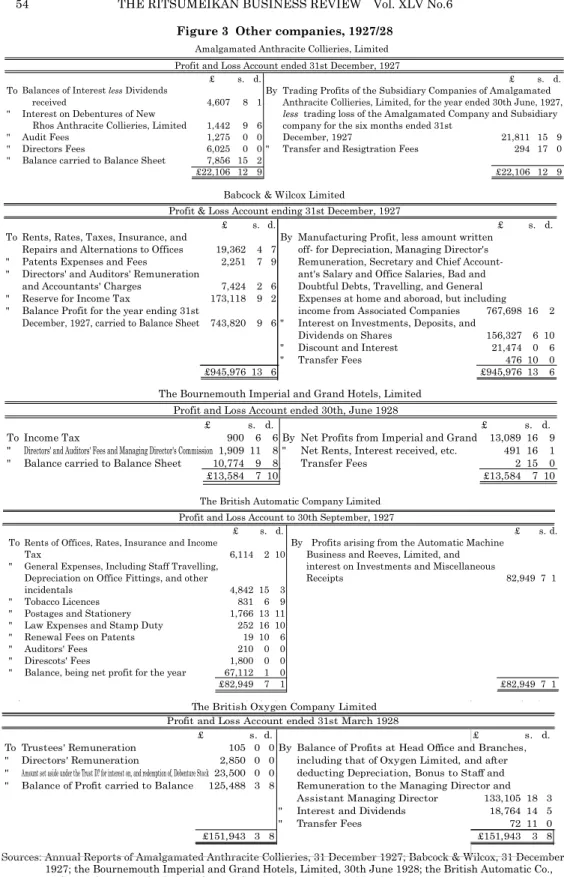
Figure 3 contains extracts from the annual reports of five companies which have been judged as users of the equity method because all of them refer to the inclusion of profits from subsidiary or other companies25) (the Condition 3 is satisfied). It must be noted that
25) Amalgamated Anthracite Collieries, Limited, uses the term ‘subsidiary company’, while Babcock & Wilcox Limited calls it ‘associated company’. The Bournemouth Imperial and Grand Hotels Limited, the British Automatic Co., and the British Oxygen Company Limited publish names of companies (Imperial and Grand Hotels, Limited, Automatic Machine Business and Reeves, Limited, and Oxygen Limited)
£ s. d. £ s. d.
To Interim Dividend on Preference By Balance brought forward from Shares at the rate of 7.5 per the year ended 28th February, cent. per annum for the half- 1927, per Directors' Report
year ended 30th September, of 28th June, 1927 6,256 9 3
1927 (less Indome Tax) 10,799 19 9 " Net Profit on Trading to 29th " Sundry Charges for the year ended February, 1928, after deduct-29th February, 1928, Interest, ing Taxation Liabilities and Bonus Fund, Trade Subscrip- including a Credit in respect tions, Donations, and Sundry of accrued Profits in
Associ-Reserves 6,414 10 8 ated Companies 7,518 7 2
" Balance Carried forward, 29th " Interest Account 2,797 6 4
February 1928 19,386 0 10 " Transfer Fees 28 8 6
Reserve
Fund-" Amount Transferred 20,000 0 0
£36,600 11 3 £36,600 11 3
£ s. d. £ s. d.
Capital Issued and Fully Paid 410,000 0 0 Goodwill as at formation of Sundry Creditors and Bills payable 133,659 14 1 the Company on 21st July,
Loans and Deposits 94,864 11 8 1898 35,445 3 10
Reserves 26,586 2 3 Premises, Plant, Machinery,
Reserve Fund 20,000 0 0 &c. 81,463 13 1
Revenue Account- Balance Debtors on Sales Ledger
29th February, 1928 19,386 0 10 Accounts 105,247 16 11
Debtors pm Npigjt Ledger,
Stock and other Accounts 20,151 11 4 Bank and Cash Accounts 38,091 4 9 Stock-in-Trade on hand 88,464 7 9
Stock in Transit 11,208 14 4
Investments, -including holdings in and
Loans to Associated Companies 324,423 16 10
£704,496 8 10 £704,496 8 10
H.H. & S. Budgett & Co., Limited Revenue Account ending February 29th, 1928
H.H. & S. Budgett & Co., Limited Balance Sheet, February 29th, 1928
Source: Annual Report of H.H. & S. Budgett & Co., Limited, 29th February, 1928.
£ s. d. £ s. d. To Balances of InterestlessDividends By Trading Profits of the Subsidiary Companies of Amalgamated
received 4,607 8 1 Anthracite Collieries, Limited, for the year ended 30th June, 1927, " Interest on Debentures of New less trading loss of the Amalgamated Company and Subsidiary
Rhos Anthracite Collieries, Limited 1,442 9 6 company for the six months ended 31st
" Audit Fees 1,275 0 0 December, 1927 21,811 15 9
" Directors Fees 6,025 0 0 " Transfer and Resigtration Fees 294 17 0 " Balance carried to Balance Sheet 7,856 15 2
£22,106 12 9 £22,106 12 9
Amalgamated Anthracite Collieries, Limited Profit and Loss Account ended 31st December, 1927
£ s. d. £ s. d.
To Rents, Rates, Taxes, Insurance, and By Manufacturing Profit, less amount written Repairs and Alternations to Offices 19,362 4 7 off- for Depreciation, Managing Director's " Patents Expenses and Fees 2,251 7 9 Remuneration, Secretary and Chief Account-" Directors' and Auditors' Remuneration ant's Salary and Office Salaries, Bad and
and Accountants' Charges 7,424 2 6 Doubtful Debts, Travelling, and General " Reserve for Income Tax 173,118 9 2 Expenses at home and aboroad, but including " Balance Profit for the year ending 31st income from Associated Companies 767,698 16 2
December, 1927, carried to Balance Sheet 743,820 9 6 " Interest on Investments, Deposits, and
Dividends on Shares 156,327 6 10 " Discount and Interest 21,474 0 6
" Transfer Fees 476 10 0
£945,976 13 6 £945,976 13 6
Babcock & Wilcox Limited
Profit & Loss Account ending 31st December, 1927
£ s. d. £ s. d.
To Income Tax 900 6 6 By Net Profits from Imperial and Grand H13,089 16 9 " Directors' and Auditors' Fees and Managing Director's Commission 1,909 11 8 " Net Rents, Interest received, etc. 491 16 1 " Balance carried to Balance Sheet 10,774 9 8 Transfer Fees 2 15 0
£13,584 7 10 £13,584 7 10
The Bournemouth Imperial and Grand Hotels, Limited Profit and Loss Account ended 30th, June 1928
£ s. d. £ s. d.
To Rents of Offices, Rates, Insurance and Income By Profits arising from the Automatic Machine
Tax 6,114 2 10 Business and Reeves, Limited, and
" General Expenses, Including Staff Travelling, interest on Investments and Miscellaneous
Depreciation on Office Fittings, and other Receipts 82,949 7 1
incidentals 4,842 15 3
" Tobacco Licences 831 6 9
" Postages and Stationery 1,766 13 11 " Law Expenses and Stamp Duty 252 16 10 " Renewal Fees on Patents 19 10 6
" Auditors' Fees 210 0 0
" Direscots' Fees 1,800 0 0
" Balance, being net profit for the year 67,112 1 0
£82,949 7 1 £82,949 7 1
The British Automatic Company Limited Profit and Loss Account to 30th September, 1927
Figure 3 Other companies, 1927/28
Sources: Annual Reports of Amalgamated Anthracite Collieries, 31 December 1927; Babcock & Wilcox, 31 December 1927; the Bournemouth Imperial and Grand Hotels, Limited, 30th June 1928; the British Automatic Co., 30 September 1927; the British Oxygen Company Limited, 31st March 1928.
£ s. d. £ s. d.
To Trustees' Remuneration 105 0 0 By Balance of Profits at Head Office and Branches, " Directors' Remuneration 2,850 0 0 including that of Oxygen Limited, and after " Amount set aside underthe Trust D? forinterest on, and redemption of, Debenture Stock 23,500 0 0 deducting Depreciation, Bonus to Staff and " Balance of Profit carried to Balance S 125,488 3 8 Remuneration to the Managing Director and
Assistant Managing Director 133,105 18 3 " Interest and Dividends 18,764 14 5
" Transfer Fees 72 11 0
£151,943 3 8 £151,943 3 8
The British Oxygen Company Limited Profit and Loss Account ended 31st March 1928
the wording of Babcock & Wilcox, Limited, is ambiguous, referring to income (which might mean profits or dividends).
4.3.2 Evidences for 1930/31
In the accounting year of 1930/31, thirty-six British holding companies are judged to be using the equity method in the data set for this study (Table 3). Table 6 is a list of names of the companies. Nine companies satisfied either Condition 1 or Condition 2, and seven of them satisfied simultaneously also Condition 4. Two companies satisfied only Condition 1, and the reason will be stated below. The rest of 28 companies are judged as users of the equity method through compliance with Condition 4, i.e. the content of the directors’ statement in compliance with Section 126 of CA29.
There are 9 companies which published both consolidated accounts and legal entity-based accounts in 1930/31 (Table 3). Of these companies, 3 have the same profits/losses in the two accounts, while 6 companies show different amounts. The three companies (Aeolian, Crosse & Blackwell, and Ebbw Vale Steel, Iron and Coal) are considered to satisfy Condition 1 and judged to be users of the equity method.
The accounts of Crosse & Blackwell published for the year of 1930/31 are not considerably different from the accounts in 1927/28 which were reproduced as Figure 1 in this paper. Extracts from the accounts published by Aeolian are reproduced below as Figure 4. It must be admitted that, for 1930/31, the presence of Condition 1 does not provide such unassailable evidence of use of the equity method as was the case in 1927/28. This is because, as Figure 4 indicates, the accounts of company are making losses both in consolidated accounts and in legal entity-based accounts. By 1930/31, it was rather common practice to provide for subsidiary companies’ losses in the parent’s accounts, even if the holding company is adopting the cost method rather than the equity method, in valuing shares in subsidiary companies. That is, we cannot be certain that these companies would have accrued fully the results of the subsidiaries if they had generated a profit rather than a loss.
However, the company is picked up through an automatic scrutinising of the data set, because its balances of profit and loss account in consolidated accounts and legal entity-based accounts are the same amount (Condition 1 nevertheless remains satisfied).
There are seven companies in 1930/31 which satisfy Condition 2 (see Table 6). One is Crosse & Blackwell, which also meets Condition 1. The accounts of H. H. & S. Budgett published for the year of 1930/31 are not considerably different from the accounts in 1927/28 which was reproduced as Figure 2 in this paper. The accounts of Bleachers’
Company Industry* consolidated B/S condition**
1 Aberdeen Lime Company CI No 4
2 Aeolian Company CI Yes 1
3 Albion Motor Car Company CI No 4
4 Angus (George) & Company CI No 4
5 Ardath Tobacco Company CI No 4
6 Associated Dyers & Cleaners CI No 4
7 Baird (Hugh) and Sons CI No 4
8 Baker (Charles) and Company CI No 4
9 Bleachers’ Association CI No 2+4
10 Borax Consolidated CI No 4
11 Bovis CI No 4
12 Bradford Dyers’ Association CI No 4
13 Brazilian Warrant Company CI No 4
14 British Cotton and Wool Dyers Association CI No 4
15 British Cyanides Company CI No 4
16 British Glues and Chemicals CI No 4
17 British Oil and Cake Mills CI No 2+4
18 Budgett (H.H. & S.) and Company CI No 2+4
19 Cammell Laird and Company ICS No 4
20 Campbells and Stewart & McDonald CI No 4
21 Card Clothing & Belting CI No 4
22 Cawthra (J.) and Company CI No 4
23 Components CI No 4
24 Cooper, McDougall & Robertson CI No 2+4
25 Copestake, Crampton & Company CI No 4
26 Crosfield (Joseph) and Sons CI No 2+4
27 Crosse & Blackwell CI Yes 1+2+4
28 Crosses & Winkworth Consolidated Mills CI No 4
29 De La Rue (Thomas) and Company CI No 2+4
30 Dick (W.B.) and Company CI No 4
31 Duck, Son & Pinker CI No 4
32 Ebbw Vale Steel, Iron and Coal ICA Yes 1
33 Grayson, Rollo & Clover Docks ICS No 4
34 Manchester Collieries ICS No 4
35 Smith, Parkinson & Cole ICS No 4
36 United National Collieries ICS No 4
Table 6 Companies adopting the equity method 1930/31
* ICS for Iron, Coal & Steel industry; CI for Commercial & Industrial ** the conditions introduced in 4.4.2
Association (Figure 5), British Oil and Cake Mills (Figure 6), Cooper, McDougall & Robertson (Figure 7), Crosfield (Joseph) and Sons (Figure 8) and De La Rue (Thomas) and Company will be examined respectively.
Figure 5 is an extract from annual reports of Bleachers’ Association. The company
explains the figure of ‘shares in subsidiary companies’ as ‘being the excess of the Assets over the Liabilities of such companies’. It seems plausible to assume that the amount ‘the assets over the liabilities of subsidiary companies’ includes undistributed profits
Figure 4 Aeolian, 1930/31
£ s. d. £ s. d.
To Share Capital 430,000 0 0 By Bond Street Property 255,000 0 0 " Mortgage Debentures 325,000 0 0 " Freehold Property at Hayes 285,871 1 5 " Bank Loan 73,500 0 0 " Leasehold Properties and Improvements 3,015 10 0 " Mortgage on Bond Street Property 100,000 0 0 " Furniture, Fixtures and Fittings 21,998 1 2 " Aeolian Co., New York 317,806 10 0 " Investments in Subsidiary Companies 5,523 2 4 " Indebtedness to Subsidiary Companies 2,712 2 7 " Amount due by Aeolian Weber Piano
" Sundry Trade Creditors and Accrued Charges 40,459 4 2 and Pianola Company New York 25,879 9 10 " Preference Dividend 7,031 5 0 " Trade Investments 1,500 0 0 " Reserve Accounts 155,758 15 4 " Mortgage Redemption Policy 5,141 13 4
" Stock of Manufactured Goods,
Raw Materials, Work in Progress, &c. 81,122 0 2 " Sundry Debtors 163,918 16 4 " Payments in Advance 615 17 7 " Bills Receivable 15,474 1 8 " Cash at Bank and in Hand 20,657 0 4 " Trade Marks and Patens 1 0 0 " Profit and Loss Account 241,550 2 11
1,127,267 17 1 1,127,267 17 1
£ s. d. £ s. d.
To Net Deficiency on Trading and Reorganisation 115,615 9 0 By Dividends from Investments 883 9 9 " Debenture and Mortgage Interest 9,791 8 9 " Transfer Fees 11 7 6 " Deficiency Carried to Balance Sheet 124,422 0 6
125,316 17 9 125,316 17 9
£ s. d. £ s. d.
To Share Capital 430,000 0 0 By Bond Street Property 255,000 0 0 " Mortgage Debentures 325,000 0 0 " Freehold Property at Hayes 285,871 1 5 " Bank Loan 73,500 0 0 " Leasehold Properties and Improvements 3,015 10 0 " Mortgage on Bond Street Property 100,000 0 0 " Furniture, Fixtures and Fittings 21,998 2 2 " Aeolian Co. New York 317,806 10 0 " Amount due by Aeolian Weber Piano
" Sundry Trade Creditors and Accrued Charges 40,482 3 4 and Pianola Company New York 25,879 9 10 " Preference Dividend 7,031 5 0 " Trade Investment 21,278 6 10 " Reserve Accounts 175,280 15 11 " Mortgage Redemption Policy 5,141 13 4
" Stock of Manufactured Goods, Raw
Materials, Work in Progress, &c. 82,821 16 10 " Sundry Debtors 164,414 16 5 " Payments in Advance 615 17 7 " Bills Receivable 15,688 14 1 " Cash at Bank and in Hand 20,822 2 10 " Trade Marks and Patens 3 0 0 " Profit and Loss Account 241,550 2 11
1,144,100 14 3 1,144,100 14 3
The Aeolian Company, Limited Balance Sheet, 30th June 1931
The Aeolian Company, Limited, and of the Companies of which it is sole proprietor Amalgamated Statement of the Assets and Liabilities at 30th June 1931
Profit & Loss Account for the Year ended 30th June, 1931
of subsidiaries. It is considered in this study that this case is satisfying the Condition 2, even though the company does not use the words ‘undistributed’ or ‘accrued’ profits of subsidiary companies.
Figure 5 Bleachers’ Association, 1930/31
Extract from list of assets in balance sheet at 31 March 1931
Shares in Subsidiary Companies being the excess of the Assets over the Liabilities of such Companies, as shown by their Books (including Goodwill and Trade Marks assigned to such Companies) also fully paid Shares in Companies whose businesses have been acquired by purchase of the Shares
744,212 9 5
Source: Annual Reports of Bleachers’ Association, 31st March, 1931.
Figure 6 is an extract from annual reports of the British Oil and Cake Mills, Limited. The company discloses the treatment of its subsidiary’s undistributed profits both in the balance sheet and in the profit and loss accounts. In the balance sheet, investments in subsidiary companies are valued by ‘Shares (taken at Cost) and balance of Undistributed Profits less provisions for…’ In the profit and loss account, it is clearly stated that ‘undistributed profits less provision for losses of subsidiary companies’ are credited
(emphasis added).
Figure 6 British Oil and Cake Mills, 1930/31
Extract from list of assets in balance sheet at 31 December 1930
Investments in and Indebtedness of Subsidiary Companies Shares (taken at Cost) and balance of Undistributed Profits less provisions for Losses
1,818,126 2 6
Extract from explanation of revenue in profit and loss account at 31 December 1930
Balance of trading account, after Crediting dividends receivable from and undistributed profits less provision for losses of subsidiary companies and dividends on investments and after adjustment of Reserves for Taxation and Contingencies and crediting Reserves no longer required
248,963 4 5
Source: Annual Reports of the British Oil and Cake Mills, 31st December, 1930.
In the cases of Cooper, McDougall & Robertson (Figure 7) and Crosfield (Joseph) & Sons (Figure 8), the inclusion of subsidiary’s undistributed profit is revealed in their Profit and Loss Accounts.
Figure 7 Cooper, McDougall & Robertson, 1930/31
Extract from explanation of revenue in profit and loss account at 30 September 1930
Profit on Trading, including undistributed profits of Subsidiary Companies less losses, for the year to 30th September, 1930, and after charging Directors’ salaries and fixed renumeration for services
238,097 5 5
Source: Annual Report of Cooper, McDougall & Robertson, 30th September, 1930.
Figure 8 Crosfield (Joseph) and Sons, 1930/31
Extract from explanation of revenue in profit and loss account at 31 December 1930
Profit for the 13 months ended 31st December, 1930, after charging Repairs, Depreciation, Insurance, Advertising, and all expenses and including Dividends estimated to be received on Investments and the Company’s proportion of the undistributed profits less losses of Subsidiary and Allied Companies, partly estimated
598,458 9 4
Source: Annual Reports of Crosfield (Joseph) & Sons, 31st December, 1930.
The last case that satisfies Condition 2 is that of De La Rue (Thomas) and Company. In this case, the treatment of including undistributed profits of subsidiary companies can not be seen in published accounts, but in the ‘statement required by Companies Act, 1929, Section 126’. The company’s directors state that ‘The Profits and Losses of Subsidiary Companies have been brought into account irrespective of dividends declared by such subsidiaries’ (emphasis added). It is clearly inferred by this statement that the company uses the equity method.
Table 7 is a list of directors’ statements in compliance with Section 126 of CA29 of
the nine companies satisfying Conditions 1 and 2. It can be observed that all of them simultaneously satisfy Condition 4, i.e. there is a 126 statement that indicates inclusion of profits and losses of subsidiary companies.
Table 8 is a list of other companies and their directors’ statements in compliance with Section 126 of CA 29. It can be reasonably assumed from the statements that the companies are users of the equity method (Condition 4 is satisfied). In the case of holding companies having plural subsidiary companies and of treating their profits and losses in different ways, the main treatment was examined to decide whether it includes results of subsidiary companies. When there is no indication among the plurality of treatments which is the main treatment, the first mentioned treatment is assumed to be the main treatment for the purpose of this study.
The archives reveal that there are two main types of wordings used to in the 126 statements made by directors.
1. the profits and losses of the subsidiary companies have been included in the accounts of the company
2. the profits and losses of the subsidiary companies have been included in the accounts of the company to the extent of dividends declared
It is assumed that wordings corresponding to 1 above indicate use of the equity method. It is of course possible that the term profit is used in a loose manner and does not properly describe inclusion of the holding companies entire share of the profit of a subsidiary.
Company 126 statement
1 Aeolian Company The losses of the Subsidiary Companies have been carried forward in their own accounts, but have been provided for in the above account.
2 Bleachers’ Association The Profits and Losses of all the Subsidiary Companies have been included in the Accounts of the Association.
3 British Oil and Cake Mills The above Profit and Loss Account includes all Dividends receivable from Subsidiary Companies in respect of the year ended 31st December, 1930, and the balance of their Undistributed Profits as at that date. Any losses have been provided for in the Accounts of this Company.
4 Budgett (H.H. & S.) and
Company The profits of Subsidiary Companies have been brought to Credit in the above Profit and Loss Account, and full provision made therein for any losses sustained by Subsidiary Companies.
5 Cooper, McDougall &
Robertson The Company’s proportion of the undistributed profits and losses of Subsidiary Companies have been credited and debited respectively in the Profit and Loss Account.
6 Crosfield (Joseph) and Sons The above figure of profit has been arrived at after crediting and debiting respectively the Company’s proportion of the total profits and losses, partly estimated, of Subsidiary Companies for the 13 months ended 31st December 1930.
7 Crosse & Blackwell This Company’s proportion of Profits and Losses of Subsidiary and Associated Companies is included in the above Profits with the exception of Losses in connection with Canadian and French Factories.
8 De La Rue (Thomas) and
Company The Profits and Losses of Subsidiary Companies have been brought into account irrespective of dividends declared by such Subsidiaries. 9 Ebbw Vale Steel, Iron and
Coal The aggregate losses made by the four Subsidiary Companies have been dealt with in this Company’s Profit and Loss Account. Table 7 Directors’ statements indicating adoption of the equity method, 1930/31
Company 126 statement
1 Aberdeen Lime
Company The Profits and Losses made by Subsidiary Companies have been included in the Profit and Loss Account. 2 Albion Motor Car
Company The profits for the year include the profits earned by the Subsidiary Company for the year ended 30th September, 1930. 3 Angus (George) &
Company A loss has been incurred by a Subsidiary Company during the last year for which its accounts are available, and so far as such loss relates to shares held by this Company it has been provided for by writing down the book value of Investments held by this Company in Subsidiary Companies. The profit earned by a Subsidiary Company for the past year has been taken credit for in the accounts of your Company.
4 Ardath Tobacco
Company The profits made by subsidiary companies for the year ended 30 th June, 1931, have been included in the above account.
5 Associated Dyers &
Cleaners Associated Dyers & Cleaners Limited owns the whole of the Issued Capitals of all its Subsidiaries. All the Subsidiaries carried profits for the year ended 31st December, 1930, and those profits are included in the above Profit and Loss Account.
6 Baird (Hugh) and
Sons The Profit from the Subsidiary Company has been included in the above figures. 7 Baker (Charles) and
Company The Profit of the Company for the year ended 31
st January, 1931, includes the Profit of the Subsidiary Company for the same period.
8 Borax Consolidated The Profits or Losses shown in the Accounts of Subsidiary Companies made up to a date within the year ended 30th September, 1930, have been dealt with, in arriving at the figure of profit shown in the annexed Profit and Loss Account, as
follows:-The profits of two Subsidiary Companies earned, during the year, have been, as hitherto, included in the profits of Borax Consolidated, Ltd. The profits made by four other Subsidiary Companies, during the year, have not yet been distributed by those Subsidiaries, but Borax Consolidated, Ltd., has received, as hitherto, dividends declared by these Companies out of profits made in previous years.
The profit made by one Subsidiary Company has been retained by that Company and used to write down losses made in previous years.
9 Bovis Profits earned by Subsidiary Companies for the period covered by the last audited accounts have been merged in those of the Company and no losses have been incurred by such Companies.
10 Bradford Dyers’
Association The profits and losses of all subsidiary companies have been included in the accounts of this company. 11 Brazilian Warrant
Company The aggregate profits and losses of the Subsidiary Companies for the year ended 31st December, 1930, have been taken into the accounts of the Brazilian Warrant Agency and Finance Company Limited, with the exception of the Cia. Unial dos Transportes, in respect of which the dividend paid on shares held by this Company has been taken in, and of Cmmbuby Coffee and Cotton Estates Ltd., the accounts of which Company showed a loss for the year ended 31st December, 1930, which has been carried forward, no part of which has been provided for in these accounts.
12 British Cotton and Wool Dyers Association
The Profits and Losses of the Subsidiary Companies are included in the Association’s Profit and Loss Account as Profits and Losses of the Association except in the case of one Company from which Dividends have been received and these are also included in the profits of the Association. 13 British Cyanides
Company The Profits and Losses of all the Subsidiary Companies for the year ended 30th June, 1931, have been included in or provided for out of the profits of this Company. In the case of Beatl Sales, Ltd., the Auditors’ Report is qualified as follows: “Subject to the capitalization of Expenditure on Advertising and Developments, £3,238 1s. 5d. during the year ended 30th June, 1931, making a total of £8,194 11s. 8d., to that date.”
14 British Glues and
Chemicals The Company’s proportions of profits and losses of its subsidiary companies as disclosed by their accounts made up during the year is brought to credit of, or reserved for in, the above Profit and Loss Account. 15 Cammell Laird and
Company The Profit shewn by the Subsidiary Company (Tranmere Bay Development Co. Ltd.) for the year ended December 31st, 1930, which represents an adjustment of the Rental Charge amounting to £16 4s. 4d., is included in the above Profit and Loss Account.
16 Campbells and Stewart & McDonald
The results of the Export Company’s operations are embodied in the above figures.
17 Card Clothing &
Belting In compliance with the Companies Act, 1929, the Directors inform the Shareholders that the results for the year as shown by the Profit and Loss Accounts of the Subsidiary Companies have been embodied in this Company’s Profit and Loss Account.
18 Cawthra (J.) and
Company The assets and liabilities and trading transactions of one Subsidiary Company are incorporated in the Accounts of the Parent Company. No part of the profits of the other Subsidiary Company is included in the foregoing Profit and Loss Account.
19 Components The trading results of Ariel Works Ltd., are merged in the accounts of the Parent Company. Provision has been made for the loss of a subsidiary company and credit has been taken for dividend declared by another Subsidiary Company.
20 Copestake, Crampton & Company
The result of the trading of Copestake, Crampton & Co. (Colonial) Limited is included in the Profit and Loss Account, the whole of the Capital of the Company having been provided by Copestake, Crampton & Co., Ltd. 21 Crosfield (Joseph)
and Sons The above figure of profit has been arrived at after crediting and debiting respectively the Company’s proportion of the total profits and losses, partly estimated.
22 Crosses & Winkworth Consolidated Mills
The aggregate Profits and Losses of Subsidiary Companies to the date of this Balance Sheet, so far as they concern this Company, have been credited or fully provided for, as the case may be, in the foregoing Balance Sheet, except the Profits and Losses of Crosses & Heatons’ Associated Mills, Limited. Which are shown in the Balance Sheet of that Company annexed to this Account. The amount of Working Capital advanced to the Subsidiary Companies is included in the Assets and Liabilities.
23 Dick (W.B.) and
Company With regard to this Company’s Subsidiary Companies:1. The profits of W. B. Dick & Company, Inc., for the year 1930 have been included in the above Balance Sheet.
2. The profits of two other Subsidiary Companies for the year 1930 have not been included in the above Balance Sheet.
3. The remaining Subsidiary Company has sustained a loss for the year 1930. No provision has been made in the above Balance Sheet for such loss, as it is more than covered by the Reserve standing in the Books of the Subsidiary Company itself.
24 Duck, Son & Pinker The Profits of the Subsidiary Company for the period covered by this account have been incorporated with those of the Parent Company. 25 Grayson, Rollo &
Clover Docks The Profits and Losses of Subsidiary Companies have been included in the above Accounts. 26 Manchester
Collieries The above Profit and Loss Account includes the Profits of the Company’s Subsidiaries for the year to 31st March, 1931. 27 Smith, Parkinson &
Cole The Profits and Losses of all Subsidiary Companies have been included in the Accounts of this Company, and the Trade Creditors and Debts of the Subsidiary Companies as at 31st March, 1931, have been incorporated in the above Balance Sheet.
28 United National
Collieries It is hereby declared that the profit of Subsidiary Company, Burnyeat, Brown & Co., Limited, has been set against accumulated losses in that Company’s Balance Sheet. Credit for the profit has been taken in the above Balance Sheet.
However, this is impossible to conirm and the interpretation adopted is perfectly reasonable.
4.3.3 Evidences for 1942/43
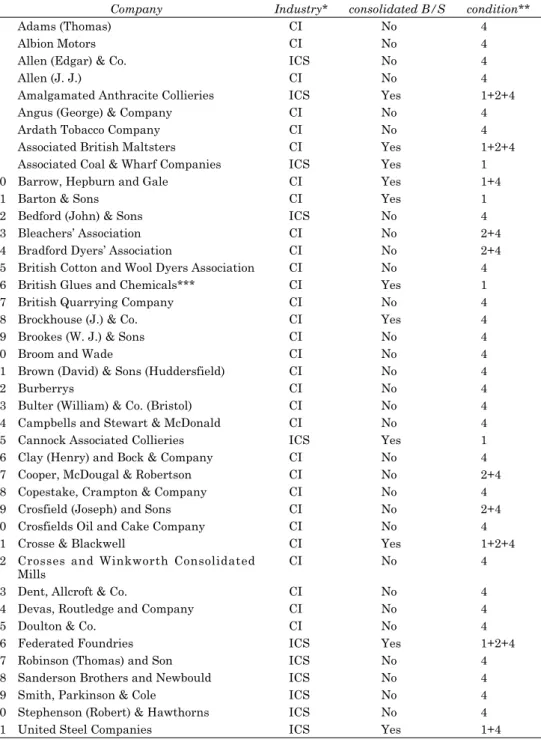
In the accounting year of 1942/43, 41 British holding companies are judged to be using the equity method in the data set for this study (Table 3). Table 9 is a list of names of the companies. 14 companies satisfied either Condition 1 or Condition 2, and 10 of them satisfied simultaneously Condition 4. These examples are considered to present rather strong evidence of using the equity method. The other 4 companies satisfied only Condition 1, whose reason will be stated below. The remaining 27 companies are judged as users of the equity method by examining Condition 4, i.e. their directors’ statement in compliance with Section 126 of CA29. Sufficient examples of these treatments are given in the previous section and no further illustrations are provided here.
There are 41 companies which published both consolidated accounts and legal entity-based accounts in 1942/43 (Table 3). Out of these companies, 10 companies have the same profits in the two accounts (Condition 1 was satisfied), while 31 companies show different amounts26). One company (J. Brockhouse & Co.) presents different profits, but the directors’ 126 statement reveals that the reason of the difference is an exceptional treatment of a part of profits made by subsidiary companies27).
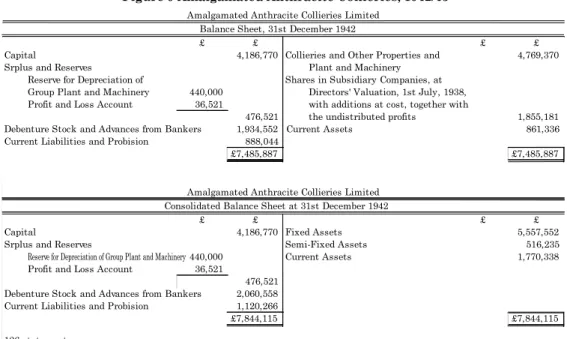
Figure 9 is an extract from Amalgamated Anthracite Collieries, which gives a concrete
evidence of using the equity method. The company satisfies Conditions 1, because the
26) All of the ten companies show their accumulated profits. Therefore, unlike the two cases in 1930/31, the ten companies in 1942/43 which have the same profit amounts both in consolidated accounts and in legal entity-based accounts do not require any doubt about their use of the equity method. However, attention is needed to four companies which satisfy only Condition 1. Within the ten companies satisfying Condition 1, as shown in Table 9, six companies simultaneously satisfy Condition 4 (and Condition 2). These six examples are considered to provide relatively strong evidences that indicate the use of the equity method. On the other hand, the four companies do not provide such strong evidences. This is because three of them actually adopt the cost method, rather than the equity method, since their 126 statements reveal that they include Subsidiary companies’ profits only to the extent of dividends paid. It is possible for cost method users to show the same profits both in consolidated and in legal entity-based accounts, as long as the dividends are paid just the same amount of their proportion in subsidiary profits. One company (British Glues and Chemicals) does not provide strong evidence either, because their 126 statement was not found and it is impossible to know whether they used the equity method or the cost method.
27) ‘The Profits of Subsidiary Companies have been included in the above Profit and Loss Account except the sum of £819 11s. 6d. Three Subsidiary Companies have shown losses which have been provided as above.’
Company Industry* consolidated B/S condition**
1 Adams (Thomas) CI No 4
2 Albion Motors CI No 4
3 Allen (Edgar) & Co. ICS No 4
4 Allen (J. J.) CI No 4
5 Amalgamated Anthracite Collieries ICS Yes 1+2+4
6 Angus (George) & Company CI No 4
7 Ardath Tobacco Company CI No 4
8 Associated British Maltsters CI Yes 1+2+4
9 Associated Coal & Wharf Companies ICS Yes 1
10 Barrow, Hepburn and Gale CI Yes 1+4
11 Barton & Sons CI Yes 1
12 Bedford (John) & Sons ICS No 4
13 Bleachers’ Association CI No 2+4
14 Bradford Dyers’ Association CI No 2+4
15 British Cotton and Wool Dyers Association CI No 4
16 British Glues and Chemicals*** CI Yes 1
17 British Quarrying Company CI No 4
18 Brockhouse (J.) & Co. CI Yes 4
19 Brookes (W. J.) & Sons CI No 4
20 Broom and Wade CI No 4
21 Brown (David) & Sons (Huddersfield) CI No 4
22 Burberrys CI No 4
23 Bulter (William) & Co. (Bristol) CI No 4
24 Campbells and Stewart & McDonald CI No 4
25 Cannock Associated Collieries ICS Yes 1
26 Clay (Henry) and Bock & Company CI No 4
27 Cooper, McDougal & Robertson CI No 2+4
28 Copestake, Crampton & Company CI No 4
29 Crosfield (Joseph) and Sons CI No 2+4
30 Crosfields Oil and Cake Company CI No 4
31 Crosse & Blackwell CI Yes 1+2+4
32 Crosses and Winkworth Consolidated
Mills CI No 4
33 Dent, Allcroft & Co. CI No 4
34 Devas, Routledge and Company CI No 4
35 Doulton & Co. CI No 4
36 Federated Foundries ICS Yes 1+2+4
37 Robinson (Thomas) and Son ICS No 4
38 Sanderson Brothers and Newbould ICS No 4
39 Smith, Parkinson & Cole ICS No 4
40 Stephenson (Robert) & Hawthorns ICS No 4
41 United Steel Companies ICS Yes 1+4
Table 9 Companies adopting the equity method 1942/43
* ICS for Iron, Coal & Steel industry; CI for Commercial & Industrial ** the conditions introduced in 4.4.2
*** no 126 statement was found. Source: original
same amount of profit (£36,521) is shown both in consolidated and legal entity-based balance sheets. The company also satisfies Condition 2, because it reveals that ‘Shares in Subsidiary Companies’ is including the undistributed profits. Finally, the company satisfies Condition 4, because it states that profits and losses of subsidiary companies are included in their accounts. Figure 11 is an extract from Associated Coal & Wharf Companies, which is an example of non-user of the equity method even though the same profits are shown both in consolidated accounts and in legal entity-based accounts.
4.3.4 Evidences for 1946/47
In the accounting year of 1946/47, 49 British holding companies are judged to be using the equity method in the data set for this study (Table 3). Table 10 is a list of names of the companies. The selection of the companies was conducted in the same way as in the 1930/31 and 1942/43. Sufficient examples of these treatments are given in the previous section and no further illustrations are provided here.
Figure 9 Amalgamated Anthracite Collieries, 1942/43
£ £ £ £
Capital 4,186,770 Collieries and Other Properties and 4,769,370
Srplus and Reserves Plant and Machinery
Reserve for Depreciation of Shares in Subsidiary Companies, at Group Plant and Machinery 440,000 Directors' Valuation, 1st July, 1938, Profit and Loss Account 36,521 with additions at cost, together with
476,521 the undistributed profits 1,855,181 Debenture Stock and Advances from Bankers 1,934,552 Current Assets 861,336 Current Liabilities and Probision 888,044
£7,485,887 £7,485,887
£ £ £ £
Capital 4,186,770 Fixed Assets 5,557,552
Srplus and Reserves Semi-Fixed Assets 516,235
Reserve for Depreciation of Group Plant and Machinery 440,000 Current Assets 1,770,338 Profit and Loss Account 36,521
476,521 Debenture Stock and Advances from Bankers 2,060,558 Current Liabilities and Probision 1,120,266
£7,844,115 £7,844,115
126 statement
Profits and Losses of Subsidiary Companies have been taken to credit or provided for in the above accounts. Amalgamated Anthracite Collieries Limited
Balance Sheet, 31st December 1942
Amalgamated Anthracite Collieries Limited Consolidated Balance Sheet at 31st December 1942
Company Industry* consolidated B/S condition**
1 Adams (Thomas) CI No 4
2 Aerated Bread Company CI Yes 1
3 Albion Motors CI No 4
4 Allen (Edgar) & Co. ICS No 4
5 Allen (J. J.) CI No 4
6 Allied Produce Company CI Yes 2+4
7 Amalgamated Anthracite Collieries ICS Yes 1+4
8 Amalgamated Cotton Mills Trust CI Yes 1+2+4
9 Angus (George) & Company CI No 4
10 Associated British Maltsters CI Yes 1+2+4
11 Associated Piano Company CI Yes 1+4
12 Associated Provincial Picture Houses CI Yes 1+4
13 Barrow, Hepburn and Gale CI Yes 1+4
14 Bedford (John) & Sons CI No 4
15 Birmingham Small Arms Company CI Yes 1+4
16 Blantyre and East Africa CI No 4
17 Bleachers’ Association CI Yes 2+4
18 Boots Pure Drug Company CI No 4
19 Bradford Dyers’ Association CI Yes 1+2+4
20 British Cotton and Wool Dyers Association CI Yes 4
21 British Drug Houses CI Yes 4
22 British Glues and Chemicals CI Yes 1+4
23 British Quarrying Company CI Yes 1+4
24 British Rollmakers Corporation ICS Yes 1+4
25 Brockhouse (J.) & Co. CI Yes 4
26 Brooks (J. B.) & Co. CI No 4
27 Broom and Wade CI No 4
28 Brown (David) & Sons (Huddersfield) CI Yes 1+4
29 Budgett (H. H. and S.) and company CI Yes 1+4
30 Burberrys CI Yes 1
31 Cannock Associated Collieries ICS Yes 1+4
32 Cooper, McDougal & Robertson CI Yes 1+2+4
33 Copestake, Crampton & Company CI No 4
34 Cowan (Alex.) & Sons CI Yes 1+4
35 Crosfields Oil and Cake Company CI No 4
36 Crosse & Blackwell CI Yes 2+4
37 Denny, Mott and Dickson CI Yes 1+4
38 Dent, Allcroft & Co. CI No 4
39 Dick (W. B.) and Company CI No 4
40 Dixon (William) & Company, Nottingham CI No 4
41 Doulton & Co. CI Yes 1+4
42 Evans (Richd.) and Co. ICS No 4
43 Federated Foundries ICS Yes 1+4
44 Osborn (Samuel) & Co. ICS No 4
45 Settle Speakman & Company ICS No 2+4
46 Smith, Parkinson & Cole ICS No 4
47 South Hetton Coal Company ICS No 4
48 Stephenson (Robert) & Hawthorns ICS No 4
49 United Steel Companies ICS Yes 1+2+4
Table 10 Companies adopting the equity method 1946/47
* ICS for Iron, Coal & Steel industry; CI for Commercial & Industrial ** the conditions introduced in 4.4.2