Abstract
The article discusses the looming ASEAN (Association of Southeast Asia Nations) regional architecture as it faces a puzzling question on how the region is moving towards a deepening economic integration beyond its ASEAN Economic Community (AEC) scheme. It addresses the issue in the context of the association s wider economic integration that is in parallel with its major member economies participation in regional production networks (RPNs). Automotive and electronics are selected as sectors RITSUMEIKAN INTERNATIONAL AFFAIRS Vol.15, pp.67-120 (2017).
1) Earlier version of the article was presented at the Association of Southeast Asian Studies in the United Kingdom (ASEASUK) Conference 2016 (School of Oriental and African Stud-ies, University of London: 16-18 September 2016). The author would like to express his gratitude to the following individuals who have shown their keen interests on the article by offering constructive comments and inputs: two anonymous reviewers of Ritsumeikan International Affairs journal at the Institute of International Relations and Area Studies (IIRAS); the author s chief dissertation adviser, Professor Hideaki Ohta, along with Profes-sor Ryoji Nakagawa (the author s 2nd dissertation adviser) and Professor Masahiko Itaki
(observer) at the Graduate School of International Relations, Ritsumeikan University; and fellow discussants/participants at the ASEASUK Conference 2016. The article is part of a study conducted by the author entitled Regional Value Chains in Japan-ASEAN Automo-tive and Electronics Production Networks (PhD Program in International Relations, Graduate School of International Relations, Ritsumeikan University) in which portions of the funding (including fieldwork activities) are provided under the DIKTI (Government of Indonesia s Higher Education) Scholarship and Ritsumeikan University s Kokusaiteki Re-search Fund (2015-2016).
2) PhD student, Graduate School of International Relations, Ritsumeikan University (Kyoto/ Japan), e-mail contacts: [email protected]; [email protected]
Political Economy of Regionalism in
ASEAN and Its +3 Partners:
Contemporary Changes in the Automotive and
Electronics Production Networks
1)in which firms originated from the +3 neighboring East Asian countries (China, Japan and Korea) –along with their suppliers, local partners and subsidiaries operated in the hosting ASEAN countries̶ are the major drivers.
Dynamic trade setting and value chain structures resulted from deepening participation in the automotive and electronics RPNs by ASEAN major economies (namely Indonesia, Malaysia, Singapore and Thailand) have paved the way for further ASEAN+3 regionalization. ASEAN+3 trade in the two sectors suggests a case in point that signifi es the functioning of both intra (within ASEAN) and inter-regional (between ASEAN and its +3 partners) economic integration. Benefitting from such a trade setting, firms and other relevant stakeholders in the two sectors undertake strategies to capture value added featuring hierarchical and market value chain structures for automotive and electronics respectively. A typical smiley curve is less represented as value creation spans across different level of downstream, midstream and upstream business activities, and as firms –alongside their suppliers, local partners and subsidiaries̶ strategically respond to the ASEAN major hosting governments investment and industrial policy scheme.
Keywords:
regional production networks, regional value chains, intra and inter-regional trade, regional economic integration, ASEAN regionalism
JEL Classification:
F13 (Trade Policy, International Trade Organizations), F15 (Economic Integration), L5 (Regulation and Industrial Policy), L6 (Industry Studies: Manufacturing), O19 (International Linkages to Development, Roles of International Organizations)
A. BACKGROUND
Beyond its 27th summit in Kuala Lumpur (November 18th - 22nd 2015) that marked the official launch of ASEAN (Association of Southeast Asia Nations) Community (due by December 31st 2015), ASEAN regional archi-tecture should be in a question mark, particularly as to how its ASEAN Economic Community (AEC) pillar will be progressed further. Relevance of CEPT-AFTA (Common Effective Preferential Tariffs of ASEAN Free Trade Area agreement) scheme is worth scrutinized as most manufactured goods have been exchanged among ASEAN member countries at near-zero tariff rates. As of February 2015, average tariff rate of overall ASEAN-10 mem-bers is 0.23% (for a number of 98,821 tariff lines) where the ASEAN-6 has a mere 0.03% average tariff rate (for a number of 60,925 tariff lines) and the ASEAN-CLMV has a record of 0.55 average tariff rate (for a number of 37,896 tariff lines)3).
Despite its successful trade-creation effects on promoting intra-ASE-AN trade4), the question lingers on how firms and other relevant stake-holders in the member economies would actually benefit from deepened economic integration under the current scheme. A study by Okabe and Urata (2013) maintains that tariff elimination under AFTA-CEPT scheme has resulted in an increased intra-ASEAN trade activity in a wide range of products5). However, as suggested by Chapponniere and Lautier (2016),
3) The original agreement (i.e. the Agreement on Common Effective Preferential Tariff (CEPT) Scheme for the ASEAN Free Trade Area/AFTA) was signed by relevant ministers of the six ASEAN member nations (ASEAN-6), i.e. Brunei Darussalam, Indonesia, Malay-sia, the Philippines, Singapore and Thailand during the 4th ASEAN Summit (on January
28th 1992 in Singapore) covering all manufactured goods (i.e. to include capital goods,
pro-cessed agricultural products and those products failing outside the definition of agricultur-al products) to have 0-5% tariff rate reductions (within ASEAN members, based on each national schedules). The ASEAN-6 tariff reduction schedules were initially targeted for the commencement of AFTA by the year of 2008, but then ware revised during the ASEAN Ministerial Meetings in September 1994 and July 1998 that the target was advanced to 2002. Major and significant revision on AFTA-CEPT schedules was finally undertaken un-der the ATIGA (ASEAN Trade in Goods Agreement) signed in February 2009 that mandat-ed 0% tariff rate for all products in the Inclusion List (IL) for ASEAN-6 by 2010 and ASE-AN-CLMV (Cambodia, Laos, Myanmar and Vietnam) by 2015 (ASEAN Secretariat 2016). 4) See for example ASEAN Integration Report 2015, ASEAN Integration Monitoring Report
2013, and Okabe and Urata (2013) for more detailed assessment on the accomplishment. 5) The study exposes the changing patterns of intra-ASEAN trade flows where intra-ASEAN
import share increased (16% in 1990 to over 24% in 2004, then stayed around that level) and by contrast intra-ASEAN export share declined (22% in 1994 to around 18% in 1998,
the scheme offers limited spread between the AFTA-CEPT preferential tariff and the WTO-MFN (World Trade Organization-Most Favored Na-tion) tariff which explain general attitude of firms (as exporters) who con-sider that AFTA tariff gain is not worthwhile as it is smaller than its cost of transactions6).
The article nevertheless suggests that those dynamic patterns of in-tra-ASEAN trade would correspond to changes in production networks be-tween ASEAN and its key trading partners7). In terms of achieving a re-gional production base8), the changing intra-ASEAN trade patterns
then increased gradually to reach 20–22% in the late 2000s, but did not exceed the corre-sponding import share). There is a rising trend of intra-ASEAN export share for processed goods in the 2000s. Declining trends of intra-ASEAN export shares are clearly distin-guished for parts and components and capital goods, while primary goods and consumption goods remain more or less constant through the 1985–2010 period. Moreover, Okabe and Urata (2013) found that the changing patterns of intra-ASEAN import shares differ con-siderably from those for exports. Intra-ASEAN imports of parts and components and capi-tal goods contributed to the rise of the intra-ASEAN import share from the early 1990s to the mid-2000s. The share for parts and components increased from 15.5% to 27.7% over the period from 1990 to 2002 and the share for capital goods rose from 7.7% to 21.4% dur-ing the 1990–2000 period. However, these shares began to decline slowly in the mid-2000s. One observes a rather noticeable increase in the intra-ASEAN import share for processed materials from the mid-1990s until the mid-2000s. The import share for the consumption goods increased slowly over the 1985–2010 period. Contrastingly, the share for primary goods declined notably from the mid-1980s until 2000 before rising very slowly. As a result of these changes, the gaps between the intra-ASEAN import shares for these categories of products (consumption goods, processed materials, parts and components, primary goods, and capital goods) narrowed over the 1985–2010 period. The gap between the highest and lowest shares was more than 20 percentage points in 1985 but declined to less than 15 per-centage points in 2010.
6) As quoted by Chaponniere and Lautiere (2016), surveys carried out in the 1990s revealed that only 1.5 percent of intra-ASEAN exporters benefited from AFTA tariff exemptions (Nesadurai, 2003), and an Asian Development Bank (ADB) study revealed that only 22 percent of firms used the CEPT mechanism in 2006 (Cinievski, 2010).
7) A couple of indications are suggested by Okabe and Urata (2013): (1) increasing trend in the intra-ASEAN import shares in parts and components and capital goods indicate the formation of regional production networks in ASEAN, under which procurement of these intermediate products is sourced within ASEAN; and (2) recognizing that China has be-come an increasingly important destination of ASEAN exports in parts and components and capital goods, a declining trend in intra-ASEAN exports in these intermediate goods indicate the presence of a production network involving ASEAN and China.
8) Establishing a single market and production base is one of the AEC major characteristics and elements which consists of free flow of goods, services, investment, capital and skilled labor (AEC Blueprint 2008-2105) with 12 priority sectors to be kept in mind, i.e. agro-based goods, air transport, automotive products, e-ASEAN (including ICT equipment), electronics goods, fisheries, health care products, rubber-based goods, textiles and clothing, tourism, wood-based products (ASEAN Bali Concord II Declaration 2003) and logistics
(particularly in products related to manufacturing) offer a new insight in comprehending and developing the ASEAN hosting governments foreign direct investments (FDIs) promotion and industrial policy schemes, re-gional production networks (RPNs) and rere-gional value chains (RVCs) that have been expanded alongside its neighboring East Asian partners, i.e. the +3 countries (China, Japan and Korea)9). ASEAN economies deepening in-tegration into RPNs/RVCs is predominantly apparent in the two leading manufacturing sectors, i.e. automotive and electronics, despite insignifi-cant use of CEPT-AFTA mechanism by firms in the two sectors10).
The article therefore aims to understand ASEAN economic integra-tion, particularly in the context of ASEAN+311) regionalization, by looking at its major member countries (i.e. Indonesia, Malaysia, Singapore,
Thai-(added at the 2006 ASEAN Ministerial Meeting).
9) Prevailing comprehension on East and Southeast Asian production networks relies on combination of market and institutional-led factors where both multinational companies (MNCs) decisions (to locate and coordinate their fragmented production processes and val-ue chains activities) and hosting government policy directives (in designing trade and in-vestment policies to encourage in-bound FDIs for the purpose of import-substitution, ex-port promotion and the elimination of domestic gaps in the value chain of production) play the key roles in developing the networks. The 1985 Plaza Accord which triggered apprecia-tion of yen was considered as the major corner stone marking the beginning of internaapprecia-tion- internation-al production networks in East Asia following decisions made by leading Japanese multi-national companies (MNCs) to relocate their production bases to Southeast Asian countries (particularly Malaysia, Singapore and Thailand) seeking for lower production and labor costs (see e.g. Cheewatrakoolpong, Sabhasri, and Bunditwattanawong (2013) for elaborate discussion on the emergence and advancement of East and Southeast Asia pro-duction networks).
10) Apart from its facilitating role for the regional export of agricultural products and pro-cessed materials, tariff elimination under CEPT-AFTA scheme promotes imports in electri-cal machinery and automobile equipment for which regional production networks have been set up (Okabe and Urata 2013). However, as previously indicated, CEPT-AFTA mech-anism was utilized by only 22 percent of firms in 2006 (ADB study as quoted by Cinievski, 2010 in Chaponniere and Lautier, 2015). Yet the share for Thailand rose up by 26.7 percent in 2008 (Chirathivat, quoted in ADB 2012) with large variations by sector as follows: 28 percent in the automobile industry (due to locational factor as Toyota s regional hub) and very low for electronics due to removal of customs tariffs on information technology (IT) products (Chaponniere and Lautier, 2015).
11) ASEAN+3 denotes the 10 ASEAN member countries and their 3 neighboring East Asian countries, i.e. China, Japan and Korea.
land and Vietnam) participation in the automotive12) and electronics13) RPNs. It comprehends regionalization not only as stages towards further trade liberalization, but also as a phenomenon that is significantly affect-ed by changes in its lingering trade setting, i.e. the production networks and value chains. Such changes would in turn suggest distinctive value chains structures, FDI promotion and industrial policy schemes offered by the hosting governments. By such a postulation, it is understood that post-AEC integration is (and should be fostered) in parallel with the ASEAN economies deepening participation in the RPNs, and that ASEAN+3 re-gionalization depends accordingly on how firms and the host governments advance value addition activities as they benefit from (and eventually deal with) changes in the production networks.
12) The article defines automotive sector as an economic area covering an industry that com-prises a wide range of companies or firms along with their supply chains as well as other organizations involved in the design, development, manufacturing, marketing and selling of motor vehicles. In terms of commodities traded within the sector and/or industry, it is mainly categorized under HS (Harmonized System) Commodity Code number 87 (Vehicles other than railway, tramway) and/or SITC (Standard International Trade Classification) categorized under Transport Equipment.
13) Defining electronics sector and/or industry is a daunting task given its complexity and a wide range of products to be covered and categorized under the term of electronics. In its scientific term, electronics itself refer to electrical circuits that involve active electrical components, such as vacuum tubes, transistors, diodes and integrated circuits, and associ-ated passive electrical components and interconnection technologies. Commonly, electronic devices contain circuitry consisting primarily or exclusively of active semiconductors sup-plemented with passive elements; such a circuit, and is described as an electronic circuit. Hence, at macro-level analysis, the article delineate electronics as mainly referring to products traded under HS Commodity Code number 85 (Electrical, electronic equipment) and/or SITC categorized under Electrical and Optical Equipment. However, at micro-level analysis, the definition of electronics may varied considerably due to indistinct categoriza-tion of contemporary products and manufacturing processes in the industry related to elec-tronics, thus studying specific firm such as Panasonic would require a very careful analy-sis on its products development and segmentation. Sturgeon and Kawakami (2010) offer a useful categorization of the electronics industry based on its main products output, i.e. (1) Computers; (2) Computer Peripherals and Other Office Equipment; (3) Consumer Elec-tronics; (4) Server and Storage Devices; (5) Networking; (6) Automobile ElecElec-tronics; (7) Medical Electronics; (8) Industrial Electronics; and (9) Military and Aerospace Electronics. Referring to the categorization, the article s micro-level analysis –that is based on firms-level assessment on companies such as Panasonic̶ primarily falls under category number (3) Consumer Electronics. The term consumer electronics is therefore preferably used in the article, i.e. to cover the micro firm-level analysis as in the case on Panasonic. Likewise the term electrical (home) appliances also resembles similarity of consumer electronics category.
B. QUESTIONS TO ADDRESS
Considering such background and intention, the following guiding questions are put across as follows:
1. How do contemporary changes in the regional automotive and electron-ics production networks signify ASEAN+3 regionalization? What char-acterize the changes, i.e. in terms of trade pattern and trends in value added?
2. How do the changes characterize regional value chains structures in the two sectors? What responses are engaged by firms and other rele-vant stakeholders to deal with such changes?
3. In light of such changes, how do the hosting ASEAN governments fur-ther develop FDI promotion and industrial policy schemes? What are key lessons learnt?
C. ARGUMENT TO PROPOSE
To address the questions, the article offers a conceptual framework that is based on an alternative approach to the existing theorization on re-gional economic integration and is thus focused on evolving concepts of global value chain and global production network (GVC/GPN) and their embedded notion of value addition. ASEAN+3 regionalization is hence un-derstood as a phenomenon linked to byproduct setting of GVC/GPN –i.e. regional production networks and regional value chains (RPNs/RVCs)̶ in which automotive and electronics serve major driving roles. The following sets of argument are proposed in line with the framework and elaborated correspondingly to the above-mentioned guiding questions:
1. The automotive and electronics RPNs –driven mostly by lead firms and 1st tier suppliers whose home countries are of those the +3 partner countries̶ offer the following empirical (macro-level) setting for ASE-AN+3 regionalization:
a. Trade between major ASEAN economies (Indonesia, Malaysia, Sin-gapore, Thailand and Vietnam, hereafter called as ASEAN5) and their +3 East Asian trading partners (China, Japan and Korea) in
automotive and electronics-related commodities (i.e. under Harmo-nized System (HS) Code 87-vehicles other than railway, tramway, HS Code 85-electrical, electronic equipment, Standard Internation-al Trade Classification (SITC) C34T35-transport equipment and SITC-C30T33-electrical-optical equipment) represent both dynamic trade pattern and trends in value added.
b. By total value of trade, Japan and China lead the ASEAN5+3 auto-motive and electronics trade respectively in the last five years. Thailand, Indonesia and Malaysia are the major trading partners of Japan in automotive (mainly in parts and components), while China s major trading partners in electronics are Singapore, Ma-laysia and Thailand (principally in electronics integrated circuits (ICs) and micro assemblies) and also recently Vietnam (in electrical apparatus for line telephony and telegraph). In terms of major ex-port destination and imex-port origin, ASEAN5+3 trade in the two sectors indicate up-to-date positions of the +3 countries, particular-ly in the cases of Japan and China where the former keeps its dom-inance in the inter-regional automotive trade and the later have put its ascendency in the inter-regional electronics one.
c. In terms of value added created, the automotive sector reveals Chi-na-Japan trade capturing most of the foreign content of exported products, i.e. by more than five times that of Japan-Thailand and China-Korea trades. The added value created from domestic con-tent of exported products for the automotive, however, is mostly captured within the +3 countries trade, with Indonesia-Thailand trade is closely trailing behind. Meanwhile in terms of value added captured, the electronics sector exposes superior China-Japan trade as it generates most of the foreign content of exported products by more than six times that of Korea-China & Japan-Korea trades. The added value generated from domestic content of exported prod-ucts for the electronics is dominated by Korea-China trade, howev-er inthowev-erregional trades (particularly between China and Malaysia & Singapore) is catching up more and more domestic content of ex-ported products.
2. At institutional (micro-level) setting, such changes implicate to firms strategy in capturing value added, how firms manage their relations
with suppliers, local partners/subsidiaries in maintaining and develop-ing value addition activities, and how they respond to the hostdevelop-ing ASE-AN governments FDI promotion and industrial policies.
a. Responses by firms and other related stakeholders to the changes is characterized by value chain structures that denote: (1) a hierar-chical network in the case of automotive sector where capturing added values are mostly depended on and relied upon the lead firm s value addition activities, and (2) a market network in the case of electronics (consumer electronics) as generating added val-ues are much more diffused and shared among the lead firm, its suppliers and local partners/subsidiaries.
b. Based on micro-level analysis and two purposively selected case studies on Toyota (as a lead firm exemplifying automotive sector) and Panasonic (as a lead firm representing typical consumer elec-tronics industry) that are both operated in ASEAN+3 RPNs, back to basic value addition activities are preferred, i.e. firms (along with their supply chain and distribution networks) tend to endeav-or efficiency not only in upstream and downstream activities (by capturing value added in the areas of research, development and design (RD&D), and marketing and services), but also in mid-stream activities (by also capturing value added in the areas of pro-duction and logistics).
3. Those strategic responses by firms and the resulted value chains struc-tures define regional value chains of the two sectors and how other re-lated stakeholders, especially the hosting ASEAN governments, man-age the chains both within ASEAN (intra-regional) and ASEAN+3 (inter-regional).
a. Intra-regionally, hosting governments of key ASEAN economies (Indonesia, Malaysia-Singapore and Thailand) deliver variations in strategies to adjust the economies to both types of value chains structures, i.e. by orienting the chains more domestically (in the case of Indonesia), spatially conjoining the chains (in the case of Malaysia/Singapore) and immersing the chains of the two sectors (in the case of Thailand).
b. Inter-regionally, in light of the ensuing regional value chains, three key policy issues are worth noticed as they cover topics on: (1) link-ing FDI and industrial policy schemes to the value chains; (2) es-tablishing common policy platform for human resource develop-ment (HRD) and research, design and developdevelop-ment (RD&D); and finally (3) seeking regional industrial cooperation mechanism in which existing ASEAN integration institutional schemes are to be utilized.
The following diagram –outlining the overall argument̶ offers styl-ized comprehension on the resulted value chains structures (a hierarchical network type for automotive and a market network type for electronics) as they correlate and generate impacts to both levels of regional economic in-tegration and eventually as they define the ensuing regional value chains (RVCs) of the two sectors.
D. OUTLINE OF THE ARTICLE
To elaborate the argument, the remaining parts of the article are structured as follows. The subsequent Part E (Conceptual Framework) presents theoretical surveys clarifying conceptual understanding on re-gional economic integration as seen from GPN and GVC perspectives. A brief backgrounder of ASEAN+3 regionalization and description of South-east Asia s position in contemporary GPNs are presented in next part (Part F). The presentation aims to offer an up-to-date assessment on ASE-AN/Southeast Asia distinctive feature in contemporary regionalism.
The next following parts discuss the core argument of the article con-sisting three sections. The first section (Part G) presents macro-level trade setting that characterizes changes in the two sectors RPNs by displaying ASEAN5+3 trade pattern and trends in value added in commodities relat-ed to automotive (HS 87 and SITC C34T35) and electronics (HS 85 and SITC C30T33). The second section (Part H) presents micro-level setting that characterizes value chains structures of the two sectors RPNs as it also showcases value addition activities performed by firms (as exempli-fied in the cases of Toyota and Panasonic) and the hosting governments (as represented by key economies in the region: Indonesia, Malaysia, Sin-gapore and Thailand). The third section (Part I) proposes key policy issues
Diagram 1: Outlining the Argument Types of
Value Chains Structure
Features and Impacts Key Policy Issues toward Regional Value Chains Intra-regional (within ASEAN) Inter-regional (ASEAN+3) Hierarchical Network: Automotive
Major Trade Nexus: Thailand-Indonesia* Main Commodities Traded: Passenger Cars (HS 8703), Parts and Accessories (HS 8708)* Major Trend in Value Added: Thailand-Indone-sia in domestic content of exported products (DVA) Host Countries Value Chains Strategies: (1) Domestically Oriented Chains (Indonesia); (2) Chains Immersion (Thailand)
Major Trade Nexus: Japan - Thailand, Indone-sia and MalayIndone-sia Main Commodities Traded: Parts and Acces-sories (HS 8708) Major Trend in Value Added: Japan-Thailand in foreign content of export-ed products (FVA) Firms Level Strategy: Case on Toyota Value added are mostly captured by relying upon the lead firm s value addition activities
→
(1) FDI Promotion and Industrial Policy Linkage
Different magnitudes in the host country s structural problems, variations in policy design and degree of implementation Aspiration for FDI promotion and indus-trial development schemes that are oriented towards value added-ness
(2) HRD and RD&D Policy Platform
Prerequisite for value added as stakeholders are shared common challenges and need concerted actions in the issues of HRD (technical capacity and vocational training) and RD&D
(3) Regional Industrial Cooperation
ASEAN initiatives and facilitating roles: trade and industry clearing house and enhanced collaboration with the +3 countries agencies (e.g. by emulating the Japanese HIDA best practices in HRD training network) Market Network: Electronics/ Consumer Electronics
Major Trade Nexus: Malaysia-Singapore-Thailand*
Main Commodities Traded: Electronics Integrated Circuits and Micro Assemblies (HS 8542), TV, Video Monitors and Projectors (HS 8528)* No Major Trends in Value Added are Indicated (neither in terms of FVA nor DVA)
Host Countries Value Chains Strategies: Spatially Conjoined Chains (Malaysia-Singa-pore)
Major Trade Nexus: China – Singapore, Malaysia and Thailand Main Commodities Traded: Electronics Integrated Circuits and Micro Assemblies (HS 8542), and more recently electrical apparatus for line telephony and telegraph (HS 8617) Major Trend in Value Added: China-Malaysia/ Singapore DVA Firms Level Strategy: Case on Panasonic Value added are diffused and shared among the lead firm, suppliers, local partners and subsidiaries
→
*Note: data on these specific findings are not presented in the article as detailed presenta-tion is previously elaborated in Arfani (2015).
worth considering in an endeavor towards the two sectors regional value chains. The last part summarizes, draws and offers policy lessons and rec-ommendations.
E. CONCEPTUAL FRAMEWORK
Late regionalization processes (including that of ASEAN and ASE-AN+3) typically follow the prototype of that of European Union (EU)14). Following the prototype however is the two contending international polit-ical economic approaches on economic regionalism15): the neo-functional-ism16) and the inter-governmentalism. 17) The ASEAN+3 regionalization
14) Emerged initially in the context of 1951 Treaty of Paris that was officially inaugurated the European Coal and Steel Community (ECSC), EU (through its leaders) drafted a constitu-tion concluding its fully-fledged process of regionalizaconstitu-tion in October 2004. The 1957 Trea-ties of Rome embarked the installment of EEC (European Economic Community), Eurat-om and CEurat-ommon Market marking an era of much more fully-fledged regional integration among its members. In 1967, the three were merged to observe the establishment of the so-called EC (European Community) that in 1973 saw its first enlargement, then further enlargement since the 1980s onward. The 1992 Treaty of Maastricht eventually escorted the formation of European Union (EU) paving the way to even much more integrated so-cial, economic, legal and political regional arrangement of the greater Europe. As of Janu-ary 1st 1999, a common currency –Euro̶ was officially adopted in major parts of EU
coun-tries commencing the so-called Eurozone.
15) Early theorization and conceptualization of regional economic integration processes (that is empirically referred to European experience) could be traced back to the works of Ernst B. Haas (1958) The Uniting of Europe: Political, Social and Economic Forces (1950-57) (Stanford: Stanford Univ. Press) and Bela Balassa (1961) Theory of Economic Integration (Homewood, IL: RD Irwin). The works sparked the long-standing debate between the neo-functionalist theories (which are typically in line with Haas and Balassa) versus the inter-governmentalist theories (which offer counter-explanation to the phenomenon with Stan-ley Hoffman as the major figure). The neo-functionalist argues that spill-over effects of functional activities among countries involved in such processes would eventually gener-ate integration of various economic and political activities. See section on Conceptual Frameworks for further discussion on this.
16) Referred mainly to the works of Haas (1958) and Balassa (1961), neo-functionalism is a novel synthesis of Mitrany s theory of functionalism [David Mitrany (1943/1966) A
Work-ing Peace System (London and Chicago: RII/Quadrangle Books)] and Jean Monnet s
prag-matic strategy of European integration. Jean Monnet s works (as the Secretary General of ECSC among others) contribute to the establishment and actual operation of the modest association of ECSC. Begun in the ECSC era onward, the neo-functionalist considers that integration of various economic and political activities among member states has signified the roles of non-state actors: interest associations, social movement, and secretariat of the organization.
17) Arguing against the spill-over effects explanation of neo-functionalism, inter-governmen-talist theories –under their major figure of Stanley Hoffman̶ developed the approach in
offers an interesting case where it involves a large body of governmental involvement in the process but also seen as copycatting the functionalist European model. Empirical observation –such as in the automotive and electronics sectors̶ would reveal dynamic regional integration processes where industries, business practitioners and other key economic players are deliberately attached during various official talks. The consequence of such processes would bring about pressures (but also opportunities) among ASEAN countries and its +3 partners on how decisions should be made, on whose benefits and costs, and finally how political mechanism eventually negotiates the process18).
An alternative approach to those existing theorizations is offered to capture how transformation of ASEAN took place in the context of ASE-AN+3 integration efforts. In this particular case, the nature of regionaliza-tion is neither fully funcregionaliza-tional nor fully inter-governmental. Rather, it has been deeply influenced by market forces as well as inter-governmental de-cisions designed mainly in the milieu of trade and changes in its corre-sponding production networks as well as economic liberalization. It is therefore crucial to apprehend nature of those political economic relations –both at domestic and international levels̶ in acquiring the ASEAN+3 regional integration processes.
At this point, Global Value Chain (GVC) framework19) is applied to
the mid of 1960s. Building on realist premises, it rejects the idea of neo-functionalism of loosely designed and developed integration. Rather, it proposes the idea that integration is a convergence of national interests. Thus the focus of regionalization is more on its major sets of inter-state bargains (especially inter-governmental conferences) and on the deci-sion-making of the Councils of Ministers, rather than on the roles of the Commission, Eu-ropean Parliament, or societal actors.
18) Political economic explanations on this are diverse. Hurrell (1995) identify 3 (three) differ-ent clusters of this specific category of study: (1) the systemic theories, which emphasize the importance of the broader political and economic structures within which regionalist schemes are embedded, (2) the interdependent theories, which consist of neo-functionalism and neo-liberal institutionalism, and (3) the domestic-level theories, which highlight inter-est-group politics and societal pressures over foreign economic policy. The study considers that this three-level categorization is an essential foundation to comprehend the dynamics of ASEAN+3 regional integration processes.
19) GVC analysis has emerged since the early 1990s as a novel methodological tool for under-standing the dynamics of economic globalization and international trade. It is based on the analysis of discrete value chains where input supply, production, trade and consumption or disposal are explicitly and (at least to some extent) coherently linked. GVC discussion has revolved around two analytical issues: how GVC are governed (in the context of a larg-er institutional framework) and how upgrading or downgrading takes place along GVCs.
comprehend the ASEAN+3 regional economic integration by focusing on its production networks and commodity chains (IDE JETRO and WTO 2011, UNCTAD 2013). Special attention has then been given to the re-gion s manufacturing industries following the achievement of its automo-tive and electronics sectors integration to the global networks (Humphrey and Memedovic 2003, JAMA 2013, Sturgeon and Kawakami 2010, Ueki 2013). The two sectors are considered as success stories given relatively significant roles of domestic suppliers and subsidiaries in value addition activities taken by Japanese lead firms (Kawakami 2008, Kuroiwa and Heng 2008).
The region s gradual integration to the global production network (GPN) that eventually began in the 1980s has paved the way to the devel-opment of its regional growth zones serving as a catalyst for the two sec-tors20). As previously described, the year of 1994 has marked the region s crucial move toward deeper integration by kick-offing the ASEAN Free Trade Area (AFTA) agreement which was then followed by series of inter-regional free trade agreements (FTAs) with the region s major trading partners including particularly of China, Japan and Korea as a finale for the two industries incorporation to the GPN. Contemporary GVC and GPN practices are originated from and hence a part of long-debated con-cept on economic regionalism. The debate refers to the effects of trade agreements among countries on their larger economic context, i.e. whether such agreements would create or divert economic benefits towards its
GVC institutional framework identifies how local, national and international conditions and policies shape the globalization in each stage of the value chain (Gereffi and Fernan-dez-Stark 2011).
20) While the concept of GVCs explores vertical and linear sequences of events along the chains, the concept of global production network –featured mostly by complex yet systemic relationships and interrelations between firms̶ deals with complex network structures in which there are intricate links (horizontal, diagonal as well as vertical) forming multi-di-mensional, multi-layered structures of economic activities (Kuroiwa and Heng 2008). Typi-cal organizational structures of a production network consist of global flagships (played by mostly multinational lead firms which are at the heart of a network) and local suppliers (which are characteristically featured based on their higher tier and lower tier positions in a network). Higher tier suppliers serve an intermediary role between lead firms and local suppliers. They usually have direct access to lead firms for negotiation and decisions over production-related activities. Lower tier suppliers are employed as price breakers and ca-pacity buffers (which could be dropped at short notice) with no direct access to lead firms (Kuroiwa and Heng 2008).
member and non-member countries21). Emphasize is thus put more on the zero-sum nature of regional economic integration where participating and non-participating countries alike are struggling to pursue limited economic benefits of trade agreements.
1. GVC and GPN Concepts
Introduction of GVC and GPN concepts –which immediately followed the concept of Global Commodity Chains (GCCs), discussed initially by Hopkins and Wallerstein (1986, 1994), and then elaborated thoroughly in the wake of massive economic globalization in 1990s by Gereffi (1994, 1995, 1996)̶ has redirected the debate on economic regionalism beyond traditional state-centric approach which relies on country-to-country trade performance. GVC and GPN practices –which are mostly operated under lasting (regional) trade agreements̶ have shifted the debate over whether developing a positive-sum scheme among participating parties in an integrated economic region should be the main concern. It thus broadens focus of the debate by encompassing non-state parties (particu-larly those of lead firms and their supply chains network) which are pro-posed in the later studies on GVC and GPN practices, such as indicated in Humphrey and Schmitz (2000), Gereffi and Fernandez-Stark (2001), Schmitz (2003), and Sturgeon (2008)22).
Theoretical strands resulted from those early GVC and GPN concep-tualization are focused on the analysis of value chain governance struc-tures (Gereffi 1994, Gereffi et al 2005 and Sturgeon 2009), relational net-work configurations (Dicken at al 2001, Henderson et al 2002, and Yeung 2005), and industrial upgrading and the strategic coupling of clusters and
21) Viner (1950) coined the terms of trade creation and trade diversion to describe those ef-fects of the formation of free trade agreement. Referring to recent phenomenon of regional trade agreements (RTAs), Baldwin (2004) recapped the debate in its more contemporary trade context as of whether RTAs are stepping stones or stumbling blocks of the multilat-eral trading system.
22) GVC and GPN are conceptually developed mainly in the studies of economic geography, economic sociology, development studies, regional studies, international economics and in-ternational business. Gereffi (1994) and Humphrey (1995) are among the pioneer works of GVC conceptualization, which then followed by works of Bair and Gereffi (2001), Gibbon (2001), Humphrey and Schmitz (2002), Sturgeon (2002), and Gereffi, Humphrey and Stur-geon (2005). The so-called Manchester School of Economic Geographers, meanwhile, began conceptualizing GPN as early as of 2000s. They consist of, among others, Dicken et al (2001), Henderson et al (2002), Coe et al (2004, 2008), and Yeung (2009).
regions (Humphrey and Schmitz et al 2002, Smith et al 2002, Coe at al 2004, Yeung 2009 and MacKinnon 2012). Nevertheless, as suggested by Yeung and Coe (2015), conceptual framework in the GVC research has been characterized by its dyadic and static conception of industrial govern-ance, its relative neglect of territorial organization, and its failure to theo-rize competitive dynamics and evolutionary processes of multi-commodi-ty and multi-industry production networks. It is in response to such limitation of GVC research framework that the so-called GPN 1.0 frame-work was then proposed23).
Much more dynamic changes in GPN practices, especially during the past decade, has made GPN 1.0 obsolete in terms of how firms and other actors or stakeholders in a production network survive and sustain de-spite uncertain market conditions (re: since particularly the global finan-cial turmoil of 2007-8 and it prolonged global market slumps). GPN 2.0 framework was then suggested as a more ambitious round of theoretical innovation that seeks to break signify new conceptual ground and to in-form subsequent rounds of empirical research (Yeung and Coe 2015)24).
23) Developed chiefly under the studies of economic geography and international political economy, GPN 1.0 emphasizes the complex firm networks and territorial institutions in-volved in all economic activity, and how these are structured both organizationally and ge-ographically (Yeung and Coe 2015). Development of GPN 1.0 framework aims at providing a more generally applicable conceptualization of the GPN (Henderson et al 1999, 2002). Gaining influential role as a heuristic framework in economic geography research and the wider social sciences (Hess and Yeung 2006b, Coe, Hess and Dicken 2008, Coe 2009, 2012, and Neilson, Pritchard and Yeung 2014), GPN 1.0 proposed a theoretical claim that re-frames previous GVC-GPN debates, i.e. away from industry-level generalizations, towards a more dynamic theory of GPN by focusing on the structural competitive dynamics and ac-tor-specific strategies shaping the network and their organizational configuration within and across different industries and localities. Under GPN 1.0 framework, GPN is defined as an organizational arrangement comprising interconnected economic and non-economic actors coordinated by a global lead firm and producing goods or services across multiple geographic locations for worldwide markets. It therefore specifies actors as different types of firms as well as non-firms ones (such as the state, international organizations, la-bor groups, consumers, civil society organizations) in diverse localities. Thus GPN 1.0 ana-lytical focus is: (1) actors; (2) their organizational relationships (that constitute GPN in dif-ferent industries, with a lead firm being a central, necessary prerequisite); and (3) those multiple locations that are bound together by economic relations between these actors (Yeung and Coe 2015).
24) In so doing, conceptualization on three competitive dynamics is offered, i.e. cost-capability ratio, sustaining market development, and working with financial discipline. Theoretically it needs to be seen how those competitive dynamics –considered as the independent varia-bles (IV) where their existence varies geographically̶ interact with firms and non-firms actors in generating actor-specific or firms-level strategies (considered as the dependent
2. Value Addition
Empirical research ground brought about by this GPN 2.0 frame-works would need to go deeper into cases at firms-level strategies, indus-try-level structures, and other stakeholders (such as particularly the host-ing governments) specific strategies for investment promotion and industrial development. In the cases of ASEAN+3 automotive and elec-tronics GPNs, the article is to showcase Toyota and Panasonic as a prime illustration of lead firms –originated from one of the +3 countries̶ en-deavoring strategies for value-added in the two respective sectors or in-dustries. At industry-level, a typical value chain structure of ASEAN+3 automotive and electronics GPNs is featured to illustrate an early emer-gence of the two sectors regional value chains.
Typical value addition activities at firms-level are depended upon firms and their suppliers and subsidiaries efforts in adding values of their production or manufacturing processes, range of products, product variety, differentiation, mixture of activities and application of skills and/or knowl-edge in a variety of functions. In so doing, firms typically will go through all the way from their upstream business activities to the downstream sides by introducing series of efficiency, cost-cutting efforts and at the same time acquiring added values in their production sites/facilities,
prod-variables (DV) with their geographically specific manifestation). GPN 2.0 framework fore-sees the following four different firms-level or actor-specific strategies in organizing GPN: (1) intra-firm coordination, (2) inter-firm control; (3) inter-firm partnerships, and (4) extra-firm bargaining (Yeung and Coe 2015). With such a framework, GPN 2.0 would extend be-yond the industry approach commonly found in the existing framework of value chain gov-ernance to the micro-level analysis of actors or stakeholders seeking for industrial upgrading and local development, i.e. to include efforts to capture value added generated in the network. The micro-level analysis, which is also employed in this study, would catch specific responses of geographically situated firms and other stakeholders that are likely to adopt and pursue different strategies even within the same global industry, regional or national economy. The study –on which this article is based̶ therefore keens to further explore those firms-level/actor-specific strategies by purposely focusing on how they cap-ture value added by taking the case of ASEAN4-Japan automotive and electronics produc-tion network. GPN 2.0 framework complements existing GVC analysis in inter-firm gov-ernance structures by identifying firms-level or actors-specific strategies in value addition activities at network formation stage and its industrial/territorial outcomes at the later capital accumulation stage. By so doing, it complements existing GVC analysis (such as on complexity and codifiability of inter-firm transactions and technology and knowledge ca-pabilities within the supply chains) by offering causal explanation of the surrounding com-petitive dynamics and firms-level/actor-specific strategies.
uct development, organization of their supply chains, and technological de-velopment.
Originated from early GVC/GPN theoretical framework, conventional model of value addition activities at firms level emphasizes the differences of firms operated prior to the economic globalization (i.e. during the 1970s) and those operated after the era (i.e. in the 2000s). It maintains the idea that firms in the 2000s tend to be more efficient both in upstream and downstream activities making them to create more value added in the are-as of R&D, design (upstream) and of marketing and services (down-stream), while at the same time they tend to create less value added in midstream activities (especially in the areas of production and logistics). Firms in the 1970s therefore are considered as having less value added both in upstream and downstream activities, and tend to be dominated by production and logistics activities which make them not so efficient in cre-ating added value. See Appendix 1 for an illustration of typical value addi-tion at firm-level, a smiley curve depicting the differences between firms in the 1970s and the 2000s.
Value addition activities are also typically apparent in the form of transactions among firms, suppliers and other stakeholders in GVC/GPN. Transactions are conducted in line with the levels of its complexity (Cx-T) and codification (Cd-T), and of the competence of its major suppliers (SC)25). Typical value chains structure resulted from such transactions are defined based on their explicit coordination and power asymmetry levels where the higher they are, the more hierarchical, and the lower they are, the less hierarchical. Coordination among related stakeholders is conduct-ed more explicitly in hierarchical value chains structure type rather than the market one. Relations among them hence tend to be more asymmetri-cal when they are in hierarchiasymmetri-cal type than the one in market type.
The hierarchical structure type therefore is common within integrated firms where explicit coordination is of its core feature. The captive
25) Cx-T represents complexity of transactions conducted by related players in the value chain, Cd-T denotes the level of codification of the transactions made by related players, and SC signifies the level of major suppliers competence in order to complete the transac-tions. Five types of transactions are typically identified: (1) market where Cx-T is usually low level, but Cd-T and SC are high levels, (2) modular where Cx-T, Cd-T and SC are all high levels, (3) relational where Cx-T and SC are high levels and Cd-T is low level, (4) cap-tive where Cx-T and Cd-T are both high levels, but SC is low level, and finally (5) hierar-chical where Cx-T is high level, but both Cd-T and SC are low levels.
ture type takes place where lead firms have direct control over their cap-tive suppliers. The relational structure type indicates the presence of rela-tional suppliers who serve mainly as intermediaries between the lead firm and its component and material suppliers. The modular structure likewise suggests the emergence of turn-key suppliers who have managed, at cer-tain stage, to convert their roles and position from mere component and material suppliers. The market structure type eventually represents sym-metric relations between the suppliers and their lead firm(s) and/or sub-sidiaries, especially in terms of the use of market price as the sole mecha-nism.
Last but not least, strategic measures of host ASEAN governments in the area of investment promotion and industrial development are exam-ined to stipulate legal and political economic environments confronted by the lead firms and their GPNs. In this article, cases on Indonesia, Malay-sia and Thailand are offered in the context of initiating discussion on key policy issues confronted by relevant stakeholders in the network. The dis-cussion comprises a concise and summarized assessment on historical and legal context of the policies, major key governmental agencies and other relevant stakeholders of the two sectors, and fundamental predicaments in delivering the measures and how policy adjustment are made.
F. ASEAN REGIONALISM
The 1967 Bangkok Declaration marked the onset of ASEAN regional-ism. It is then followed by series of treaties and declarations covering broad areas of shared issues, values and norms among ASEAN member states and their partners. Treaty of Amity of Cooperation (TAC) of 1976 Bali Declaration is the major landmark that provides the basis for ASEAN cooperation in political security, socio-cultural and economic affairs. Eco-nomic affairs cooperation was then being realized in 1992 Singapore Sum-mit marking the initiation of trade liberalization under AFTA-CEPT agreement. In 2003, Tokyo Declaration witnessed enlargement of regional-ization process, i.e. to include China, Japan and Korea under ASEAN+3 EAS (East Asian Summit).
1. Brief Backgrounder to ASEAN+3
re-flects an intense and constant involvement of state/governments in its ar-rangement. The early historical outlook of ASEAN formation is highly po-liticized. It is appropriately explained in terms of the Cold War era marking the ASEAN national governments commitment to neutrality , the term that is only nicely applied to the fields of diplomacy, but not to military, economy and political ones. Militarily-speaking, all of the five ASEAN founding countries are heavily depended and relied on the US/ Western powers since their successes in crushing Communist and other socialist forces domestically in the late 1960s onward. ASEAN economy was since then designed as parallel to the interests of the US/Western gov-ernments and businesses. Politically, there is no room to maneuver for ASEAN governments beyond the US/Western model of developmental po-litical regime –be it authoritarian, soft authoritarian, semi-democratic, or democratic. Their East Asian counterparts –especially Japan and Korea, but also later China̶ shared similar historical backgrounds.
Accordingly, ASEAN arrangement and its ensuing development in the fields of economy, politics and military is deeply influenced by intentions to keep on tracks of neutrality, economic development needs, political and military amity among neighbors (under the hegemonic power of the US), and non-interference conception on any domestic affairs. The intention would then have been manifested in the notion and practice of Treaty of Amity and Cooperation (TAC). The TAC paved the foundation of the so-called ASEAN Way as a principle in solving disputes among member countries. This has ultimately been the major landmark in the enlarge-ment of ASEAN. The membership of Brunei Darussalam in the mid 1980s constructed the ASEAN-6 that completed with the memberships of four additional Southeast Asian countries (Cambodia, Laos, Myanmar and Vi-etnam) in the 1990s to form the ASEAN-10. Inter-regional dialogues be-tween ASEAN and its partners open the way to broader regional arrange-ment to include the +3 East Asian countries (China, Japan and Korea) that is ultimately peaked in the idea of EAC (East Asian Community).
2. Southeast Asia in Contemporary GPN
Southeast Asian countries participation in GPN is directly linked to the +3 countries –in the neighboring East Asia̶ that are home for lead firms operating mostly under the region s production networks. Share of East and Southeast Asia in the world manufacture trade, as a result, has
increased significantly during the past 25 years. East Asia s manufacture trade export rises from 28.3% (in 1992-3) to 35.1% (in 2009-10) and its manufacture trade import rises from 21.7% (1992-3) to 25.7% (2009-10), while Southeast Asia s manufacture trade export has almost doubled, from 3.5% (1992-3) to 6.3% (2009-10), and its manufacture trade import has slightly down from 6.2% (1992-3) to 5.7% (2009-10) (Athukorala and Kohpaiboon 2013). Pioneered by Malaysia and Singapore, the region par-ticipation in GPN dates back to the 1970s, especially in the network prod-ucts (parts and components, and final assembly traded within production networks) which now account for almost two thirds of the merchandise ex-ports of Singapore, Malaysia and the Philippines, almost half those of Thailand, and smaller but still significant share for Indonesia (Athukorala 2015)26).
Based on commodities traded (SITC), Southeast Asia s network prod-ucts export composition confirms heavy concentration of network exports from Southeast Asia in electronics and electrical goods (SITC 75, 76 and 77) in particular, and semiconductor devices compared to total world net-work exports. Automobiles and other transport equipment account for only 9% of Southeast Asian exports, compared to a global average of 30%. At the individual country level, the composition of network exports from Thailand is much more diversified compared to the other countries. The striking difference between Thailand and Malaysia relating to the relative importance of automobiles within GPN is particularly noteworthy27). For semiconductors, network exports are significantly higher for Singapore (44.6%), the Philippines (42.7%), and Malaysia (36.2%), compared to Thai-land (11.4%), Indonesia (4.7%) and Vietnam (4%) as of 2011-12
26) Shares of Southeast Asia network products in world manufacturing trade have also been persistently growing during the past 25 years. Share of the region s parts and components export has doubled from 22.7% (1992-3) to 52.5% (2011-12), and its import has also in-creased from 36% (1992-3) to 47.3% (2011-12). However, in the final assembly, Southeast Asia export share has declined quite significantly from 34.1% (1992-3) to 19.5% (2011-12), and its import share has dropped slightly from 18.4% (1992-3) to 16.3% (2011-12). The growing importance of Southeast Asian countries as suppliers of parts and components to final assembly activities within China-dominated production network needs to be pointed out, especially when it is compared with corresponding data of China. Over 22% of parts and components imports (2011-12) to China originated from Southeast Asia, up from 12% (1992-3), and share of parts and components in total manufacturing exports to China from Southeast Asia increased from 38% (1992-3) to 62% (2009-10) (Athukorala 2015).
27) See Athukorala and Kohpaiboon (2010) for deeper analysis on the two countries contrast-ing policies over domestic automobile industry.
la 2015).
The growing significance of Southeast Asia as parts and components trade hub is certain in the case of electronics, but also is suggesting in the case of automotive sector. As part of global and regional production net-works, dynamic trade pattern among ASEAN4 countries in electronics sec-tors have fostered them to involve in various types of parts and compo-nents trade along with its network products, such as electronic integrated circuits and micro-assemblies. In automotive sector, despite the fact that parts and components (i.e. motor vehicles/motorcycles parts and accesso-ries) trade value is still lagging behind final assembly (i.e. passenger cars, trucks and motorcycles) ones, there has been a steady increase in parts and components trade among ASEAN4 countries (especially between Indo-nesia and Thailand, 2009-13).
G. ASEAN+3 MACRO-LEVEL TRADE SETTING
Seen from a macro-level (empirical) setting, ASEAN+3 regionalization is signified by distinctive trade pattern and trend in value added that is generated from the two sectors intra-regional (within ASEAN) and inter-regional (ASEAN+3) trading activities. ASEAN5 countries exemplify in-tra-ASEAN trade, whereas ASEAN+3 represents trade between ASEAN5 and the +3 countries. This section thus provide elaboration on the trade pattern and trends in value added of ASEAN5+3 trade in commodities re-lated to automotive and electronics sectors. The analysis is based on sta-tistical database and calculations provided by the UN Comtrade Database (2011, 2012, 2013, 2014 and 2015) and the WTO-OECD Trade in Value Added (TiVA) Statistical Database (2008, 2009, 2010 and 2011).
As previously mentioned, the following commodities under the Har-monized System (HS) (applied in the UN Comtrade Database) and Stand-ard International Trade Classification (SITC) (applied in the WTO-OECD TiVA Statistical Database) are selected: HS Code 87-vehicles other than railway, tramway, HS Code 85-electrical, electronic equipment, SITC C34T35-transport equipment and SITC-C30T33-electrical-optical equip-ment. The following two sub-sections offers presentation on trade pattern (Sub-section 1) and trends in value added (Sub-section 2) respectively.
1. Trade Pattern
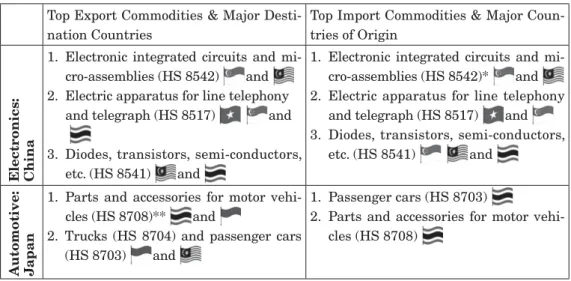
In automotive sector, ASEAN5+3 trade nexus is led by Japan. Its main trade partners in ASEAN5 are Thailand, Indonesia and Malaysia, traded largely in parts and components. Total trade value (2015) for HS 87 between Japan (as reporter) and these three countries (as partners) is US $ 8,121,376,798, down from total value of US $ 13,079,062,700 (2013), but doubled that of China and the three countries total trade value for HS 87 (US $ 4,080,945,878; 2015). As major partners, Thailand, Indonesia and Malaysia s trade with Japan in the automotive sector is steadily intensify-ing. Despite such a decline (since 2013 onward), key players in the indus-try expect a turn this year as the last year s trend shows a slight growth once again (Nakanishi 2015). Japan s main export commodities are parts and accessories for motor vehicles (HS 8708) and its top destinations are Thailand and Indonesia. Its export of trucks (HS 8704) and passenger cars (HS 8703) is still substantial to Indonesia and Malaysia respectively. The country imports passenger cars and parts and accessories for motor vehi-cles quite substantially from Thailand.
Japan s trade with Thailand and Indonesia in parts and accessories for motor vehicles (HS 8708) is particularly in: (1) Transmissions for motor vehicles (HS 870840), i.e. export to Thailand at the value of US $ 1,423,495,776 (2013) and Indonesia at the value of US $ 577,167,074 (2013); and (2) Motor vehicles parts, nes./not elsewhere specified (HS 870899), i.e. export to Thailand at the value of US $ 717,883,874 (2013) and Indonesia at the value of US $ 455,638,641 (2013). Thailand and Indo-nesia are the major players in automotive industry among ASEAN5 coun-tries. The two countries export and import activities in the sector s com-modities are solidly increasing since 2009, with more and more passenger cars and parts and components being traded between the two countries, exceeding the volumes that previously existed between Thailand and Ma-laysia. Indonesia and Thailand trade is dominated by commodities under HS Code 8703, i.e. motor vehicles for the transport of persons (or passen-ger cars).
In electronics sector, ASEAN5+3 trade nexus is led by China trading mostly in electronic integrated circuits (ICs) and micro assemblies. ASE-AN5 leading partners of China in HS 87 are Singapore, Malaysia and Thailand (respectively based on the total value of trade in the last five years). Despite an increasing trend in 2011-2014, the total trade value (in 2015) between China and these three countries for HS 85 decreases slight-l y t o U S $ 74,097,150,426 ( f r o m i t s 2014 t o t a slight-l v a slight-l u e o f U S $ 77,407,845,153).
China s main export commodities are electronic integrated circuits and micro-assemblies (HS Code 8542) and its top destinations are Singa-pore and Malaysia. Its export of electric apparatus for line telephony and telegraph (HS 8517) has been considerably large, i.e. to Vietnam, Singa-pore and Thailand. Its diodes, transistors, semi-conductors, etc. (HS Code 8541) export is quite substantial to Malaysia and Thailand. The country imports electronic integrated circuits and micro-assemblies (HS Code 8542) in much more gigantic size (than its export) from Singapore and Ma-laysia, while it imports electric apparatus for line telephony and telegraph (HS 8517) quite substantially from Vietnam and Singapore, and also di-odes, transistors, semi-conductors, etc. (HS Code 8541) quite substantially from Singapore, Malaysia and Thailand.
To recap, in terms of export destination and import origin, ASEAN+3 trade in automotive and electronics indicate changes in position of the +3
countries. Shifting positions are apparent particularly for Japan and Chi-na. Despite Japan dominant position in the automotive sector (that is chiefly performed with its traditional partners of Indonesia and Thailand), China s increasing role as major export destination is noticeable for Ma-laysia and Singapore, while Vietnam also imports more and more from China and Korea in commodities under HS 87. China s leading position in the electronics sector is evident as major import origin country for all ASEAN5. In the last 5 years, the country is the major export destination country in commodities under HS 85 for Singapore, and also lately (in the past 2 years) for Vietnam. The following Table 1reveals the more complete description of the +3 countries position.
In terms of major commodities traded (HS four digits code), the fol-lowing Table 2 outlines the trends for China and Japan in electronics and automotive-related commodities traded in 2011-2015 as previously de-scribed.
Table 1: Position of the +3 Countries in ASEAN5+3 Trade in Automotive and Electronics-related Commodities (2011-2015)
Sector ASEAN5 Automotive Electronics Major Export Destination Country Major Import Origin Country
Major Export Desti-nation Country
Major Import Origin Country
Indonesia
Malaysia *
Singapore and ** and *
Thailand
Vietnam and and * and
Notes: *the trade value is increasing quite substantially over the years; **the trade value is increasing lately (particularly in the last two years) Source: UN Comtrade Database (2011-2015)
2. Trends in Value Added
This sub-section highlights pattern of trade in value added of the ASEAN+3 trade nexus in automotive-related and electronics-related com-modities (for the year of 2008, 2009, 2010 and 2011) by featuring two se-lected variables, i.e. the foreign value added (FVA) embodied in domestic final demand and the domestic value added (DVA) embodied in foreign fi-nal demand. Domestic value-added content of export (DVA) is domestic content of exported products, while foreign value-added content of export (FVA) is foreign content of exported products. These two variables are se-lected to measure a country s GVC participation in world trade (UNCTAD, 2013). Each of the variables presents embodied value added in trade among ASEAN5 countries, China, Japan, and Korea for commodities relat-ed to the two sectors as describrelat-ed previously.
For automotive, as depicted in Chart 1 below, Japan-ASEAN5 trade produced considerably more FVAs and DVAs than the ones resulted in China-ASEAN5 or Korea-ASEAN5 trades. Japan-ASEAN5 trade in trans-port equipment generated much more FVAs than FVAs created between China or Korea and ASEAN5 countries. Japan-Thailand FVAs stood at US
Table 2: Major Commodities Traded: China and Japan (HS 85 and 87, 2011-2015)
Top Export Commodities & Major Desti-nation Countries
Top Import Commodities & Major Coun-tries of Origin
Electronics: China
1. Electronic integrated circuits and mi-cro-assemblies (HS 8542) and 2. Electric apparatus for line telephony
and telegraph (HS 8517) and
3. Diodes, transistors, semi-conductors, etc. (HS 8541) and
1. Electronic integrated circuits and mi-cro-assemblies (HS 8542)* and 2. Electric apparatus for line telephony
and telegraph (HS 8517) and 3. Diodes, transistors, semi-conductors,
etc. (HS 8541) and
Automotive: Japan
1. Parts and accessories for motor vehi-cles (HS 8708)** and
2. Trucks (HS 8704) and passenger cars (HS 8703) and
1. Passenger cars (HS 8703) 2. Parts and accessories for motor
vehi-cles (HS 8708)
Notes: *The trade value is almost quadrupled than that of the export;
**The most traded commodities are transmissions for motor vehicles (HS 870840) and motor vehicles parts, nes./not elsewhere specified (HS 870899)
$ 837.81 million (2008) and US $ 1296.39 million (2011). Japan-Indonesia FVAs stood at US $ 951.62 million (2008) and US $ 782.51 million (2011). However, the largest FVAs are resulted from Japan-China trade where it stood at US $ 3107.19 million (in 2008) and peaked at US $ 5685.64 mil-lion (in 2011). Japan-Korea and Korea-China trade FVAs are trailing far behind with the values that are comparable to Thailand and Japan-Indonesia FVAs respectively. The total added value of Japan-China FVAs is five times more than the FVAs value of Japan-Korea, China-Korea, Ja-pan-Thailand or Japan-Indonesia.
Chart 1: ASEAN+3 Trends in Value Added ~ Automotive (2011)
In terms of DVAs, ASEAN+3 trade in transport equipment captures the highest value in Korea-China trade gaining US $ 2803.45 million in 2011. It is then followed by China-Japan (US $ 2276.11 million) and Ko-rea-Japan (US $ 696.83 million). It means that, the added value of domes-tic content of exported products in the ASEAN+ trade nexus is quite sig-nificantly captured among the +3 countries. It is slightly different from the trend in the FVAs, as previously described, where the added value of foreign content of exported products is captured inter-regionally, i.e. in the case of Thailand (although the value is one fifth of that of Japan-China). However, Japan-Thailand FVAs is slightly higher than that of Chi-na-Korea. The prevalence of Indonesia-Thailand DVAs that has an added value of US $ 582.89 million in 2011 is worth noted since the value is close to that of Korea-Japan US $ 696.83 million.
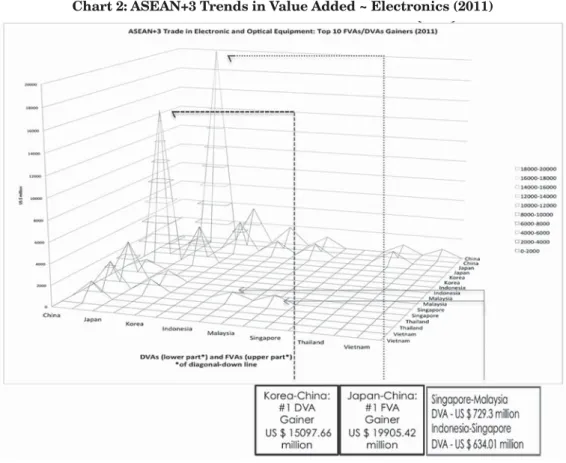
Chart 2 below depicts that, for electronics, inter-regionally China-ASEAN5 trade generated more FVAs and DVAs than the one created in Japan-ASEAN5 or Korea-ASEAN5 trades. The highest interregional add-ed value creatadd-ed from foreign content of exportadd-ed products is in China-In-donesia trade. It has an FVA of US $ 1812.83 million (2011). The value is considerably higher than the one created in Japan-Malaysia (US $ 1275.84 million), Japan-Indonesia (US $ 1218.04 million) and Japan-Thai-land (US $ 1169.46 million). In terms of the domestic content of exported products, the highest interregional added value generated in the Malay-sia-China trade that has a DVA of US $ 3489.27 million. It is followed closely by Singapore-China that has a DVA of 2507.66 million. Those fig-ures further reinforce major shifting in the electronics industry and its GPN that China is not only leading in terms of trade, but also in terms of value added. Like the automotive (such as in the case of Indonesia-Thai-land DVA), there is obvious evidence in intra-ASEAN5 electronics trade that creates significant added value, i.e. the cases of Singapore-Malaysia and Indonesia-China that has a DVA value of US $ 729.3 million and of US $ 634.01 million respectively (2011).
Table 3 below records the complete dataset for both sectors top 10 FVA and DVA gainers. The dataset shows which country is gaining more value added as it trades with each respective partner in a particular sec-tor. The findings are as follows:
1. Inter-regional (ASEAN5+3)
a. Japan-ASEAN5 automotive trade nexus maintains its sub-stantial capture of FVAs which means that Japan gains most foreign value added content of its export in commodities relat-ing to SITC transport equipment to ASEAN5 (valued US $ 2749.96, a sum total of Japan s FVAs with Thailand, Indonesia and Malaysia, highlighted by * in Table 3, see automotive FVA column);
Chart 2: ASEAN+3 Trends in Value Added ~ Electronics (2011)
b. China-ASEAN5 electronics trade nexus captures most FVAs which means that China captures most foreign value added content of its export in commodities relating to SITC electronic and optical equipment to ASEAN5 (valued US $ 4592.04, a sum total of China s FVAs with Indonesia, Malaysia, Thailand and Vietnam highlighted by ** in Table 3, see electronics FVA column);
2. Intra-regional (ASEAN5)
a. Thailand-Indonesia automotive trade captures the greatest FVAs which means that Thailand gains most foreign value added content of its export in commodities relating to SITC transport equipment to Indonesia (worth US $ 394.26, indicat-ed by *** in Table 3, see automotive FVAs column);
b. Indonesia-Thailand and Indonesia-Singapore automotive trades capture most DVAs which means that Indonesia gains most domestic value added content of its export in commodi-ties relating to SITC transport equipment to Thailand and Sin-gapore (worth US $ 872.92, a total of Indonesia s DVAs with Thailand Singapore, indicated by **** in Table 3, see automo-tive DVAs column);
c. Singapore-Malaysia electronics trade gains most DVAs which means that Singapore captures most domestic value added content of its export in commodities relating to SITC electronic and optical equipment to Malaysia (worth US $ 729.3, indicat-ed by ***** in Table 3, see electronics DVAs column).