HAUSDORFF DIMENSION OF CANTOR SET OF
INFINITELY RENORMALIZABLE DISK-DIFFEOMORPHISMS
NAOYA SUMI(鷲見直哉)
Department of Mathematics, Tokyo Metropolitan University, Minami-Osawa 1-1, Hachioji City, Tokyo 192-03, Japan
ABSTRACT. The notion of infinitely renormalizable diffeomorphisms is given. It is
discussed that the regularity of such diffeomorphismsis closelyrelated to Hausdorff dimension ofcertain Cantorsets, andcheckedmoreoverthatnosuch diffeomorphism
with $C^{3}$is able toconstruct underour definition.
In two-dimensional dynamics we consider some questions for the dynamics of
infinitely renormalizable diffeomorphisms, which is studied in $[\mathrm{B}- \mathrm{G}-\mathrm{L}- \mathrm{T}]$, inspired
by Denjoy’s theorem and Falconer’s $\mathrm{B}\mathrm{o}\mathrm{o}\mathrm{k}[\mathrm{F}]$
.
A construction ofan infinitely renormalizable diffeomorphism is found in [B-F] and [F-Y]. By making use of the construction they gave answers for a problem of whether there exist Kupka-Smale diffeomorphisms ofthe sphere with neither sinks
or sources, rasied by $\mathrm{S}\mathrm{m}\mathrm{a}\mathrm{l}\mathrm{e}[\mathrm{S}]$
.
For $C^{1+\epsilon}$-infinitely renormalizable diffeomorphismsthe dynamics of the Cantor set founded by them was characterized in [B-G-L-T].
It was proved [S-W] that a homeomorphism of a Cantor set with some conditions
is topologically conjugate with the restriction to a Cantor set ofan example
con-structed in [B-F].
Before describing our result taken aim atthis paper forinfinitely renormalizable
diffeomorphisms we define an orientation preserving diffeomorphismwhichis called
infinitely renormalizable.
Let $D$ denote the unit disk centered at the origin of $\mathbb{R}^{2}$ and $\ell$ be an arbitraly
integer more than one. Take an infinite sequence $\{p_{i}^{n}|n\geq 1,1\leq i\leq P^{n}\}$ of points
belonging to $D$
.
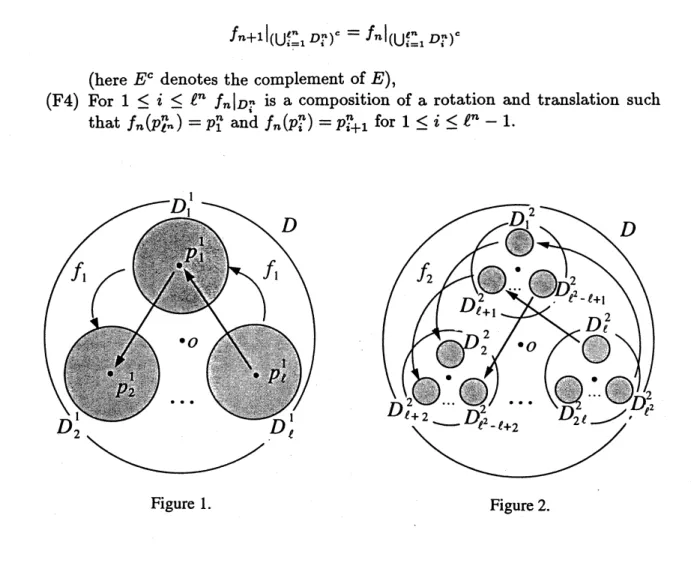
First we define a sequence $\{D_{i}^{n}|n\geq 1,1\leq i\leq\ell^{n}\}$ of subdisks of $D$ and a
sequence $\{r_{n}|n\geq 1\}$ satisfying the conditions:
(D1) $0<r_{1}<1/2$ and $0<r_{n+1}<r_{n}/2$ for $n\geq 1$,
(D2) for fixed $n\geq 1$ and all $i$ with $1\leq i\leq\ell^{n},$
$D_{i}^{n}$ is a disk centered at $p_{i}^{n}$ with
radius $r_{n}$,
(D3) $D_{i}^{n}\cap D_{j}^{n}=\emptyset$ for $i\neq j$ and $n\geq 1$,
(D4) $\bigcup_{j+}^{t_{-}1n}=0D_{i}+1j\cdot \mathit{1}n\subset D_{i}^{n}$ for $n\geq 1$ and $1\leq i\leq\ell^{n}$
.
Next we define a sequence $\{f_{n}\}$ ofdiffeomorphisms satisfying the conditions: for
every $n\geq 1$
(F2) $D_{i}^{n}=f_{n}^{-1}(D^{n})1$ for $1\leq i\leq P^{n}$ and $f_{n}^{\ell^{\mathfrak{n}}}(D_{1}^{n})=D_{1}^{n}$,
(F3) $f_{n+1}$ and $f_{n}$ agree on the complement of$\bigcup_{i=}^{t^{n_{1}}}D_{i}^{n}$, i.e.
$f_{n+1}|_{(\cup\dot{.}.)^{\mathrm{c}}}\ell \mathfrak{n}_{1}=D^{\mathfrak{n}}.=f_{n}|_{(\cup D^{n})^{\mathrm{c}}}i=1:p\mathfrak{n}$
(here $E^{c}$ denotes the complement of$E$),
(F4) For $1\leq i\leq\ell^{n}f_{n}|_{D_{i}^{n}}$ is a composition of a rotation and translation such
that $f_{n}(p_{l^{n}}^{n})=p_{1}^{n}$ and $f_{n}(p_{i}^{n})=p_{i+1}^{n}$ for $1\leq i\leq\ell^{n}-1$
.
Figure 1. Figure2.
Under the above notations we need the following assumption to obtain our de-sired diffeomorphism.
(A) There exists a constant $C>0$ such that for $n\geq 1$
$\sup\{\max\{||D_{x}f_{n}+1-I||, ||Dxf^{-}n+11-I||\}|x\in i=\bigcup_{1}^{\ell^{n}}D_{i}n\}\leq C/\ell^{n}$
.
The assumption (A) implies that $\{f_{n}\}$ is a $C^{1}$-Cauchy sequence. Thus we have
a limit $f$ : $Darrow D$ which is called an infinitely renormalizable diffeomorphism.
Obviously $K= \bigcap_{n\geq 1}\bigcup_{i=1}^{\ell^{\mathfrak{n}}}D_{i}n$ is a $f$-invariant Cantor set in $D$
.
Our resultswhich will be made precise later depend heavily on the properties of the set $K$
.
Remark 1. The topological entropy of$f|_{K}$ is zero, i.e. $h(f|_{K})=0$
.
Indeed, for $m>0$ denoteas $r_{m}(\epsilon, E)$ the smallest cardinarityof the finite subset
$\{y_{1}, \cdots , y_{k}\}\subset E$ satisfying that for $x\in E$ there is $y_{i}(1\leq i\leq k)$ such that $\max\{|f^{j}(x)-f^{j}(y_{i})| ; 0\leq j\underline{<}m-1\}\leq\epsilon$.
By (D1) - (D4), for $\epsilon>0$ we can choose $N>0$ such that $|D_{i}^{N}|=2r_{N}<\epsilon$ for
$1\leq i\leq\ell^{N}$
.
Thus$r_{m}(\epsilon, K)\leq rm(_{\mathcal{E}}, i=\cup Di)N\leq\ell N1\ell^{N}$
for $m>0$
.
Since the topological entropy of$f|_{K}$ is given by$h(f|_{K})= \lim_{\epsilonarrow 0}-\mathrm{l}\mathrm{i}\mathrm{m}marrow\infty(1/m)\log r(m\epsilon, K)$,
we have $h(f|_{K}) \leq\lim_{\epsilonarrow 0^{\varlimsup_{m\infty}}(}arrow 1/m)\log P^{N}=0$
.
$\square$Remark 2. $f|_{K}$ is minimal, i.e. for any $x\in K$ the orbit $O(x)=\{f^{n}(x) : n\geq 0\}$ is
dense in $K$
.
Indeed, since $r_{n}arrow 0(narrow\infty)$, for $\epsilon>0$ there is $N>0$ such that $2r_{N}<\epsilon$
.
Since $K \subset\bigcup_{i=1i}^{\ell^{N}}D^{N}$, for two points
$x,$$y\in K$ we have $x\in D_{i_{1}}^{N}$ and $y\in D_{i_{2}}^{N}$ for
some $i_{1}$ and $i_{2}$
.
Thus we have $|f^{n}(X)-y|<\epsilon$ since $f^{n}(D_{i_{1}}^{N})=D_{i_{2}}^{N}$ for some $n$ (by(F2)$)$
.
This implies the minimality of$f|_{K}$.
$\square$For our definition we remark that the choice of subdisks $D_{i}^{n}$ to n-th stage is
ruled by $\ell^{n}$ number. Now we can describe one ofour results as follows.
Theorem A. Let $f$ : $Darrow D$ be an infinitely renormalizable diffeomorphism and
$K$ be the Cantor set constructed as above.
If
$f$ isof
$C^{1+\xi}$ then $\epsilon\leq dim_{H}(K)$ where $dim_{H}(K)$ denotes theHausdorff
di-mensionof
K. Moreoverif
$f$ isof
$C^{2+\epsilon}$ then $1+\epsilon\leq dim_{H}(K)$.
The converse of Theorem A will be proved for infinitely renormalizable
diffeo-morphisms constructed without the assumption (A). We shall describe it later on.
The followinglemma plays an important role to show Theorem A.
Lemma. Let $\{D_{i}^{n}|n\geq 1,1\leq i\leq\ell^{n}\}$ be the subdisks satisfying $(Dl)-(D\mathit{4})$ and
$f$ : $Darrow D$ be the infinitely renormalizable diffeomorphism. Then there exist a
constant $C_{1}>0$ and a sequence
of
points $x_{n}$ in $\bigcup_{i=1}^{\ell^{n}}D_{i}n$ satisfying$||D_{x_{n}}f-I||\geq C_{1}/p^{n}$ $(n\geq 1)$
.
$\mathrm{N}$ we establishLemma, then Theorem A is concluded as follows.
Proof
of
Theorem $A$.
Let $C_{1}$ and $\{x_{n}\}$ be as in Lemma. Then, for $n>0$ there is$1\leq i_{n}\leq p^{n}$ such that $x_{n}\in D_{i_{n}}^{n}$
.
For $n>0$ we can take $q_{n}\in\partial D_{i_{n}}^{n}$.
We remarkthat $D_{q_{n}}^{2}f=0$ by (F4) and $D_{q_{n}}f=\mathrm{i}\mathrm{d}$ by (A). From the mean value theorem we
have that $||D_{x_{n}}f-D_{q_{n}}f||\leq||D_{y_{n}}^{2}f||\cdot|x_{n}-q_{n}|$ for some $y_{n}\in D_{i_{n}}^{n}$
.
Thus,$||D_{y_{n}}^{2}f||\geq||D_{x_{n}}f-D_{q_{n}}f||/|x_{n}-q_{n}|\geq C_{1}/2\ell^{n}r_{n}$
.
$(*)$Since $f$ is of $C^{2+\epsilon}$, there is a constant $\overline{C}>0$ such that $||D_{x}^{2}f-D_{y}^{2}f||\leq\overline{C}|x-y|\epsilon$
for $x,$$y\in D$, and so
from which we have
$r_{n}\geq(C_{1}/\overline{c}2^{1\epsilon n}+\ell)1/(1+\epsilon)$
.
For $n\geq 1$ and $i$ with $1\leq i\leq p^{n}$ let $\tilde{D}_{i}^{n}$ be a disk centered at
$p_{i}^{n}$ (which is the
center of $D_{i}^{n}$) with radius $(C_{1}/\overline{c}2^{1+}\epsilon pn)^{1/}(1+\epsilon)$
.
Then $K’= \bigcap_{n\geq 1}(\bigcup_{i=}^{\ell}\tilde{D}^{n}n_{1i})$ hasthe Hausdorff dimension which is calculated as
$\dim_{H}(K’)=-\log P/\log(1/\ell)^{1/(1}+\epsilon)=1+\epsilon$
.
(for the details see Remark 6 described later on) and therefore$\dim_{H}(K)\geq\dim_{H}(K’)=1+\epsilon$
.
$\square$
Remark 3. Under our definition, no infinitely renormalizable diffeomorphism with
the $C^{3}$ is able to constructed.
Indeed, suppose $f$ isof$C^{3}$
.
Let$C_{1},$$\{x_{n}\}$ be as in Lemma and let $\{i_{n}\},$$\{y_{n}\},$$\{q_{n}\}$
be as in the proofof Theorem A. Then we have $(*)$
.
Use the mean value theorem.Then, $||D_{y_{n}}^{2}f-D2fq_{n}||\leq||D_{z_{n}}^{3}f||\cdot|y_{n}-q_{n}|$ for some $z_{n}\in D_{i_{n}}^{n}$, from which
$||D_{z_{n}}^{3}f||\geq||D_{y_{n}q_{n}}^{2}f-D^{2}f||/|y_{n}-q_{n}|\geq||D_{y_{n}}^{2}f||/2r_{n}\geq C_{1}/(4\ell nr)2n$
.
Take a subsequence $\{z_{n_{j}}\}$ of $\{z_{n}\}$ such that $\lim_{jarrow\infty}zn_{j}=z\in K$
.
Since $D_{z}^{3}f=0$,we have $\lim_{jarrow\infty}||D_{zn_{\mathrm{j}}}^{3}f||=0$, and thus
$0= \lim_{jarrow\infty}||D_{zn_{j}}^{3}f||\geq\lim_{jarrow\infty}C_{1}/(4\ell nj2)rn_{j}$
.
Since $\ell n_{j}r_{n_{j}}\mathrm{o}20>1$ forsome$j_{0}>0$, we have $r_{n_{j_{0}}}>1/\sqrt{\ell^{n_{j_{0}}}}$
.
Let $\lambda$ denote Lebesguemeasure of$\mathbb{R}^{2}$
.
Then we have$\pi=\lambda(D)>\lambda(\bigcup_{k}D_{k}n_{j_{0)}}=^{p^{n_{\mathrm{j}_{0}}}r_{n_{j}}}\pi 20>\pi$,
thus contradicting. Remark 3 was proved. $\square$
A $C^{\infty}$-Kupka-Smale diffeomorphism ofthe sphere with neither sinks or sources
was constructed in [G-S-T]. The main step ofit is to obtain an embedding ofthe
2-disk without using the technique of [B-F] and [F-Y]. Thus the method of [G-S-T]
is justified by Remark 3.
Remark
4.
If a $C^{1}$-diffeomorphism $f$ : $Darrow D$ constructed by Bowen-Franks is of$C^{1+\epsilon}$, then $\epsilon\leq\dim_{H}(K)$
.
Indeed, the construction of an infinitely renormalizable diffeomorphism done in
[B-F] does not require the assumption (A). Therefore Theorem A concludes Remark 4. $\square$
Proof
of
Lemma. Since $f^{l^{n}}(D_{1}^{n})=f_{n}^{l^{n}}(D_{1}^{n})=D_{1}^{n}$for $n\geq 1$ (by (F2)), we can find$\overline{x}_{n}\in D_{1}^{n}$ such that
Flgure$s$
.
Flgure$\angle\dagger$.
Indeed, from Brouwer’s theorem it follows that $f^{\ell^{n+1}}(\overline{p}^{n})=\overline{p}^{n}$ for some $\overline{p}^{n}\in$
$D_{1}^{n+1}$
.
Remark that $\overline{p}^{n}$ is a periodic point with period $p$ of $f^{\mathit{1}^{\mathfrak{n}}}|_{D_{1}^{n}}$.
For simplicity we fix $n\geq 1$ and write $\overline{D}=D_{1}^{n},$ $\overline{f}=f^{l^{n}}|_{D_{1}^{n}},\overline{p}_{1}=\overline{p}^{n}$ and
$-i-1$
$\overline{p}_{i}=f$ $(\overline{p}_{1})(2\leq i\leq\ell)$
.
Put $q_{i}=\overline{p}_{(+}i1$)$\mathrm{m}\mathrm{o}\mathrm{d}l-\overline{p}_{i}$ for $1\leq i\leq\ell$
.
Then each of $q_{i}$ is non-zero and can becalculated as
$|q_{i}|= \int_{0}^{1}|\dot{C}_{i}(t)|dt$ $(1\leq i\leq\ell)$
where $c_{i}(t)=(1-t)\overline{p}_{i}+t\overline{p}(i+1)\mathrm{m}\mathrm{o}\mathrm{d}l$
.
Since $q_{i}=\overline{f}(\overline{p}_{i})-\overline{p}_{i}=\overline{p}_{(+}i1)\mathrm{m}\mathrm{o}\mathrm{d}\ell-\overline{p}_{i}$for$1\leq i\leq\ell$, obviously
$\sum_{i=1}^{l}q_{i}=(\overline{p}2-\overline{p}_{1})+(\overline{p}_{3^{-\overline{p}_{2}}})+\cdots+(\overline{p}_{1}-\overline{p}_{l})=(\mathrm{o}, \mathrm{o})$.
Remark that $(\overline{f}-\mathrm{i}\mathrm{d})(Ci(0))=q_{i}$ and $(\overline{f}-\mathrm{i}\mathrm{d})(Ci(1))=q_{(i+1)}\mathrm{m}\mathrm{o}\mathrm{d}l$. Then we have
that for $1\leq i\leq p$
$|q_{i}-q(i+1) \mathrm{m}\mathrm{o}\mathrm{d}\mathit{1}|\leq\int_{0}^{1}|(D_{c:}(t)\overline{f}-I)\dot{C}_{i}(t)|dt$ $\leq\int_{0}^{1}||D_{\mathrm{C}}t)\overline{f}:(-I||\cdot|\dot{c}_{i}(t)|dt$ $= \sup||D_{c:}(t)\overline{f}-I||\cdot|qi|$, $t\in[0,1]$ from which $\sup||D_{\mathrm{c}:(t)}\overline{f}-I||\geq|q_{i}-q_{(+)}i1\mathrm{m}\mathrm{o}\mathrm{d}l|/|q_{i}|$
.
$t\in[0,1]$Thus, to obtain the conclusion it suffices to show that there is $1\leq i\leq\ell$satisfying
$\frac{|q_{i}-q_{(}i+1)\mathrm{m}\mathrm{o}\mathrm{d}l|}{|q_{i}|}\geq 1/P$
.
$(\uparrow)$To do so if (\dagger) is false, and put $|q_{i_{0}}|= \max\{|q_{i}||1\leq i\leq\ell\}$, then we have that for $1\leq i\leq P$
$|q_{i}-q_{i\mathrm{o}}|\leq|q_{1}-q2|+\cdots+|ql-q1|$ $<|q_{1}|/\ell+\cdots+|q\ell|/p$ $\leq|q_{i_{\mathrm{O}}}|$
.
Let $p$
.
$q_{i_{0}}$ denotes the sum of
$\ell$ time of
$q_{i_{\mathrm{O}}}$ (i.e.
$p$
.
$q_{i_{\mathrm{O}}}=q_{i_{0}}+\cdots+q_{i_{\mathrm{O}}}$). Since$\sum_{i=}^{\ell}1qi=(0,0)$, we have
$| \ell\cdot qi\mathrm{O}|=|\sum_{i=1}^{l}q_{i}-\ell\cdot qi\mathrm{o}|\leq\sum_{i=1}^{l}|q_{i}-qi_{0}|<|\ell\cdot qi\mathrm{o}|$,
thus contradicting.
Therefore, for $n\geq 1$ there is $\overline{x}_{n}\in D_{1}^{n}$ such that $||D_{\overline{x}_{n}}f^{\ell^{n}}-I||\geq 1/\ell$
.
We now are a position to show the lemma. Since $||D_{y}f||\leq 1+C/l^{n}$ for $y\in$ $\bigcup_{i=}^{t^{n_{1}}}D_{i}^{n}$ (bythe assumption $(\mathrm{A})$), bythe choice of$\overline{x}_{n}\in D_{1}^{n}$we have that for $n\geq 1$
$1/P \leq||D_{\overline{x}_{n}}f^{l^{n}}-I||\leq\ell^{n}1\sum_{i=0}^{-}||D_{\overline{x}_{n}}fi+1-D\overline{x}_{n}fi||$
$\leq\sum_{i=0}^{\ell^{n}-1}||D_{f^{:}(\overline{x}n)}f-I||\cdot||D_{\overline{x}_{n}}f^{i}||$
$\leq\sum_{i=0}^{\ell^{n}-1}||D_{f}:(\overline{x}_{n})f-I||\cdot\{_{j\mathrm{o}}^{i-}\prod_{=}^{1}||Dff^{j}\mathrm{t}^{\overline{x}_{n}})||\}$
$\leq\sum_{i=0}^{l^{n}}|-1|Dif(\overline{x}_{n})f-I||\cdot(1+c/^{p^{n}})i$
(since $||D_{y}f||\leq 1+C/\ell^{n}$ for $y \in\bigcup_{i=1}^{l^{n}}D_{i}n$)
$\leq e^{\mathrm{c}}\sum||Dif(\overline{x}_{n})f-I||l^{n}-1$
,
$i=0$
from which we can find $0\leq i_{1}\leq P^{n}-1$ such that
Putting $x_{n}=f^{i_{1}}(\overline{x}_{n})$ and $C_{1}=(e^{c}P)^{-1}$, we have the conclusion of the lemma. $\square$
For a question of whether the converse of Theorem A is true, we can give an answer for infinitely renormalizable diffeomorphisms constructed concretely as fol-lows.
Let $D$ and $\ell$ be as before and take a finite sequence $\{p_{i}|1\leq i\leq p\}$ of points
belonging to $D$
.
Define a sequence $\{D_{i}|1\leq i\leq\ell\}$ of subdisks included in $D$ suchthat
$(\mathrm{D}’ 1)$ for $i,$ $D_{i}$ is a disk centered at$p_{i}$ with radius $0<r<1/2$,
$(\mathrm{D}’ 2)D_{i}\cap D_{j}=\emptyset$ for $i\neq j$,
$( \mathrm{D}’ 3)\bigcup_{i=1}^{l}D_{i}\subset D$
.
We consider an $C^{\infty}$-isotopy $h_{t}$
:
$[0,1]\cross \mathbb{R}^{2}arrow \mathbb{R}^{2}$ satisfying(H1) $h_{0}(x)=x$ for $x\in \mathbb{R}^{2}$ and $h_{t}(D)=D,h_{t}(D^{c})=D^{c}$ for $t\in[0,1]$,
(H2) $h_{1}(D_{i})=D_{i+1}$ for $1\leq i\leq\ell-1$ and $h_{1}(D_{l})=D_{1}$,
(H3) for a fixed $\alpha>0$ and $t\in[0,1],$ $h_{t}|_{D^{\mathrm{c}}}$ is a rotation ofthe angle $t\alpha$ which is
centered at the origin of$\mathbb{R}^{2}$,
(H4) fix $1\leq i\leq p$, and for $t\in[0,1],$ $h_{t}|_{D:}$ is a composition of a translation and
a rotation of the angle $t\alpha/\ell$ which is centered at $p_{i}$
.
By using the isotopy $h_{t}$ : $[0,1]\cross \mathbb{R}^{2}arrow \mathbb{R}^{2}$ we can define a $C^{\infty}$ diffeomorphism
$g(i, N):Darrow D$ by
$g(i, N)=h_{i/N^{\circ}}h(i-1)/N-1$ $(N\in \mathrm{N}, 1\leq i\leq N)$
.
Then it follows that
$h_{1}=g(N, N)\circ g(N-1, N)\circ\cdots g(1, N)$
.
From now on we construct a sequence $\{D_{i}^{n}|n\geq 1,1\leq i\leq\ell^{n}\}$ of subdisks of $D$
satisfying $(\mathrm{D}1)-(\mathrm{D}4)$ and a sequence $\{f_{n}\}$ of $C^{\infty}$-diffeomorphisms of $D$ satisfying
$(\mathrm{F}1)-(\mathrm{F}4)$
.
These constructions are inductively done as follows.First put $f_{1}=h_{1}$
.
Obviously $f_{1}$:
$Darrow D$ is a $C^{\infty}$-diffeomorphism. We write$D_{i}^{1}=D_{i}$ and $p_{i}^{1}=p_{i}$ for $1\leq i\leq\ell$
.
Then$D_{i}^{1}=f_{1}^{i-1}(D_{1}^{1})(1\leq i\leq\ell)$, $f_{1}^{t}(D_{1}^{1})=D_{1}1$
.
By (H2) and (H4) we have that $f_{1}(p_{i}^{1})=p_{i+1}^{1}(1\leq i\leq P-1)$ and $f_{1}^{t}(p_{1}^{1})=p_{1}^{1}$,
which satisfy conditions (F2) and (F4).
Next put
$f_{2}(X)=\{$
$f_{1}(x)$ $(x \not\in\bigcup_{i}^{l}=1D_{i}^{1})$
$r\cdot g(i,p)((x-p_{i}^{1})/r)+p(i+1)\mathrm{m}1\mathrm{o}\mathrm{d}\ell$ $(x\in D_{i}^{1})$
where
$(i+1)\mathrm{m}\mathrm{o}\mathrm{d}\ell=\{$
$i+1$ for $1\leq i\leq\ell-1$
1 for $i=p$
.
Define a map $\beta_{2}$ : $Darrow D_{1}^{1}$ by $\beta_{2}(x)=r\cdot x+p_{1}^{1}$
.
Then $D_{1}^{2}=\beta_{2}(D_{1}^{1})$ is a disk withradius $r^{2}$
.
Writeand denote as$p_{i}^{2}$ the center of$D_{i}^{2}$ for $1\leq i\leq\ell^{2}$
.
Obviously, $f_{2}$ : $Darrow D$ is a $C^{\infty}$-diffeomorphism and for $x\in D_{i}^{1}(1\leq i\leq P)$
$f_{2}^{t}(x)=r\cdot g(^{\ell},l)\circ g(\ell-1, l)\circ\cdots\circ g(1,\ell)\{(x-p_{i}^{1})/r\}+p_{i}^{1}$ $=r\prime h_{1}((x-p^{1}i)/r)+p_{i}^{1}$
.
Thus the sequence $\{D_{i}^{2}|1\leq i\leq\ell^{2}\}$ satisfies the conditions $(\mathrm{D}1)-(\mathrm{D}4)$, and the
diffeomorphism $f_{2}$ : $Darrow D$ satisfies the conditions $(\mathrm{F}1)-(\mathrm{F}4)$
.
Continuing thisprocesswe obtain asequence$\{f_{n}|n\geq 1\}$of$C^{\infty}$-diffeomorphisms
of$D$ satisfying
$f_{n+1}(_{X})=\{$
$f_{n}(x)$ $(x \not\in\bigcup_{i1i}^{\mathit{1}}=nD^{n})$
$r^{n}\cdot g(i,\ell^{n})((_{X}-p^{n}i)/r^{n})+p_{(i+)0}n1\mathrm{m}\mathrm{d}\ell^{n}$ $(x\in D_{i}^{n})$
where
$(i+1)\mathrm{m}\mathrm{o}\mathrm{d}\ell n=\{$
$i+1$ $(1\leq i\leq\ell^{n}-1)$
1 $(i=^{p)}n$,
and a sequence $\{D_{i}^{n}|n\geq 1,1\leq i\leq\ell^{n}\}$ of subdisks centered at $p_{i}^{n}$ with radius $r^{n}$
satisfying
$D_{1}^{n+1}=\beta_{n+1}(D^{n})1$
$D_{i}^{n+1}=f_{n+}^{i}-11(D_{1^{+1}}n)$ $(2\leq i\leq pn+1)$
where $\beta_{n+1}$ : $D_{1}^{n-1}arrow D_{1}^{n}$ is defined by $\beta_{n+1}(x)=r\cdot(x-p_{1}^{n-})1+p_{1}^{n}$
.
The sequence $\{D_{i}^{n}|n\geq 1,1\leq i\leq\ell^{n}\}$ satisfies $(\mathrm{D}1)-(\mathrm{D}4)$, and the sequence
$\{f_{n}\}$ satisfies $(\mathrm{F}1)-(\mathrm{F}4)$
.
Remark 5. We can check that the sequence $\{f_{n}\}$ constructed concretely as above
satisfies (A).
Indeed, by Lemma 3 of [F-Y], there is $C’>0$ such that for $N\in \mathrm{N}$ and $x\in D$
$||D_{x}g(i, N)-I||\leq C’/N$
.
Thus, for $x\in D_{i}^{n}(1\leq i\leq P^{n}, n\geq 1)$
$||D_{x}f_{n+1}-I||=||D_{\{(x-pi)}n/r^{n}\}^{g(}i,P^{n})-I||\leq C’/\ell^{n}$
.
By the same way we can find $C”>0$ such that for $N\in \mathrm{N}$ and $x\in D$$||D_{x}g(i, N)^{-}1I-||\leq C’’/N$,
and for $x\in D_{i}^{n}(1\leq i\leq P^{n}, n\geq 1)$
$||D_{x}f^{-}n+11-I||\leq C’’/p^{n}$,
Therefore we see that the class ofinfinitely renormalizable diffeomorphisms
con-structed under the first definition contains that of diffeomorphisms done under the second definition.
By Remark 5 the sequence $\{f_{n}\}$ is a $C^{1}$-Cauchy sequence, and so its limit $f$ :
$Darrow D$ is an infinite renormalizable diffeomorphism constructed byusing isotopys. The set $K_{1}= \bigcap_{n=1}^{\infty}\bigcup_{i=1}^{l^{n}}D_{i}^{n}$ is a Cantor set and $f$-invariant. For the
diffeomor-phism we have the following second result of this paper.
Theorem B. Let $f$ : $Darrow D$ be an infinitely renormalizable diffeomorphism
con-structed by using $isotopy_{\mathit{8}}$ and $K_{1}$ be the Cantor set related to $f$
.
(1) Suppose that $0<dim_{H}(K_{1})\leq 1$
.
Then $fi_{\mathit{8}}$of
$C^{1+\epsilon}$if
and onlyif
$\epsilon\leq$ $dim_{H}(K_{1})$,
(2) Suppose that $1<dim_{H}(K_{1})$
.
Then $f$ isof
$C^{2}$, and moreover$f$ isof
$C^{2+\epsilon}$if
and onlyif
$\epsilon+1\leq dim_{H}(K_{1})$.
Remark 6. The Hausdorff dimension of$K_{1}\mathrm{i}\mathrm{s}-\log\ell/\log r$
.
For the proof put $s=-\log P/\log r$
.
Then Hausdorffmeasure of$K_{1}$ is calculatedas
$\mathcal{H}^{s}(K_{1})=\lim_{\deltaarrow 0}(\inf\{\sum_{i=1}^{\infty}|U_{i}\cap K_{1}|^{s}$ : $\{U_{i}\}$ is a $\delta$-cover of $D\})$
$\leq\varlimsup_{narrow\infty}\sum^{l^{n}}i=1|K_{1}\cap D_{i}^{n}|^{s}\leq 2^{s}\varlimsup_{narrow\infty}(p.rs)^{n}=2s$
.
Thus we have $\dim_{H}(K_{1})\leq s$
.
To see $\dim_{H}(K_{1})\geq s$ define a sequence space$I= \prod_{i=1}^{\infty}\{1, \cdots,p\}$, and let $\{1, \cdots,\ell\}$ have the discrete topology. Obviously $I$ is a
compact metric space under the product topology. For $k\geq 1$ denote as $I_{i_{1},\cdots,i_{k}}=\{(i_{1}, \cdots, i_{k,q_{k+1},\cdots)} :\leq q_{j}\leq\ell, j\geq k+1\}$
a subset of$I$ with initial terms $(i_{1}, \cdots, i_{k})$, and define a set function $\mu$ of$I$ by
$\mu(I_{i_{1},\cdots,i})k--rks$
.
Because of
$\mu(I_{i_{1}},\cdots,i_{k})=r^{ks}=r^{ks}(\ell\cdot r)s\sum=j=1t(r^{k}+1)^{s}=\sum_{=j1}^{l}\mu(I_{i}\ldots,ikj)1,,$
shows that $\mu$is a Borel probability measure of
$I$
.
For$k\geq 1$ we write $J_{k}=$ $\{(i_{1}, \cdots , i_{k})|1\leq i_{j}\leq P, 1\leq j\leq k\}$and for convenience
$D_{i_{1},i_{2}},\cdots,i_{k}=D_{i_{1}+\ell}^{k}.i_{2}+\cdots+\ell k-1.i_{k}$ $((i_{1}, i_{2}, \cdots, i_{k})\in J_{k})$
.
Since, for $\underline{i}=(i_{1}, \cdots, i_{k}),$ $\underline{i’}=(i_{1}’, \cdot\cdot b,i_{k}’)\in J_{k}$
$D_{\underline{i},i_{k+1}}\subset D_{\underline{i}}$
$D_{\underline{i}}\cap D_{\underline{i’}}=\emptyset$ if$\underline{i}\neq\underline{i’}$ $\bigcup_{\mathrm{j}J\underline{i}}D_{jk}^{k}=\cup D$
(the notation $\underline{i},$$i_{k}+1$ means that $\underline{i},$$i_{k+1}=(i_{1},$
$\cdots,$$i_{k},$$i_{k+}1)$), we have that
$\{D_{i}^{k}|1\leq i\leq\ell^{k}\}=\{Di1,\cdots,i_{k}|(i_{1}, \cdots, i_{k})\in J_{k}\}$
.
For $(i_{1}, i_{2}, \cdots)\in I$ there exists a unique point $x_{i_{1},i_{2}},\cdots\in K_{1}$ such that
$x_{i_{1},i_{2}},\cdots=$
$\bigcap_{k=1}^{\infty}D_{i_{1}},\cdots,ik$
.
Thus, by $h((i_{1}, i_{2}, \cdots))=x_{i_{1},i_{2}},\cdots$ a continuous bijection $h:Iarrow K_{1}$is defined, and thus for any ball $B$
$\mu(h^{-1}B)=\mu(h^{-1}(B\cap K1))$
$=\mu(\{(i_{1}, i_{2}, \cdots)|X_{i_{1},i}2,\cdots\in K_{1}\cap B\})$ $(\dagger\dagger)$
Let $B$ be an ball ofradius $u<1$ and let $k_{0}= \min\{k\geq 0|r^{k}\leq u\}$
.
Then we have$r\cdot u\leq \mathrm{r}\mathrm{a}\mathrm{d}\mathrm{i}\mathrm{u}\mathrm{s}$ of
$D_{i_{1},\cdots,i_{k_{0}}}\leq u$,
and the cardinarity of
$Q_{1}=\{(i_{1}, \cdots,i_{k_{0}})\in Jk_{\mathrm{O}}|Di1,\cdots,i_{k_{0}}\cap B\neq\emptyset\}$
is equal to 9/4 (see Lemma 9.2 of [F]). Thus,
$\mu(h^{-1}B)\leq\mu(\bigcup_{Q_{1}}I_{i_{1},\cdots,i_{k}\mathrm{o}})$ (from (\dagger\dagger))
$\leq\sum_{Q_{1}}r^{k\mathrm{o}s}\leq\sum_{Q_{1}}u^{s}\leq(9/4)u^{s}$,
from which we have$\mathcal{H}^{s}(K_{1})>0$ (seeMass distribution principle [F]), and therefore
$\dim_{H}(K_{1})\geq s$
.
$\square$Remark 7. The $C^{2}$ diffeomorphism
$f$ : $Darrow D$ constructed in [F-Y] belongs to the
class of infinitely renormalizable diffeomorphisms defined by using isotopys. Thus
the example ofFranks-Young satisfies Theorem B.
Proof
of
Theorem $B$.
Proof of (1) is very similar to that of (2). Thus we give theproofof (2) and will be omit it of (1).
By Remark 6 we know that $\dim_{H}(K_{1})=-\log\ell/\log r$, and so write
$s=-\log P/\log r$
.
We claim that $c\infty$-diffeomorphisms $g(i, \ell^{n})$ have the property
that for $n\geq 1$ and
$1\leq i\leq\ell^{n}$ there is $\tilde{C}>0$ satisfying
$||D_{x}^{2}g(i,\ell n)||\leq\tilde{C}/\ell^{n}$
$(\ddagger)$
$||D_{x}^{3}g(i,\ell^{n})||\leq\tilde{C}/\ell^{n}$
This is obtained by applying Lemma 3 of [F-Y]. From the construction of $f$ it
follows that for $x \in D_{i}^{n}\backslash (\bigcup_{j=}^{\ell^{n+1}}1D^{n+1}j)$ and $n\geq 1,1\leq i\leq\ell^{n}$
and thus
$D_{x}^{2}f=D^{2}xf_{n+}1=r-n$
.
$D^{2}n\{(x-p:)/r^{n}\}g(i, \ell n)$$D_{x}^{3}f=D_{x}^{3}fn+1=r^{-2n}\cdot D_{\{)}^{3}(x-p_{i}n/r^{n}\}g(i,\ell^{n})$
.
We use (\ddagger) and have then
$||D_{x}^{2}f||\leq\tilde{C}/(r\ell)^{n}$, $||D_{x}^{3}f||\leq\tilde{C}/(r^{2}\ell)^{n}$
.
(\ddagger\ddagger)Therefore we can conclude that $f$ is of $C^{2}$, since $rP>1$.
Next we prove that if$\epsilon+1\leq\dim_{H}(K_{1})$ then $f$ is of $C^{2+\mathrm{g}}$
.
To do so we dividinto three parts the proof. Pick up points $x,$$y$ from $D$
.
Part (a): If $x,y\in K_{1}$, then we have $D_{x}^{2}f=D_{y}^{2}f=0$
.
Obviously$||D_{x}^{2}f-D^{2}fy||=0\leq|x-y|^{s-1}$
Part (b): Ifthere exist $n\geq 1$ and $1\leq i\leq\ell^{n}$ such that $x,$$y \in D_{i}^{n}\backslash (\bigcup_{j=1}^{\ell^{n}}D_{j}^{n+}\dagger 22)$, by the mean value theorem
$||D_{x}^{2}f-D_{y}^{2}f||=||D_{x}2f_{n+2}-D^{2}yfn+2|| \leq\sup_{z\in D^{n}}\dot{.}||D_{z}^{3}fn+2||\cdot|x-y|$
.
Since $\dim_{H}(K_{1})\leq 2$, we have $\ell r^{2}\leq 1$ and so by (\ddagger\ddagger)
$\sup_{z\in D}.\cdot||nD^{3}zfn+2||\leq\tilde{C}/(r^{2}p_{)^{n+1}}$,
from which
$||D_{x}^{2}f-D_{y}^{2}f||\leq(\tilde{C}/(r^{2}\ell)^{n+1})|x-y|^{2-s}\cdot|x-y|s-1$
$\leq(\tilde{C}/r^{2)}\ell\frac{1}{(r^{s}\ell)^{n}}\frac{|x-y|^{2-s}}{(r^{n})^{2-s}}|x-y|^{s-1}$
Since $r^{s}\ell=1$ and $|x-y|\leq r^{n}$, we have $\frac{1}{(r^{\epsilon}l)^{n}}\frac{|x-y|^{2}-8}{(r^{n})^{2-\epsilon}}\leq 1$ and therefore
$||D_{x}^{2}f-D_{y}^{2}f||\leq(\tilde{C}/r^{2)}\ell|x-y|^{s-1}.$ $($\ddagger \ddagger $\ddagger)$
Part (c):When the points $x,$$y$ do not satisfy (a) and (b), we have $x\not\in K_{1}$ or
$x\not\in K_{1}$
.
Define the integer$n_{0}= \min\{n>0x-\in i=\bigcup_{1}^{\ell^{n}}D_{\iota}^{n}’\backslash (\bigcup_{\mathrm{j}=1}^{l^{n}}D_{j}n+1)+1$, or $y \in\bigcup_{i=1}^{\ell^{n}}Din\backslash (\bigcup_{=j1}^{t^{n+}}D_{j}n+1)1\}$ ,
and for the case when $x \in\bigcup_{i=1}^{l^{n_{0}}}D^{n}i0\backslash (\bigcup_{j\mathrm{j}}^{l^{n}+}=1^{+})01D^{n\mathrm{o}}1$it sufficesto show (\ddagger\ddagger \ddagger). In
fact it follows that $x\in D_{i}^{n_{\mathrm{O}}0}$ for some $1\leq i_{0}\leq\ell^{n_{0}}$
.
The point $y$ satisfies one of thetwo cases
(C-1) $y\in D_{i_{1}}^{n_{\mathrm{O}}}$ for some $1\leq i_{1}\leq p^{n_{0}}$ with $i_{1}\neq i_{0}$,
Figure5(Case (C-1)). Figure6(Case (C-2)).
Let $h_{t}$ : $[0,1]\cross \mathbb{R}^{2}arrow \mathbb{R}^{2}$ be the $C^{\infty}$-isotopy and $\{D_{i}|1\leq i\leq\ell\}$ be the subdisks
appeared in the construction of $f$
.
We define$\delta=\min\{\min\{d(h_{t}(Di), ht(D_{j})), d(D^{c}, h_{t}(Di))|1\leq i\neq j\leq P\}\}$
.
$t\in[0,1]$
Obviously, $\delta>0$
.
The shadow parts of Figures 5 and 6 is a copy shrinking theshadow part of the following Figure.
Figure 7.
The Figures 5 and 6made $r^{n0-1}$ and $r^{n_{0}+1}$ times as large respectively. Thus we
have
In any case of (C-1) and (C-2) we have by using (\ddagger\ddagger) that
$||D_{x}^{2}f-D_{y}^{2}f||\leq||D_{x}^{2}f||+||D_{y}2f||$
$\leq 2\tilde{C}/(rp)^{n}0\leq\frac{2}{r^{s-1}}\frac{\tilde{C}}{(r^{s}p)^{n\mathrm{o}}}(r^{n\mathrm{o}+1})^{s}-1$
$\leq\frac{2\tilde{C}}{(r\delta)^{s-1}}|x-y|^{s-1}$
Therefore we conclude that $f$ is of$C^{2+\epsilon}$ when $\epsilon\leq s-1=\dim_{H}(K_{1})-1$
.
The partof”only if’ was proved. The proof$\mathrm{o}\mathrm{f}$”$\mathrm{i}\mathrm{f}$ part” is clear by Theorem A. $\square$
REFERENCES
[B-F] R. BowenandJ. Franks, The periodic points ofthe disk and the interval, Topology 15
(1976), 337-342.
$[\mathrm{B}- \mathrm{G}- \mathrm{L}- \mathrm{T}]$ C. Bonatti, J. Gambaudo, J. Lion and C. Tresser, Wandering domainsfor infinitely
renormalizable diffeomorphismsofthe disk, Proc. Amer.Math. Soc.122 (1994), 1273-1278.
[F] K. Falconer, Fractal Geometry, Mathematical Foundations and Applications, John
Wiley and Sons, 1990.
[F-Y] J. Franks and L.-S. Young, A $C^{2}$ Kupka-Smale diffeomorphism of the disk with no
sources or sinks, in: Proceedings Warrick Conference, Lecture Notes in Math., vol 1007, Springer-Verlag (1980), 90-98.
[G-S-T] J. Gambaudo, S. vanStrien and C. Tresser, Henon-like maps with strange attractors:
there exist $c\infty$ Kupka-Smale diffeomorphisms on $S^{2}$ with neither sinks nor sources,
Nonlinearity 2 (1989), 287-304.
[S-W] M.D. Sanford, R.B. Walker, Kupka-Smale extensions of Cantorset homeomorphisms
without sources or sinks, Topology anditsApplications 59 (1994), 273-285.
[S] S. Smale, Dynamical systems and the topological conjugacy problem for