Elliptic KZ system, braid
group
of the torus and Vassiliev invariants TOSHITAKE KOHNOシ可ず青 $\mathrm{t}’\ell\hat{\check{\wedge}}j_{\sim}$ ( $\mathrm{E}$ 、数理
)
Introduction
The purpose ofthis paper is to construct $\mathrm{V}\mathrm{a}s$siliev invariants for links in the product
of the torus and the unit interval by means of the elliptic Knizhnik-Zamolodchikov $(\mathrm{K}\mathrm{Z})$
equation.
Let $D$ be a chord diagram, which consists of oriented circles and chords marked on them. Let $\Sigma$ be a closed oriented surface. We
are
going to consider chord diagrams on$\Sigma$
.
Namely, we consider the homotopy classes of continuous maps $\gamma$:
$Darrow\Sigma$ for anychord diagram$D$
.
The vector space spanned by all such chord diagrams on $\Sigma$modulo the4-term relation is denoted by $A(\Sigma)$
.
As was explained by Reshetikhin in [R], the vectorspace $A(\Sigma)$ has a structure ofa Poisson algebra.
Let $G$ be a Lie group whose Lie algebra is equipped with a non-degenerate adjoint invariant symmetric bilinear form. Let $\phi$ be a flat $G$ connection on $\Sigma$
.
To a chorddiagram $\Gamma$ on $\Sigma$ and the flat connection $\phi$ we associate a scalar $\tau_{\phi}(\mathrm{r})$ satisfying the 4
term relation. In otller words $\mathcal{T}_{\phi}$, which is called the weight system associated with the
flat connection $\phi$, is considered to be an element ofthe dual space $A(\Sigma)^{*}$ of$A(\Sigma)$
.
In [V], Vassiliev investigated the O-th cohomology ofthe space ofembeddings ofa circle
into$\mathrm{R}^{3}$, and defined the notion of$\mathrm{t}1_{1}\mathrm{e}$ invariants of finite order for oriented knots. In this
paper we adapt the formulation due to Birman and Lin [BL] to define the invariants of finite order for oriented links in a 3-manifold $M$
.
Let us consider the casewhen $M$ is theproduct of the closed oriented surface $\Sigma$ and the unit interval $I$. Let $v$ be an invariant
of finite order for oriented framed links in $\Sigma\cross I$
.
It can be shown that $v$ determines in anatural way an element of $A(\Sigma)^{*}$
.
Now the problenl is to reconstruct an invariant of finite order for oriented franled links
from a given element of $A(\Sigma)^{*}$
.
In the case of knots in $\mathrm{R}^{3}$, this problem was solved byKontsevich [K] using the iterated $\mathrm{i}_{11}\mathrm{t}_{\mathrm{C}}\mathrm{g}\mathrm{r}\mathrm{a}1$ ofthe universal KZ connection.
Let us recall that tlle KZ connection is defined associated with the simplest rational solution of the classical Yang-Baxter equation of tlle form $r(u)=\Omega/u$, where $\Omega$ is the
Casimir element. A systematic classification of non-degenerate solutions ofthe classical Yang-Baxter equation was established by Belavin and Drinfel’d $(1\mathrm{B}\mathrm{D}])$. In this paper
we focus on $\mathrm{t}1_{1}\mathrm{e}$ elliptic solutions to define the associated local system on the space of
configuration of $n$ distinct points on $\mathrm{t}\mathrm{l}\iota \mathrm{e}$ elliptic curve $E=\mathrm{C}/\mathrm{Z}+\mathrm{Z}\tau,$ ${\rm Im}\tau>0$. We
by Etingof [E] from the viewpoint ofvertex operators. As the holonomy of the elliptic
KZ system, we obtain projectively linear representations of the braid group ofthe torus.
The situation we are going to discuss in this paper is the case $\mathrm{w}1_{1\mathrm{e}\mathrm{n}}M$ is the product
of the elliptic curve $E$ and the unit interval $I$
.
We consider a projective $10\mathbb{C}\mathrm{a}_{\vee}1$ systemon
$E$ determined by a representation of the Heisenberg group, which is considered to be a
central extension of$H_{1}(E, \mathrm{Z}_{N})$
.
Associated with the Lie algebra $sl(N, \mathrm{c})$ and the abovelocal system on $E$ we can define a weight system for chord diagrams on the torus. The KZ connection in the case $M=\mathrm{R}^{3}$ is replaced by the elliptic KZ system in our case.
We integrate the above weight system to construct invariants offinite order for oriented framed links in $E\cross I$ by investigating the holonomy ofthe elliptic KZ system.
The paper is organized in the following way. In Section 1, we recall basic properties
of the elliptic solution of the classical Yang-Baxter equation and the associated elliptic
KZ system on the configuration space of the elliptic curve. In Section 2, we describe
representations of the braid group of the torus obtained as the holonomy ofthe elliptic
KZ system. Section 3 starts from an exposition of a general framework to define the
weight system for chord $\mathrm{d}\mathrm{i}\mathrm{a}\mathrm{g}\mathrm{r}\mathrm{a}\mathrm{n}$)$\mathrm{S}$ on a closed oriented surface, associated with a flat
$G$ connection and representations of $G$. Then, we explain the case of the torus for
representations of the Lie algebra $sl(N, \mathrm{c})$ together with the Heisenberg group action.
Finally, in Section 4, we integrate the weight system for chord diagrams on the torus
defined in Section 3 to construct invariants of finite order for oriented framed links in $E\cross I$
.
A part of this work was presented at $\mathrm{t}1_{1}\mathrm{e}$ meeting “Knotentheorie”,Oberwolfach in September, 1995.
Acknowledgement: This work was partially supported by Grant-in-Aid for Scientific Research on Priority Areas 231 “Infinite Analysis”.
1. Elliptic KZ system
Let $\mathrm{g}$ be a finitc
$\mathrm{d}\mathrm{i}\mathrm{n}$
)$\mathrm{e}\mathrm{n}\mathrm{S}\mathrm{i}\mathrm{o}\mathrm{n}\mathrm{a}\mathrm{l}$ conlplex sinlple
Lie algebra. First, werecall the definition
of the classical Yang-Baxter equation following Belavin and Drinfel’d [BD]. We fix an
associative $\mathrm{a}\mathrm{l}\mathrm{g}\mathrm{e}\mathrm{b}_{\mathrm{l}\mathrm{a}}$$A$ $\mathrm{w}\mathrm{i}\mathrm{t}1_{1}$ unit containing
$\mathrm{g}$. Let $r(u)$ be a $1\mathrm{n}\mathrm{e}\mathrm{r}\mathrm{o}111\mathrm{o}\mathrm{r}_{\mathrm{P}}\mathrm{h}\mathrm{i}_{\mathrm{C}}$ function $\mathrm{w}\mathrm{i}\mathrm{t}1_{1}$
values in the tensor product $\mathrm{g}\otimes \mathrm{g}$
.
The functional equation for $r(u)$ in $A\otimes A\otimes A$ of the form$[r_{12}(u_{1}-u_{2}), r13(u1-u_{3})]+[r_{12}(u_{1}-u_{2}), r_{23}(u_{2}-u_{3})]+[r_{13(}u1-u_{3}$),$r_{23}(u_{2}-u3)1=0$ (1.1)
is called $\mathrm{t}1_{1}\mathrm{e}$ classical Yang-Baxtcr equation. Hcre the meaning of
$\mathrm{t}1_{1}\mathrm{e}$ suffix is as follows.
We dcfine the embedding $\varphi_{1}2$ : $\mathrm{g}\otimes \mathrm{g}arrow A\otimes A\otimes A$ by $\varphi_{12}(a\otimes b)=a\otimes b\otimes 1$ and we put
$\varphi 12(r(u))=r_{12}(u)$. Analogously we dcfine $r_{13}(u)$ and $r_{23}(u)$
.
con-dition
$r_{12()=-}-ur21(u)$ (1.2)
have been classified by
Belavin-Drinfel’d
[BD] into threeclasses–rational
solutions,trigonometric solutions and elliptic solutions. We denote by $\{I_{\mu}\}$ an orthonormal basis
of $\mathrm{g}$ with respect to the Cartan-Killing form. We put
$\Omega=\sum_{\mu}I_{\mu}\otimes I_{l},$. (1.3)
Then the function $r(u)=\Omega/u$ is a typical rational solution of the classical Yang-Baxter
equation.
Let $\pi_{j}$
:
$\mathrm{g}arrow End(V_{j}),$$1\leq j\leq n$, be finite dimensional representations of the Liealgebra $\mathrm{g}$. Let $r(u)$ be an arbitrary solution of the classical Yang-Baxter equation. We
denote by $r_{ij}(u)\in End(V_{1}\otimes\cdots\otimes V_{n}),$ $1\leq i,j\leq n$, the operation of $r(u)$ on the i-th
and j-th components through the above representations. Let us consider the system of partial differential equation for a function $\varphi(z_{1}, \cdots, z_{n})$ with values in $V_{1}\otimes\cdots\otimes V_{n}$ of
the form
$\frac{\partial\varphi}{\partial z_{i}}=\sum_{j,j\neq i}rij(z_{i}-Z_{j})\varphi$
.
(1.4)A solution of the above differential equation is considered to be a horizontal section of
the meromorphic connection
$\omega=\sum_{i<j}r_{ij}(zi-zj)(dz_{i}-dz_{j})$ (1.5)
for a trivial vector bundle over $\mathrm{C}^{n}$ with fiber $V_{1}\otimes\cdots\otimes V_{n}$
.
The following lemma wasobserved by Cherednik [Cll].
Lemma 1.6.
If
$r(u)$ is a solutionof
the classical Yang-Baxterequation, then the equation(1.4) is consistent. Namely, $\mathrm{r}ve$ have,$\frac{\partial^{2}\varphi}{\partial_{\sim i}\partial_{\sim j}},=\frac{\partial^{2}\varphi}{\partial z_{j}\partial z_{i}}$
for
any $i,j$.
In the following of this section, we restrict ourselves to consider the Lie algebra $\mathrm{g}=$
$sl(N, \mathrm{c})$. Let $\mathrm{e}_{j},$ $1\leq j\leq N$, be
$\mathrm{t}\mathrm{l}\iota \mathrm{c}$standard $\mathrm{b}\mathrm{a}s$is of the conuplex vector space
$\mathrm{C}^{N}$. We
put $\epsilon=e^{2\pi\sqrt{-1}/N}$
.
Let $A_{1}$ and $A_{2}$ bc tlle lnatrices $\mathrm{d}\mathrm{c}\mathrm{f}\mathrm{i}_{1}1\mathrm{c}\mathrm{d}$ by$A_{1}\mathrm{e}_{jj}=\epsilon^{j}-1\mathrm{e}$, $1\leq j\leq N$
(1.7)
$A_{2}\mathrm{e}_{jj+1}=\mathrm{e},1\leq j\leq N-1$, $A_{2}\mathrm{e}_{N}=\mathrm{e}_{1}$
.
Then, $A_{1}$ and $A_{2}$ satisfy $A_{1}A_{2}=\epsilon A_{2}A_{1}$
.
Let $a_{1}$ and $a_{2}$ be$\mathrm{t}\mathrm{l}\iota \mathrm{e}$ inner $\mathrm{a}\mathrm{u}\mathrm{t}\mathrm{o}\mathrm{m}\mathrm{o}\mathrm{r}\mathrm{p}\mathrm{h}\mathrm{i}_{\mathrm{S}\mathrm{n})\mathrm{s}}$ of
$sl(N, \mathrm{c})$ defined by
for $X\in \mathit{8}l(N, \mathrm{C})$
.
We see that $a_{1}$ and $a_{2}$ are commuting automorphisms of order $N$ andthat they do not have a conumon non zero fixed vector. For $l,$ $m\in \mathrm{Z}$, we define $\Omega^{(l,m)}$ by
$\Omega^{(l,m)}=(a_{1}^{lm}a_{2}\otimes 1)(\Omega)$
.
(1.9)It can be checked that we have the relation
$(a_{1}^{l}a_{2}^{m}\otimes 1)(\Omega)=(1\otimes a_{1}^{-}a_{2})l-m(\Omega)$
.
(1.10)Putting $\alpha=(l, m)$, and considering $\alpha$ as an element of the direct sum $\mathrm{Z}_{N}\oplus \mathrm{Z}_{N}$, we
write $\Omega^{\alpha}$ for $\Omega^{(l,m)}$. Here
$\mathrm{Z}_{N}$ denotes the cyclic group of order $N$
.
We can $\mathrm{e}\mathrm{a}s$ily checkthe followinglemma.
Lemma 1.11. The above $\Omega^{\alpha},$$\alpha\in \mathrm{Z}_{N}\oplus \mathrm{Z}_{N}$,
satisfies
the following properties.(1) Wehave$P\Omega^{\alpha}=\Omega^{-\alpha}$, where$P$ is the permutation operator
defined
by $P(x\otimes y)=y\otimes x$.
(2) The relation
$[\Omega_{1213}^{\alpha}+\Omega^{\beta\gamma}, \Omega_{2}]3=0$
holds
if
$\alpha-\beta+\gamma=0$.
Here the meaningof
thesuffix for
$\Omega$ is the same as$r_{ij}$ in the
equation (1.1).
(3) We have
$\sum_{0\in \mathrm{Z}N\oplus \mathrm{Z}_{N}}\Omega\alpha=0$.
The elliptic solution which we are going to discuss appeared in the work of Belavin
[B]. To describe the solution we first recall some $\mathrm{b}\mathrm{a}s$ic properties of the Weierstrass
$($
function. Let $\omega_{1}$ and $\omega_{2}$ be complex nunubers with ${\rm Im}\omega_{2}/\omega_{1}>0$ and $L$ the lattice
defined by $L=\{l\omega_{1}+m\omega_{2}|l, ??\tau\in \mathrm{Z}\}$
.
The Weierstrass (function is defined by theseries
($(z)= \frac{1}{z}+\sum_{\neq\omega\in \mathrm{r}_{\omega}0},[\frac{1}{z-\omega}+\frac{1}{\omega}+\frac{z}{\omega^{2}}]$ , (1.12)
which is a $\mathrm{n}$)
$\mathrm{e}\mathrm{r}\mathrm{o}\mathrm{l}\mathrm{n}\mathrm{o}\mathrm{r}\iota$)
$1\mathrm{l}\mathrm{i}\mathrm{c}$ function $\mathrm{w}\mathrm{i}\mathrm{t}1_{1}$ sinlple poles at $\omega\in L$. We put
$\omega_{3}=\omega_{1}+\omega_{2}$
.
Thefunction ($(z)$ is an odd function of $z$, with the $1^{)\Gamma \mathrm{O}}\mathrm{P}^{\mathrm{e}}\mathrm{r}\mathrm{t}\mathrm{i}\mathrm{e}\mathrm{s}$
($(z+ \omega_{j})=((z)+2\zeta(\frac{\omega_{j}}{2})$ , $j=1,2,3$. (1.13)
In particular, for $\omega_{1}=1$ and $\omega_{2}=\tau \mathrm{w}\mathrm{i}\mathrm{t}\mathrm{l}\iota{\rm Im}\tau>0,$ $\mathrm{t}\mathrm{l}\iota \mathrm{e}$ function
$\zeta(z)$ is also denoted by $\zeta(z|\tau)$.
With the above notation, we put $\rho(z)=\Omega\zeta(Z|N\mathcal{T})$
$+$ $\sum$ $\Omega^{(l,m)}1^{((}z-l-m\mathcal{T}|N\tau)+\zeta(l+m\mathcal{T}|N\tau)]$ .
$0\leq l,m\leq N-1,(l,m)\neq(0,0)$ (1.14)
The following proposition was shown in [BD](see also [E]).
Proposition 1.15. The
function
$\rho(z)$satisfies
thefollowing properties.(1)$\rho(z)$ is a meromo$7$]$JhiC$
function
which has onlypolesof
order 1 at$l+m\tau$ with$l,$ $m\in \mathrm{Z}$.
The residue
of
$\rho(z)$ at$z=l+m\tau$ is $\Omega^{(l,m)}$.
(2)$\rho(z+1)=(a1\otimes 1)\rho(Z)$, $\rho(z+\tau)=(a_{2}\otimes 1)\rho(Z)$ where $a_{1}$ and $a_{2}$ are inner automorphisms
of
$sl(N, \mathrm{c})$defined
as in (1.8).(3) $\rho(z)$ is a solution
of
the classical Yang-Baxter equation.Moreover, $\rho(z)$ is characte$7\dot{\tau}zed$ by the above properties (1) $-(\mathit{3})$
.
Since $a_{1}$ and $a_{2}$ are $\mathrm{a}\mathrm{u}\mathrm{t}_{\mathrm{o}\mathrm{n}}1\mathrm{o}\mathrm{r}\mathrm{P}\mathrm{h}\mathrm{i}_{\mathrm{S}}\mathrm{n}\mathrm{l}\mathrm{s}$ of order $N$, it follows from the above property (2)
that we have
$\rho(z+N)=\rho(z)$, $\rho(z+N\tau)=\rho(z)$. (1.16)
This implies that $\rho(z)$ defines a meronlorphic function
on
the ellipticcurve
$E_{N}=\mathrm{C}/L_{N}$,with the lattice
$L_{N}=\{lN+mN_{\mathcal{T}}|l, n\in \mathrm{Z}\}$
.
On the elliptic curve $E=\mathrm{C}/\mathrm{Z}+\mathrm{Z}\tau,$ $\rho(z)$ defines a lllultivalued meromorphic function
with only one pole.
2. Representations of the braid group of the torus
Let $H_{N}$ denote the Heisenberg group with generators $x,$$y$ with relations
$x^{N}=y^{N}=1,$ $[[x, y],$$X]=[[x, y],$$y]=1$
.
(2.1)The central $\mathrm{e}\mathrm{l}\mathrm{e}\mathrm{n}\mathrm{l}\mathrm{e}\mathrm{n}\mathrm{t}[x, y]$is denoted by $c$. We havc thc following cxact sequence
$0arrow \mathrm{Z}_{\mathit{1}\mathrm{V}}arrow H_{i}\mathrm{v}^{l^{)}}arrow H_{1}(E, \mathrm{Z}_{N})arrow 0$ (2.2)
where $H_{1}(E, \mathrm{Z}_{N})\cong \mathrm{Z}_{N}\oplus \mathrm{Z}_{N}1_{1\mathrm{e}}\backslash \mathrm{s}$ as a basis the $\mathrm{h}_{\mathrm{o}\mathrm{n}\mathrm{l}\mathrm{O}}\mathrm{l}\mathrm{o}\mathrm{g}\mathrm{y}$ cycles corresponding to the
deck transformations $\lambda$ aud
The above map $p$ : $H_{N}arrow H_{1}(E, \mathrm{Z}_{N})$ is given by $p(x)=\lambda$ and $p(y)=\mu$
.
We have theembedding $\iota$ : $H_{N}arrow GL(N, \mathrm{c})$ defined by $\iota(x)=A_{1},$ $\iota(y)=A_{2}$ and$j(c)=\epsilon I$,
where the matrices $A_{1}$ and $A_{2}$ are given asin (1.7). Let $s:H_{1}(T;\mathrm{Z}_{N})arrow H_{N}$ be the map defined by
$s(l\lambda+m\mu)=A^{l}12A^{m}$
.
In the following, we fix the above section $s$ for the exact sequence(2.2).
Fora manifold$M$, wedenote by $c_{onf_{n}}(M)$ theconfiguration space ofordered $n$ points
in $M$. Namely, we set
$c_{onf_{n}}(M)=$
{
$(X_{1},$ $\cdots,$$x_{n})|x_{1},$$\cdots,$$x_{n}\in M$, $x_{i}\neq x_{j}$ if $i\neq j$}.
As is the previous section, we denote by $E_{N}$ the elliptic
curve
$\mathrm{C}/L_{N}$.
We fix finitedimensional representations $\pi_{j}$ : $sl(N, \mathrm{c})arrow End(V_{j}),$ $1\leq j\leq n$
.
Let us consider themeromorphic 1-form on $\mathrm{C}^{n}$ with values in End
$(V_{1}\otimes\cdots\otimes V_{n})$ defined by
$\omega=\frac{1}{2\pi\sqrt{-1}\kappa}\sum_{1\leq i<j\leq n}\rho ij(z_{i}-z_{j})(dz_{i}-d_{Z}j)$, (2.3)
where $\rho(z)$ is the elliptic solution of the classical Yang-Baxter equation as in Section 1
and $\kappa$ is a
non-zero
$\mathrm{C}\mathrm{O}111\mathrm{P}^{\mathrm{l}\mathrm{e}}\mathrm{x}$ parameter.Let us denote by $\lambda_{j}$ and
$\mu_{j},$ $1\leq j\leq n$, the deck transformations on $\mathrm{C}^{n}$ defined by
$\lambda_{j}(z_{1}, \cdots , z_{j}, \cdots, z_{n})=(z_{1}, \cdots, z_{j}+1, \cdots , z_{n})$and $\mu_{j}(z_{1}, \cdots, z_{j}, \cdots, z_{n})=(z_{1},$$\cdots$ ,$z_{j}+$
$\tau,$$\cdots,$$z_{n})$ respectively. Itfollowsfrom (1.16) that the 1-form$\omega$isinvariant under the deck
transformations $\lambda_{j}^{N}$ and $\mu_{j}^{N}$ for $1\leq j\leq n$
.
Thus it defines a meromorphic 1-form overthe Cartesian product $E_{N}^{n}$
.
The 1-form$\omega$ on $E_{N}^{n}$ has poles whenever$z_{i}-z_{j}\in \mathrm{Z}+\mathrm{Z}\tau$.
Weconsider $\omega$ asameromorphic connection for atrivial vector bundlewithfiber
$V_{1}\otimes\cdots\otimes V_{n}$
over the base space $E_{N}^{n}$. This determines a local system $\mathcal{L}$ over
$E_{N}^{n}$ with singularities.
The Heisenberg group $H_{N}$ acts on $E_{N}$ by $x(z)=z+1,$ $y(z)=z+\tau$ and $c(z)=z$,
which induces a natural action ofthe direct sum $H_{N}^{\oplus n}=H_{N}\oplus\cdots\oplus H_{N}$ on $E_{N}^{n}$
.
On theother hand, $H_{N}^{\oplus n}$ acts naturally on $V_{1}\otimes\cdots\otimes V_{n}\mathrm{t}\mathrm{l}$)$\mathrm{r}\mathrm{o}\mathrm{U}\mathrm{g}\mathrm{h}\iota$ : $H_{N}arrow GL(N, \mathrm{c})$. It follows
from part (2) ofProposition 1.15 that $\mathrm{t}\mathrm{l}\mathrm{l}\mathrm{e}$ connection
$\omega$ is compatible with the action of
$H_{N}^{\oplus n}$. Considering the quotient by this action, we obtain a projective
local system $\overline{\mathcal{L}}$
over
$E^{n}$. $\mathrm{T}1_{1}\mathrm{e}$ induced $\mathrm{c}\mathrm{o}11\mathrm{n}\mathrm{e}\mathrm{C}\mathrm{t}\mathrm{i}_{01}1$ does not $1\mathrm{l}\mathrm{a}\mathrm{v}\mathrm{e}$ poles on
$c_{onf_{n}}(E)$
.
We call the above localsystem $\overline{\mathcal{L}}$
the elliptic KZ systen).
The 1-form $\omega$ defines a projectively flat collnection on$\overline{\mathcal{L}}$
.
The holonomy of this connec-tion gives a projectively lincar rcprcsentation of the pure braid group of tlle torus with $n$ strings
$\theta$ :
$\pi_{1}(co\gamma \mathrm{t}f_{1l}(E), *)arrow GL(V_{1}\otimes\cdots\otimes V_{n})$. (2.4)
Let us notice that the mcromorpllic l-fornl $\omega$ defined on $\mathrm{C}^{n}$ is written as
with a holomorphic 1-form $\varphi$
.
We describe the relations satisfied by the matrices$\Omega_{ij}^{(l,m)}$
.
Since $\Omega_{ij}^{(\iota,m)}=\Omega_{ij}^{(l’’}’ m$) if$l\equiv l’,$$m\equiv m’\mathrm{m}\mathrm{o}\mathrm{d}\mathrm{u}1_{\mathrm{o}N}$, weconsider $\alpha=(l, m)$ as an element of
$\mathrm{Z}_{N}\oplus \mathrm{Z}_{N}$
.
It follows immediatelyfrom Lemma 1.11 that the matrices $\Omega_{ij}^{\alpha},$ $1\leq i\neq j\leq n$,satisfy the following relations:
(1) $\Omega_{ij}^{\alpha}=\Omega_{ji}-\alpha$,
(2) [$\Omega_{\dot{l}}^{\alpha}j+\Omega_{ik}^{\beta},$
$\Omega_{j\kappa}^{\gamma}.1$ for distinct $i,j,$$k$ with $\alpha-\beta+\gamma=0$,
(3) $[\Omega_{ij}^{\alpha}, \Omega^{\rho_{l}}k]=0$ for distinct $i,j,$$k,$$l$,
(4) $\Sigma_{\alpha\in \mathrm{Z}_{N}\oplus}\mathrm{Z}_{N}\Omega^{\alpha}ji=0$
.
Let us notice that in the case$N=1$ the above relations (2) and (3) were called
infinites-imal pure braid relations in [Kol] and [Ko2].
Let us describethe monodronuy representation $\theta$ in terms of theiterated integral of the
l-fornl$\omega$. Wetakeanelelnent of$\pi_{1}(c_{\mathit{0}}nfn(E), *),$ wllichislifted to apath $\gamma(t),$ $0\leq t\leq 1$,
in $\mathrm{C}^{n}$ with a basepoint $7(0)=(x_{1}^{0}, x_{2}^{0}, \cdots , x_{n}^{0})$. We suppose that the basepoint satisfies
$x_{1}^{0},$$\cdots$ ,$x_{n}^{0}\in \mathrm{R}$ and $0<x_{1}^{0}<\cdots<x_{n}^{0}<1$
.
For each $j,$ $1\leq j\leq n$, we denote by$\xi_{j}\in L$ the deck transformation sending $\gamma_{j}(0)$ to $\gamma_{j}(1)$. Identifying the lattice $L$ with $H_{1}(E, \mathrm{Z}_{N})$, we obtain an element of the Heisenberg group $s(\xi_{j})\in H_{N}$ by means of the
section $s$ defined in the previous section. Let usrecall that the Heisenberg group $H_{N}$ acts
naturally on the representation space $V_{j}$
.
We denote by $X_{j}$ the linear transformation on$V_{1}\otimes\cdots\otimes V_{n}$ obtained as the action of $s(\xi_{j})$ on the j-th component of $V_{1}\otimes\cdots\otimes V_{n}$.
Pulling back $\omega$ by $\gamma$
:
$[0,1]arrow \mathrm{C}^{n}$, we set $\gamma^{*}\omega=\alpha(t)dt$.
We consider the iteratedintegral
$\int_{\gamma}\omega\omega\cdots\omega\sim m=\int_{0<t_{1}<t_{2}}<\cdots<tm<1(\alpha(t_{1})\alpha(t_{2})\cdots\alpha t_{m})dt_{1}dt_{2}\cdots dt_{m}$. (2.6)
We have the following Proposition.
Proposition 2.7. The holonomy
of
the local system$\overline{\mathcal{L}}$over $c_{onf_{n}}(E)$
for
the $h_{\mathit{0}7\dot{2}Zon}tal$section is expressed as the sum
of
the iterated integrals$\theta(\gamma)=X_{1}X_{2}\cdots X_{l},(I+\int\gamma\omega+\int\gamma\int\gamma\omega\omega\cdot\vee\omega\omega+\cdots+m$. $.\omega+\cdots)$
with the linear
transfo
$7mationSx_{1},$$\cdots$ ,$X_{n}$defined
above. This $dete7mineS$ a projectivelylinear representation
Here the associated 2-cocycle $c$ determined by $\theta(x_{12}x)=c(x_{1}, X_{2})\theta(X1)\theta(x_{2}),$
$x_{1},$$x_{2}\in$
$\pi_{1}(c_{\mathit{0}}nfn(E), *)$,
satisfies
$c(x_{1}, x_{2})^{N}=1$.Proof: We startwith the trivial vector bundleover $\mathrm{C}^{n}$ withfiber $V_{1}\otimes\cdots\otimes V_{n}$equipped
with the connection $\omega$
.
Let us consider the parallel transport for the connection$\omega$ along
the lifted path $\gamma(t),$ $0\leq t\leq 1$, in $\mathrm{C}^{n}$. We may suppose that $\gamma(t)$ does not pass through
the poles of$\omega$. The parallel $\mathrm{t}\mathrm{r}\mathrm{a}11\mathrm{s}_{\mathrm{P}}\mathrm{o}\mathrm{r}\mathrm{t}$ is expressed as the iterated integral
$\tilde{\theta}(\gamma)=I+\int_{\gamma}\omega+\int\gamma\omega\omega+\cdots+\int\gamma\sim\omega\omega\cdots\omega+m\ldots$
The parallel transport for the induced connection ofthe trivial vector bundle over $E_{N}$ is
also expressed as the sanle integral. Now we consider the quotient by the action of$H_{N}^{\oplus n}$.
The holonomy along the path 7 on $c_{onf_{n}}(E)$ is written as $s(\xi_{1})\otimes\cdots\otimes s(\epsilon_{n})\tilde{\theta}(\gamma)$, which
shows the first part ofthe proposition. Let us suppose that $x_{1}$ and $x_{2}$ in $\pi_{1}(C_{\mathit{0}}nfn(E), *)$
are represented by $\mathrm{t}1_{1}\mathrm{e}$ paths
$\gamma_{1}$ and $\gamma_{2}$ respectively. For the composition of paths, we
have $\tilde{\theta}(\gamma_{1}\gamma_{2})=\tilde{\theta}(\gamma_{1})\tilde{\theta}(\gamma_{2})$. We denote
by $(\xi_{11}, \cdots, \xi_{1n})$ and $(\xi_{21}, \cdots, \xi_{2n})$ the elements
of $H_{N}^{\oplus n}$ corresponding to
$\gamma_{1}$ and $\gamma_{2}$ respectively. The 2-cocycle in the statement of the
proposition is expressed as $c(x_{1}, x_{2})=c_{1}\cdots c_{n}$ with $c_{j},$ $1\leq j\leq n$, determined by
$s(\xi 1j\xi 2j)=c_{j}s(\xi_{1}j)s(\xi_{2j})$. Thus we have $c(x_{1}, x_{2})^{N}=1$. This completes the proof.
For a fixed elliptic curve $E=\mathrm{C}/\mathrm{Z}+\mathrm{Z}\tau$, the above construction gives projective
representations of the pure braid group of the torus with $\mathrm{P}^{\mathrm{a}\mathrm{r}\mathrm{a}\mathrm{n}\mathrm{l}\mathrm{e}}\mathrm{t}\mathrm{e}\mathrm{r}\kappa’$. The term with
the iterated integral oflength $m$ contains $t\dot{v}-m$
.
If $V_{1}=\cdots=V_{n}$, then we get projectiverepresentations of the braid group ofthe torus. The explicit form of such representations
was $\mathrm{c}\mathrm{o}\mathrm{n}$)$\mathrm{p}_{\mathrm{U}\mathrm{t}\mathrm{e}}\mathrm{d}$ by Etingof [E]. We refer the reader to [CFW] for a different
approach to
representations of the braid group of the torus based on quantized universal enveloping
algebras. In [Ko3], Vassiliev invariants for pure braids were discussed in terms of the
representation of the pure braid group into the algebra defined by the infinitesimal pure
braid relations. An elliptic analogue of sucll construction will be discussed in a separate publication.
3. Chord diagrams on surfaces and their weight systems First, we describesolne $\mathrm{b}\mathrm{a}s$
ic facts on chord diagralns on surfaces. Let $G$ be a Lie group whose Lie algebra $\mathrm{g}$ is equipped
$\mathrm{w}\mathrm{i}\mathrm{t}1_{1}$ an adjoint invariant symmetric
non-degenerate bilinear form $B:\mathrm{g}\cross \mathrm{g}arrow$ R. Let $\Sigma$ be a closed oriented surface ofgenus
$g$, and consider
the nloduli space $\mathcal{M}_{\Sigma}(G)$ of flat $G$ conllectiol\iota s on $\Sigma$. $\mathrm{T}11\mathrm{G}$ nloduli space
$\mathcal{M}_{\Sigma}(G)$ is
identified with the set of colljugacy classes of representations of the fundamental group
conjugacy classes of irreducible representations of $\pi_{1}(\Sigma)$, which has a structure of a
symplectic manifold.
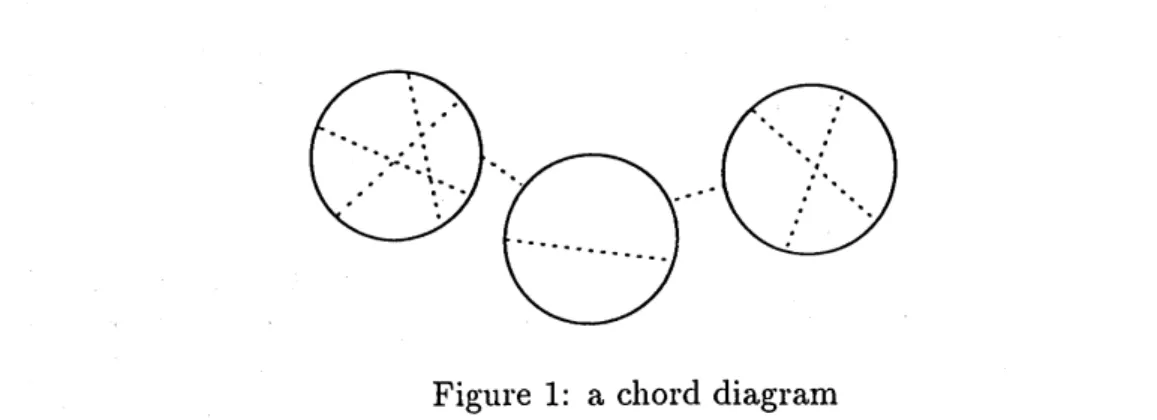
A chord diagram is a collection of finitely many oriented circles with finitely many chords attached on them, regarded up to orientation preserving diffeomorphisms of the circles. Herewe assumethat the endpoints of the chordsaredistinct and lie
on
thecircles. The chords are depicted by dashed lines as in Figure 1.Figure 1: a chord diagram
Let $D$ be a chord diagram. We consider acontinuous map $\gamma$ : $Darrow\Sigma$ and wedenote by
$[\gamma]$ its free homotopy class. We call such $[\gamma]$ a chord diagram on $\Sigma$
.
Up to homotopy weshrink the chords on $\Sigma$ as shown in Figure 2 to get loops with transversal intersections.
We represent $[\gamma]$ by loops with specified vertices. Here the vertices correspond to the
shrunk chords as depicted in Figure 2.
Figure 2: shrinking chords on tlue torus
We denote by $D_{\Sigma}$ the complex vector space spanned by all chord diagrams on $\Sigma$ and
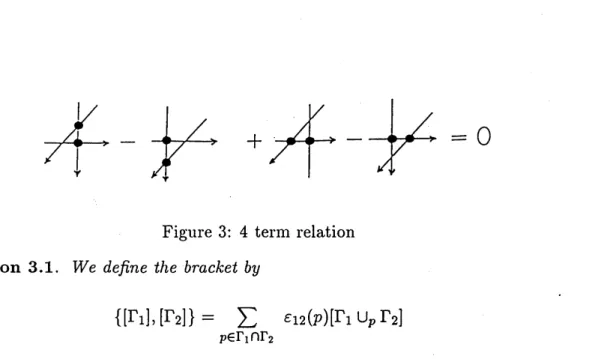
by $A(\Sigma)$ its quotient space lnodulo 4 $\mathrm{t}\mathrm{e}\Gamma \mathrm{n}\mathrm{l}$ relations as depicted in Figure 3.
As was explained by Reshetikhin in [R], $A(\Sigma)$ has a structure of a Poisson algebra in
the following way. Let $\Gamma_{1}$ and $\Gamma_{2}$ be chord diagranus on $\Sigma \mathrm{w}1_{1}\mathrm{e}\mathrm{r}\mathrm{e}$ the chords are $\mathrm{s}\mathrm{l}\mathrm{l}\mathrm{r}\mathrm{U}\mathrm{n}\mathrm{k}$
and are represented by the specific vertices as explained above. We suppose that $\Gamma_{\mathrm{I}}$ and
$\Gamma_{2}$ intersect transverselyon $\Sigma$. Let
$p$ be one of the intersections of$\Gamma_{1}$ and $\Gamma_{2}$
.
We denoteby$\Gamma_{1}\bigcup_{p}\Gamma_{2}$ the chord diagram on $\Sigma$ wllich is the union of$\Gamma_{1}$ and $\Gamma_{2}$, with
$p$ considered to
be the specific vertex$\mathrm{c}\mathrm{o}\mathrm{r}\mathrm{r}\mathrm{e}\mathrm{s}\mathrm{I}$)
$\mathrm{o}\mathrm{n}\mathrm{d}\mathrm{i}\mathrm{n}\mathrm{g}$to a $\mathrm{s}\mathrm{l}_{1}\mathrm{r}\mathrm{U}\mathrm{n}\mathrm{k}_{\mathrm{C}}1_{1\mathrm{o}\mathrm{r}}\mathrm{d}$. For a chord diagram $\Gamma$ we denote
$=0$
Figure 3: 4 term relation Proposition 3.1. We
define
the bracket by$\{[\Gamma_{1}], [\Gamma_{2}]\}=\sum_{\Gamma_{2}p\in\Gamma_{1^{\cap}}}\epsilon_{12}(p)1^{\Gamma_{1}\bigcup_{p}}\mathrm{r}_{2}]$
where$\epsilon_{12}(p)$ is set to be 1 or-l according as the way
of
intersection as shown in Figure$\mathit{4}a$
.
Then the above bracket is anti-symmet$7\dot{T}C$ andsatisfies
the Jacobi identity.– $)$ $($
$\epsilon_{12}(p)=1$ $\epsilon_{12}(p)=-1$
$4b$ $4a$
Figure 4
Let $A^{n}(\Sigma)$ denote the subspace of $A(\Sigma)$ spanned by the chord diagrams on $\Sigma$ with
$n$ circles. Then $A^{n}(\Sigma)$ is a graded vector space $\oplus_{k\geq 0}.A_{k(\Sigma}n$) where $A_{k}^{n}(\Sigma)$ is the subspace
spanned by the chord diagranls on $\Sigma$ with $n$ circles and $k$ chords.
We observe that the quotient space of $A^{1}(\Sigma)$ by the ideal spanned by the diagrams
which look locally as depicted in Figure $4\mathrm{b}$ is the Poisson algebra structure on the free
$1\mathrm{l}\mathrm{o}\mathrm{n})\mathrm{o}\mathrm{t}\mathrm{o}\mathrm{p}\mathrm{y}$classes ofloops on $\Sigma$ introduced by Goldman [G].
Let $D$ be achord diagram with $n$ oriented circles $C_{1},$ $C_{2},$$\cdots$ , $C_{n}$ and $\gamma$ : $Darrow\Sigma$ a chord
diagramon$\Sigma$, considercd up to freeholnotopy. Asin$\mathrm{t}1_{1}\mathrm{e}$previous paragraph weshrinkthe
chordson $\Sigma$ and represent$\Gamma=[\gamma]$ by
$n$ loops on $\Sigma$ with transversal intersectionsand with
the specified vertices corresponding to the shrunk chords. We assign finite dimensional
representations $R_{j}$ : $Garrow Aut(V_{j}),$ $1\leq j\leq n$, and the associated representations of the
Lie algebra are denoted by $r_{j}$ : $\mathrm{g}arrow End(V_{j}),$ $1\leq j\leq n$.
Let $\phi$ be a flat $G$ connection on $\Sigma$. Associated $\mathrm{w}\mathrm{i}\mathrm{t}1_{1}\phi$ and the above representations
$r_{j}$ : $\mathrm{g}arrow End(V_{j}),$ $1\leq j\leq n$, we definc a function $\mathcal{T}_{\phi}$ : $A^{n}(\Sigma)arrow \mathrm{C}$ in the following
We show it graphically as in Figure $5\mathrm{a}$. The invariant bilinear form $B$ : $\mathrm{g}\cross \mathrm{g}arrow \mathrm{R}$
defines $\Omega\in \mathrm{g}\otimes \mathrm{g}$ by identifying $\mathrm{g}$ with its dual, which is shown graphically as in Figure
$5\mathrm{b}$ associated to each chord. By the endpoints of the chords, each oriented circle $C_{j}$,
$1\leq j\leq n$, is divided into several arcs $C_{jk},$$k=1,2,$$\cdots$
.
Considering the holonomy alongthe path $\gamma(C_{jk})$ on $\Sigma$ we obtain a linear map
$Hol_{\gamma()j}c_{j}k$
:
$Varrow V_{j}$, which is considered tobe an element of $V_{j}^{*}\otimes V_{j}$ and is shown graphically as in Figure $5\mathrm{c}$
.
Our way ofdefining $\mathcal{T}_{\phi}(\Gamma)$ is quite similar to the method to define the weight system in
[BN]. Contracting the above three kind oftensors according to the chord diagram on $\Sigma$
we obtainascalar which is denoted by $\tau_{\phi}(\mathrm{r})$
.
We call $\mathcal{T}_{\phi}(\Gamma)$ the weight system associatedwith the holonomy $\phi$ and the representations
$r_{j}$ : $\mathrm{g}arrow End(V_{j}),$ $1\leq j\leq n$. We have the
followingproposition.
$- \mathrm{g}$
$\mathrm{g}$ $\mathrm{g}$
$5a$ $5b$
Figure 5: graphical representation of the tensors
Proposition 3.2. The above $\tau_{\phi}(\mathrm{r})$ is compatible with the
4
term relation anddefines
amap
$\mathcal{T}_{\phi}$ : $A^{n}(\Sigma)arrow \mathrm{C}$.
Let us go back to the case of the torus. We are going to discuss a slightly modified
versionoftheabove general $\mathrm{f}_{\Gamma \mathrm{a}1}\mathrm{n}\mathrm{e}\mathrm{w}\mathrm{o}\mathrm{r}\mathrm{k}$ in tlle case ofthe torus. Let
$E=\mathrm{C}/\mathrm{Z}+\mathrm{Z}\tau$ be an
elliptic curve with the basis $\lambda,$
$\mu$ of$H_{1}(E, \mathrm{Z})$ as in the previous section. Let $\mathrm{g}$ be the Lie
algebra $sl(N, \mathrm{c})$ andwe fix representations $\pi_{j}$ : $\mathrm{g}arrow End(V_{j}),$$1\leq j\leq n$. TheHeisenberg
group $H_{N}$ acts naturallyon $V_{j}$ by$\mathrm{n}\mathrm{l}\mathrm{e}\mathrm{a}\mathrm{n}\mathrm{S}$of theenubedding $\iota$
:
$H_{N}arrow GL(N, \mathrm{C})$ defined bythematrices$A_{1}$ and $A_{2}$ as in Section 2. Weconsider the projectively linear representation
$\alpha$
:
$H_{1}(E, \mathrm{Z})arrow Aut(V_{j}),$ $1\leq j\leq n$ defined by $\lambda\mapsto A_{1}$ and $\murightarrow A_{2}$.
More precisely, weconsider the representation of tlle Heisenberggroup $\tilde{\alpha}$
:
$H_{N}arrow Aut(V_{j})$, by corresponding
to each element $x$ of $H_{1}(E, \mathrm{Z}_{N})$ the linear transfornlation $\rho(s(x))$, where $s$ is as defined
in Section 2.
Let $\Gamma$ be a chord $\mathrm{d}\mathrm{i}\mathrm{a}\mathrm{g}\mathrm{r}\mathrm{a}\ln$ on the torus with $n$ circles. Tllen, by lneans of the process
of the contraction of$\mathrm{t}1_{1}\mathrm{e}$ tcnsors
$\mathrm{u}\mathrm{s}\mathrm{i}\mathrm{l}$ the above $1^{\cdot}\mathrm{e}\mathrm{p}\mathrm{r}\mathrm{e}\mathrm{s}\mathrm{c}\mathrm{n}\mathrm{t}\mathrm{a}\mathrm{t}\mathrm{i}\mathrm{o}\mathrm{n}\mathrm{s}\pi_{j},$$1\leq j\leq n$, and the
projectively lineal$\cdot$
$\mathrm{r}\mathrm{e}\mathrm{p}_{\mathrm{l}\mathrm{e}\mathrm{s}\mathrm{C}}\mathrm{n}\mathrm{t}\mathrm{a}\mathrm{t}\mathrm{i}_{\mathrm{o}\mathrm{n}}\alpha$ of $H_{1}(E, \mathrm{Z}_{N})$, wc obtain a scalar, which is delloted
by $\mathcal{T}(\Gamma)$. Let us notice $\mathrm{t}\mathrm{l}$
)$\mathrm{a}\mathrm{t}$ since
olll$\cdot$
$\mathrm{r}\mathrm{e}\mathrm{p}_{\mathrm{l}\mathrm{e}\mathrm{s}\mathrm{e}\mathrm{n}}\mathrm{t}\mathrm{a}\mathrm{t}\mathrm{i}\mathrm{o}\mathrm{n}$of the fundamental group of the
torus is projectively linear, $\mathcal{T}(\Gamma)$ is only well-defined up to a $\mathrm{n}\mathrm{u}\mathrm{u}\mathrm{l}\mathrm{t}\mathrm{i}\mathrm{p}\mathrm{l}\mathrm{i}_{\mathrm{C}}\mathrm{a}\mathrm{t}\mathrm{i}\mathrm{o}\mathrm{I}1$ of a N-th
So far, we have represented the chord diagranl on the torus by shrinking the chords.
To compute $\mathcal{T}(\Gamma)$ using the chord diagram with chords not necessarily shrunk, we notice
that for$v\in V,$ $w\in V^{*},$ $g\in H_{N}$ and $X\in \mathrm{g}$wehave $<w,$$X(gv)>=<gw,$$Ad(g)x(v)>$
.
The above adjoint action ofthe Heisenberg group is exactly the
same
as in (1.8).4. Vassiliev invatiants
Let us recall the definition ofan invariantoffiniteorderfororientedlinks in anoriented 3-manifold $M$ following [BL]. Any $\mathrm{C}$ valued invariant
$v$ oforiented links in $M$ can be
ex-tended to be an invariant ofimmersed circles in $M$, which are allowed to have transversal
intersections, using the rule:
$=$ $v(/\backslash ^{\nearrow})$
Here we think of the above graphs as parts ofbigger graphs which are identical outside
a small sphere. Let $k$ be a non-negative integer. An invariant
$v$ of oriented links in
$M$ is called an invariant of order $k$, if $v$ vanishes on singular links with more than $k$
intersections. An invariant $v$ of oriented links in $M$ is called a Vassiliev invariant, or an
invariantoffinite order, if it is of order $k$ for some non-negative integer $k$. We denote by
$\mathcal{V}_{k}$ the vector space of$\mathrm{V}\mathrm{a}s$siliev invariants
of order $k$ for oriented links in $M$
.
The spaceofall $\mathrm{V}\mathrm{a}s$siliev invariants
$\mathcal{V}=\bigcup_{k\geq 0}\mathcal{V}_{k}$. is a vector space with the increasing filtration
$v_{0\subset}v_{1}\subset\cdots \mathcal{V}_{k}$. $\subset\cdots$ (4.1)
Let us now consider the case when $M$ is the product ofa closed oriented surface $\Sigma$ and
the unit interval $I=[0,1]$. We have a natural projection map $p:Marrow\Sigma$. Let $L$ be an
oriented link with $n$ components in $M=\Sigma\cross I$. Projecting $L$ onto $\Sigma$ by
$p$, we obtain a
link diagran) drawn on $\Sigma$. The notion ofthe franling is well-defined for links in
$\Sigma\cross I$.
Let $\mathcal{V}_{k}^{n}.(\Sigma)$ denote the space of all $\mathrm{C}$ valued invariants
of order $k$ for oriented framed
links in $\Sigma\cross I$. For a chord diagram $\Gamma$ on $\Sigma$ we define $w(v)(\Gamma)\in \mathrm{C}$ by
the rule:
It can be checkedthat the above $w(v)$ is compatible with the 4 term relation and is called
the weight system associated with the invariant $v$
.
This induces a map$w:\mathcal{V}_{k()}^{n}\Sigma/v_{k-1}^{ll}(\Sigma)arrow Hom\mathrm{c}(A^{n}k(\Sigma), \mathrm{C})$
.
(4.2)In the previous section we have shown that associated with representations of a Lie
group $R_{j}$
:
$Garrow Aut(V_{j}),$ $1\leq j\leq n$, and a flat $G$ connection $\phi$ on$\Sigma$, we can define
$\mathcal{T}_{\phi}\in Hom_{\mathrm{C}}(A^{n}k(\Sigma), \mathrm{C})$
.
From the viewpoint of the Chern-Simons perturbative theory itwould be natural to ask ifone can integrate $\mathcal{T}_{\phi}$ to construct a Vassiliev invariant $v$ such
that $w(v)=\mathcal{T}_{\emptyset}$
.
We now go back to the case of the torus with the projective local system defined in the previous section. For a chord diagram $\Gamma$ on the elliptic curve $E=\mathrm{C}/\mathrm{Z}+\mathrm{Z}\tau$ we
have defined the weight $\mathcal{T}(\Gamma)$ satisfying the 4 term relation. We are going to construct
a Vassiliev invariant $v$ of an oriented framed link in $E\cross I$ satisfying $w(v)=\mathcal{T}$
.
Ourmethod is based on the holonomy
‘of
the elliptic KZ system. We refer the reader to [Go] and [S] for a different approach in the case oflinks in a solid torus.Before explaining our construction of Vassiliev invariants for links, let us first describe tangles in $E\cross I$
.
We set $E_{t}=E\cross\{t\}\subset E\cross I,$ $0\leq t\leq 1$.
A tangle $T$ in $E\cross I$ is a one-dimensional submanifold with boundary of $E\cross I$ such that the boundary $\partial T$ iscontained in $E_{0}\cup E_{1}$. Let $J$ denote the segment in $E$ defined as the image of the open interval $(0,1)$ by tlle covering map $\pi$
:
$\mathrm{C}arrow E$. We suppose that $\partial T\cap E_{0}$ and $\partial T\cap E_{1}$consist of distinct pointsin the segment $J$. In the followingwe consider a tangle in $E\cross I$ such that each connected $\mathrm{C}\mathrm{o}\mathrm{n}$)$\mathrm{p}_{\mathrm{o}\mathrm{n}\mathrm{e}\mathrm{n}}\mathrm{t}$ is oriented and framed.
Let $T$ be an oriented framed tangle in $E\cross I$
.
To each connected component$T_{j}$ of$T$, weassign a finite dinuensional representation of $sl(N, \mathrm{c})$. We consider the parameter $t$ for
the unit interval $[0,1]$ as a height function. Deforming the tangle up to regular isotopy,
we may suppose that there exists a partition of the unit interval $0=t_{0}<t_{1}<\cdots<t_{i}<$
$t_{i+1}<\cdot\cdot.\cdot<t_{p}=1$ satisfying the following conditions:
(1) For each $i,$ $1\leq i\leq p,$ $E_{t_{i}}$ intersects transversely with the tangle $T$, and $T\cap E_{t_{i}}$
consists of distinct $\mathrm{p}_{\mathrm{o}\mathrm{i}_{11}}\mathrm{t}\mathrm{s}$ in the segment $J$
.
(2) The restricted tangle $T\cap E\cross[t_{i},$$t_{i+1}1$ is one ofthe following three types. (i) a tangle with only olle lninimal point,
(ii) a tangle with only one nlaximal point,
(iii) a braid of $E$.
Wedenote by$n(i)\mathrm{t}\mathrm{l}\mathrm{l}\mathrm{e}$nunlber of$1$)
$\mathrm{o}\mathrm{i}11\mathrm{t}_{\mathrm{S}}$in$T\cap E_{t_{i}}$ andwcput$T\cap E_{t_{i}}=\{z_{1}, z_{2}, \cdots , z_{n(i)}\}$
with $z_{1},$$\cdots$ , $z_{n(i)}\in J$ and $z_{1}<z_{2}<\cdots<z_{\iota(i)},$
.
Let $V_{ij},$ $1\leq j\leq n(i)$, be the$\dot{?}$ $\dot{r}\neq 1$
$.\cdot...\cdot.\cdot.\cdot..|.\cdot...\cdot...\cdot...\cdot.\cdot$
$.\cdot..\cdot s_{i}+\epsilon t_{i+1}t_{i}si$
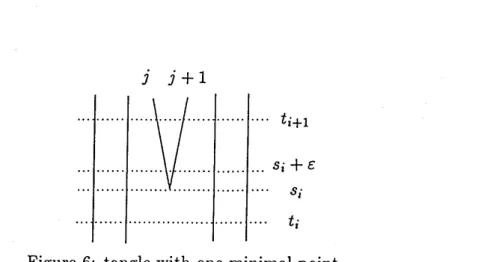
Figure 6: tangle with one minimal point
correspond to $z_{j}\in T\cap E_{t_{i}}$ the representation $V_{ij}^{\epsilon(i)}$, where $\epsilon(i)$ is 1 or-l according as $T$
passes through $E_{t_{i}}$ downward or upward. The notation $V_{ij}^{\epsilon}$ stands for $V_{ij}$ if $\epsilon=1$ and for
the dual representation of$V_{ij}$ if $\epsilon=-1$.
For each $t_{i},$ $1\leq i\leq p$, we consider the tensor product
$V(t_{i})=V^{(1}\otimes i1i2\otimes\cdots\otimes\epsilon)(2V^{\epsilon})\epsilon(n(iVi,n(i)^{)})$
.
(4.3)Let us denote by $T_{i,i+1}$ the tangle $T$ restricted to the interval $[t_{i}, t_{i+1}]$. We are going to
construct a map
$Z_{i}^{i+1}$
:
$V(t_{i})arrow V(t_{i+1}),$ $0\leq i\leq p-1$. (4.4)Our construction is quite sinlilar to the well-known one due to Reshetikhin and Turaev
[RT] and others, except that we are considering braids of the torus.
Ill the case when the tangle $T_{i,i+1}$ is a braid of the torus, we assign the linear map
$Z_{i}^{i+1}$ : $V(t_{i})arrow V(t_{i+1})$ obtained as the holonomy of the elliptic KZ system.
Let us now consider the case when the tangle $T_{i,i+1}$ contains only one minimal point
at $t=s_{i},$ $t_{i}<s_{i}<t_{i+1}$ as shown in Figure 6. We set $V(s_{i})=V(t_{i})$ and to the tangle
restricted to $[t_{i}, s_{i}]$ we assign the identitymap. We denote by $\cup$ the tangle $T$ restricted to
$[s_{i}, t_{i+1}]$. Let$\epsilon$ be asufficiently snuallpositive number andwedecompose the
tangle$\cup$ into
2 parts, $[s_{i}, s_{i}+\epsilon]$ and $[s_{i}+\epsilon, t_{i+1}]$. We denote by $\bigcup_{\mathcal{E}}$ the tangle restricted to $[s_{i}+\epsilon, t_{i+1}]$
.
To the tangle $\bigcup_{\mathcal{E}}$ we assign the linear map $f_{\epsilon}$ : $V(s_{i}+\epsilon)arrow V(t_{i+1})$ obtained as the
holonolny of the elliptic KZ system. We have a natural injection $e$ : $V(s_{i})arrow V(s_{i}+\epsilon)$
deternuined by the canollical enlbedding $\mathrm{C}arrow V_{ij^{(j)}}^{\epsilon}\otimes V_{i,j+}^{\xi}(j+1)1$
.
Here $V_{i,j+1}^{\epsilon(j)}+1$ is the dual representation of $V_{ij}^{\epsilon(j)}$.
We defille$Z( \bigcup_{\epsilon})$ : $V(s_{i})arrow V(t_{i+1})$ to be the composition $f_{\epsilon}\mathrm{o}e$.
We set
$Z( \cup)=1\mathrm{i}_{1,arrow 0}11Z\epsilon(\cup\Xi)\exp(-\frac{\Omega_{j,j+1}}{2\pi\sqrt{-1}\kappa’}\log\epsilon)$
.
(4.5)Investigating the local behaviour of $\mathrm{t}\mathrm{l}\iota \mathrm{c}$ solution of
$\mathrm{t}1_{1}\mathrm{e}$ elliptic KZ system, it can been
shown in a similar way as in [LM] $\mathrm{t}1_{1}\mathrm{a}\mathrm{t}\mathrm{t}1_{1}\mathrm{e}$ above lilnit is convergent. $\mathrm{T}1_{1}\mathrm{i}\mathrm{s}$ construction
defines a linear map
$Z(\cup):V(_{S_{i}})arrow V(t_{i+1})$. (4.6)
In the case when the tangle $T_{i,i+1}$ contains only one maximal point, we define $Z_{i}^{i+1}$ in
a similar way using
$Z( \cap)=_{\epsilon}1\mathrm{i}\mathrm{n}_{0}1\exparrow(\frac{\Omega_{j,j+1}}{2\pi\sqrt{-1}\kappa}\log\epsilon)Z(\bigcap_{\epsilon})$. (4.7)
Now we define $Z(T)$ by the composition $z_{p-1}^{p}\cdots z^{21}1Z_{0}$. Using the integrability of the
elliptic KZ system, we can show in a similar way as in [BN] the following proposition.
Proposition 4.8. For an $\mathit{0}?^{\mathrm{Y}}iented$
framed
tangle $T$ in $E\cross I$, the map $Z(T)$:
$V(\mathrm{O})arrow$ $V(1)$ is invariant by a $hor\dot{\eta}Zontal$ move preserving the framing, up to a multiplicationof
a N-th rootof
unity.Let $L$ be an oriented framed link in $E\cross I$ with $n$ components. To each component $L_{j}$
weassign $V_{j}$, a finite dimensional representationof$sl(N, \mathrm{c})$ and we regard $L$ as acolored
oriented framed tangle. The above construction gives a linear map $Z(L)$ : $\mathrm{C}arrow$ C. We
denote by the same $\mathrm{s}\mathrm{y}\mathrm{n}\mathrm{l}\mathrm{b}_{\mathrm{o}1}Z(L)$, or $Z(L;V_{1}, \cdots, V_{n})$ the complex number $Z(L)(1)$.
Let $C$ be a trivial knot with $0$-franing possessing 2 minimal points and 2 maximal
points. We put $\gamma_{j}=Z(C;V_{j})$. As in [K] (see also [BN] and [LM]), wenormalize $Z(L)$ as
$\hat{Z}(L)=\gamma 1’\gamma\gamma\iota-n1\ldots-m_{1},Z(L)$, (4.9)
where $m_{j},$ $1\leq j\leq n$, is the number ofmaximal points on the j-th component of$L$. The
above $\hat{Z}(L)$ has an expansion with respect to $h=\kappa^{\wedge^{-1}}$ of the form
$\hat{Z}(L)=\hat{Z}_{0}(L)+.\sum_{k>0}\hat{Z}_{k(}L)h^{k}$. (4.10)
Theorem 4.11. Let $L$ be an $\mathit{0}$riented
framed
link in the productof
an elliptic curve$E$ and the unit inte$7^{\vee}ual$ I. Then,
$u_{I}$’ to a multiplication
of
a N-th rootof
unity, $\hat{Z}(L)$satisfies
the following properties.(1) $\hat{Z}(L)$ is a regularisotopy inva$7\dot{2}$ant
of
$L$.
(2) $\hat{Z}_{k\backslash }(L)$ is a Vassiliev inva$7\dot{\tau}ant$
of
order$k$.
(3) For$\Gamma$ a chord diagram on $E$ with $k$ chords, we have $w(\hat{Z}_{k}.)(\mathrm{r})=\mathcal{T}(\Gamma)$
.
Proof: To show $\mathrm{t}1_{1}\mathrm{c}\mathrm{a}\mathrm{s}\mathrm{s}\mathrm{c}1^{\cdot}\mathrm{t}\mathrm{i}_{0}\mathrm{n}(1)$, it is $\mathrm{c}\mathrm{n}\mathrm{o}\iota \mathrm{l}\mathrm{g}\mathrm{l}\mathrm{l}$ to verify $\mathrm{t}1_{1}\mathrm{a}\mathrm{t}\hat{Z}(L)$ is invariant under
vertical moves $\mathrm{p}_{\mathrm{l}\mathrm{e}\mathrm{S}}\mathrm{e}1^{\cdot}\mathrm{v}\mathrm{i}\mathrm{n}\mathrm{g}$the fianling. Let $L’$ be the
$1\mathrm{i}_{11}\mathrm{k}$ obtained by the $\mathrm{n}$)$\mathrm{o}\mathrm{v}\mathrm{e}$ on the
point. Then we have $Z(L’)=\gamma_{j}Z(L)$. Thus $\hat{Z}(L)$ is invariant under the above move.
Using this, in a similar way as in [BN], one can conclude that $\hat{Z}(L)$ is a regular isotopy
invariant. Theassertion (2) followsdirectly from thedefinitionofinvariantsoffiniteorder
and the expression ofthe holonomy ofthe elliptic KZ system given as in Proposition 2.7.
Finally, to evaluate$w(Z_{k})$ on achord diagram $\Gamma$ with $k$ chords, wenotice thatthe l-form
$\omega$ is written in the fornu as in (2.5) and that the local monodromy along
$z_{i}=z_{j}$ is given
by $\Omega_{ij}/\kappa$. Comparing with the definition of $\mathcal{T}(\Gamma)$, we obtain the assertion (3). This completes the proof.
Remark Ifthelink $L$iscontained in a3-ball, thenitis clearthat ourinvariants coincide with usual Vassiliev invariants oforiented framed links in $\mathrm{R}^{3}$ for $sl(N, \mathrm{c})$
.
REFERENCES
[BN] D. Bar-Natan, On Vassiliev knot$inva\dot{n}ant_{S}$, Topology 34-2 (1995), 423-472.
[B] A. A. Belavin, Discrete groups and the integrability ofquantumsystems, Funkts. Anal. 14-4 (1980),
18-26.
[BD] A. A. Belavin and V. G. Drinfel’d, Solutions ofthe classical Yang-Baxter equationforsimple Lie
algebras, Funkts. Anal. 16-3 (1982), 1-29.
[BL] J. S. BirmanandX.-S. Lin, Knotpolynomials and Vassiliev’s invariants, Invent. Math.
111.
(1993),225-270.
[Ch] I. Cherednik, Generalized braid groups and local$r$-matrix systems, Sov. Math. Dokl. 307 (1990),
43-47.
[CFW] M. Crivelli, G. Felderand C. Wieczerkowski, Generalized hypergeometricfunctions on the torus
and adjoint representationof$U_{q}(sl_{2})$, Lett. Math. Phys. 30 (1994), 71-85.
[E] P. Etingof, Representations of affine Lie algebras, elliptic $r$-matrix systems, and special functions,
Commun. Math. Phys. 159 (1994), 471-502.
[G] W. M. Goldman, Invariantfunctions on Lie groups and Hamiltonian fl,ows of surface group repre-sentations, Invent. Math. 85 (1986), 263-302.
[Go] V. Goryunov, Vassiliev type invariants in Arnold’s $J^{+}$-theory of plane curves without direct
self-tangencies, preprint, UniversityofLiverpool, 1995.
[Kol] T. $\mathrm{I}\zeta \mathrm{o}\mathrm{h}\mathrm{n}\mathrm{o}$, S\’eriedePoincare’-Koszulassoci\’eeaux groupesde
tresses pures, Invent. Math. 82 (1985),
57-75.
[Ko2] T. $\mathrm{I}\langle \mathrm{o}\mathrm{h}\mathrm{n}\mathrm{o}$, Monodromy representations
of braid $g_{\Gamma ou}l^{)s}$ and Yang-Baxter equations, Ann. Inst.
Fourier 37 (1987), 139-160.
[Ko3] T. Kohno, Vassiliev invariants and de Rll.am complex on$t/\iota e$ space
ofknots, Contemp. Math. 179
(1994), 123-138.
[K] M. Kontsevicll, Vassiliev’sknot invariants, Advancesin Soviet Matllenlatics 16 (1993), 137-150.
[LM] Le Tu Quoc Tllangaltd Jun Murakami, Representation ofthe category oftangles by Kontsevich’s
iterated integral, preprint, 1994.
[R] N. Y. Reshetikhin, Lecture given at Tokyo Institute of Technology, December,
1994.
[RT] N. Y. Reshctikhin and T. G. Ttlracv, Ribbon $grap\prime_{l}s$ and their invariants deived from quanium
groups, Commun. Math. Phys. 127 (1990), 262-288.
[S] Y. Suetsugu, Kontsevich invariantfor links in a donut and links ofsattelitefom, preprint, Osaka
University, 1995.
[V] V. A.Vassiliev, Cohomology ofknot$s_{l}$)aces,Tlleory ofsingularities $\mathrm{a}\mathrm{l}\iota \mathrm{d}$its
apl)$\mathrm{l}\mathrm{i}\mathrm{c}\mathrm{a}\iota \mathrm{i}\mathrm{o}\mathrm{n}\mathrm{S}$, Amer. Math.
Soc. (1992).
$\mathrm{D}\mathrm{e}_{1^{)\mathrm{a}\mathrm{r}}}\mathrm{t}\mathrm{m}\mathrm{e}\mathrm{p}\mathrm{t}$ofMatllematicad Sciences, Ulliversity of Tokyo, $\mathrm{I}_{\mathrm{C}}’\mathrm{o}\mathrm{I}\mathrm{n}\mathrm{a}[_{)\mathrm{a}}$,
Meguro-ku, Tokyo 153, Japan