Japan Advanced Institute of Science and Technology
JAIST Repository
https://dspace.jaist.ac.jp/Title Using the Concept of Serendipity in Education
Author(s) Sawaizumi, Shigekazu; Katai, Osamu; Kawakami, Hiroshi; Shiose, Takayuki
Citation
Issue Date 2007-11
Type Conference Paper
Text version publisher
URL http://hdl.handle.net/10119/4087
Rights
Description
The original publication is available at JAIST Press http://www.jaist.ac.jp/library/jaist-press/index.html, KICSS 2007 : The Second International Conference on Knowledge, Information and Creativity Support Systems : PROCEEDINGS OF THE CONFERENCE, November 5-7, 2007, [Ishikawa High-Tech Conference Center, Nomi, Ishikawa, JAPAN]
Using the Concept of Serendipity in Education
Shigekazu Sawaizumi† Osamu Katai‡ Hiroshi Kawakami* Takayuki Shiose**
† ‡ * **Graduate School of Informatics, Kyoto University,
Department of Systems Science
†[email protected]
‡ * ** {katai, kawakami, shiose}@i.kyoto-u.ac.jp
Abstract
The word "serendipity" was introduced to the field of science by Merton while studying the progress of science and noticed that accidental discoveries often contributed to its progress. We have developed a serendipity-card system to increase discovery encounters because we be-lieve the concept of serendipity works in the re-lations of subjects.
In education, when students experience the sat-isfaction of finding something by themselves through serendipitous patterns, their motivation for research is raised since they have an interest in and responsibility for particular subjects. The purpose for using the concept of serendipity is not to obtain high efficiency but to think about "the deepness in events," as suggested by Katai. Consequently, discovery encounters are to be increased in such environments.
We introduce a curriculum called "Serendipity and Creativity" to use serendipity in education with support theories for making accidental dis-coveries.
In the era when computers and manuals take away the time of consideration from human be-ings in programmed fields, the practical use of serendipity recovers a habit of observation and consideration.
Keywords: discoveries, serendipity,
acci-dents, sagacity, MOT
1 Introduction
Serendipity was coined in 1754 by Horace Walpole based on a fable called the Pilgrimage of Three Princes of Serendip [1]. Robert K. Merton introduced the concept of serendipity to science
[2] after noticing that its progress reflected the contribution of discoveries obtained from unex-pected results. While trying to explain this phe-nomenon, he "serendipitously" found "serendip-ity" in the E.O.D., and he used the term. This term was widely accepted. Norbert Wiener wrote that this trait of the three princes was very vital weapon in the armory of the scientist [3]. In the Journal of Chemical Education, Ronald S. Lenox recommended the use of this concept in the education for science students [4], writing "Ser-endipitous or chance discovery is one of the im-portant avenues for discovery in science. As such, it is important to recognize it and to educate stu-dents"
We developed a curriculum called "serendipity and creativity" which is ten times of every 90 minutes in MOT education of Toyama Prefec-tural University. The purpose of the curriculum is to experience encounters with discoveries by making hypotheses. In the curriculum, we also practice correlating themes and articles across different disciplines to nourish small notices into significant ones over long period of times, be-cause serendipitous discoveries show similar patterns.
2 MOT Curriculum
The following are main contents of curriculum: a. Introduction of serendipity
b. Quasi-experience of cross-cultural community exercised by games of playing cards
c. Theories of Umberto Eco who describes how easily serendipity happens in cross-cultural communities [5]
d. Significance of preparing an hypothesis that may cause encounters with serendipity
e. Practice making hypotheses
with the introduction of the "KJ Method" and the "NM method"
g. Characteristics of the externalization of a no-tice [7]
h. Semantic networks and the meaning of semi-lattice structure in networks [8]
i. The Small World Network [9], the Strength of Ties [10], the Chance Discovery [11] and the Social Network [12]
j. Value of information and how to adopt it k. Nourishing an hypothesis and discovering significance
l. Verification of an hypothesis using Charles S. Peirce's abduction method [13]
m. Risk management when using serendipity in organizations
Koichiro Hioki wrote that how a solution is ob-tained often effectively amplifies the uncertainty [14]. Many discoveries and inventions have sprung from experiment failures amplifying un-certainty. He argues that obtaining solutions while amplifying uncertainty is necessary, even though the way doesn't exist.
A curriculum that uses the concept of serendipity is one way of the amplifying uncertainty.
3 Concept of Serendipity
Serendipity meant "the faculty of making happy and unexpected discovery by accident" in the time when Walpole coined it [15]. He wrote in his letter "you will understand it better by the deviation than by the definition." The concept of serendipity last over 250 year, since it has gen-erality and mysterious attraction. In a fable 450 years old since the king of Serendip wanted his three princes to complete their educations from first class masters in his palace. But he had no-ticed that a significance of practice in the outside, and he sent them on pilgrimages so that they could look at the world by themselves and through the thoughts of others. The king believed that learning extended beyond the desk. He gave his princes an opportunity to see the relations between the world and themselves.
The concept of serendipity consists of three key words: "discovery", "accident" and "sagacity". Merton, sociologist expanded the concept to academic and scientific fields through a study of the progress of science. A curriculum that ex-ploits serendipity creates more encounters for discovery with the support of the related theories,
in which we relate the works of computers and human beings.
Many scientists and literary figures have recog-nized the significance of the accidental discov-eries based on their own experience of learning something unexpectedly. Still they have not openly embraced the practice to increase seren-dipitous encounters.
We have developed a program that incorporates various theories to utilize the concept of seren-dipity which can be included in most disciplines to add an additional way of thinking.
Margaret Mead described the concept of cyber-netics as a media for exchanging most opinions [16], and we can add that the concept of seren-dipity provides one view for seeing all aspects. In the cases shown below, the concept of seren-dipity sometimes works voluntarily or involun-tarily.
a. Loosening the restraints of the current para-digm for making a new idea
b. Holding the conviction up to the time of suc-cess
c. Having minds that challenge even the most daring cases
d. Meeting an important person for obtaining solutions
e. Making caution or having interests in different disciplines
f. Noticing even a subject's small significance g. Nourishing a subject's great significance Merton pointed out the similarity of the concepts between serendipity and Thomas Kuhn's para-digm shift [17]. The view that normal science does not contribute to scientific advances argued by Kuhn, means the significance of unexpected discoveries like serendipity.
4 Role of Accidents in Discoveries
The role of accidents in discoveries not for only provides an encounter situation, but also frees human beings from the constraints of the current paradigm. How human beings think is usually very limited due to the learning function of the brain that follows precedents. Since an accident loosens thinking, one may have a chance to create an innovative idea. Innovation is often disrupted by a man who succeeded on past jobs demon-strating the difficulty of the loosening constraints of the current paradigm.conviction to execute the invention, while the advancing new technology may assist successful completion. Umberto Eco called this the force of false.
Even though in the long term the results of ser-endipitous encounters are not always positive, a culture that accepts mistakes as challenges to innovation can be properly evaluated to develop serendipity.
We propose the evaluation for using serendipity in three phase times of works, starting, executing, resulting. Because the concept of serendipity lacks steadiness of manual documents, the failure process must be valued in some cases for the following successes. The concept of serendipity has a challenging "high-risk high-return" culture.
5. Serendipity-cards System
The history of science shows that the sagacity makes encounters with a small notice of signifi-cance at the first stage of most discoveries or inventions. We obtain two important messages from it.
One is how to detect a small notice in the first stage. The second is how to nourish it into an effective significance in the second stage.
To solve these two subjects, we propose a ser-endipity-card system that creates relations with many concerns in a semi-lattice structure among notices. Serendipity cards are filled with hy-pothesis formats when one notices something in any encounter, based on Peirce's abduction me-thod.
Serendipity cards have characteristics for in-creasing encounters by themselves with infor-mation concerning subjects due to responsibility and the curiosity of personnel notices. Serendip-ity cards which are small enough to be kept in a pocket can be easily used to record a notice in any situations [6].
We value the externalization of notices, because it allows us to process and intentionally keep them. We can also use computers in many phases of works after externalization for making en-counters with discoveries. D. Green describes this as combining lots of different pieces of data leads inevitably to serendipity, to unexpected discoveries in the Serendipity Machine [18]. The items completed in serendipity cards include theme, hypothesis, the related articles of 5W+1H (who, what, when, where, why, how), result and
date.
Figure 1. Serendipity-Card
Their role of serendipity-cards is the externaliza-tion of notices from our brains. In this stage, an important caution is that a notice to be recoded does not necessarily have great significance, as we spin and weave significance with small no-tices. In the process of thinking, we sometimes do not evaluate the caution and miss a notice. An ideal flowchart of the serendipity-cards sys-tem is shown in Figure 2.
: Using Serendipity Card Accidents
Impression
Externalization Observe Notice withSagacity
Write on Card Naming Hypothesize Recognition ofTheme
File Information InformationSeeking SignificanceMake Correlating
Widen Activity Nourishment Verify Discovery
Review Cards Brain-inventory Evaluate Creativity
Flowchart of
Deed Flowchart ofMeans
Flowchart of Intended
Activity
Flowchart of Phenomenon
Figure 2. Ideal Flowchart of Serendipity-Cards System
After externalization, we nourish notices with many concerns in and out of our disciplines. As an hypothesis declaration creates interest in the results, one easily makes an encounter with any information concerning the hypothesis through a long period of time.
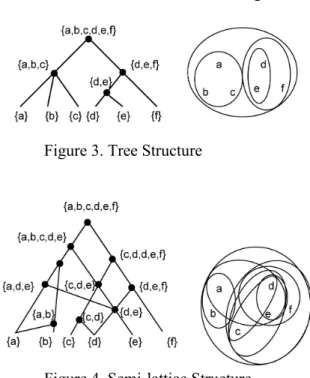
The related articles of 5W+1H help compose the semi-lattice structure, which can result in rich relations with hierarchies on themes and articles. Possible case grammar applications of
exter-nalization are expected to be expanded by com-puters. We are studying articles, but not yet, as Fillmore defined words as agent, counter agent, object, result, instrument, source, goal, and ex-periment [19].
We designed use of the serendipity-cards system to be simple because human beings must think deeply and holistically about their concerns by themselves, as in the pilgrimage of three princes of Serendip. We are aware that simple pondering without concerns results in simple consideration. Whenever the occasion demands, we review the serendipity cards to seek relations among many concerns. While seeking relations in the cards, their subjects are absorbed into our brains or remembered, and these works may affect sub-sequent encounters.
For human beings, high work efficiency is not always good for obtaining useful knowledge based on long term. People do not only follow high efficiency to obtain the results. We allow ourselves to repeatedly review the cards to find
new notices of relations among them.
Figure 3. Tree Structure
Figure 4. Semi-lattice Structure
We named the work of reviewing relations among serendipity cards "brain inventory", since memory after the work easily evokes subjects [6]. A hierarchy among theme and the related articles of 5W+1H constitutes a semi-lattice structure on relations among the cards. When we apply a tree structure or a semi-lattice structure, articles of "why" and "how" may give hints to produce
further hypothesis on the same theme in a dif-ferent hierarchy of a tree structure as shown in Figure 3 or a semi-lattice structure in Figure 4. In case of a tree structure, a hypothesis is led to seek solution in a narrow bottom, while in a case of semi-lattice structure a hypothesis may be led to other branch. Semi-lattice structures may ex-pand the possibility for discovering new relations among cards by computer. An application of small world network is one of an interesting study of encounters. As Green called computers "Serendipity Machines", we expect that com-puters will also play important roles in discovery encounters. Human beings have to play the deep thinking roles in many aspects.
6. Significance of Relations
Since we understand that the significance of most discoveries is in its relations to others, we value the relations among subjects.
O. Katai et al. introduced a novel scheme of eventual structure on individuals called "rhizome of events [8]." In the same paper they also in-troduced a viewpoint on relationalism and Piece's existential graph. The paper shows that coexis-tence structures can be represented by networks where the individuals are expressed by the curved line segments and predicates (relations) as nodes (circles). Leibniz defined the relations: space is the "Order of the co-existence of entities" and time is the "Order of Succession of events." In Newtonian conceptions, they have expressed as "Monochronic Time" and "Polychronic Time." An effective hypothesis is concerned with the subjects by itself in many relations. We make situations where human beings are more con-cerned with others to make encounters with dif-ferent disciplines. Since the works of serendipity are implicit, one must concentrate on making knowledge explicit in any phases of the work. Collaboration between human beings and com-puters may make implicit knowledge to explicit. The concept of the Small World Network pro-posed by Duncan J. Watts [9] partly explains the phenomenon of serendipitous encounters. The theory of the strength of weak ties [10] proposed by Mark S. Granovetter explains significance which correlate or makes clusters, nodes and paths among cards, and causes useful encounters with serendipity.
their spreading activation theory by A. M. Collins and E. F. Loftus [20], which are concerned with the subjects and articles of serendipity cards. "Information visualization and problem finding" reported by Konomu Dobashi utilize hypotheses system to make discoveries with computers [21]. The chance discovery reported by Yukio Ohsawa suggested an important approach that contrasts the viewpoint concerning the effort of human beings. The difference between the serendip-ity-cards system in discovery and other heuristic system is in the purpose. The former exploits human brainpower while the latter wants to effi-ciently discover the objects.
The serendipity-cards system stresses improving human beings. We expect that the results of using the serendipity-cards system will be reflected in human behavior. Human motivations may be raised by the system.
7. The Difference of Role between
Human Serendipity and Computer
In studies of these subjects, we have recognized that the human serendipity is to cope with unex-pected occurrences of events (imagination of relevant events, information or knowledge, evaluation and judgments of processed data by computer), while the computer is to follow pre-specified ways of processing of data or in-formation (combination of data), rearrangements, classification, etc.As the model and format developed for computer shows the simplified way of human action, it is sometimes useful to instruct human beings with these model and format.
The significance that serendipity-cards is ade-quate to catch the characteristic of subjects without judging in binary system of “good or bad,” due to the complex relations of other con-cerns. Consequently, the evaluation of many relevant subjects has chances to be effective in unexpected fields.
Since the necessity of consideration in wide disciplines makes discovery, we give a role to serendipity-card system for seeking correlation with consideration.
8. Reports of Participants and
Con-tinuing Research
Most of the reports from 14 participants of the MOT course showed interest in hypothesizing for serendipitous encounters. Even though none of the great encounters were observed during six-month course, they are still interested in hy-pothesizing about concerned subjects. They re-alized the significance that observations of cir-cumstance provide as a theme to think deeply concerning with others. One established a re-search club to continue the work for utilizing the serendipity system.
We are researching the utilization of case grammar for externalization and the assessment of results for making more encounters with the serendipity-cards system.
9. Conclusion
We have recognized an effectiveness of using the concept of serendipity in education by experience, and developed a curriculum. Many theories re-lated to computer, network, informatics, cogni-tive science and brain science support the effec-tiveness of serendipity analogically. We need objectivity for an assessment of the effectiveness. Since, the concept of serendipity value ability of brain, we have to consider a weight of them. Ideally the bridge between human beings and computer would be constructed from both sides. However, currently the construction is mainly proceeding from the computer side. Computer science is progressing faster than such human sciences as cognitive science and brain science. In such situations, we are using computers to increase efficiency, without considering that human beings may lose the ability to continue research. Since human beings are more creative than computers, we must keep this ability in good use.
Based on the above consideration we proposed serendipity so that we continue using our brains. While recognizing the necessity of computers in many fields as support for human beings, we also need time to think deeply to maintain creativity. Requiring opportunities to think deeply and ponder subjects, creativity is nourished by the concept of serendipity.
When we reach the connecting point of a bridge from both sides of human beings and computers, we will recognize that our targets are identical.
Acknowledgment
Thanks to Ex-president Kyoichi Nakashima, Emeritus professor Tetsutaro Uematsu, Professor Toshiro Matsuda and Professor Toshimi Okada of Toyama Prefectural University for establish-ing and developestablish-ing MOT course.
References
[1] Cristiforo Armeo, Peregrinaggio di tre giovani figliuoli del re di serendippo, Salerno Editrice S.r.l., Roma, 2000
[2] Robert K. Merton and Elinor Barber, The Travels and Adventures of Serendipity, Princeton Univer-sity Press, USA, 2004
[3] Norbert Wiener, INVENTION, The MIT Press, Massachusetts, 1994, pp.21.
[4] Ronald S. Lenox, "Educating for the Serendipitous
Discovery", Journal of Chemical Education,
Vol-ume 62 Number4 April 1985, pp. 282-285. [5] Umberto Eco, Serendipities, Orion, London, 1999. [6] Shigekazu Sawaizumi, Takayuki Shiose, Hiroshi Kawakami, and Osamu Katai, "The Use of
Seren-dipity for Discoveries," IES2005.
[7] Yoshio Miyake, "A thinking aid environment constructing on externalization of individual knowledge structure," Vol. 1994 No. 23, pp.109-116, kIPSJ on demand service, 1994.
[8] O. Katai, T. Ohya, T. Shiose, and H. Kawakami, "Information Edapholoy: A framework for
em-bodying "Nature" in our Cybersociety," WSEAS
Trans. On Information Science and Applications, Vol.10. No.3, pp.1893-1900, 2006.
[9] Duncan J. Watts, "Networks, dynamics and the
small world phenomenon," American Journal of
Sociology, Vol.105, No. 2, pp.493-524,1999. [10] Mark Granovetter, "Strength of Weak Ties,"
American Journal of Sociology, 78, pp.1360-1380, 1973.
[11] Yukio Ohsawa, "Chance Discovery," Springer, Boston, 2002
[12] A-L Baraba'si, R. Albert and H. Jeong,
"Mean-field theory for scale -free Networks," Phisica A,
272, pp.173-187, 1999.
[13] Charles Sanders Peirce, "Chance, Love, and
Logic," Bison Books, USA, 1998, pp.150-153.
[14] Koichiro Hioki, "Nihongata MOT (or MOT in
Japanese style)" (only in Japanese language), Chuo
Keizai Sha, 2005.
[15] W. S. Lewis, "The Yale Edition of Horace Wal-pole's Correspondence, Volume 20," 1960. pp. 407-411
[16] Keizo Sato, "History and Mind of Cybernetics," Revue de la Pensee d'aujourd'hui, April, pp.101-105.2001.
[17] T. S. Kuhn, "The structure of Scientific
Revolu-tions," Chicago Press, Chicago, 1962.
[18] David Green, "The Serendipity Machine," ALLEN & UNWIN, Australia, 2004.
[19] Stuart C. Shapiro, "Encyclopedia of Artifi-cial Intelligence, Second Edition Volume 1," John Wiley & Sons, Inc.,
[20] A. M. Collins and E. F. Loftus, "A spreading
activation theory of semantic processing,"
Psy-chological Review, vol.82, No.6, pp.407-428. 1975.
[21] Konomu Dobashi, "Information Visualiza-tion and Problem Finding", KK Arumu, Nagoya, 2000.