A Class
of
Generalized
Cyclic
Codes
1)
Zhuojun
Liu ([email protected])
Institute
of
Systems Science, Academia Sinica
Beijing 100080, P.
R. China
1. Introduction
Prange was considered to be first people to study cyclic codes in the end of $1950s$, see [3]
and [8]. Since then, cyclic codes are the most studied of all codes, because they are easy
to encode, and include animportant family of BCH codes. A code $C$ is cyclic if it is linear
and if any cyclic shift of a codeword is also a codeword, i.e., whenever $(c_{0}, c_{1}, \ldots, C_{n}-1)$ is
in $C$ then so is $(c_{n-1}, c0, \ldots, cn-2)$. In fact, one could define a cyclic
code to be an ideal in the ring of polynomial modulo $x^{n}-1$. Equivalently, a cyclic code of length $n$ over $F_{q}$
consists of all multiples ofa generator polynomial $g(x)$, which is the monic polynomial of
least degree in thecode, and is a divisor of$x^{n}-1$. That
means
each cyclic code of length $n$willcorrespond to
a
factor of$x^{n}-1$ over$F_{q}$. Therefore, the number of cycliccodes, usuallyis restricted quite a lot, especially we always
assume
that $n$ and $q$ are relatively prime.Instead of $x^{n}-1$, by considering any polynomial $f(x)$ of degree $n$ over $F_{q}$, we could
construct a class of linear codes, one special case of which is cyclic code. $W.e$ may as well
call them to be the generalized cyclic codes, denoted by GCC.
2.
GCC Construction
Suppose $F_{q}$ to be a finite field, and by $F_{q}[x]$ we denote the set of polynomial in $x$ with coefficients from $F_{q}$. It is well known that $R_{n}=F_{q}[x]/(x^{n}-1)$ is a principle ideal ring,
which consists of the residue classes of$F_{q}[x]$ modulo $x^{n}-1$. We associate with the vector
$c=(c_{0}, c_{1}, \ldots, C_{n}-1)$ in $F_{q}^{n}$ the polynomial $c(x)=c_{0}+c_{1}x+\ldots+C_{n-1}Xn-1$ in $R_{n}$. The map
$\phi:c_{01}+cx+\ldots+C_{n}-1Xn-1arrow(_{C_{0},C_{1}}, \ldots, C_{n}-1)$ (1)
defines a 1-1 corresponding between $R_{n}$ and
$F_{q}^{n}$. Now, we want to consider more general
polynomial $f(x)$ of degree $n$ over $F_{q}[x]$ rather than $x^{n}-1$. Let
$f(x)=f_{0}+f_{1^{X}}+\ldots+fnx^{n}$.
1) This workwassupported by the ClimbingProject Fundation of
We always
assume
$f_{n}\neq 0$ in this paper. Define $R_{n}(f)=F_{q}[x]/f$as
the set ofthe residueclasses of $F_{q}[x]$ modulo $f$. Similar with the discussion to $R_{n}(cf[8])$, we
can
show $R_{n}(f)$forms a principle ideal ring. Clearly $R_{n}(f)$ is
a
ring with the operations $of+and^{*}$ underthe modulo $f(x)$.
Given
a.ny
ideal $I$ of $R_{n}(f)$, we select the monic polynomial $g(x)$ of theleast degree in $I$. Then for any $c(x)\in I$,
we
calculate the remainder$c(x)=u(x)*g(x)+r(x)$,
where degree$(g(x))>degree(r(x))$. According to the
selecti.o.
$n$ of$g(x)$, it must be $r(x)=0$,namely
$c(x)=u(_{X})*g(X)$. (2) So, $I$ is a principle ideal. That implies $R_{n}(f)$ is a principle ideal ring. It is easy to know
$g(x)$ is
a
divisor of $f(x)$, since $f(x)\in R_{n}(f)$ satisfies (2). On the other hand, for any factor $g(x)$ of $f(x)$, we define $I$ to be a subset of$R_{n}(f)$ consisting of all multiples of$g(x)$,denoted by $I=<g(x)>.$. It is not hard to
see
$I$ isan
ideal of $R_{n}(f)$. Of course, wecan
also establish
a
1-1 correspondingbetween $R_{n}(f)$ and $F_{q}^{n}$, just like (1), still denoted by $\phi$.Definition 2..1 A linear code of length $n$ over $F_{q}$ with the generating matrix
$G_{n-r,n}=$
(3)is called a generalized cyclic code(GCC), provided $g_{r}=1$.
In fact, for any given polynomial$g(x)\in F_{q}[x]$ of degree $r(\leq n)$ with$g_{r}=1$, there always
exists apolynomial$f(x)\in F_{q}[x]$ of degree $n$, such that $g(x)$ is adivisor of$f(x)$, and $f_{n}\neq 0$.
We have
Lemma 2..1 Suppose $I=<g(x)>\subset R_{n}(f)$, in which $g(x)$ is a monic polynomial of
degree $r$. Then $\phi(I)$ is an $n-r$ dimensional subspace of $F_{q}^{n}$.
Proof. Let
$k=n-r$
. For any $c(x)\in I$, according to (2),we
have$c_{0}+c_{1}x+\ldots+C_{n}-1xn-1$ $=$ $(u_{0}+u1X+\ldots+uk-1^{X^{k}}-1)(g_{0++\ldots+x^{r}}g1Xg_{r})$
$=$ $(u_{0},‘ u_{1}, \ldots, uk-1)$
Combining with (3), this implies
Because of$g_{r}=1$, we have proved $\phi(I)$ is a $k$ dimensional subspace of $F_{q}^{n}$. $\square$
Since Lemma 2..1,
we
usually associate $<g(x)>$a
linear code of $[n, n-r]_{q}$, provided$g(x)\in F_{q}[x]$ with degree $r$ and $g_{r}=1$. This corresponding GCC, according to
Defini-tion 2..1, is also said to be generated by$g(x)$. Furthermore, according to (2), $g(x)$ is called a generator polynomial, $u(x)$
a
message polynomial, $c(x)$ a codeword polynomial.Obvi-ously, any cyclic code oflength $n$ must be a
GCC.
Meanwhile, GCCcan
signifiC.a
ntly give more linear codes.Theorem 2..2 For any $n\geq k$, there exist $q^{r}$ GCC with parameters of $[n, n-r]_{q}$.
Proof. Clearly, in $F_{q}[x]..’$. there are exact $q^{r}$ different polynomials in the following form
.
$g(x),=g_{0}+g_{1}x+\ldots+g_{r}-1X^{r-}+x^{r}1$. (4)Now, suppose $b(x)$ is another monic polynomial of degree $r$. Below, we only need to
prove $<g(x)>\neq<b(x)>$, if $g(x)$ $\neq b(x)$. However, this is clearly true. Otherwise,
$<g(x)>=<b(x)>impliesb(x)\in<g(x)>$
.
By (2), it must be $b(x)=g(x)$. $\square$3. Some Applications of GCC
Double-Byte Error-Correcting codes are great important since their significant appli-cation to computer industry. By a theorem(theorem 3.1 in [1]), we know there exists a
linear code of $[9, 2, \geq 5]_{3}$. Here, GCC can give more support to [1]. In fact, according to
Theorem 2..2, there exist $3^{5}=243$ GCCs of $[9, 4]_{3}$. By a searching algorithm described in
Section 4, one can find four ofthem have the minimum distance of5. They are generated by
$x^{5}+2x^{3}+x^{2}+2x+2$,
$x^{5}+2x^{3}+2x^{2}+2x+1$,
$x^{5}+x^{4}+2X^{3}+X+22$, $x^{5}+2x^{4}+2x^{3}+2x^{2}+1$
respectively. The corresponding generating matrix
are
$(0001$ $0011$ $2011$ $2111$ $0211$ $0221$ $0021$ $0002$ $0002\backslash$
,
On the other hand, since 9 and 3
are
not relatively prime, there does not exist cyclic codeswe
can
only geta
cyclic code $[9, 4, 3]_{3}$ generated by $(x+2)^{5}$, which is clearlya
factor of$x^{9}-1=(x+2)^{9}$ mod
3.
For the following discussion, we need to define$D_{q}(n, k)= \max$
{
$d|$ there isa GCC
of $[n,$$k,$$d]_{q}$}.
Proposition 3..1 $D_{q}(n, k)\geq D_{q}(n+1, k+1)$.
Proof. Suppose $g(x)$ is the generator of a
GCC
of $[n+1, k+1, D_{q}(n+1, k+1)]_{q}$. Itsgenerator matrix will have the form,
$G_{k+1,n+1}=$
Clearly, the minimum distance decided by $G_{k,n}$ is at least $D_{q}(n+1, k+1)$. So, $D_{q}(n, k)\geq$
$D_{q}(n+1, k+1)$. $\square$
Proposition 3..2 For any $2^{m}>n>2m$, there exists a
GCC
of $[n, n-2m, \geq 5]_{2}$.Proof. We recall
a
well known results about double-error-correcting BCH code$(for$example, see page 193 in [8]$)$:
$g(x)=M^{(1})(X)M^{(3)}(X)$
generates a cyclic code of
$[2^{m}-1,2^{m}-1-2m, \geq 5]_{2},$$m\geq 3$,
where degree$(g(x))=2m$. In addition, for $\alpha$, a primitive element of $F_{2^{m}}$,
$M^{(1)}(\alpha)M^{(}3)(\alpha)=0$.
By Proposition 3..1, we have
$D(n, n-2m)\geq D(2^{m}-1,2^{m}-1-2m)\geq 5$,
for all $2^{m}-1\geq n>2m$. Thus we have proved our proposition. $\square$
Now, let us consider a $MacWilliams$ problem(page 184 in [8]): How close can
one
get: is there a $[90, 77, 5]_{2}$ code?Since $2^{7}>90>14$, by Proposition 3..2, we can find a GCC with parametersof [90,$76,$ $\geq$
$5]_{2}$. However,
we
willsee
thereare
only cyclic codes of$[90, 76, \leq 4]_{2}$ when wedon not insist
the condition that $n$ and $q$ have to be relatively prime.
Since
over $F_{2}$, we have irreduciblefactorization $x^{90}-1$ $=$ $(_{X^{12}+X^{9}}+1)2(x+X^{3}+112)2(x+x63+1)2(x^{4}+X^{3}+1)2(x^{4}+x+1)^{2}$ $(_{X^{4}+X^{3}+}x^{2}+X+1)2(_{X^{2}+X+}1)2(x+1)^{2}$ $x^{45}-1$ $=$ $(x^{12}+X^{9}+1)(X12+x+13)(X^{6}+X^{3}+1)(X^{4}+x+31)(X+X+14)$ $(_{X^{4}+X^{3}++X}x^{2}+1)(X+X+21)(X+1)$ $x^{15}-1$ $=$ $(X^{4}+X^{3}+1)(_{X^{4}+X+}1)(X^{4}+X+x^{2}+X+13)(X+X+21)(X+1)$ $x^{9}-1$ $=$ $(x^{6}+X^{3}+1)(X^{2}+X+1)(X+1)$
It is not hard to know all factors of$x^{90}-1$ with degree 14 will be a factor either of
$(x^{45}-1)(x-151)=x^{6}+X^{1}+10_{+x}455$
or
$(x^{45}-1)(X^{9}-1)=x^{54}+x^{4}+x+159$
So, any cyclic codes of $[90, 76]_{2}$ must contain $x^{60}+x^{45}+x^{15}+1$ or $x^{54}+x^{45}+x^{9}+1$ as a
codeword polynomial. This shows its minimum distance is at most 4.
4. Comparison of
GCC
and Cyclic
Codes
for
$n=27$
In previous sections, we have
seen GCC
can give better parameters, say $d$, relatived tocyclic codes. The idea to get GCC is simple, the method to construct GCC is straightfor-ward. Below is the outline description of a searching algorithm for GCC.
Algorithm 4..1 $D(n, k,p, g(X))$: Algorithm to decide the minimum distance. Input : $n,$$k,p$(a prime), $g(x)$($a$ generator polynomial);
Output
:
$d$, the minimum distance for a given GCC generated by $g(x)$.Step 1) Construct a generating matrix $G_{k,n}$ from $g(x)$.
Step 2) By seeing all possible codewords to decide $d$.
Stop. $\square$
Algorithm 4..2 Searching Algorithm for
GCC.
Input : $n,$$k,p$;
Output
:
$D_{p}(n, k)$ and the number of corresponding GCCs.Step $O$)$[initiall]$ Set dl $=1,$ $N=0$.
Step $1$)$[initial2]$ Set $PS=al1$ polynomial in $F_{p}[x]$ with degree
$n-k$.
Step $2$)$[selecting]$ Select a $g(x)$ from $PS$, then set $PS=PS-\{g\}$.
Step $3$)$[decidingd]d=D(n, k,p, g(x))$.
Step $4$)$[counting]$ If$d>d1$ then
{dl
$=d,$ $N=1$}
else if$d=dl$ then $N=N+1$.Step $5$)$[continue?]$ If $PS$ not enipty then goto Step 2 else
{output
$N$ and $d$}.
Stop. $\square$
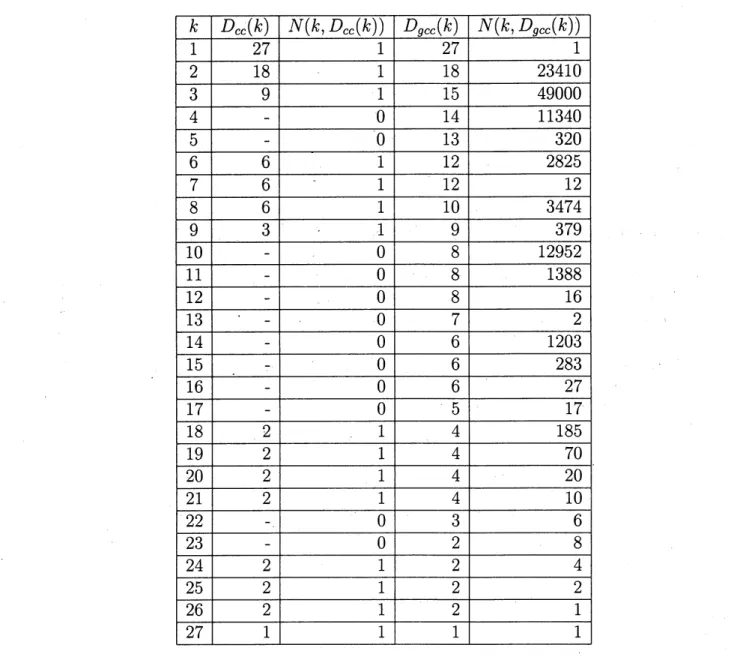
Wewould like to give thoroughcomputationsfor$n=27$tocolnparethe behavior between
Fig. 1. Comparison between binary cyclic codes and GCC with $n=27$.
In Fig.1, $D_{CC}(k)$ means the best minimum distance of $k$ dimensional binary cyclic code.
$N(k, D_{C}c(k))$ is the number of $k$ dimensional binary cyclic codes with minimum distance
$D_{CC}(k)$. Notice, since there is no cyclic codes at all for
some
$k$, the corresponding $D_{cc}(k)$has no definition and $N(k, D_{C}c(k))=0$. Similarly, we define $D_{gcc}(k)$ as the best minimum
distance of $k$ dimensional binary $GCC\backslash ’ N(k, D_{9^{CC}}(k))$ as the number of the possible $k$
dimensional
GCC
with minimum distance of$D_{gcc}(k)$.The experiments show GCC can work much better than cyclic codes.
5.
Conclusion
and Acknowledgement
we presented a method to construct a class ofgeneralized cyclic codes.
Theresearch at this stage shows
GCC
ismuch better than cyclic codes. Meanwhile there are still many questions to be worth of answering forGCC.
For example, isGCC
a class of good linear codes?Can
we find an efficient decoding algorithm for GCC?The author wishes to acknowledge the discussion with Hong DU and Changyan DI while
preparingthe manuscript. Thanks also to Gui Liang FENG forhis suggestion to write this paper and to Fujio Kako to arrange my visiting Japan under the supporting from JSPS.
参考文献
[1] G. L. Feng, X. W. Wu and T. R. N. Rao, ”New Double-Byte Error-Correcting Codes for
Memory Systems,” Proceedingsof$1997IEEE$International SymposiumonInformation
The-ory, Ulm, Germany, 1997. .
[2] V. D. Goppa, ”Geometry andCodes,” inMathematics anditsApplication, vol. 24. Dordrecht,
The Netherlands:Kluwer, 1991.
[3] E. Prange, ”Theuseofinformationsets in decoding cyclic codes,” IEEE Tran. Info. Theory, 8(5), 1962.
[4] M. A. Tsfasman, S. G. $Vl\dot{a}dut,$ ”$Algebraic$-Geometric Codes,” in Mathematics and its
Ap-plications, vol. 58. Dordrecht, The $NetherlandS:KluWer$, 1991.
[5] J. H. Van Lint, ”Algebraic geometric codes,” in Coding Theory and Design Theory, vol.
20($IMA$ Volumes in Mathematics and its Application). $NewYork:Springer$-Verlag, 1988, pp.
137-162.
[6] J. H. Van Lint and G. van der Geer, Introduction to coding theory and algebraic geometry,
DMV Seminar vol. 12, Birkh\"auser Verlag, Basel Boston Berlin, 1990.
[7] Zhe Xian WAN, ”Algebra and Codingtheory”, Scientific Press, Beijing 1980 (in Chinese).
[8] $F.J$. $MacWilliamS$, N.J.A. Sloane, ”The Theoryof Error-Correcting Codes”, North-Holland