交通流の離散モデルにおける数理
龍谷大理工西成活裕 (Katsuhiro Nishinari)
1
Introduction
Traffic phenomena attracts much attention for physicists in recent years. It shows complex
phase transition from free to congested state, and many theoretical models have been
proposedsofar to explain the$\mathrm{t}\mathrm{r}\mathrm{a}\mathrm{n}\mathrm{S}\mathrm{i}\mathrm{t}\mathrm{i}\mathrm{o}\mathrm{n}[1]-[7]$. Among themwewill focusondeterministic
cellular automaton $(\mathrm{C}\mathrm{A})$ models in this paper. CA models are quite simple and has
flexibility, and suitable for computer simulations of discrete phenomena.
The rule-184 $\mathrm{C}\mathrm{A}[8]$ has been widely used as a prototype of deterministic model of
traffic flow, and several variations of it has been proposed. First, Fukui and Ishibashi
proposeda high speed $\mathrm{m}\mathrm{o}\mathrm{d}\mathrm{e}\mathrm{l}[6]$ of the rule-184 CA., i.e., cars move more than one site per
a time if there are enough space ahead. Second. Fuks and Boccaraproposed a $(‘ \mathrm{m}\mathrm{o}\mathrm{n}\mathrm{i}\mathrm{t}\mathrm{o}\mathrm{r}\mathrm{e}\mathrm{d}$
traffic model$\cdot$,
[9], which is considered as a kind of quick start(QS) model. In the model.
driver can see further than just one site forward and he predict that the obstacle car in
front of him will move forward whentwo sites ahead is empty. Thus cars will start quickly
compared with the rule-184 $\mathrm{C}\mathrm{A}$. Third, M.Takayasu and H.Takayasu proposed a slow
start(SlS) $\mathrm{m}\mathrm{o}\mathrm{d}\mathrm{e}\mathrm{l}[10]$, inwhich cars stops at a time cannot move at the next time and wait
one
time step to move forward. This represents an asymmetry of stop and start behaviorof cars. We call these variants as the rule-184 CA family in this paper.
Let us see here real observed data in the Hanshin expressway taken by the Japan
Highway Public $\mathrm{C}_{\mathrm{o}\mathrm{r}}\mathrm{p}_{0}\mathrm{r}\mathrm{a}\mathrm{t}\mathrm{i}\mathrm{o}\mathrm{n}[12]$ . Fig.l shows the flow-density diagram, which is called
the fundamental diagram. We find a discontinuity at the occupancy $\sim 25\%,$ and there
seems
to exist multiple states around the critical occupancy. Many other diagrams showthis type ofgraphs and the flow-density curve shows a shape of”inverse $\lambda$”$[12]$.
There is another observed result that above a certain critical density, a perturbation
on an uniform flow will give rise to the formation of a jam, and “stop-and-go” wave
propagates $\mathrm{b}\mathrm{a}\mathrm{c}\mathrm{k}\mathrm{W}\mathrm{a}\mathrm{r}\mathrm{d}[13]$. This
means
thatcars
accelerate and decelerate alternately inFigurel: Fundamental diagram of the Hanshin expressway taken by the Japan Highway Public Corporation.
are suitable for traffic model. In the rule-184 CA family, only in the SIS model there
are the multiple state near the critical density and the “stop-and-go” wave propagates
backward.
Recently, a multi-value generalization of the rule-184 model has been proposed by
using the ultra discrete $\mathrm{m}\mathrm{e}\mathrm{t}\mathrm{h}\mathrm{o}\mathrm{d}[14]$. The model is
$U_{j}^{t+1}=U_{j}^{t}+ \min(U_{j-1}t, L-Ut)j-\min(U_{j}^{t}, L-U_{j+}t)1$’ (1)
where $U_{j}^{t}$ represents the number ofcars at site$j$ at time $t$, and $L$ is an integer. Each site
are assumed to hold $L$
cars
at most.We
can prove that if $L>0$ and $0\leq U_{j}^{t}\leq L$ for any$j$ at a certain $t$, then $0\leq U_{j}^{t+1}\leq L$ holds for any $j$. (1) is obtained from the Burgers’
equation, and then it is called Burgers $\mathrm{C}\mathrm{A}(\mathrm{B}\mathrm{c}\mathrm{A})[15]$. BCA contains the rule-184 CA
as
a
specialcase
$L=1$. We have introduced the positive integer $L$ in (1), and physicalmeanings of it can be considered as following three ways: first, the road is $L$-lane freeway
we considersingle-lane freeway and $U_{j}^{t}/L$ represents probability of existing ofa car at site
$j$ and time $t$. Third, the length of
one
site is long enough to contain the number of carsat most $L$ in a single-lane freeway. In the Appendix, we have shown a direct proof that
BCA with $L=2$
can
be considered as a two lane model of the rule-184 $\mathrm{C}\mathrm{A}$.BCAdoes not show the multiplestate, but wehave shown that its high speed extension
shows the state aroundthe critical $\mathrm{d}\mathrm{e}\mathrm{n}\mathrm{s}\mathrm{i}\mathrm{t}\mathrm{y}[16]$. The modelis considered as a
one
ofmulti-value generalization of the FI model. This will be treated again in Sec.2.3. Another
models in the rule-184 CA family, such as the SIS model and QS model, have been only
treated as “$0’$’ and “1” CA so far. Thus in this paper, we will generalize the whole
rule-184 CA family to multi-value CAs’, and investigate its properties in detail.
Multi-value generalization of CAs’ has following advantages: we can consider general algebraic
properties ofCAs’ which are free ofparticular properties that comes from two-valueness.
Moreover, by introducing the parameter $L$ we may apply those models with flexibility as
other transport phenomena. such as granular flow and internet packet transportation.
2
Multi-value
generalization
In this section, we will present five CA models, which are multi-value extensions of the
rule-184 family.
2.1
Multi-value
QS model
First, wewill generalize the QS model to a multi-value one. In the model, cars know not
only the number ofvacant spaces in their next site, but also know those in the two sites
ahead. Then cars in the site $j$ know the number of
cars
that can move from the $\mathrm{s}\mathrm{i}\uparrow\lrcorner \mathrm{e}j+1$to $j+2$in the next time, i.e., $\min(U_{j+1}^{t}, L-U_{j+2}t)$, while they do not know it in the BCA.
Thus, vacant spaces at the site $j+1$ is considered to be $L-U_{j+1}^{t}+ \min(U_{j1}^{t}+’ L-U_{j+}t)2$
in this model. Therefore the CA rule in this model is given by
$U_{j}^{t+1}$ $=$ $U_{j}^{t}+ \min(U_{j1}^{tt}-, L-U_{j}+\min(U_{j}t, L-U_{j1}t)+)$
$- \min(U_{j}^{t}, L-U^{t}j+1+\min(U_{j}^{t}+1’ L-Uj+2t))$
This is
a
multi-value extension ofthe QS model. Cars willmove
forward by expectingthat their preceding cars also move forward. From (2),
cars
will move to the next siteby considering the sum of the vacant spaces in next two sites. In the
case
of $L=1$, thismodel corresponds to the rule-3212885888 CA of a neighborhood size “5” by Wolfram’s
terminology [8].
2.2
Multi-value SIS model
In the S1S model, standing cars cannot move
soon
at the next time, and they can moveat two time steps later if there are vacant spaces in their next site. In the multi-value
case, we should distinguish standingcars and movingcars in eachsites, and only standing
cars
need to wait one time step. The number ofcars at the site $j-1$ blocked by cars infront of them at time $t-1$ is represented by $U_{j-1}^{t-1}- \min(Ut-1L-j-1’ U^{t1}j-)$. These cannot
moveat time $t$, then the maximum number ofcars that move to the site$j$ at $t$ is given by
$U_{j-1}^{t}- \{U_{j-1^{-}}^{t-1}\min(U_{j}t-1L-1\cdot-U_{j}^{t-1})\}$. Therefore, considering the number ofcars entering
into and escaping from site $j_{\mathit{1}}$. the multi-value generalized S1S CA is given by
$U_{j}^{t+1}=U_{j}^{t}$ $+$ $\min[U_{j-1}^{t}-\{U_{j-1}^{t1}--\min(U_{j}L-1L-1’-U^{t-1})j\},$$L-U_{j}^{t}]$
$\min[U_{j}^{t}-\{U_{j}^{t-1}-\min(U_{j}t-1, L-Ul-1)j+1\},$ $L-U_{j1}t+)]$ (3)
Wenote that this model includes$\mathrm{T}^{2}$ model in the case $L=1$, which cannot be represented
by the usual Wolfram’s number because time neighborhood size is “3”.
2.3
EBCA2
model
In our previous $\mathrm{p}\mathrm{a}\mathrm{p}\mathrm{e}\mathrm{r}[16]$, we propose the EBCA model which is a high speed extension
of BCA to a velocity “2”, i.e., cars can move two site at a time if the successive two sites
are
not fully occupied. In this paper, we refer the modelas
EBCA2, because we haveassumed that
cars
moving two sites have priority to those movingone
$\mathrm{s}\mathrm{i}\mathrm{t}\mathrm{e}[16]$.EBCA2 is given by
$U_{j}^{t+1}=U_{j}^{t}+ \min(b_{j-1}^{t}+a_{j-2}^{t}, L-U_{j}t+a_{j-1}^{t})-\min(b_{j}^{t}+a_{j-1}^{t}, L-U_{j+1}t+a_{j}^{t})$, (4)
where $a_{j}^{t} \equiv\min(U_{j}^{t}, L-U^{t}L-U^{t})j+1’ j+2$ and $b_{j}^{t} \equiv\min(U_{j}^{t}, L-U_{j+}t)1$. In [16], we study the
section. It is noted that (4) includes the FI model with velocity “2” in the case $L=1$.
which rule number is
3436170432.
2.4
EBCAI model
There is another possibility when we extend BCA to the velocity “2” In contrast to
EBCA2, weconsider that cars movingone site have priority to those which
can
move twosites. This new model is called EBCAI in this paper.
Let us consider the evolutional rule of this model. One time step consists of two
successive procedures. First, cars move according to BCA, i.e., the number of cars at
site $j$ that can move according to BCA rule is given by $b_{j}^{t} \equiv\min(U_{j}^{t}, L-U^{t})j+1$. Ncxt.
only those cars that move one site. which is represented by $b_{j}^{t}$, can move more one site
according to BCA if the site infront of them are not fully occupied. That is, the number
ofcars that move two sites in one time step is given by $\min(b_{j}^{t}. L-U^{t}j+2-b^{t}j+1+b_{j+2}^{t})$.
where the last term in $\min$ representsvacant spaces at site$j+2$ after thefirst procedure.
Therefore, considering the number of cars entering into and escaping from site $j$, the
evolutional rule ofEBCAI is given by
$U_{j}^{t+1}$ $=$ $U_{j}^{t}+b_{j-}^{t}-1b^{t}j$
$+ \min(b_{j-}^{T}2’ L-Ul-jb_{j}^{t}-1+b_{j}^{t})-\min(btL-1’-U_{j}jt+1-b^{t}j+b_{j+1}^{t})$
$=$ $U_{j}^{t}+ \min(b_{j-1}^{t}+b_{j-2}^{t}, L-U_{j}t+b_{j}^{t})-\min(b_{j}^{t}+b_{j-1}^{t}, L-Uj+1t+b_{j+1}^{t})$. (5)
It is noted that (5) of $L=1$ differs from the FI model. EBCAI becomes the
rule-3372206272
CA in the case $L=1$.2.5
Multi-value S1S model with
a
higher
velocity
Let us consider a generalization of the S1S rule to the velocity “2”. To this purpose, we
will consider a model ofa combination of EBCAI and the SIS model. First, we generalize
the slow-start rule. In the
case
of the velocity “2”, standingcars
willmove
at most onesite by the
BCA
rule instead of stopping at the next time step. They can move with thevelocity $‘(2$” only after two time steps later. That is, if once cars stop, then they will
cars can
move at leastone
site at every time step whether they have stopped or not inthe preceding time. The number of standing cars at the site$j-2$ at time $t-1$ is given by
$U_{j-2}^{t-1}-b_{j2}t-1-$, where $b_{j}^{t}$ is the
same
definition as before. These cannotmove
two sites due tothe slow-start rule, then the maximum number ofcars that
can
move
from the site $j-2$to $j$ is given by $\min(U_{j-2^{-}}^{t}(U_{j-2}^{t-1}-b^{t}-1)j-2’ L-U_{j}^{t}-1)$. Therefore, following the discussion
in Sec.3.2 and Sec.3.4, the evolutional rule is given by
$U_{j}^{t+1}$ $=$ $U_{j}^{t}+b^{t}-j-1b^{t}j$
$+ \min(\min(U_{j}^{t}-2-(U_{j-}^{t-1}b_{j}t-1)2^{-}-2’-LU_{j-1}^{t}), L-Ut-b^{t}jj-1+b_{j}^{t})$
$- \min(\min(U_{j}^{t}-1-(U_{j-1}^{t-1}-bt-1)j-1.\mathrm{i})L-U_{j}^{t}, L-U^{tt}j+1^{-b}j+b_{j+1}^{t})$
$=$ $U_{j}^{t}+ \min(U_{j-}^{t}2-Uj-2t-1+b_{j-1}^{t}+b_{j-2}^{t-1}, L-Uj-1t+b_{j-1^{\tau}}^{t}L-U_{j}t+b_{j}^{t})$
$- \min(U_{j-}^{:}1^{-U^{t-1}}j-1+b_{j}^{t}+b_{j-1}^{t-1}, L-U_{j}t+b_{j}^{t}. L-U_{j+1}^{t}+b_{j+1}^{t})$ . (6)
This model becomes a generalization of the $\mathrm{T}^{2}$ model to
the maximum speed “2’ in the
case $L=1$.
3
Fundamental diagram and
multiple
state
The fundamental diagram ofnew CA models discussed in the previous section is studied
in detail in this section. All models in Sec.2 are in conserved form such as
$\triangle_{t}U_{j}^{t}+\triangle_{jq^{t}}=0j$
’ (7)
where $\triangle_{t}$ and $\triangle_{j}$ are forward difference operator with respect to indicatedvariables, and
$q_{j}^{t}$ represents the traffic flow. In the followings, we will consider a periodic road, or a
circuit. The average density $\rho^{t}$ and average flow $Q^{t}$ over entire system is defined by
$\rho^{t}$ $\equiv$ $\frac{1}{KL}\sum_{j=1}^{K}U_{j}^{t}$, (8)
$Q^{t}$ $\equiv$ $\frac{1}{KL}\sum_{j=1}^{K}q_{j}^{t}$. (9)
where $K$ is the number of sites in a period. Since in our models, the average density is a
Fig.2.$\mathrm{A}-\mathrm{E}$
are
the density-flow diagram of each models with $L=2$. We plot theflow $Q^{t}$ for $t=2K$, which is sufficiently long enough to relax an initial configration.
We superpose many values of $Q^{2K}$ starting from random initial conditions in writing the
diagram. We see that in fig.2.B-E there are multiple states around the critical density.
B) A)
C) D)
E)
Figure 2: Fundamental diagram of multi-value CA models. $\mathrm{A}$)$\mathrm{Q}\mathrm{S}$ model
$\mathrm{B})\mathrm{S}\mathrm{l}\mathrm{S}$ model $\mathrm{C}$)$\mathrm{E}\mathrm{B}\mathrm{c}\mathrm{A}2\mathrm{D}$)$\mathrm{E}\mathrm{B}\mathrm{C}\mathrm{A}\mathrm{l}\mathrm{E}$)$\mathrm{S}\mathrm{l}\mathrm{S}$-EBCAI with $L=2$ and $K=100$
.
SIS model. In other models. therelaxation to steady states will be realized in a relatively
short time. From fig.2.$\mathrm{B},$ $\mathrm{D}$ and $\mathrm{E}$, we see that a new small branch exists near critical
density. Stabilities of these branches will be studied in the next section.
$\mathrm{Q}$
Figure 3: Fundamental diagram of EBCAI with $L=1$
.
Fig.3 is the fundamental diagram ofEBCAI with $L=1$. There exist a multiple state
even in the
case
$L=1$. i.e., in the rule-3372206272 $\mathrm{C}\mathrm{A}$. In deterministic two-value CAmodels, only the S1S model proposed by M.Takayasu and H.Takayasu is known to show
metastable state. EBCAI becomes the next example of such kind of models in two-value
$\mathrm{C}\mathrm{A}$.
$0$
Figure 4: Fundamental diagram of EBCA2 with $L=7$
.
of EBCA2 with $L=7$ is given in Fig.4. We see that there are many branches around
the critical density. The small branches, or $‘(\mathrm{h}\mathrm{a}\mathrm{t}$ shapes”
come
from the rule-184 $\mathrm{C}\mathrm{A}$;the two numbers that their sum is $\mathrm{L}$, i.e., $0$ and $L,$ $1$ and $L-1$, etc., evolve like the
rule-184
CA
of the two numbers under EBCA2, and they form the hat shape in thefundamental $\mathrm{d}\mathrm{i}\mathrm{a}\mathrm{g}\mathrm{r}\mathrm{a}\mathrm{m}[15]$. For example, the truth value table of EBCA2 with $L=7$ in
the case $U_{j}^{t}\in\{1,6\}$ is expressed symbolically by
$\frac{U_{j-1}^{t}U_{j}tU_{j+1}^{t}}{U_{j}^{t+1}}=\underline{111},$
$\underline{116},$ $\underline{161},$ $\underline{166},$ $\underline{611},$ $\underline{616},$ $\underline{661},$
$\underline{666}$ .
11166616’
then we see that $U_{j}^{t}\in\{1,6\}$ for all $t$. This is nothing but the rule-184 CA for “$1^{i}$’ and
(
$‘ 6$” and this corresponds to the branch $Q=-\rho+8/7$ in Fig.4.
4
Stability
of flow
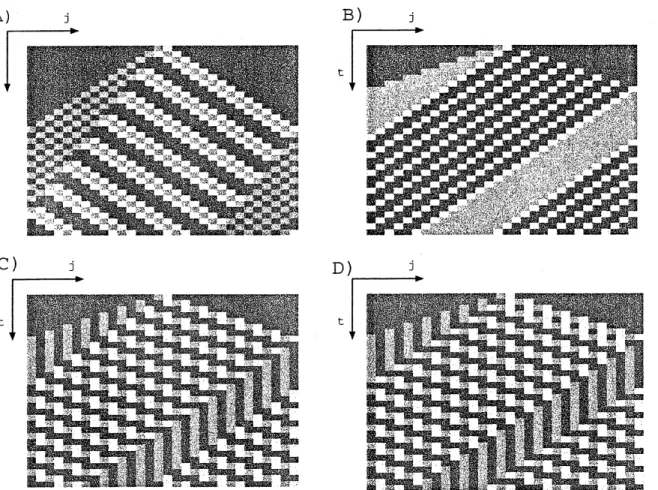
Fig.5.$\mathrm{A}-\mathrm{D}$ shows an instability of uniform flow of each models at the critical density.
Figure 5: Instability of Uniform flow in $\mathrm{A}$)$\mathrm{S}\mathrm{l}\mathrm{S}$ model $\mathrm{B}$)$\mathrm{E}\mathrm{B}\mathrm{C}\mathrm{A}2\mathrm{C}$)$\mathrm{E}\mathrm{B}\mathrm{c}\mathrm{A}1$
We can see the (
$‘ \mathrm{s}\mathrm{t}\mathrm{o}\mathrm{p}- \mathrm{a}\mathrm{n}\mathrm{d}-\mathrm{g}\mathrm{o}$
” wave propagates backward from the perturbated place
of uniform flow in Fig.$5\mathrm{A},$ $\mathrm{C}$ and $\mathrm{D}$, i.e., the SIS model, the EBCAI model and the
SISEBCAI
model, respectively. The time evolution of the EBCAI and SISEBCAI modelshow almost
same
pattern. This is explained as follows. The string “$\cdots 111020\cdots$ ”and
“ $\cdots 121212\cdots$ ” are both steady states of two models. These
are
represented at $\mathrm{B}$ and $\mathrm{C}$in Fig.6, respectively.
Figure 6: Schematic fundamental diagram of EBCAI and SISEBCAI
If we add a perturbation to the state at $\mathrm{A}$, then the flow decreases and transits to the
state D. This is the case in Fig.5. In the lower branch $Q=-\rho+1$ of congested phase,
the string “ $\cdots 2222\cdots$” appears, while in the upper branch $\mathrm{B}-\mathrm{C}$, the site $‘\prime 2$” is not last
more than two successive sites. We see in Fig.7 that ifa perturbation to the uniform flow
A is large enough, then the string “$\cdots 2222\cdot\cdot,$” appears and direct transition from A to
$\mathrm{D}$
occurs.
5
Concluding
Discussions
In this paper, multi-value extension of the rule-184 family is studied. We conclude that
EBCAI model is good for traffic model. The S1S model is also good for trafficmodel, but
if we consider a higher speed model, then the difference between EBCAI and high speed
SIS
model($\mathrm{S}\mathrm{l}\mathrm{S}$-EBCAI) becomes little. Wecan
easily dealEBCAI
than theS1S
modelbecause
EBCAI uses
only two successive time steps.We investigate CAs’ with $L=2$, and only in the
case
ofEBCA2 we have commenteda result of general $L$. It is observed in other models with $L>3$ that there appear small
branches like those of EBCA2, but they have complicated nature than EBCA2. The
general results of the multi-value family and its two-dimensional extension will appear
elsewhere.
References
[1] H. Greenberg, Oper. Res., 7 (1959) pp.79.
[2] B. S. Kerner and P. Konh\"auser, Phys. Rev. E, 48 (1993) p.2335.
[3] G. F. Newell, Oper. Res., 9 (1961) p.209.
[4] M. Bando, K. Hasebe, A. Nakayama, A. Shibata and Y. Sugiyama, Phys. Rev. E. 51
(1995) p.1035.
[5] K. Nagel and M. Schreckenberg, J. Phys. I France 2 (1992) p.2221.
[6] M. Fukui and Y. Ishibashi, J. Phys. Soc. Jpn., 65 (1996) p.1868.
[7] D. E. Wolf, M. Schreckenberg and A. Bachem (editors), Workshop in
Traffic
andGranular Flow, (World Scientific, Singapore, 1996).
[8] S. Wolfram, Theory and Applications
of
Cellular Automata (World Scientific,Singa-pore, 1986).
[9] H. Fuk\’{s} and N. Boccara, Int.
J.
Mod. Phys. C, 9 (1998), p.1.[11] Traffic Engineering (in Japanese), T. Sasaki and Y. Iida, Eds. (Kokumin Kagakusha., 1992).
[12] K. Nishinari and M. Hayashi (editors),
Traffic
Statisticsin Tomei Express Way, (TheMathematical Society ofTraffic Flow, Japan, 1999).
[13] R. Herman, E.W. Montroll, R.B. Potts and R.W. $\mathrm{R}\mathrm{o}\mathrm{t}\mathrm{h}\mathrm{e}\mathrm{r}\mathrm{y}\text{ノ}$. Opns. Res.,7 (1959) p.86.
[14] T. Tokihiro, D. Takahashi, J. Matsukidaira and J. Satsuma, Phys. Rev. Lett. 76
(1996) p.3247.
[15] K. Nishinari and D. Takahashi, J. Phys. A 31 (1998) p.5439.
[16] K. Nishinari and D. Takahashi, J. Phys. A 32 (1999) p.93.
Appendix
In this appendix, we will show a direct proof that a two-lane model of the rule-184 CA
corresponds to BCA with L $=2$. The two-lane model is shown in Fig.Al.
Figure Al: Two lane model of the rule-184 CA.
Cars move according to the rule-184 CA in each lane except the case of a lane change. If
a
car
exists in the site j in the A-lane and the site in front ofit is occupied, then the carfeel like changing its lane. When the site j and $j+1$ inthe $\mathrm{B}$-lane is empty, then the
car
will change its lane and go to the site $j+1$ in the $\mathrm{B}$-lane. This is the
same
changing rulefor a car in the $\mathrm{B}$-lane. Thus the lane change rule is represented by
$(A_{j}^{t}, A_{j1’}^{t}$$B_{j+1}+t)$
Bt,
$=$ (1, 1, 0,0) then $B_{j+1}^{t+1}=1$, $(A_{j}^{t}, A_{j+}^{t}B_{j}tB_{j}^{t})1"+1$ $=$ (0,0,1,1) then $A_{j+1}^{t+1}=1$.Then time evolution of the A-lane is given by
$A_{j}^{t+1}$ $=$ $A_{j}^{t}+ \min(A_{j-1}t,1-A_{j}\iota)-\min(A_{j}t, 1-A_{j+}t)1$
$+ \min(1-A_{j1}^{t}-,1-AtBj’ j-1t, B^{t}j)-\min(A_{jj}^{t}.A^{t}1-+1’ B_{j}^{t}, 1-B_{j+}t)1’(10)$
where the first and second terms in right side hand of (10) represent the rule-184 $\mathrm{C}\mathrm{A}$,
and the third and fourth terms represent lane change of cars that come from and go to
the $\mathrm{B}$-lane, respectively. We replace $A$ to $B$, then we obtain time evolution for the B-lane
as
$B_{j}^{t+1}$ $=$ $B_{j}^{t}+ \min(B_{j-1}t,1-B_{j}t)-\min(Bjt, 1-B_{j+1}t)$
$+ \min(1-B_{j1}t1-\cdot-B^{t}, AtAjj-1’ jt)-\min(B_{j}^{t}, B_{j}t.1-A_{j}t1-A_{j}t)+1’+1$. (11)
Ifwe put
$U_{j}^{t}=A_{j}^{t}+B_{j}^{t}$, (12)
then summing (10) and (11), we can derive (1) with $L=2$ by simple calculations with
formulae $\min(A, B)+\min(A. 1-B)=A$ and $\min(A, B)+\min(c, D)=\min(A+C,$$A+$