On Rational
Quadratic
B\’ezier
Curves
Kagoshima
University
Katsuyuki
Suenaga
$*$Kagoshima University
Manabu
Sakai
\daggerKagoshima
University
Hiroshi
Yadohisa
\ddaggerAbstract
Spiralcurveshave several advantages of containing neither inflection points,
singular-ities norcurvature extrema. Using much algebraiv manipulation with aid of Mathematica
(A System of for Doing Mathematics by Computer), we give a simple derivation of
nec-essary and sufficient conditions for the rational quadratic B\’ezier curve to be a spiral or
to have local extrema by means of
differentiation
and Descartes’s ruleof
signs. Its useenables us to determine (i) how to placethe control vertices, (ii) how to give the tangent vectors at the endpoints for the spiral, and (iii) a spiral condition for anoffset curve. keywords: inflection points, singularities, rationalquadraticB\’eziersegments, offset curves.
1
Introduction
Much attention has been focused on a single- and vector-valued shape preserving
in-terpolation. Spiral curves have several advantages of containing neither inflection points,
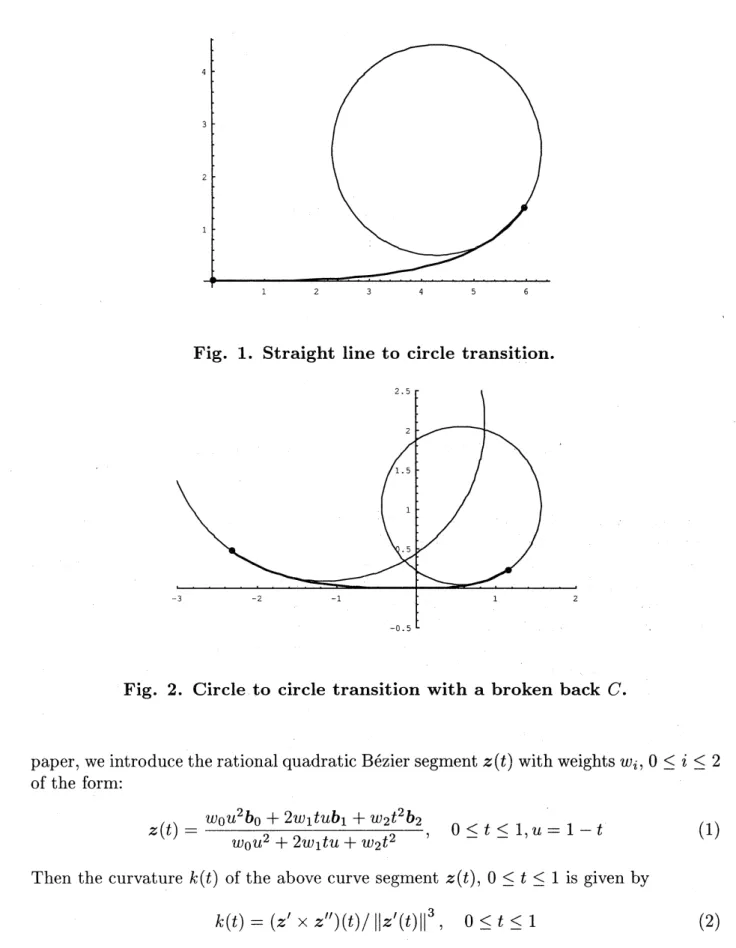
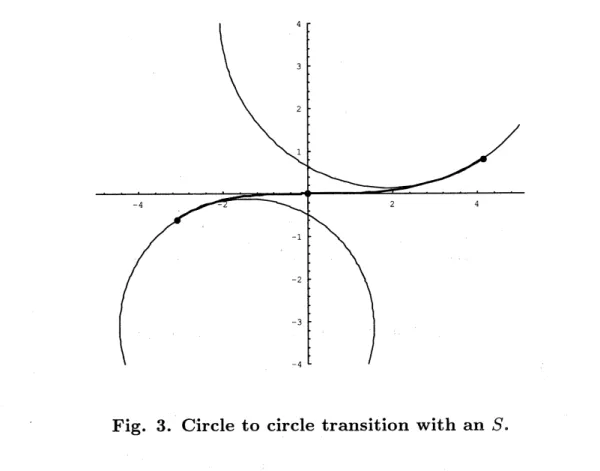
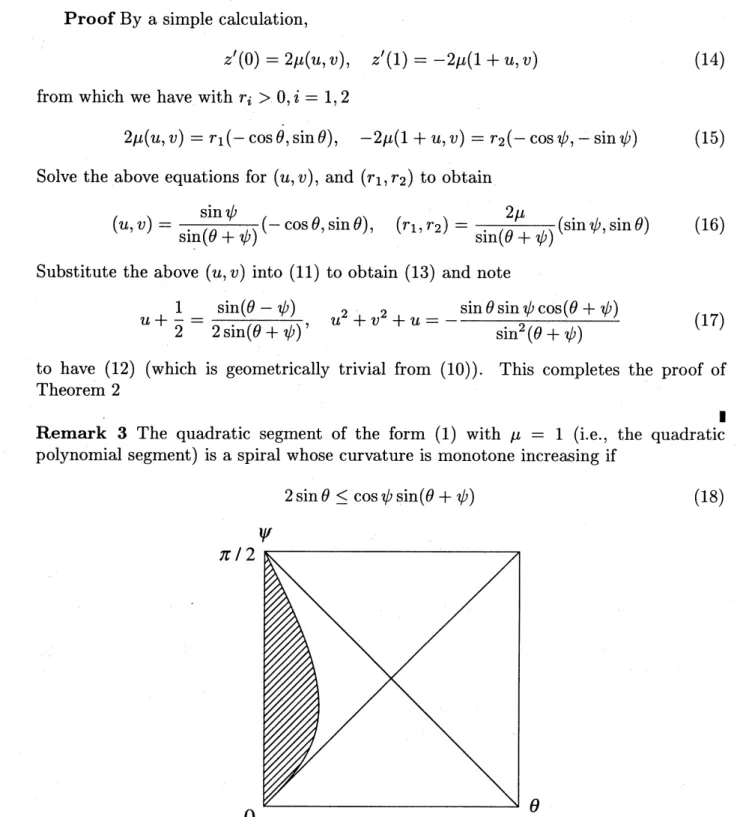
singularities nor curvature extrema. They are used to join (i) a straight line to a circle,
(ii) two circles with a broken back $C,$ $(\mathrm{i}\mathrm{i}\mathrm{i})$ two circles with an $S,$ $(\mathrm{i}\mathrm{v})$ two non-parallel
straight lines and also (v) two circles with
one
circle inside the other as shown in Figs 1-5:Polynomial curves have been widely used in computer-aided design. A drawback of
the curves is indicated by the fact that they do not always generate “visually pleasing”, “shape preserving” (or simply “fair”) interpolants which do not contain unwanted inte-rior inflection points and singularities (loop or cusp) to aset ofplanar data points. There is a considerable literature on numerical methods for generating a shape preserving
in-terpolation; for example, see Ahn and Kim [1], Farin [2], Meek&Walton [3], Sakai [6],
Sp\"ath [7], [8], and the references therein. A way of overcoming this problem is to consider nonlinear approximation sets, for example, exponential segments, lacunary segments,
ra-tional segments with variable addira-tional nodes. The rara-tional segments have been of the forms: $\mathrm{q}\mathrm{u}\mathrm{a}\mathrm{d}\mathrm{r}\mathrm{a}\mathrm{t}\mathrm{i}\mathrm{c}/\mathrm{l}\mathrm{i}\mathrm{n}\mathrm{e}\mathrm{a}\mathrm{r},$$\mathrm{c}\mathrm{u}\mathrm{b}\mathrm{i}\mathrm{c}/\mathrm{l}\mathrm{i}\mathrm{n}\mathrm{e}\mathrm{a}\mathrm{r},$ $\mathrm{q}\mathrm{u}\mathrm{a}\mathrm{d}\mathrm{r}\mathrm{a}\mathrm{t}\mathrm{i}\mathrm{c}/\mathrm{q}\mathrm{u}\mathrm{a}\mathrm{d}\mathrm{r}\mathrm{a}\mathrm{t}\mathrm{i}\mathrm{c}$, and $\mathrm{c}\mathrm{u}\mathrm{b}\mathrm{i}\mathrm{c}/\mathrm{q}\mathrm{u}\mathrm{a}\mathrm{d}\mathrm{r}\mathrm{a}\mathrm{t}\mathrm{i}\mathrm{c}$. In this
\dagger [email protected]
数理解析研究所講究録
Fig. 1. Straight line to circle transition.
Fig. 2. Circle to circle transition with a broken back $C$
.
paper,
we
introduce the rational quadraticB\’eziersegment $z(t)$ with weights $w_{i},$ $0\leq i\leq 2$of the form:
$z(t)= \frac{w_{0}u^{2}b_{0}+2w_{1}tub_{1}+w_{2}t^{2}b_{2}}{w_{0}u^{2}+2w_{1}tu+w_{2}t^{2}}$ , $0\leq t\leq 1,$$u=1-t$ (1)
Then the curvature $k(t)$ of the above curve segment $z(t),$ $0\leq t\leq 1$ is given by
$k(t)=(z’\cross z’’)(t)/||z’(t)||^{3}$, $0\leq t\leq 1$ (2)
where $\cross$ means a vector product and $||\bullet||$ is the Euclidean norm. The control points $b_{i}$
belong to $R^{2}$ and we assume that the weights
$w_{i}$ are all positive. By use of symmetry of conics, Ahn and Kim [1] obtained necessary and sufficient conditions for the curvature of the quadratic rational B\’ezier
curve
to be monotone (i.e., a spiral), to have a unique localFig. 3. Circle to circle transition with
an
$S$.
minimum, to havealocal maximum, andto have both extrema. We assumethe quadratic
rational B\’ezier curve to be of the standard form, i.e., $w_{0}=w_{2}=1,$ $w_{1}=\mu(>0)$ and for
simplicity, $b_{0}=(0,0)’.b_{2}=(-1,0)$. In addition, we assume that the remaining vertex $b_{1}$
is restricted to be above the $X$-axis and left of the vertical line $u=-1/2$.
In Section 2, we also use
differentiation
and Descartes’ ruleof
signs to obtain thesame necessary and. sufficient conditions for the rational quadratic B\’ezier spiral segment in terms of (i) the control vertices and (ii) the angles of the tangent vectors at the
endpoints. In addition,
we
shall note that an introduction of the weights does enlargethe region required for the rational quadratic B\’ezier spiral. In addition, we consider
a spiral condition for an offset curve. Finally in Section 3, we give simple numerical
examples to assure our theoretical results in Section 2.
Fig. 4. Straight line to strairght line transition.
Fig. 5. Two circles with one circle inside the other.
2
Main Theorems
The first theorem considers
a
choice of the control vertex $b_{1}=(u, v),$$u\leq-1/2,$$v>0$ for the rational quadratic spiral whose curvature is monotone increasing; note that theproof is easier to read and
more
straightforward than theone
given in Ahn and Kim[1]. For later use, we define $D_{i},$$i=1,2$
as
$D_{1}=\{(u, v)|2\mu^{2}(u^{2}+v^{2})+u\geq 0\}$,$D_{2}=\{(u, v)|2\mu^{2}\{(u+1)^{2}+v^{2}\}-(u+1)\leq 0\}$, and $D_{1}^{c}(D_{2}^{c})$ is the complimentary set of$D_{1}(D_{2})$. Then for $u<-1/2$,
we
have the corresponding result [1]:Theorem 1
If
$(u, v)\in$(i) $D_{1}\cap D_{2}$, (ii) $D_{1}\cap D_{2}^{c}$, (iii) $D_{1}^{c}\cap D_{2}$, (iv) $D_{1}^{c}\cap D_{2}^{\mathrm{c}}$ (3)
then the curvature
of
the rational quadratic B\’ezier curve segmentof
theform
(1) is (i) monotone increasing, (ii) has just one local maximum, (iii) has just one local minimum, (iv)first
just one local minimum and next just one local maximum.ProofWith help ofMathematica
or
notso
lengthy calculation by hand,$k’(t)= \frac{3v\mu[(s+1)(s^{2}+2\mu s+1)]^{2}q_{4}(s)}{2\{r_{4}(s)\}^{5/2}}$, $t=1/(1+s),$$0\leq s<\infty$ (4)
where quadratic polynomials $q_{4}(s),$ $r_{4}(s)$ are given by
$q_{4}(s)$ $=$ $\mu\{2\mu^{2}(u^{2}+v^{2})+u\}s^{4}+\{4\mu^{2}(u^{2}+v^{2})-1\}s^{3}-3\mu(2u+1)s^{2}$
$-[4\mu^{2}\{(u+1)^{2}+v^{2}\}-1]s-\mu[2\mu^{2}\{(u+1)^{2}+v^{2}\}-(u+1)]$
(5)
$r_{4}(s)$ $=$ $\{s+\mu+\mu u(1-s^{2})\}^{2}+\{\mu v(1-s^{2})\}^{2}$
Depending on the signs of the coefficient $a_{4}(=\mu\{2\mu^{2}(u^{2}+v^{2})+u\})$ of $s^{4}$ and the constant term $a_{0}(=-\mu[2\mu^{2}\{(u+1)^{2}+v^{2}\}-(u+1)])$ in $q_{4}(s)$, we consider the four
cases in which we shall count of the number of the positive roots of$q_{4}(s)=0$:
(i) for $a_{4}\geq 0,$ $a_{0}\geq 0(\Leftrightarrow(u, v)\in D_{1}\cap D_{2})$; then the coefficients of $s^{k},$$k=1,3$ are non-negative
as
follows$4\mu^{2}(u^{2}+v^{2})-1\geq-(2u+1)(>0),$ $-[4\mu^{2}\{(u+1)^{2}+v^{2}\}-1]\geq-(2u+1)(>0)$
(6)
In addition, note the positivity of the coefficient of $s^{2}$ since
$-3\mu(2u+1)>0$
.
In thiscase, all the coefficients of$s^{k},$$0\leq k\leq 4$ being
nonnegative,.
Descartes’ rule ofsigns showsthat the segment is a spiral.
(ii) for$a_{4}\geq 0,$ $a_{0}<0(\Leftrightarrow(u, v)\in D_{1}\cap D_{2}^{c})$; then thecoefficient of$s^{3}$ being nonnegative as (i), the sequence of the signs of the coefficients of $s^{k},$$0\leq k\leq 4$ of ascending order
is $(-, ?, +, +, +or0)$ from which combining Descartes’ rule of signs and theorem of
intermediate value shows that the curvature has just one local $\mathrm{m}\mathrm{a}\mathrm{x}\mathrm{i}\mathrm{m}\mathrm{u}\mathrm{m}^{r}\cdot$, note that $t=0$
and $t=1$ correspond to $s=\infty$ and $s=0$, respectively.
(iii) for $a_{4}<0,$ $a_{0}\geq 0(\Leftrightarrow(u, v)\in D_{1}^{\mathrm{c}}\cap D_{2})$; the coefficient of$s$ is nonnegative
as
$-[4\mu^{2}\{(u+1)^{2}+v^{2}\}-1]\geq 1-2(u+1)=-(2u+1)>0$ (7)
Hence, the sequence of the signs of the coefficients of $s^{k},$$0\leq k\leq 4$ is $(+, +, +, ?, -)$,
and so combine the rule of signs and theorem of intermediate value to show that the
curvature has just
one
local minimum.(iv) for $a_{4}<0,$ $a_{0}<0(\Leftrightarrow(u, v)\in D_{1}^{c}\cap D_{2}^{c})$; then the sequence of the signs of the
coefficients $s^{k},$$0\leq k\leq 4$ is $($-,$?,$ $+$, ?, -$)$ and $q_{4}(0)<0,$$q_{4}(1)(=-2\mu(\mu+1)^{2}(2u+1))>$
$0,$$q_{4}(\infty)<0$ which imply that the curvature has first just
one
local minimum and next110
just
one
local maximumas
the segment starts at $b_{0}$ and ends at $b_{2}$.1
Remark 1 For $u=-1/2$,
$q_{4}(s)= \{4\mu^{2}(v^{2}+\frac{1}{4})-1\}(s^{2}-1)\{\frac{\mu}{2}(s^{2}+1)+s\}$ (8)
from which the segment (1) is a spiral (circular arc) if$4\mu^{2}(v^{2}+1/4)-1=0$. Ifotherwise,
it has just
one
local maximum or minimum. Strictly speaking, the segment has a local maximum (minimum) if$v^{2}>(<)(1/\mu^{2}-1)/4$.Since
$\frac{u+1}{(u+1)^{2}+v^{2}}-\{-\frac{u}{u^{2}+v^{2}}\}=\frac{(2u+1)(u^{2}+v^{2}+u)}{(u^{2}+v^{2})\{(u+1)^{2}+v^{2}\}}$, (9)
combine Theorem 1 and Remark 1 to obtain
Remark 2 For a control vertex $b_{1}=(u, v),$ $u\leq-1/2,$$v>0$, the segment (1.1) whose
curvature is monotone increasing is a spiral if
$u^{2}+v^{2}+u\leq 0$ (10)
where the weight $\mu(>0)$ must satisfy
$- \frac{u}{u^{2}+v^{2}}\leq 2\mu^{2}\leq\frac{u+1}{(u+1)^{2}+v^{2}}$ (11)
Here wenote that the quadraticsegment ofthe form (1) with$\mu=1$ (when (1) reduces
to the quadratic polynomial) is a spiral if $2(u^{2}+v^{2})+u\leq 0$. Therefore, an introduction
of the weight $\mu$ enlarges the region for the rational quadratic segment to be a spiral.
Assume that the the tangent vector rotates counterclockwise
as one
traverses the segment which starts at $b_{0}$ with tangent vector $t_{0}$ at angle $\pi-\theta$, and ends at $b_{2}$ with tangent vector $t_{2}$ at angle $\pi+\psi$; note $(\theta, \psi)=(\pi-\arg t_{0}, -\arg t_{2}),$$0<\theta,$ $\psi<\pi/2$.Then, Remark 2 gives the necessary and sufficient condition on the angles of the tangent
vectors $t_{0},$$t_{2}$ at $b_{0},$ $b_{2}$ for the the rational quadratic spiral segment as follows.
Theorem 2
If
the rational quadratic segmentof
theform
(1)satisfies
the Hermite in-terpolation conditions: $z’(\mathrm{O})||t_{0},$$z’(1)||t_{2}$, it is a spiral whose curvature is monotoneincreasing
if
$0<\theta\leq\psi<\pi/2$, $\theta+\psi\leq\pi/2$ (12) where the weight $\mu(>0)$ must be
Proof By a simple calculation,
$z’(0)=2\mu(u, v)$, $z’(1)=-2\mu(1+u, v)$ (14)
from which we have with $r_{i}>0,$ $i=1,2$
$2\mu(u, v)=r_{1}(-\cos\dot{\theta}, \sin\theta)$, $-2\mu(1+u, v)=r_{2}(-\cos\psi, -\sin\psi)$ (15) Solve the above equations for $(u, v)$, and $(r_{1}, r_{2})$ to obtain
$(u, v)=. \frac{\sin\psi}{\sin(\theta+\psi)}(-\cos\theta, \sin\theta)$, $(r_{1}, r_{2})= \frac{2\mu}{\sin(\theta+\psi)}(\sin\psi, \sin\theta)$ (16)
Substitute the above $(u, v)$ into (11) to obtain (13) and note
$u+ \frac{1}{2}=\frac{\sin(\theta-\psi)}{2\sin(\theta+\psi)}$, $u^{2}+v^{2}+u=- \frac{\sin\theta\sin\psi\cos(\theta+\psi)}{\sin^{2}(\theta+\psi)}$ (17)
to have (12) (which is geometrically trivial from (10)). This completes the proof of
Theorem 2
$\mathrm{R}\mathrm{e}\mathrm{m}\mathrm{a}\mathrm{r}\dot{\mathrm{k}}3$
The quadratic segment of the form (1) with $\mu=1$ (i.e., the $\mathrm{q}\mathrm{u}\mathrm{a}\mathrm{d}\mathrm{r}\mathrm{a}\mathrm{t}\mathrm{i}\mathrm{c}|$
polynomial segment) is a spiral whose curvature is monotone increasing if
2$\sin\theta\leq\cos\psi\sin(\theta+\psi)$ (18)
Fig. 6. Angles $(\theta, \psi)$ oftangent vectors at both endpoints for a spiral. Fig6 gives anrestriction onthe angles $(\theta, \psi)$ of the tangent vectors at the both endpoints
$b_{0}=(0,0),$$b_{2}=(-1,0)$ for the rational quadratic B\’ezier segment (1) to be a spiral with
a
monotone increasing curvaturewhere the region $\{(\theta, \psi)|0<\theta\leq\psi<\pi/2, \theta+\psi\leq\pi/2\}$ is divided by thecurve:
2$\sin\theta=\cos\psi\sin(\theta+\psi)$, Remark 3 meansthat the dashed region is theone
for the quadratic segment $(\mu=1)$ to be a spiral.By
means
of Theorem 1, we obtaina
spiral condition for an offsetcurve
$z_{d}$ with $n(t)$ the unit normal vector of $z$ at $z(t)$ and its direction outward from the vector $z$$z_{d}(t)=z(t)+dn(t)$, $d\in R$ (19)
Note
$n(t)=(y’(t), -x’(t))/||z’(t)||$, $z’(t)=(x’(t), y’(t))$ (20)
to obtain
$z_{d}’(t)=\{1+dk(t)\}z’(t)$, $(z_{d}’\cross z_{d}’’)(t)=\{1+dk(t)\}^{2}(z’\mathrm{x}z’’)(t)$ (21)
Hence, we have a condition on radius $d$ for the offset (19) to be a spiral.
Remark 4 Assume that all the conditions in Remark 2, i.e., $u^{2}+v^{2}+u\leq 0,$$u\leq-1/2$.
Then the offset
curve
(19) is also a spiral whose curvature is monotone increasing and has the same tangent direction with the segment (1) at bothendpoints $b_{0},$$b_{2}$ if and only if$d>-1/ \min\{k(t)\}0\leq t\leq 1\Rightarrow d>-\frac{1}{k(0)}(=-\frac{2\mu^{2}(u^{2}+v^{2})^{3/2}}{v})$ (22)
where $\mu$ satisfies (11).
3
Numerical Examples
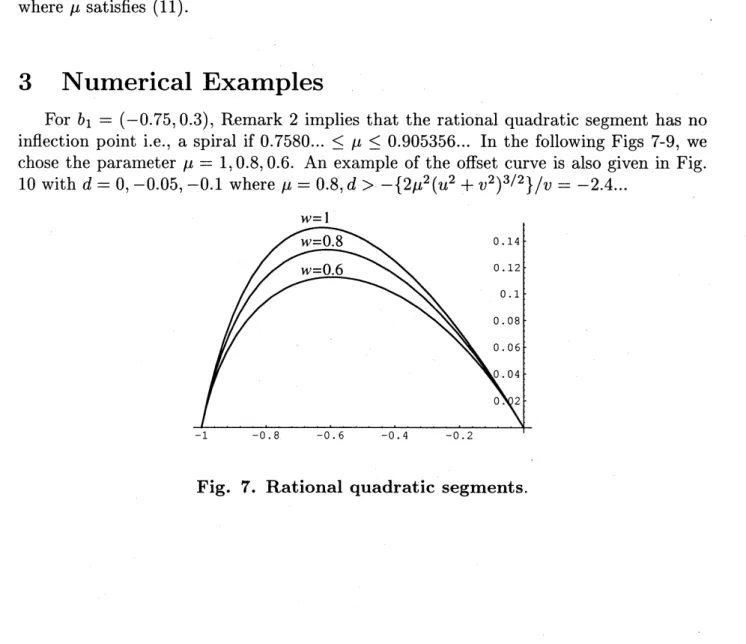
For $b_{1}=(-0.75,0.3)$, Remark 2 implies that the rational quadratic segment has no
inflection point i.e., a spiral if 0.7580$\ldots$ $\leq\mu\leq$ 0.905356... In the following Figs 7-9, we
chose the parameter $\mu=1,0.8,0.6$
.
An example of the offsetcurve
is also given in Fig.10 with $d=0,$ $-0.05,$ $-0.1$ where $\mu=0.8,$$d>-\{2\mu^{2}(u^{2}+v^{2})^{3/2}\}/v=-2.4\ldots$
Fig. 8. Graphs of the curvature $k(t)$.
Fig. 9. Graphs of the derivative of the curvature $k(t)$.
Fig. 10. Offset curves.
References
[1] Ahn, Y. J. and Kim, H. O.: Curvatures of the quadratic rational B\’ezier
curves.
Computers Math. Applic., 36, 1998, 71-83.
[2] Farin, G.: Curves and
Surfaces
for
Computer-Aided Geometric Design: A PracticalGuide. Academic Press, New York, 1996.
[3] Meek, D. and Walton, D.: Hermite interpolation with Tschirnhausen cubic spirals,
Computer Aided Geometric Design, F4, 1997, 619-635.
[4] Sakai, M. and Usmani,
R.A.: On
fair parametric rational cubic curves, BIT, 36,1995,
349-367.
[5] Sakai, M.: Inflections and singularity on parametric rational cubic curves. Numer.
Math., 76, 1997, 403-417.
[6] Sakai, M.: Inflection points and singularities on planar rational cubic curves,
Com-puter Aided Geometric Design, 16, 1999, 149-156.
[7] Sp\"ath, H.: One Dimensional Spline Interpolation Algorithms. AK Peters Wellesley,
Masasachusetts, 1995.
[8] Sp\"ath, H.: Two Dimensional Spline Interpolation Algorithms. AK Peters Wellesley,