
JAIST Repository: 小分子添加によるタンパク質加熱凝集の制御
5
0
0
全文
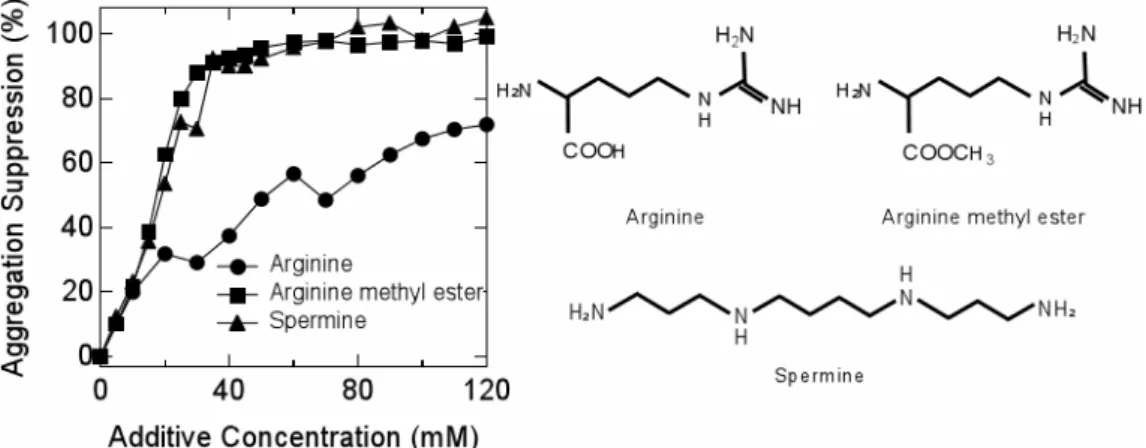
(2) 1. 博士論文概要. 小分子添加によるタンパク質加熱凝集の制御. 高木研究室. 学籍番号 340016. 氏名. 工藤基徳. 【研究の背景・目的】 タンパク質は常に唯一の立体構造を持つのではなく、溶媒条件によってその構造が変化する。 変性したタンパク質は会合して凝集体を形成する。特に、疎水性領域に富む膜結合型タンパク 質や複合体を形成するタンパク質は凝集体を形成しやすい。タンパク質の凝集体はタンパク質 本来の活性がないばかりでなく毒性を持つ場合もあるので、医療や工業の分野において重大な 問題となっている。タンパク質の凝集体形成は立体構造に依存した会合反応なのでタンパク質 濃度や pH、温度などの条件を制御するだけでも、ある程度制御することが可能である。しか し、産業レベルにスケールを拡大した場合には、より効果的でしかも簡便な凝集の抑制法が必 要となる。特に、小分子の添加による凝集抑制法は、透析や脱塩カラム等で容易にタンパク質 と小分子が分離できる利点があるが、これまでにアルギニンなど数種類の小分子だけが凝集抑 制剤として利用されているにすぎず、その効果も十分でない。そこで本研究では小分子の添加 によって凝集体形成を制御することを目的とした。 【結果】 凝集抑制小分子を探索するためのモデ ルタンパク質としてニワトリリゾチーム を選択した。リゾチーム溶液に任意の濃 度の小分子を添加した後、加熱すること で凝集体を形成させた。上清に残るタン パク質濃度および残存活性を測定するこ とで小分子の凝集抑制効果を評価した。 芳香族と難溶性アミノ酸を除く 15 種類の アミノ酸の凝集抑制効果を網羅的に比較 したところ、側鎖に電荷を持つアミノ酸、 特に塩基性のアミノ酸は凝集抑制効果を 持つことが明らかとなった(Fig.1)。 次に、アミノ酸を改変し、さらに凝集 抑制効果のある小分子について探索した。 結果としてカルボキシル基をエステル化 した化合物であるアミノ酸エステルには、 アルギニンより高い凝集抑制効果をもつ ことを発見した。また、超好熱菌内に多 く存在するアミノ基を多く持つ分子であ るポリアミンについて凝集抑制効果を測 定した。ポリアミンであるスペルミンや スペルミジンは、アルギニンより高い凝 集抑制効果を持つことが分かった (Fig.2)。. Figure 1. Preventive effect of amino acids on heat-induced aggregation of lysozyme.. Inserted letters show the single letter. code. as. for. amino. acids. additives.. Soluble. lysozyme. concentration after heat-induced denaturation at 98˚C for 30 min with 200 mM (open bars) and 50 mM (shaded bars) of each amino acid.. Data for Q, D, and E at 200 mM could not be determined. because of the low solubility of the amino acids in the buffer.. Q,. D, and E at 200 mM could not be determined because of low.
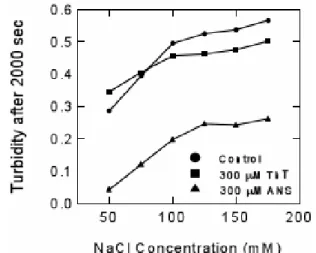
(3) 2. Figure 2. Aggregation suppression of lysozyme after the heat treatment at 98˚C for 30 min. lysozyme in 50 mM Na-phosphate buffer (pH 6.5) with various concentrations of additives.. The samples were 0.2 mg/ml. Arg, closed circles; Arg methyl ester,. closed squares, Spermine closed triangles.. 超好熱菌におけるポリアミンの役割はまだ不明であるが、アミノ基が多いことからポリアミ ンにはタンパク質の凝集体形成を抑制する役割を担っていることが考えられた。アミノ酸エ ステルやポリアミンの添加はリゾチームの熱安定性を向上させなかったので、タンパク質の変 性するプロセスを防ぐのではなく変性したタンパク質の会合を抑制することが考えられた。 タンパク質の凝集体形成の知見を得る ためにはネイティブ構造の残存量を測定 するだけでは不十分であり、凝集体形成の プロセスを理解することが必要である。そ こで、ナタ豆コンカナバリンAをモデルタ ンパク質として選択し凝集体形成を動的 に観察した。コンカナバリンAはアミノ酸 配列にシステインがなく、アポ体にするこ とで凝集しやすいので凝集体形成の観察 に都合が良い。 円偏光二色の観察から加熱によるコン カナバリンAの構造変化には中間体が存 Figure 3. Salt-jump experiment monitored by turbidity at 360 nm. 在することが明らかとなった。また、塩添 Representative data of the effect of salt jump on heat-induced 加が凝集体形成に与える影響を分光光度 aggregation monitored by turbidity at 360 nm. Control experiment 計で調べたところ、可溶性のオリゴマーど (closed circles): The sample containing 4.7 μM aConA with 100 mM うしが会合して凝集体が成長しただけで NaCl was subjected to the temperature jump from 20°C to 60°C. はなく、可溶性のオリゴマーにモノマーが Salt-jump experiment (open circles): 付加して凝集体が成長することが考えら れた。 コンカナバリンAの加熱凝集体の特徴を調べるために、タンパク質研究でよく用いられている疎 水面を認識するプローブ(アニリノナフタレンスルホン酸)と分子間のβ構造を認識するプローブ (チオフラビンT)をそれぞれ添加した。どちらのプローブを添加しても蛍光を発したので、コン カナバリンAの凝集体はタンパク質の変性に伴って露出した疎水面どうしの会合と分子間β構造 で形成されていることが分かった。これらプローブの凝集抑制効果を調査したところ、アニリノナ フタレンスルホン酸は溶媒の塩濃度に関わらずコンカナバリンAの加熱凝集体の形成を抑制した が、チオフラビン T は塩濃度が低い場合には凝集体の形成を促進し、塩濃度が高い場合には凝集体.
(4) 3. の形成を抑制した。これらのプローブの添加は十数μM の濃度でタンパク質の凝集体形成を抑制す ることができた。 【考察】 タンパク質の凝集を抑制する小分子の探 索は、アルギニンの発見以降、広くは行わ れていない。今回、アミノ酸による凝集抑 制効果は側鎖によるものと推定できたこと は、より効果が高い凝集抑制剤を合成する 上で非常に意義深い。また、アミノ酸の誘 導体や類似構造を探索することでアミノ酸 エステルやポリアミンに著しい凝集抑制効 果があることを発見できた。今後、コンビ ナトリアルケミストリーを用いてアミノ酸 エステルやポリアミンの化学構造を改変し、 より凝集抑制効果が高い小分子を合成する ことが期待される。. Figure 4. Turbidity dependence on NaCl concentration in presence of ANS and ThT.. Turbidities after heating for 2000. seconds in the absence (closed circles), or presence of 300 μM ThT (closed squares), and ANS (closed triangles).. 凝集体の形態は、モノマーであるタンパク質の変性の程度と凝集のプロセスによって決められて いる。これまでに凝集のプロセスが研究されている例にアミロイド線維がある。アミロイド線維と は直径 10nm 程度の細長い構造のタンパク質凝集体であり、約 20 種類の疾患の原因と知られてい る。アミロイド線維が形成する場合には、はじめに核が形成され、その後に核が伸長して線維にな るという二段階形成モデルが考えられている。アミロイド線維のカギである核は、可溶性のオリゴ マーと考えられている。核がどのような相互作用で形成されているのか、どのくらいの大きさなの か?ということはいまだに不明である。しかも、細胞毒性は線維よりもむしろ小さいオリゴマーが 強いことが知られており、オリゴマーの形成が近年注目されている。 コンカナバリン A の加熱凝集体形成を動的に追跡したところ、可溶性のオリゴマの存在を確認で きた。加熱凝集体形成のプロセスには、可溶性のオリゴマーどうしが単に会合するだけではなく、 モノマーがオリゴマーに結合する反応も含まれていることが明らかとなった。つまり、加熱凝集体 形成のプロセスにもアミロイド線維形成と同様の反応が含まれていることを示している。このオリ ゴマーがアミロイド線維の形成に関与するオリゴマーと同じか否かということは非常に興味深い 点である。 コンカナバリンAの加熱凝集体にもアミロイド様の構造が含まれていることが蛍光プローブに よる観察から示唆された。アミロイド線維は凝集体内部にある分子間β構造によってアミロイド線 維は安定化されており、界面活性剤による変性やプロテアーゼによる加水分解を受けにくい。アミ ロイド線維は多数のタンパク質が分子間β構造で規則的に結合した凝集体である。アミロイド線維 と加熱凝集体の安定性の違いはβ構造の規則性によるものと考えられる。 【まとめ】 本研究は、タンパク質の凝集体形成を抑制する新規の凝集抑制分子であるポリアミンとアミノ 酸エステルを発見した。これらの分子はタンパク質の熱安定性を向上させるのではなく、タンパク 質どうしの会合を抑制すると考えられた。また、加熱凝集体の形成におけるプロセスを解析するこ とで加熱凝集体でも可溶性のオリゴマーが観察できた。加熱凝集体の内部にもアミロイド線維と類 似のβ構造が存在することを明らかにした。.
(5) 4. 【論文目次】 Chapter 1 General introduction 1 Chapter 2 Effects of amino acids on the prevention of heat induced aggregation of HEL 9 Chapter 3 Amino Acid Esters Prevent Thermal Inactivation and Aggregation of HEL 22 Chapter 4 Prevention of thermal inactivation and aggregation of HEL by polyamines 33 Chapter 5 Stretched-exponential analysis of heat-induced aggregation of aConA 44 Chapter 6 Thioflavin T and 8-anilino-1-naphthalenesulfonate recognize the thermal aggregation of aCon A 62 Chapter 7 General conclusion 78. 【業績】 Kentaro Shiraki, Motonori Kudou, Shinsuke Fujiwara, Tadayuki Imanaka, and Masahiro Takagi. Biophysical effect of amino acids on the prevention of protein aggregation. J. Biochem., 132(2002)591-595. Motonori Kudou, Kentaro Shiraki, Shinsuke Fujiwara,Tadayuki Imanaka, and Masahiro Takagi. Prevention of thermal inactivation and aggregation of lysozyme by polyamines. Eur. J. Biochem., 270(2003)4547-4554. Kentaro Shiraki, Motonori Kudou, Shingo Nishikori, Harue Kitagawa, Tadayuki Imanaka, and Masahiro Takagi. Arginine ethylester prevent heat inactivation and aggregation of lysozyme. Eur. J. Biochem., 271(2004) 3242-3247. Kentaro Shiraki, Motonori Kudou, Ryusuke Sakamoto, Itaru Yanagihara, and Masahiro Takagi. Amino acid ester prevent thermal inactivation and aggregation of lysozyme. Biotechnol. Prog., 21(2005) 640-643. Motonori Kudou, Kentaro Shiraki, and Masahiro Takagi. Stretched-exponential analysis of heat-induced aggregation of apo-concanavalin A. Protein J., 24(2005)193-199. Motonori Kudou, Kentaro Shiraki, and Masahiro Takagi. Thioflavin T and 8-anilino-1-naphthalenesulfonate recognize the thermal aggregation of apo-concanavalin A. in preparation.
(6)
図
関連したドキュメント
All of these compounds have absorption maxima approximately 330 nm (Fig. 2FGHI), indicating the presence of 1,3-diaminocyclohexen chromophore conjugated with two
The main challenge of an effective phytoremediation strategy for the removal of heavy metals from contaminated sites is the choice of a potential plant species
In Chapter 2, a class of penalty functions for solving convex programming problems with general constraint set is
In addition to extending our existence proof there to the case of nonzero continuous drift (Theorem 1.6) and examining the effects of the order parameters 1 , 2 on e heat 1 , 2
The exporting Party shall ensure that the exporter to whom a Certificate of Origin for a product has been issued, or the producer referred to in subparagraph 5(b), notifies in
This product controls annual and perennial weeds listed on this label prior to planting or emergence of corn, cotton, rice, sorghum and soybeans, and following the harvest of any
If a new certificate of origin was issued in accordance with Rules 3(e) of the operational procedures referred to Chapter 2 (Trade in Goods) and Chapter 3 (Rules of
With respect to each good of Chapter 50 through 63 of the Harmonized System, in the case where a material of the other Country or a third State which is a member country of the
