内 文 山 目。岡 ω 向 昌 国 = 闘 F ん 著 ⋮ 一 原 小 鳴門教育大学学校教育研究紀要 20, 91 -94, 2005
DEVELOPMENT OF
TEACHING MATERIALS FROM
ENVIRONMENTAL
SAMPLE OF
MINES AND
RIVERS
Katsuo MURATA
,
Moses MLOMBO and N
o
r
i
k
o
SAIJO
Naruto University of Education, Naruto, Tokushima 772-8502, Japan 抄録:この研究は鉱山とその付近の川の試料を用いた教材の開発について報告したものです。これは 堆積物や表面水中のマンガンを間接的に求める研究であり 教育実践に適するように実験操作は高校 生用に簡易化した。ここではマンガンを堆積物から抽出し 紫色の過マンガン酸塩 (Mn04-) に酸化 し,標準濃度の溶液と比色することにより試料中のマンガンの濃度を求めた。堆積物中のマンガン量 は,過マンガン酸塩の濃度を対比させることにより求めた。授業実践を想定した生徒の活動を計画し, これを地元の鳴門高校の2年生40名に対して試みた。 キーワード:マンガン,鉱山,過マンガン酸塩,授業活動,高校生Abstract : This study reports on the development of teaching materia1s by using samples from mines and their neighboring rivers. The indirect analysis of manganese in sediment and surface water was studied, and the procedures were simplified for high schoollearners. Here, manganese was extracted from sediment, oxidized to the violet permanganate(Mn04一)complex and the concentration of the complex determined by color comparison with standard solutions. The concentration of the permanganate complex was used as the relative measure of the amount of manganese in the sediment. The lesson activities developed and were tried to forty (40) grade 11 learners at Naruto high school, Japan.
Keywords : Manganese, Mine, Permanganate, Lesson Activities, High schoollearners
INTRODUCTION
Manganese compounds have extensive applications in science teaching. Compounds like, Mn02組dKMn04, are
widely shown in secondary school textbooks as being used as oxidizing agents, catalysts and in dry cells (Hom,1987,1988). Owing to its numerous oxidation states (+2, +3, +4, +6 and +7), manganese forms various compounds with distinct colors, making it an interesting subject for learners to study about. More over, manganese is a relatively abundant element, naturally found in rocks, soil, water and food, and consisting approximately 0.1% of the earth's crust (WebElements Periodic) (Bruce,J.,2002).
Scientists perform the direct analysis of manganese through atomic flame emission spectrometry, a technique that is too advanced for most amateur chemists. In this study, an indirect ana1ysis of manganese was explored. Here,
manganese was first extracted from sediment and出en oxidized to the permanganate complex according to the following equation: No. 20 (2005) General knowledge 1.An oxidation reaction is:① gain of electrons② loss of electrons 2.A reduction reaction is:① gain of electrons② loss of electrons 3. Which has a bigger oxidation number between neutral Cu and Cu in CuO? ①Cu ②CuO Properties of manganese 4.Name: Manganese:…・・・…・・・…..(Namein Japanese) 5. Symbol:一・ 6. Physical state:①Solid②Liquid③Gas 7. Color:・・・・・ 8. Classification:①Metallic②Non metallic 9. Give any compound(s) of manganese that you know: 10. Give any use(s) of manganese or manganese compounds that you know:・. T able 1: Pre/Post activity questions 91
x = 2, 3, 4 ,6 or 7
Phosphoric acid must be present in the solution to prevent the precipitation of ferric periodate and iodate, and to decolorize cations, like ferric and cupric ions, through complex formation.
METHODOLOGY
An old copper mine and its neighboring river, Hiroishidani river, in Kamiyama town, Japan, were chosen for this study. Samples were collected along the river from the Fish site (up-stream), the Mine site (adjacent to the mine slag), the Blue concrete site (further down stream) and the Hill site (mine slag). Most noticeable about the river is that the Fish site is inhabited by fish species, something not observed in the other two sites.
The lesson was composed of a number of teaching strategies like brain-storming, open discussions and hands-activities. A questionnaire was distributed at the beginning and at the end of the lesson. Table 1 shows a sample of the questions. The questionnaire's main purpose was to assess learners' prior knowledge on the properties of manganese and to verify if learning has taken place.
Since the extraction requires more time, it was done by the facilitator prior to the lesson. Learners had to proceed with oxidation and analysis.
To a sample solution, 0.5 g of potassium periodate and 3 ml of 85% phosphoric acid were added. The beaker was covered with a watch glass, the solution boiled and kept at the boiling temperature for at least 3 minutes. After cooling to room temperature, the solution was transferred to a 100 ml volumetric flask and diluted with distilled water to the mark. After mixing, the color intensity was compared with that of
...
r CHEMICAL CHEMICAL NAME OXIDATION NUMBER OF COLOR
I
FORMULA (ft1l'4IJJ1i) MANGANESE ATOM (@.) (ft$~) (-;>,:,;jJ:';Q)lftl)K
2Mn0
4(aq)
Potassium (a)M 0 ,..
(b).veetl
manganate solution r, .(. ~ ("?:.tjf:.tlj]~ ~t 4· H) ~-2 r;A*~ifl) 'r-t
'[~
,,-1 (, f'111:t' (c)~0
Potassium (d)M' .
(e) Mn 0\(0-\).,04
yttpol permanganate*
-t 4t-l)~AI
solutionl-t:.-'
(1,..~jf~Ii19 t~.,., ?A*.~)til ..
:.?
Figure 1: An extract from a student's worksheet 92
potassium permanganate standard solutions. The procedures were simplified from those of Kolthoff and Sandell (Kolthoff,LM.,Sandell,E.B., 1952).
Standard solutions were prepared by the facilitator prior to the lesson. For simplicity, learners used the concentration of the permanganate ion as a quantitative measure of manganese content.
RESULTS AND DISCUSSION
1. ACTIVITY 1: POTASSIUM MANGANATE VS POTASSIUM PERMANGANATE
After brain-storming and discussion on the properties of manganese and its compounds, had to prepare dilute solutions of potassium manganate and potassium permanganate in test tubes, record the color of each solution and then calculate the oxidation number of the manganese ion in each compound. The outcomes of this activity were, mainly, to demonstrate the various oxidation states of manganese and the different colors of manganese containing compounds.
Figure 1 is an extract from a leamer's worksheet. It was encouraging to note that some learners attempted to write their answers in both Japanese and English.
Also encouraging is that some learners showed how they calculated the oxidation number of the manganese ion.
2. ACTIVITY 2: INDIRECT ANALYSIS OF MANGANESE FROM ENVIRONMENTAL SAMPLES OF MINES AND RIVERS.
RESUL
TS(~l.)
s
10
10II;
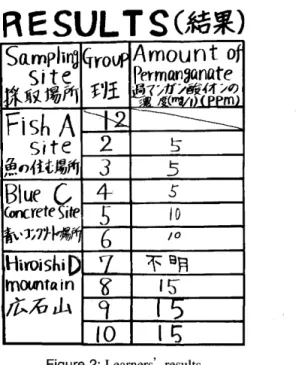
The focus of the activity was to demonstrate the relationship between aquatic life, fish in this case, and chemical pollution by using manganese as an example. Since the amount of manganese in the river' s surface water is very low, the highest being 0.13 ppm at the Mine site, this study alone cannot, therefore, conclude on the effect of manganese to aquatic life.
The biggest challenge encountered was that learners did not understand that the amount of manganese determined was from sediment, not from surface water. This could be due to the fact that learners did not perform the extraction themselves.
Figure 2 shows results that were obtained by learners, 9 groups are shown. Due to insufficient samples, the concentration of the permanganate ion from the Mine site was provided as 30 ppm. The result for group 11 was unfortunately not recorded on the sheet. Nevertheless, both groups 2 and 3 obtained the same permanganate ion concentration of 5 ppm in sediment from the Fish site. Groups 5 and 6 agreed that the concentration of permanganate ion in samples from the Blue concrete site was 10 ppm, group 4 recorded it as 5 ppm. For the Hill site all groups, except Group 7, recorded 15 ppm as their results. Group 7 was not successful in obtaining positive results, because of the precipitation of ferric periodate and iodate.
Although some learners' results were different from those expected, the activity was successful in achieving certain outcomes. Learners were able to execute the oxidation process and estimate the amount of permanganate ion in the samples. Further more, the origin of manganese and the environmental impact of the old mine was, to some extent, realized.
In future, there should be more explanation on how to estimate the concentration from standard solutions. Most importantly, care should be taken that enough phosphoric acid is added to prevent the problem of precipitation as experienced by Group 7. None the less, learners seemed to have enjoyed the lesson as revealed by the following comments:
I found that Mn has several oxidation numbers. Your lesson was very much exciting. It was my first time to see Mn. When I answered about the color of Mn, you said "may be grey", I was impressed. I want you to come and present another lesson again!
I think it (fish) can be used as an indicator (of chemical pollution) because fishes do not live in the place where the concentration of Mn04 - is high. (The learner probably
No. 20 (2005) 100 90 80 70 60 % 50 40 30 20 10
o
Learners' responses on the properties of Mn
Question
1 - Before
DAfter
1Figure 1: Learners' responses on the properties of manganese
90 80 70 60 % 50 40 30 20 10
o
Learners' responses on question 9
Formula Name Formula & No attempt Name
Style of answering
I_
BeforeDAfter
1
Figure 2: Learners' responses on manganese compounds thought that Mn is present in sediment or service water in the form of the permanganate complex)
3. THE ANALYSIS OF THE QUESTIONNAIRE 3.1 REDUCTION AND OXIDATION PROCESSES (QUESTIONS 1,2 AND 3)
Results show that in general, learners had a good understanding of the concept of oxidation and reduction processes.
3.2 PROPERTIES OF MANGANESE (QUESTIONS 4, 5, 6, 7, AND 8)
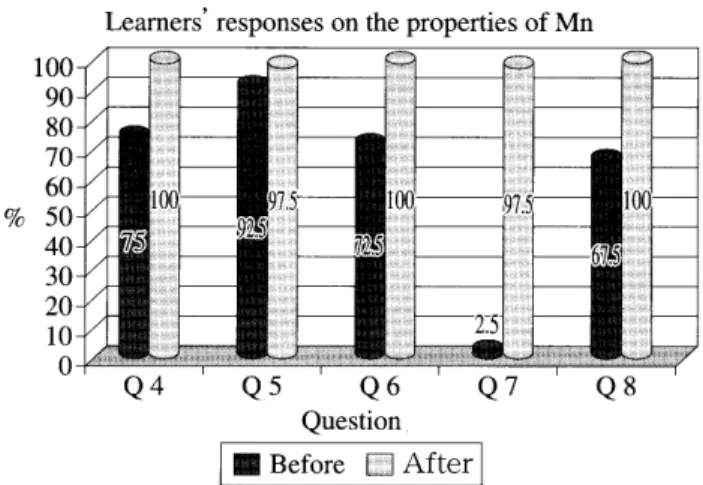
Figure 1 shows that, out of the 40 learners,92.5% (37 learners) knew the symbol of manganese as Mn (Q5), but only 75% (30 learners) could write the name 'manganese' in Japanese (Q4). Results improved to 100% for the later and 97.5% for the former. As for questions 6 and 8, respectively, learners correctly classified manganese as solid, 72.5% (29 learners), and as metallic, 67.5% (27 learners). In both questions 6 and 8 the results improved to 100%.
Question 7, the colour of metallic manganese, was the most challenging question for learners. For this question,
only 1 learner (2.5%), wrote the answer as grey. This suggests that, although learners knew about manganese, they never had the opportunity to see the real substance. Never the less, it is interesting to see the results improving to 97.5% (39 learners).
3.3 MANGANESE COMPOUNDS (QUESTION 9)
85%, 34 learners, knew certain examples of manganese compounds, with Mn02 and KMn04 dominating the responses. The results improved to 100% after the lesson. Figure 2 shows that initially 47.5% (19 learners) gave the answer in a form of a formula and later the figure increased to 87.5% (35 learners).
Initially, 32.5% (13 learners) gave the answer in a form of a chemical name but after the lesson the percentage dropped to 12.5% (5 learners), 7.5% (3 learners) wrote both chemical formula and name, and 12.5% (5 learners) never attempted the question.
Apart from the improvement in results, it is also interesting to note that learners became more decisive. They all attempted the question and gave their responses either in a form of a formula or name. Arguably, this could be regarded as a positive sign that learners were active participants in the learning process. The increase in the use of chemical formulae at the expense of chemical name could be explained by the fact that the activity itself was dominated by formulae.
3.4 USES OF MANGANESE AND MANGANESE COMPOUNDS (QUESTION 10)
Although many learners had an idea about manganese compounds, fewer knew their uses. 57.5% (23 learners) gave dry cell and production of oxygen as answers and 35% (14 learners) never attempted the question. After the lesson, 38 learners (95%) gave correct responses. Of the 38 correct responses, 32 learners (84.2%) gave dry cell as an answer and 6 learners (15.8%) wrote both chlorine and dry cell as an answer. Not even a single learner mentioned the preparation of oxygen. This is probably due to the fact that the facilitator gave only the two written cases as examples.
CONCLUSION
While these activities shall improve learners' knowledge, values and skills in chemistry; they shall also sensitize learners, as members of various communities, on the importance of sustaining a healthy environment, with emphasis on water pollution. This will offer an opportunity to
94
implement the UN' s Education for Sustainable Development (Zakri,2004 ).
If properly planned, these activities would help to link the science theory with daily life experience. Research has shown that laboratory activities, does not necessarily enhance learners' understanding on how chemical principles affect their universe, the earth, its ecosystem, and the mechanisms of life (Hawkes,2004). These activities could therefore link the laboratory experiment with the environment and could help to create ideal conditions to introduce science knowledge in a 'natural' .
REFERENCES
Bruce,J., Analysis of manganese in water using voltametry(2002).
http://www.laboratorytalk.comlnews/mea/mea 138 .html Hawkes, SJ. "Chemistry Is Not a Laboratory Science" Journal of Chemical Education, Vol. 81, No.9, 2004, 1257-1258.
Hom, L., et al. (1987). "Physical Science in Action, Standard 9" . Juta & Co, Ltd, Kenwyn, South Africa
Hom, L., et al (1988). "Physical Science in Action, Standard 10. Juta & CO, Ltd, Kenwyn, South Africa
Kolthoff, LM., and Sandell, E.B. (1952) "Textbook of Quantitative Inorganic Analysis" . Third Edition. The Macmillan Company, New York.
WebElements Periodic Table, Manganese, Geological information.
http://www.webelements.comlwebelements/elements/te-xtIMnigeol.html
Zakri,A.H., (2004) IMPORTANT ROLE THAT EDUCATORS SHOULD PLAY FOR SUSTAINABLE DEVELOPMENT.
http://www.un.org/esa/sustdev/csd/csd12/statements/unu.pdf