Journal of the Operations Research Society of Japan
Vol. 45, No. 2, June 2002
AN IMPROVED FUZZY MCDM MODEL
BASED ON IDEAL AND ANTI-IDEAL CONCEPTS
Chung-Tsen Tsao Ta-Chung Chu
National Ping Tung Institute of Commerce Southern Taiwan University of Technology
(Received December 20, 2000; Revised September 7, 2001)
Abstract Liaiig presented a fuzzy multiple criteria decision making (MCDM) method based on the concepts of ideal and anti-ideal points. Despite its merits, Liang method has the following limitations: ( i ) the objective criteria are converted into dimensionless indices and the subjective criteria are not converted, which may prevent compatibility for these criteria, (ii) the formulas for converting objective criteria are not reliable, and (iii) an unreliable ranking method, i.e. maximizing set and minimizing set, is applied to rank the fuzzy numbers. This paper applies the Hsu and Chen method and suggests a fuzzy number ranking method to propose an improved fuzzy MCDM model based on ideal and anti-ideal concepts to overcome the shortcomings of the Liang method. Numerical examples demonstrate the effectiveness and feasibility of the proposed ranking method and the improved model, respectively.
1. Introduction
Liang [17] proposed a fuzzy multiple criteria decision making (MCDM) method based on the concepts of ideal and anti-ideal points. His method can be regarded as an application of fuzzy set theory 1231 t o TOPSIS (technique for order performance by similarity to ideal solution).
The TOPSIS technique was initiated by Hwang and Yoon [13] and has become one of the most commonly used multiple criteria decision-making (MCDM) methods [4, 221. This technique is based on the concept that an alternative t o be evaluated by n attributes can be represented as a point in n-dimensional space. Geometrical relationships among m points can be constructed. The ideal alternative has the best level for all attributes considered, while the anti (or negative)-ideal as the one with all the worst attribute values. Solutions from TOPSIS are defined as the points which are simultaneously farthest from the anti- ideal point and closest to the ideal point. To consider the uncertainty associated with the mapping of human perception to a number, the application of fuzzy numbers to TOPSIS was suggested by Negi [19] and Chen e t al. [4]. However, what they presented are just prototype models.
In 1999, Liang [17] proposed a fuzzy TOPSIS model t o solve the ill-defined MCDM problems. Despite the merits, the Liang method does contain several shortcomings how- ever. First, the objective criteria are converted into dimensionless indices and the subjective criteria are not converted, which may not ensure the compatibility of these criteria. For example, if the linguistic terms represented by fuzzy numbers used to assess the suitability of alternatives under subjective criteria are not defined in the range [O, 11, but in [I, 101, the converted objective criteria and the aggregated ratings of subjective criteria are incom- mensurable. Second, the formulas for converting objective criteria are not reliable. For example, assume that the evaluation of three alternatives under a benefit criterion ($ x lo6)
are Al = (0.2,0.35,0.45,0.65), A2 = (0.3,0.45,0.55,0.75), and A3 = (0.32,0.5,0.73,0.925). By Liang's direct relationship formula fl71, the conversion of A3 is (0.14,0.29,0.56,1.13). This does not fall between [O, 11 and results in incompatibility between the converted A3 and fuzzy numbers ranged in [O, 11. This same problem also exists in Liang's inverse relationship formula [17]. For example, suppose the evaluation of three alternatives under a cost crite- rion ($ x 106) are Ai = (8,11,18,20), A2 = (7,9,17,19), and A, = (6,8,16,18). The Liang formula conversion of A3 is (0.13,0.19,0.71,1.05), which again is not ranged in [O, 11. Third, Liang applied an unreliable ranking method (i.e. Chen's maximizing set and minimizing set 3 ) to rank fuzzy numbers (i. e. weighted suitability elements) to help complete his model. Although the Chen method [3] was verified illogical by Liou and Wang [18] in 1992, the Liou and Wang method also contains shortcomings as it inconsistently ranks fuzzy numbers and their opposites (see Section 3.2). To overcome the above shortcomings, this paper applies the Hsu and Chen method [12] and suggests a ranking method to propose an improved fuzzy MCDM model based on ideal and anti-ideal concepts. The proposed model provides an accurate means of applying fuzzy set theory to TOPSIS.
A review of many of the numerous fuzzy number ranking methods can be found in Bor- tolan et al. [I], Chen et at. [4] and [5, 6, 7, 8, 9, 11, 14, 16, 20, 211. This paper proposes ranking fuzzy numbers by the average of the relative regions. The left relative region is defined as the area bounded by the left membership function of the fuzzy number and the axis a t xmin- a relative minimal value on the x-axis. Similarly, the right relative region is defined as the area bounded by the right membership function of the fuzzy number and the axis a t xmm. The arithmetic average of the left and right relative regions is referred to herein as the average of the relative regions, which is used to rank fuzzy numbers. This ranking method can consistently rank all fuzzy numbers and their opposites. Formulas for ranking triangular and trapezoidal fuzzy numbers are also presented for easily performing applications. Comparative examples from Liou and Wang [18] demonstrate the advantages of the proposed ranking method. This ranking method is also utilized t o determine the ideal/anti-ideal solutions and to measure the distance between the weighted converted el- ements and the ideal/anti-ideal solutions in order to complete the proposed fuzzy MCDM model. The numerical example in Liang [17] demonstrates the feasibility of the proposed model.
The rest of this paper is organized as follows. Section 2 introduces fuzzy numbers. Section 3 presents ranking fuzzy numbers by the average of the relative regions. Comparative examples are also included in this section to illustrate the advantages of the proposed ranking method. Meanwhile, Section 4 proposes an improved fuzzy MCDM model based on the ideal and anti-ideal concepts and the numerical example in Section 5 demonstrates the feasibility of the proposed model. Conclusions are finally made in Section 6.
2. Fuzzy numbers
The concept of fuzzy number can be defined as follows [lo]:
Definition 1. A real fuzzy number A is described as any fuzzy subset of the real line R
with membership function f A which processes the following properties: (a) JA is a continuous mapping from
R
to the closed interval [O, 11; (b) f~ (x) = 0, for all x G ( - 0 0 , a ] ;(c) f.4 is strictly increasing on [a, b] ;
(d) f A (x) = 1, for all x E [b, c]; (e) f A is strictly decreasing on [c, dl;
An Improved Fuzzy MCDM Model 187
(f) f ~ ( x ) = 0, for all x E (d, m],
where a, 6, c and d are real numbers. We may let a = -00, or a = b, or b = c, or c = d, or
d = +GO. Unless elsewhere specified, it is assumed that A is convex, normal and bounded, i.e. -CQ
<
a, d<
CQ. For convenience, the fuzzy number in Definition 1 can be denoted by A = [a, 6, c, d; 11. The opposite of A can be given by -A = [-d, -c, -6, -a; 11 [15].The membership function f A of A can be expressed as
\
0, otherwise,where
fi
: [ a , b] -Ã [O, 11 is the left membership function and f" [c, d] -> [O, 11 is the right membership function of the fuzzy number A. Since the left membership function, i. e. f%x) , is continuous on [a, b], f;(x) is integrable on [a, b]. That is,/:
f 2 x ) d x exists. Similarlyld
f;(x)dx exists [18].Definition 2. The a-cut of fuzzy number A can be defined as [15] Aff = {x
I
f A ( x )>
a ) , where x E R , a E [O, 11.AO is a non-empty bounded closed interval contained in
R
and it can be denoted by Aff = [A?, A:], where A? and A: are the lower and upper bounds of the closed interval respectively.Given any two fuzzy numbers, A = [al, bl, el, dl] and
B
= [a2, b2) c2, dz] as in (1)) thea-cut of A and
B
are A" = [A?, A:] andB"
=[By,
B:] respectively. According to [15], some main operations of A andB
can be expressed as follows:= [A?
+
Br7
A:+
Ba})( A ( - ) B r =
[A?
- BZAZ - B?},( A ( x ) B I 0 = [Af-Br,A>B:], if a l > 0 , a 2 > 0 ,
3. Ranking Fuzzy Numbers by the Average of the Relative Regions
Suppose n fuzzy numbers, A,, i '= 1
-
n, as in Definition 1, each with membership functionf A , (x), A, = [at, bi, c,, d*], 2 = 1
-
n , must be compared to decide their ranking order. Theleft relative region, i.e. ^(Ai), and the right relative region, i.e. SR(Ai), are defined as
where xmin = infP, P =
U?=l
Pi, Pi = {x\
fAi(x)>
O}, both SL(Ai) and SR(A*)>
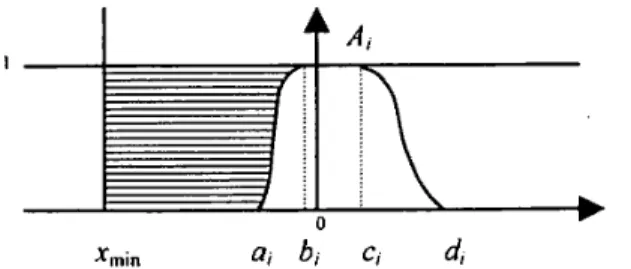
0. The SL(Ai) stretches from the left membership function of the fuzzy number A; to the axis a t xmin. The xmin denotes a relative minimal value on the x-axis. The SR(Ai)stretches from the right membership function of the fuzzy number A; t o the axis at xmin- The meanings of SL(Ai) and SR(Ai) are expressed in Figires 1 and 2, respectively. Clearly, the fuzzy number A, becomes larger if ^(A;) and/or SR(Ai) are larger. Thus, both SL(Ai) and SR(Ai) must be considered when ranking fuzzy numbers.
Xmin U, b, C, d,
Figure 1: The left relative surface SL(Ai) of Ai
Figure 2: The right relative surface Sp^Ai) of A,
The arithmetic average of the left and right relative regions for A; can then be defined as
1
S(Ai) = , ( s ~ ( A i )
+
S R ( A ~ ) ) (9) where SL(Ai) and S&Ai) are the left and right relative regions of A;.Herein, S(A;] is used t o rank fuzzy numbers. The larger the S(A;), the larger the fuzzy number A;. Therefore, for any two fuzzy numbers Ai and Aj, if S(Ai)
>
S ( A j ) , then A;>
A,. If S(Ai) = S ( A j ) , then Ai = Aj. Finally, if S(Ai) < S ( A j ) , then A;< A,. If A; is
a non-normal fuzzy number, f A can always be normalized by dividing the maximal value
of /A, before ranking, that is, (x) = fAi (x)/ ma,x fA, (x),where
A;
denotes the normalizedfuzzy number of A; and
hi
(x) denotes the membership function ofA,.
Thus, the relative region ofA;
represents the relative region of A; when being ranked, i. e. SL(A) =SL(A)
and Sn(A) = S p W .Property 1. For any two fuzzy numbers Al = [al, bl, el, dl] and A2 = [a2, b2, c2, d2] as in Definition 1. If S ( A l )
>
S(A2), then S(-Ai)<
S(-A;); if S ( A l ) = S ( A 2 ) , then S(-Al) = S(-A,); and if S ( A l )<
S(A2), then S(-Al)>
S(-A,).Proof- X m a x = SUPP, Xmin = inf P , P =
u;=~
Pi, Pi = {X1
fA,(x)>
0). Let zma =xmin
+
J7 ? I?'.Let xLin = inf
Pi, P'
=u2=1
P,,
P', = {x1
f-A,(x)>
O } . Obviously, xinin = -xmax- BY ( 7 ) 4 9 ) ,An Improved Fuzzy MCDM Model 189
Similarly, S(--A2) = -S(A2)
+
6. Thus,Similarly, if S ( A i ) = ,?(A2), then S ( - A l ) = S(-A2), and if S ( A l )
<
S ( A 2 ) , then S ( - A l )>
S(-A,). 0
Property 2. The ranking of any two given fuzzy numbers, Al = [al, bl,cl, dl] and A2 =
[a2, 62, c2, d2] as in Definition 1, will not be altered when xmin is changed.
Suppose fuzzy number A3 is added to compare with Al and A2.
Similarly, S'(A2) = S(A2)
+
d. Thus, if S ( A i )>
S(A2), then S t ( A l )>
St(A2); if S ( A l ) =~ ( A z ) , then S'(A1) = Sf(A2); and if S ( A l )
<
S(A2), then S f ( A l )<
St(A2).3.1. The average of the relative regions for trapezoidal and triangular fuzzy numbers
Definition 3. T h e fuzzy number B is a trapezoidal fuzzy number if its membership function
fa
is given by [15]( (x - a ) / @ - a ) , a
5
x5
6,(
0, otherwise,where a , b, c and d are real numbers. For convenience,
B
can be denoted by (a, b, c, d).Suppose
B
= (a, b, c,d)
is a trapezoidal fuzzy number as in Definition 3. By (7)-(9)) the average of the relative regions for B can be obtained as:Definition 4. T h e fuzzy number
A
is a triangular fuzzy number if its membership function/ A is given by [15]
otherwise,
where a , b and c are real numbers. For convenience A can be denoted by ( a , b, c ) .
Suppose A = (a, b, c ) is a triangular fuzzy number as in Definition 4. By ( 7 ) ~ ( 9 ) , the average of the relative regions for A can be obtained as:
Notably, when xmin = 0, formula (11) is the same as the one in Kaufmann and Gupta [14Is
3.2. Comparative examples
Consider the two triangular fuzzy numbers, Al = (3,5,7; 1 ) ) A2 = (3,5,7; 0.8), and the three trapezoidal fuzzy numbers,
Bl
= (5,7,9,10; I ) ,B2
= (6,7,9,10; 0.6),B3
= (7,8,9,10; 0.4) as in Figure 3 from Liou and Wang [I$].Figure 3: Triangular fuzzy numbers Al = (3,5,7; 1) and A2 = (3,5,7; 0.8), and trapezoidal fuzzy numbers, Bl = (5,7,9,10; l ) ,
B2
= (6,7,9,10; 0.6) and By = (7,8,9,10; 0.4)By Liou and Wang method, /?(Al) = I?(A2) = 4 + l a , obtaining Al = At for a ? ( 0 , l ) . Moreover, I$(Bl) = 6
+
3.5a, /+(B2) = 6.5+
3 a , and I^{B^ = 7.5+
2 a ) obtaining Bl<
B2
<
B3
for 05
a < 1 and Bl = B2 = B3 for a = 1. From this result, we logically infer -Ai = -A2 for a ? [0,1], -Bl>
-B2>
- B y for 0<
a< 1 and
-Bl = -B2 = -B3forQ = 1. However, by their method, I+(-Al) = IT(-A2) = -6
+
2 a , IT(-Bl) = -9.5+
3 . 5 ~ ~ )I$(-Bt) = -9.5
+
3 0 , and IF(-B3) = -9.5+
2 a . We obtain -Al = -A2 for a E [O, 11, -Bl>
-B2
>
-B3
for 0<
a5
1 and -Bl = -B2 = -B3 for a = 0. Obviously, the Liou and Wang method inconsistently ranks fuzzy numbers and their opposites. By the proposed method, xmin = 3, S ( A l ) = S(A2) = 2, Af(Bl) = 4.75, M ( B 2 ) = 5, and M(B3) = 5.5, producing the ranking order Al = As<
Bl
<
B2<
Bs. In addition, S(-Al) = S(-A2) = 6.25, M(-Bl) = 2-25) M(-&) = 2, and M(-By) = 1.5, implying that -Al = -A2> -Bl
>
-B2> -B3. Therefore, the proposed method can overcome
the shortcomings of the Liou and Wang method.Furthermore, consider the triangular fuzzy number, A = (1,2,5; I ) , and the general fuzzy number, B = (1,2,2,4; I], as in Figure 4 from Liou and Wang [I$]. The membership function of
B
is defined as1 5 x 5 2 , otherwise,
An Improved Fuzzy MCDM Model
2 1/2
where f g ( x ) = [I - (x - 2)2]1/2 and f^(x) = [I - \(x - 2)
]
Figure 4: The triangular fuzzy numbers A = (1,2,5; 1) and the general fuzzy number B = [ l , 2 , 2 , 4 ; 1]
By Liou and Wang method, the total integral value of A is I$(A) = 1.5
+
2 a , and the total integral value of B isIF(B)
= 1.2+
2 . 4 ~ ~ . For an optimistic decision maker, witha = 1: A
<
B ; for a moderate decision maker, with a = 0.5: A >B;
and for a pessimistic decision maker, with a = 0: A>
B . From this result, we logically infer -A>
- B fora = 1, - A
<
-B for a = 0.5, and -A<
-B for a = 0. However, by their method, IF(-A) = -3.5+
2a, IF(-B) = -3.6+
2.4a, which implies -A<
-B for a = 1, -A<
-Bfor a = 0.5, and -A
>
-El for a = 0. Again, the Liou and Wang method inconsistently ranks fuzzy numbers and their opposites. By our method, x h = 1, S(A) = 1.5 andS ( B ) = 1.39, obtaining the ranking order A > B. And by Property 1, we obtain -A
<
- B. Therefore, the method proposed herein overcomes the shortcomings of the Liou and Wang method by simpler results.The proposed ranking method is also utilized to establish an improved fuzzy MCDM model based on the concepts of the ideal and anti-ideal points as shown in the next section.
4. An Improved Fuzzy MCDM Model Based on Ideal and Anti-ideal Concepts
This section presents an improved fuzzy MCDM model based on the ideal and anti-ideal concepts, where the importance weights of all criteria and the ratings of alternatives under subjective criteria are assessed in linguistic terms [24] represented by trapezoidal fuzzy numbers. Rigorously, extensive experiment is needed to determine the linguistic terms and their corresponding fuzzy numbers to solve the fuzzy MCDM problems. Herein, for convenience, the linguistic terms and fuzzy numbers used in Liang [17] will be applied to the numerical example in Section 5. Assume that a committee of n decision-makers (Dj, j = 1
-
n ) is responsible for assessing m alternatives (Ai, i = 1-
m ) under each of k criteria (Ct, t = 1-
k) as well as assessing the importance weights of the criteria, k , m , n E N .4.1. Aggregate the importance weights of criteria
Many methods are available to pool the decision-makers' opinions, for example, mean, median, max, min and mixed operators [2]. Each of operators has its limitations. Criteria for selecting appropriate aggregation operator can be found in Zimmerrnann [25]. Since the average operation is the most commonly used aggregation method, in here, the mean operator is used to pool the decision-makers' opinions [17]. Let W t j = (aij, btj, Q j , &), t =
1
-
k, j = 1-
n , be the linguistic weight assigned to criterion Ct by decision-makerDj*
The aggregated linguistic weight,
IVt
= (at, bt, ct, d o ,t
= 1-
k, for criteriont
from n decision-makers' opinions can be calculated by:j= 1 j=l j= 1 J=l
4.2. Convert the aggregated linguistic ratings of alternatives under subjective
criteria
Let Xitj = (lit,, mitj, r i i t j , oitj), i = 1
-
m , t = 1-
h , j = 1-
n, denote the linguistic ratingassigned to alternative Ai by decision-maker
Dj
for subjective criterion Ct. The mean operator is also used to pool the decision-makers' opinions [17]. The aggregated linguistic rating, Xit = (ln,mit,nit,oit), z = 1-
m , t = 1-
h 7 of alternative Ai under subjective criterion Ct from n decision-makers7 opinions can be calculated by:j=l J'= 1 J'= 1 j=l
In Section 4.3, the ranges of the converted objective criteria belong to [O, 11. If the linguistic ratings are not defined in [O, 11, e.g. [ I , 101, the aggregated linguistic ratings are incommensurable with the converted objective criteria. Thus, to ensure compatibility between the converted objective criteria and the aggregated linguistic ratings, the aggre- gated linguistic ratings must also be converted. Herein, the conversion is performed by applying the Hsu and Chen method [12], which preserves the property that the ranges of the converted trapezoidal fuzzy numbers belong to [O, 11. By our concept, the linguis- tic ratings can be defined anywhere in R^. The converted aggregated linguistic ratings,
A& = (piti qit
,
?*it -> sit), i = l-
m , f = 1-
h, can be calculated by: where o* = rnax oit, pit = lit /oL qit = mi( /or, rit = nit lo*, sit = oit10;.
2
4.3. Convert the objective criteria
The objective criteria (fuzzy or non-fuzzy) can be classified to two categories: cost and benefit. Objective criteria have incommensurable units. To ensure compatibility, they need to be converted into a compatible scale (into dimensionless indices). Herein, the conversion is performed by applying the Hsu and Chen method [12] since it preserves the property that the ranges of converted trapezoidal fuzzy numbers belong to [O, 11. If T,t =
(gh uit, vit, wit), i = 1
-
m, t = h+
1-
k, represents the fuzzy (or non-fuzzy) total cost/benefit assigned t o alternative A; versus objective criterion Ct,
then the converted objective criteria, Mit = (pit, qit,rit, sit), i = I-
m , t = h+
1 -^ k, can be calculated by: (1) For benefit criteriawhere w> max wit, pit = git/wh git = uu/w;, rii = vit/w' $t
2
h + 1 - k .
An Improved Fuzzy MCDM Model 1 93
4.4. Construct the weighted converted fuzzy decision matrix
Let Dit, i = 1
-
m, t = 1-
k,
be an element of the weighted converted fuzzy decision matrix D , 2.e. D = [DitImxk. The weighted converted fuzzy rating, Dit, of each alternative versus each criterion can be calculated by:where Wt = ( a t , bt,ct,dt), Mit = (pit,qit,rit,sit) and i = 1
-
m , t = 1-
k.
Herein, Dit does not yield a trapezoidal shape. By formula (4), the membership function for Dii can. be developed as follows:
There are two equations to solve, that is,
Let F,l = (bt - at) (qit -
m )
,
Gitl = at(qit - pit)+
pit (bt - a t ) ,F^
= (ct - dt ) (?*it - sit) 7 Hit1 =G i t l / 2 c t l , Git2 = dt{rit - sit)
+
sit(ct - d t ) ) Hit2 = -Git2/2&2? Uit = d t p hKt
= btqit 7 Kt =ctrit, Zit = dtsn. Equations ( 1 8 ) and (19) can be presented as
Only two roots in [O, 11 are retained,
(
0, otherwise.For convenience, Dit can be expressed as [17]:
Da = (Uit)
l < ( ) X t )
Zit\&,
FitI,K t 2 ,
^ Ã ˆ t 2 ) 2 = 1-
m , ^ = 1-
k.
4.5. Determine the ideal ( I + ) and anti-ideal ( I ) solutions
By the proposed ranking method, i. e. formulas ( 7 ) - ( 9 ) , the ranking values of Dit,
i
= 1-
m and fixedt ,
of the alternatives can be easily calculated to determine the ideal ( I + ) and anti-ideal ( I ) solutions as:I+ = (1;) I ; ; - - , 1:)) I - = ( I ; , I ; , - - - , I;), where I: = m a x { D i t } and IF = m j n { D i f } , t = 1
-
k.
4.6. Calculate the distance between the different alternatives versus I+ and I-
Let d: and d denote the distance of the alternative A, versus /+ and I , respectively. Define
where S(Dit'), S(I:) and S ( I ( ) denote the ranking values of
4.7. Calculate the closeness coefficient
(25) i = 1 - r n , (26)
Diti
It
and I , respectively.The closeness coefficient, c:, z = 1
-
rn, can be calculated by:Since alternative A, is closer to the ideal point (I:) and farther from the anti-ideal point
(1;) as c: approaches 1, the ranking order of all alternatives can be determined and the optimum choice can be selected according to the closeness coefficient.
5. Example
The numerical example presented in Liang [17] is applied to illustrate the feasibility of the improved model. Assume that a high technology company must choose a site to build a new plant. Three alternative sites Al, A2 and As remain after preliminary screening. A committee of four decision-makers, D l ,
D2,
Ds and D4, is formed to determine the most appropriate site. Three subjective criteria: climate(Cl),
labour force quality (C;), trans- portation availability (C3), and one objective criterion, investment cost (C4), are considered. The decision-makers employ a linguistic weighting set W = {VL,L ,
M , H , VH}, where VL =very low, L =low, M =medium, H =high, and V H =very high, t o evaluate the impor- tance of the criteria. And VL = (0,0,0,0.3),L
= (0,0.3,0.3,0.5), M = (0.2.0.5,0.5,0.8),H
= (0.5,0.7,0.7, I ) , V H = (0.7,1,1,1). The decision-makers utilize the linguistic rating set S = {VP, B . V P & P , P, B . P & F , F', B.F&G, G 7 B.G&VG, VG}, where V P =very poor, B.VP&iP = between very poor and poor, P =poor, B . P & F =between poor and fair, F =fair, B.F&iG =between fair and good, G =good B.G&VG =between good and very good, and VG =very good, t o assess the suitability of alternatives under each of the sub- jective criteria. And V P = (0,0,0,0.2), B . V P & P = (0,0,0.2,0.4), P = (0,0.2,0.2,0.4), B . P & F = (0,0.2,0.5,0.7), F = (0.3,0.5,0.5,0.7), B.FS-iG = (0.3,0.5,0.8, I ) ,G
= (0.6,0.8, 0.8, l ) , B.G&VG = (0.6,0.8,1, I ) , and V G = (0.8,1,1,1). The investment cost ($ x lo6) are Al = (33,35,45,47), A2 = (22,25,30,32) and As = (22,26,26,28).Liang [17] assumed that the aggregated linguistic weights, i.e. W,,
t
= 1-
4, for the four criteria from the three decision-makersy opinions are:Liang [17] also presumed that the aggregated linguistic ratings of different alternative
An Improved Fuzzy MCDM Model 295
By formula (141, these aggregated linguistic ratings can be converted into:
By applying formula (16)? the investment costs (objective criterion) can be converted into:
By formulas (17)- (22)) the elements of the weighted converted fuzzy decision matrix, D = [Dit]3x4, can be obtained as:
Formulas (7)- (9) propose that the ideal ( I + ) and anti-ideal (I-) solutions can be obtained via:
1' = (D21, D32, D131 D34), 1- = (D11 7 D12, D33, D14).
Formulas (25)- (26) reveal that the distance between alternative Ai versus 1' and I- can be obtained via:
dT
= 1.368, d$ = 0,557,d t
= 0.6, dy = 0.337, d; = 1.276, and d~ = 1.137.Formula (27) verifies the closeness coefficient for each alternative i , i = l , 2,3, can be obtained via:
c; = 0.498, c; = 0.696 and c; = 0.655.
The optimal selection is alternative A2 since the ranking order for the three alternatives is A2, A3 and AI: a result that coincides with Liang [17].
6. Conclusions
Liang [l71 proposed a fuzzy MCDM method based on the concepts of ideal and anti-ideal poiiits, which can be regarded as an application of fuzzy set theory to TOPSIS. Several s h o r t c o ~ ~ ~ n g s in Liang method have been verified in this paper. By applyi~lg the Hsu and Chen rnetllod [l21 and a proposed ranking method, an improved MCDM model based on ideal and anti-ideal coi~cepts was proposed to solve the shortco~nings of the Liang ~ n e t l ~ o d . Numerical exai-nples have demonstrated the efTectiveness and feasibility of the proposed ranking method and the improved model, respectively. The proposed model provides an accurate means of applying fuzzy set theory to TOPSIS.
Acknowledgen~ent
The authors would like to thank the two anonymous referees for providing very helpful comments and suggestions. Their insight led to a better presentation of the ideas expressed iii this work. This work was supported in part by National Science Council: Taiwan, R.O.C., under Grant NSC89-2416-H-251-007.
References
G.
Bortolan andR.
Degani: A review of some inethods for ranking fuzzy numbers.Fuzzy Sets and Systems, 15(1985) 1-19.
J.J. Buckley: The multiple judge, multiple criteria ranking problem: A fuzzy set ap- proach. Fuzzy Sets and Systems, 13 (1984) 25-37.
S.H. Che11: Ranking fuzzy numbers with maximizing set and 111inimizilig set. Fuzzy Sets and Systems, 17 (1985) 113-129.
S.J. C l ~ e n and C.L. Hwalig: Fuzzy Multiple Attribute Decision Making (Springer, Berlin,
1992).
C.H. Cheng: A new approach for ranking fuzzy numbers by distance method. Fuzzy Sets and S'ystems, 95 (1998) 307-317,
F. Choobineh and H. Li: An index for ordering fuzzy numbers. Fuzzy Sets and Systems,
54 (1993) 287-294.
T.C. Chu and C.T. Tsao: Ranking fuzzy numbers with an area between the cm- troid point and original point. Cornpaters & Mathematzcs with Applications, (2000),
accepted .
T.C.
Chu aiid C.T. Tsao: Defuzzifying trapezoidal and triangular fuzzy numbers withcenter of area. Fuzzy Sets and Systems, (2000), revised.
0 . Dias: Raiikii~g alternatives using fuzzy numbers: A computational approach. Fuzzy
Sets and Systems, 56 (1993) 247-252.
D. Dubois and H. Prade: Operatio~ls on fuzzy numbers. International Journal of Sys- tems Science, 9 (1978) 613-626.
P. Fortemps and M. Roubens: Ranking and defuzzification methods based on area compe~xsation- Fuzzy Sets and Systems, 82 (1996) 319-330.
H.M.
Hsu and C.T. Cl~eii: Fuzzy credibility relation method for inultiple criteria deci-sion inaking problems. Information Sciences, 96 (1997) 79-91.
C.L.
Hwang andK ,
Yoon: Multiple Attribute Decision Making-Methods and Applica-tions: A State of the Art Survey (Springer-Verlag? New York, 1981).
A. Kaufmann and M.M. Gupta: Fuzzy Mathematical Models in Engineering and Man- agement Science (Elsevier, Amsterdam, 1988), 37-39.
An Improved Fuzzy MCDM Model 197
[15] A. Kaufmann and M.M. Gupta: Introduction to Fuzzy Arithmetic: Theory and Appli-
cation (VanNostrand Reinhold, New York, 1991).
[16] K.-M. Lee, C.-H. Cho and H. Lee-Kwang: Ranking fuzzy values with satisfaction func- tion. Fuzzy Sets and Systems, 64 (1994) 295-311.
[17]
G.S.
Liang: Fuzzy MCDM based on ideal and anti-ideal concepts. Europeal Journal ofOperational Research, 11 2 (1 999) 682-691.
[18] T.S. Liou and M.-J.J. Wang: Ranking fuzzy numbers with integral value. Fuzzy Sets
and Systems, 5 0 (1992) 247-255.
[19]
D
.S. Negi: Fuzzy Analysis and Optimization) Ph.D. Thesis, Department of Industrial Engineering, Kansas State University (1 989).[20] P.A. Raj and D.N. Kumar: Ranking alternatives with fuzzy weights using maximizing set and minimizing set. Fuzzy Sets and Systems, 105 (1999) 365-375.
211 I. Requena, M. Delgado and J.L. Verdegay: Automatic ranking of fuzzy numbers with the criterion of decision-maker learnt by an artificial neural network. Fuzzy Sets and
Systems) 64 (1994) 1-19.
[22] T.J. Stewart: A critical survey on the status of multiple criteria decision making theory and practice. OMEGA, 20 (1992) 569-586.
[23] L.A. Zadeh: Fuzzy sets. Information and Control, 8 (1965) 338-353.
[24] L.A. Zadeh: T h e concept of a linguistic variable and its application t o approximate reasoning. Information Sciences, 8 (1975) 199-249(1), 301-357(11).
[25] H.J. Zimmermann: Fuzzy Sets, Decision Making, and Expert Systems (Kluwer Aca- demic Publishers, Boston, 1987).
Chung-Tsen Tsao Department of Finance
National Ping Tung Institute of Commerce No. 51, Min Sheng E. Rd.
Ping Tung 900, Taiwan, R.O.C. E m a i l : faith0npic.edu.t~