発行日 2020 年 12 月 31 日
Sufficient conditions for log-concave conjecture
on all-terminal reliability polynomial of a network
Abstract
Consider a graph G that is simple, undirected, and connected, and has n vertices and m edges, and let denote the number of connected spanning i-edge-subgraphs in a graph G for an integer . For a graph G and all integers i ’s , it is well-known that the problem of computing all is #P-complete (see e.g., [3, 7, 14, 31]), and that log-concave conjecture (see e.g., [3, 14, 37]), that is, holds, is still open. In this paper, by introducing new methods of partitioning into a sequence of part integers, and by investigating properties of the sequence, we propose sufficient conditions to ensure the validity of log-concavity of sequence .
Keyword: Network Reliability, Reliability Polynomial, Log-Concave Conjecture, Graph Theory, Connected Spanning Subgraph
ネットワークの全節点間信頼性多項式における
対数的凹形予想の十分条件
程 鵬
名古屋学院大学商学部 要 旨 n 個の節点と m 本の辺を持つ単純な連結無向グラフ G を考える。Ni(G) は G の i 本の辺からなる 連結全域部分グラフの個数を表す。Nn-1(G),Nn(G),…,Nm(G) が全節点間のネットワーク信頼 性評価において信頼性多項式の係数として使われている。また,Nn-1(G),Nn(G),…,Nm(G) を 計算する問題は #P- 完全な問題であると知られている一方,Nn-1(G),Nn(G),…,Nm(G) におけ る対数的凹形予想(log-concave conjecture),つまり,Ni 2≥Ni-1Ni+1(n≤i≤m-1) が成り立つことも
予想されている。本稿では,Ni(G) をより小さい整数からなる系列に分割し,そして分割した整 数系列の性質を用いて対数的凹形予想が成り立つための十分条件を示す。 キーワード: ネットワーク信頼性,信頼性多項式,対数的凹形予想,グラフ理論,連結全域部 分グラフ 〔Article〕
Peng CHENG
Faculty of Commerce Nagoya Gakuin University1 Introduction
In daily life, there are many systems utilized such as computer networks (Internet), biological networks, utility infrastructure (for transport of energy, water, gas, waste, etc.), social networks, and so on. Such complex systems can be modeled as various kinds of graphs, and the problems that exit in complex systems can be also considered as problems of graph theory (see. e.g., [1, 3, 6, 13, 15, 17, 18, 19, 26, 29, 38]). As one of the well-known problems in network analysis, the problem of network reliability analysis has been vigorously studied, and a lots of research results (see e.g. [3, 4, 7, 13, 20, 21, 23, 24, 25, 27, 28, 32]) have been reported.
In this paper we use graph terminologies in [19] unless otherwise declaration. A graph G=(V,
E) is considered to be simple, connected, and undirected, and consisting of =n vertices and =
m edges. Let for an integer denote the number of all possible connected
spanning subgraphs with i edges in G.
In all-terminal reliability analysis of a network, are usually employed as the coefficients of reliability polynomial , defined as follows:
(1)
where a network(, namely, probabilistic graph) is consisting of the vertices that have no failure, and the edges that operate statistically independent probability . Namely, is the probability that, if some edges fail with probability ρ independently, the remaining graph is connected.
It has been shown in [31] that the problem of computing all is #P-complete, even if G is a bipartite planar graph as well (see e.g., [10, 30, 36]). In particular, it is still unsolved whether there is a polynomial time algorithm to compute for a graph G (see e.g., [7]), even if
is efficiently computed by the well-known Matrix-Tree theorem (see e.g., [19]).
In addition, explicit formulas in terms of n to count and have been obtained
for some special cases: [9]; [10];
[11]. Moreover, the known results with respect to computational complexity on various kinds of network reliability measurement can be found in e.g., [2, 3, 4, 7, 13, 14, 27, 35]. However, it remains open whether there is an algorithm for efficiently computing for a graph G except for the above special cases. This means that the problem of efficiently computing is very hard in a point of view of computational complexity theory (see e.g., [16]) as complexity grows exponentially with the size n of G. Thus, it is important for network reliability analysis to find some algorithms of approximately computing . In addition, the known results in studying approximation algorithms can be also found in e.g., [21, 23].
A sequence of real numbers is said to be log-concave if for all indices . Studies on log-concavity of coefficient sequences of various kinds of polynomials can be found in e.g., [5, 22, 27, 33, 34, 37]. Note that log-concavity on a sequence implies that all elements are approximately computed by starting at any two .
For all-terminal reliability polynomial, it was posed as log-concave conjecture (see e.g., [14, 37])
that sequence is log-concave. We showed in [12] that
holds for indices satisfying . However, when
index i is less than , even if i =n, little is known about results in proving , except for several special cases: G has at most 7 vertices (namely, ) in [8]; G is a multigraph with a pair of vertices having at least +1 multiple edges
in [8]; in [9], [10], and in [11].
This paper mainly focuses on the problem of finding some sufficient conditions with respect to
log-concavity of sequence for a graph G with n vertices and m
edges. In order to find it, we introduce notation for an integer to denote the number of connected spanning i-edge b-bridge subgraphs in a graph G, and notation to denote the average value on these numbers of bridges in all connected spanning i-edge subgraphs. Furthermore, we introduce notation , defined in Section 4, which is a value more than . We propose the sufficient conditions as follows. For a graph G and an integer , ・
・
In addition, the following inequality is obtained to express a relationship between , and .
The remainder of this paper is organized as follows. In Section 2, we clarify the basic terminologies used in this paper, and introduce notations for , and
for , respectively, such that is respectively partitioned into both , and . In addition, a fundamental relationship between and is also shown by formulas. In Section 3, fundamental relationships between and is expressed by formulas. In section 4, by introducing the average values β of these numbers of bridges in connected spanning i-edge-subgraphs, we propose sufficient conditions to ensure that holds. In Section 5, some remarks with respect to the results of this paper will be given, and some interesting subjects as future research will be presented.
2 Preliminaries
Throughout this paper, a graph is considered to be consisting of vertex-set V and
edge-set E, and to be simple, undirected, and connected. Furthermore, we always assume that G
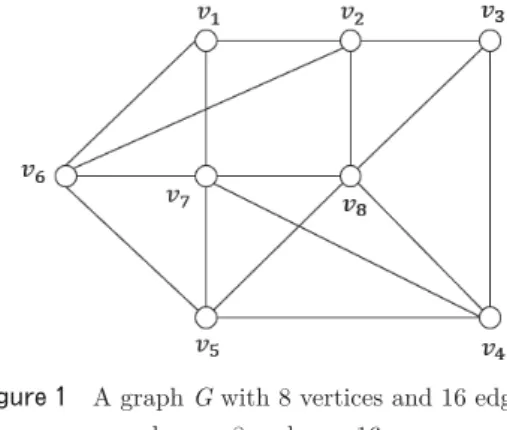
has n vertices and m edges, namely, = n and = m. Figure 1 depicts an example of the graphs considered in this paper, where G is simple, undirected, and connected.
Figure 1 A graph G with 8 vertices and 16 edges, namely, n = 8 and m = 16.
For two sets X and Y, let X - Y denote the set obtained from X by removing all elements of Y. For an edge-subset , let denote the spanning subgraph obtained by removing all edges of U from G, namely, . A graph having i edges is also called i-edge-graph. Figure 2 depicts four spanning 10―edge-subgraphs of G shown in Figure 1.
Each of the spanning subgraphs in Figure 2 is obtained by removing exactly 6 edges from G of Figure 1, namely, each of the subgraphs has exactly 10 edges. Clearly, the spanning subgraphs are either disconnected (see Figure 2(a)) nor connected (see Figure 2 (b), (c), (d)). In fact, = 8008 spanning subgraphs can be obtained by respectively removing exactly 6 edges from G of Figure 1.
For a graph , an edge-subset is called edge-cut of G, if becomes a disconnected spanning subgraph. For example, for shown in Figure 1,
is an edge-cut of G, as (see Figure 2(a)) is disconnected. However,
is not an edge-cut of G, as (see Figure 2(b)) is connected as well.
Furthermore, if an edge-subset consisting of only one e ∈ E is an edge-cut, then the edge e is said to be bridge of G. For example, edge is a bridge of the graph of Figure
2(b). However, edge of the graph of Figure 1 is not a bridge. This means that an edge not being a bridge in G may be contained as a bridge in some connected spanning subgraphs of G. Let brg (G) denote the number of bridges in a graph G. Clearly, iff G is a tree, and brg (G) = 0 for some graphs (see e.g. Figure 1, Figure 2(d)). Thus,
holds for a graph G. Furthermore, it is not hard to verify that, in general, may not hold for two graphs G, G' with n vertices and m edges. Note that, for given two integers n,
m , the maximum number of bridges for all connected graphs consisting of n vertices and
m edges is invariant.
Let maxβ(n, m) denote the number of bridges in the graph that has the maximum number of
bridges among all connected graphs consisting of n vertices and m edges. Both two graphs in Figure 3 have the maximum number of bridges for all connected graphs consisting of 8 vertices and 11 edges.
Given two integers n and , we can show the following formula to find maxβ(n, m),
where denotes the least integer more than or equal to x.
(2) Figure 2 Four spanning 10-edge-subgraphs of G of Figure 1.
By formula (2), for the graphs of Figure 3 with n=8 and m=11,
, which implies that the graph with the maximum number of bridges is not unique.
For an integer , let denote the set of all possible connected spanning
i-edge-subgraphs in G. In addition, let .
Note that = n and = m for a graph G = (V, E). We introduce a new notation for an integer , which is defined as follows.
Definition 1. For a graph G and two integers , let
denote the set of all possible connected spanning i-edge-subgraphs of G, each of which has exactly
b bridges. In addition, let .
Note that we have = 0 for an integer b satisfying b . Consequently,
is partitioned into , namely,
(3)
Formula (3) implies that is obtained by computing .
Consequently, the problem of computing all for is #P-complete. The degree of a vertex v V, denoted by deg (v), is the number of edges incident on v. Clearly,
holds for any v V by |V| = n. A vertex v with deg(v) = 1 is called terminal of G. Let trm(G) denote the number of terminals in G.
Clearly, the only one edge incident on a terminal v (namely, deg(v) = 1) must be a bridge. This means that for a graph G we have
(4) For example, three subgraphs in Figure 2(b), (c), (d) respectively have one terminal v1, two
terminals v1, v3, and no terminal. A complete bipartite graph is the unique graph with
n - 1 terminals. In general, .
Let denote the number of terminals in a graph that has the maximum number of Figure 3 Two graphs with 8 vertices and 11 edges.
terminals among all connected graphs consisting of n vertices and m edges. Note that, for the graph G in Figure . In fact, we can also verify that the maximum number of terminals is equal to the maximum number of bridges, namely,
(5)
Definition 2. For a graph G and two integers , let
denote the set of all possible connected spanning i-edge-subgraphs of G, each of which has exactly
t terminals. In addition, let .
By definitions, we have is justly
partitioned into , namely,
(6)
Formula (6) implies that we can obtain by computing
. Consequently, the problem of computing all is #P-complete. Next, we introduce new notations and , respectively, defined as follows:
(7)
(8)
It is not difficult to see that and respectively represent the number of connected spanning i-edge-subgraphs of G, each of which has at least x terminals, and bridges, respectively. Now, we give the following theorems to reveal a fundamental relationship between
and .
Theorem 1. For a graph G and two integers , we have
(9)
Proof. By formula (4), a graph with t terminals has at least t bridges, as one terminal justly
corresponds to one bridge. On the other hand, it is not hard to see that a graph with b bridges has at most b terminals by definitions.
For every subgraph , it is easy to see that if H is counted one time by then it is also counted one time by . Thus, we obtain the validity of inequality (9). □ Similarly, we also introduce notations and , respectively, defined as follows:
(10)
(11)
Clearly, and respectively represent the number of connected spanning i-edge-subgraphs of G, each of which has at most x terminals, and bridges, respectively.
Theorem 2. For a graph G and two integers , we have
(12)
Proof. By definitions, for a given , we have
and
Note that . Immediately, formula (12) follows formula (9). □ By definitions, it is obvious that
(13) and
(14) In the following discussions, for shorting notations, when the graph G is clearly specified,
, , , are always abbreviated to respectively.
3 Formulas for Expressing Relationships between and
This section aims to show some formulas for specifying relationships between and . In order to do it, we need new notations.
In order to clarify affiliation without confusion, we also employ EG to denote the edge-set of a
brg(H) = b for a subgraph .
For a subgraph and an edge , let H+e denote the graph obtained by adding e into H. Namely, . Let H-e denote the graph obtained by
removing e from H. Namely, .
By definitions, the sum of the numbers for all is expressed as follows: (15)
We introduce the average value on the numbers for all , denoted by abbreviated to , to be defined as follows.
(16)
Clearly, .
Lemma 1. For a graph G and an integer
Proof. As in formula (16), it is trivial. □
By setting m = i into formula (2), we have
(17) The following lemma establishes a fundamental relationship between and by employing
.
Lemma 2. For a graph G and an integer
(18)
Proof. By definitions, is a connected spanning i-edge-subgraph of G. Thus, for
every , we can obtain H + e that is a connected spanning (i + 1)-edge-subgraph of G.
Namely, . Note that . Consequently,
from every , we can obtain the number m - i of connected spanning (i + 1)-edge-subgraphs in by adding every into H.
On the other hand, is a connected spanning (i + 1)-edge-subgraph of G. Thus, by removing an edge from F, where e is not a bridge of F, we can obtain one subgraph . This means that every are obtained from the number i + 1 - brg(F) of different connected spanning i-edge-subgraphs in .
Combining with the above discussions, we obtain
which has proven the validity of this lemma. □
Lemma 2 implies that the following theorem is true.
Theorem 3. For a graph G and an index
(19)
Proof. It is straightforward from formula (18). □
In Theorem 3 a very useful fact has been described, that is, it is possible to prove the validity of by investigating the property on and . In the next section, we will do it.
4 Sufficient Conditions for Satisfying
In this section, we will show sufficient conditions such that the validity of log-concavity of
sequence is true.
Theorem 4. For a graph G, the inequality holds if an index
satisfies one of the following conditions:
Proof. By Theorem 3, it is sufficient to find the condition satisfying the following inequality:
Furthermore, the above inequality is rewritten as follows:
(20)
Note that , namely, . When ,
inequality (20) holds immediately. This means that (i) can be considered as a sufficient condition
such that holds.
Next, we assume , and show the condition on an index i such that inequality (20) holds. We further write inequality (20) as follows:
(21) which implies that (ii) can be considered as a sufficient condition such that
holds. □
Next, we further investigate some properties on a graph such that the sufficient conditions in Theorem 4 hold. In order to do it, we need new notations. For an integer , we recall and , written as follows:
We introduce notations and , respectively, defined as follows:
(22)
(23)
Lemma 3. For a graph G and an index , we have the following inequalities with
respect to an integer .
Proof. It is trivial by definitions. □
Clearly, by Lemma 3. We further give the following lemma to present more strict inequalities.
Lemma 4. For a graph G and an index , we have the following inequalities with
respect to an integer .
Proof. (i) By definitions, it is sufficient to show the validity of the following inequality.
(24)
Clearly, the validity of inequality (24) is true with equivalent iff . Next, we assume , and show the validity of inequality (24).
By Lemma 3 and definitions, we have
Therefore,
which is rewritten as follows:
Thus, we can obtain inequality (24) by adding the term into both hand-sides of the above inequality.
By definition, it is not hard to see that . Hence, the validity of (i) has been shown.
(ii) We can also show the validity of (ii) by employing the method similar to that of (i). □ By Lemma 4, we obtain
Lemma 5. For a graph G and an index , we have the following inequalities with
respect to an integer .
Proof. Let with at most x bridges, namely, . It is easy to verify
that, for every , H + e has at most x bridges. This means that H + e is in , and has at most x bridges, namely, . Note that
has at most x bridges, are obtained by adding every into H.
Conversely, for every with and an edge where e is not a bridge of F, F - e has at least brg(F) bridges, namely, . This means that there may be a subgraph F in , where , and an edge e in , where e is not bridge of F, such that
.
Based on the above discussion, the validity of (i) has been shown.
By employing the method similar with that of (i), the validity of (ii) can be shown. □ By Lemma 5 and definitions, we immediately obtain the following inequalities.
(25) (26) The following formulas are driven by the definitions of , and .
(27)
(28) We introduce notation to be defined as follows:
(29) It is not hard to verify that by definitions. Namely,
By the definition of , we also have
(30) Thus,
(31) By formula (2), it is easy to verify that
In particular, there are many integers such that .
Now, we consider an integer i of the case: . We take the sum on both hand-sides of inequality (25) over all , and obtain
(32)
Note that . By applying the above formulas, from the above
inequality, we can obtain
By formula (18), the above inequality is written as follows:
which is further rewritten as follows:
(33) Concluding the above discussions, we have obtained the following theorem.
Theorem 5. For a graph G and an index with , we
(34)
Proof. Concluding the above discussions, it follows inequality (33). □
For integers satisfying , we can also obtain the result
similar to inequality (34) by the method above used. In particular, by Theorem 4(i), if
equivalently,
(35) then
This means that holds for the larger integers that are larger than
. Investigating properties on the graphs satisfying inequality (35) is also interesting as a future research subject.
5 Concluding Remarks
Based on the number of bridges in a graph, we propose a new method of partitioning the set of the all possible connected spanning i-edge-subgraphs of G into the subsets: ,
represents the set of all possible connected spanning i-edge-subgraphs of G having b bridges. Similarly, by employing the number of terminals in a graph, we
can also partition into the subsets, where
represents the set of all possible connected spanning i-edge-subgraphs of G having t terminals. In particular, inequalities have been shown in Theorems 1, 2 to express fundamental relationships
between and .
Furthermore, we introduce notation , defined in formula (16), to represent the average value of bridges with respect to all possible connected spanning i-edge-subgraphs. By applying , we have obtained a formula (19) to express a fundamental relationship between and , shown in Theorem 3. Consequently, we have obtained sufficient conditions, shown in Theorem 4,
to ensure that sequence is log-concave, namely,
holds for all integers . Note that both are contained in the sufficient conditions.
establish some inequalities for expressing some relationships between and , e.g., see Theorems 5. In particular, by Theorems 4, 5, we have obtained that sequence
for a graph G is log-concave if the following inequality holds for all integers .
This means that if we can prove inequality then the validity of log-concave conjecture on sequence will be obtained. However, it is
open whither, holds or not.
Then, it seems to be interesting to find properties of a graph G such that
holds by further investigating properties of . In addition, little is known about results in investigating them.
On the other hand, by using the method similar to that of investigating in this paper, we can also obtain formulas on and may obtain some results desired for proving log-concavity of sequence by using the formulas. Then, it seems to be an interesting subject as future research.
References
[ 1 ] A. L. Barabási, Network Science, Cambridge University Press, 2016.
[ 2 ] M. O. Ball, “Computational complexity of network reliability analysis: An overview”, IEEE Transactions on Reliability 35: 3 (1986), pp. 230―239.
[ 3 ] M. Ball, C. Colbourn, and J. Provan, Network Reliability, in Handbook of Operations Research: Network Models, Elsevier North-Holland (1995), pp. 673―762.
[ 4 ] H. L. Bodlaender and T. Wolle, “A note on the complexity of network reliability problems”, Institute of Information and Computing Sciences, Utrecht University, Technical Report UU―CS―2004―001.
[ 5 ] F. Brenti, “Log-concave and unimodal sequences in algebra, combinatorics, and geometry: an update”, in Jerusatem Combinatorics ’93, in: Contemp. Math., Vol. 178 (1994), American Mathematical Society, Providence, pp. 71―89.
[ 6 ] G. Caldarelli and A. Chessa, Data Science and Complex Networks, Oxford University Press, 2016. [ 7 ] M. Chari and C. J. Colbourn, “Reliability polynomials: a survey”, J. Combin. Inform. System Sci. 22 (1997),
pp. 177―193.
[ 8 ] P. Cheng and S. Masuyama, “Inequalities on the number of connected spanning subgraphs in a multigraph”, IEICE Trans. Information and Systems, E91―D (2008), No. 2, pp. 178―186.
[ 9 ] P. Cheng and S. Masuyama, “Formulas for counting connected spanning subgraphs with at most n + 1 edges in a complete graph Kn”, IEICE Trans. Fundamentals, E91―A (2008), No. 9, pp. 2314―2321.
[10] P. Cheng and S. Masuyama, “Counting connected spanning subgraphs with at most n+1 edges in special
pp. 115―122.
[11] P. Cheng and S. Masuyama, “Counting connected spanning subgraphs with at most p +q +1 edges in a complete bipartite graph Kp,q”, IEICE Technical Report COMP. Vol 108 (2008), No. 206, pp. 9―16.
[12] P. Cheng and S. Masuyama, “A proof of unimodality on the numbers of connected spanning subgraphs in an n-vertex graph with at least edges”, Discrete Applied Mathematics, 158: 6 (2010), pp. 608―619.
[13] C. J. Colbourn, The Combinatorics of Network Reliability, Oxford University Press, Oxford, 1987.
[14] C. J. Colbourn, “Some open problems on reliability polynomials”, In: Proc. Twentyfourth Southeastern Conf. Combin., Graph Theory Computing, Congr. Numer. 93 (1993), pp. 187―202. (DIMACS Technical Report 93―28, April 1993).
[15] F. Fouss, M. Saerens, and M. Shimbo, Algorithms and Models for Network Data and Link Analysis, Cambridge University Press, 2016.
[16] M. R. Garey and D. S. Johnson, Computers and Intractability: A guide to the Theory of NP-Completeness, W. H. Freeman, San Francisco, 1979.
[17] I. B. Gertsbakh and Y. Shpungin, Models of Network Reliability: Analysis, Combinatorics, and Monte Carlo, CRC Press, 2016.
[18] E. N. Gilbert, “Random graphs”, Ann. Math. Statist., 30 (1959), pp. 1141―1144.
[19] J. L. Gross, J. Yellen, and P. Zhang, Handbook of Graph Theory (Second Edition), Chapman and Hall/ CRC, 2014.
[20] R. Guidotti and P. Gardoni, Y. Chen, “Network reliability analysis with link and nodal weights and auxiliary nodes”, Structural Safety 65 (2017), pp 12―26.
[21] H. Guo and M. Jerrum “A polynomial-time approximation algorithm for all-terminal network reliability”, SIAM J. Comput., 48: 3 (2019), pp. 964―978.
[22] J. Huh “h-Vectors of matroids and logarithmic concavity”, Advances in Mathematics 270 (2015), pp. 49― 59.
[23] D. R. Karger, “A randomized fully polynomial time approximation scheme for the all-terminal network reliability problem”, SIAM review 43: 3 (2001), pp. 499―522.
[24] A. K. Kelmans, “Crossing properties of graph reliability functions”, DIMACS Technical Report 98―39 (1999).
[25] W. Myrvold, “Reliable network synthesis: Some recent developments”, In Proceedings of the Eighth International Conferences on Graph Theory, Combinatorics, Algorithms, and Applications, Volume II (1996), pp. 650―660.
[26] M. E. J. D. Newman, Networks: An Introduction, Oxford University Press, Oxford, U. K., 2010.
[27] J. Oxley, “Chromatic, flow, and reliability polynomials: the complexity of their coefficients”, Combin. Probab. Comput. 11: 4 (2002), pp. 403―426.
[28] L. B. Page and J. E. Perry, “Reliability polynomials and link importance in networks”, IEEE Trans. Reliability 43 (1994), pp. 51―58.
[29] M. A. Porter and J. P. Gleeson, Dynamical Systems on Networks: A Tutorial, Spinger International Publishing Switzerland, 2016.
[30] J. S. Provan, “The complexity of reliability computations in planar and acyclic graphs”, SIAM J. Comput., 15: 3 (1986), pp. 694―702.
[31] J. S. Provan and M. O. Ball, “The complexity of counting cuts and computing the reliability that a graph is connected”, SIAM J. Comput., 12: 4 (1983), pp. 777―888.
[32] M. L. Rebaiaia and D. Ait-Kadi, “Network reliability evaluation and optimization: Methods, Algorithms and Software Tools”, CIRRELT―2013―79 (December 2013).
[33] R. P. Stanley, “Log-concave and unimodal sequences in algebra, combinatorics, and geometry”, in Graph Theory and Applications: East and West, Jinan, 1989, Annals of New York Academy of Sciences. 576 (1989), pp. 500―535.
[34] R. P. Stanley, “Positivity problems and conjectures in algebraic combinatorics”, in: Mathematics: Frontiers and Perspectives, American Mathematical Society, Providence, 2000, pp. 295―319.
[35] L. G. Valiant, “The complexity of enumeration and reliability problems”, SIAM J. Comput., 8: 3 (1979), pp. 410―421.
[36] D. Vertigan, “The computational complexity of Tutte invariants for planar graphs”, SIAM J. Comput. 35: 3 (2005), pp. 690―712.
[37] D. J. A. Welsh, “Combinatorial problems in matroid theory”, in Combinatorial Mathematics and Its Applications (ed. D. J. A. Welsh), Academic Press, London, 1971, pp. 291―306.
[38] S. Yang, F. B. Keller, and L. Zheng, Social Network Analysis: Methods and Examples, SAGE Publications, Inc., 2017.