
分散表現を用いた単語の感情極性抽出
6
0
0
全文
(2) Vol.2016-NL-228 No.12 2016/9/30. 情報処理学会研究報告 IPSJ SIG Technical Report あることを示すために用いる文分類手法である.. 3.1.3 言語横断単語分散表現. 3.1.1 Skip-gram[9], GloVe[10]. 異なる言語の単語を同じ空間で表現する言語横断単語分. 分散表現を計算する2つの手法で,文書中の単語の共起. 散表現を求める手法は,いくつか提案されている. 関係を利用して,似た意味の単語は似たベクトルになるよ. [26,27,28].その中で Mikolov らの提案した手法[26]は,. うに学習するアルゴリズムである.Skip-gram [9]は,単語. 前もって計算されたある言語の分散表現を線形写像により. の出現を予測するモデルであり,GloVe [10]は単語の頻度. 別の言語に変換する手法である.計算コストの点で他の手. を基にしたモデルである.これらの手法により獲得される. 法に対して優位性があるため,本稿ではこの手法を用いる.. 分散表現は,単語間の類似度を計算するために使用される,. 変換行列 V は,一部の単語対をもとに推定する.次の最適. 様々な研究課題で素性ベクトルとして用いられる,あるい. 化問題を解くことで,変換行列を得る:. はニューラルネットワークの入力として用いられるなど, 自然言語処理でも盛んに利用されている.. N. min J. 𝑉𝑥& − 𝑧&. M. . (4). &OP. 3.1.2 単語極性反転モデル 池田らの単語極性反転モデル[8]は,単語に付与された極. ただし,𝑥& , 𝑧& は原言語と目的言語の単語対の分散表現であ. 性を文レベルの分類に利用したモデルである.単純に多数. る.変換行列 V で線形変換した𝑥& が𝑧& に近づくように,𝑉を. 決による分類ではなく,逆説や否定など,文脈によって起. 学習する.本稿の実験では𝑥& が日本語単語のベクトルであ. こる極性の反転を捉えたモデルとなっている.単語の極性. り,𝑧& が対応する英単語のベクトルになる.. は文の極性と一致していることを前提とし,異なっている 場合は,文脈によって反転が起こっていると考え,その反. 3.2 分散表現による単語極性の抽出とその利用. 転を機械学習により捉える.. 本節では,3.1 節で説明した基盤技術を用いて単語極性. 文 S 中における各極性付き単語𝑥の反転は,以下の式で. を抽出する手法,及びその利用方法について説明する.. 定式化される: 3.2.1 単語の感情極性抽出 𝑆$%&'( 𝑥, 𝑆 =𝜔 ∙ 𝜙 𝑥, 𝑆 . 1. まず,3.1.1 節で説明した Skip-gram および GloVe を用 いて単語の分散表現を計算する.得られた分散表現を分類. ただし,𝜙は素性関数,𝜔はその重みベクトルである 単語. 器の素性にして単語の感情極性分類器を学習する.この際,. 𝑥の極性が文中で反転していれば𝑆$%&'( 𝑥, 𝑆 > 0, そうでな. 訓練事例としては,既存の極性辞書に含まれる極性単語を. ければ𝑆$%&'( 𝑥, 𝑆 ≤ 0を返す.素性関数𝜙として,文 S にお. 用いる.学習された分類器を,分散表現が得られた単語に. いて単語𝑥の前後に出現する単語などを用いることにより,. 適用し,その極性を決定する.その際,ポジティブ側の閾. 否定表現や逆説表現による極性反転を捉えている.. 値𝜃6S$ ,ネガティブ側の閾値𝜃NTU を用意し,単語𝑥に関する. 学習は,重みベクトル𝜔を推定する.各文を事例にして,. 分類器の出力スコア𝑓 𝑥 が,𝑓 𝑥 ≧ 𝜃6S$ であればポジティ. 文全体での分類結果が最適になるように行う.. ブ,𝑓 𝑥 ≦ 𝜃NTU であればネガティブであると判定する.一. 定式化すると以下のようになる:. 般的に,非常に大規模な単語集合に対して効率的に分散表 現を計算することができるので,大規模な単語極性辞書を. 𝑆𝑐𝑜𝑟𝑒6 𝑆 = 𝜔 ∙. 𝑆$%&'( 𝑥, 𝑆 𝐼 𝑥 8∈:. = . 𝜔 ∙ 𝜙 𝑥, 𝑆 𝐼 𝑥. 構築することが可能である.また,分類器としてサポート ベクトルマシンや対数線形モデルのようにスコアを算出で きるものを用いることで,ポジティブもしくはネガティブ の極性だけでなく,極性分類結果がどの程度信頼できるか. 8∈:. = 𝜔 ∙. 𝜙 𝑥, 𝑆 𝐼 𝑥 . (2). を表す信頼度スコアを得ることができる.. 8∈:. 3.2.2 文の感情極性分類 ただし,𝐼 𝑥 は以下で定義される関数である:. 前節で作成した拡張辞書を極性辞書として,池田らの単 語極性反転モデル[8]を用いて文の感情極性分類を行う.た. +1, 𝐼 𝑥 = −1, 0,. 𝑥∈𝑁 𝑥 ∈ 𝑃 (3) else. だし,池田らのモデルをそのまま用いる手法と,その変種 を考える. まず,前節で説明したように,ポジティブ側の閾値𝜃6S$ , ネガティブ側の閾値𝜃NTU を設定することで,ポジティブ単. ⓒ2016 Information Processing Society of Japan. 2.
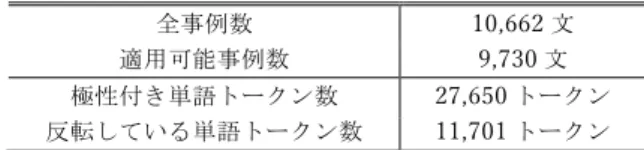
(3) Vol.2016-NL-228 No.12 2016/9/30. 情報処理学会研究報告 IPSJ SIG Technical Report 語集合 P とネガティブ単語集合 N を構成し,これを用い. の計算に使う単語対は,一般公開されている英和辞書であ. て池田らのモデルをそのまま用いることができる.. る edict (http://www.edrdg.org/jmdict/edict.html)から,単. また,ポジティブ単語集合 P とネガティブ単語集合 N を. 語同士の対となるものを抽出し収集した.日本語の分散表. 明示的に構成せず,単語極性分類器の出力スコア𝑓 𝑥 を用. 現は日本語版 Wikipedia から Skip-gram で学習し,次元は. いる方法も考える.この場合は,文全体の極性を. 300 次元とした.英語の次元もここでは 300 とした.また, 東北大学より公開されている日本語評価極性辞書[29,30]. 𝑆𝑐𝑜𝑟𝑒6 𝑆 = 𝜔 ∙ −. 𝜙 𝑥, 𝑆 𝑓 𝑥 . (5) 8∈:. から,複数語から成る表現を削除して単語だけを抽出する ことで集めた極性単語集合を,日本語の単語の感情極性の 評価データとした.. によって決定する.式(2)との差異は,𝐼(𝑥)の代わりに出力 表 1 Movie Review コーパスの統計値.. スコア𝑓 𝑥 を用いている点である.このモデルの利点は, 二つの閾値𝜃6S$ および𝜃NTU を決定する必要がない点である. 3.2.3 他言語の単語への感情極性抽出 3.2.1 節で作成した感情極性分類器の,他言語への適用可 能性を検討する.. ただし,この表の適用可能事例数は,General Inquirer を用いたときのもので ある.反転している単語とは,文の極性と極性辞書での極性が異なる単語のこ とである. ※. 全事例数 適用可能事例数. 10,662 文 9,730 文. 極性付き単語トークン数 反転している単語トークン数. 27,650 トークン 11,701 トークン. 英語以外のリソースから学習された分散表現を 3.1.3 節 で述べた Mikolov らの手法を使って,少量の単語ペアから,. 4.2 単語の感情極性分類. 英語のベクトル空間に射影する.得られた分散表現は英語. 単語の分散表現を素性ベクトルにして単語の感情極性の. 空間における意味情報を有してると考えられるため,3.2.1. 識別モデルを構築する.分散表現の学習には Skip-gram と. 節で構築した分類器がそのまま適応可能である.. GloVe を使い,次元数を変えたものや,Skip-gram と GloVe. を組み合わせたベクトルによる分類精度を比較する.Skip-. 4. 実験. gram については 階層的ソフトマックスを用い,窓幅=5 と し,GloVe については,x-max=100,窓幅=5 に設定した.. 4.1 実験データ. また,分類器としてはサポートベクトルマシン(SVM)を用. 単 語 の 分 散 表 現 の 学 習 用 コ ー パ ス に は English. い,線形カーネルと RBF カーネルを試した. ハイパーパ. Wikipedia の全ページの本文を使用する.単語感情極性辞. ラメータとして,線形カーネルでは正則化パラメータ C∈. 書としては General Inquirer[24]からポジティブ/ネガティ. {1,10,100,1000},RBF カーネルでは C∈{1,10,100,1000}に. ブ極性の付与された,それぞれ 1636 語,1698 語を抽出し. 加 え γ ∈ {0.001, 0.0001} (γ は カ ー ネ ル パ ラ メ ー タ で. て用いた.単語極性の推定実験では,General Inquirer から 抽出したこのデータに対し 10 分割交差検定を行うことで. M. 𝐾 𝑥& , 𝑥[ = exp (−𝛾 𝑥& − 𝑥[ ) において使用される) で最適な. パラメータを選択する.ハイパーパラメータは訓練データ. 評価をした.池田らの手法[8]による評価文分類実験の評価. 中 5 分割交差検定をすることで最適パラメータを選択した.. データには,Pang ら[25]による Movie Review のコーパス. 表 2 に Skip-gram,表 3 に GloVe,表 4 に Skip-gram+GloVe. を用いた.これは文単位に感情極性の付与された英文コー. の各次元の正解率を示す.. パスで,評価情報分析で多く用いられている.事例数を表. Skip-gram も GloVe も次元数が増えるごとに分類精度が. 1に示す.池田らの手法とその変種は,極性辞書に含まれ. 向上してく傾向があるが,Skip-gram では 900 次元あたり,. る単語が一つも含まれない文には適用できない.分散表現. GloVe では 400 次元あたりで分類精度は変わらなくなり,. を用いて構築した極性辞書は General Inquirer より規模が. 頭打ちとなっている.線形カーネルと RBF カーネルとでは. 大きいので,より多くの文を池田らの手法に適用すること. ほとんどの場合で RBF カーネルの方が高い精度で分類す. ができる.しかし,ここでは評価データを揃えるために,. ることができた.文書分類を含む言語処理における分類課. General Inquirer に含まれる単語を一つも持たない文はデ. 題では,線形カーネルで十分な精度が得られることが多い.. ータセットから除外した.実験では,適用可能事例数 9,730. これについての議論は,文献[23]の Appendix C を参照さ. 文を使用し,各単語は基本形に直した.実験の際には池田. れたい.しかし,分散表現を用いた単語の極性分類におい. らの手順に従って,このデータに対し文単位の 5 分割交差. ては,RBF の明らかな優位性が示された.このことは,分. 検定による評価を行い,評価尺度には正解率を用いた.. 散表現を分類問題に用いる場合のカーネル関数の選択につ. 3.2.3 節で説明した言語横断的な単語の感情極性分類に. いて考慮すべきであり,本稿の一つの知見である.表 4 で. おいては,Mikolov らの手法[26]により,日本語の単語分. は RBF カーネルの結果のみを表示している.. 散表現を英語の単語分散表現の空間に写像した.変換行列. ⓒ2016 Information Processing Society of Japan. 3.
(4) Vol.2016-NL-228 No.12 2016/9/30. 情報処理学会研究報告 IPSJ SIG Technical Report 表 4 に示すように,Skip-gram と GloVe の組み合わせで. 4.3 評価文分類. は,異なる2つの分散表現がお互いを補い合うように高い. 拡張極性辞書の有効性を示すために,評価文分類による. 分類精度を出している.特に Skip-gram の 900-1200 次元. 評価実験を行う.この実験では,以下の 3 つ手法について. と GloVe の組み合わせは多くが単独 の場合よりも高い正. それぞれ実験し比較する:. 解率を出している.結果として Skip-gram 1100 次元と GloVe 400 次元を組み合わせた分散表現が 90.80%で最も. •. 高い分類精度を出した.以降 Skip-gram 1100 次元,GloVe 400 次元の分散表現を使用する.この組み合わせを用いて,. General Inquirer(ベースライン) :. General Inquire を利用した評価文分類. •. General Inquirer + 拡張辞書,閾値 :. General-Inquirer から抽出した全単語を訓練データにして. 3.2.1 節で述べた,閾値𝜃6S$ ,𝜃NTU を考慮した拡張極性. 分類器を学習し,感情極性が付与されていない全単語を分. 辞書と General Inquirer を利用した評価文分類 なお,(𝜃6S$ , 𝜃NTU ) = (0.2, −0.4)とする.. 類し,拡張極性辞書を作成した. •. General Inquirer + 拡張辞書, 𝒇 𝒙 :. 3.2.2 節 で 述 べ た , 拡 張 極 性 辞 書 の ス コ ア 𝑓 𝑥 と. 表 2 次元ごとの分類正解率 (Skip-gram) 次元. 線形. RBF. General Inquirer を利用した評価文分類.General. 100. 0.8592. 0.8575. Inquirer のスコアは,ポジティブであれば 1,ネガテ. 200. 0.8723. 0.8765. 300. 0.8765. 0.8876. 400. 0.8809. 0.8960. 500. 0.8717. 0.8954. 性に直接関わらないと考えられる単語は事前に取り除いた.. 600. 0.8734. 0.8971. モデルの設定は,池田らの実験設定に準じて行ない,素. 700. 0.8681. 0.9021. 性表現としては,極性単語 x 自身を含む周囲 3 単語と単語. 800. 0.8703. 0.9046. 900. 0.8687. 0.9030. 1000. 0.8567. 0.8965. 1100. 0.8620. 0.9007. ータ C は各手法ごとに最適なパラメータを実験を通して選. 1200. 0.8592. 0.9030. 択した.. ィブであれば-1 とした. なお,拡張極性辞書において,助詞や前置詞など感情極. x に付与されたスコアを用いた.学習器には SVM を使い, カーネルは 2 次の多項式カーネルを使った.正則化パラメ. 実験結果を表 5 に示す.拡張極性辞書の利用によってベ 表 3 次元ごとの分類正解率 (GloVe). ースラインと比べて良い正解率を得た.. 次元. 線形. RBF. 拡張極性辞書のスコア𝑓 𝑥 を利用する変種モデルは最も. 100. 0.8709. 0.8773. 良い結果を得ており,文の感情極性分類に効果的に作用し. 200. 0.8751. 0.8862. 300. 0.8717. 0.8871. 400. 0.8581. 0.8924. 500. 0.8597. 0.8885. ていることがわかる. 表 5 分類結果 正解率. 表 4 Skip-gram+GloVe の分類正解率 GloVe. General Inquirer(ベースライン). 0.692. + 拡張辞書,閾値. 0.703. + 拡張辞書,𝑓 𝑥. 0.716. 100. 200. 300. 400. 500. 100. 0.8826. 0.8932. 0.8938. 0.8996. 0.8949. 4.4 言語横断的な単語の感情極性分類. 200. 0.8840. 0.8932. 0.9010. 0.8971. 0.9007. Mikolov らのモデル[26]を使って,日本語の単語の分散. 300. 0.8929. 0.8943. 0.8977. 0.8991. 0.8993. 表現を英語の分散表現の空間に写像した.英単語に対して. 400. 0.8826. 0.8840. 0.8929. 0.9018. 0.8929. 学習された感情極性分類器を用いて他の言語の単語の感情. 500. 0.8949. 0.9007. 0.8993. 0.9032. 0.9018. 600. 0.8915. 0.8991. 0.9032. 0.9010. 0.8960. 700. 0.8974. 0.8996. 0.9046. 0.8993. 0.9013. とができた.ここでは,300 次元から 300 次元へ写像した. 800. 0.8974. 0.8999. 0.9049. 0.9055. 0.9010. 場合についての結果を報告したが,次元数を含む様々な設. 900. 0.9018. 0.9063. 0.9052. 0.9052. 0.9024. 定次第により分類結果は変化する可能性があり,そのよう. 1000. 0.9013. 0.9030. 0.8991. 0.9016. 0.9004. な影響の調査は今後の課題とする.. 1100. 0.9074. 0.9049. 0.9066. 0.9080. 0.9041. 1200. 0.9002. 0.9046. 0.9044. 0.9049. 0.9024. Skipgram. ⓒ2016 Information Processing Society of Japan. 極性を判定した.その結果,80.1%の正解率で分類するこ. 4.
(5) Vol.2016-NL-228 No.12 2016/9/30. 情報処理学会研究報告 IPSJ SIG Technical Report. 5. おわりに 本研究では,単語の分散表現を使って単語の感情極性分 類を行った.分散表現を素性ベクトルとして分類器を学習 することにより,約 90%の正解率で単語の感情極性を推定. [11]. することができた.学習したモデルを使って感情極性が付 与されていない単語の感情極性を実際に推定し,これを既 存の文分類手法に適用することで文の感情極性分類精度が. [12]. 向上することを示した.また,学習した感情極性分類器の, 他の言語への適用可能性についても調査した.本研究で獲 得した単語感情極性は一般に公開する予定である. [13]. 参考文献 [1]. [2]. [3]. [4]. [5]. [6]. [7]. [8]. [9]. [10]. Tetsuji Nakagawa, Kentaro Inui, and Sadao Kurohashi, Dependency Tree-Based Sentiment Classification using CRFs with Hidden Variables. In Proceedings of the Human Language Technologies and the Annual Conference of the North American Chapter of the Association for Computational Linguistics (HLT-NAACL), pages 786-794, 2010. Richard Socher, Brody Huval, Christopher D. Manning, and Andrew Y. Ng. Semantic Compositionality through Recursive Matrix-Vector Spaces. In Proceedings of the Joint Conference on Empirical Methods in Natural Language Processing and Computational Natural Language Learning (EMNLP-CONLL), pages 1201-1211, 2012. Hiroshi Ishijima, Takuro Kazumi, and Akira Maeda. Sentiment Analysis for the Japanese Stock Market, Global Business and Economic Review, vol. 17, no. 3, pages 237255, 2015. Sho Tsugawa, Yusuke Kikuchi, Fumio Kishino, Kosuke Nakajima, Yuichi Itoh, and Hiroyuki Ohsaki. Recognizing Depression from Twitter Activity. In Proceedings of the 33rd Annual ACM Conference on Human Factors in Computing Systems, pages 3187-3196, 2015. Shoko Wakamiya, Lamia belouaer, David Brosset, Yukiko Kawai, Christophe Claramunt, and Kazutoshi Sumiya. Exploring Geographical Crowdʼs Emotions with Twitter. Information and Media Technologies, vol. 10, no. 2, pages 357-363, 2015. Prem Melville, Wojciech Gryc, and Richard D. Lawrence. Lexical Knowledge with Text Classification. In Proceedings of the 15th ACM SIGKDD International Conference on Knowledge Discovery and Data Mining (KDD), pages 12751284, 2009. Tao Li, Yi Zhang, and Vikas Sindhwani. A Non-negative Matrix Tri-factorization Approach to Sentiment Classification with Lexical Prior Knowledge. In Proceedings of the Joint Conference of the 47th Annual Meeting of the Association of Computational Linguistics and the 4th International Joint Conference on Natural Language Processing (ACL-IJCNLP), pages 244-252, 2009. 池田大介, 高村大也, 奥村学. 単語極性反転モデルによる評 価文分類. 人工知能学会論文誌 vol. 25, no. 1, pages 50-57, 2010. Tomas Mikolov and Jeffery Dean. Distributed representations of words and phrases and their compositionality. Advances in neural information processing systems, 2013. Jeffrey Pennington, Richard Socher, and Christopher D.. ⓒ2016 Information Processing Society of Japan. [14]. [15]. [16]. [17]. [18]. [19]. [20]. [21]. [22]. [23]. Manning. Glove: Global Vectors for Word Representation. In Proceedings of the Conference on Empirical Methods in Natural Language Processing (EMNLP), pages 1532-1543, 2014. Shih-Ming Wang, and Lun-Wei Ku. ANTUSD: A Large Chinese Sentiment Dictionary. In Proceedings of the 10th International Conference on Language Resources and Evaluation (LREC), pages 23-28, 2016. Giuseppe Castellucci, Danilo Croce, and Roberto Basili. Acquiring a large scale polarity lexicon through unsupervised distributional methods. In Proceedings of the International Conference on Applications of Natural Language to Information Systems. Springer International Publishing, 2015. Hiromu Sugawara, Ryohei Sasano, Hiroya Takamura, and Manabu Okumura. Context representation with word embeddings for WSD. In Proceedings of the International Conference of the Pacific Association for Computational Linguistics. Springer Singapore, 2015. Vasileios Hatzivassiloglou and Kathleen R. McKeown. Predicting the semantic orientation of adjectives. In Proceedings of the eighth conference on European chapter of the Association for Computational Linguistics. Association for Computational Linguistics, 1997. Peter Turney and Michael L. Littman. Measuring praise and criticism: Inference of Semantic Orientation from Association. ACM Transactions on Information Systems, vol. 21, no. 4, pages 315-346, 2003. Jaap Kamps, Maarten Marx, Robert J. Mokken, and Maarten de Rijke. "Using WordNet to measure semantic orientations of adjectives." (2004): 1115-1118. Hiroya Takamura Takashi Inui, and Manabu Okumura. Extracting semantic orientations of words using spin model. In Proceedings of the 43rd Annual Meeting on Association for Computational Linguistics, pages 133-140, Association for Computational Linguistics, 2005. Andrea Esuli and Fabrizio Sebastiani. Determining the semantic orientation of terms through gloss classification. In Proceedings of the 14th ACM International Conference on Information and Knowledge Management (CIKM), pages 617-624, 2005. Delip Rao and Deepak Ravichandran. Semi-supervised polarity lexicon induction. In Proceedings of the 12th Conference of the European Chapter of the Association for Computational Linguistics (EACL), pages 675-682, Association for Computational Linguistics, 2009. Michael Speriosu and Nikita Sudan. Twitter polarity classification with label propagation over lexical links and the follower graph. In Proceedings of the First workshop on Unsupervised Learning in NLP, pages 53-63, Association for Computational Linguistics, 2011. Samuel Brody and Nicholas Diakopoulos. "Cooooooooooooooollllllllllllll!!!!!!!!!!!!!!: using word lengthening to detect sentiment in microblogs." In Proceedings of the Conference on Empirical Methods in Natural Language Processing (EMNLP), pages 562-570, Association for Computational Linguistics, 2011. Xiaojin Zhu and Zoubin Ghahramani. Learning from labeled and unlabeled data with label propagation. Technical Report CMU-CALD-02-107, Carnegie Mellon University, 2002. Chih-Wei Hsu, Chih-Chung Chang, and Chih-Jen Lin, A Practical Guide to Support Vector Classification. Technical Report at Department of Computer Science, National Taiwan University, 2003.. 5.
(6) 情報処理学会研究報告 IPSJ SIG Technical Report. Vol.2016-NL-228 No.12 2016/9/30. [24] Philip J. Stone, Dexter C. Dunphy, Marshall S. Smith, and Daniel M. Ogilvie. 1966. The General Inquirer: A Computer Approach to Content Analysis. The MIT Press. [25] Bo Pang, Lillian Lee, and Shivakumar Vaithyanathan. Thumbs up?: sentiment classification using machine learning techniques. In Proceedings of the Conference on Empirical Methods in Natural Language Processing (EMNLP), pages 79-86, Association for Computational Linguistics, 2002. [26] Tomas Mikolov, Quoc V. Le, and Ilya Sutskever. Exploiting similarities among languages for machine translation. arXiv preprint arXiv:1309.4168 (2013). [27] Stephan Gouws, Yoshua Bengio, and Greg Corrado. BilBOWA: Fast bilingual distributed representations without word alignments. In Proceedings of the 32nd International Conference on Machine Learning, pages 748-756, 2015. [28] Will Y. Zou, Richard Socher, Daniel Cer, and Christopher D. Manning. Bilingual word embeddings for phrase-based machine translation. In Proceedings of the Conference on Empirical Methods in Natural Language Processing (EMNLP), pages 1393-1398, 2013. [29] 小林のぞみ,乾健太郎,松本裕治,立石健二,福島俊一. 意 見抽出のための評価表現の収集. 自然言語処理, Vol.12, pages 203-222, 2005. [30] 東山昌彦, 乾健太郎, 松本裕治, 述語の選択選好性に着目し た名詞評価極性の獲得, 言語処理学会第 14 回年次大会論文 集, pages 584-587, 2008.. ⓒ2016 Information Processing Society of Japan. 6.
(7)
図
関連したドキュメント
In Combinatorial Surveys: Proceedings of the Sixth British Combinatorial Conference, pages 45–86.. On generic rigidity in
Our guiding philosophy will now be to prove refined Kato inequalities for sections lying in the kernels of natural first-order elliptic operators on E, with the constants given in
Analogs of this theorem were proved by Roitberg for nonregular elliptic boundary- value problems and for general elliptic systems of differential equations, the mod- ified scale of
Then it follows immediately from a suitable version of “Hensel’s Lemma” [cf., e.g., the argument of [4], Lemma 2.1] that S may be obtained, as the notation suggests, as the m A
Definition An embeddable tiled surface is a tiled surface which is actually achieved as the graph of singular leaves of some embedded orientable surface with closed braid
Correspondingly, the limiting sequence of metric spaces has a surpris- ingly simple description as a collection of random real trees (given below) in which certain pairs of
The results of this study indicate that the robust MCUSUM and MEWMA procedures, based on the MVE or the MCD estimators, improve the detection probability of scatter outliers with
Failing to provide return transportation or pay for the cost of return transportation upon the end of employment, for an employee who was not a national of the country in which
