Some Considerations on College Composition
(1)-Writing Behaviors Reflected on
Evaluation-journal or
publication title
福井医科大学一般教育紀要
volume
3
page range
45-63
year
1983-12
URL
http://hdl.handle.net/10098/5320
Bulletin of Liberal Arts, Fukui Medical School No.3 (1983)
Some Considerations on College Composition
(1)- Writing Behaviors Reflected on Evaluation
-*
Koju FUJIEDA
English Department
(Rec~ived on October 26, 1983)
Abstract
This paper aims to investigate the writing behaviors. especially in organization, revision and Japanese use, of Japanese college students in relation with the evaluation of their essays. Two classes of medical students, 125 in number, wrote SOD-word essays on medical themes, their essays were compiled into a booklet, a questionnaire was conducted on their writing behaviors and opinions on the publication, and their essays were evaluated by four teachers on a simplified version of the ESL Composition profile consisting of five categories: Content, Organization, Vocabulary, Language Use, and Mechanics.
The results were: (1) The readers all emphasized 'meaning' rather than 'form: (2) The students' pro-organization and pro-revision behaviors were positively evaluated. (3) The more proficient writers proved to be more meaning-oriented. (4) The use of Japanese in writing outlines and drafts bore no difference in the ultimate assessment. Using Japanese even seemed to help some students find meaning. (5) Instruction in essay writing proved effective.
These findings imply that college writers should be taught to pay more attention to 'meaning' , which results from the interaction between organization and revision, while they should not be prohibited from using Japanese in the planning and drafting stages so long as verbatim translation does not follow.
*
(he author wishes to thank Dr. Thomas E. Recchio, a visiting lecturer at Fukui University, Mr. Fumihiko Tsujimoto, professor at Fukui Technical College and Mr. William W. A. Waters, a visiting lecturer at Fukui Institute of Technology (listed in the alphabetical order) for their help in assessing the essays.He is also grateful to Mr. Kiyoshi Tsuneki, professor at Toyama Medical and Pharmaceutical University, for his comments on the original version of this paper.
Koju FUJIEDA I Background
In the general trend of second or foreign-language teaching that highlights the development of communicative competence as its principal objective (Finocchiaro 1982; 5,9), recent re-search in ESL composition has focused on the process-centered teaching of writing. Taylor
(1981) views essay writing as a bi-directional movement between content and written form, Watson (1982) advocates using models fully integrated into the sequence of activities within the writing lesson, and Cardelle and Corno (1981) and Hillocks (1982) seek for the most effective teacher involvement in the composing process of students. Among many others, Zamel (1982, 1983), in her case studies of proficient / advanced ESL writers, emphasizes writing as a non-linear, exploratory, and generative process, maintaining that revision become the main component of writing instruction.
The issues of revision and its inherent task of organization are surely the most crucial factors in teaching writing "as a creative discovery procedure characterized by the dynamic interplay of content and language" (Taylor 1981). Due consideration, however, should be given to teaching conditions - to the differences of linguistic situations between ESL and
EFL learners, and also to the differences of proficiency level (Zughoul and Kamba11983; 93). Students' learning styles and strategies are various across different cultures and groups
(Finocchiaro 1982; 7, 10). Another consideration is pertinent in this context: the problem of how the efforts of writing for meaning are evaluated by readers. That is a test of commu-nication, the very objective of the current approach to teaching writing.
2 Investigation
This is an observation of the writing behaviors of medical college students in Japan prepar-ing essays as homework assignments, and also of how their behaviors affect the assessment of their essays. Among various writing behaviors, organization, revision and use of Japanese were central in the investigation. The use of the native language seemed to be an inevitable practice, in spite of the warning by Rivers (1968; 253). in the situation of EFL, pre-advanced level, and 'essay' writing.
Procedure s,'
To investigate the above-mentioned issues, the author, taking the occasion of publishing The Kuzuryu Memoirs (KM) 1 and 2, students' essay collections, conducted questionnaires on the publication, obtained assessments of their essays from four raters, and analyzed the data.
Some Considerations on College Composition (1)
(1) Subjects and their writing tasks: fhe number of subjects was 52 for KM 1 and 73 for KM 2. The KM 1 class was asked "at the outset of the final semester of their general course to write a 500-word essay concerning their future profession, especially on the ideal kind of doctor that they would like to become" (Fujieda 1983a;iiO, with notification of the publication scheme on campus. In preparation for their composing task, however, they had not received any paragraph or essay writing instruction in particular in our college; only they had practiced Japanese-English translation for a year, occasionally writing 70-150 word compositions. To add to their handicap, they had to work out the present essay merely as homework and had no feedback from the teacher. They were just a case of the "as signment/ no revision" group (Hillocks 1982). They turned in their typed drafts towards the end of their course. Before publication, however, their works were edited by two readers, an Australian teacher and the author, and all scripts were re-typed.
The KM 2 class, on the other hand, did not share the fate of their predecessors. "A ten-week course of paragraph writing was given to facilitate the essay writing in the next semester. The theme was so set as to offer a wider range of choice. An underlay format was given to each student to unify the typing form and to put the final scripts directly to offset print" (Fujieda 1983b, iii). Moreover, the second class had two chances of teacher feedback, one with indication of correction by the author and the second with correction of surface errors by an American teacher. The final drafts were put to print directly without editing.
(2) Questionnaires: To know the students' writing behaviors and reaction to the annual publication of the KM, the author carried out a 15-item questionnaire with both classes, every item but the last having three to eight alternatives to choose from. The answering rates with KM 1 and KM 2 were 56 and 75 percent, respectively.
(3) Evaluation: To secure a higher reliability of evaluation (Jacobs et al. 1981 ;69), four readers, an American, an Australian and two Japanese including the author, assessed the KM 2 essays. We used a simplified v~rsion of the ESL Composition Profile on the; holis-tic evaluation system. Instead of the weighted scale of the Profile (Jacobs et al. 1981; 30), the five-point scale was applied to each of the five component categories - Content, Organization, Vocabulary, Language Use, and Mechanics. This was partly to ease the readers of complexity and fatigue and to enhance the reader reliability across the subje~ts. The other intention was to make a fairer comparison of which writing activity counts most m our evaluation. In the same way the author read and evaluated the KM 1 essays or rawer the drafts before correction.
Koju FUJIEDA Statistics and Analysis:
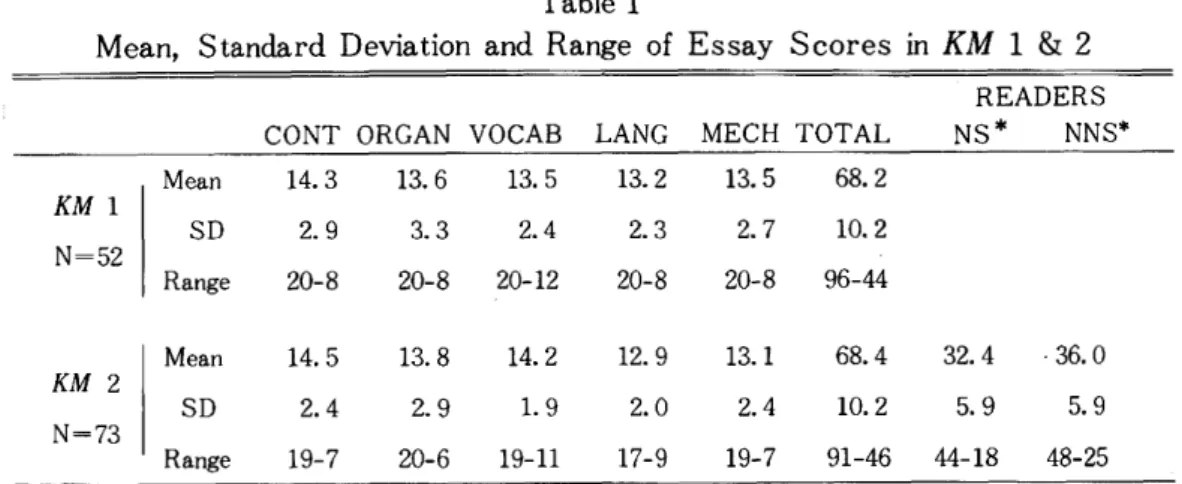
(1) Essay scores: The scores of both classes, KM 1 and KM 2, were computed in terms of mean, standard deviation, and range across the categories and total (Table 1).
Table 1 also shows those statistics and the correlation between Native and Non-Native English speaking readers (NS and NNS, respectively). NNS tended to rate higher than NS (36.0 to 32.4), but the standard deviation (5.9) was the same with both. The correla-tion in terms of sum total of the five categories between NS and NNS (.50) was lower than expected; only with less proficient writers, the readers were observed to agree more. However, since subjective estimation varies so often and the real communicative situation is full of such subjectivity, suffice it to say that four subjective assessments were much better than one and nearer to objective evaluation.
Table 1
Mean, Standard Deviation and Range of Essay Scores in
KM
1
&
2
READERSCaNT ORGAN VOCAB LANG MECH TOTAL NS* NNS*
Mean 14.3 13.6 13.5 13.2 13.5 68. 2 KM 1 SD 2.9 3.3 2.4 2.3 2. 7 10.2 N=52 Range 20-8 20-8 20-12 20-8 20-8 96-44 Mean 14.5 13.8 14.2 12.9 13.1 68. 4 32.4 ·36.0 KM 2 SD 2.4 2.9 1.9 2.0 2.4 10.2 5.9 5.9 N=73 Range 19-7 20-6 19-11 17-9 19-7 91-46 44-18 48-25
*
rNS·NSS= .50 With regard to mean, Content (14.3, 14.5-in KM 1 and KM 2, respectively) was the highest, Organization (13.6, 13.8) and Vocabulary (13.5, 14.2) the middle, and Mechanics (13.5, 13. 1) and Language Use (13. 2, 12.9) the lowest two. In standard deviation, a measure more related to discrimination, Organization (3.3, 2.9) stood far atop, followed by Content (2. 9, 2.4) and Mechanics (2. 7, 2.4), leaving Language (2.3, 2.0) and Vocabu-lary (2.4, 1. 9) at the bottom.To magnify the discrimination powers of those category scores and later to probe deeper into the writing behaviors, a Good/Poor (G/P) Contrast was devised: Good is a group of a round number of subjects nearest to 24 percent-corresponding to 5 and 4 on the 5-grade system (+0. 7~+3. 5a on Z-score)-of the whole from the top, and Poor is the bottom counterpart (Table 2). The contrast shows that the difference between the two groups was found greatest with Organization (6.7, 7.0); Content (5.4, 5.9) came next.
Some Considerations on College Composition (1)
Table 2
Good-Poor Contrast of Essay Scores' in
KM
1
&
2
CaNT ORGAN VOCAB LANG MECH TOTAL
Good tea" 16.9 17.5 16.6 15. 7 15.7 82.4
N=13 SD 1.7 2.5 2.1 1.9 2.5 6.0
KMI Poor
I
Mean 11.5 10.8 12.1 U.8 11.5 57. 7N=16 SD 1.3 1.8 1.1 1.7 1.3 4.0 Difference 5.4 6.7 4.5 3.9 4.2 24.7 Good
I
Mean 17.4 17.4 16.6 15.3 15.6 82.1 N=16 SD 1.1 1.3 1.2 0.8 1.4 4.2 KM2 PoorI
Poor 11.5 10.4 11.8 10.5 10.8 54.8 N=17 SD 1.6 1.7 0.6 1.0 1.6 3.5 Difference 5.9 7.0 4.8 4.8 4.8 27.3To see it in another light, In
o
rganiza tion, whose overall mean stood second among thefive categories in both KM 1 and 2 (Table 1), the means of Good (17.5, 17.4) ranked highest and those of Poor (10.8, 10.4) virtually lowest in Table 2.
In terms of the correlations between each category score and the total (Table 3), Orga-nization (.83, .93) was the highest and Vocabulary (.81, .91) was the second highest across the classes; Language Use was here again the lowest in KM 2 and the lowest but one in KM 1.
Table 3
Correlations between Category Score and Total
CONT ORGAN VOCAB LANG MECH
KM 1 .76 .83 .81 .72 .64
KM 2 .88 .93 .91 .79 .91
To sum up the discriminative features (SD,
G/P
Contrast, and correlations) of the categories in terms of ranking order across the classes, it goes from the top as follows:Organization, Content, Vocabulary, Mechanics, and Language Use.
These facts mostly coincide with Jacob's report (1981; 35) on Freedman's findings:-"They (the teachers) valued content first and then organization. They also valued
mechanics, but not as much as they did content and organization. Interestingly, they cared more about mechanics, proper punctuation, and the like than about the quality
Koju FUJIEDA or the structure of the sentences."
(2) Questionnaire Response and Evaluation:
The whole text of the questionnaire, the total response percentage with parenthesized G/P Contrast, and the corresponding mean essay scores are summarized in Appendix 1.
Besides these statistics, t test and X2 test were applied to the data when necessary. To
facilitate analysis of a bulk of data, four blocks, four comparisons and re-formed tables were prepared.
The fifteen items of the questionnaire were broken down into four blocks: i) #3, #6a, #8a~b, (#12c~e) ---Organization ii) # 6c, # 7, # 9, # 10 --- Revision iii) # 4 -- --- --- ---- --- -- --- ---- --- --- -- ---- -- ---- --- --- Japanese Use iv) the rest --- Publication of KM
The above blocks, especially the first three 'writing behaivors were analyzed through the following four comparisons, which can be read in the tables 4~6 :
A) Comparison by total response percentage to know the general tendency of the stu-dents' writing behaviors. (See' Total' columns and'
Diff'
lines.)B) Good-Poor Contrast by response percentage of each group to know how the behaviors differ with proficiency levels. (See' G/P G - P' columns.)
C) Comparison between total response percentage and corresponding mean essay scores to know behavior-evaluation relations. (See 'Total' and' Score' columns.)
D) Comparison between KM 1 and KM 2 to see if there was any instructional effect. (See 'KM 2-1' columns.)
In the re-formed tables, numbers were rounded, alternatives were sometimes combined, and difference columns were provided for easier comparison.
i) Organization: (A) As is shown in Table 4, about 60 to 70 percent of the students wrote out an outline for their essays in the prewriting stage (# 3), spending a little more than 20 percent of the overall compostition time (# 6), but in the revising stage (# 8), only about 40 percent were concerned with' meaning. ' This tendency was also revealed in their psychological reaction (# 12): about 30 to 40 percent of the subjects regarded English-Japanese thought gap, logical organization, and theme difficulty-all meaning-related items-as drawbacks to their otherwise better performance.
B) More Good students assumed desirable behaviors to organization across the items, except for the case of supposed drawbacks to composition (# 12) in KM 1. With concerns
Some Considerations on College Composition (1)
in revision (#: 8) in KM 2, for example, the number of meaning-concerned subjects from Good was 40 percent more than that from Poor, which difference was proved significant.
Table 4
Questionnaire Response Percentage and Essay Scores by Organization
KM 1 n=52 (13/16) KM 2 h=73 (16/17) KM 2 -1
Item Response (%) Score Response (%) Score Dif{(%)
-Total (G/P G-P) - - -Mean Total (G/P G -P) Mean Total #3 In drafting:
a~b) Outlinining 58 (69/50 19) 70 73 (87/71 16) 69 15
c~e) No outlining 42. (31/50 -19) 66 27 (13/29 -16) 66 -15
Diff (a~b - c~e) 16 (38/ 0 -) 4 46 (7/42 -) 31*1 # 6 Time spent in:
a) Organization 21 (25/20 5) 23 (24/21 3) -2 # 8 Concerns in revision: a~b) Meaning 38 (40/24 16) 69 39 (63/23 40(*)) 71 1 c~e) Form 62 (60/76 -16) 66 '61 (37/77 -401*1) 66 -1 Diff(a~b- c~e) -24 (-20/-52 -) 3 -22 (267 -54 -) 1*1 (*, 5* # 12 Drawback consiousness: c~e) Meaning 31 (37/46 -9) 70 40 (57/35 22) 75 9 a~b) Form 65 (62/47 15) 67 54 (37/59 -22) 68 -11 Diff(c~e - a~b) -34 (-25/-1 -) 3 -14 (20/-24 -) 7*
*
Significant by t test: P<O. 05.(*) '" " ' , with the original data.
(*) Significant by X 2 test: P<O.001, with the original data.
(C) The pro-organization behaviors (#3 a~b, #8 a~b) tended to earn higher scores. Actually, the minute planning (#:3a) group significantly excelled the rough idea (;l:3c) and the offhand (;I: 3d) groups, just as the meaning-conscious group did the form-conscious group (:# 12) .
(D) A 15 percent increase in outlining (#3 a~b) with KM.2, a 9 percent increase in meaning-consciousness (;I: 12 c ~e) and an 11 percent decrease in form-consciousness (;I: 12
a~b) are outstanding in the KM 2-1 column. A two percent decrease of organizing time in the first draft (# 6) in KM 2 is probably related to the fact that the KM 2 class still had a second and a third draft to work on, while the KM 1 class turned in the first draft as the final. In revision concerns (# 8) , ove rail difference between KM 1 and 2 was only one percent, but in G/P contrast, the gain of 40 percent by Good in KM 2 was much greater than that (16%) in KM 1. Consequently, the G/P Contrast in revision concerns (# 8) of
KM
2 was verified significant byX
2 test. It can be said that Good students were converted more to 'meaning mindedness' by instruction.Koju FITJIEDA
ii) Revision: This block refers to the mode and quantity of revision, not to its quali-ty, which was already dealt with in the last block. Since the KM 1 class received no feed-back,
# 9 and
# 10 lack their data. (See Table 5.)
(A) On the average, the students spent 11 to 14 percent of their time or 1. 3 to 1. 5
hours in revising their drafts. About 50 to 70 percent of the subjects made revisions after writing their drafts, while the rest did in parts as they wrote on. After the first feedback from the teacher, about 30 percent of them corrected their writings only where the teacher indicated, about a half revised on their own too, and nearly 20 percent re-wrote drastically. With the second feedback, the ratio of teacher-dependents and self-revisers was almost 50-50.
(B) There was no G/P contrast in revision time (#6), but in revision mode (#7) and reaction to feedback (# 9), Good outdid Poor by 22 and 35 percent respectively. The latter difference proved to be significant at .05 level.
(C) Revision-intent groups received higher evaluation, especially with significant promi-nence in the first feedback (# 9).
(D) In terms of revision time, the KM 2 class did only a little better than the KM 1, but in revision mode the difference (20%) between them was fairly great, though not verified significant. Here again is an instruction effect felt.
Table 5
Questionnaire Response Percentage and Essay Scores by Revision
KMI n=52 (13/16) KM2 n=73 (16/17) KM2-1
Item
Response (%) Score Response (%) Score Dif{(%)
Tota}(G / P G- P) Mean Total (G / P G-P) Mean Total # 6 Time spent in:
c) Revision (%)
#
7 Mode of revision: 11 (12/12 0) a) In parts 50 (46 / 62 -16 ) 67 b) Overall in review Diff (b-a) 50 (54 / 38 16) 69o
(8/-24 -) 2#
9 Revision after 1st feedback: a) Indications onlyb) Small self-revision
c- d) Sharp / overall self-revision
#
10 Revision after 2nd feedback:a) Indications only b) Small self-revision
c-d) Sharp / overall self-revision
14 (I5/15 30 (19/41 70 (81/59 40 (72/18 29 (12/47 53 (75/24 18 (13/29 49 ~31 /41 47 (56/53 4 (13/ 6 0) -22) 22 ) -)
'*
- 35)'*
51 )'*
-16 ) -10 ) 3) 7)*
Significant by X2 test: P<O. 05.*
Significant by t te s t: P< O. 05. 66 70 465]
diff 71 6* 61) 68 6t{ 77 3Some Considerations on College Composition (l)
iii) Japanese Use: 'Japanese Use' is defined as using, that is, writing Japanese in some way or another in the prewriting stage. Since there was only one questionnaire item related to this theme, four-way (A ~ D) analyses will be done all together on the basis of Table 6.
In general, 15 to 23 percent of the student writers did not use any Japanese at all, 38 to 47 percent used Japanese in parts and 30 to 47 percent wrote the whole draft in their native language. Especially in KM 2, 59 percent of Poor, which was 15 percent over Good, relied on their mother tongue. Strangely, however, in KM 1 Poor behaved in reverse: 37 percent used no Japanese, and only 19 percent wrote all in Japanese, well in contrast with 39 percent of Good. This is a problem to be discussed later.
Table 6
Questionnaire Response Percentage and Essay Scores by Japanese Use
KM 1 n=52 (13/16)KM
2 n=73 (16/17) KM 2-1 ItemResponse ( %) Score Response (%) Score Diff(%)
Tota}(G/PG-P) Mean Total(G/PG-p) Mean Total
#
4 Japanese use in drafting:a) No Japanese 23 (15
I
37 -22 ) 66 15 (13I
12 1 ) 68 -8 b) Partly Japanese 47 (46I
44 2) 69 38 (44I
29 14 ) 70 -9c) All Japanese 30 (39 119 20) 70 47 (44/59 -15 ) 67 17
Another feature of Japanese Use is that statistically there was no significant difference of scores detected between the three groups. Moreover, All Japanese (70, 67) did better or as well as No Japanese (66, 68), contrary to our expectation that overall use of the native language would result in lower evaluation because of Japanese interference. Only Poor's 15 percent dominance over Good in the KM 2 All Japanese seems to support our anticipation slightly. This issue will be another topic for later discussion in connec-tion with the evaluaconnec-tion procedures.
iv) Publication of KM: A greater part of the students preferred 'a theme within a limited scope,' thought of 620 words as an optimum essay length, spent about 11 hours in completing the first draft, and felt about 60 percent satisfaction with their performance. In regard to the publication of KM itself, about a half of the KM 1 class and three quar-ters of the KM 2 found it significant, first as a memory of the general education course, and then as an occasion of mutual understanding or as a real situation of communication in English. Naturally, Good students were more positive in all these opinions.
Koju FUJIEDA
Discussion
Concerning Japanese Use, two problems arose: why did Poor in KM 2 turn to All Japa-nese while the KM 1 Poor preferred No Japanese? What are the implications of scanty effects of Japanese use on evaluation?
A probable key to the first problem lies in the instruction of essay writing to the KM 2 class, which rendered the students more 'meaning-minded' than their seniors. Once awakened to the importance of 'meaning; the KM 2 students must have found writing a SOO-word essay all the more demanding. Then, less proficient writers were presumably obliged to rely on their mother tongue for the identification and development of their ideas before putting them, not to say translating them, into English. In this sense, the KM 1 Poor might have been free enough of such apprehensions to write off all in 'their' English.
(See Ex 4 in Appendix 2.)
The second problem requires deeper considerations. The evaluation procedures have to be reviewed first. With KM I, since assessment was made of the students' raw drafts before they were edited, its scores need no modification. With KM 2, however, it may be cleverly inferred that because of the flattest discrimination power of Language Use, the Language-Porfile assessment could not differentiate essays affected by the use of Japa-nese, and that the double teacher feedback did blunt the test power. To probe into this suspicicl, the frequencies of the two teacher corrections were investigated with the
Table 7
Mean Frequencies of Correction with the First and Second Drafts in
KM 2
Jap. Use Feedback Feedback 2 Feedback 1 & 2 Av.
n LANG {Grm MEC TOT
Exp n LANG{ Grm MEC Exp TOT LANG 1 Grm Exp MEC TOT No Jap 6 18.
811~: ~
2.3 23.2 11 14.61 7.0 5.6 21. 2 16.1 { 7.6 4.5 21. 9 7.6 8.5 Part Jap 13 12.2 { 4.9 2.7 16.3 27 16.4 { 7.1 4.5 21. 6 15.01 6.4 3.9 19.9 7.3 9.3 8.6 All Jap 16 13.2 { 4.8 1.8 16.0 34 13.91 7.3 3.8 18.3 13.61 6.5 2.8 17.6 8.4 6.6 7. 1 Total 35* 13.81 5.5 8.3 2.2 17.3 72 ** 14.9 { 7.1 7.8 4.3 20.0 14.61 6.6 7.9 3.5 19.1*
Available data only.**
One datum missing. Grm=Grammar TOT=Total of the 5 Exp= Expression categories includingSome Considerations on College Composition (1)
anticipation that the groups that used Japanese would have more corrections related to Language Use, especially to Expression.
The results as are shown in Table 7, however, contradict the prospects. In both feed-backs, No Japanese was subjected to more corrections (18.8, 14.6) than All Japanese
(13.2, 13.9), in terms of Language Use. With Total categories, too, the inclination is the same. Expression, which had been expected to be more sensitive to Japanese inter-ference, turned out to be higher in correction rate than Grammar, but this gap can be seen all across the groups, not restricted to All Japanese.
*
So far as the results of this investigation are concerened, it was discovered that the behavior of writing out an essay' outline and draft in Japanese, whether partly or totally, does not bear any deteriorating effect on the assessment of the essay in terms of score. But does it also guarantee that use of Japanese in any form does not affect the communi-cability of the product in any way? We should say no, for two reasons. Not' writing' in Japanese, for one thing, does not necessarily imply not' thinking' in Japanese when composing an essay. Just to think of 'speaking' errors ascribed to interference from the habits of the mother tongue (Corder 1981; 12) will be enough for that consideration. For another, so long as English remains a foreign language to Japanese college students, it will be safer to assume that there is always such interference persisting more or less in their English writing, regardless of writing behaviors or proficiency. (Appendix 2 sho~s just a few of many such examples found in the KM drafts. Those samples were all taken from No Japanese, but they are not immune to Japanese interference. Compared with the Japanese originals, the erroneous sentences will be found to come from the simplistic presupposition that there is always a one to one correspondence between Japanese and English. )
*
As this was a serious finding, an urgent and fragmentary survey was carried out in much the same way with KM 3, which is now in the making. Two readers, each from the KM 2 NS and NNS, made an independent assessment of the first drafts with the same Profile. The rater-correlation was .69, significantly higher than before. Ninety subjects answered the questionnaire on Japanese Use. The results were: No Japanese Part Japanese All Japanese [AJ for Reference AJ for Translation]n 26 35 33 ( 29 4
M 64.8 65.0 64.2 ( 63.4 69.0
SD
14.9 11. 6 13.4 ( 13.0 14.0The mean scores were more levelled across the groups than in KM 1 and 2. The number of No Japa-nese increased, probably because the composition course was conducted by the NS instructor. But its standard deviation was the greatest. The largest part of All Japanese used the native language not for translation, but for reference in writing an English version.
Koju FUJIEDA
The graphic use of Japanese in drafting is scarcely a problem, and it can even help find meaning, unless verbatim translation follows.
It
is rather the internal use of the na~ivelanguage that should be guarded against by all foreign writers.
3 Implications
The findings of this research were:
(1) The readers, who hopefully approximated objectivity in the assessment of written communication, all emphasized' meaning' rather than' form.'
(2) The pro-organization and pro-revision behaviors on the part of the students were positively evaluated.
(3) The more proficient writers were more 'meaning-oriented.'
(4) The graphic use of Japanese in drafting bore no difference in evaluation.
It
could even help find' meaning,' though verbatim translation should be guarded against. (5) Instruction for 'meaning' was effective.The general trend of these results is directed towards 'meaning, and in that sense it is in line with the current researchers of writing like Taylor and Zamel. But their focus seems to be on 'writing process' as revision, not on preliminary planning. They are quite right and very inspiring in. that they have revealed the realistic features of com-position as 'the constant interplay of thinking, writing and rewriting' (Zamel 1983; 172), not as the 'straightforward plan - outline - write process' (Taylor 1981; 5). We should make the most of their insight. But do we also have to abandon pre-writing organization then? Our answer should be a conditional no.
Firstly, they do not wholly discard preliminary organizational activities. Zamel reports: "All of the students spent a great deal of time thinking about the essay at the outset, trying to figure out how to proceed" (1983;172), adding later, "our students should be encouraged to work with preliminary and tentative lists and notes" (1983;181). Taylor also concedes, "While it is certainly true that much of an essay can be planned in advance, one must also recognize that the very act of writing can itself serve to fa-cilita te thought and shape ideas."
Secondly, if our students, who are not such proficient ESL writers as Zamel's sub-jects. started writing' offhand,' what would be the reuslts? Lower evaluation, that is, less communicative effect, as was already mentioned on Page 51.
Considera tions should be given, therefore. to the most effective interaction of orga-nization, revision and Japanese use or language use.
Some Considerations on College Composition (1)
To say nothing of theme setting, purpose defining, and sources and data finding, 'writ-ing out outlines' should be strongly recommended. Just as 'meaning' is reportedly formed gradually by writing, a clearer vista to what one wants to say must also be pre-sented by putting it down. Once written out, it is easier to review and' rewrite' even at this stage. U sing Japanese in outlining had better not be prohibited, if the writer finds it more helpful for organization. Teacher-student conferences on planning writing are expected to be very instrumental in attaining efficiency in the efforts both on the part of students and teachers, as has already been tried with KM 3.
This type of rather minute planning, however,. does not preclude revision during the writing process, of course. On the contrary, most revision should be made first for 'meaning' -that is, to check the unity and coherence of the essay, as Item
#:
8 in the questionnaire querried. In other words, the first session of revision should involve eliminating communication blocks not only in vocabulary and language use, but also in logical development (Tsuneki 1982). Teacher feedback and peer checking will be wel-comed to make the writer aware of such 'traps,' in whiCh he has been caught mostly unconsciously. The revision at this stage can naturally require global or total rewriting and therefore reforming the outline itself. In this way, organization and revision should be closely interrelated to establish meaning, especially in the initial stages of writing.The second phase of revision should deal with minor surface errors in language use (grammar and expression) and mechanics. F or pre-advanced college students, cor-rection symbols, accompanied by some kind of handbook, if possible, that illustrates them, will be less time-consuming for teachers and more instructive for the students; peer cor-rection will also be feasible to a great extent. Especially, those stigmatic errors coming from the characteristics of the Japanese language might as well be classified in the hand-book for ready use at any stage.
Since the instruction in essay writing proved effective, all the above teaching and writ-ing activities should, of course, be done in class, or at least within the scope of the course, not leaving them to out of class assignment alone.
The proposed writing courses, correction handbooks and, moreover, extensive read-ing for ideas, their development and fluency and correctness-all these will serve stu-dents as 'input.' However, whether they make the 'input' their own 'intake' (Krashen 1978) depends greatly upon their motivation. A strong desire, or at least an imminent necessity, to express themselves to the best of their ability will bring all the efforts by them and by their teachers to a success. For such motivation, it is hoped, the publibation , ,'.'
Koju FUJIEDA
of The Kuzuryu Memoirs will function, and so will the results of this investigation, now that we have' learned more about how and what students learn' than before (Corder
1967, quoted in Zamel 1983; 169).
References
Cardelle, Maria and Lyn Corno. 1981. Effects on Second Language Learning of Variations
in Written Feedbeck on Homework Assignments. TESOL Quarterly 15, 3.
Corder, S. Pit. 1981. Error Analysis and Interlanguage. Oxford University Press.
Finocchiaro, Mary. 1982. Reflections on the Past, the Present, and the Future.
English Teaching Forum July 1982.
Fujieda, Koju (ed.) 1983a. The Kuzuryu Memoirs 1. (Intramural publication: English Depart-ment, Fukui Medical School.)
(ed.) 1983b. The Kuzuryu Memoirs 2. (ditto)
Hillocks, George, Jr. 1982. The Interaction of Instruction, Teacher Comment, and Revision
in Teaching the Composing Process. Research in the Teaching of English 16, 3.
Iwahara, Shinkuro. 1957. Kyoiku to Shinri no tame no Suikeigaku. Tokyo:
Nippon-bunka-kagaku-sha.
Jacobs, Holley L. et al. 1981. Testing ESL Composition. London, Newbury House Publishers.
Krashen, Stephen D. 1978. Individual Variation in the Use of the Monitor. W. C. Richie
(ed.), Second Language Acquisition Research. New York:Academic Press.
Rivers, Wilga. 1968. Teaching Foreign Language Skills. Chicago: The University of Chicago Press.
Shikata, Jitsukazu and Tsuyoshi Ichitani. 1963. Kyoiku Tokei - ho Nyumon. Tokyo: Nippon-bunka-kagaku-sha.
Taylor, P. Barry. 1981. Content and Written Form. TESOL Quarterly 15, 1.
Tsuneki, Kiyoshi. 1982. A Pedagogic Grammar for Teaching Paragraph Writing to Japanese Stu-dents of English. Bulletin of Toyama Medical and Pharmaceutical University, Liberal Arts.
Watson, Cynthia B. 1982. The Use and Abuse of Models in the ESL Writing Class. TESOL
Quarterly 16, 1.
Williams, J. D. and Scott D. Alden. 1983. Motivation in the Composition Class. Research
in the Teaching of English 17, 2.
Zamel, Vivian. 1982. Writing: The Process of Discovering Meaning. TESOL Quarterly 16, 2. 1983. The Composing Process of Advanced ESL Students: Six Case Studies.
TESOL Quarterly 17. 2.
Some Considerations on College Composition (I)
Appendix 1
The Statistics of the Questionnaires on
The Kuzuryu Memoirs
1 & 2- Response Percentage and Corresponding Mean Essay Scores
-Item KM 1 n=52 (13/16) KM 2 n=73 (16/17)
Question Answer
Response P. C. of Total (Good/ Poor)
Mean Response P. C. of Mean
Score Total(Good / Poor) Score
# 1 Which theme do you prefer?
a A specified theme.
b A theme within a limit.
c A free theme.
#
2 Which is the optimum lengthof your essay? a 1000 words and above. b 800 words. c 500 words. d 300 words. e Otherwise. 13.5 (15.4/18.8) 68.0 63.5 (69.2/43.8) 69.6 23.1 (15.4/37.5) 64.8 7. 7 ( 7. 7 / 6. 3) 28.8 (23.1/25.0) 69.2 (?7.2 53.8 (69.2/43.8) 70.0 7.7 ( 0 /18.8) 60.0 1. 9 ( 0 / 6.3) 60.0 (Average: 612 ( 608/ 538) words
# 3 How did you organize your
essay in drafting? a Wrote out a minute plan
and considered it well. 5.8 ( 7.7/ 6.3) 74.7
b W rote out main points
and made an outline. 51. 9 (61. 5 /43.8) 69.0
c F armed a rough plan in mind
but didn't write it out. 23. 1 (15.4/18.8) 67.0
d Made no plan in particular,
and wrote offhand. 19.2 (15.4/31. 3) 65.2
e Otherwise. 0 (0 / 0 )
#
4 Did you use Japanese in drafting?a Used no Japanese at all. bUsed Japanese in parts. c Drafted all in Japanese.
#
5 How many hours did it takeyou to complete your first draft? 23.1 (15.4/37.5) 65. 7 46.3 (46.2/43.8) 68.5 30.1 (38.5/18.8) 69.5 (Average: 11. 7 (11.1/11. 5) hours 4. 1 ( 0 / 11.8) 58. 7 56.2 (50.0/41. 2) 69.5 39. 7 (50.0/47. 1) 67.9 5.5 (12.4/11. 8) 35. 6 (43. 8/35. 3) 69.5 69.8 53.4 (37.5/47.1) 67.1 5.5 ( 6.3/ 5.9) 72.0
o
(0 / 0 ) 623 ( 681/ 653) words] 4. 1 (12. 5 / 0) 81. 3 68. 5 (75. 0 /70. 6) 68. 6 16.4 (6.3/11.8) 67.3 9.6 (6.3/17.6) 64.4 1. 4 ( 0 / 0) 62. 0 15.1 (12.5/11. 8) 67.5 38.4 (43.8/29.4) 70.3 46.6 (43.8/58.8) 67.2 10. 3 ( 9. 8/ 9.2) hours) (Continued)Koju FUJIEDA
Appendix 1 (continued)
Item KM 1 n=52 (13/16) KM 2 n=73 (16/17) .
Question Answer
Response P. C. of Mean Response P. C. of Mean Total (Good / Poor) Score T otal (Good / Poor) Score ;I: 6 What percentage of your time
went to the following tasks? (Average)
a Organization. 20.8 (25.0/20.0)
b Writing English. 39.2 (34. 2 / 35. 7) c Revision (during and
after writing). 11. 2 (11.7/11.5)
d Typing. 29. 8 (28. 8 / 30. 1)
;I: 7 How did you revise (rewrite) your essay?
a Revised in parts while writing.
b Revised in review after writing up.
c Otherwise.
;I: 8* What were your concerns in revision? Mark two main items.
a Unity and consistency. b Effective development. c Wording and expression. d Grammar and usage. e Spelling and punctuation.
Otherwise.
:1:1: 9 How did you revise your essay
after receiving the first feedback?
a Revised only the indicated parts.
b Revised some other parts besides those indicated. c Revised pretty sharply including the· feedback. d Rewrote overall. including
the feedback. 50.0 (46.2/62.5) 67.1 50.0 (53.8/37.5) 69.2
o
(0 / 0 ) 31. 0 (35. 0 / 20. 0) } A 68. 9 6. 9 ( 5. 0 / 4. 0) 26.4 27.6 8.0o
(30.0/24.0)1
(25.0/36.0) ( 5.0/16.0) ( 0 / 0 ) (Average) 23.0 (23.8/20.6) 37.2 (32.5/36.2) 14. 1 (14. 7 /14. 7) 25. 7 (21. 6/27.9) 30. 1 (18. 8/41. 2) 65. 7 69. 9 (81~ 3 /58.8) 69.6o
(0 / 0 ) 26.3 (40.0/12.5) } A' 70.5 12. 8 (23. 3 / 5. 0) 30.8 (20.0/25.0) 19.5 ( 6.7/20.0) 10. 5 (10. 0/ 37. 5)o
(0 / 0 ) 28.8 (12.5/47.1) 53.4 (75.0/23.5) 15.1 (12. 5/29.4) } 2.7 ( 0 / 0 ) 64.8 71. 4 65.6*
In this item, the percentage is ofthe total responses.
A (n = 30). A' (n = 43): of those who chose a/h. B (n=21). 8' (n=30): of those who did not choose a/h.
Some Considerations on College Composition (1)
Appendix 1 (continued)
Question Answer
Item
#10 How did you revise your essay after receiving the second feedback?
a Revised only the corrected parts.
b Revised some other parts besides those corrected. c Revised pretty sharply
including the feedback. d Rewrote overall, including
the feedback.
#11 To what extent do you think you could express yourself ? a 90% and above. b 80-89% c 70-79% d 60-69% e 50-59% Under 50% KM 1 n=52 (13 /16) Response P. C. of Mean Total (Good / Poor) Score
1.9 ( 0
/
o )
72.0 9.6 ( 7.7 / 12. 5) 65.6 23.1 (38. 5/ 12. 5) 71. 2 32.7 (30.8/25.0) 68.0 11.5 ( 7.7/18.8) 67.2 21. 2 (15. 4 / 31. 3) 66.4 KM 2 n=73(16/17) Response P. C. of Total (Good / Poor)48.6 (31. 3 / 41. 2) 47.2 (56.3/52.9) 4.2 (12.5/ 5.9) 0 ( 0
/
o )
4.2 (12.5/ 5.9) 12.7 (12.5/17.6)22.0
(18.8/11.8) 26.8 (37.5/11.8) 19.7 ( 6.3/29.4) 16.4 (12. 5 / 23. 5) Mean Score 67.6 68.4 76.7 74.7 69.4 69.8 70.4 65.0 65.2 (Average: 59. 4 (61. 5/46.3) % 60.7 (65.0/58.8)%J
# 12* What do you think drew you backfrom a 100 percent expression? Mark 1 or 2 items.
a Poor vocabulary. b Uncertain knowledge of
grammar and word usage. c Difference of thought
pattern between English and Japanese.
d Difficulty in logical organiza tion.
e Difficulty in handling the theme.
Limitation of essay length. g Publication of the essay. h Otherwise.
*
In this item, the percentage is ofthe total responses.
36.2 (25.0/28.6)
1
27.0 (16.7/29.4)1 69.7 c (20.0/29.4) ) 67.5 c · 28. 7 (37.0/17.9)1
27.0 66.1 D 67.0 D' 10.6 (22.2/21.4)1
10.2 (16.7/11.8)1
11. 7 ( 7.4/10. 7) 66. 7 E 21. 9 (30. 0 / 23. 5) 75.1 E' 8.5 ( 7.4/14.3) 8.0 (10.0/ 0 ) 0 ( 0 / 0 ) } 3.6 ( 6.7/ 2.9)} 3.2 (0 / 7. 1) 64. 0 F 1.0 (0 / 2.9) 70.8 F' 1.1 (0 / 0 ) 1.0 (0 / 0 )C(n=23), C(n=21): of those who chose alb exclusively.
D(n=19),D'(n=3S): " a/bandc/d/e.
E(n=6), E'(n=14): ~ c/d/e exclusively.
F(n=4), F'(n=S) : I; fig/h.
Koju FUJIEDA
Appendix 1 (continued)
Question Answer
Item
:1:1: 13 Do you find significant this
scheme of publishing students' essays every year ?
aYes, greatly. b Yes, to some extent. c Don't know.
d No, not very. e No, not in the least.
:1:1: 14
* In what points do you think
it is significant?
Mark as many as you find relevant.
a As a real situation of communica tion in English. b As an occasion to
under-stand all classmates. c As a memory of the general
education course at college. d As composition samples for
the following classes. e Otherwise.
KM 1 n=52 (13/16) KM 2 n=73 (16/17)
Response P. C. of Mean Response P. C. of Mean Total (Good/ Poor) Score Total (Good/ Poor) Score
21. 2 (15. 3/ 18. 8) 66. 8 26.9 (23.1/18.8) 68. 8 40.4 (46.2/50.0) 68.4 7. 6 ( 7. 7 / 6. 3) 67. 2 3. 8 ( 7.7/ 6.3) 68.0 16.3 ( 6.6/18.8) 64.5 26.5 (33.3/18.8) 70.5 46.9 (46.7 / 50. 0) 69.2 10.2 (13.3/ 12. 5) 71. 2
o
(0 / 0 ) 21.9 (37.5/17.6) 52.1 (43.8/58.8) 19. 2 (12. 4 /23. 5) 5.5 ( 6.3/ 0 ) 1.4 (0 / 0 71. 9 67.6 65.6 73.0 67.0 25. 8 (37. 5/29. 4) 71. 0 19.4 (31. 3 / 29.4) 69.7 43.0 (56.3/58.8) 68.9 6.5 ( 0 5.4 ( 0 /11. 8) / 5.9) 63.3 67.0:1:1: 15 Write other opinions and impressions, if any, on the publication of your essays.
(The answers are omitted here.)
Some Considerations on College Composition (1)
Appendix 2
Exa!llples of Japanese Interference from the KM Drafts
Notes: 1 The underline represents Japanese interference in some way or another.
Ex 1.
Ex 2.
Ex 3.
Ex 4.
2 The block letters in the brackets represent the estimated Japanese originals. 3 The Italics in the parentheses represent the proposed revision.
4 Errors other than from Japanese interference are not touched here.
Doctor is a profession of tending sick persons. -No Jap, Good, KM 1
(Isha wa byonin 0 miru shokugyo de aru.J
(A doc tor tends sick per sons.)
Some months ago it happened that a surgeon at the Saitama Medicle College hospital operated on a contrary arm which was not necessary for an operation and not prepared
for one. -No Jap, Good, KM 2
(···shujutsu no hitsuyo no nai, dakara sono junbi no shite nai hantai no ude ni shujutsu 0 shita.J
(-"operated on the wrong arm.)
There was the dead body of grandmotherl
about 70 years old. I can not have a good
look at her face. I seemed she laughed. 2
"This is women. She is just woman."J
Then I remembered face of my grandmother. I was difficult of touching her skin. 4
-No Jap, Mid, KM 2
Cobasan 2Watashi niwa kanojo ga waratte iru yoni mieta. 3"Kore wa onna da. Honto ni onna da." 4Watashi wa kanojo no hifu ni sawari gatakatta.J
Can old woman 2It seemed to me as if she were laughing. 3 " This is a woman. Really a
woman." 4/ found it difficult to touch her skin.)
"Then you will be a specialist who can not consult patientsl as human beings who have
hearts, minds, and emotions."
"Well, you see the truth. A doctor espicially clinician must consult so. 2 We had
better become like sea or mountain. If patients hope something to US,3 we react
natu-rally and as patients recover from disease, a value of us will be gone out. 4
-No Jap, Poor, KM 1
C Kanja 0 miru 2sonoyo ni miru 3Moshi kanja ga wareware ni nanika 0
nozomu nara ba 4wareware no neuchi ga detekuru de aro.J
esee patients 2treat them as such 3If patients hope for something of us 40ur value will be known.)