PERSPECTIVES ON THE RELATIONSHIP BETWEEN THE
UNCERTAINTY AND INNOVATION MANAGEMENT ─BASED
ON COMPANIES’ VIEW─
その他(別言語等)
のタイトル
不確実性とイノベーション・マネジメントの関係に
関する分析 ─企業の視点に基づいて─
著者
GUO Yuanyu
著者別名
郭 媛瑜
journal or
publication title
Bulletin of the Graduate School, Toyo
University
volume
57
page range
59-87
year
2021-03
ABSTRACT
There are some market situations where it is quite possible for several innovators to be successful simultaneously or nearly so. In the case of a monopolist or a socialist system of innovation, failures would persist for three reasons: technical uncertainty, market uncertainty and general business uncertainty. Deep uncertainty (DU) exists anywhere in connected interdependent economies experiencing rapid technological change. Uncertainty is very different from risk, which can be managed using traditional tools and approaches.
Traditional approach leads executives to view uncertainty by clustering in large established companies. Large established companies typically focus on enhancing their ability to manage their core businesses, with emphasis on cost reduction, quality improvements, and incremental innovation (II) in existing products and processes. That approach serves companies well in relatively stable business environment. However, when there is deep uncertainty about the future, mature established companies must in parallel develop radical innovations (RI) as a basis for building and dominating fundamentally new markets.
Risks are not only concentrated in the large-companies, but also exists in the start-ups and entrepreneurs to a great extent. For the start-ups, they have to accept more risks and uncertainties than the large-companies. When uncertainty is enhanced, the change is necessary for companies to remain competitive, especially for the start-ups.
Doctoral Program in Graduate School of Business Administration, Course of Business Administration, Third Year Student,
PERSPECTIVES ON THE RELATIONSHIP
BETWEEN THE UNCERTAINTY AND
INNOVATION MANAGEMENT
─BASED ON COMPANIES’ VIEW─
Under uncertainty, large-companies and start-ups, build two completely different innovation models. For the former, they can investment management by highly effective interaction which occur endogenous science, technological research and exogenous scientific inventions. For the later, due to lack of management resources, the start-ups must hold the ability to successfully manage uncertainty by repeatedly creating ecosystems to put innovation management and achieving regional and global competitiveness further.
In this paper, we tried to clearly reveal the relationship between the uncertainty and innovation management from the theoretical level of view. Meanwhile, we combined the different innovation processes and models between the large-companies and the star-ups as two additional dimensions to compare these differences obviously. The results of this research could provide extremely powerful references to different companies, because it including the suitable and optimal innovation determinations, and the developed innovation precesses. It depends vitally on the level of uncertainty.
Keywords: uncertainty, innovation management, Schumpeter, ecosystems, company CONTENTS
1. INTRODUCTION 2. LITERATURE REVIEW
3. THEORETICAL MODEL AND HYPOTHESIS 4. CONCLUSION
1. INTRODUCTION
Most business and companies involve risk and uncertainty. Risk is associated with known outcomes where the probability of reoccur[1] is well calibrated. Uncertainty is about unknown unknowns (Teece, 2016). Uncertainty is often mentioned as a critical factor (Rogers, 2003), and manage uncertainty in innovation projects during the past two decades (e.g., Burgelman 1983b; Cheng and Van de Ven, 1996; Christensen, 1998; Huchzermeier and Loch, 2001; Iansiti, 1995; Kanter, 1989; McGrath and MacMillan 2000; Van de Ven, 1986), companies continue to struggle with the discovery, development, and commercialization[1] of radical innovations, There is relatively little work about the theoretical relationship between uncertainty and innovation management, which are embedded in ecosystems. Most existing research focuses on the development of new products. More specifically project selection (Michnik, 2013; Nishimura, 2011; Graves and Ringuest, 2009; Jacob and Kwak, 2003),
techniques to better predict (Fuglsang and Mattsson, 2011; Kwak and Stoddard, 2004; Benaroch, 2001), and to mitigate and manage uncertainty (Magnusson and Berggren, 2001; Sicotte and Langley, 2000), difference in approach if managing commercialization of sustaining versus disruptive innovation (Kassicieh et al., 2002), uncertainty is a key contingency for both managerial and organizational structure for innovation (Tidd, 2001). In addition, uncertainty is one of the natural consequences of innovation. Regardless of the particular area, innovation leads to unknown situations ranging from the creation of high-tech new products to profound modification of economic and social structures (A Le Flanchec, 2004).
While researchers recognize that uncertainty can be used to distinguish between types of innovation (Ansoff, 1965; AC Cooper, 1993), scholars place differential importance on various types of uncertainties. Some focus primarily on the variability of technical uncertainty (Iansiti, 1995; Wheelwright and Clark, 1992), and more recent work identifies market payoff, budgets, product performance, market requirements, and project schedules as five distinct and important sources of uncertainty in technically based innovations (Huchzermeier and Loch, 2001). Others (Lynn and Akgün 1998; Moriarty and Kosnik, 1989; Morone, 1993; Souder, Sherman, and Davies[1]Cooper, 1998) focus on the interaction of technical and market uncertainty to define the spectrum of innovation. Other scholars note many other sources of uncertainty for major innovation projects including, among others, strategic ambiguity (Burgelman 1983b, Zahra, 2008), differing organizational interpretive lenses (Dougherty and Hardy, 1996), and competency gaps (Danneels, 2002; Tripsas and Gavetti, 2000). Companies are faced with radical uncertainty or second-order ignorance: they do not, and cannot, know in advance what they need to know. No single mind can specify in advance what kind of practical knowledge is going to be relevant, when and where (Tsoukas, 1996). Especially with technological innovation, radical innovation explores areas that are novel; the technological feasibility is usually a major problem and forecasting sales is nothing more than a reasonable guess (Vanhaverbeke et al., 2003).
While academic scholarship has failed so far to converge on any single definition, there is a flurry of academic activity in this domain (Cardinal, 2001; Garcia and Calantone, 2002). Nearly all agree that radical innovation is associated with high levels of uncertainty. There is a recognition of the importance of risk, importance of uncertainty and innovation management beyond theory. However, clearly there is much to be learned and while drawing on other fields (Phan and Chambers, 2013) is helpful and should be pursued. It is
Our objective is to complement the relationship between uncertainty and innovation management from the theoretical view, by analyzing what and how large-companies and start-ups are different in innovation process under uncertainty, and by clarifying what unique model they have built. We also distinguish clusters and start-ups which belong to different dimensions within and between uncertainty and innovation management. We conclude with the resulting research. This research serves to increase the body of existing knowledge while acting as a call for more research.
2. LITERATURE REVIEW
2.1 Types of uncertainty
The word “uncertainty” is so commonly used that “it is all too easy to assume that one knows what he or she is talking about” when using the term (Downey and Slocum, 1975). Such an as assumption may cause researchers to pay insufficient attention to the conceptualization and ope-rationalization of a construct. Furthermore, researchers who assume agreement may interpret the literature as though there was agreement when, in fact, there is tremendous inconsistency and confusion about how a construct is defined and used.
Most of these definitions are adaptations of definitions of uncertainty offered by theorists in the fields of psychology and economics (Garner,1962; Lucea and Raiffa,1957; MacCrimmon,1966). Some researchers (Duncan,1972; Miles & Snow, 1978; Tosi & Slocum, 1984), however, suggested that such a broad conceptualization of environmental uncertainty may not be a particularly useful one. They suggested that uncertainty should be studied in relation to specific components of the environment (e.g., suppliers, competitors, government, distributors, consumers, etc.).
The second type of uncertainty is effect uncertainty. Effect uncertainty involves a lack of understanding of cause-effect relationships (Duncan, 1972; Lawrence & Lorsch, 1967). If state uncertainty involves uncertainty about the future state of the world, then effect uncertainty involves uncertainty about the implications of a given state of events in terms of its likely impact on the organization's ability to function in that future state (Duncan, 1972; Lawrence & Lorsch, 1967).
A third type of uncertainty is response uncertainty. Response uncertainty is defined as a lack of knowledge of response options and/or an inability to predict the likely consequences of a response choice (Conrath, 1967; Duncan, 1972; Taylor, 1984). This type of uncertainty is
closest conceptually to definitions of uncertainty offered by decision theorists (Conrath, 1967; Taylor, 1984).
Each of these types of uncertainty corresponds roughly to a type of information shortage that has been used either singly or in combination to define the concept of environmental uncertainty.
Moreover, the most business environment is under highly uncertain environment. For strategy, four levels of uncertainty have been proposed (Hugh Cpurtney, Jane Kirkland, Patrick Viguerie, 1997):
1) Level-1: A clear-enough future; 2) Level-2: Alternate futures; 3) Level-3: A range of futures; 4) Level-4: True ambiguity.
At level 1, A single forecast precise enough for determining strategy can be known, and we can use traditional strategy tool to analyze it. At level 2, a few discrete outcomes that define the future, the analytic tools are decision analysis, option valuation models, and game theory. At level 3, a range of possible outcomes, but no natural scenarios can be known, we can use latent-demand research, technology forecasting and scenario planning to consider it. At level 4, no basis to forecast the future can be known, and analytic tools are analogies and pattern recognition, nonlinear dynamic models.
With uncertainty present, doing things, the actual execution of activity, becomes real sense a secondary part of life; the primary problem or function is deciding what to do and how to do it (Frank Knight, 1921). Under uncertainty, doing the right things is more important than doing things right. However, it’s hard to do the right things when facing a wall of unknown unknowns. One cannot insure against unknown unknowns. Doing the right things under deep uncertainty requires entrepreneurial management (Teece, 2016). Janeway also notes that: “a market mechanism for hedging the sort of ontological uncertainty that proliferates where entrepreneurial innovation meets emerging market opportunity has never existed, is unlikely to ever exist, and will not persist if someone is foolish enough to create it”. Briefly, four categories of uncertainty as key drivers in our paper: technical, market, organizational, and resource uncertainty. Each of these four categories is elaborated in the context of radical innovation and further distinguished via two additional dimensions: clusters and ecosystems.
2.2 Uncertainty and innovation management
new business models. Innovation creates new opportunities for both investment and consumption, and these drive economic change. At the same time, innovation destroys some or all of the old. It is this that makes capitalism the restless, continually changing,’creative destructive’ (to use Schumpeter’s terminology) system. From a longer-term perspective, Freeman, like Schumpeter, saw radical innovation emerging periodically in clustered bursts.
Some researchers focused on some of the seminal contributions that have given rise to two clusters of literature that have a close bearing on the notion of innovation being a systemic phenomenon. These are the “innovation systems” and “business ecosystems” literature. We also should understand two questions. The first is how does innovation happen. In other words, what are the processes that facilitate the creation of innovations that increase competitiveness, a common concern in both approaches? And the second is who makes this innovation happen. That is, which players actually do what must be done to make competitiveness-enhancing innovation happen and what is the division of labour among them. To analyse these questions in more detail, endogenising them in the conceptualization of the system, a third approach is suggested, namely the innovation ecosystems approach.
There is also some agreement regarding who makes innovation happen. For Schumpeter, it is the entrepreneur who innovates, and innovation, accordingly, is the function of entrepreneurship. Subsequent literature in the Schumpeterian tradition has also emphasized the important role in innovation played by institutions of various kinds.
Since the 1980s two important concepts have been developed and widely adopted, by academics, companies, and policymakers, to get a better ‘handle’ on the determinants of innovation. The first is the concept of ‘national innovation systems’. The second is the concept of ‘business ecosystems’. Innovation is essentially a two-sided or coupling activity. It has been reconsidered as tools to response the various uncertainty, for example, market uncertainty, technical uncertainty, organizational uncertainty, and general business uncertainty.
The other types of uncertainty are specific to the particular innovation project and can’t be discounted, eliminated or assessed as an insurable type of risk. Technical uncertainty can be very much reduced in the experimental development. Trial production stages that is indeed one purpose of these activities. However, the outcome of these stages cannot be known before their completion, otherwise the work is not experimental and the activity is not truly innovative.
decisive for success. Technical innovation does not create value directly; all it does is create change in processes, functionality or utility. It is the extent to which internal operations or external customers value a change, that leverage is created (Paap and Katz, 2004). Indeed, the problem is very rarely reduced to this simple level. Much more usually it is a question of degree-of standards of performance under various operating conditions and at what cost. The uncertainty lies in the extent to which the innovation will satisfy a variety of technical criteria without increased cost of development, production or operation.
The ”risk” attached to technological innovation is different from the insurable ”normal” risk. Most economists distinguish measurable uncertainty or appropriate risk from unmeasurable uncertainty or real uncertainty. Technological innovation usually falls into the second category. By definition, innovation is not the same kind of event, but it is certain that some innovation categories have less uncertainty and lower risk than others. As Knight recognizes, the classification of ”risk” and ”uncertainty” is only a matter of degree, with the exception of extreme cases.
Numerous attempts have been made to deal with the uncertainty inherent in innovation by substituting subjective probability or credibility estimates for the relatively objective data used in estimating life insurance tables and other insurable risks (Allen, 1968, 1972; Beattie and Reader, 1971).
Table 1 – Degree of uncertainty associated with various types of innovation
1. True uncertainty
fundamental research
fundamental invention
2.Very high degree of
uncertainty
radical product innovations
radical process innovations
outside company
3.High degree of
uncertainty
major product innovations
radical process innovations in own establishment or system
4.Moderate uncertainty
new ‘generations’ of established products
5.Little uncertainty
licensed innovation
imitation of product innovations
modification of products and processes
early adoption of established process
6.Very little uncertainty
new model
product differentiation
agency for established product innovation
late adoption of established process innovation in own
establishment
minor technical improvements
(Source: Christopher, 1982)
As table 1, there are obvious relationship between uncertainty and innovation. The acceptance of a high degree of uncertainty in innovation is likely to be confined to some categories. Generally speaking, start-ups perform strongly in level one. For true uncertainty, they occupy a large proportion, which better on numbers of patents or number of ‘major’ inventions in relation to their R&D inputs, they are consistently more efficient in R&D performance than large-companies. However, the relative performance of start-ups and large-companies varies widely from industry.
In some industries, since both of the research and development are very expensive, large-companies predominate in both inventor and innovation. Furthermore, it makes sense that start-ups and companies have a relative advantage in the early stages of ingenuity and have cheaper and more innovative innovations. On the other hand, large-companies have the advantage of improving and expanding late stages and early breakthroughs.
Thus, for maintaining and sustaining competitive advantage over the long term, start-ups must in parallel build, participate, integrate, develop ecosystems as a basis for building and dominating fundamentally new markets to adapt to uncertainty. Especially, the external environment uncertainty, such as Alibaba, Silicon Valley, which are always viewed as typical representative in the world.
Innovation covers the continuity from incremental or sustainable innovation (reconstruction function) to radical or disruptive innovation (breakthrough paradigm shift). The development of incremental innovation is still within the scope of the organization's existing market and technology or process. In a rapidly changing world, innovation is the key to gain competitive advantage. Until now, innovation also increases uncertainty and market pressure (Lettice and Thomond, 2002; van Ex, 1999). The more radical the innovation, the more difficult it is to estimate its market acceptance and potential. The increasing complexity and market dynamics create a substantial knowledge gap between theory and practice. Many companies are not organized to give new ideas a chance, to recognize trend breaking points in the market, to adapt quickly to changing market circumstances, or to cause market changes in the first place (Markides, 1999).
Disruptive innovations “change the game”. They attack an existing business, and offer great opportunities for new profit growth. Only radical innovations lead to growth (Hamel, 2003). Lettice and Thomond (2002) define disruptive innovation as: “A successfully exploited product, service or business model that significantly transforms the demand and needs of an existing market and disrupts its former key players”. Damanpour (1996) defines it as “... those that produce fundamental changes in the activities of an organization and represent
a large departure from existing practices”, and a radical innovation is a product, process or service with either unprecedented performance features or familiar features that offers significant improvements in performance or cost that transform existing markets or create new ones (Leifer, 2001). Brown (2003) considers disruptive innovation as something that changes social practices, the way we live, work and learn. It requires breaking conceptual frameworks, reframing the problem and going to the very roots of it. Breakthrough innovations are based on inventions that serve as a source of many subsequent inventions (Ahuja and Lampert, 2001). Ambiguous, extremely turbulent and uncertain times, combined with a long development time, make breakthrough innovations a highly risky matter. Veryzer (Lettice and Thomond, 2002) distinguishes three types of disruptive innovation: technological discontinuity (e.g. PC, flat TV monitor, internet, MP3, nanotechnology), commercial discontinuity (e.g. Sony Walkman, E-commerce, business models) and a combination of both (e.g. compact disk, cellular mobile telecommunications).
Moreover, innovation patterns appear as fractals, with small decision cycles embedded in larger decision cycles (Leonard and Sensiper, 1998), in which the basic development steps (identify-develop-plan- implement) are the guiding principle. Within this basic outline, the process of disruptive innovation is a rhythm of searching and selecting, exploring and experimenting, learning and unlearning, cycles of divergent and convergent thinking. It is a complex and interactive process of probing and learning or feedback (see Figure 1).
Disruptive innovation is a very hard concept to grasp and hardly a one-time effort; rather, it is an all-absorbing activity requiring continuous improvement in the overall capability of firms (Cohen and Levinthal, 1990). Based on her research, Henderson (1993) suggests that incumbents invest more in incremental innovation than in radical innovation and are significantly less effective than entrants in their efforts to introduce radical innovations successfully, such that it makes their existing capabilities obsolete. The term ‘capabilities’ emphasizes the key role of strategic management in appropriately adapting, integrating and re-configuring organizational skills, resources and functional competencies to match the requirements of a changing environment. In high-velocity markets, the ability to renew competencies to accommodate the changing business environment is very important, referred to as dynamic capabilities (Teece et al., 1997). Most often, disruptive growth opportunities lie outside a company’s current technology base and markets (Marnix Assink, 2006).
In the early stage of breakthrough innovation, it is not very safe to predict and influence market potential and demand, but we should actively avoid ”trap” and reduce uncertainty. The influence is very important. According to Brown (2003), it is not technology as such
Figure 1 –dynamic disruptive innovation process
(Source:Van Witteloostuijn, 1996, p.756)
Resources,Competencies, Strategy, Structure, Team, Culture IMPLEMENT-.
、 。、
.
‘
・
ヽ 9 -ヽ ヽ ヽ ヽ Disruptive Innovation Process,
,
,
,
I PLAN DEVELOP→
Probe(orexplore)→
Fastfeed-forwardloop→
Learn(orunlearn)→
Fast feed-back loop • • • •Feed-back decision cyclethat matters, but technology-in-use, something that is hard to predict ahead of time. Unpredictability makes it hard to obtain long-term internal support and resources (Sandberg, 2002; Christensen, 2003).
2.3 Innovation for clusters
Many companies are restricted by external and internal uncertainty that get in the way of developing the right capabilities to support innovation. Alfred Marshall (1918) that it is specialized agglomerations or clusters which give rise to sectoral knowledge spillovers as a key to innovation (Glaeser et al., 1992; Baptista and Swann, 1998; Henderson, 2003). Feldman and Audretsch (1999) showed sectoral diversity is most strongly associated with regional innovativeness. Also, we can explore it from global city theory’s perspective. Large cities and clusters at the same time have to be seen as local concentrations of knowledge providers such as universities, research organizations, and companies from which various kinds of knowledge spillovers and knowledge links emanate. For companies, especially for large-companies, it’s always located within complex economic, political and social systems. The relationship between companies and their environments is complex, dynamic and blurred, and the two cannot be considered as discrete. Thus, it is crucial for clusters, even for our analytical purposes.
In this perspective, knowledge and innovation in clusters are more focused on. Here, we regard a large-company as a component within clusters which are affected by several factors to analyze (as figure 2). In previous hypothesis of company-environment, we can understand: (1) companies and their environments are separate entities with clearly defined boundaries; (2) companies have no control of their environments and which aspects of them are relevant; (3) companies must adapt to environmental conditions in order to be successful. Put differently, companies have to rapidly response all kinds of external and internal uncertainties to be successful (Paul Tracey and Gordonl Clark, 2003).
However, for many large-companies, many winners often become losers, losing their innovative edge (Paap and Katz, 2004). The reason is that dominant design, path dependency and successful concepts (Marnix Assink, 2006). Many companies limit themselves for too long to incremental innovation, such as improvements of existing designs and technologies, the so-called dominant design (Marnix Assink, 2006). They run the risk of being overtaken by entrepreneurial companies that introduce a disruptive innovation that totally disrupts the market (Christensen, 2003). Existing successful products, designs or technologies limit the will to take risky initiatives and increase the risk of falling into the familiarity trap, the tyranny of success (Ahuja and Lampert, 2001; Christensen, 2003) in large established companies. Especially with a dominant design, technology innovation is path-dependent, with roots in the past that the company has continued ever since (Christensen, 2003).
They are less appropriate and flexible for radical innovation development (Moorman and Miner, 1997). Large-companies often lack a clear two-fold structure1, combining consistency
for incremental innovation, and flexibility and experimenting capabilities for radical innovation (Cosier and Hughes, 2001; Tushman, 1997; Sharma, 1999). Existing successful products, a dominant design and a risk-averse attitude create a status quo preference that limits the willingness to stimulate disruptive innovation and to accept cannibalization of its own investments (Chandy and Tellis, 1998).
According to Stringer (2000), generic conservatism and learning deficiency are the main reasons why large-companies find it so hard to successfully embrace radical innovation and then commercialize on it. Stinger argues that most large-companies are genetically programmed to preserve the status quo; they have invested too much in it to embrace radical innovation. When companies grow they often lose the capability to penetrate smaller,
Figure 2 –a conventional approach to large-company-environment interaction
(Source:Van Witteloostuijn, 1996, p.756)
Economic Factors Demographics Socio-cultu叫 Factors Technology Labour Market Competition Government Suppliesemergent markets as it usually does not serve their growth needs (Loutfy and Belkhir, 2001; Christensen, 2001, 2003). Product sales margins can be perceived as adequate by smaller companies, whereas large organizations may consider them inadequate, often due to the higher cost structure (Marnix Assink, 2006).
Thus, we are trying to reveal clearly the barriers to innovation in large-companies (or to say clusters) by comparing with small companies, and then we emphasize on the importance of ecosystem to explain these problems better.
2.4 Ecosystem as a new factor between uncertainty and innovation
The diffusion process cannot be viewed as one of simple replication and carboncopy imitation (Rosenberg, 1976). However, as more and more companies participate and start learning new technologies and strive to stand out from competitors, a series of further innovations (small and large companies) are often involved. A ‘standard model’ of diffusion of innovations was developed by Mansfield (1961). This model, although considered very useful for many purposes, neglected changes in the environment during the process of diffusion and changes in the innovation itself during that process.
Thus, in order to have a better adaptation, we emphasize that establish ecosystems, which are viewed as an individual company or new venture, and view the ecosystem as a “community of organizations, institutions, and individuals that impact the companies and the companies’ customers and supplies” (Teece, 2007). Companies as elements and components in the ecosystem, they combine their individual offerings into a coherent, customer-facing solution (Adner, 2006). We are also interested in how these interdependent components interact to create and commercialize innovations that benefit the end customer-with the corollary that if coordination customer-within the ecosystem is inadequate, innovations will fail (Adner, 2012; Adner & Kapoor, 2010; Kapoor & Lee, 2013). Put differently, the ecosystem which as “complex entities or group-related actors”(Brusoni & Prencipe, 2013) offer focal and complementary innovations. Research has considered how different collaborative arrangements between the innovator and its complementors affect both groups’ ability to coordinate investments into a new technology and its commercialization (Kapoor & Lee, 2013; Leten, Vanhaverbeke, Roijakkers, Clerix, Helleputte, 2013).
Besides, ecosystems take a “hub and spoke” form, with an array of peripheral companies connected to the central platform via shared or open-source technologies and / or technical standards. Start-ups as the units of interest, tie to ecosystems, and the companies have to
units of interest have considered interconnected innovations upstream (components) and downstream (complements) in the same industry (Adner & Kapoor, 2010), connections running through sub-industries, company complementor dryads (Kapoor and Lee, 2013) or multiparty collaboration (Leten et al, 2013; West & Wood, 2013). By doing so, start-ups may can offset their shortcomings of resources to improve their competitiveness.
2.5 The relationship of cluster and ecosystem in companies
Large-companies and start-ups are in different situations under uncertainty. Although, large-companies possess more social resources, most of them are independent and powerful components and individuals, compared to start-ups. It’s difficult to form networks and ecosystems which provide more information, knowledge, skills and innovation. Moreover, clusters are considered as such platforms by researchers which include open innovation (Chesbrough, 2003, 2006)2 3 4 and user innovation (C. Baldwin, Eric von Hippel, 2011)5. These
large-companies have more stable internal management models, they achieve innovation by external environmental changes.
Some types of innovation are beyond the resources of the start-ups. The absolute number of components is one factor which affect this. Large-companies can enjoy an advantage where large numbers of different specialists are needed to solve a problem or expensive instrumentation. For large-companies, they also have comparative advantages, with several possible paths to success, all of which are uncertain, but benefits from the simultaneous pursuit of several.
Large-companies typically focus on enhancing their ability to manage their core businesses, with an emphasis on cost reduction, quality improvements, and incremental innovation in existing products and processes (Gina Colarelli O’ Connor and Mark P. Rice, 2013). For large-companies, radical innovations (RI) is very important.
Comparatively, for start-ups, the lack of resources limits their development. They score better on number of patents or number of ‘major’ inventions in relation to their R&D inputs, they are consistently more efficient in R&D performance than large-companies. We can get the answer from the following literature (Freeman, 1982):
(1) A number of Jewkes’ ‘private’ inventions were in fact developed and brought to market by large corporations. Of the inventions made outside large-companies R&D, perhaps about half were innovated in this way. The final aim of industrial R&D is a flow of innovations, so that efficiency in development is just as important as the earlier stages of inventive work.
(2) It’s usually possible to say more precisely which companies made an innovation, in the sense of first launching a new product or process commercially. The relative performance of large-companies is apparently better with respect to innovations than with respect to inventions.
Thus, start-ups use entrepreneurship, the individual power and collaborative innovations to achieve competitive advantage. They have some competitive advantage in the earlier stages of inventive work and the less expensive, but more radical innovation (RI), while large-companies have an advantage in the later stages and in improvement and scaling up of early breakthroughs (Freeman, 1982).
We also can see the greatest advantage of the start-ups lies in flexibility, concentration, and internal communications(Freeman,1982). Flexibility are rarely existent in large-companies. Shimshoni (1966, 1970) found the start-ups had played a critical part in innovating several key instruments and postulated that their main advantages lay in motivation, low costs, lead-time in development work and flexibility (see Table 2). He also concluded that new companies had a major advantage in external economies in the form of technological expertise brought from elsewhere in the R&D system. Large-companies don’t predominate in the process of innovation. The larger corporations did continue to contribute a large share of the key innovation, they accounted for more than half the key process innovations. Rothwell and Zegveld (1982), whilst accepting that start-ups enjoy some advantages in the innovation process, have also pointed out some of the disadvantages, such as access to finance, ability to copy with government regulations and lack of specialist management expertise.
Table 2 – Comparative advantage of types of companies in instrument innovation
Innovation process Established large-companies Recent start-ups on second or subsequent products Entrepreneur, first product Motivation to innovate 3 1- 1 Ability to have or develop own
knowledge, technology 1 3 1 Cost advantages, using outside knowledge 2 3 1
Resources available to penetrate market 1 2- 3 Resources for new product development 1 3 1 or 2 Advantage in costs and speed of prototype
and early model manufacture 3 1- 1 Flexibility to adopt new product or
technology 3 2 1+
Cost advantage, large series production
From the previous research analysis6 we can know that different sizes of companies and
different industries showed different innovations. Start-ups made little or no discernible contribution to innovation, either absolutely or relatively. For example, aerospace, motor vehicles, dyes, pharmaceuticals, cement, glass, steel, aluminum, synthetic resins and shipbuilding, and coal and gas.
In scientific instruments, some types of machinery and paper and board, start-ups contributed proportionately more than their share of output to innovations. Medium-size companies also contributed substantially to innovation in these industries (Freeman, 1982).
In R&D intensive industries competition mainly takes the form of technical innovation and technical services to customers. Entry is restricted by R&D capacity and by the need to provide marketing and technical service facilities. Each company which wishes to stay in the business must be capable, if not of making a major innovation itself, at least of imitating those made by its more advanced competitors within a short time. To do this it must have a certain R&D capacity, even if it also makes use of licensing and know-how agreements. If a company’s market share is low, then this level of expenditure may be a very high ratio of slakes; other companies with a larger market share will have a lower ratio and will make more profits. A variety of alternative strategies are possible, including socialization and international ownership or participation in the key world companies in communications, information systems, natural resources and transport. There also be strong reasons associated with work satisfaction for giving preference to start-ups (Schumacher, 1973).
3. THEORETICAL MODEL AND HYPOTHESIS
3.1 Schumpeter’ s theoretical model
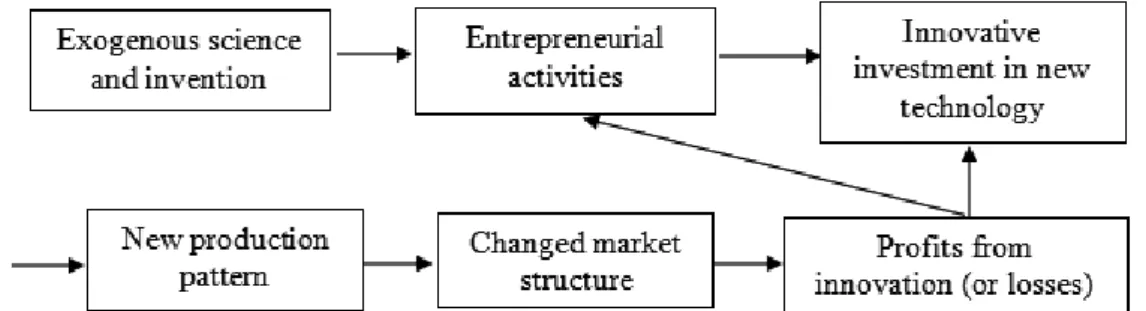
Almarin Phillips (1971) pointed out that there is not one Schumpeterian model but two. The first is that already developed by the young Schumpeter before World War I and expounded in his Theory of Economic Development (1912). The second is that advanced in his later book Capitalism, Socialism and Democracy (1942). From figure 1 and figure 2, we can clearly see a schematic representation of these two models which have been designated as Schumpeter I and Schumpeter II. They are based essentially on the diagrams used by Phillips (1971) with minor modifications. Specifically, the two models can be briefly summarized as follows:
developments in science. There are largely exogenous to existing companies and market structures, and hence to any measurable type of ‘market demand’, although they may certainly be influenced by the belief in a potential demand or concept of unmet need, or shortages of existing products.
(2) A group of entrepreneurs (who in Schumpeter’s view are responsible for the main dynamic thrust in capitalist economies) realize the future potential of these inventions and are prepared to take the risk of developing and innovating. This hazardous activity would not be undertaken by the average capitalist or manager but only by exceptional individuals, whom he defines as entrepreneurs.
(3) Once a radical innovation had been made, it would de-equilibrate existing market structures and reward the successful innovator with exceptional growth and temporary monopoly profits. However, this monopoly will be later whittled away by the entry of swarming secondary innovators giving rise to the cyclical phenomena already described.
The main difference between Schumpeter mark I and Schumpeter Mark II is the
Figure 3 – Schematic representation of Schumpeter’s model of entrepreneurial innovation (Mark I)
(Source: Christopher Freeman, The Economics of Industrial Innovation Second Edition, MIT Press, 1982, p.212.)
Figure 4 – Schematic representation of Schumpeter’s model of entrepreneurial innovation (Mark II)
(Source: Christopher Freeman, The Economics of Industrial Innovation Second Edition, MIT Press, 1982, p.213.) Exogenous science and invention ~ N cw production panem Endogenous science and technology (mainly in-house R&D) Exogenous science and technology ~ Entrepreneurial Changed market structure Management of 皿 ovatlve investment Profits from innovation(or losses) I nnovanve investment m new technology Profits from innovation(or losses) New patterns of production Changed market structure
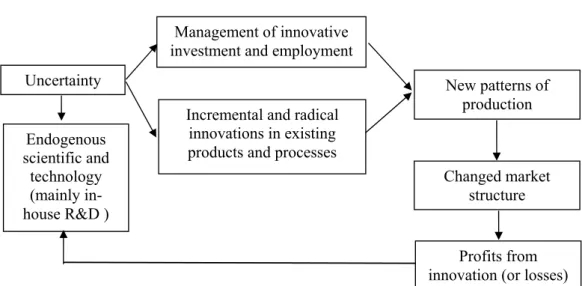
companies. Large companies create innovation endogenous in R & D centers. From successful innovation to increased R & D activities, there is a strong positive feedback loop, which establishes a ”benign” self-strengthening cycle, which leads to a new impetus to improve market concentration. Schumpeter believes that invention activities are increasingly controlled by big companies and enhance their competitive position. The ”coupling” between science, technology, innovation, investment and markets was once loose and delayed for a long time, but now it is closer and more sustained.
The overall long-term trend and long-term cyclical rise in innovation concentration of large companies are very consistent with the possibility of a revival of model 1 start-ups, and the model of electronics and scientific instruments does provide evidence of this.
However, in the birth of emerging industries, especially in the IT industry and e-commerce industry, start-ups may be particularly important. There are some ”replicability”, which include the innovative results of entrepreneurial activities. By prospering, growing, and gathering in businesses, we can see the process of building new ecosystems that are embedded in certain industries and companies.
Put differently, Schumpeter Mark I is still important but Schumpeter Mark II predominates. Thus, core competencies, although very useful in the past, can become “core rigidities” or “capability-rigidity paradoxes” for future effective radical innovation (Leonard-Barton, 1992; Johannessen et al., 2001). Large-companies lack the management ability to adapt the necessary skills to engage in and profit from new technology and to manage the challenges that will reap the business opportunities that lie in disruptive technology. Also, Cravens et al. (2002) and Chandy and Tellis (1998) argue that firms that dominate markets are often reluctant to foster radical innovation because they are unwilling to cannibalize their own investments and assets until it is too late. Although substitution of existing products and markets mainly applies in a later phase of the process, due to the initial sub-optimal state of the disruptive innovation for existing markets, it may affect early management decisions (Christensen, 2003). In contrast, start-ups possess this ability by the interaction of endogenous and exogenous science and technology.
It will be argued that the nature of the uncertainty related to innovation makes most companies have a strong motivation to not carry out more radical product innovation, but focus their industrial R & D on defensive, imitative innovation, product differentiation and process innovation. The difference between internal process innovation and open market product innovation is very important. Product innovation involves technical and market uncertainty. In the case of in-house applications, process innovators are only involved in
technical uncertainty, which, as Hollander points out, may be small for minor technical improvements.
3.2 Two conceptual models
4. CONCLUSION
In this paper, a new theoretical viewpoint for considering the relationship between uncertainty and innovation management is offered. There are three main points need to
i. Large-companies
Figure 5– Large-companies’ model of innovation management under uncertainty
(Source: GUO, 2019) Uncertainty
Management of innovative investment and employment
Incremental and radical innovations in existing products and processes Endogenous scientific and technology (mainly in-house R&D ) New patterns of production Changed market structure Profits from innovation (or losses)
ii. Start-ups
Figure 6– Start-ups’ model of innovation management under uncertainty
(Source: GUO, 2019)
Uncertainty Disruptive innovations in new products and
processes Build an ecosystem and then embedded in some industries and companies New patterns of production Changed market structure Profits from innovation (or losses) Technical, market, organizational, resource Entrepreneur activities
organizational and resource uncertainty. Based on these uncertainties, we try to use Schumpeter’s theoretical model (Mark I and Mark II) to explain incremental and radical innovations in large-companies, also disruptive innovations in start-ups again. In addition, we compared the differences about the innovation process models between large-companies and start-ups. Schumpeter (1996) stressed the importance of autonomous invention and entrepreneurship. We not only encourage start-ups to make up for deficiencies of their own resources by establishing ecosystems, but also emphasize the autonomous reproduction of ecosystems, in order to the quality of entrepreneurship or market demand and achieve regional and global competitiveness further.
The elaboration of these categories helps enrich them so that future research might develop and validate measures of these constructs: next steps in developing a comprehensive set of measures for uncertainty in innovation projects. Besides, we will try to explain the process of building successful ecosystems and how these ecosystems were embedded in some industries and companies. Also, we clearly reveal these ecosystems’ reproduction.
Put differently, for start-ups, Schumpeter’s theory of an autonomous impetus in science and invention and imaginative entrepreneurship of innovation process can be redefined:
That is, once a major innovation has been made, then a pattern of demanded secondary inventions and innovations within ecosystems, especially technology, organization and market. By disruptive innovations in new products and processes, new various products that satisfy customers’ needs are created, and then market structure has been changed. Finally, companies gain or loss profits from automatic innovation ecosystems. These entrepreneur activities can be conducted to thrive, grow, clusters in ventures against internal and external uncertainty, especially external uncertainty (figure 6).
Finally, we will choose representative cases and use empirical data to provide useful research on innovation management and ecosystems under uncertainty in our future research.
REFERENCES
Magazine
Adner, R. (2006) , “Match your innovation strategy to your innovation ecosystem,” Harvard Business Review, Vol.84, No.4, pp.98-107.
Adner, R., Kapoor, R. (2010) , “ Value creation in innovation ecosystems: How the structure of technological interdependence affects firm performance in new technology generations,” Strategic management journal, Vol.31, No.3, pp.306-333.
AC Cooper (1993) , “Challenges in predicting new firm performance,” Journal of business venturing, Vol.8, No.3, pp.241-253.
Adner, R. (2017) , “Ecosystem as structure: An actionable construct for strategy,” Journal of Management, Vol.43, No.1, pp.39-58.
A Huchzermeier, CH Loch (2001), “Project Management Under Risk: Using the Real Options Approach to Evaluate Flexibility in R…D,” Management Science,Vol.47, No.1, pp.5-204. AH Van de Ven (1986), “Central problems in the management of innovation,” Management
science, Vol.32, No.5, pp.513-644.
A Le Flanchec (2004), “How to reduce uncertainty in a context of innovation: The case of IBM's negotiation of its European works council,” International Negotiation, Vol.9, No.2. https://doi. org/10.1163/1571806042403036
Baldwin, C., & Von Hippel, E.(2011), “Modeling a paradigm shift: From producer innovation to user and open collaborative innovation,” Organization Science, Vol.22, No.6, pp.1399-1417. Belderbos, Rene, Bart Leten, and Shinya Suzuki (2013), “How global is R&D? Firm-level
determinants of home-country bias in R&D,” Journal of International Business Studies, Vol.44, No.8, pp.765-786.
C.Baldwin (2012), “Organization design for business ecosystems,” Journal of Organization Design, Vol.1, No.1, pp.20-23.
C.Baldwin, Eric von Hippel (2011) , “Modeling a Paradigm Shift: From Producer Innovation to User and Open Collaborative Innovation,” Organization Science, Vol. 22, No. 6, pp.1369-1683. Chang, D.R., Park, S.-B. (2013), “The effects of brand strategy and technological uncertainty on
pioneering advantage in the multigenerational product market ,” J. Product Innovation Management, Vol.30, No.1, pp.82-95.
Chua, Jess H., James J. Chrisman, and Pramodita Sharma. (1999), “ Defining the family business by behavior,” Entrepreneurship theory and practice,Vol. 23, No. 4, pp.19-39.
Chiesa, V., Frattini, F. (2011), “ Commercializing technological innovation: learning from failures in high-tech markets,” J. Product Innov. Manag, Vol.28, No.4, pp.437-454.
C Moorman, AS Miner (1997), “The impact of organizational memory on new product performance an creativity,” Journal of marketing research, Vol.34, No.1, pp.91-106.
Cumming, B. S. (1998), “ Innovation overview and future challenges,” European journal of innovation management, Vol.1, No.1, pp.21-29.
CJ Beattie, RD Reader (1971), “ Communicating the results of research,” Quantitative Management in R & D, Springer, Boston, MA, pp.187-220.
Management Journal, Vol.23, No.12, pp.1095-1121.
D Leonard, S Sensiper (1998), “The role of tacit knowledge in group innovation,” California management review, Vol.40, No.3, pp.112-132.
Dougherty, D., and C. Hardy. (1996), “Sustained product innovation in large, mature organizations: Overcoming innovation-to-organization problems,” Academy of Management Journal, Vol.39, No.5, pp.1120-1153.
DW Conrath (1967), “Organizational decision making behavior under varying conditions of uncertainty,” Management Science, Vol.13, No.8, pp. B-387-C-203.
E Danneels (2002), “The dynamics of product innovation and firm competences,” Strategic management journal, Vol.23, No.12, pp.1095-1121.
E Danneels (2004), “Disruptive technology reconsidered: A critique and research agenda,” Journal of product innovation management,Vol.21, No.4, pp.246-258.
E Mansfield (1961), “Technical change and the rate of imitation,” Econometric: Journal of the Econometric Society, pp.741-766.
F Damanpour (1996), “Organizational complexity and innovation: developing and testing multiple contingency models,” Management science, Vol.42, No.5, pp.629-782.
Frances J. Milliken (1987), “Three Types of Perceived Uncertainty about the Environment: State, Effect, and Response Uncertainty,” The Academy of Management Review, Vol.12, No.1, pp. 133-143.
G Cosier, PM Hughes (2001), “The problem with disruption,” BT Technology Journal, Vol.19, No.4, pp.9-14.
GS Lynn, AE Akgün (1998), “Innovation strategies under uncertainty: a contingency approach for new product development,” Engineering Management Journal,Vol.10, No.3, pp.11-18. G Ahuja, C Morris Lampert (2001), “Entrepreneurship in the large corporation: A longitudinal
study of how established firms create breakthrough inventions,” Strategic management journal, Vol.22, No.6/7, pp.521-543.
Howell, J. M., and C. A. Higgins. (1990), “Champions of technological innovation ,” Administrative Science Quarterly, Vol.35, No.2, pp.317-341.
H. Kirk Downey, Don Hellriegel and John W. Slocum, Jr. (1975), “Environmental Uncertainty: The Construct and Its Application ,” Administrative Science Quarterly, Vol.20, No.4, pp.613-629. Huchzermeier, A., and C. H. Loch. (2001), “Project management under risk:Using the real options
approach to evaluate flexibility in R&D,” Management Science, Vol.47, No.1, pp.85-101.
H Courtney, J Kirkland, P Viguerie (1997), “ Strategy under uncertainty,” Harvard business review, Vol.75, No.6, pp.67-79.
H Sicotte, A Langley (2000), “Integration mechanisms and R&D project performance,” Journal of Engineering and technology management, Vol.17, No.1, pp.1-37.
H Tsoukas, DB Papoulias (1996), “Creativity in OR/MS: From technique to epistemology,” DB Papoulias-Interfaces,Vol.26, No.2, pp.1-122.
Jacob, W.F., Kwak, Y.H., (2003), “In search of innovative techniques to evaluate pharmaceutical R&D projects,” Technovation, Vol.23, No.4, pp.291–296.
JD Sherman, R Davies-Cooper (1998), “Environmental uncertainty, organizational integration, and new product development effectiveness: a test of contingency theory,” Journal of Product Innovation Management, Vol.15, No.6, pp.520-533.
June Kaminski (2011), “Diffusion of Innovation Theory,” Canadian Journal of Nursing Informatics, Vol.6, No.2, http://cjni.net/journal/?p=1444.
J Tidd (2001), “Innovation management in context: environment, organization and performance,” International Journal of Management Reviews, Vol.3, No.3, pp.169-183.
J Paap, R Katz (2004), “Anticipating disruptive innovation,” Research-Technology Management, Vol.47, No.5, pp.13-22.
Kapoor, Rahul, and Joon Mahn Lee (2013), “Coordinating and competing in ecosystems: How organizational forms shape new technology investments,” Strategic management journal, Vol.34, No.3, pp.274-296.
LB Cardinal (2001), “Technological innovation in the pharmaceutical industry: The use of organizational control in managing research and development,” Organization science, Vol.12, No.1, pp.1-95.
Loch, C. H., M. E. Solt, and E. M. Bailey. (2008), “Diagnosing unforeseeable uncertainty in a new venture,” Journal of Product Innovation Management 25, pp.28–46.
Lynn, G. S., and A. E. Akgün. (1998), “Innovation strategies under uncertainty: A contingency approach for new product development,” Engineering Management Journal, Vol.10, pp.11-18. Lundblad, Jennifer P. (2003), “A Review and Critique of Rogers' Diffusion of Innovation Theory
as it Applies to Organizations,” Organization Development Journal, Vol.21, No.4, pp.50–64. L Fuglsang, J Mattsson (2011), “Making sense of innovation: A future perfect approach,” Journal
of Management & Organization,Vol.17, No.4, pp.448-458 .
M Assink (2006), “Inhibitors of disruptive innovation capability:a conceptual model,” European Journal of Innovation Management,Vol.9, No.2, pp.215-233.
ML Tushman (1997), “Winning through innovation,” Strategy and Leadership, Vol.24, No.5, pp.14-19.
environment,” Research policy,Vol.24, No.4, pp.521-542.
M Benaroch (2001), “Option-based management of technology investment risk,” IEEE Transactions on Engineering Management, Vol.48, No.4, pp.428-444.
MP Feldman, DB Audretsch (1999), “Innovation in cities:: Science-based diversity, specialization and localized competition,” European economic review, Vol.43, No.2, pp.409-429.
O’Connor, G. C., and M. P. Rice. (2001), “Opportunity recognition and breakthrough innovation in large established companies,” California Management Review, Vol.43, No.2, pp.95-116.
Olander, H., Hurmelinna-Laukkanen, P., and Mähönen, J. (2009), “ What’s small size got to do with it? Protection of intellectual assets in SMEs,” International Journal of Innovation Management, Vol.13, No.3, pp.349–370.
Pennings, J. M. (1981), “Strategically interdependent organizations,” Handbook of organizational design, Vol.1, pp.433-455.
Pitelis, C. (2012), “Clusters, entrepreneurial ecosystem co-creation, and appropriability: A conceptual framework,” Industrial and Corporate Change,Vol.21, No.6, pp.1359–1388.
P Phan, C Chambers (2013), “Advancing theory in entrepreneurship from the lens of operations management,” Production and Operations Management,Vol.22, No.6, pp.1423-1428.
PR Lawrence, JW Lorsch (1967), “Differentiation and integration in complex organizations,” Administrative science quarterly,Vol.12, No.1, pp.1-47.
P Thomond, F Lettice (2002), “Disruptive innovation explored,” Concurrent Engineering Conference Proceedings. No.7.
R Garcia, R Calantone (2002), “A critical look at technological innovation typology and innovativeness terminology: a literature review,” Journal of Product Innovation Management, Vol.19, No.2, pp.110-132.
R Baptista, P Swann (1998), “Do firms in clusters innovate more?,” Research policy, Vol.27, No.5, pp.525-540.
RK Chandy, GJ Tellis (1998), “Organizing for radical product innovation: The overlooked role of willingness to cannibalize,” Journal of marketing research, Vol.35, No.4, pp.474-487.
R Loutfy, L Belkhir (2001), “Managing innovation at Xerox,” Research-Technology Management, Vol.44, No.4, pp.15-24.
Rice, M. P., G. C. O’Connor, and R. Pierantozzi. (2008), “ Implementing a learning plan to counter project uncertainty,” Sloan Management Review, Vol.49, No.2, pp.54–62.
Rothwell, R. and Dodgson, M. (1991), “ External linkages and innovation in small and medium-sized companiess,” R&D Management, Vol.21, No.2, pp.125–138.
Diversified Major Firm,” Administrative Science Quarterly, Vol.28, No.2, pp.223–244. RM Kanter (1989), “The new managerial work,” Harvard business review,Vol.67, No.6, pp.85–92. Roijakkers, N., Leten, B., Vanhaverbeke, W., Clerix, A., Van Helleputte, J (2013), “Orchestrating
Innovation Ecosystems_IMEC. In Proceedings of the 35th DRUID Conference 2013, pp.17– 19.
RT Moriarty, TJ Kosnik (1989), “High-tech marketing: concepts, continuity, and change,” MIT Sloan Management Review, Vol.30, No.4, p.7.
R Stringer (2000), “How to manage radical innovation,” California management review, Vol.42, No.4, pp.85-92.
SC Wheelwright, KB Clark (1992), “ Competing through development capability in a manufacturing-based organization,” Business horizons, pp.29–43.
Souder, W. E., D. J. Sherman, and R. Davies-Cooper. (1998), “ Environmental uncertainty, organizational integration, and new product development effectiveness: A test of contingency theory,” Journal of Product Innovation Management, Vol.15, pp.520–533.
SB Graves, JL Ringuest (2009), “Probabilistic dominance criteria for comparing uncertain alternatives: A tutorial,” Omega,Vol.37, No.2, pp.346-357.
Shaker A. Zahra Hans N. Rawhouser Nachiket Bhawe Donald O. Neubaum James C. Hayton (2008), “ Globalization of social entrepreneurship opportunist,” Strategic Entrepreneurship Journal, Vol.2, No.2, pp.117-131 .
SL Brown, KM Eisenhardt (1995), “Product development: Past research, present findings, and future directions,” Academy of management review, Vol.20, No.2, pp.343-378.
SK Kassicieh, ST Walsh, JC Cummings (2002), “Factors differentiating the commercialization of disruptive and sustaining technologies,” IEEE Transactions on Engineering Management, Vol.49, No.4, pp.375-387.
Teece, D.J. (1986), “ Profiting from technological innovation: implications for integration, collaboration, licensing and public policy,” Research Policy,Vol.15,No.6, pp.285-305.
Teece (2016), “Dynamic Capabilities and Organizational Agility,” California management review,Vol.58, No.4, pp.133-143.
T Magnusson, C Berggren (2001), “ Environmental innovation in auto development-managing technological uncertainty within strict time limits,” International Journal of Vehicle Design,Vol.26, No.2/3, pp.101-115.
Wareham, J., Fox, P.B., & Cano Giner, J. L. (2014), “Technology ecosystem governance,” Organization Science, Vol.25, No.4, pp.1195-1215.
platform,” Advanves in Strategic Management,Vol.30, pp.27-67.
Williamson, P. J., & De Meyer, A. (2012), “Ecosystem advantage: How to successfully harness the power of partners,” California Management Review, Vol.55, No.1, pp.24-46.
WM Cohen, DA Levinthal (1990), “Absorptive capacity: A new perspective on learning and innovation,” Administrative science quarterly, Vol.35, No.1, pp.128-152.
WF Jacob, YH Kwak, “In search of innovative techniques to evaluate pharmaceutical R&D projects,” Technovation, Vol.23, No.4, pp.291-296.
YT Cheng, AH Van de Ven (1996), “Learning the innovation journey: order out of chaos?,” Organization science,Vol.25, No.4, pp.1195-1215.
YH Kwak, J Stoddard (2004), “Project risk management: lessons learned from software development environment,” Technovation,Vol.24, No.11, pp.915-920.
Zacharakis, A. L., Shepherd, D. A., & Coombs, J. E. (2003), “The development of venture-backed internet companies: An ecosystem perspective,” Journal of Business Venturing,Vol.18, No.2, pp.217-231.
Zahra, S. A., & Nambisan, S. (2012), “Entrepreneurship and strategic thinking in business ecosystems,” Business Horizons,Vol.55, No.3, pp.219-229.
Monograph
Adner, R. (2017) The wide lens: A new strategy for innovation, London, England: Penguin.
Brusoni, Stefano, and Andrea Prencipe (2013) The organization of innovation in ecosystems: problem framing, problem solving, and patterns of coupling, Emerald Group Publishing Limited, pp.20-23.
Christopher Freeman (1982) The Economics of Industrial Innovation Second Edition, MIT Press. p.212.
Christensen, C. (1998) The innovator’s dilemma. Boston: Harvard Business School Press.
Chesbrough, H.W. (2003) Open Innovation: The New Imperative for Creating and Profiting from Technology, Boston: Harvard Business School Press.
Chesbrough, H.W. (2006) Open Business Models: How to Thrive in the New Innovation Landscape, Boston: Harvard Business School Press.
Chesbrough, H.W., Vanhaverbeke, W., and West, J. (eds) (2006) Open Innovation: Researching a New Paradigm, Oxford: Oxford University Press.
Frank H. Knight (1921) Risk, Uncertainty, and Profit , New York, NY: Harper, p.268.
HI Ansoff (1965) Corporate strategy: business policy for growth and expansion, McGraw-Hill Book. JG Morone (1993) Winning in High-Tech Markets: The Role of General Management : How
Motorola, Corning, and General Electric Have Built Global Leadership Through Tech, cposecurity.co.uk.
Marshall, A. (1966) Memorials of Alfred Marshall, Kelley.
McGrath, R., and I. C. MacMillan. (2000) The entrepreneurial mindset, Boston, MA: Harvard Business School Press.
O’Connor, G. C., R. L. Leifer, A. L. Paulson, and P. Lois. (2008) Grabbing lightning: Building a capability for breakthrough innovation, San Francisco, CA: Jossey Bass.
RG McGrath, RG Mac Grath, IC MacMillan (2000) The entrepreneurial mindset: Strategies for continuously creating opportunity in an age of uncertainty, Printed in the United States of America.
Rosenberg, N. (1976) Perspectives on technology, CUP Archive.
Sharma, A. (2000) A linkage model of corporate new ventures, Boston: Marketing Science Institute. Schumpeter, J.A., (1967) The Theory of Economic Development 5th ed, Oxford University Press,
Oxford, England.
Schumpeter, J. A. (1996) Behavioral norms, technological progress, and economic dynamics: studies in Schumpeterian economics (Vol. 5), University of Michigan Press.
William Janeway (2012) Doing Capitalism in the Innovation Economy, Cambridge: Cambridge University Press, pp.58-59.
1 Paap and Katz (2004) argue that patterns of success may cause a conflict between functioning efficiently to sustain the current successful business model and incorporating disruptive innovations that will enable a company to be competitive in the future. Brown (1998) terms this one of the trickiest issues we face in achieving the right balance between centralization and decentralization. To some extent, the hierarchical structure was failure. 2 Chesbrough, H.W. (2003) Open Innovation: The New Imperative for Creating and Profiting
from Technology, Boston: Harvard Business School Press.
3 Chesbrough, H.W. (2006) Open Business Models: How to Thrive in the New Innovation Landscape, Boston: Harvard Business School Press.
4 Chesbrough, H.W., Vanhaverbeke, W., and West, J. (eds) (2006) Open Innovation: Researching a New Paradigm, Oxford: Oxford University Press.
5 C.Baldwin, Eric von Hippel (2011) , “Modeling a Paradigm Shift: From Producer Innovation to User and Open Collaborative Innovation,” Organization Science, Vol. 22, No. 6,
pp.1369-6 Christopher Freeman (1982) The Economics of Industrial Innovation, MIT Press. pp.139- 141.
要 旨 いくつかのイノベーターが同時に成功する可能性のある市場現状が明らかにする。あるプ レーヤーの成功は、必ずしも別のプレーヤーの失敗を意味するわけではない。独占者または 社会主義のイノベーションの場合には、技術的不確実性、市場的不確実性および一般的なビ ジネスの不確実性といった3つの理由によって失敗が持続している。深い不確実性は、世界 的な依存経済に存在する。特に、急速な技術開発の影響を受けている。不確実性は、従来の ツールとアプローチを使う管理できるリスクとは大きく異なっている。不確実性を過小評価 することは、脅威を防御することも、より高いレベルの不確実性がもたらす可能性のある機 会を利用することもしない企業につながる可能性がある。 伝統的なアプローチでは、確立された大手企業をクラスタリングすることによって、経営 者が不確実性を見るようになっている。一般的には、既存の大手企業は自社のコア製品を管 理する能力の強化に重点を置いており、既存製品とプロセスのコスト削減、品質向上、段階 的なイノベーションに移行する。このアプローチは、比較的安定したビジネス環境のある企 業によく役立つのである。しかしながら、将来は高い不確実性があるならば、成熟した企業 は根本的に新しい市場を構築して、支配する基盤として根本的なイノベーションを開発しな ければならない。 同時に、リスクは大手企業に集中しているだけではなく、新興企業と起業家にもかなり存 在している。新興企業にとっては、大手企業よりも多くのリスクと不確実性を受け入れる必 要がある。不確実性が高まると、企業は自社の競争力を維持するために、特に新興企業にと っては変化が必要になる。 不確実性の状況では大手企業と新興企業が2つの完全的な異なるイノベーションモデルを 構築している。前者の場合は、内在的な科学技術研究と外因性の科学発明を生み出す非常に 効果的な相互作用による投資管理を行うことができる。一方で、経営資源の不足により、新 興企業は、エコシステムを繰り返し作成したイノベーション・マネジメントを行い、地域的 かつ世界的な競争力をさらに高めることにより、不確実性をうまく管理する能力を持たなけ ればならないのである。 本稿では、理論的レベルの視点から不確実性とイノベーション・マネジメンの関係を明確 する。そのうえ、新興企業と大手企業の間の違いを比較する2つの追加の次元として、イノ ベーション・プロセスとモデルを組み合わせて分析する。なぜなら、どのイノベーションが 適切で最良であるか、およびイノベーション・プロセスがどのように開発すべきか、といっ た決定されることは、異なる企業の不確実性のレベルに依存する。 キーワード:不確実性、イノベーション・マネジメント、シュンペーター、エコシステム、