C11
Flood Frequency Analysis under Climate Change Effects in the Lower Mekong Basin
using d4PDF Datasets
〇Sophal TRY, Shigenobu TANAKA, Kenji TANAKA, Takahiro SAYAMA, Chantha OEURNG
Introduction
The future change of intensity and frequency of precipitation will definitely affect the flood characteristic in the river basin. The insufficient number of ensemble members would lead to increase uncertainty in climate simulation. To deal with this issue, the objective of this study is to evaluate future changes of flood extreme in the Mekong River Basin (MRB) using a large ensemble dataset.
Study Area
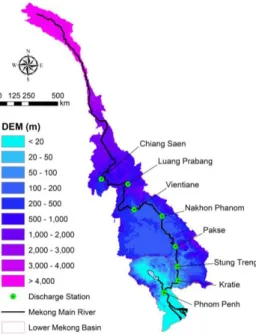
The MRB is one among the world global large-scale basins where flood occurs almost every year. More than 60 million people live in the Lower Mekong Basin (LMB) in Thailand, Lao PDR, Cambodia, and Vietnam where the annual average flood economic damage ranges US$ 60-70 million. The frequency and severity of extreme flood in this region were expected to be significantly affected by climate change effects.
Fig. 1. The Mekong River Basin
Method
The Rainfall-Runoff-Inundation (RRI) model, a distributed rainfall-runoff and inundation model with diffusive wave approximation (Sayama et al., 2014), was used for flood inundation simulation in this study. The RRI model was calibrated and validated for the MRB from the previous study (Try et al., 2020). The Generalized Extreme Value (GEV) was used for flood extreme fitting (annual peak discharge). The Kolmogorov-Smirnov (K–S) test of two samples was also used to distinguish the likelihood from each SST pattern. Combination cases of two samples from 6 SST patterns (15 combination cases) were tested. The null hypothesis assumes that two samples have no significant difference of their cumulative distribution function.
This study used the database for policy decision-making for future climate change (d4PDF) which was projected under 4 K warming scenario considered sea surface temperature (SST) pattern from six CMIP5 models: CCSM4, GFDL-CM3, HadGEM2-AO, MIROC5, MPI-ESM-MR, and MRI-CGCM3. The d4PDF dataset has 100 ensemble members for historical climate simulation (1951-2010) and 90 members for future experiment (2051-2110) from six SST patterns namely as CC, GF, HA, MI, MP, and MR (15 members for each SST pattern).
Results
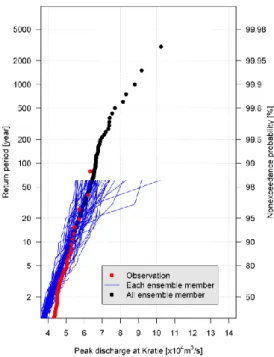
Fig. 2 shows comparison of probability of extreme flood in the LMB between observation and simulation from historical 50 ensemble members of d4PDF dataset. The results indicated a good agreement
between observation (red dots) and ensemble mean (black dots) values while the prediction was estimation for low frequency flood event (i.e., return period of ~ 2-year or smaller). The blue lines specified the uncertainty range for each ensemble member.
Fig. 2. Comparison of observation and historical simulation of d4PDF
Fig. 3. Comparison of fitted historical (GEV HPB)
and future experiments (GEV HFB) with their confidence interval 95%
The results from K-S test revealed that only one combination case (CC-HA) was found to accept the null hypothesis while null hypothesis of other 14 cases was rejected. Here after, only CC and HA were used for future projection. 20-year block maxima was used to investigate change of flood extreme values in Fig. 3. The extreme flood of 50-year, 100-year, and
1000-year events in the fitted GEV for present climate experiment were 61,588 m3/s, 67,400 m3/s, and 84,762 m3/s. These values significantly increased to 77,103 m3/s, 89,331 m3/s, and 118,912 m3/s corresponding with relative ratios of 1.25, 1.33, and 1.40, respectively.
Discussion and Conclusion
This study investigated the applicability of a large ensemble dataset (d4PDF) for changes of future flood extreme. The results demonstrated a good agreement between flood probability of ensemble mean and observation. The K-S test of two samples indicated significant difference of SST pattern in majority (14 out of 15 cases). This means that SST pattern is a major uncertainty source in projected atmospheric model, and diversity of SST will have great effect on changing extreme precipitation as well as river discharge. Therefore, using reliability SST will improve the performance of atmospheric model in projecting future climate. The findings of increasing severity of extreme flood in the LMB might be a key information for water resources management as well as flood mitigation and adaptation counter measures are necessary to reduce future flood risk damage in this area.
References
Sayama, T., Tatebe, Y., Iwami, Y., Tanaka, S. (2014). Hydrologic sensitivity of flood runoff and inundation: 2011 Thailand floods in the Chao Phraya River basin. Natural Hazards and Earth System Sciences, 15: 7027-7059.
Try, S., Tanaka, S., Tanaka, K., Sayama, T., et al. (2020). Comparison of gridded precipitation datasets for rainfall-runoff and inundation modeling in the Mekong River Basin. PloS One, 15(1), e02268.