
Toward Recognizing Unknown Activities Using Word Vectors
4
0
0
全文
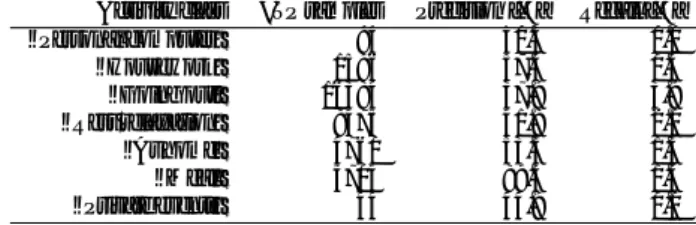
(2) Vol.2016-UBI-50 No.8 2016/5/28. IPSJ SIG Technical Report. Activity classes:. Feature vectors:. Y. X. “walk” “sleep” ・ ・ ・. x1 x2 ・ ・ ・. f : X→Y. y=f(xnew) Fig. 1. Traditional activity recognition: supervised machine learning with X as explanatory variables, and Y as the response variable.. dataset of X and Y. Let X and Y also denotes the variables for each sample in them. Then, the supervised machine learning generates the function f : X → Y. When we estimate an activity y˜ , we can perform y˜ = f (xnew ) from a new input xnew . 2.2 Utilizing zero-shot learning Activity classes:. Feature vectors:. Y. X. Z. x1 x2 ・ ・ ・. z1 z2 ・ ・ ・. “walk” “sleep” ・ ・ ・. Word vectors:. g : Z→Y. y˜ = g(h(xnew )) from new input xnew . Because the activity labels Y and the word vectors Z can include the activity classes which do not appear in the feature vectors X, we can estimate activity classes which are new for the sensor data. 2.3 Utilization of word vectors In the field of natural language processing, the tool ‘word2vec’ for modeling latent semantics from text data is frequently used. Word2vec generates word vectors for each word by training neural autoencoder with the neighboring information in the text. Using word2vec, we generated word vectors from the Japanese Wikipedia, and picked up the word vectors corresponding to the activity classes. Note that some of the activity labels include multiple words, such as “Newspaper / radio / TV”. For such label, we merged the word vectors by taking the mean of the word vectors.. 3. Preliminary Evaluation In this section, we evaluate the proposed method with the dataset collected from households with simple sensors and usergenerated activity labels. In particular, we focus on the question whether the activity classes which do not appear in the training data are correctly estimated. 3.1 Dataset As a dataset, we utilized the dataset of light and power sensor data and activity labels from 20 households collected through the experiment with 35 households for 4 months[5].. Calendar. h : X→Z. y = g(h( xnew ) ) Fig. 2. Confirmed/ edited activities. The proposed method:with the word vectors Z, generate g : Z → Y, and h : X → Z, and obtain y˜ = g(h(xnew )) for the estimation.. In zero-shot learning, we assume that we have word vectors Z, where each of which corresponds to the sample of activity labels Y. We describe how to build word vectors in Section ??. Fig. 2 illustrates the proposed method. The proposed method is described in the following: ( 1 ) with the word vectors Z and the activity labels Y, generate the function g : Z → Y by supervised machine learning, ( 2 ) with the feature vectors X and the word vectors Z, generate the function h : X → Z by supervised machine learning, and ( 3 ) when we estimate an activity y˜ , we can perform ⓒ 2016 Information Processing Society of Japan. Estimated activities Fig. 3. Web view for estimating/editing/recording activity labels.. We lent tablet terminals to the subjects, and asked them to place each of them at a frequently-used place, such as in a living or dining room. The terminal has a light sensor, and sends the light data periodically to the server. We also collected the entire electricity data from an easy-to-setup smart meter from each household, 2.
(3) Vol.2016-UBI-50 No.8 2016/5/28. IPSJ SIG Technical Report. which were stored in the server. As for activity labels, we utilized the web-based system with which each subject can define or edit new activity classes based on the estimated activities by the system. We asked for each subject to input the activity record a few minutes in a day. Note that the labels were recorded in Japanese language, but we interpret into English throughout this paper. 3.2 Preprocessing We used the lights and power consumption data, and the activity labels each of the subjects recorded obtained in the experiment. For a light sensor data and the power data, we extracted the following feature vectors X by 1 minutes: • minutes in a day, • mean / standard deviation / maximum / minimum value of light sensors, and • watt values obtained from power meters by 1 minutes. For the word vectors Z, we we applied word2vec tool to the Japanese Wikipedia site, which resulted in 100 dimensions of word vectors. Moreover, we reduced the dimensions to top 10 important variables by applying the random forest algorithm. As a result, the activity classes Z became the number of 52, as “Sleep”, “Breakfast”, “Lunch”, “Dinner”, “Bath”, “Television”, “Reading”, “At home”, “Washing”, “Clean up”, “Personal computer”, “Study”, “Private events”, “Commute”, “Work,/academic”, “Meal”, “Housework”, “Television/radio/newspaper/magazine”, “Rest/relaxation”, “Going out”, “Cooking”, “Buy something”, “Lunch preparation”, “Yoga”, “Game”, “Walk”, “Lunch making”, “Hula dance”, “Purring”, “Cloth drier”, “Tableware washing dryer”, “Ironing”, “Snacking”, “Tablet”, “Rice cooker”, “Movement”, “Business”, “Work”, “Eating out”, “Video”, “Bike loading”, “Business trip”, “Shopping”, “Beauty salons”, “Yu Yu land”, “Update the vehicle insurance”, “Bake cookies”, “Land office”, “Individual enrichment courses”, “Hatsuuma Festival”, “Garbage”, and “Morning reading” 3.3 Evaluation method As a base algorithm for supervised machine learning, we adopted k-nearest neighborhood method, with k = 3. This algorithm is considered to be appropriate to reflect the distances among samples directly. To evaluate whether the proposed method could estimate the activity classes which does not appear in the training data, we take the following steps: For each activity class y ∈ Y, ( 1 ) remove the samples with activity class y from the data, ( 2 ) train with the data after removal, and ( 3 ) test with the data before removal. By this, we can evaluate whether the each of the removed activity classes could be estimated in the original data as test data. As measures of accuracy, we adopt precision — the rate of correctly estimated samples among the samples which were estimated as the activity class —, and recall — the rate of correctly estimated samples among the samples of activity class in the ground truth —. To eliminate the imbalances in the ground ⓒ 2016 Information Processing Society of Japan. truth, we applied bootstrap sampling for each of positive and negative samples in the ground truth data. 3.4 Result We show the recognition result of activities which do not exist in the training data in Table 3.4. In the table, for the activity classes which was successful to be estimated, the number of true positive samples, precision, and recall, are shown. Table 1 Newly estimated activities which do not exist in the training data. Activity class “Personal computer” “Housework” “Going out” “Rest/relaxation” “At home” “Meal” “Private events”. #TP samples 94 1596 16384 8475 4760 5704 44. Precision [%] 50.3 57.4 37.9 41.8 53.5 89.3 44.9. Recall [%] 0.0 0.4 3.9 2.0 1.3 1.3 0.0. From Table 3.4, “Personal computer”, “Housework”, “Going out”, “Rest/relaxation”, “At home”, “Meal, “Private events” could be estimated even if such classes does not appear in the training data. The best precision was 89% for “Meal”, which means that the most of the estimations for “Meal” are correct. However, the recall is still 1.3% at the best. This means that many of the activities are missed to be estimated correctly. 3.5 Discussion As in Table 3.4, “Housework”, “Going out”, “At home”, and “Meal” could be estimated even when each of them does not appear in the training data. On the other hand, the rest of the activity classes could not be estimated in the same situation. Amont them, “Sleep”,“Breakfast”, “Clean up”, and “Bath” have large number of true samples. We can set an assumption that for for these failed activity classes are close to the estimated activity classes in the feature or the word vectors, and that is why the estimation failed. For example, “Breakfast”, “Lunch”, and “Dinner” could be close to “Meal”, and “Clean up”, could be close to “Housework” from the meaning of the activity classes. As a future work, to confirm this assumption, we will have to train with various combination of activity classes to be removed. Moreover, We didnot observe difference between activity labels with single word or multiple words, in which the latter was combined by the mean of word vectors. We will also investigate the better method for integrating multiple word vectors.. 4. Conclusion In this paper, we proposed a method for activity recognition which can estimate new activities which does not appear in the training data, combining word vectors obtained by natural language processing. We combined zero-shot machine learning method and word vectors generated by the natural language processing tool ‘word2vec’. As a result of evaluation whether we could estimate new activities which does not appear in the training data, with the sensor dataset collected along with the usergenerated labels, However, we also found several challenges for accuracies and differences among activity classes. Further work 3.
(4) IPSJ SIG Technical Report. Vol.2016-UBI-50 No.8 2016/5/28. is expected to improve such activity recognition for unknown activity classes. References [1]. [2]. [3]. [4] [5]. Cheng, H.-t., Griss, M., Davis, P., Li, J. and You, D.: Towards zeroshot learning for human activity recognition using semantic attribute sequence model, Proceedings of the 2013 ACM international joint conference on Pervasive and ubiquitous computing - UbiComp ’13, No. 2, p. 355 (online), DOI: 10.1145/2493432.2493511 (2013). Mikolov, T., Corrado, G., Chen, K. and Dean, J.: Efficient Estimation of Word Representations in Vector Space, Proceedings of the International Conference on Learning Representations (ICLR 2013), pp. 1–12 (online), DOI: 10.1162/153244303322533223 (2013). Nguyen, L. T., Zeng, M., Tague, P. and Zhang, J.: Recognizing new activities with limited training data, Proceedings of the 2015 ACM International Symposium on Wearable Computers, pp. 67–74 (online), DOI: 10.1145/2802083.2808388 (2015). Palatucci, M., Hinton, G., Pomerleau, D. and Mitchell, T. M.: ZeroShot Learning with Semantic Output Codes, Neural Information Processing Systems, pp. 1–9 (2009). Pan, X., Minezaki, T., Isoda, T., Tanaka, S., Uchino, Y. and Inoue, S.: Analyzing Daily-life Activities and Power Consumptions Using Tablet Sensors and Activity Annotation Web System, Adjunct Proceedings of the 2015 ACM International Joint Conference on Pervasive and Ubiquitous Computing and Proceedings of the 2015 ACM International Symposium on Wearable Computers, UbiComp/ISWC’15 Adjunct, New York, NY, USA, ACM, pp. 1443–1452 (online), DOI: 10.1145/2800835.2801615 (2015).. ⓒ 2016 Information Processing Society of Japan. 4.
(5)
図

関連したドキュメント
Furthermore, another study examined brain activity during performance of the Word Fluency Task, which can be used to evaluate frontal lobe function, using NIRS and confirmed
To evalu- ate the applicability of word analogy to the discovery of new relation between drug and disease, checked whether most of the displacement vectors
When we consider using WEKO as a data repository, it is not easy for the users to search the data which they wish because metadata are not well standardized in many academic fields..
In Section 5 we consider substitutions for which the incidence matrix is unimodular, and we show that the projected points form a central word if and only if the substitution
In this paper, we introduce a new combinatorial formula for this Hilbert series when µ is a hook shape which can be calculated by summing terms over only the standard Young tableaux
Thus, in order to achieve results on fixed moments, it is crucial to extend the idea of pullback attraction to impulsive systems for non- autonomous differential equations.. Although
In this paper, we apply the modified variational iteration method MVIM, which is obtained by the elegant coupling of variational iteration method and the Adomian’s polynomials
In this paper, based on the concept of rough variable proposed by Liu 14, we discuss a simplest game, namely, the game in which the number of players is two and rough payoffs which
