I
IntroductionOn 5th November 2008, Queen Elizabeth attended the opening ceremony for a new aca-demic building at the London School of Economics. After being briefed by academics at the LSE about the turmoil and crisis on the international stock market, the Queen sudden-ly asked to the professors the question: "Why did nobody notice it?" In spite of the fact that these depressive things were so large, the Queen wondered why everyone in the academ-ic circle failed to foresee the crisis. Then Professor Luis Garicano, director of research at the management department, had very hard time to explain the origins and effects of the credit crunch. He barely managed to tell the Queen, "At every stage, someone was relying on somebody else and everyone thought that they were doing the right thing."1)
In hindsight, history tells us that in 2008 the people around the world were in the midst of the biggest crisis since the infamous Great De-pression of the 1930s. As was clearly pointed out by Posner, a noted Harvard professor, we have shockingly seen disappointed perfor-mance of the economics profession in regard to anticipating and providing guidance to re-sponding to the depression.2)
We now live in the age of uncertainty. As Beck (1986) has rightfully noted, we could also say that we live in Risk Society. While most of swans are surely white birds, there are never-theless a considerable number of Black Swans in modern society. According to N.N. Taleb (2007), "Black Swan logic makes what you don't know far more relevant than what you do know. Consider that many Black Swans can be caused and exacerbated by their being unexpected."
Pre-On the Economics of
Risk and Uncertainty
A Historical Perspective
Yasuhiro Sakai
Shiga University / Professor Emeritus
Articles
1) For details, see Pierce (2008). 2) For details, see Posner (2009).
3) There have been still very few books and papers that discuss the history of the economics of risk and uncer-tainty. A modern and systematic approach to the history was provided by Sakai (2010).
sumably, the 2008 credit crunch which surprised the Queen as well as the economics profession was one of those Black Swans. Ta-leb proceeds to say that a Black Swan is an event with the following three attributes. First, it lies outside the realm of regular expectations, because nothing in the past can convincingly point to its possibility in the present. Second, it may sometimes carry an extreme impact as was illustrated by the Great Depression in the 1930s and the financial crisis in 2008. Third, human nature makes us concoct some explana-tions and even excuses only after the event happened.
We now believe that it is high time to sys-tematically summarize and critically reevaluate the long history of the economics of risk and uncertainty. Carrying out such a mission is certainly the main goal of this paper. The con-tents of the paper are briefly described as follows. In Section 2, we carefully survey the economics of risk and uncertainty from a his-torical perspective. We will show that there are six stages of development, with each stage re-flecting its historical events. In Section 3, we will focus on Keynes and Knight. the two great economists in modern times. While they both can be regarded as pioneers of non-measurable uncertainty, their relations are rather complex and even strange. Their positions are separat-ing in one time yet approachseparat-ing in other times. We will attempt to shed new light on their del-icate relationship. And some final remarks will be made in Session 4.
II
The Economics of Riskand Uncertainty: The Six Stages of Development
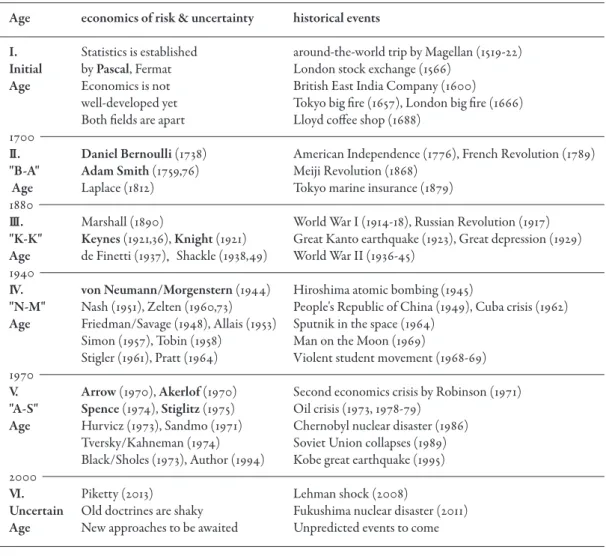
The economics of risk and uncertainty has a long history over 300 years. In this section, we would like to systematically summarize and critically reevaluate it. In our opinion, as is seen Table 1, there are the six stages of develop-ment, with each stage corresponding very well to its historical background. 3)
2–1. The Initial Age as the First Stage:Greatness and Suffering of Blaise Pascal
Concerning the economics of risk and un-certainty, as is seen in Table 1, the first stage of its development corresponded to a long period before 1700. Although statistics as a branch of mathematics was firmly established by Pascal and Fermat, economic theory was not well-de-veloped yet. So we would like to regard this first stage as the Initial Age. Regarding its out-standing historical events, we can point out the around-the-world trip by F. Magellan, a Portu-guese adventurer, for the period 1519–22, the opening of London stock exchange, the estab-lishment of British East India Company in 1600, and the opening of Lloyd coffee shop as a forerunner of marine insurance company in 1688. Remarkably, a big fire took place in To-kyo in 1657, being followed by another big fire in London in 1665. Therefore, the initial age was well-characterized by risky ventures by ad-venturers with animal spirits, and risk sharing management by stock and insurance compa-nies.
4) For this point, see Galbraith (1987) and Hicks (1969). It is noted that the period of around 300
years before 1700 can be regarded as the era of the merchants, namely the one which was called mercantilism or the mercantile economy. In fact, the merchants of seven-teenth-century Osaka were even able to carry out very sophisticated mercantile dealings such as futures trading. Unfortunately, in
these three centuries of mercantilism, eco-nomic the or y did not have a famous spokesman, none such as Adam Smith, Alfred Marshall, Karl Marx, and J.M. Keynes in later years.4)
Mathematics has a longer history than eco-nomic theory. In this initial age, statistics as a branch of mathematics was firmly established by the two great men of mathematicians — P.
Age economics of risk & uncertainty historical events
I. Statistics is established around-the-world trip by Magellan (1519-22) Initial by Pascal, Fermat London stock exchange (1566)
Age Economics is not British East India Company (1600) well-developed yet Tokyo big fire (1657), London big fire (1666) Both fields are apart Lloyd coffee shop (1688)
1700
II. Daniel Bernoulli (1738) American Independence (1776), French Revolution (1789) "B-A" Adam Smith (1759,76) Meiji Revolution (1868)
Age Laplace (1812) Tokyo marine insurance (1879) 1880
III. Marshall (1890) World War I (1914-18), Russian Revolution (1917) "K-K" Keynes (1921,36), Knight (1921) Great Kanto earthquake (1923), Great depression (1929) Age de Finetti (1937),Shackle (1938,49) World War II (1936-45)
1940
IV. von Neumann/Morgenstern (1944) Hiroshima atomic bombing (1945)
"N-M" Nash (1951), Zelten (1960,73) People's Republic of China (1949), Cuba crisis (1962) Age Friedman/Savage (1948), Allais (1953) Sputnik in the space (1964)
Simon (1957), Tobin (1958) Man on the Moon (1969)
Stigler (1961), Pratt (1964) Violent student movement (1968-69) 1970
V. Arrow (1970), Akerlof (1970) Second economics crisis by Robinson (1971) "A-S" Spence (1974), Stiglitz (1975) Oil crisis (1973, 1978-79)
Age Hurvicz (1973), Sandmo (1971) Chernobyl nuclear disaster (1986) Tversky/Kahneman (1974) Soviet Union collapses (1989) Black/Sholes (1973), Author (1994) Kobe great earthquake (1995) 2000
VI. Piketty (2013) Lehman shock (2008)
Uncertain Old doctrines are shaky Fukushima nuclear disaster (2011) Age New approaches to be awaited Unpredicted events to come
6) It should be noted that the original writings of Pascal (1656) were occasionally unclear and unnecessarily re-petitive to the modern mind. While its English tion by Trotter (1910) is available, the Japanese transla-tion by Matsunami (1965) is more instructive than the English one since Mtsunami offers the reader a series of helpful translation remarks.
5) For details on Pascal and Laplace, see Bell (1937), Chapter 5. Laplace's dramatic life was described by Bell as "from peasant to snob".
Fermat (1601–1665) and B. Pascal (1623–1662). In connection with the risk theory and its im-plication to human behavior which constitute the main subject of this paper, Pascal would perhaps be one of the most remarkable persons in the whole history of mankind. He was not only a very famous mathematician, but also a first-rate philosopher and an excellent essayist. According to E.T. Bell, a noted historian of mathematics, Pascal was perhaps the greatest might-have-been in the history of mathemat-ics. "If ever a wonderfully gifted man buried his talent, Pascal did; and if ever a medieval mind was cracked and burst asunder by its at-tempt to hold the new wine of seventeenth-century science, Pascal was. His great gifts were bestowed upon the wrong person." (Bell (1937), p. 74). We would like to add that Pascal was perhaps one of the greatest might-have-been in the history of the science of human behavior: he would perhaps have cracked a medieval mind by his attempt to establish a new wine of risk science.
P. S. Laplace (1749–1827), a noted mathema-tician, once remarked:
"We see ... that the theory of probability is at bottom only common sense reduced to cal-culation; it makes us appreciate with exactitude what reasonable minds feel by a sort of instinct, often without being able to account for it. ... It is remarkable that this sci-ence, which originated in the consideration of games of chance, should have become the most important object of human knowl-edge." 5)
Yes, it would appear that the theory of prob-ability is at bottom only commonsense reduced
to calculation. This is a viewpoint commonly shared by classical statisticians. The position of modern probability is different from the classi-cal one since the former thinks that probability cannot simply be reducible to common sense; it should something more than mere calcula-tion.
The founders of the classical theory of proba-bility were Pascal and Fermat. The initial problem, called the "problem of points," was originally proposed to Pascal by his friend de Méré, a professional gambler, and successfully solved by the close correspondence between the two mathematicians, Pascal and Fermat. Let us suppose that each of the two players gambling with dice must gain a certain number of points to win the game. And suppose that because of some reasons, they have to discon-tinue the game before it is finished. Then the question that would naturally arise is how the stakes should be divided between the two play-ers. It was Pascal and Fermat who jointly analysed the chance of winning or losing by help of the consideration of probability.6)
Pascal made the important application of probabilities which for his time was very prac-tical as well. Interestingly enough, this is the very fundamental problem of whether "God is" or "He is not." According to his eloquent yet classical expressions, Pascal once wrote:
"Let us say, 'God is', or 'He is not.' To which side shall we incline? Reason can decide nothing here. There is an infinite chaos which separate us. A game is being played at the extremity of this infinite distance where heads or tails will turn up.
What will you wager? According to reason, you can neither the one thing nor the other;
according to reason, you can defend neither of the proposition. ... Yes; but you must wager. It is not optional. You are embarked. Which will you choose then? ... Let us weigh the gain and the loss in wagering that God is. ... There is here an infinity of an infi-nitely happy life to gain against a finite number of chances of loss, and what you stake is finite. It is all divided; wherever the infinite is here and there is not an infinity of chances of loss against that of gain, you must divide."
(Pascal (1656); Trotter (1910), p. 47) Unfortunately, Pascal's expressions seem to be speculative and unclear, so that the modern mind needs to have much patience for full un-derstanding. In our opinion, an expected utility interpretation would be very helpful in grasping the Pascal's final problem. In Table 2, there are two alternative states: "God is" and "He is not". Let us suppose that the probability that the "God is" and the one that "He is not" are respectively denoted by p and (1–p). Pre-sumably, the value of p is a very small fraction, but it is not zero.
Theoretically speaking, there are two possi-bilities: "God is" and "He is not". On the one
hand, Pascal claims that if "God is" then "an in-finitely happy life to gain" will be promised, whence its utility can be expressed as an infini-ty: U (God is) = +∞. Since the expected utility is equal to the product of probability and utility, we must have
EU (God is) = p × ∞ = ∞. On the other hand, if "He is not" then the amount of utility achievable is as much as n , a certain finite number: U (He is not) = n. As a result, we ob-tain EU (He is not) = (1–p ) n < ∞. Since an infinite number is greater than any finite num-ber, the value of EU (God is) exceeds the one of EU (He is not). So
Pascal concludes that there is no time to hesi-tate but decide to wager that God is.
Pascal as a "thinking reed" put all his energy into the final problem, namely the one whether "God is" or "He is not". In the above, we have attempted to provide a modern interpretation by help of the expected utility theory. It was Daniel Bernoulli who systematically devel-oped the powerful theory of risk almost one hundred years later than Pascal.
2–2. The "B–A" Age as the Second Stage: Daniel Bernoulli and Adam Smith on Risk
If we make a bird's-eye view of the history of the economics of risk and uncertainty, we find that there existed the two great pioneers for the period from 1700 to 1880: Daniel Bernoulli (1700–82) and Adam Smith (1723–90). They were both outstanding contemporaries of the 18th century. And Laplace (1812) was an out-standing successor of Pascal and Fermat in the field of mathematical statistics.
In this period, we had big political upheavals such as American Independence (1776), French
Alternative states "God is" "He is not" Probability p 1–p
Utility ∞ n
Expected utility ∞ (1–p) n Table 2 Pascal's final problem: "God is" or "He is not" ?
8) The establishment and development of the Peters-burg academy was well described by Fellman (2007). 7) A notable exception was Alfred Marshall (1890), the
man of "cool head but warm heart", carefully recorded Bernoulli's work in risk theory in a mathematical appen-dix of his great lifework.
Revolution (1789), Meiji Revolution (1868). It is also noted that the opening of Lloyd coffee shop in London stood out as the beginning of modern insurance company.
Daniel Bernoulli was then regarded as one of the most famous mathematicians after the death of Isaac Newton (1642–1727). Besides, quite fortunately, he could have a plenty of pas-time for gambling, which presumably led him to establish the fundamental theory of human decision making under risk: indeed, he might occupy the position of the "father of risk eco-nomics." While Smith was well known as the author of The Wealth of Nations (1776), the greatest economics book ever written in hu-man history, it would be a pity that he has been a rather forgotten man in the field of risk and uncertainty. It is high time to shed new light on the "side jobs" of those two giants who greatly contributed to the formation of the
sec-ond stage: the "Bernoulli-Adam" Age, or simply the "B–A" Age.7)
St. Petersburg, once the capital of the mighty Russian Empire, was artificially built by Peter the Great at the beginning of the 18th century, at the swampy mouth of the Neva river. There stood the famed statue The Bronze Horseman whose greatness was documented by a narrative poem written in 1833 by Aleksandr Pushkin, a respected Russian poet. At this time, scientific academies of high prestige existed in several cities such as Paris, London, Rome and Bolo-gna. When Peter the Great determined to construct the Petersburg Academy, a Russian equivalent of the Paris Academy, he enthusias-tically invited a group of first-rate scientists from western Europe, among whom were Dan-iel Bernoulli and Leonhard Euler, very close friends and highly productive mathemati-cians.8)
Nicholous Senior (merchant) 1623-1708
Jacob I Nicholous Ⅰ JohannesⅠ 1654-1705 1662-1716 1667-1748
Nicholous Ⅱ Nicholous Ⅲ Daniel Johannes Ⅱ 1687-1759 1695-1726 1700-1782 1710-1790
(painter)
Johannes Ⅲ Jacob Ⅱ 1746-1807 1759-1789 Fig. 1 The family tree of the mathematicians of Bernoulli
10) Following the academic custom at that time, Ber-noulli (1738) was originally written in Latin on the acad-emy bulletin of the Petersburg acadacad-emy. and had been almost forgotten since then. It is after 200 years that its English translation was published in Econometrica (Vol.
22, No.1, 1954) and built up a solid reputation as a monu-mental work.
9) For the family tree of Bernoulli, see Bell (1937). Which is the most deciding factor in the emergence of genius, nature or nurture? This would certainly be one of the most intriguing questions to ask. While this constitutes a still unsettled controversy, the most striking case has been provided by the mathematical Ber-noulli family. This family produced eight first-rate mathematicians over three generations. Take a look at Fig. 1. Out of the number of ten persons indicated there, those eight persons framed by squares were noted mathematicians. One exception was Nicholas Senior (1623– 1708), who headed the family tree, was a great merchant as his father and grandfather had been. Another exception was Nicholous II, who was a son of great mathematician Nicho-lous I, was not a mathematician at all but a very good painter.9)
Daniel Bernoulli, a grandson of Nicholas Se-nior and also a noted mathematician, dared to leave Basle, Switzerland, toward the capital of the Russian Empire, becoming a professor of mathematics at the Petersburg Academy. His academic work was vast and productive, in-cluding differential equations, probability and many other problems in applied mathematics. Considering the harsh weather and his
loneli-ness in Petersburg, it would perhaps be no wonder that he found much interest in gam-bling and its related topic of individual decision making under risk.
It is in 1738 that he published an epoch-mak-ing article in Latin, which is now regarded as the beginning of the modern theory of risk aversion and expected utility. Bernoulli con-sidered the following coin-tossing game shown in Table 3.10)
Now let us toss a brand-new coin. Then we will find the two possibilities, "head" and "tail". If we find the head, you get 2 hundred dollars as a prize and stop the game . If you find the tail, we continue to toss it again until you find the head. Now suppose
that the head appears at the first time after the i -th toss ( i = 1, 2, 3,..., N,...). Then, as is seen in Table 2, the following sequences of probabilities and prizes will appear:
Probability: 1/2 1/4 1/8 ... 1/2N ...
Prizes (100 dollars): 2 4 8 ... 2N ...
Since the expected prize is equal to the prod-uct of probability and prize, and the expected utility, the one of probability and the utility of
Events (coin tossing) i = 1 i = 2 i = 3 ... i = N ...
Prizes (100 dollars) 2 4 8 ... 2N ... Probability 1/2 1/4 1/8 ... 1/ 2N ...
Expected prizes 1 1 1 ... 1 ... Expected utility (1/2)U(2) (1/4)U(4) (1/8)U(8) ... (1/ 2N )U(2N ) ...
Remark. We suppose that the head appears for the first time after the i- th toss.
prize, the following sequences of expected priz-es and expected utility will come out:
Expected prizes: 1 1 1 ... 1 ... Expected utility: (1/2)U(2) (1/4)U(4) (1/8)U(8) ... (1/2N )U(2N ) ...
Now let us assume that if we want to partici-pate in the coin-tossing game aforementioned, we have to pay a certain amount of entry fee, say one million dollars. The question which would naturally arise to our mind is whether or not we are really willing to play the game. Since one million dollars are no doubt a huge amount of money, common sense would tell us that the answer should definitely be negative. If we rely on the expected prizes, however, the opposite answer would come out. In order to prove this, let us look at the fourth line of Ta-ble 2.3. Then we will immediately see that the total sum of prizes obtainable from the game is given by
EΠ≡ 1 + 1 + 1 + ... + 1 + ... = +∞, (1) which is the amount of money larger than one million dollars. Therefore obeying the simple rule of expected prizes, we should by all means play the game. Do not play the game emotionally, but do play it theoretically! Such a counter-intuitive result is often called the St. Petersburg paradox.
In order to get out of the paradox, we ought to introduce a new decision rule that is com-pletely different from the rule of expected prizes. Bernoulii was brave enough to replace the old rule of expected prizes by the new rule of expected utility of prizes :
EU≡(1/2)U(2) + (1/4)U(4) + (1/8)U(8) + ... + (1/2N)U(2N) + ... (2)
In a historical perspective, Bernoulli was a very practical man in the sense that he wisely employed a very convenient logarithm func-tion: U (x) = log x . Then the expected utility of playing the game can easily be calculated as follows:
EU≡(1/2)(log 2) + (1/4)(log4) + (1/8) (log8) + ... + (1/ 2N )(log 2N ) ...
={(1/2) + (2/4) + (3/8) + ... + (N / 2N)} (log 2) + ... (3)
If we let A = {(1/2) + (2/4) + (3/8) + ... + (N / 2N ) }, then it is not hard to find that A – (1/2)A = 1, implying that the value of A is just two. Therefore, the expected utility of playing the game is shown by EU (playing the game) = 2 (log 2) = log 4.
It is recalled that the (expected) utility of the entry fee of coin-tossing is shown by EU (pay-ing the entry fee) = log 100. What we have learned from the above calculations is the im-portance of a comparison of the two values : namely, log 4 and log 100. Since the value of log 4 is definitely smaller than the one of log 100, we should not play the coin-tossing game, which is apparently a reasonable conclusion. Thus Daniel Bernoulli, a man of mathematical genius, has at last succeeded in solving the St. Petersburg paradox!
We are ready to turn another towering giant in "B–A" age, namely Adam Smith. In contrast to Daniel Bernoulli who was born with a silver spoon in Central Europe, Adam Smith was born with a wooden spoon in a small village of Scotland, far away from the center of Europe.
Under the influence of David Hume (1739), a noted philosopher of skepticism, Adam Smith published two great books, The Theory of Moral Sentiments (1759) and The Wealth of Nations (1776).
Smith (1759), his first great book, was an out-standing breakthrough on moral philosophy. The book asserted that both moral ideas and human actions were produced by our very na-ture as social creana-tures. Concerning the special relationship between self-interest and sympa-thy, Smith (1759) began with the following famous assertion:
"How selfish soever man may be supposed, there are evidently some principles in his na-ture, which interest him in the fortunes of others, and render their happiness necessary to him, though he derives nothing from it, except the pleasure of seeing it. Of this kind is pity or compassion, the emotion we feel for the misery of others, when we either see it, are made to conceive it in a very lively manner." ( Smith (1759), p. 9)
Smith (1776) , his second great book, was no doubt a historical landmark on economic sci-ence. There he boldly assumed that a man pursued his self-interest first without due con-sideration of the interests of others, and discussed the question how and to what extent the whole economy worked as the interactions of those selfish persons. So on appearance, the first book Moral Sentiments was somehow at odds with the second book Wealth of Nations. We believe, however, there should have been no contradictions whatever between those two books because they were really the products of the same brilliant brain. We must bear in mind
that Smith was a professor of moral science at the University of Glasgow, whence paying at-tention on the moral behavior of the Total Man, or the man who could be influenced by many factors such as emotions, justice, power, and economic gains. This was really the re-search subject of the first book. If we narrowed our scope on the material side only, the total man may have shrunk to the Economic Man, or the man who was so self-centered and seeked his own material wealth. This was apparently the main subject of the second book. We should point it out, however, that even in the second book, the behavior of the Total Man appeared here and there, thus exceeding the limited scope of the Economic Man. Putting it differently, Smith shrewdly succeeded in intro-ducing the non-economic aspects of the first book into the economical second book. Such a mixture of economic and non-economic fac-tors became quite clear when he turned his attention to his pet problem of how a man in the street behaved under the conditions of risk and uncertainty.
In the second great book, Smith once re-marked:
"The chance of gain is by every man more or less over-valued, and the chance of loss by most men under-valued..." (Smith (1776), p.107)
According to Smith, on the one hand, the universal success of lotteries told us that a man tended to overvalue the chance of gain. Objec-tively speaking, there was a very small hope of gaining some of great prizes. The man never-theless wished to participate in a lottery in order to make rich quick. This showed that a
11) The collaboration between Morgenstern and Von Neumann was one of the most interesting stories ever told in the history of economic theories. See Morgen-stern (1976)..
man may sometimes be motivated emotionally rather than economically. On the other hand, the chance of loss was frequently undervalued. In the time of Smith, although sea risk were alarmingly high, the proportion of uninsured ships to those insured was much greater. This evidently demonstrated people's neglect of in-surance on shipping and also on houses.
The problem of making a bridge between the Total Man and the Economical Man has been one of main targets of investigation since Smith. To tell the truth, it still remains un-solved even today.
2–3. The "K–K" Age as the Third Stage: Keynes and Knight on Uncertainty
Regarding the history of the economics of risk and uncertainty, the period from 1880 to 1940 could be characterized as the "K–K" age, or the age in which J.M. Keynes (1883–1946) and F.H. Knight (1885–1972), somehow un-usual pupils of Alfred Marshall (1842–1924), revolutionized the main stream of economic theory by first dealing with the new factor "un-certainty" as distinct from the old factor "risk". The relation between Keynes and Knight was so delicate and complex that it could not be de-scribed by a single passage. It was really described as a sequence of separation, ap-proaching, separation again and approaching again. So it would be a good idea to spare one full section, namely the next section, for a full-er discussion on this subject.
We would like to point out that both Keynes and Knight were contemporaries and lived through the two world wars, the First World War (1914–18) and the Second World War (1939–45). In this inter-war period, people's
lives were greatly affected by many serious inci-dents including Russian Revolution (1917), Great Kanto earthquake (1923) and the out-break of Great Depression (1929) and its aftereffects.
2–4. The "N–M" Age as the Fourth Stage: Von Neumann and
Morgenstern on Strategy and Game
The fourth stage was set up by the over-whelming rise and striking development of the new field of game theory. In fact, Von Neu-mann and Oscar Morgenstern (1944) was the culmination of the joint work of the two out-standing scientists in different fields — applied mathematics and economic theory. So we could call this stage the "N–M" age by noting the initials of the authors.11)
As was systematically discussed by Sakai (1982, 2019), their ideas were still further devel-oped by Nash (1951), Zelten (1960, 73), and others. Besides, individual behavior under risk was carefully studied by Friedman/Savage (1948), Allais (1957), Tobin (1958), Stigler (1964), and Pratt (1964).
Without getting into details, we would like to point out that in this "N–M" age, we saw a series of extraordinary things such as atomic bombing in Hiroshima and Nagasaki (1945), the rise of People's Republic of China (1049), the Cuba crisis between the capitalist bloc and the socialist bloc (1962), the Russian spaceship Sputnik in the space (1964), the first man on the Moon by American space project (1969), and the frequent occurrence of violent student movements (1968–69). Needless to say, those events were more or less the products of the
so-13) For details, see Sakai (1972). 12) During the Cold War, a great number of papers on
game theory and general equilibrium theory were finan-cially supported by military-related funds such as the Office of Naval Research Logistics Project. We should always remember that the Cold War carried out not only militarily but also ideologically.
called Cold War between the two blocs aforementioned.
We would to add that another sort of Cold War took place on the academic front as well. Das Kapital (1867) by Karl Marx had been re-garded as a Bible for a long time. It told us how the socialist economy a la the Soviet Union was economically and morally better than the capi-talist economy a la the United States. In our opinion, the mathematically powerful theory of games and its elegant application to general equilibrium theory served very well as the per-fect justification for the superiority of capitalism over socialism. As philosopher Em-manuel Kant noted, people tended to seek the nice combination of the three virtues, Truth, Justice and Beauty !12)
2–5. The "A–S" Age as the Fifth Stage: The Arrow-Akerlof-Spence-Stiglitz Quartet on Imperfect Information
While game theorists were mainly concerned with measurable risk rather than non-measur-able uncertainty, a group of clever economists looked at human interactions from a different angle. Remarkably, in the 1970s, explosion on papers on uncertainty and imperfect informa-tion took place as exemplified by Arrow (1970), Akerlof (1970), Spence (1973), and Stiglitz (1974). Since the initials of those authors were "A" or "S", it could be appropriate to call this fifth stage the "A–S" Age.13)
If we follow the popular expression of Taleb (2007), then the period from 1970 to 2000 contained so many "black swans" or highly im-probable events such as the first oil crisis (1973), the second oil crisis (1978–79), Chernobyl nu-clear disaster (1986), the collapse of the Soviet
Union (1989), and Kobe great earthquake (1995). Already in 1971, famous Post-Keynes-ian economist Joan Robinson (1971) pointed out the lack of correspondence between the as-sumptions of the new doctrine after Keynes and the unvarnished facts in reality :
"The new doctrine is now coming to a crisis. The first part of the doctrine—that the amount of investment is controlled by how much society wants to save—was discredited in the great slump. The second part, that the form of investment is controlled by the prin-ciple of maximizing the welfare of society, is being discredited by the awakening of public opinion to the persistence of poverty—even hunger—in the wealthiest nations, the decay of cities, the pollution of environment, the manipulation of demand by salesmanship, the vested interests in war, not to mention the still more shocking problems of the world outside the prosperous industrial economies. The complacency of neo-laisser faire cuts the economists off discussing the economic problems of today just as Say's Law cut them off discussing unemployment in the world slump.
It seems that this second crisis, like the first, is due to the uncritical acceptance of the apologetic that seemed plausible (though it was never logical) in the nineteenth century." ( Joan Robinson (1971), Introduction. pp. xiv–xv).
It seemed that the emergence of the econom-ics of uncertainty and imperfect information in the 1970s was one step forward for filling the gap between the doctrine and the facts in reali-ty. If Joan Robinson would have lived longer
14) Sakai (2015) , written in Japanese, is one of notable exceptions. This paper is regarded as a completely re-vised English version of it.
until 2000, then she would have found much interest in some other problems caused by nu-clear power explosion and their serious aftereffects. The incentive compatibility prob-lem paused by Hurwitz (1970), saving decisions under uncertainty by Sandmo (1971), behavior economics by Tversky & Kahneman (1974), the mathematical option problem of Black and Sholes, and the complexity problem of Author (1994) were also intensively investigated in this exciting era.
2–6. The Uncertain Age as the Sixth Stage: The Return of Keynes and Knight, and Beyond
We are now in the Uncertainty Age as the sixth stage. It seems that all the old doctrines have been built on very shaky grounds, hoping for the arrival of new approaches. There are many people who eagerly look forward to the return of Keynes and/or Knight, the grand masters of the third stage. Alas, almost half a century has passed since their deaths. The sim-ple return of the old masters would be no help! Probably, we need a new Keynes and/or a new Knight.
Quite recently, French economist Thomas Piketty (2013) has published a highly exciting book, first written in French and then immedi-ately translated into English. It deals with the dynamics of wealth and income inequality cov-ering a long span of the last 200 years. Piketty persuasively argues that we are now on the way back to the old-fashioned capitalism, in which the wealth and income inequalities are widen-ing again and thus social and economic instabilities are also increasing . Since its publi-cation, there have been many pros and cons for
the book. Paul Krugman, Nobel prize winner, praised it very highly:
"It seems safe to say that Capital in the Twen-ty-First Century, the magnum opus of the French economist Thomas Piketty, will be the most important economics book of the year—and maybe the decade."(Krugman (2013) New York Times)
We are not certain whether and to what ex-tent Krugman's appraisal of Piketty is correct. If we think of the happenings of big unexpect-ed events such as Lehman shock (2008) and Fukushima nuclear disaster (2011), however, we must eagerly hope for the coming of new eco-nomic science. Piketty's new and ambitious analysis will perhaps be one of the most impor-tant books for many years to come.
III
J.M. Keynes and F.H. Knighton the Role of Uncertainty in Human Behavior
In view of the history of economic theory, there existed two outstanding superstars on uncertainty as distinct from risk. They were J.M. Keynes and F.H. Knight. Strangely enough, however, very few books and papers on Keynes versus Knight have been published so far.14)
While Keynes and Knight were contempo-raries, it seemed that their relations were rather strange, possibly being characterized as the al-ternation succession of separating and approaching. Their strange relations were chronologically stated in Table 4. Keeping in mind that their influences has remained strong and will continue to be so after their deaths, it
would be quite convenient to divide those rela-tions into the four phases to be seen in the table.
Let us make use of the two comparisons of Micro versus Macro, and of Certainty versus Uncertainty, they we could classify all the economists into four groups. Lionel McKen-zie represented the pair (Micro, Certainty), Karl Marx the pair (Macro, Certainty), J.M. Keynes the pair (Macro, Uncertainty), and F.H. Knight the pair (Micro, Uncertainty). McK-enzie and Keynes were diametrically opposite, and so were Marx and Knight. As McKenzie and Marx were partially opposed, so were Keynes and Knight. It is noted that academi-cally partial opposition may emotionally yield more than partial disappointment, even very keen antagonism. After all, human beings are very emotional animals !
As Keynes noted, we are all dead in the long run. While the short life of Keynes ended in 1946, the long life of Knight finished in 1972. Since the year of 1980, especially after 2000, the academic wind has gradually changed its direction in favor of Keynes and Knight. We are now entering the fourth and final phase of approaching. The return of the two masters are eagerly called for in the academic world. In the cinema world, the man called 007 is alive twice. Likewise, Keynes and Knight seem to be immortal !
IV
Final RemarksIn our opinion, B. Pascal (1623–62), who as a mathematical-philosophical genius made a spectacular showing in the initial age, seems to be still alive after 450 years of his death. He paid much attention to the critical difference
PHASE KEYNES (1883-1946) KNIGHT (1885-1972) PHASE 1 Born with a silver spoon Born with a wooden spoon Separating (~ 1890) Colorful life Monotone life
Poles apart at Cambridge, U.K. at Illinois, U.S.A.
PHASE 2 Treatise on probability (21) Risk, uncertainty and profit (21)
Approaching (1890-1930) Took a middle position Risk is measurable, but Research fields similar Treacherous concept uncertainty is non-measurable, PHASE 3 The General Theory (36) Ethics of Competition (35)
Separating again (1930-80) Macro with animal spirits Micro, against Macro MACRO vs. MICRO Involuntary unemployment Full employment at start
Practical man Academic man
PHASE 4 Return of depression econ Failure of capitalism again Approaching again (1980~) Lehman shock (08) Economic gaps widening Return of the masters Second Keynes awaited Second Knight awaited
15) Concerning this sentence, the English translation by Trotter (1919) seems to be less than perfect. In our opinion, the sprit of geometry should correspond to the original French expression esprit de géométrie, and the
spirit of fineness esprit de finessee.
between the two spirits: the sprit of geometry (or esprit de géométrie) and the spirit of fineness (or esprit de finessee). His famous Pensée (1656) should be regarded as a monumental book on the study of man. At its very beginning, he wrote:
"The difference between the spirit of geome-try and the spirit of finesse — in the one, the principles are clear, but removed from ordi-nary use, so that it is difficult to turn one's spirit in that direction... In the spirit of fi-nesses, however, the principles are found in common use and before the eyes of every-body. One has only to look, and no effort is necessary, it is a question of good eyesight. But it must be good because the principles are so subtle and numerous that it is almost impossible to follow, thus tending to escape notice."15)
Concerning with the sprit of Euclidean ge-ometry, the principles are quite clear and can logically be derived on the basis of a set of axi-oms. People's mind, however, is usually non-mathematical, so that it is very difficult to turn one's mind in a mathematically rigorous direc-tion. In contrast, as to the sprit of fineness, the principles are found in common use and can intuitively be understood by every man. They are so subtle and numerous that they tend to escape notice. Correspondingly, there are two kinds of intellect: the mathematical intellect and the intuitive intellect. The former has power and exactness in the sense that it can comprehend a great number of premises with-out confusing them. The latter can penetrate quickly into the conclusions of premises with-out intermediate steps. Pascal stresses the
necessity to have those two different kinds of intellect. He observes, however, that it is very rare in the real world that good mathemati-cians have good intuitive minds and vice versa. It is worthy of notice that the difference be-tween the spirit of geometry and the one of fineness may be quite applicable in modern times. In his best sellers, Richard Thaler (2008, 2015), who won the 2017 Nobel Prize in eco-nomic science, has energetically asserted that a distinction between two kinds of thinking must be kept in mind, one that is deductive and slow, and another that is intuitive and slow. In a similar fashion, we should not mix up the following two concepts —homo economicus (or Econs in short) and homo sapiens (or Humans in short). Econs never make an important de-cision without checking with their deductive systems, thus being time consuming. Humans may sometimes rely on the rules of thumb, thus thinking and deciding fast. Needless to say, Econs, not Humans, appear in many economic textbooks. Thaler advocates the return of Hu-mans in the world of economics. In passing, we note that Econs and Humans respectively correspond well to the Econnmic Man and the Total Man in our terminology aforementioned. We are now in the New Age of Uncertainty. Although so many theories and doctrines of risk and uncertainty have been accumulated so far, it seems that almost all of them are now getting behind the times, thus having less pow-er of applicability than evpow-er before. It seems that Keynes and Knight are rare exceptions, and still alive even today. It seems the age of uncertainty has double meaning. First, it is the age in which the economics of risk and uncer-tainty is established and flourished: more exactly, it should be the age of uncertainty
eco-nomics. Second, it is the age in which the existing economic ideas are uncertain and un-reliable: it should be the age of uncertain economic thought. It is in this second mean-ing that Galbraith employed in his popular book and excited so many people.
Since Lehman shock (2008) and Fukushima nuclear crisis (2011), many people have had se-rious doubts about the foundation of the uncertainty economics per se. In other words, economic science per se is now in crisis. In or-der to get out of the crisis, new approaches and doctrines are urgently needed. Although the ideas of Keynes and Knight were once power-ful and influential, they are now only has-beens; they are no longer almighty. In the 21st century, however, neither a Keynes nor a Knight is not in sight. The new Keynes and/or the new Knight are urgently awaited. Where there is a solid will, there should be a good way out!
References
⦿ Akerlof, G.A. (1970) / "The Market for Lemons: Quali-tative Uncertainty and the Market Mechanism," Quar-terly Journal of Economics, Vol. 84, pp. 488–500.
⦿ Akerlof, GA (1984) An Economic Theorist's Book of Tales: Essays that Entertain the Consequences of New Assumptions in Economic Theory. Cambridge Univer-sity Press.
⦿ Arrow, KJ (1970) Essays in the Theory of Risk-Gearing. Amsterdam: North-Holland.
⦿ Beck U (1986) Risikogesellschaft: Auf dem Weg in eine Andere Moderne, Surbkamp Verlag, Frankfurt am Main. English translation by Ritter M (1992) Risk Soci-ety: Towards a New Modernity. London: SAGE Publi-cations.. ––
⦿ Bell ET (1937) Men of Mathematics. New York.: Simon and Schuster.
⦿ Bernoulli D (1738) Specimen Theoriae Novae de Men-sura Sortes. Commentarii Academiae Scientiarum Im-periales Petropolitanae, (in Latin), Vol. 5. English translation by Sommer, L. (1954) Exposition of a New Theory on the Measurement of Risk. Econometrica: 22– 1.
⦿ Black F, Scholes M (1973) The Pricing of Options and Corporate Liabilities. Journal of Political Economy, 81. ⦿ Borch KH (1968) The Economics of Uncertainty,
Princ-eton University Press.
⦿ Emmett RB (ed.) (1999) Selected Essays by Frank H. Knight, Vol.1 & Vol.2. University of Chicago Press. ⦿ Fellmann EA (1995) Leonhard Euler, Rowohlt
Yaschen-buch Verlag. English Translation by Gautschi, Erika, Walter (2007) Birkhäuer Verlag. Switzerland: Basel.. ⦿ Hicks JR (1969) A Theory of Economic History.
Ox-ford University Press.
⦿ Hume D (1739) A Treatise of Human Nature. Edin-burgh.
⦿ Leibnitz GW (1703) Correspondence between Leibnitz and Jac Bernoulli.
⦿ K night FH (1921) R isk, Uncertainty and Profit. Houghton Mifflin & Co.
⦿ Krugman P (2014) The Piketty Panic. New York Times, April 24.
⦿ Marx K (1867) Das Kapital. London.
⦿ Mizushima K (ed.) (1995) Insurance Culture: Risk and the Japanese People (in Japanese). Tokyo: Chikura Pub-lishing Company.
⦿ Morgenstern O (1976) The Collaboration between Os-car Morgenstern and John Von Neumann. Journal of Economic Literature: 14–3.
⦿ Morishima M (1994) Modern Economics as Economic Thought (in Japanese). Tokyo: Iwanami Publishing Company.
⦿ Morishima M (1999) Will Japan Collapse? (in Japanese) Tokyo: Iwanami Publishing Company..
⦿ Negishi T (1989) History of Economic Theory. Amster-dam: North-Holland.
⦿ Ogura E (1980) Ohmi Merchants: A Historical Perspec-tive (in Japanese). Nihon Keizai Newspaper Company. ⦿ Pascal B (1656) Pensée. Paris. English translation by
Trotter, W.F. (1910) Blaire Pascal's Pensée. Suzeteo En-terprises. Japanese translation by Matsunami S (1965) Tokyo: Kawade Shobo Shinsha Company.
⦿ Pierce, A. (2008) "The Queen asks why no one was the credit crunch coming," The Telegram, November 5,
⦿ Piketty T (2013) Le capita Capital in the l au XXI siècle.
Paris. English translation by Goldhammer(2014) Capi-tal in the twenty-first century. Harvard University Press.
⦿ Posner R (2009) A failure of capitalism: the crisis of '08 and the descent into depression. Harvard University Press.
⦿ Robinson J (1971) Economic heresies: some old-fash-ioned questions in economic theory. New York: Basic Books Publishers. .
⦿ Sakai Y (1982) The economics of uncertainty (in Japa-nese). Tokyo: Yuhikaku Publishing Company. ⦿ Sakai Y (1985) The value of information in a simple
duo-poly model. Journal of Economic Theory: 36.
⦿ Sakai Y (1990) The theory of oligopoly and information (in Japanese). Tokyo: Toyo Keizai Publishing Compa-ny.
⦿ Sakai Y (1996) The economics of risk: information and society, Yuhikaku Publishing Company, Tokyo, in Japa-nese.
⦿ Sakai, Y (2010) Economic thought of risk and uncer-tainty (in Japanese). Kyoto: Minerva Publishing Com-pany.
⦿ Sakai Y (2017) J.M. Keynes on probability versus F.H. Knight on uncertainty: reflections on the miracle year of 1921. Evolutionary and Institutional Economics Re-view: 13–1, 1–21.
⦿ Schumacher, EF (1973) Small is beautiful: economics as if people mattered. London: Blond & Briggs.
⦿ Shackle, GLS (1938) Expectations, investment and in-come. London School of Economics Press.
⦿ Shackle, GLS (1949) Expectation in economics. Cam-bridge University Press.
⦿ Skidelsky, R (2009) Keynes: The return of the master. New York: Public Affairs..
⦿ Soros, G (1998) The crisis of global capitalism. New York: Public Affairs.
⦿ Smith, Adam (1759) The theory of moral sentiments. London. Liberty Fund Edition by Raphael, DD, Mac-Fie A L (eds.) (1976) Oxford University Press.
⦿ Smith, Adam (1776) An inquiry into the nature and causes of the wealth of nations. London. The First Tut-tle Edition by E. Cannan (ed.) (1937). Random House. ⦿ Spence, AM(1974) Market signaling. Harvard
Universi-ty Press.
⦿ Stiglitz, J (1975) The theory of screening, education, and distribution. American Economic Review: 65.
⦿ Taleb, NN (2007) The black swan: the impact of the highly improbable. Random House.
⦿ Thaler, RH (2015) Misbehaving: the making of behav-ioral economics. New York: Norton..
⦿ Thaler, RH, Sunstein, CR (2009) Nudge: improving de-cisions about health, wealth and happiness. London: Penguin Books Ltd.
⦿ Von Neumann, J, Morgenstern, O (1944) Game theory and economic behavior. Princeton University Press.
On the Economics of Risk and Uncertainty A Historical Perspective
Yasuhiro Sakai
The economics of risk and uncertainty has a long history over 300 years. This paper aims to systematically summarize and critically reevalu-ate it, with special reference to John M. Keynes and Frank H. Knight, the two giants in mod-ern times.
In our opinion, there are the six stages of de-velopment, with each stage vividly reflecting its historical background. The first stage, named the Initial Age, corresponds to a long period before 1700, the one in which statistics was firmly established by B. Pascal as a branch of mathematics but economic theory per se was not well developed. The second stage, called the "B-A" Age, covers the period from 1700 to 1880, is characterized by the two superstars, Daniel Bernoulli and Adam Smith. The third stage from 1880 to 1940 may be named the "K-K" Age because it was dominated by J.M. Keynes and F.H. Knight. The fourth stage, called the "N-M" age, eyewitnesses the birth of game theory, with von Neumann and Morgen-stern being its foundering fathers. The fifth stage from 1970 to 2000, named the "A-S" Age, is characterized by several distinguished schol-ars with their initials "A" or "S". Finally, in 2000 and onward, while many doubts have been raised about existing doctrines, new approaches have not emerged yet, thus being named the Uncertain Age.
The relationship between Keynes and Knight is both complex and rather strange. It has a his-tory of separating, approaching, separating again and approaching again. As the saying goes, a new wine should be poured into a new bottle. We would urgently need a Keynes and/ or a Knight toward a new horizon of the eco-nomics of risk and uncertainty.
Key words: Economics of risk and uncertainty, Daniel Bernoulli, J.M. Keynes, F.H. Knight