NII-Electronic Library Service
UNDERSTANDING
DESIGN
RESEARCH
Toward
an
Achievement
of
Balance
Charles
L.
Owen
INrlRODUCTION
"Reseaich"
in
design
has
along
but
not very robusthistory.
Individuals
have
published
onthe
subjectalmost
from
the
time
design
was recognized as somethingto
be
taught
(engineering
and architecturaldesign
theories
have
been
in
the
literature
sinceRoman
times).
Yet,
despite
exceptional effortsby
someindividuals,
the
degree
ofinterest
in
research amongthe
design
disciplines
has
been
quite
uneven, rangingfrom
morethan
alittle
in
engineering
design,
to
some
in
architectural andproduct
design,
to
notvery
much
in
the
fields
of
desigri
most
closely
associated
with
the
arts
and
crafts.
In
sum,
in
comparison
to
what
is
normally
encountered
in
the
sciences,
humanities
and
other
scholarly
disciplines,
there
has
been
precious
little
'interest
in
what mightbe
thought
of as "classic" research.But
changeis
afoot,
Events
are
propelling
industries
and
countries
into
new economic relationships,and
design
is
being
recognizedas
a.critical
factor
fbr
business
success.
The
resultis
newinterest
in
the
quality
of
design
available,and
more
fundamentally
interest
in
how
design
canbe
improved.
As
export
strength
commands
more
attention as an economicindicator,
the
improvement
questien
becomes
veryimportant,
ltsanswer lmperatlve.For
developed
and
developing
countries
alike,
high-quality
design
is
the
most
cost-effective
resource
available
to
improve
trade
balances,
A
few
good
designers
using
advanced
design
processes
can
have
dramatic
impact
on
the
success ofproducts
and services.The
obvious
inference
is
that
it
behooves
countries,
industries
and companiesto
develop
high-quality
designers
and equipthem
withhigh-quality
design
tools:
theory,
methods andprocesses,
Thus,
design
research,And
thus,
amongdesign
educators,
new
interest
in
the
natureof
design
research--especially
as
it
may
extend
understandingbeyond
definitions
of
classic
research
used
by
the
sciences
and
scholarly
disciplines.
In
fields
wherethe
thrust
of workis
synthetic ratherthan
analytic,this
questioning
is
not naive.There
is
valuein
serious reflection onthe
mostbasic
questions
conceming research.What
fo11ows
should
be
interpreted
as
such
an
exploration
--an
attempt
to
abstract
from
what
we
know
in
the
hope
of
finding
new
modelsthat
mayshed
light
on
what wecan
do
in
design.
THE
PROBLEM
Design,
as adiscipline,
is
stillyoung
(or,
perhaps,
is
a slowlearner).
At
any rate,it
has
notdeveloped
the
intemal
structures and understandingthat
olderdisciplines
have.
Design
is
not science, andit
is
not art--36SPECIAL
ISSUE OF JSSD VoL5 No.2 1991 7tfl;.\esfig-gJapanese Society for the Science of Design
NII-Electronic Library Service
JapaneseSociety for the Science of Design
or any other
discipline.
It
has
its
ownpurposes,
values, measures andprocedures.
These
become
evidentthrough
comparisons,but
they
have
notbeen
extensively
investigated,
formalized,
codified or eventhought
much aboutin
literature
createdfor
the
field.
In
short,
there
is
little
to
point
to
as
atheoretical
knowie(ige
base
fbr
design.
As
a
result,those
who seekto
work rnore rigorouslylook
to
scientific andscholarly
models
fbr
guidance,
and
wefind
referencesto
"designscience" and examples of
"design
research"
that
would seemto
fit
moreappropriately
in
other
fields.
Figue 1,A Map ofDisciplines.
Yet,
it
is
reasonableto
think
that
there
are
areas
of
knowledge
andways
of
proceeding
that
are very specialto
design,
andit
seems
sensiblethat
there
should
be
waysof
building
knowledge
that
are especially suitedto
the
waydesign
is
studied andpracticed.
To
approachthese
questions,
it
is
probably
best
to
abandonthe
term
"research"for
a
time
and,instead,
look
athow
knowledge
is
used andaccumulated
--since
building
knowledge,
after
all,
is
the
goal
of
research.As
acontext
fbr
thinking
about
specialized
knowledge
acquisitionand
use,a
Map
ofDiscipfines revealsinteresting
differences
amongtraditional
fields
of study andpractice.
Two
axesdefine
the
mapin
Figure
l
.
Separating
the
mapinto
left
and righthalves
is
anAnatytiaX
Syrlthetic
axis.Disciplines
positioned
to
the
left
of center are more concerned with i'finding" ordiscovering;
disciplines
to
the
right are orientedtoward
"making"and
inventing,
A
Symbolic
1
Real
axisdivides
the
map againinto
halves
--vertically
this
time,
according
to
the
nature ofthe
subjects
ofinterest,
Disciplines
in
the
upperhalf
ofthe
map are moreconcerned
withthe
abstract
worldand
the
institutions
and
communications
that
allow
people
to
live
and work
together.
Disciplines
in
the
lower
half
work
withthe
real worldand
the
artifacts
and systemsthat
enable usto
operate
in
the
physical,
notalways
ftiendly,
environment.A
sample
of
disciplines
illustrates
how
the
mapdiscriminates.
In
the
upperhalf,
mathematics,statutory
law
and
painting
work
with
abstract,
symbolic
subjects;
below,
product
design,
mechanical
engineering and chemistrydeal
with real worldphenomena.
Mathematics,
painting
and chemistry areprimarily
analyticin
procedure;
product
design
is
almost entirely synthetic; and statutorylaw
and mechanical engineering achieve something of abalance,
The
positionings
are, of course, subjective and relative,but
they
provide
a
meansfbr
gross
comparisons
on
the
basis
oftwo
veryfundamental
ideas
about content andprocedure.
The
mapis
also a meansfbr
examining other relationships.Mechanical
engineering seems nicely centeredbetween
the
analylic and syntheticdomains,
but
it
is
adiscipline
with subdisciplines.Engineering
science,fifrf)\-vekke SPECIAL ISSUE OF JSSDVoL5 No.2 1997
37
NII-ElectronicNII-Electronic Library Service as
one
ofthese,
wouldbe
located
onthe
analytic side; engineeringdesign
wouldbe
more onthe
syntheticside.
Hierarchical
decompositions
such
asthis
afford opportunitiesfor
leveling
orsharpening
descriptions.
Merging
usualiy
levels,
movingthe
result of compositiontoward
the
center;decomposing
sharpens,
disseminating
newelements
into
the
quadrants
.
Movements
ofdisciplines
overtime
can alsobe
tracked.
Through
much ofits
history,
painting
wasconcerned with commissioned applications
fbr
clients,The
trends
ofthe
last
century movedit
radicallyto
the
left,
and
it
has
become
considerably
more analylical and exploratoryin
intent
and
procedure.
No
matter wherethey
areon
the
map orhow
they
move, merge ordiverge,
alldisciplines
build
knowledge
bases,
How
they
do
this
is
important
because
it
shedslight
onthe
process
and offers analogiesfor
design.
There
is
no single means, andthe
multiplicity strengthensthe
results.CHARACTERIZING
THE
PROCESS
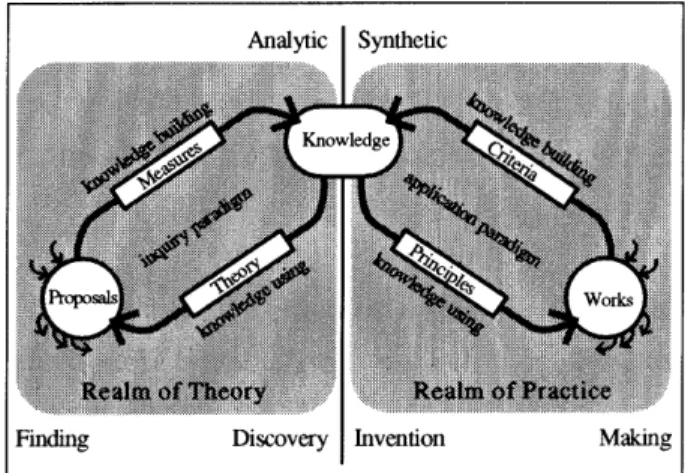
Knowledge
is
generated
and accumulatedthrough
action.Doing
somethingand
judging
the
resultsis
the
general
model.In
Figure
2,
the
process
is
shown as a cyclein
whichknowledge
is
usedto
create works,and
works
are
evaluated
to
build
knowledge.
Knowledge
usingand
knowledge
building
are
not
unstructuredprocesses.
They
are controlledby
chaflnels
that
direct
the
procedures
that
are usedto
do
andjudge
the
work,These
channels
arethe
systemsof conventions and rules under which
the
discipline
operates.They
embodythe
rneasures
and
valuesthat
have
been
empiricallydeveloped
as "waysof
knowing"
asthe
discipline
has
matured.They
mayborrow
from
or
emulate
aspects
of
other
disciplinesi
channels,
but,
in
the
end,they
are specialto
the
discipline
and areproducts
ofits
evolution,The
general
model ofFigure
2
canbe
extendedto
a modelthat
fits
the
dual
natureof
actionssuggested
by
the
analyticlsyntheticdimension
ofthe
map ofdisciplines,
In
Figure
3,
this
is
done
withan
additional
specialization
of
labels.
Figure
2.
A
gncra1ma(lelfor
generatingand accumulatingknowlcdgo.Figuie
3,
Using
and aceumuladng kncAvledgeinthetwe realms・38SPECIAL
ISSUE OFJSSD VoL5 No.2 1997 rtr'l;.\ffvenfgJapanese Society for the Science of Design
NII-Electronic Library Service
JapaneseSociety for the Science of Design
On
the
left
side
of
the
diagram,
the
realmof
theory,
the
model
is
a
paradigm
for
inquiry.
Existing
knowJe{ige,
underthe
direction
oftheary,
is
usedto
generate
prqposals.
Proposals
aretested
withmeasures
that
verifyor
refuteconclusions
to
build
knowledge.
On
the
right
side,the
realm ofpractice,
the
modelforms
aparadigm
fbr
application.Here,
knowie(ige
is
used
through
the
application ofpa'nciples
to
produce
woi:ks.Works
arejudged
for
their
worthas
additionsto
the
knowledge
base
usingthe
crzr'ten'a
ofthe
discipline.
Proposals
and
worksalso
benefit
from
and
contribute
to
ideas
in
other
discipiines.
A
more
complex
diagram
would showinterdisciplinary
relationships.Figure
3
suggeststhese
asdashed
arrows enteringand
leaving
proposals
and works,
Some
Examples
To
test
the
model,
Figure
4
shows
the
sample
disciplines
of
Figure
1
fitted
withtitles
more
expressive
of
their
specialcharacters.
The
darkness
ofthe
background
suggeststhe
skewof
their
primary
activity
to
either
the
realm oftheory
or realm ofpractice--darker
meaning more commitment.It
is
hard
to
find
a set of wordsthat
optimallyfits
adiscipline
--clearly
fits
it
better
than
any other set of words anddifferentiates
it
distinctly
from
otherdisciplines.
Such
nuance requires considerable variety andsubtlety,
Fortunately,
both
are
available
in
English,
and
at
least
an
attempt
can
be
made.
As
an
example,
mathematics,
fbr
aparadigm
ofinquiry,
postulates
propositions
usingaxiomatic
theery
and
proves
them
with reason
to
build
knowledge.
In
application, models arebuilt
with mathematicalIm'ncrPles
and verified withthe
Iaws
of mathematicsto
addto
appliedknowledge.
For
better
or worse,the
other examplesin
Figure
4
similarly attemptto
distinguish
differences
in
procedure,
objects of effort and means ofprocedural
controlthrough
choices of appropriateterms.
Selectively
substituted
wordsbring
the
generalized
model
into
harmony
witha
specific
discipline.
Even
though
notperfect,
they
convey meanings well enoughto
convince,They
also supplydifferent
viewpoints, agoal
fbr
extending our conception ofknowledge-building
processes
in
design.
USING
AND
BUILDING
In
the
acts
of
both
doing
and
judging,
questions
are
asked,
answers
obtained
and
decisions
made.
How
these
arefbrmed
is
the
key
to
usingknowledge
successfullyto
build
newknowledge.
Questions,
answers anddecisions
differ
fundamentally
in
naturefrom
discipline
to
discipline.
They
areframed
from
the
valuesystems
embedded
in
the
disciplines,
Table
1
suggests
someof
the
these
differences
using
the
sample
disciplines.
Note
that
the
differences
are
far
deeper
than
issues
of
content.
They
grow
directly
from
the
basic
valuesthat
create
the
knowledge
structures of adiscipline.
As
aninteresting
derivative
ofthis
comparison,it
is
possible
to
seethrough
these
differences
the
reasonthat
design
is
not science or art,althoughit
shares some ofthe
characteristics ofeach.TNifltr\esvek=g SPECIALISSUEOFJSSD VoL5 No.2 1997 NII-Electronic
NII-Electronic Library Service
Ma出 a血cs Chemis町y
StatUtory
Law
Mecha
皿ca 【恥 即 eenngPaln血9 Produc巳Desゆ
Figure
4
,
Sarnple
disclp
血 es wi 山ntles appropna1e to血elrPurPoses
・
40SPECIAL
IS$UE OF JSSD Vol.
5 No.
2 1997 デ ザ イ ン学研究特粟 号Japanese Society for the Science of Design
NII-Electronic Library Service
JapaneseSociety for the Science of Design
The
forms
ofquestions,
answers anddecisions
alsodiffer
withindisciplines
--between
inquiry
andapplication,
and
between
doing
andjudging.
These
reflectthe
difference
in
purpose
between
inquiry
and
application
andthe
difference
in
process
between
doing
andjudging.
For
comparisonpurposes,
the
processes
of
usingand
building
knowledge
can
be
expressed
as
concatenations
of
question/answer
and
question/decision
mediatedthrough
the
channel
apropriateto
the
process.
Consider
first
the
case ofinquiry,
the
classic and mostthoroughly
discussed
process.
Here,
the
form
of aquestion
in
knowledge
using,
ordoing,
is
theoretical
or
methodological,seeking
to
find
understandingof
a
phenomenon
orprocess
important
to
the
discipline,
An
answeris
fbrmed
as an evaluatableproposal.
For
the
judging
tequiredfor
knowledge
building,
the
form
ofquestion
anddecision
is
derived
from
the
discipline's
valuesystem,
setting aframework
for
judgment
and
measures
to
be
used.On
the
application side,doing
involves
questions
and answers specificto
a workor
project
that
has
been
undertaken,
Questions
searchfor
understanding of entities, relationships and contextual elements withinthe
project.
Answers
embodythe
understandingin
ideas
that
draw
oninsights
--solutions
to
problems,
Judging,
again,
draws
on
the
valuesof
the
discipline
fbr
the
kinds
of
questions
to
ask
and
the
criteria
to
make
decisions.
Questions
thoughtfully
constmcted
usingthese
criteria
exact
decisions
that
determine
awork's contribution
to
the
knowledge
base.
The
contribution,in
this
case,is
the
work or aspects ofit
that,
through
new syntheses, addto
whatis
known
abouthow
the
discipline's
knowledge
canbe
applied.A
DESIGN
PROGRAM
Design
(and
design
education),
though
young
in
comparison
with manydisciplines,
has
had
sufficient
time
to
move
from
fledgling
practice
to
responsible
discipline.
And
the
issues
discussed
here
are
now
being
addressedin
many colleges and universities aroundthe
world,At
the
Institute
ofDesign,
this
selfl examinationprocess
has
led
to
a reconceptualization ofthe
school'sprograms,
its
purpose
withinthe
evolving
discipline,
andits
role as an educational and research unit ofits
university,Illinois
Institute
ofTechnology.
Table1.DifferencesinMeasures
DemainDiscilme
MeasuresSourceofValues
ScicnccMathcmatics Chemistry trtterfalleeoeffectfmmut conrpletqltmu)mplete tmeffalse reasonbgicphysicalworkl oorfuctfmoorToct righthymgworkskloein'twnk TechnelogyMachanicallhgheednsripmsbedwmb,lworkphysicalworld brtif/icia1word laWStatukuyLawtswstfifuIma'UStwfu righLimg socialcontrnct' ArtsPaintingk2x:Pinwafu1
oppmpmcu1ture
DesignPreductDesignbedertwsemuWdi)esi'teewotkstdDesn'twnkcultuleartirrculw{idFigure5.Mergingand repasitioning theIhstituteof
Design'sprograms.
f・ifi)\-verek- SPECtAL ISSUE OF JSSD VoL5 No.2 1997
41
NII-Electronic Library Service
Over
the
last
nine
years,
the
Institute
ofDesign
has
moved
organizationally
from
a
department
ofthe
College
ofArchitecture,
Planning
andDesign
to
a college-level unit ofthe
university, movedgeographically
to
newquarters
in
the
university's researchinstitute,
and completely regeneratedits
graduate
programs.
Since
the
fall
of1991,
the
schoolhas
offeredtwo
graduate
programs,
one aprofessional,
terminal-degree,
Master
of
Desigri
(MDes)
program,
andone
a researchprogram
withIVfaster
ofSciencein
Desigi]
(LILtfS)
andRhD
degrees.
Matching
the
Map
With
the
insights
ofthe
map ofdisciplines
in
mind,the
newprograms
mergethe
previous
programs
andposition
the
Institute
ofDesign's
total
offeringin
abetter
balance
ofinquiry
and
application.The
newprograms
alsointegrate
design
specialtiesto
create courses more appropriatefbr
today's
needs(Figure
5).
Product
Design
and
Communication
Design
from
the
old
program
are now mergedinto
a
single
design
program
withtwo
tracks.
This
wasdone
to
recognize
the
changing
nature
of
products,
communications,systems and services
that
increasingly
actinterdependently,
mixhardware
and software as well asproducts
andinfbrmation
systems, and aredesigned
by
interdisciplinary
teams.
Replacing
the
previous
program
organized verticallyinto
Product
Design
andCommunication
Design,
is
a newhorizontal
"track''division:
Design
Planning,
concerned withissues
ofconcept,process,
program
andplanning;
andHuman-Centered
Design,
concerned withdetails,
human
factors,
artifact anddeyelopment,
Both
tracks
deal
withcommunications,
products,
services and systems.In
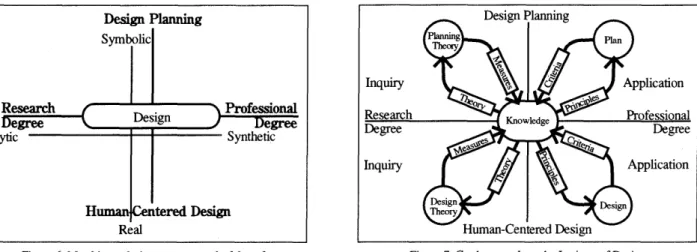
Figure
6,
a new set of axes representingthe
degrees
andtracks
ofthe
newprogram
is
matchedto
the
map of
disciplines.
Matching
the
Analytic/Synthetic
axisis
an axisfbr
the
degrees:
researchdegrees
for
inquiry,
aprofessional
degree
for
application.Matching
the
Symbolic/Real
axisis
the
axis
for
tracks:
Design
Planning
concerned
with
the
concept-buildingaspects
of
design,
Human-Centered
Design
concerned
withthe
specifics ofform
andfunction.
Extending
the
general
modelfor
knowledge
using andknowledge
building
to
the
new axis systemproduces
afbur-lobed
model(Figure
7).
The
fbur
quadrants
ofthe
map articulatethe
purposes
of
design
Analytic
DeslgnPlannirtg
Symbolic
Resear=hegree'
Prnfesslomi
Design
gree
Synthetic
ytic
HumanteredDesign
Real
Figure
6.
Matchingadesignp[ogram
totheMap ofDisciplines.
Figure
7.
Graduate
studyat
the
Institute
efDesign.
42SPECIAL
ISSUE OF JSSD VoL5 Ne,2 1997 7iflv\asSfipteJapanese Society for the Science of Design
NII-Electronic Library Service
JapaneseSociety for the Science of Design
inquiry
and application clearlyfor
the
two-track
program.
Design
Rlannjng
Reseatch
studentsinvestigate
and
develop
theory,
methods andprocesses
for
planning
and
concept
formation.
Human-Centered
Research
studentsinvestigate
and
develop
theory,
methods
and
process
fbr
the
detailed
design
of systemsand services and
their
incorporated
products
and communications.Design
Rlanning
Ilrofessional
students applythe
tools
ofdesign
planning
to
the
creation
of
design
plans
for
institutions
andindustry.
Human-dentered
Design
Ilrofessional
students applythe
tools
ofhurnan-centered
design
to
problems
of systemsand services with
their
associatedproducts
and communications.
DESIGN
RESEARCH
What
light
does
all
of
this
shed
on
the
subject
ofdesign
research?For
abeginning,there
are severalgeneral
insights.
Some
General
Insights
First,
research should notbe
thought
of asbeing
limied
in
form,
in
particular,
to
the
classicalforms
ofscholarly and scientific research.
Those
forms
of research, asprocesses
ofknowledge
using andbuilding
in
the
service
of
inquiry,
are
practiced
by
nearly
all
disciplines,
but
to
greater
or
lesser
extents,
Knowledge
using andbuilding
for
the
purposes
of applicationis
an equallyproductive
process,
adding
to
a
discipline's
knowledge
base
through
the
contribution of worked examples.A
corollarylesson
from
this
reflection
is
that
balance
maybe
useful.Second,
the
processes
ofknowledge
using andbuilding
arefundamentally
the
samefor
inquiry
andapplication.
The
differences
are morein
the
purpose
of
the
activity.
In
both
cases
whatis
known
is
used
to
generate
something newthat
willprovide
answersto
questions
inspired
by
afelt
need.In
the
case
of
inquiry,
the
needis
fbr
deeper
understandingof
the
subjects of adiscipline;
in
the
case of application,the
need
is
for
artifacts andinstitutions
that
employthe
knowledge
ofthe
discipline
more successfu11y.Third,
determinations
of value mustbe
understoodto
derive
from
the
valuesystem
underlying adiscipline.
The
kinds
ofquestions
framed
by
onediscipline
are not necessarilythose
of another.It
is
counterproductive, misleadingand
a
mistake,for
example,
to
attempt
to
determine
''rightness"or
''truthfulness"
within
a
discipline
if
these
are notthe
relevantkinds
ofquestions
to
ask.Fourth,
aposition
far
to
the
left
orright
onthe
Map
ofDisciplines
opens special opportunitiesfor
kinds
ofresearch appropriate
to
the
other
side.
Disciplines
skewed
to
the
analytic
side
probably
have
unexplored
opportunities
for
knowledge
building
through
applications.Disciplines
onthe
synthetic
side
should
look
to
areas
ofinquiry
--frequently
the
tools
ofthe
discipline
(theory,
methods,process)
are worthy subjectsfbr
research.Fifth,
withinthe
processes
offraming
questions
and constructing answersor
decisions
lies
the
heart
of
good
research and, ultimately,the
basis
for
its
quality.
Questions
sharplyhoned
againstthe
contextof
adiscipline's
valuesystem
require
answers
similarly
crafted
and
decisions
equally
wellconstructed.
9if-f;.\orveklg SPECIALIssUEOFJSsD VoL5 No.2 1997
43
NII-Electronic Library Service
Creativity,
whetherdiscovery
orinvention,
is
inspired
by
good
questions,
Recommendations
fbr
Design
The
design
disciplines
are onthe
synthetic
side ofthe
Map
ofDisciplines,
far
enough
to
the
right
that
their
claims
to
accomplishments
in
matters
of
inquiry
are
not
extensive.
This
suggests
a
movement
correction
to
the
left
for
balance.
Several
other recommendations canbe
made;those
following
areprimarily
fbr
design
education,but
adiscipline
includes
practitioners,
educators, researchers and otherassociates with specialized responsibilities, so
there
areimplications
for
many,including
those
responsible
fbr
collecting anddisseminating
design
knowledge.
e
Distinguish
between
research andprofessional
advanced education.Graduate
studies shouldbe
formalized
to
recognizethe
difference
between
studiesto
achieve mastery ofthe
latest
and mostsophisticated
design
theory,
methods andprocess
(application),
and studiesto
create newdesign
theory,
methods and
process
(inquiry).
Degree
titles
can recognizethese
distinctions.
e
Institute
more structuredprograms
of advanced study.Design
has
reached alevel
of maturity at whichgraduate
courses canbe
taught
with realinformation
content.The
masterlapprentice model of an advanceddegree
course requiring only alonger,
rnorethorough
project
is
nolonger
adequate.Masters
anddoctoral
programs
withtaught-course
components
are
feasible
and
necessary,
e
Define
areas ofdesign
inquiry
and applicationfor
which researchis
desired
and establishfunded
centers and
programs
to
accomplishthe
research.Design
researchhas
majorpotential
valuein
a number of content areas--transportation,
health
care,information
access,learning,
work, urban systems, anddesign
processes
--to
namejust
a
few,
eDifferentiate areas of
design
specialty and concentrate resources.Schools
with specialized researchprograms
can assemble equipment,financial
andhuman
resources synergisticallyto
do
better
workthan
can
be
done
withthe
same resources spread among many.eSeek out
faculty
with research experiencefrom
disciplines
relatedto
design,
To
prime
the
pump,
faculty
membersfrom
otherfields
who are sympatheticto
the
goals
ofdesign
canbring
general
researchattitudes,
procedures
and rigorto
the
discipline.
A
few
such
interdis,ciplinary
memberswill
notdilute
a
design
program,
and
their
fresh
ideas
may welllead
to
usefu1evolutions
in
design
research.e
Initiate
studies ofthe
philosophy
of
design.
Just
as
studies
of
the
philosophy
of
science,
history,
religion,etc,
seek
to
understand
the
underpinning
values,
structures
and
processes
within
these
systems
of
knowledge
building
and
using,there
needto
be
studies
ofthe
natureof
design.
The
design
disciplines
needthoughtfu1
study
of
how
design
proposals
and
works areproduced
and evaluated.Measures
and criteria as well asprocedures
for
use andjudgment
shouldhave
the
same attentiongiven
to
scientific method.What
is
the
analogousdesign
method?44SPECIALISSUEOFJSSD
VeL5 No,2 1997 f'v'(tz\lffiagkSJapanese Society for the Science of Design
NII-Electronic Library Service
JapaneseSociety for the Science of Design
eExtend
the
rneansfor
communicatingdesign
knowledge.
Most
analytically orienteddisciplines
have
extensive
infrastructures
of
conferences,
symposia,journals,
text
book
publishing
and other communicationsystems
that
attract,
collect anddistribute
developing
knowledge.
These
also act as recognition systems andcreate
incentives
fbr
young
faculty
membersto
produce
work of value.e
Inculcate
knowledge-using
more effectivelyin
the
question-asking
phases
ofdesign
applications.Design
prejects
that
have
better
thought-out
beginnings
willhave
better
thought-out
endings and,therefbre,
willbe
better
candidates
for
building
the
experiential
knowledge
base,
CONCLUSIONS
Stepping
awayfrom
the
term
researchallows
it
to
be
seen
more
clearly.
Asking
instead
how
knowledge
is
built,
widensthe
focus.
With
abroader
view,it
is
possible
to
seehow
activities,
seemingly
opposed,
actually work
together
to
supportthe
growth
ofknowledge.A
knowledge-using/knowledge-building
model resolvesthe
"whodoes
research?'b
debate.
Khowledge
building
is
done
in
different
ways, allof which contribute.In
recognition ofthis,
the
Institute
ofDesign
has
tailored
its
graduate
programs
to
research andprofessional
degrees
(inquiry
and applicationdimensions)
paired
withtracks
fbr
design
planning
andhuman-centered
design
(symbolic
and realdimensions).
Knowledge
using andbuilding
arefundamental
to
the
tracks
in
both
pregrams.
The
interest
nowbeing
shown
in
design
researchis
timely.
Whether
its
inspiration
is
defensive
ijustifying
educational
budgets),
competitive(contributing
to
an educational orindustrial
advantage), or simplyidealistic
(bringing
the
discipline
to
maturity),the
impact
willbe
the
same.
The
health
of
our
discipline
will
be
well servedby
this
needed attentionto
its
fOundations.
T-ifrf?\asenlg SPECtAL tSSUE OF JSSD VoL 5 No. 2 1997 NII-Electronic