Doctral Dissertation
Characterization and Isomerization of (all-E)-Lycopene Derived from
Natural Origin
Masaki Honda
Research & Development Division, Kagome Co., Ltd., Nishitomiyama, Nasushiobara, Japan
February 2016
Graphica abstract
Abstract
Characterization of (all-E)- and (15Z)-lycopene purified from natural origin, and
isomerization of (all-E)-lycopene to Z-isomers by heating, photoirradiation, and catalyst
were demonstrated.
A large amount of (all-E)-lycopene was successfully purified from tomato paste using
an improved method that included a procedure to wash crystalline powder with acetone.
The melting point of (all-E)-lycopene was determined to be 173.2 °C by differential
scanning calorimetry (DSC) measurements. Bathochromic shifts were observed in the
absorption maxima of all solvents tested (at most a 36 nm shift for λ2 in carbon
disulfide, as was observed in hexane) and were accompanied by absorbance decreases,
namely, a hypochromic effect, showing a higher correlation between the position and
the intensity of the main absorption bands. This bathochromic shift was dependent upon
the polarizability of the solvent rather than its polarity. The structure of (all-E)-lycopene
in CDCl3 and C6D6 was identified on the basis of one- and two-dimensional nuclear
magnetic resonance (NMR) spectra, including 1H and 13C NMR, homonuclear
correlation spectroscopy (1H-1H COSY), heteronuclear multiple-quantum coherence
(HMQC), and heteronuclear multiplebond connectivity (HMBC).
(15Z)-Lycopene was prepared by thermal isomerization of (all-E)-lycopene derived
from tomatoes, and isolated by using a series of chromatographies. The fine red
crystalline powder of (15Z)-lycopene was obtained from 556 mg of (all-E)-lycopene
with a yield of 0.6 mg (purity: reversed-phase HPLC, 97.2%; normal-phase HPLC,
≥99.9%), and 1H and 13C NMR spectra of the isomer were fully assigned. Moreover, the
occurrence and availability of the 15Z-isomer were discussed on the basis of the
calculation method.
Thermal isomerization of (all-E)-lycopene was investigated in various organic
solvents. Isomerization ratios to the Z-isomers of lycopene in CH2Cl2 and CHCl3 over
24 h were calculated to be 19.7% and 11.4% at 4 °C and 77.8% and 48.4% at 50 °C,
respectively. In CH2Br2, more than 60% was attained in the first several hours,
independent of temperature. The predominant Z-isomers obtained thermally, (9Z)- and
(13Z)-lycopene, were purified and their absorption maxima and molar extinction
coefficients in hexane were determined for the first time. Absorption values at 460 nm
were also measured for both Z-isomers along with (all-E)-lycopene to accurately
evaluate their concentrations by HPLC analysis. This approach successfully revealed
that (13Z)-lycopene formed predominantly in benzene or CHCl3 at 50 °C; in contrast,
the 5Z-isomer was preferentially obtained in CH2Cl2 or CH2Br2.
Photoisomerization of (all-E)-lycopene to the corresponding Z-isomers was
investigated under visible to middle-infrared light irradiation in the presence of several
sensitizers, including edible ones. Highly purified (all-E)-lycopene from tomato paste
was isomerized to Z-isomers to the extent of 46.4–57.4% after irradiation with the
sensitizers for 60 min in acetone, in which a thermodynamically-stable isomer of
(5Z)-lycopene was predominantly generated, while kinetically-preferable (9Z)- and
(13Z)-lycopene were dominant without sensitizer. Examination of the time course of
photoisomerization demonstrated that the highest isomerization efficiency (80.4%) was
attained using erythrosine as the sensitizer under 480–600 nm light irradiation in hexane
for 60 min, a protocol which successfully suppressed the decomposition of lycopene.
(5Z)-Lycopene, reported as a more bioavailable isomer, was again predominantly
produced with erythrosine and rose bengal in each solvent.
Catalytic isomerization of (all-E)-lycopene to Z-isomers using iron(III) chloride was
investigated and optimized under various conditions of solvents, concentrations of
iron(III) chloride, and reaction temperatures. The total contents of Z-isomers converted
were higher in the order of CH2Cl2 (78.4%) > benzene (61.4%) > acetone (51.5%) >
ethyl acetate (50.8%) at 20 °C for 3 h using 1.0 × 10⁻³ mg/mL iron(III) chloride for 0.1
mg/mL (all-E)-lycopene. However, the decomposition of lycopene was markedly
accelerated in CH2Cl2. As the concentration of catalyst increased in acetone, the
Z-isomerization ratio of lycopene increased to more than 80%, followed by rapid
decomposition of lycopene to undetectable levels using > 4.0 × 10⁻³ mg/mL iron(III)
chloride with the above concentration of (all-E)-lycopene. Finally, greater isomerization
(79.9%) was attained at 60 °C in acetone for 3 h in the presence of 1.0 × 10⁻³ mg/mL
iron(III) chloride, largely without decomposition of lycopene (remaining ratio of total
amount of lycopene isomers after the reaction, 96.5%).
As a method without use of organic solvents and food additives, thermal
isomerization of (all-E)-lycopene in edible vegetable oils (perilla, linseed, grape seed,
soybean, corn, sesame, rapeseed, rice bran, safflower seed, olive, and sunflower seed
oil) was also investigated. Purified (all-E)-lycopene from tomatoes was converted to
Z-isomers in the range of 44.8 to 58.8% content, and the remaining ratio of total amount
of lycopene isomers without decomposition were ranged from 38.8 to 79.6% after
heating at 100 °C for 1 h in the vegetable oils. Both of the values were exceedingly high
in sesame oil; 58.8% of total Z-isomers content and 78.3% of remaining lycopene. In
particular, (5Z)-lycopene which has higher bioavailability and antioxidant capacity as
well as greater storage stability among the Z-isomers was notably increased in that oil;
approximately threefold higher than the average of the other vegetable oils.
Contents
Graphical abstract
... iAbstract
... iiContents
... viAbbreviations
... xiChapter 1 General introduction
... 11.1. Background ... 2
1.2. Research objectives ... 6
1.3. References ... 8
Chapter 2 Purification and characterization of (all-E)-lycopene from tomato paste
... 142.1. Table of contents ... 15
2.2. Introduction ... 15
2.3. Materials and methods ... 16 2.3.1. Chemicals
2.3.2. Extraction and purification of (all-E)-lycopene from tomato paste 2.3.3. UV−vis, FTIR, mass, and NMR spectroscopic analyses
2.3.4. DSC analysis 2.3.5. HPLC analysis
2.3.6. Computational analysis
2.4. Results and discussion ... 19
2.4.1. Physical Properties of (all-E)-Lycopene 2.4.2. NMR Assignment of (all-E)-Lycopene 2.5. Reference ... 28
Chapter 3 Isolation and characterization of (15Z)-lycopene thermally generated from a natural source
... 323.1. Table of contents ... 33
3.2. Introduction ... 33
3.3. Materials and methods ... 35
3.3.1. General 3.3.2. Preparation of (all-E)-lycopene 3.3.3. Thermal isomerization of lycopene 3.3.4. Isolation of (15Z)-lycopene 3.3.5. NMR spectroscopy 3.3.6. Computational analysis 3.4. Results and discussion ... 39
3.4.1. Isolation of (15Z)-lycopene thermally generated from a tomato sample 3.4.2. Characterization of (15Z)-lycopene by NMR spectroscopy 3.4.3. Computational simulation of isomerization of (all-E)-lycopene to (15Z)-lycopene and other mono-Z-isomers. 3.5. Reference ... 54
Chapter 4
Effects of solvent and temperature on E/Z isomerization of
(all-E)-Lycopene
... 584.1. Table of contents ... 59
4.2. Introduction ... 59
4.3. Materials and methods ... 60
4.3.1. Chemicals 4.3.2. Isomerization of (all-E)-lycopene 4.3.3. HPLC analysis 4.3.4. Isolation and identification of (9Z)- and (13Z)-lycopene 4.3.5. UV–vis and NMR spectroscopic analyses of (all-E)-, (9Z)-, and (13Z)-lycopene 4.3.6. Evaluation of isomerization rate 4.4. Results and discussion ... 64
4.4.1. General profile of the thermal isomerization of (all-E)-lycopene 4.4.2. Purification and characterization of (9Z)- and (13Z)-lycopene 4.4.3. Thermal isomerization of lycopene and relevant solvent effects 4.5. Reference ... 80
Chapter 5 Photosensitized E/Z isomerization of (all-E)-lycopene aiming at practical applications
... 845.1. Table of contents ... 85
5.2. Introduction ... 85
5.3. Materials and methods ... 86
5.3.1. Chemicals 5.3.2. Preparation of (all-E)-lycopene. 5.3.3. Photosensitized isomerization of (all-E)-lycopene 5.3.4. HPLC analysis 5.4. Results and discussion ... 88
5.4.1. Photoisomerization with various sensitizers
5.4.2. Time course of the photosensitized isomerization of lycopene and solvent effects on the content of Z-isomers
5.5. Reference ... 97
Chapter 6 Enhanced E/Z isomerization of (all-E)-lycopene by employing iron(III) chloride as a catalyst
... 1006.1. Table of contents ... 101
6.2. Introduction ... 101
6.3. Materials and methods ... 102
6.3.1. Chemicals 6.3.2. E/Z isomerization of (all-E)-lycopene using iron(III) chloride 6.3.3. HPLC analysis 6.3.4. Evaluation of the decomposition rate 6.4. Results and discussion ... 104
6.4.1. Profile of isomerization of (all-E)-lycopene to Z-isomers in the presence of iron(III) chloride 6.4.2. Effect of solvent on isomerization of (all-E)-lycopene with iron(III) chloride 6.4.3. Dependence of iron(III) chloride concentration on isomerization of (all-E)-lycopene 6.4.4. Effect of reaction temperature on isomerization of (all-E)-lycopene with iron(III) chloride and a possible isomerization process 6.5. Reference ... 118
Chapter 7
Vegetable oil-mediated thermal isomerization of
(all-E)-lycopene: facile and efficient production of
Z-isomers
... 1217.1. Table of contents ... 122
7.2. Introduction ... 122
7.3. Materials and methods ... 123
7.3.1. Chemicals 7.3.2. Purification of (all-E)-lycopene 7.3.3. Thermal isomerization of purified (all-E)-lycopene in vegetable oils 7.3.4. HPLC analysis 7.4. Results and discussion ... 126
7.5. Reference ... 135
Chapter 8 Overall conclusion
... 138Acknowledgements
... 142Publications
... 144Abbreviations
B3LYP: Becke-3-Lee-Yang-Parr
CCl4: tetrachloride
C6D6: benzene-d6
CDCl3: chloroform-d
CH2Br2: dibromomethane
CH2Cl2: dichloromethane
CHCl3: chloroform
DFT: density-functional theory
DIPEA: N,N-diisopropylethylamine
DSC: differential scanning calorimetry
Erythrosine: erythrosine B
FA: fatty acid
FAB: fast-atom bombardment
FTIR: fourier transform infrared
1H-1H COSY: homonuclear correlation spectroscopy
HMBC: heteronuclear multiplebond connectivity
HMHU: (3E,5E,7E,9E,11E,13E,15E,17E,19E,21E,23E)-3,7,11,16,20,24-
hexamethylhexacosa-3,5,7,9,11,13,15,17,19,21,23-undecaene
HMQC: heteronuclear multiple-quantum coherence
HPLC: high-performance liquid chromatography
HRMS: high-resolution mass spectrum
IV: iodine value
MB: methylene blue
MTBE: methyl tert-butyl ether
ND: not detected
NMR: nuclear magnetic resonance
NOE: nuclear Overhauser effect
PTFE: polytetrafluoroethylene
RB: rose bengal
SD: standard deviation
SV: saponification value
SE: standard error
TMS: tetramethylsilane
TMTU: (2Z,4E,6E,8E,10E,12E,14E,16E,18E,20E,22Z)-6,10,15,19-tetramethytetracosa-
2,4,6,8,10,12,14,16,18,20,22-undecaene
TS: transition state
UV–vis: ultraviolet–visible
UZ: unidentified Z-isomer of lycopene
Chapter 1
General introduction
1.1. Background
Lycopene is a well-known carotenoid found abundantly in vegetables and fruits with
a red color such as tomatoes, red carrots [1], watermelons, and gac (Momordica
cochinchinensis) [2] as well as in microorganisms such as Dunaliella salina [3],
Chlorella spp. [4,5], and Blakeslea trispora [6,7]. Lycopene, like other carotenoids, is
responsible for the characteristic bright color of these organisms and plays a protective
role against oxidative stress [8–10]. The natural benefits of lycopene have been applied
not only to food and dietary supplements as edible colorants and antioxidants, but also
to medical approaches to cancer and arteriosclerosis prevention [11–13], taking
advantage of its physiological properties and biocompatibility. These useful functions of
lycopene, the molecular formula of which is C40H56, have been attributed to its chemical
structure containing many unsaturated bonds in which eleven double bonds are
conjugated and more effectively allow the absorption of relatively long-wavelength
light and quench singlet oxygen. Therefore, many researchers have studied this useful
pigment, and published excellent reports from the middle of the 20th century [14–19].
However, these studies were performed with lycopene prepared from different origins
and with different purification degrees, which could lead to a misunderstanding due to
different values for basic physicochemical properties. Under these circumstances, first
of all, we performed an extraction of (all-E)-lycopene (Figure 1A) with higher purity
from a tomato paste, and determined its physical and chemical properties including
some spectrophotometric measurements.
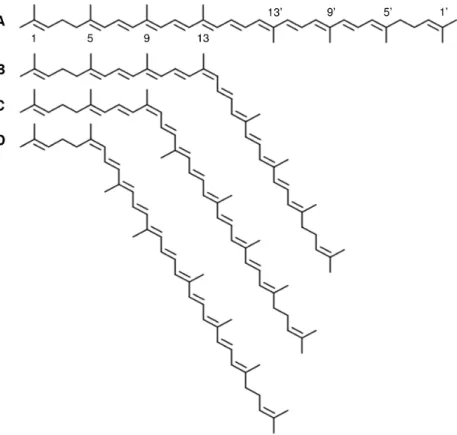
The structural assignments and UV–vis spectral features of (5Z)-, (9Z)- and
(13Z)-lycopene (Figure 1B–D), the predominant Z-isomers contained in processed
tomato products [20], were demonstrated through the successful acquisition of highly
purified preparations of the isomers by using a series of chromatographies [21].
Figure 1. Chemical structures of the predominant isomers of lycopene contained in processed tomato products: (A) (all-E)-lycopene; (B) (13Z)-lycopene; (C) (9Z)-lycopene; (D) (5Z)-lycopene.
On the other hand, (15Z)-lycopene (Figure 2) which would be generated from
(all-E)-lycopene by geometric isomerization was considered to be a putative isomer for
more than half a century, whereas a possible (15Z)-lycopene was synthesized via a
Wittig reaction [22,23]. In the present study, we revealed, for the first time, the
occurrence of (15Z)-lycopene from natural sources during a heat treatment by isolating
and identifying the isomer on the basis of more sophisticated chromatographic and
spectroscopic methods, respectively. These characterization of (all-E)-lycopene and the
Z-isomers is considered important to attain depth the discussions about isomerization of
lycopene.
Figure 2. Chemical structure of (15Z)-lycopene. (15Z)-Lycopene in this study was purified from a mixture of lycopene isomers, which was prepared by heating (all-E)-lycopene of a tomato origin.
Although lycopene has a large number of geometric isomers caused by E/Z
isomerization at arbitrary sites within the 11 conjugated double bonds (Figure 1), most
lycopene is present in the all-E-configuration (Figure1A) in plants, representing about
80–97% of total lycopene in tomatoes and related products [20]. However, in the human
body, such as blood and prostate tissue, more than 50% of total lycopene exists in the
Z-form (Figure 1B–D) [20,24–29]. This suggests that Z-isomers of lycopene are more
bioavailable than the all-E-configuration. In fact, according to experiments using a
Caco-2 human intestinal cell model [30] and lymph cannulated ferrets [29], the
bioavailability of Z-isomers of lycopene was shown to be significantly greater than that
of the all-E-configuration. Also in humans, the intake of tomato sauce rich in Z-form
lycopene brought about a marked increase of plasma lycopene concentration, compared
with one rich in all-E-isomer [31]. In addition, Z-isomers of lycopene have been
reported to show a higher antioxidant capacity than the all-E configuration [32–34]. As
such, it is conceivable that intake of Z-isomers of lycopene could be preferable for
health reasons because of their good bioavailability and functionality, and it is therefore
important to gain a better understanding of the isomerization of (all-E)-lycopene to
Z-isomers and to develop the efficient methods for this reaction. Since global trend is
toward natural and additive-free for foods and drinks, and it is required to produce more
safely and accurately lycopene preparations rich in Z-forms without those chemical
agents, we developed not only the isomerization methods using additives and organic
solvents putting importance on efficiency but also additive- and organic solvent-free
isomerization method. Namely, we demonstrated the isomerization of (all-E)-lycopene
by heating, photoirradiation, and catalyst in organic solvent putting importance on
efficiency, and heating in edible vegetable oils putting importance on natural,
respectively, in this study.
1.2. Research objectives
This study focuses on characterization of (all-E)- and (15Z)-lycopene purified from
natural origin, and isomerization of (all-E)-lycopene to Z-isomers. First of all we aimed
to establish a purification method of (all-E)-lycopene from tomato paste, and acquired
its chemical and physical properties to deepen the understanding of the E/Z
isomerization reaction of lycopene in Chapter 2. In the same way, (15Z)-lycopene which
has never identified from natural origin was purified and characterized in Chapter 3.
Then we aimed to establish isomerization methods of (all-E)-lycopene to Z-isomers,
which were focused on both efficiency (Chapter 4–6) and natural (Chapter 7). Detailed
objectives of this study as follows:
♦ To examine the fundamental data such as the melting point, UV–vis, IR, and NMR
spectra of purified (all-E)-lycopene from tomato paste (Chapter 2).
♦ To characterize (15Z)-lycopene which has never identified from natural origin by
spectral methods such as UV–vis, 1H, and 13C NMR spectroscopy (Chapter 3).
♦ To develop the efficient isomerization method of (all-E)-lycopene to Z-isomers by
heating, photoirradiation, and catalyst in organic solvent (Chapter 4–6).
♦ To develop the additive- and organic solvent-free isomerization method of
(all-E)-lycopene to Z-isomers by heating in edible vegetable oils (Chapter 7).
1.3. References
[1] Horvitz, M. A., Simon, P. W., Tanumihardjo, S. A. Lycopene and β-carotene are
bioavailable from lycopene ‘red’ carrots in humans. Eur. J. Clin. Nutr. 2004, 58, 803–
811.
[2] Aoki, H., Kieu, N. T., Kuze, N., Tomisaka, K., Van Chuyen, N. Carotenoid
pigments in GAC fruit (Momordica cochinchinensis SPRENG). Biosci. Biotechnol.
Biochem. 2002, 66, 2479–2482.
[3] Orset, S. C., Young, A. J. Exposure to low irradiances favors the synthesis of 9-cis
β, β-carotene in Dunaliella salina (Teod.). Plant Physiol. 2000, 122, 609–618.
[4] Ishikawa, E., Abe, H. Lycopene accumulation and cyclic carotenoid deficiency in
heterotrophic Chlorella treated with nicotine. J. Ind. Microbiol. Biotechnol. 2004, 31,
585–589.
[5] Renju, G. L., Muraleedhara Kurup, G., Saritha Kumari, C. H. Anti-inflammatory
activity of lycopene isolated from Chlorella marina on type II collagen induced arthritis
in Sprague Dawley rats. Immunopharmacol. Immunotoxicol. 2013, 35, 282–291.
[6] Estrella, A., López-Ortiz, J. F., Cabri, W., Rodríguez-Otero, C., Fraile, N., Erbes, A.
J., Espartero, J. L., Carmona-Cuenca, I, Chaves, E., Muñoz-Ruiz, A. Natural lycopene
from Blakeslea trispora: all-trans lycopene themochemical and structural properties.
Thermochim. Acta 2004, 417, 157–161.
[7] López-Nieto, M. J., Costa, J., Peiro, E., Méndez, E., Rodríguez-Sáiz, M., de la
Fuente, J. L., Cabri, W., Barredo, J. L. Biotechnological lycopene production by mated
fermentation of Blakeslea trispora. Appl. Microbiol. Biotechnol. 2004, 66, 153–159.
[8] Di Mascio, P., Kaiser, S., Sies, H. Lycopene as the most efficient biological
carotenoid singlet oxygen quencher. Arch. Biochem. Biophys. 1989, 274, 532–538.
[9] Stahl, W., Sies, H. Antioxidant activity of carotenoids. Mol. Aspects Med. 2003, 24,
345–351.
[10] Cantrell, A., McGarvey, D. J., Truscott, T. G., Rancan, F., Böhm, F. Singlet
oxygen quenching by dietary carotenoids in a model membrane environment. Arch.
Biochem. Biophys. 2003, 412, 47–54.
[11] Dahan, K., Fennal, M., Kumar, N. B. Lycopene in the prevention of prostate
cancer. J. Soc. Integr. Oncol. 2008, 6, 29–36.
[12] Gann, P. H., Ma, J., Giovannucci, E., Willett, W., Sacks, F. M., Hennekens, C. H.,
Stampfer, M. J. Lower prostate cancer risk in men with elevated plasma lycopene
levels: results of a prospective analysis. Cancer Res. 1999, 59, 1225–1230.
[13]Palozza, P., Parrone, N., Simone, R. E., Catalano, A. Lycopene in atherosclerosis
prevention: an integrated scheme of the potential mechanisms of action from cell
culture studies. Arch. Biochem. Biophys. 2010, 504, 26–33.
[14] Zechmeister, L., LeRosen, A. L., Schroeder, W. A., Polgár, A., Pauling, L. Spectral
characteristics and configuration of some stereoisomeric carotenoids including
prolycopene and pro-γ-carotene. J. Am. Chem. Soc. 1943, 65, 1940–1951.
[15] Davis, W. B. Preparation of lycopene from tomato paste for use as a
spectrophotometric standard. Anal. Chem. 1949, 21, 1226–1228.
[16] Karrer, P., Jucker, E. Carotenoids, Elsevier: New York and Amsterdam, 1950.
[17] Surmatis, J. D., Ofner, A. Total synthesis of spirilloxanthin, dehydrolycopene, and
1,1'-dihydroxy-1,2,1',2'-tetrahydrolycopene. J. Org. Chem. 1963, 28, 2735–2739.
[18] Manchand, P. S., Rüegg, R., Schwieter, U., Siddons, P. T., Weedon, B. C. L.
Carotenoids and related compounds. Part XI. Syntheses of δ-carotene and ε-carotene. J.
Chem. Soc. 1965, 2019–2026.
[19] Davis, B. H. Carotenoid. In Chemistry and Biochemistry of Plant Pigments;
Goodwin, T. W., Ed.; Academic Press: London, 1976; pp 38–165.
[20] Schierle, J., Bretzel, W., Bühler, I., Faccin, N., Hess, D., Steiner, K., Schüep, W.
Content and isomeric ratio of lycopene in food and human blood plasma. Food Chem.
1997, 59, 459–465.
[21] Honda, M., Takahashi, N., Kuwa, T., Takehara, M., Inoue, Y., Kumagai, T.
Spectral characterization of Z-isomers of lycopene formed during heat treatment and
solvent effects on the E/Z isomerization process. Food Chem. 2015, 171, 323–329.
[22] Hengartner, U., Bernhard, K., Meyer, K., Englert, G., Glinz, E. Synthesis,
isolation, and NMR-spectroscopic characterization of fourteen (Z)-isomers of lycopene
and of some acetylenic didehydro- and tetradehydrolycopenes. Helv. Chim. Acta 1992,
75, 1848–1865.
[23] Isler, O., Gutmann, H., Lindlar, H., Montavon, M., Rüegg, R., Ryser, G., Zeller, P.
Synthesen in der Carotinoid-Reihe. 6. Mitteilung. Synthese von Crocetindialdehyd und
Lycopin. Helv. Chim. Acta 1956, 39, 463–473.
[24] Schieber, A., Carle, R. Occurrence of carotenoid cis-isomers in food:
technological, analytical, and nutritional implications. Trends Food Sci. Technol. 2005,
16, 416–422.
[25] Stahl, W., Schwarz, W., Sundquist, A. R., Sies, H. cis–trans Isomers of lycopene
and β-carotene in human serum and tissues. Arch. Biochem. Biophys. 1992, 294, 173–
177.
[26] Clinton, S. K., Emenhiser, C., Schwartz, S. J., Bostwick, D. G., Williams, A. W.,
Moore, B. J., Erdman, J. W., Jr. cis-trans Lycopene isomers, carotenoids, and retinol in
the human prostate. Cancer Epidemiol. Biomarkers Prev. 1996, 5, 823–833.
[27] Richelle, M., Sanchez, B., Tavazzi, I., Lambelet, P., Bortlik, K., Williamson, G.
Lycopene isomerisation takes place within enterocytes during absorption in human
subjects. Br. J. Nutr. 2010, 103, 1800–1807.
[28] Richelle, M., Lambelet, P., Rytz, A., Tavazzi, I., Mermoud, A.-F., Juhel, C.,
Borel, P., Bortlik, K. The proportion of lycopene isomers in human plasma is modulated
by lycopene isomer profile in the meal but not by lycopene preparation. Br. J. Nutr.
2012, 107, 1482–1488.
[29] Boileau, A. C., Merchen, N. R., Wasson, K., Atkinson, C. A., Erdman, J. W., Jr.
cis-Lycopene is more bioavailable than trans-lycopene in vitro and in vivo in
lymph-cannulated ferrets. J. Nutr. 1999, 129, 1176–1181.
[30] Failla, M. L., Chitchumroonchokchai, C., Ishida, B. K. In vitro micellarization
and intestinal cell uptake of cis isomers of lycopene exceed those of all-trans lycopene.
J. Nutr. 2008, 138, 482–486.
[31] Unlu, N. Z., Bohn, T., Francis, D. M., Nagaraja, H. N., Clinton, S. K., Schwartz,
S. J. Lycopene from heat-induced cis-isomer-rich tomato sauce is more bioavailable
than from all-trans-rich tomato sauce in human subjects. Br. J. Nutr. 2007, 98, 140–
146.
[32] Schieber, A., Carle, R. Occurrence of carotenoid cis-isomers in food:
technological, analytical, and nutritional implications. Trends Food Sci. Technol. 2005,
16, 416–422.
[33] Böhm, V., Puspitasari-Nienaber, N. L., Ferruzzi, M. G., Schwartz, S. J. Trolox
equivalent antioxidant capacity of different geometrical isomers of α-carotene,
β-carotene, lycopene, and zeaxanthin. J. Agric. Food Chem. 2002, 50, 221–226.
[34] Müller, L., Goupy, P., Fröhlich, K., Dangles, O., Caris-Veyrat, C., Böhm, V.
Comparative study on antioxidant activity of lycopene (Z)-isomers in different assays. J.
Agric. Food Chem. 2011, 59, 4504–4511.
Chapter 2
Purification and characterization of (all-E)-lycopene from
tomato paste
2.1. Table of contents
2.2. Introduction
Many researchers have studied lycopene and published excellent reports from the
middle of the 20th century [1−6]. However, these studies were performed with lycopene
prepared from different origins and with different purification degrees, which could lead
to a misunderstanding because of different values for basic physicochemical properties.
Under these circumstances, we performed an extraction of (all-E)-lycopene (Figure 1)
with higher purity from a tomato paste and determined its physical and chemical
properties, including some spectrophotometric measurements. The results of our study
give new criteria for the identification of lycopene and contribute to the fundamental
chemistry of this carotenoid in the food science and technology field.
Figure 1. Chemical structure of (all-E)-lycopene. The NOE correlations observed in the two-dimensional NMR measurements are shown as curved lines in one half-side of the symmetrical structure of the lycopene.
2.3. Materials and methods
2.3.1. Chemicals
All reagents and solvents used in this study were summarized in Table 1.
Table 1 Summery of reagents and solvents used in this study
regents grade supplier
acetic ethera extra pure Nakaraitesuku Co., Ltd.
acetone specially prepared Nakaraitesuku Co., Ltd.
acetonitrile specially prepared Wako Pure Chemical Industries, Ltd.
anisole extra pure Kishida Chemical Co., Ltd.
benzene extra pure Nakaraitesuku Co., Ltd.
benzonitrile special Wako Pure Chemical Industries, Ltd.
t-butyl methyl ether extra pure Nakaraitesuku Co., Ltd.
carbon bisulfide special Wako Pure Chemical Industries, Ltd.
CDCl3 99.8% Sceti Co., Ltd.
CHCl3 extra pure Wako Pure Chemical Industries, Ltd.
CH2Cl2 extra pure Nakaraitesuku Co., Ltd.
cyclohexane specially prepared Wako Pure Chemical Industries, Ltd.
N,N-dimethylaniline special Wako Pure Chemical Industries, Ltd.
dimethyl phthalate special Nakaraitesuku Co., Ltd.
ethanol extra pure Nakaraitesuku Co., Ltd.
hexanea extra pure Wako Pure Chemical Industries, Ltd.
methanol HPLC Sigma-Aldrich Co.
pyridine special Nakaraitesuku Co., Ltd.
tetrahydrofurana extra pure Wako Pure Chemical Industries, Ltd.
aUsed after distilling.
2.3.2. Extraction and purification of (all-E)-lycopene from tomato paste
All procedures were performed at room temperature, unless otherwise indicated. A
total of 500 mL of CH2Cl2 was added to 50 g of tomato paste (Kagome Co., Ltd., Tokyo,
Japan; lycopene content, 8–12 g/kg) in an Erlenmeyer flask, and the mixture was stirred
for 60 min in darkness. The organic layer was separated with a separatory funnel, and
repetitive extraction was performed on the resulting suspension by the same volume of
CH2Cl2. The solvent was evaporated on a rotary evaporator under a vacuum (170
mmHg) at 25 °C for 30 min. The crude extract (345 mg) containing lycopene was
dissolved in 15 mL of benzene at 60 °C within ten minutes, and recrystallized at 4 °C
for 4 h under shading. The resulting crystals were collected by suction filtration on a
Kiriyama funnel (No. 5B filter paper), rinsed with 100 mL of acetone, and dried in
vacuo: 188 mg of fine red crystalline powder, M.p. 173.2 °C (DSC). HPLC: ≥ 99.3%.
UV–vis: Table 1. IR (KBr): Table 2. NMR: Table3. HRMS–FAB (m/z): [M + H] + calcd
for C40H57, 537.4460; found, 537.4418.
2.3.3. UV−vis, FTIR, mass, and NMR spectroscopic analyses
UV–vis spectra of the purified lycopene were measured in organic solvents over a
scanning range of 200–600 nm, and the λ maxima of the compounds were determined.
Spectra were recorded with a Hitachi U-2910 spectrophotometer (Tokyo, Japan).
IR spectrum of (all-E)-lycopene was obtained by JASCO FT/IR 4100 (Tokyo) using
the KBr disc in the range of 4000–400 cm−1.
The HRMS of (all-E)-lycopene was recorded in the positive-ion mode by FAB+ on a
JOEL JMS-700T instrument (Tokyo), using 3-nitrobenzyl alcohol as the matrix.
NMR spectra of (all-E)-lycopene were recorded using a JEOL JMN-LA400 FT 400
NMR spectrometer at 400 MHz (1H) and 100 MHz (13C). Chemical shifts were recorded
as the δ value (ppm) using TMS as an internal standard. Spectra were observed on
CDCl3 and C6D6.
2.3.4. DSC analysis
The melting point of purified (all-E)-lycopene was determined by DSC using a
DSC-60A system (Shimadzu, Kyoto, Japan). DSC measurements were performed with
aluminum sample pans and empty reference pans. Both the sample and reference were
scanned at a heating rate of 5 K/min from 303 to 473 K under a nitrogen atmosphere
with a flow rate of 50 mL/min. The mass of the sample was 7 mg. All measurements
were performed in triplicate.
2.3.5. HPLC analysis
Reversed-phase HPLC analysis with a photodiode array detector (SPD-M10AVP,
Shimadzu, Kyoto, Japan) was performed under the following conditions: column, YMC
Carotenoid (250 × 4.6 mm i.d., 5 µm particles, YMC, Kyoto); solvent A,
methanol/MTBE/ H2O (75:15:10, v/v/v); solvent B, methanol/MTBE/H2O (7:90:3,
v/v/v); gradient, started with 100% eluent A and ended with 100% eluent B over a
period of 35 min; flow rate 3.0 mL/min; column temperature, 22 °C. A typical
chromatogram of the lycopene isomers was obtained with a retention time of and
absorption maxima at: (13Z)-lycopene (24.6 min; 440.0, 465.0, 496.5 nm; (Z)-peak [7]
at 361 nm with relative intensity of 59.2% DB/DII), (9Z)-lycopene (27.6 min; 441.0,
467.0, 497.5 nm; (Z)-peak at 361 nm with 13.7% DB/DII), (all-E)-lycopene (31.9 min;
445.0, 472.5, 503.5 nm), and (5Z)-lycopene (32.6 min; 445.0, 472.0, 503.5 nm). The
quantification of all lycopene was performed by peak area integration at 470 nm,
showing a reliable approximation for the analysis of isomers [8,9].
2.3.6. Computational analysis
In order to evaluate the validity of the experimental value, Ab initio and DFT
calculations on the infrared spectrum of (all-E)-lycopene were performed with Gaussian
03 software using the B3LYP functional and 6-31G(d) basis set.
2.4. Results and discussion
2.4.1. Physical Properties of (all-E)-Lycopene
In this study, a large amount of (all-E)-lycopene was successfully purified from
tomato samples without laborious chromatographic procedures [10,11]. This improved
method included a procedure to wash crystalline powder with acetone, in which the
solubility of (all-E)-lycopene was low (ca. 0.75 mg/mL) [12]. The total yield of the pure
(all-E) form (purity ≥ 99.3% by HPLC) was at least 30% when the lycopene content of
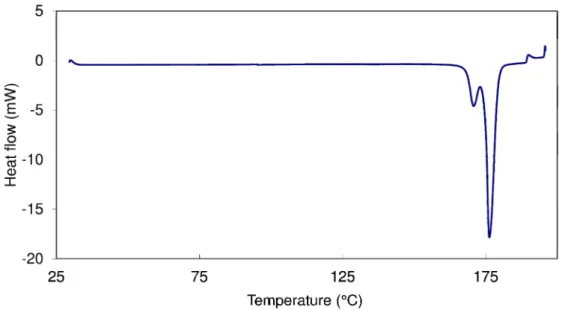
the tomato paste was considered. The DSC curve for the purified lycopene showed in
Figure 2. The melting point was determined from the onset point of the DSC curve [13],
which was scanned at a heating rate of 5 K/min: two possible melting points of 163.8 °C
and 173.2 °C were observed. The lower value would be attributed to the lycopene
(Z)-isomers arose from the (all-E) form because of the heating process. The content of
the (all-E) form was reduced to 61.6% by reversed-phase HPLC for lycopene samples
after the DSC measurement. The melting point of (all-E)-lycopene was then determined
to be 173.2 °C, which was consistent with the value obtained by Manchand et al [5].
Figure 2. DSC curve of the purified (all-E)-lycopene.
Lycopene has an electron spectrum characterized by eleven conjugated double
bonds, which geometrically impose a linear and highly planar structure. The UV spectra
and summery of absorption maxima and molecular extinction coefficient of the purified
(all-E)-lycopene in thirteen organic solvents were showed in Figure 3 and Table 2,
respectively. In hexane, (all-E)-lycopene showed strong absorption maxima at 502.5,
471.0, and 444.0 nm with molar extinction coefficients estimated as 168 × 103, 182 ×
103, and 118 × 103, corresponding to vibrational transition energies of 0–0, 0–1, and 0–2,
respectively. The peak at approximately 360 nm, the so-called Z-peak [7,14], was not
observed in this sample. Furthermore, absorption maxima and molar extinction
coefficients with (all-E)-lycopene were measured in various organic solvents to
investigate the solvent effect on the electronic spectrum of the molecule. All values for
the maxima (λ2) of the fine structure in this study were also consistent with the
calculated values according to an empirical rule [15–17]. The values (λ1, λ2, and λ3)
listed in this table were plotted as a function of wavelength in Figure 4A. From these
results, bathochromic shifts in the absorption maxima were observed in all solvents
tested (at most a 36 nm shift for λ2 in carbon disulfide, as was observed in hexane), and
were accompanied by absorbance decreases, namely a hypochromic effect, showing a
higher correlation between the position and the intensity of the main absorption bands.
Although many studies suggested that the bathochromic shift had been independently
reported previously [18,19], the highly purified (all-E)-lycopene had first enabled a
discussion of the solvent effect on this carotenoid. This bathochromic shift depends on
the polarizability of the solvent because of high correlation between them (Figure 4B)
[20], rather than on its polarity (data not shown). We revealed the solvent effect on the
electron spectra of (all-E)-lycopene for the first time. It has been difficult to evaluate the
solvent effect for (all-E)-lycopene because of its different purification grade with
different origins. This finding contributes to the fundamental chemistry of carotenoids,
and will be a new criterion for the identification and evaluation of lycopene in
agriculture, food, and medical fields.
Figure 3. Ultraviolet (UV) spectra of the purified (all-E)-lycopene in thirteen organic solvents.
Figure 4. Relationships between the absorption maxima and molar extinction coefficients of (all-E)-lycopene in various solvents (A), and between the polarizabilities of the solvents and the absorption maxima (B). The values of λ1 (○), λ2 (●), and λ3 ( ) are from Table 1. Polarizability of the solvent is calculated as follows: (n2−1)/(n2+2), where n is the refractive index of the solvent [22].
The IR spectrum of (all-E)-lycopene was measured (Figure 5) and characteristic
absorptions are shown in Table 2, along with those calculated by the Gaussian program.
Observed and calculated values from C−H and C=C stretches, and C−H out-of-plane
attributed to the alkene as well as other origins, were consistent with each other. This
computational estimation with high fidelity would depend on the restriction of the
molecular motion of lycopene caused by the eleven conjugated double bonds. Therefore,
these observations will facilitate an evaluation of the relative free energy of lycopene
(Z)-isomer contained in foods or originate from heat-induced isomerization.
Figure 5. Infrared (IR) spectrum of the purified (all-E)-lycopene.
Table 3. Infrared absorption bands of (all-E)-lycopene extracted and purified from tomato paste and their calculated values
origin frequency (cm−1)
found calcda
C−H stretch, alkene 3038,
3020 m
3072−3055, 3033−3007 m
C−H stretch, methylene/methyl 2968,
2912, 2854 s
2981−2962, 2926−2894, 2894 m to s
C=C stretch 1627, 1552 w 1636, 1558 m
C−H deformation, methylene/methyl 1441 m 1460−1444 m
C−H deformation, methyl 1391,
1364 m
1399−1375, 1364−1350 m C−H out-of-plane,
(E) disubstituted double bond
960 s 976−946 s
aCalculated by the Gaussian program.
2.4.2. NMR assignment of (all-E)-lycopene
The structure of (all-E)-lycopene has been identified on the basis of one- and
two-dimensional NMR spectra including 1H- (Figure 6) and 13C-NMR, 1H-1H-COSY
(homonuclear correlation spectroscopy), HMQC (heteronuclear multiple-quantum
coherence), and HMBC (hetero-nuclear multiple-bond connectivity). Chemical shifts
for proton and carbon signals of the (all-E)-lycopene in this work were good accordance
with those of the synthetic (all-E)-lycopene [20] (Table 3). Spectral data on
(all-E)-lycopene in CDCl3 were also independently reported by different literatures [22–
25]; however, some values reported were not consistent among the previous studies, e.g.
for the coupling constants of protons H−C(11), H−C(11´) and the chemical shift value
of carbon atoms C(14), C(14´). In our study with thoroughly purified lycopene, the
coupling constant values between H−C(11), H−C(11´) and H−C(10), H−C(10´), and
between H−C(11), H−C(11´) and H−C(12), H−C(12´) were measured as 11.4 and 14.9
Hz, respectively. The chemical shift for C(14), C(14´) could be assigned to the signal
observed at 132.64 ppm by the HMQC experiment, and refinement of the NMR signal
assignment of (all-E)-lycopene was then achieved in CDCl3.
Measurements were subsequently performed in another solvent, C6D6 in expectation
of NMR signal charts distinct from those obtained in CDCl3 because of differences in
their physical properties such as polarity, resonancy, and viscosity. Proton and 13C
signals in C6D6 were preliminarily assigned by the results obtained in CDCl3, and
ascertained by 1H homonuclear decoupling and the NOE difference experiments in
addition to the above two-dimensional measurements (Figure 1). As shown in Table 3,
chemical shifts in methyl protons between H−C(19), H−C(19´) and H−C(20), H−C(20´)
were discriminated in C6D6 at 1.925 and 1.876 ppm respectively (Table 3), whereas
these signals appeared as a singlet at 1.968 ppm in CDCl3 (this study and the references
[23,24]). Furthermore, the coupling system between H−C(14), H−C(14´) and H−C(15),
H−C(15´) could be analyzed in C6D6, whereas their corresponding signals in CDCl3
overlapped with H−C(8), H−C(8´), and H−C(11), H−C(11´), respectively and were
assigned to a multiplet. The observed spin signal occurred in the AA´BB´ type system,
to which similar coupling was assigned in some carotenoids such as prolycopene and
(9Z,9´Z)-7,8,7´,8´-tetrahydrolycopene [21,26], and the full assignment of 1H and 13C
signals was then given in Table 3. The unambiguous determination attained in this study
will also help to analyze the (Z)-isomers occurring in natural sources and those
generated from the isomerization of (all-E)-lycopene by a heating process.
Figure 6. 1H NMR spectrum of the purified (all-E)-lycopene. (400 MHz, CDCl3).
2.5. Reference
[1] Zechmeister, L., LeRosen, A. L., Schroeder, W. A., Polgár, A., Pauling, L. Spectral
characteristics and configuration of some stereoisomeric carotenoids including
prolycopene and pro-γ-carotene. J. Am. Chem. Soc. 1943, 65, 1940–1951.
[2] Davis, W. B. Preparation of lycopene from tomato paste for use as a
spectrophotometric standard. Anal. Chem. 1949, 21, 1226–1228.
[3] Karrer, P., Jucker, E. Carotenoids; Elsevier: Amsterdam, Netherlands, 1950.
[4] Surmatis, J. D., Ofner, A. Total synthesis of spirilloxanthin, dehydrolycopene, and
1,1′-dihydroxy-1,2,1′,2′-tetrahydrolycopene. J. Org. Chem. 1963, 28, 2735–2739.
[5] Manchand, P. S., Rüegg, R., Schwieter, U., Siddons, P. T., Weedon, B. C. L.
Carotenoids and related compounds. Part XI. Syntheses of δ-carotene and ε-carotene. J.
Chem. Soc. 1965, 2019–2026.
[6] Davis, B. H. Carotenoid. In Chemistry and Biochemistry of Plant Pigments;
Goodwin, T. W., Ed.; Academic Press: London, U.K., 1976; pp 38–165.
[7] Britton, G. UV/visible spectroscopy. In Carotenoids Volume 1B: Spectroscopy;
Britton, G.; Liaaen-Jensen, S.; Pfander, H., Eds.; Birkhäuser Verlag: Basel, 1995; pp
13–62.
[8] Schierle, J., Bretzel, W., Bühler, I., Faccin, N., Hess, D., Steiner, K., Schüep, W.
Content and isomeric ratio of lycopene in food and human blood plasma. Food Chem.
1997, 59, 459–465.
[9] Ishida, B. K., Ma, J., Chan, B. A simple, rapid method for HPLC analysis of
lycopene isomers. Phytochem. Anal. 2001, 12, 194–198.
[10] Zhang, J.-P., Chen, C.-H., Koyama, Y. Vibrational relaxation and redistribution in
the 2Ag− state of all-trans-lycopene as revealed by picosecond time-resolved absorption
spectroscopy. J. Phys. Chem. B 1998, 102, 1632–1640.
[11] Choksi, P. M., Joshi, V. Y. A review on lycopene−extraction, purification, stability
and applications. Int. J. Food Prop. 2007, 10, 289–298.
[12] Craft, N. E., Soares, J. H., Jr. Relative solubility, stability, and absorptivity of
lutein and β-carotene in organic solvents. J. Agric. Food Chem. 1992, 40, 431–434.
[13] Estrella, A., López-Ortiz, J. F., Cabri, W., Rodríguez-Otero, C., Fraile, N., Erbes,
A. J., Espartero, J. L., Carmona-Cuenca, I, Chaves, E., Muñoz-Ruiz, A. Natural
lycopene from Blakeslea trispora: all-trans lycopene themochemical and structural
properties. Thermochim. Acta 2004, 417, 157–161.
[14] Zechmeister, L., Polgár, A. cis–trans Isomerization and spectral characteristics of
carotenoids and some related compounds. J. Am. Chem. Soc. 1943, 65, 1522–1528.
[15] Hirayama, K. Relation between chemical structure and visible and ultra-violet
spectra. I-II. II. Polyenes and alkylated polyenes. Nippon Kagaku Zassi 1954, 75, 29–
35.
[16] Hirayama, K. Relation between chemical structure and visible and ultra-violet
spectra. III. Solvents effects on absorption of polyenes. Nippon Kagaku Zassi 1954, 75,
667–674.
[17] Hirayama, K. Relation between chemical structure and visible and ultra-violet
spectra. IV. Effects of substituents and special structures. Nippon Kagaku Zassi 1954, 75,
674–678.
[18] Naviglio, D., Pizzolongo, F., Ferrara, L., Naviglio, B., Aragòn, A., Santini, A.
Extraction of pure lycopene from industrial tomato waste in water using the extractor
Naviglio®. Afr. J. Food Sci. 2008, 2, 37–44.
[19] Hertzberg, S., Liaaren-Jensen, S. Bacterial carotenoids: the carotenoids of
Mycobacterium phlei strain Vera. 2. The Structure on the phlei-xanthophylls−two novel
tertiary glycoside. Acta Chem. Scand. 1967, 21, 15–41.
[20] Mimuro, M., Nagashima, U., Nagaoka, S., Nishimura, Y., Takaichi, S., Katoh, T.,
Yamazaki, I. Quantitative analysis of the solvent effect on the relaxation processes of
carotenoids showing dual emissive characteristics. Chem. Phys. Lett. 1992, 191, 219–
224.
[21] Hengartner, U., Bernhard, K., Meyer, K., Englert, G., Glinz, E. Synthesis,
isolation, and NMR-spectroscopic characterization of fourteen (Z)-isomers of lycopene
and of some acetylenic didehydro- and tetradehydrolycopenes. Helv. Chim. Acta 1992,
75, 1848–1865.
[22] Budavari, S., O’Neil, M. J., Smith, A., Heckelman, P. E. The Merck Index, 13th
ed.; Merck: Rahway, N. J., 2001.
[23] Tiziani, S., Schwartz, S. J., Vodovotz, Y. Profiling of carotenoids in tomato juice
by one- and two-dimensional NMR. J. Agric. Food Chem. 2006, 54, 6094–6100.
[24] Fröhlich, K., Conrad, J., Schmid, A., Breithaupt, D. E., Böhm, V. Isolation and
structural elucidation of different geometrical isomers of lycopene. Int. J. Vitam. Nutr.
Res. 2007, 77, 369–375.
[25] Kishimoto, S., Maoka, T., Sumitomo, K., Ohmiya A. Analysis of carotenoid
composition in petals of calendula (Calendula officinalis L.). Biosci. Biotechnol.
Biochem. 2005, 69, 2122–2128.
[26] Englert, G. NMR spectroscopy. In Carotenoids Volume 1B: Spectroscopy; Britton,
G., Liaaen-Jensen, S., Pfander, H., Eds.; Birkhäuser Verlag: Basel, 1995; pp 147–260.
Chapter 3
Isolation and
characterization of
(15Z)-lycopene thermally generated from a natural
source
3.1. Table of contents
3.2. Introduction
Lycopene has a large number of geometric isomers caused by E/Z isomerization at
arbitrary sites within the eleven conjugated double bonds, and 71 kinds of Z-isomers are
theoretically possible [1]. However, it is a small part of them have been characterized by
spectral methods such as UV–vis, 1H, and 13C NMR spectroscopy. The structural
assignments and UV–vis spectral features of (5Z)-, (9Z)- and (13Z)-lycopene, the
predominant Z-isomers generated during heat [1,2] or photoirradiation treatment [3,4],
were demonstrated through the successful acquisition of highly purified preparations of
the isomers by using a series of chromatographies [2]. The other theoretically-possible
mono-Z-isomer by heating, (15Z)-lycopene (Figure 1), was rationally synthesized via a
Wittig reaction [5,6], but could not be identified during the heat or photoirradiation
process, possibly because of thermodynamic instability and the presence of a small
amount of the lycopene isomer generated by isomerization [7]. On the other hand, the
structure [8,9], thermal isomerization [10,11], and bioavailability and function [12,13]
of a similar symmetrical carotenoid of (15Z)-β-carotene have been extensively
examined.
Figure 1. Chemical structure of (15Z)-lycopene. (15Z)-Lycopene in this study was purified from a mixture of lycopene isomers, which was prepared by heating (all-E)-lycopene of a tomato origin.
In the present study, (15Z)-lycopene with high purity was prepared from a mixture of
lycopene isomers thermally converted from the all-E form of a tomato origin, and
structural characterization was performed by spectral methods including UV–vis, 1H,
and 13C NMR spectroscopy. This results of this study will provide an insight into
(15Z)-lycopene and validate previous descriptions of spectral properties of a
theoretically-synthesized 15Z-isomer [14–19], including those of the synthetic
(15Z)-lycopene [5,6].
3.3. Materials and methods
3.3.1. General
Analytical grade acetone, CH2Cl2, DIEPA, ethanol and MTBE were obtained from
Nakaraitesuku Co., Ltd. (Kyoto, Japan), CDCl3 was obtained from Sceti Co., Ltd.
(Tokyo, Japan), and HPLC-grade methanol was obtained Sigma-Aldrich Co. (St. Louis,
MO, USA). Hexane obtained from a solvent-dispensing system supplied by Glass
Contour (Nikko Hansen & Co., Ltd., Osaka, Japan) under a nitrogen atmosphere after a
preliminary distillation. DFT calculations were performed with the Gaussian 09
software (Rev. D.01), and conformational search was done using CONFLEX 7 program
(Rev. B, Conflex corp., Tokyo) [20].
3.3.2. Preparation of (all-E)-lycopene
(all-E)-Lycopene was isolated from tomato paste (Kagome Co., Ltd., Tokyo;
lycopene content, 8–12 g/kg) using procedures similar to those previously described
[1,2], i.e., extraction with CH2Cl2, recrystallization from benzene, and washing with
acetone and ethanol under shading conditions: 750 mg of a fine red crystalline powder
from 140 g of a tomato sample; reversed-phase HPLC, ≥99.0% purity. Purified
lycopene was stored at −80 °C until just before use.
3.3.3. Thermal isomerization of lycopene
Purified (all-E)-lycopene (110 mg), which was dissolved in 170 mL of benzene, was
transferred into a 300-mL stainless steel pressure vessel (TP300KG, Unicontrols Co.,
Ltd., Chiba, Japan), purged with argon, and then heated at 79 °C for 19 h in an oil bath.
These procedures were conducted on five batches of the lycopene solution. The yield of
isomerization to Z-forms was estimated to be nearly 70% of all lycopene isomers by the
reversed-phase HPLC method.
3.3.4. Isolation of (15Z)-lycopene
Purification of the 15Z-isomer from the mixture of thermally-isomerized lycopene
was conducted using three-step column chromatography. All procedures were carried
out at room temperature, and light exposure was kept to a minimum throughout
purification. A batch of the lycopene mixture, which was isomerized in benzene, was
evaporated to dryness under reduced pressure, and then dissolved in 5.0 mL of hexane.
The insoluble residues (ca. 40 mg), which mostly consisted of (all-E)-lycopene, were
removed using a 0.2-µm polytetrafluoroethylene membrane filter (DISMIC-25HP,
Advantec, Tokyo) prior to chromatographic separations. The supernatant was divided
into six potions and repeatedly applied to HPLC on three normal-phase columns
tandemly connected under the following conditions: column, Nucleosil 300-5 (3 ×
250-mm in length, 10-mm inner diameter, 5-µm particle size, GL Sciences Inc., Tokyo);
solvent, hexane/DIPEA (500:1, v/v); flow rate, 2.0 mL/min; column temperature,
ambient; photodiode array detector (SPD-M10AVP, Shimadzu, Kyoto, Japan). These
procedures were applied to the other four batches, and the fractions with retention times
of 49.5–52.0 min were collected and evaporated to dryness, leaving 13.4 mg of a
red-brown substance. The resulting partially-purified sample was dissolved in 5.0 mL of
hexane, and separated again under the same chromatographic conditions, except for the
solvent (hexane/DIPEA [2000:1, v/v]). The eluted fractions with retention times of
56.0–60.0 min were combined, evaporated, and dried under reduced pressure. The
resulting red substances (2.6 mg) were dissolved in 1.5 mL of benzene, and added to
reversed-phase HPLC under the following conditions: column, YMC Carotenoid (250 ×
10-mm inner diameter, 5-µm particle size, YMC, Kyoto); solvent A,
methanol/MTBE/H2O (75:15:10, v/v/v); solvent B, methanol/MTBE/H2O (7:90:3,
v/v/v); gradient, started with 100% eluent A and ended with 100% eluent B over a
period of 35 min; flow rate 3.0 mL/min; column temperature, 22 °C. The fractions with
retention times of approximately 24.7 min were collected and dried in vacuo, resulting
in the 15Z-isomer being obtained: 0.6 mg of fine red crystalline powder; reversed-phase
HPLC, 97.2% purity; normal-phase HPLC, ≥99.9%. The purity of (15Z)-lycopene by
reversed- and normal-phase HPLC was estimated by peak area integration at 470 nm, as
previously reported [1,3].
3.3.5. NMR spectroscopy
The NMR spectra of (15Z)-lycopene were recorded on a JMN-LA400 FT NMR
spectrometer (JEOL, Tokyo) at 400 MHz for 1H and 100 MHz for 13C. Chemical shifts
were recorded as a δ value (ppm) using tetramethylsilane as an internal standard.
Spectra were observed in C6D6 as well as CDCl3.
3.3.6. Computational analysis
The geometric optimization of (all-E)- and (15Z)-lycopene was performed with DFT
as implemented in Gaussian 09 using the B3LYP functional and 6'31G(d) basis set
including a zero point vibrational energy correction. Prior to the calculation for
(all-E)-lycopene, the structures of the conjugated all-E-polyenes, CnHn+2 (n = 4–22,
even number) were optimized at the ground singlet states, and followed by the
methylated undecaenes TMTU (Figure 2A) and HMHU (Figure 2B). The structure of
HMHU was estimated using initial conformers at 30º intervals of the dihedral angles of
the free rotation in a stepwise manner for two ethyl groups, and (all-E)-lycopene was
then estimated in the same way. The initial conformations of (all-E)-lycopene were also
ascertained using the CONFLEX method and MMFF94s force field. (15Z)-lycopene
and the other mono-Z-isomers were similarly optimized by referring to the results of the
all-E-isomer. Twisted TS geometries were obtained using a TS search. Vibrational
frequency calculations were carried out in all cases to confirm the stationary point.
Energy differences between the ground state and TS electronic energies corresponded to
the activation energy of the isomerization reaction.
Figure 2. Chemical structures of (A) TMTU and (B) HMHU.
3.4. Results and discussion
3.4.1. Isolation of (15Z)-lycopene thermally generated from a tomato sample
The occurrence of (15Z)-lycopene from (all-E)-lycopene during a heating has been
suggested by several studies, and this has mainly been based on analyses of UV–vis
spectra, in which the Z-peak ratio of the isomer, DB/DII, was estimated to be 75–79% in
a HPLC mobile phase [2,16,19]. However, the existence of the Z-isomer from a natural
source has not yet been demonstrated. In the present study, a purification procedure for
(15Z)-lycopene was exploited using an elaborate HPLC technique. Prior to isolating the
Z-isomer, the geometric isomerization of (all-E)-lycopene, which was purified from
tomato paste, was conducted by heating at 79 °C for 19 h under optimal conditions that
excluded oxygen and light irradiation. Among the possible geometrical types for
lycopene in the isomerized mixture, any isomers containing the Z-configuration in the
molecule were considered to be more soluble in the hexane solvent than
(all-E)-lycopene [21]. The remaining (all-E)-lycopene (40 mg in each batch; ca. 30% of
all isomers of lycopene) was effectively removed by filtration only, and the other crude
Z-isomers were then prepared using this simple fractionation technique.
In the first chromatographic purification step, three normal-phase HPLC columns
connected in tandem were applied to separate (15Z)-lycopene (retention time, 49.5–52.0
min; DB/DII, 79% [2]) from the crude fraction (Figure 3A). The ratio of (15Z)-lycopene
to all isomers was estimated to be no more than 10% by comparisons with the peak
areas; taking into account the previous removal of insoluble (all-E)-lycopene, the
amount of the 15Z-isomer produced during the thermal process was very small,
typically a few percent or less. These results could reflect the relatively low generation
rate and/or relatively higher free energy of the 15Z-isomer [7,22]. On the other hand,
large amounts of (9Z)- and (13Z)-lycopene were observed with peak retention times of
approximately 55 and 45 min, respectively, which is consistent with previous findings
[2,17,19]. A second normal-phase HPLC was then applied to the partially-purified
fraction under the same conditions as those for the columns and mobile phase, except
for the amine concentration. HPLC separation equipped with a reversed-phase column
was conducted on fractions abundant in (15Z)-lycopene, which resulted in 0.6 mg of the
highly purified 15Z-isomer (Figure 3B) being successfully obtained from 556 mg of
(all-E)-lycopene as a starting material. The purity of (15Z)-lycopene was estimated to be
97.2% by reversed-phase HPLC analysis, in which the small amount of impurities
would have been (all-E)-lycopene generated from the reversion of (15Z)-lycopene to
(all-E)-lycopene during the chromatographic procedure, because the peak retention time
of approximately 33 min showed the all-E-isomer (Figure 3B), which was easily
removed in the purification process. Similar findings were previously observed in the
purification of other mono-Z-isomers [2]. The actual purity of (15Z)-lycopene was then
considered to be sufficiently high to be subjected to structural characterization using
NMR spectroscopy, as the value estimated in normal-phase HPLC analysis was high
(≥99.9%). Therefore, pure (15Z)-lycopene was now obtained from the thermally
isomerized lycopene sample of a natural origin. The fine control of the concentration of
amine in the normal-phase HPLC eluent led to the discovery of the isomer.
Figure 3. Separation of (A) geometrical isomers of lycopene, generated during a heating process, by normal-phase chromatography as the first purification step (solvent:
hexane/DIPEA [500:1], v/v) and (B) purified (15Z)-lycopene was then analyzed by reversed-phase HPLC.