Abstract
This case study describes the implementation and effects of a flipped class in an English curriculum at a Japanese university in the second semester of 2015. The new approach was incorporated into English courses with the aim of improving students English proficiency so as to enhance their TOEIC reading scores. In the flipped course, the students (N = 34) were required to study materials before coming to each class. To help students understand English grammar, the instructor created original materials in Japanese using PowerPoint and a digital camera. The videos were uploaded to YouTube with their URLs distributed through Google Plus. The lecture videos directed students to practice off campus, where they could access ALC Net Academy 2 by logging in and studying individually. These videos, such as how to pronounce new English vocabulary, accompanied the reading materials for each class and thus encouraged the students to read English materials in the classroom. The monitoring system of ALC Net Academy 2 showed that students logged in and studied English using the software an average of 56 minutes each per day. The result of an end-of-course survey revealed that students perceptions and attitudes toward the flipped course were overall favorable. Keywords: EFL, Flipped class, ALC Net Academy2
Introduction
This paper describes a case study of flipping methodology, and its outcome, that had been implemented in an English class, English Seminar V, Japanese name, Eigo Ensyu Five, which was a required general English subject at the university where the researcher taught the 15-week class in 2015. There are three objectives in this study. First, the study shows some findings relating to the researcher s flipped course, a general English course for Japanese university students. Secondly, this study explores whether the class-flipping model is applicable for preparing English courses for Japanese university students. Finally, this is a pilot study for following flipped course conducted by the researcher. Definition
Inoue (2014) defined a flipped class as a new active learning methodology that moves traditional lectures from the classroom and uses technology to place them on videos created by
Flipped English Courses for EFL Learners
Using ALC Net Academy 2 and YouTube
instructors, students watch out-of-classroom. Figure 1 shows a representation of the Revised Bloom s Taxonomy, a cognitive model that has been used to promote higher forms of thinking in education revised by Anderson and Krathwohl (2001). At the bottom of the triangle is remembering, and going upwards are higher cognitive levels of understanding, applying, analyzing, evaluating, and creating. In a flipped model, two of these six factors, remembering and understanding, pertain to viewing videos out-of-class, which allows learners to study at their own pace (Inoue, 2014). In the classroom, teachers provide activities that involve the other four factors and are based on knowledge that students have acquired through their out-of-class activities. These activities include both collaborative and independent exercises (Shibaike and Nakanishi, 2014).
Background
Since 2013, when the university implemented a new general English curriculum, all students who take English under a foreign language program have been required to take general English courses named English Seminar Ⅱ–VIII [Eigo Ensyu I–VIII]. Each course has a minimum passing score as measured on the Test of English for International Communication (TOEIC). In the 2015 academic year, each student received one credit for passing each of the course. During that same year, teachers were asked to consider the following three points when designing the course: the limited class time to Figure 1.
prepare for the TOEIC examination, the difficulty in dealing with different English proficiency levels of learners and their motivation, and the recommended use of ALC Net Academy 2 Super Standard Course for the university s English curriculum. However, addressing all these points in one course was challenging. Considering the situation, the researcher decided to apply the flipped classroom model to English Seminar V, of which the instructor was in charge of teaching to students in the Department of Information Media Studies. Table 1 shows the course syllabus written and used for this study by the researcher in 2015.(videos created by two teachers and the ALC Net Academy 2 Super Standard Course developed and licensed by ALC Press, Inc., and Hitachi Software Engineering Co.)
Table 1
Syllabus English Seminar V for Information Media Studies
Based on this syllabus, the instructor planned a flipped classroom approach to teach the course. Semester Heisei 27 Nenndo Academic Year 2015, Second Semester
Required/
Elective Required
Course Outline
This course is aimed at improving learners English proficiency, especially focusing on grammar and vocabulary, to help students achieve their best TOEIC score. Students are also encouraged to study independently out of class to foster their autonomy by using ALC Net Academy 2 Super Standard Course by ALC Education, Inc. In class, students develop their communication skills through oral reading activities and shadow training.
Course Goals
1. Students achieve their best TOEIC test scores above 550.
2. Students become accustomed to studying language at their own pace out-of-class.
Lecture Weeks Contents
1 Orientation: Course introduction 2 TOEIC test strategies:
five-sentence pattern, vocabulary mini-test 3 TOEIC test strategies:
adjectives and adverbs, vocabulary mini-test 4 TOEIC test strategies: nouns, vocabulary mini-test 5 TOEIC test strategies: pronouns, vocabulary mini-test 6 Mid-term test
7 TOEIC test strategies: conjunctions, vocabulary mini-test
8 TOEIC Part 5 Test strategies: tenses, present participle, past participle, participle construction 9-14 Practice tests 1-6 on the ALC Net Academy 2
15 Practice test 7 on the ALC Net Academy 2. End-of-course survey
Method
ParticipantsThirty-four students (N = 34) registered to take English Seminar V: twenty-four female and ten male first-year university students who took the course as a requirement for graduation. In the course orientation, the researcher explained how to study the materials using the flipped approach and its procedures, and then started the class with their consent.
Course Design for the Flipped Class
In a flipped class, lecture videos play an important role. Many educational institutions, such as Harvard University, have been sharing their lecture videos to teachers and students around the world through Massive Open Online Courses (MOOCs). Shibaike and Nakanishi (2014) recommend that teachers make original videos for students to meet their learning needs. In making videos, Inoue (2014) suggests to teachers the following steps: (1) planning, (2) recording, (3) publishing, and (4) delivering, which the teacher followed.
(1) Planning and Recording
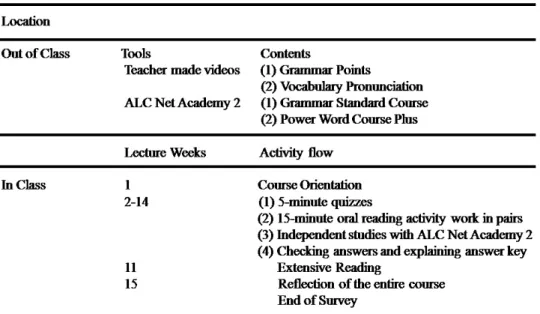
Table 2 shows the instructional design for this flipped class that was designed by the instructor. Since the course was aimed at improving English grammar and vocabulary, lecture videos were planned for each grammar point and vocabulary word. The instructor made videos for the grammar points that included narrated Microsoft PowerPoint slides. In these videos, students were directed to practice a particular grammar item using ALC Net Academy 2 that they had studied on one of the instructor-made videos. In regards to the learning of new vocabulary, students studied other videos that were Table 2
created by a native English speaker who lives in the United States. She created and presented pronunciation videos over five weeks that the students were required to watch and then post comments. Both researchers appeared on the video to explain the grammar points and how to pronounce the new words so that the students would become familiar with them.
(2) Publishing and Delivering
Google+ was used to share the lecture and pronunciation videos. The Google service can protect students privacy by limiting the viewers who can see their pages. The instructor created a page for students registered in English Seminar V. They had rights to access the instructor s Google page from any device, such as a PC or mobile phone. Figure 2 shows the screenshots from the log-in. All resources were available for viewing or downloading from the page. Students came to class following their out-of-class independent studies.
(3) In-Class Activities
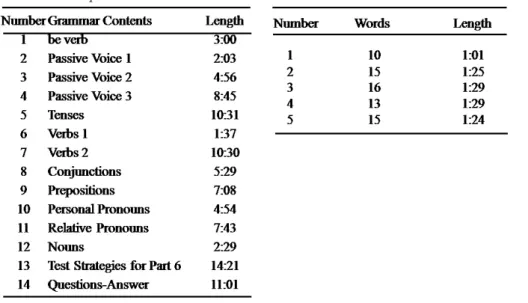
The following section explains the typical classroom lecture during weeks 2-8. The fifteen-week course was held in a CALL classroom that was set up with stationed desktop computers. Language learning using technology tends to isolate students. In this flipped class, activities were planned to provide more opportunities for interaction with the teacher as Table 2 illustrates. The videos and their content created by the Japanese instructor are shown in Table 3. The total time of all the videos was 94 minutes and 45 seconds. It also shows the time of the five pronunciation videos made by the native English speaker. Their total time was 6 minutes and 48 seconds.
Figure 2.
Data Collection
To gain and evaluate student feedback and attitudes about the flipped course, an end-of-course survey was conducted. They were distributed on the end of the end-of-course. Thirty-one students answered the end-of-course survey. Three students missed the survey because they did not attend the last class. As students watched the two sets of required videos, grammar videos created by the Japanese teacher and pronunciation videos by the native English speaker, they rated each video.
Results and Discussion
Figure 3 shows the results of Question No. 1, Did you watch the videos before coming to class? Thirty-six percent of students reported watching the grammar videos every week before coming to class, compared with 23% watching the vocabulary videos each week.
Table3
Lecture videos uploaded to YouTube
Figure 3.
Did you watch the videos before coming to class?
Grammar Videos
Pronunciation Videos
Thirteen percent of the students perceived the grammar videos as helpful for studying English at home, while 22% of all the students considered the vocabulary videos to be useful in their home learning.
The devices that students used to view the videos are given in Table 4. A large majority of students viewed them through their smartphones.
Students were asked to answer a question about their overall perceptions of the flipped class. Table 5 shows the results of question No. 5: 55% answered very good, while 39% answered good and 3% were neutral in their assessment. A vast majority of students perceived the course favorably. Question No. 5 was an open-ended query. On their answer sheets, five students wrote opinions or perceptions of the course, which are shown in Table 6.
Figure 4.
Was it helpful for you to study English at home?
Table 4
What device did you use to watch the videos?
Question No. 4 Smartphone PC Other 71% 26% 3%
Table 5
How did you perceive Flipped classes?
Question No. 5 Very good Good Neutral Bad
The end-of-course survey shows student perceptions of the course. The results suggest that the course could be helpful for students studies outside the classroom even if they were taking a flipped course for the first time. Additionally, the average daily log-in time per day while doing out-of-class work for the Power Word Course PLUS was 56 minutes per student. One possible explanation for the longer average log-in time may be that students watched pronunciation videos by the native English speaker, thus encouraging them to study new words via e-learning.
Another benefit of the flipped course was revealed when several students came to the instructor to ask questions after class: an unusual occurrence among Japanese students, who are known for their shyness and passive learning style in class. Some of their questions involved grammar points that they could not understand from the lecture videos. In response, the teacher gathered their questions, made a special video to answer them, and then shared the video with all the students via Google Plus page. It appears that the lecture videos created by the teacher may have helped students feel more familiar and relaxed with their teacher: a change of attitude that can be said to foster active learning attitudes as a result of the flipping class methodology.
Conclusion
This case study explored the first attempt by the teacher to apply flipping methodology to a university English course, which resulted in an increase in interactions between students and the teacher both during the class and afterwards. Study time also increased from the use of technology outside of class. The methodology made class time more effective and the classes themselves more active. The original videos created for the flipped course encouraged the students to embrace ALC Net Academy 2 as a learning tool. An end-of-course survey demonstrated an increase in students favorability toward the seminar and the instructor. However, some issues could be better addressed by the teacher. One would be to plan and make higher-quality videos before delivery to students, who commented on this in their feedback. Another issue was the lack of availability of post-course scores of the TOEIC, which the students were not required to take. Such post-course data, combined with pre-course data for comparison, would be needed to further investigate the methodology s effectiveness. Table 6
Open-ended comments
⃝ I think the pronunciation videos helped me to improve my pronunciation. ⃝ I was able to enjoy studying English because I could use various applications. ⃝ Teacher should use more textbooks, not videos.
⃝ When I could not understand the materials, I was able to stop the video and listen again. ⃝ The back ground noise in the videos annoyed me. If you could create videos with improved
References
Anderson, W. L., & Krathwohl,, D. R. (2001). A Taxonomy for Learning, Teaching, and Assessing: A revision of Bloom’s Taxonomy of Educational Objectives. New York: Longman.
Bergmann, J; Sams, & Aaron;. (2012). Flip your classroom: reach every student in every class every day. Eugene: ISTE and ASCD.
Inoue, H;. (2014). Hantenjyugyou Jissen Manual. Tokyo: KAIBUNDO.
Murphy, Raymond; Smalzer., & William R;. (2011). Maphy no Cambridge Eibunpou. Singapore: Cambridge University Press.
Shibaike, M., & Nakanishi, Y., (2014). Hantenjyugyou ga Kaeru Kyouiku no Mirai. Tokyo: Akashisyoten. Online Resources
coursera: https://www.coursera.org/ edx: https://www.edx.org/
Lavolette. YouTube: https://youtu.be/wW3uBtvI4Hw Lavolette. YouTube: https://youtu.be/O1d2rhEK9_A Lavolette. YouTube: https://youtu.be/GV5FiW8eVbo Lavolette. YouTube: https://youtu.be/aibooeSIHGw Lavolette. YouTube: https://youtu.be/D51w7u_655I
田中. 英語演習V予習イントロダクション:YouTube: https://youtu.be/kXQjC3V2y3Y 田中. 20151026第2回英語演習受動態1: YouTUBE: https://youtu.be/mv5pEmF4ECQ 田中. Google+: https://plus.google.com/u/0/ 田中. 英語演習V分詞イントロダクション: YouTube: https://youtu.be/NSg90JldpCA 田中. 授業振り返り英語演習Ⅴ: YouTube: https://youtu.be/heInQ4pSe0I 田中. 2015112第4回予習動画英語演習受動態2: YouTube: https://youtu.be/3jJzt6KJOYE 田中. 20151214予習動画英語演習前置詞PPT: YouTube: https://youtu.be/ck9pcCRRkK4 田中. 20151214予習動画英語演習前置詞PPT: YouTube: https://youtu.be/ck9pcCRRkK4 田中. PPT12月21日12月14日復習: YouTube: https://youtu.be/eKwNN3eYhPI 田中. 英語演習Ⅰ第1回ビデオ. YouTUBE: https://youtu.be/npppt6blrfQ 田中. 接続詞予習: YouTube: https://youtu.be/isx-EbP5cGI 田中. 2015英語演習Ⅴ第2回目時制: YouTUBE: https://youtu.be/dIChSUvpRdk 田中. 2016014ふりかえり.YouTUBE: https://youtu.be/azAbvGu4kPM 田中. 関係代名詞2016年1月14日. YouTube: https://youtu.be/MFZ2Yd9Voxg 田中. 現在完了進行形用法完了形とどうつかいわけるか補足音声入り動画. YouTube: https://youtu.be/UrUkB9m2hkE