Revisiting labour and gender issues in Export Processing Zones : the cases of South Korea, Bangladesh and India
著者 Murayama Mayumi, Nobuko Yokota
権利 Copyrights 日本貿易振興機構(ジェトロ)アジア
経済研究所 / Institute of Developing
Economies, Japan External Trade Organization (IDE‑JETRO) http://www.ide.go.jp
雑誌名 IDE Discussion Paper
巻 174
発行年 2008‑10‑01
出版者 Institute of Developing Economies (IDE‑JETRO)
URL http://hdl.handle.net/2344/793
INSTITUTE OF DEVELOPING ECONOMIES
IDE Discussion Papers are preliminary materials circulated to stimulate discussions and critical comments
Keywords: exports, information technology, FDI
* Senior Research Fellow, Area Studies Center, IDE ([email protected])
** Professor, Graduate School of East Asian Studies, Yamaguchi University ([email protected])
IDE DISCUSSION PAPER No. 174
Revisiting Labour and Gender Issues in Export Processing Zones: The Cases of South Korea, Bangladesh and India
Mayumi MURAYAMA*
Nobuko YOKOTA**
October 2008
Abstract
The establishment of Export Processing Zones (EPZs) is a strategy for economic development that was introduced almost fifty years ago and is nowadays employed in a large number of countries. While the number of EPZs including several variants such as Special Economic Zone (SEZs) has increased continuously, general interest in EPZs has declined over the years in contrast to earlier heated debates regarding the efficacy of the strategy and its welfare effects especially on women workers. This article re-evaluates the historical trajectories and outstanding labour and gender issues of EPZs on the basis of the experiences of South Korea, Bangladesh and India.
The findings suggest the necessity of enlarging our analytical scope with regard to
EPZs, which are inextricably connected with external employment structures,
whether outside the EPZ but within the same country, or outside the EPZ and its host
country altogether.
Keywords: Export Processing Zone (EPZ), Special Economic Zone (SEZ), labour, gender, South Korea, Bangladesh, India
JEL classification: F02, F16, J53
The Institute of Developing Economies (IDE) is a semigovernmental, nonpartisan, nonprofit research institute, founded in 1958. The Institute merged with the Japan External Trade Organization (JETRO) on July 1, 1998.
The Institute conducts basic and comprehensive studies on economic and related affairs in all developing countries and regions, including Asia, the Middle East, Africa, Latin America, Oceania, and Eastern Europe.
The views expressed in this publication are those of the author(s). Publication does not imply endorsement by the Institute of Developing Economies of any of the views expressed within.
INSTITUTE OF DEVELOPING ECONOMIES (IDE), JETRO 3-2-2, WAKABA,MIHAMA-KU,CHIBA-SHI
CHIBA 261-8545, JAPAN
©2008 by Institute of Developing Economies, JETRO
No part of this publication may be reproduced without the prior permission of the IDE-JETRO.
Revisiting Labour and Gender Issues in Export Processing Zones:
The Cases of South Korea, Bangladesh and India
Mayumi MURAYAMA and Nobuko YOKOTA
The Export Processing Zone (EPZ)1 is a zone in which imported raw materials and components can be processed and exported elsewhere free from the payment of duties and with minimal customs regulations. It has been more than 40 years since the first EPZ in Asia was established, in India. Today, in some countries, EPZs are no longer a topic of interest whereas in others such as India, the advent of the Special Economic Zone (SEZ, variant of the EPZ), has stirred fresh interest among academics and the public. It should be noted, however, that over the last 50 years, whether met with protests or indifference, EPZs and similar institutions have continued to proliferate, and in many countries. In the early 1980s, a well-informed observer commented that the development of EPZs had reached maturity [Lim 1984: 55]. The pronouncement, clearly, turned out to be premature.
Does the perennial expansion of EPZs signify any consensus regarding the efficacy of EPZs as a panacea for economic development? Here it should be noted that discussion of EPZs has produced a large volume of scholarly literature, both theoretical and empirical. In particular, EPZ labour issues, and more precisely women’s employment, have been critically evaluated in the context of the theory of exploitation. But the discussion of these issues tends to be over-simplistic and static as regards the nature of the EPZ. We believe that the time is now appropriate for a review of the role of the EPZ and its implications for employment. In particular, EPZs having undergone a history of nearly 50 years, we should like to assess whether or not exploitation theory holds true as regards the labour-relations experience of EPZs and what the outstanding research issues may be.
In conducting a review of this topic, it is important to unravel the myths about EPZs taking into account the specific context of each particular country, an approach that is necessary for the following reasons. First, each country has its own specific economic endowments and each has its own history of economic and political development. Moreover each has followed its own particular path of industrialisation. It follows, therefore, that perceptions of the EPZ have varied from country to country. Second, the adoption of EPZs as an industrialisation strategy was made by individual countries at different points of time in the development and proliferation of EPZs among the developing countries. This means that each country was integrated into the global economy
1 Different names such as Export Processing Zone (EPZ), Free Trade Zone (FTZ), Special Economic Zone (SEZ) and maquiladora are used in different countries to refer to similar institutions. In this paper, EPZ is used interchangeably with other terms unless specified otherwise. The different characteristics of various types of EPZs are delineated in Boyenge (2007).
through its EPZs at different stages in the deepening process of economic globalisation. For instance, late-comers who adopted the EPZ strategy had to compete with other countries already equipped with EPZs by offering increasingly generous incentives to woo foreign investors [Shoesmith 1986:28, 70-71]. In this article, we have analysed the cases of South Korea, Bangladesh and India, India being by far the largest of these three economies. In terms of length of EPZ experience, South Korea is the one of the first generation economies in which an EPZ was introduced in the early 1970s while the first EPZ in Bangladesh appeared more than a decade later.
India’s case is unique. Although it was the first country in Asia to establish an EPZ, the efficacy of EPZs did not receive much attention until the late 1980s. After a gap of 35 years, a Special Economic Zones Act which also incorporated the older EPZs was introduced.
The next section offers an economic and social overview of EPZs and summarises the recent debates regarding the efficacy of EPZs as well as labour issues associated with EPZs. The three sections that follow are country case studies, the findings of which are summarised and analysed in the last section, which discusses some implications for labour and gender issues associated with, and beyond, EPZs.
1 Economic and Social Overviews of EPZ
1.1 Evolution of EPZ
The concept of the EPZ is said to have originated from free trade zones established in major ports such as Gibraltar, Singapore and Hong Kong during the eighteenth and nineteenth centuries. Early free trade zones allowed imports and exports free from custom formalities with the purpose of facilitating the speedy re-export of goods, the victualling of ships, and the development of the commercial sector [Currie 1979: 1]. EPZs differ from free trade zones in two main ways. First, EPZs were adopted as a means of initiating export-oriented industrialisation and second, the location of an EPZ is not immediately bound by its closeness to a port [Wong and Chu 1984: 1].
As is well known, after the Second World War, newly independent countries set industrial development as one of their main objectives. In the 1950s and 1960s, it was the import substitution strategy that dominated the policy framework of most developing countries. However, instead of achieving the desired economic independence, this strategy resulted in inefficient and high-cost production. Subsequently, governments turned to the alternative strategy of export promotion. In this, the EPZs provided connecting links. First, they became a conduit whereby foreign capital could search for unexploited supplies of cheap labour and enabled the host country to connect to export markets. Second, the EPZ signified a transitional policy stance in between import substitution and export-oriented industrialisation. The enclave nature of the EPZs was
considered as a middle ground enabling countries to draw benefits from integration into the international economy through liberalization and deregulation while to a certain extent, protecting existing political, economic and social systems from direct external intervention.
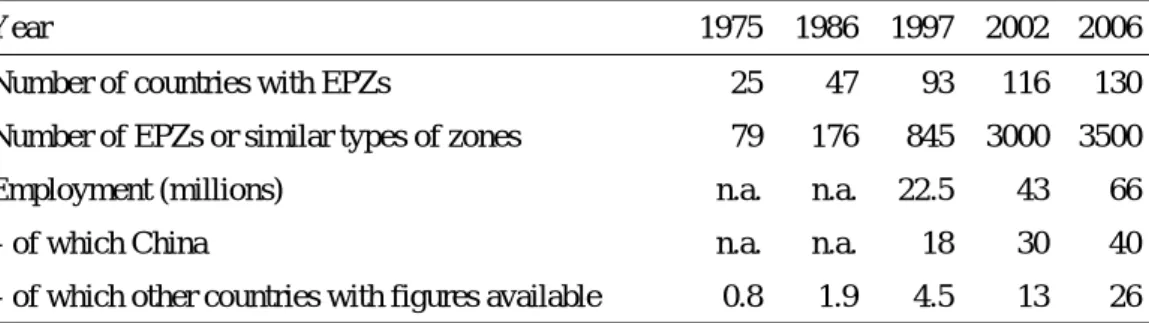
However the latter objective, protection for a domestic economy or system, seemed to lose some of its importance with the irreversible progress that globalisation was making in respect of economic integration and homogenisation of policies and institutions [Gunter and van der Hoeven 2004]. In reality, the concept of the EPZ has also broadened in ways that have overcome the physically closed nature of the enclave. Today, single-factory zones, such as the Export Oriented Units in India or the Bonded Warehouses in Bangladesh are sometimes counted as EPZs. Also the activities carried out in EPZs extend from earlier assembly and simple processing to high-tech science parks, logistics centres and even tourist resorts. The ILO statistics include these newer types in a grand total of EPZs that following a period of continuous proliferation, has now reached 3,500, spread over 130 countries (Table 1). The total employment is estimated at approximately 66 million, of whom 40 million are located in China.
Table 1. Expansion of EPZs in the world
Year 1975 1986 1997 2002 2006
Number of countries with EPZs 25 47 93 116 130
Number of EPZs or similar types of zones 79 176 845 3000 3500
Employment (millions) n.a. n.a. 22.5 43 66
– of which China n.a. n.a. 18 30 40
– of which other countries with figures available 0.8 1.9 4.5 13 26 Note: Including bonded warehouses in Bangladesh.
Source: Boyenge (2007).
Although the single-factory EPZ shares core concepts with the conventional EPZ as regards fiscal measures such as tax exemption, the main feature of the conventional EPZ, namely its existence as an enclave of substantial size in which many factories are clustered, has important implications for our later discussion of the economic and social implications of EPZs. As for enclave-type EPZs, there are no separate statistics available. One source claims that there are 12 countries that have large zones with a resident population, including the Chinese Special Economic Zones and new cities, and 126 countries with smaller zones that are generally smaller than 1000 ha, normally surrounded by some kind of fence.2
2 World Economic Processing Zones Association (WEPZA) data (http://www.wepza.org/ accessed on June 12, 2008). Besides the two categories in terms of size, another two terms, i.e., ‘Industry
In both of the definitions described above, it is evident that the EPZ has been a popular policy instrument in more than a half of the countries in the world. The first EPZ was set up at Shannon airport in Ireland in 1959. Shannon EPZ is regarded as the prototype for all subsequent EPZs and is acclaimed for its successful development of an export-based industrial sector [Currie 1979: 2].3 Puerto Rico (in 1962) and India (in 1965) were the first two developing countries to adopt the EPZ strategy. They were soon followed by Taiwan, the Philippines, Dominican Republic, Mexico and Brazil, all during the period between 1966 and 1970. During the 1970s, the number of EPZs increased greatly. Many countries in Asia (South Korea, Malaysia, Indonesia, Sri Lanka, Thailand) and in the Latin American and Caribbean region (Columbia, El Salvador, Guatemala, Honduras, Jamaica), and a few African (Mauritius, Liberia, Senegal) and Middle Eastern countries (Jordan) took up the EPZ approach. In 1979, China established its first four SEZs. Throughout the 1970s and 1980s, the older countries added new EPZs while late-comers such as Bangladesh, Pakistan, Costa Rica, Bulgaria, and Cyprus established EPZs for the first time.4 In the 1990s, while several African countries (Kenya, Namibia, Cameroon and Zimbabwe) tried the EPZ approach, variants of the EPZ began to appear. These included the Export Processing Firm (EPF), an initiative that became increasingly popular [Madani 1999].
What accounts for the increasing popularity of the EPZ strategy? Does the popularity of the concept mean that the EPZ is a successful strategy for promoting economic development?
Although the role assigned to EPZs has differed from country to country, there is an overall consensus on the primary goals of an EPZ. These include the earning of foreign exchange through increased exports, employment creation, the attraction of foreign direct investment (FDI) to the host country, technological transfer and generating linkage effects beyond the EPZ. With these broad objectives forming the context, a large number of studies have been made regarding the Specific’ and ‘Performance Specific’ EPZ, are used to classify different types of EPZs. The Industry Specific EPZs were created to support the needs of specific industries such as banking, jewellery, oil and gas, electronics, textiles, tourism, and so on. Companies invested in such zones may be located anywhere and receive benefits. Examples include India's Jewellery Zones, and many offshore banking zones. Performance Specific EPZs are Zones that admit only investors who meet certain performance criteria such as degree of exports, level of technology, size of investment, and so on. Companies can be located anywhere. Examples include India's export oriented factories, the Mexico Maquila programme, and various research parks.
3 The employment figure for Shannon Free Zone was 440 in 1960. By 1966, the number of workers had increased to 3,820 [Currie 1979: 2]. Currently, 7,500 are employed in 110 firms.
Fifty-seven percent of investment came from the United States followed by 27 percent from continental Europe (http://www.shannonireland.com/ accessed on May 25, 2007).
4 Information derived from Table A.3 in World Bank [1992].
impacts of EPZs on individual economies.5 Many studies have evaluated the performance of EPZs in terms of the contribution that EPZs have made to national economies in terms of employment, exports, and FDI inflows. But, constructing valid benefit-cost models is very difficult because of the often narrow or confused definitions of the economic and welfare effects of EPZs and because of the problems of quantifying such effects.
For instance, Warr [1989] points out that confusion exists concerning the economic and welfare effects of EPZs not just in government documents but also in the economics literature on EPZs. To assess the costs and benefits of an EPZ, as experienced by the citizens of the host country, Warr suggests an “enclave approach” in which financial flows between the EPZ and the domestic economy are relevant for estimating the welfare impacts while flows between the rest of the world and the EPZ are irrelevant for an evaluation since these transfers are taking place within the “enclave” of the zones but not within the rest of the host economy. The components that make up the expected benefits include the difference between wage paid to local labour and the shadow wage, the differences between payments by firms for public utilities and locally purchased inputs and the opportunity cost of these, and all tax payments by firms and net profit income accruing to local equity shareholders in the EPZ firms, whereas the expected costs include the capital infrastructure cost of the establishment of the EPZs and the administrative expenditure for zone operation.
The study by Warr [1989] finds that by the time of the survey (1982), among four countries, South Korea, Indonesia, Malaysia had enjoyed positive net welfare benefits while the Philippines exhibited a net negative value due to heavy infrastructure costs. Jayanthakumaran [2003], employing a similar approach, concludes that China and Sri Lanka also generated returns well above the estimated opportunity costs of the respective countries. Nevertheless, both authors are apprehensive about the broader and longer-term effects of EPZs in host countries. They maintain that EPZs can be an efficient and productive means of absorbing surplus labour for countries in the early stages of development but that even then, the benefits tend to be only a modest part of the solution of the vast employment problems of these countries. They also point out that national interest in the EPZs could well tend to disappear as industrial development proceeds.6 Warr contends that instead of establishing enclave-type zones, it might be more viable to extend the features that attract foreign investment to firms, whether foreign or domestic, that produce exports but are located outside the EPZs. A more recent review on the efficacy of EPZs by Madani
5 Madani [1999] divided the literature on the effects of EPZs into three schools, namely neo-classical, cost-benefit and new growth theory.
6 Warr [1989] also states that the demonstration effects of EPZs, such as exposure of domestic businesses to examples of internationally competitive enterprises and the on-the-job training of local managers, are valuable but should not be exaggerated.
[1999] concludes that establishing an EPZ is not a first best policy choice superior to overall liberalisation of the economy.
1.2 Labour Issues in EPZs
It is over labour and gender issues that the efficacy of EPZs has been most called into question.
Major criticisms about the role of EPZs in employment creation can be divided into quantitative and qualitative dimensions of employment.
An enclave-type of EPZ, the creation of which requires substantial resources, has an intrinsic limitation even though the employment growth within EPZs may be considerably stronger than outside the EPZs. Unless new EPZs are created continuously throughout the country, the employment contribution tends to be limited as a quantitative solution of the country’s unemployment problems. Theoretically, EPZs established in developing countries where unemployment and underemployment are high can create new job opportunities since the availability of workers at generally lower wage levels prompts foreign entrepreneurs to invest in labour-intensive production. Therefore, if properly planned and managed, EPZs can generate employment at least in the initial stages of their growth, and a high economic rate of return can be secured, especially if the alternatives to EPZ employment are unemployment or underemployment.
However, as the labour market tightens and labour costs rise, it is likely that the EPZ will lose competitiveness in terms of labour costs, and that employment generation will diminish [Wong and Chu 1984, Rondinelli 1987, Warr 1989, Madani 1999]. As we will see, South Korea is an example of this kind of trend. While some have seen the shift to technology and capital intensive industries in Masan EPZ as a positive development in terms of technological transfer [Wong and Chu 1984], others have regarded it as the stabilisation of employment at a low level [Rondinelli 1987].
It is in respect of the qualitative dimension of employment that the role of the EPZ has been most widely criticised. Many observers have concluded that employment in EPZs means low wages, high work intensity, unsafe working conditions and suppression of labour rights. While narratives of workers plights are abundant, and they represent undeniable aspects of labour in EPZs, lack of clarity in the assessment criteria do not allow us to measure the extent of the benefit, if any, that the labour force derives from working in the EPZ.
In the early 1980s, an ILO study edited by Lee [1984] stated that assertions of
“super-exploitation” regarding the nature of EPZ employment rest on two assumptions, namely a level of work intensity beyond the normal mental and physical capacity of workers, and a level of wages that is below the physical subsistence level. Both of these assumptions, according to Lee, are difficult to substantiate on the basis of the available evidence. What is clear is that in terms of both work intensity and the wages they receive, workers in EPZs are far worse off than those doing similar jobs in industrialised countries [Lee 1984: 16, 18]. That said, whether EPZ workers are
worse off compared with their rural and urban counterparts is another question, since employment effects on individual workers are multi-dimensional in both material and perceptional terms. A comparison of wage levels would be the least disputable kind of assessment, if appropriately made.
While it is generally undeniable that the wages in EPZs are higher than those available in rural areas of the same country, especially for women, it is not always the case that wages in EPZs are higher than those for comparable work outside the EPZs. Warr [1989] alleges that proponents of exploitation theory lack familiarity with labour conditions and wages in developing countries, and observes that ‘unless workers were better off being “exploited” in an EPZ, EPZ firms would find it impossible to hire.’ He adds that the greater visibility of EPZs and their politically sensitive position make violations of minimum wage restrictions more difficult. The ILO [1998a] adds that the higher take-home pay of EPZ workers is based on remuneration systems such as piece-rates or incentive schemes, both of which often imply longer hours of more intensive work than is the case in non-zone enterprises.
Available studies suggest two tendencies regarding relative wage levels of EPZ workers vis-à-vis non-EPZ workers engaged in comparable work. First, the relative wage levels of EPZs differ from country to country. In the late 1970s and early 1980s, wages in Bataan EPZ (Philippines) and Masan EPZ (South Korea) were lower than those outside, while export zones in Malaysia and Sri Lanka provided marginally higher wages than factories outside [Edgren 1984].
According to Edgren, two factors, the supply of fresh workers from the main recruitment areas and alternative sources of employment outside the EPZs, determine the relative wage levels within EPZs. Second, since those factors change over time, so do the relative wage levels of the EPZs.
As we will see in greater detail in the following section, the situation of Masan EPZ changed significantly after a nationwide workers’ struggle in 1987 after which wage levels and working conditions in the EPZ improved substantially. However, accompanying the change has been a structural shift in EPZ employment, with a decrease in the employment of women workers, the hiring of non-regular workers, and an increase in out-zone subcontracting [Also see Asia Monitor Resource Center 1998: 7-9, 17].
Assuming that wages and working conditions in the EPZs become relatively better than those outside, what are the remaining issues concerning EPZ employment? A salient feature of EPZ employment vis-à-vis non-EPZ employment in general is the restrictions that are placed on trade union movements. Not all the countries with EPZs have taken a negative stance towards trade union activity within EPZs. For instance, labour regulations in Ireland’s EPZ are the same as those applying to industry in the rest of the country and union membership within Shannon EPZ is comparable to that outside the zone [Shoesmith 1986: 110]. Singapore has been cited as a similar example [ILO 1998a]. However, on the whole, governments that have adopted the EPZ strategy have tended to act against labour movement activities within the zones. The various restrictions on labour movements that governments have taken include a total or partial ban on trade union
activities within EPZs, restriction of the scope of collective bargaining, and banning trade union organisers from entering the zones [ILO 1998a]. Some governments while enforcing strict control on labour movement, require employers to abide by government regulations on working conditions.
Shoesmith [1986: 111], however alleges that while this practice would seem to be to the advantage of workers, in fact it limits the ability of workers to independently organise or press for better working conditions than those laid down by the state. Moreover, in countries where labour inspectorates are weak, it is difficult to see how legislation on working conditions can be enforced.
2. EPZs in South Korea
2.1. Overview
Since the latter half of 1960s, the South Korean economy has achieved remarkably high rates of growth. It is well known that this growth has been led by an export-oriented industrialization strategy. During South Korea’s “developmental era” from the 1960s to the 1980s, a development dictatorship promoted exports of labour-intensive products utilising cheap labour with the aim of earning foreign exchange and attracting FDI, while simultaneously laying emphasis on the development of heavy and chemical industries in order to build up core varieties of manufacturing.
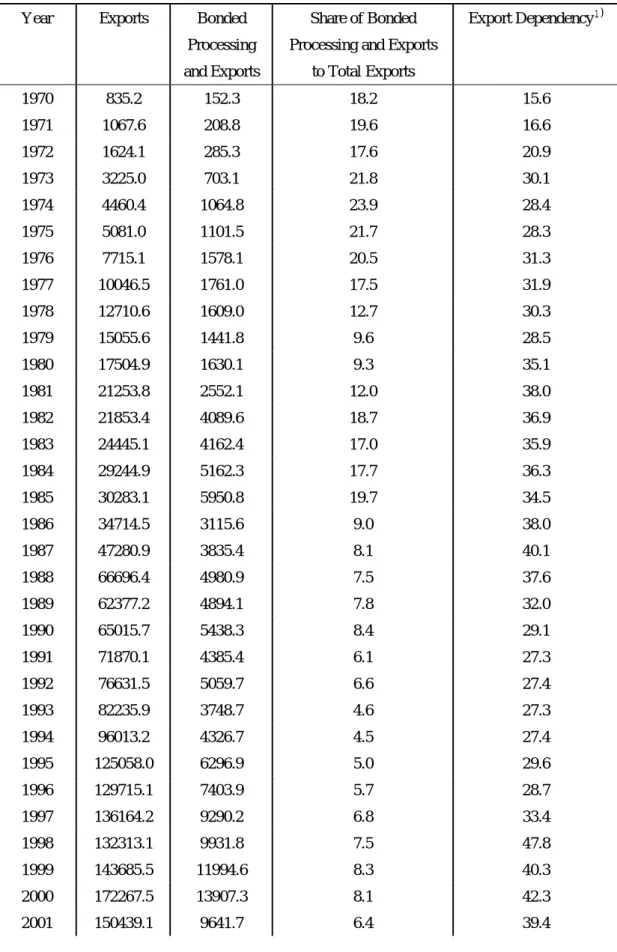
Table 2 shows that the growth of the South Korean economy was achieved chiefly through exports as is indicated by the increase of the economy’s export dependency from 15.6% during the 1970s to 40.1% in 1987. Bonded processing and exports have been encouraged as thoroughgoing export promotion measures in which capital, raw materials and spare parts have been imported at reduced or zero tariff rates, and then assembled or processed by abundant, cheap and good quality labour, and exported. EPZs7 were established in Masan in 1970 and in Iri in 1973 with a focus on labour intensive-industries such as electrical goods and electronic products, and textile and garment manufacture. As Table 2 shows, in line with a general expansion of exports, the category “bonded processing and exports” accounted for about 20 percent of South Korea’s exports from the latter half of the 1960s to the mid-1980s.
The above situation, however, changed when the military dictatorship stepped down with the declaration of democratisation on June 29, 1987. Labour disputes proliferated all over the country in what is generally called the “great labour struggle.” Through this struggle, South Korean workers have gained basic legal rights of labour, the power of trade unions has increased dramatically, and working conditions have been improved considerably. This has resulted in a
7 EPZs were called “Export Free Zones” in South Korea in those days. It is however clear that an Export Free Zone in South Korea was equivalent to an EPZ.
substantial increase in wages, with the result that export industries have lost comparative advantage in respect of cheap labour. Table 2 shows that export dependency stagnated at slightly less than 20 percent from the late 1980s to 1998 when the “IMF crisis” occurred. Bonded processing and exports, in which the source of the profit was low labour costs, rapidly declined in relative importance, and by the mid-1990s, this category accounted for less than 5 percent of total exports Subsequently, the category’s export share has recovered slightly, to between 7 and 8 percent. But it is now clearly evident that “bonded processing and exports” is no longer a key player in the economic development of South Korea as it was during the “developmental era.”
South Korea’s “IMF crisis”, which was triggered by the Asian financial crisis, constituted another turning point in the history of the country’s EPZs. The government responded to the crisis by accelerating the process of economic globalization through upgrading of the industrial structure.
In other words, an export-oriented strategy was re-adopted, but this time with a focus on high-tech industries such as the IT industry, and in an attempt to achieve this objective, FDI became an important component. The policy shift has marked the beginning of a new phase of economic development in South Korea. After 1998, export dependency increased more rapidly than during the “developmental era,” reaching 47.6% in 2007 from less than 30 percent in the 1990s. In line with rapid export increase has been a steep increase in FDI, resulting from the government’s aggressive policy of attracting FDI after the “IMF crisis.” The inflow of FDI into South Korea during the period 1962 to 2004 totalled 99,530 million dollars. Of this, an amount of only 7,870 million dollars (7.9 percent) was invested during 1962 and 1990, or in other words during the
“developmental era.” On the other hand, FDI inflows between 1997 and 2004 amounted 81,860 million dollars, which constitute no less than 82.8 percent of total FDI since 1962 [Bae 2005:6-7].
Since 2000, Free Trade Zones (FTZs) have been established one after another in an attempt to provide centres for FDI. In addition to the conventional EPZs such as Masan and Iri, production-centred FTZs have been constructed in Kunsan, Taebul, Tonghae and Yulchon. Since 2003, FTZs that function as logistics hubs have been set up in Pusan Port, Kwangyang Port, Incheon Port and Incheon International Airport [Park 2008: 37]. It should be noted that the motives of today’s foreign investors differ completely from those of investors during the
“developmental era.” According to a survey made by Korea Labour Institute in 2004, 81.6 percent of the surveyed companies referred to South Korea as a new market while only 6.1 percent of the respondents mentioned utilisation of cheap labour [Bae 2005: 51]. We can conclude that the role of EPZs or production-oriented FTZs as bonded processing and exporting zones with low cost labour has come to an end in South Korea.
Table 2. Changes of Exports and Export Dependency in Korea (%, million US dollars)
Year Exports Bonded
Processing and Exports
Share of Bonded Processing and Exports
to Total Exports
Export Dependency1)
1970 835.2 152.3 18.2 15.6
1971 1067.6 208.8 19.6 16.6
1972 1624.1 285.3 17.6 20.9
1973 3225.0 703.1 21.8 30.1
1974 4460.4 1064.8 23.9 28.4
1975 5081.0 1101.5 21.7 28.3
1976 7715.1 1578.1 20.5 31.3
1977 10046.5 1761.0 17.5 31.9
1978 12710.6 1609.0 12.7 30.3
1979 15055.6 1441.8 9.6 28.5
1980 17504.9 1630.1 9.3 35.1
1981 21253.8 2552.1 12.0 38.0
1982 21853.4 4089.6 18.7 36.9
1983 24445.1 4162.4 17.0 35.9
1984 29244.9 5162.3 17.7 36.3
1985 30283.1 5950.8 19.7 34.5
1986 34714.5 3115.6 9.0 38.0
1987 47280.9 3835.4 8.1 40.1
1988 66696.4 4980.9 7.5 37.6
1989 62377.2 4894.1 7.8 32.0
1990 65015.7 5438.3 8.4 29.1
1991 71870.1 4385.4 6.1 27.3
1992 76631.5 5059.7 6.6 27.4
1993 82235.9 3748.7 4.6 27.3
1994 96013.2 4326.7 4.5 27.4
1995 125058.0 6296.9 5.0 29.6
1996 129715.1 7403.9 5.7 28.7
1997 136164.2 9290.2 6.8 33.4
1998 132313.1 9931.8 7.5 47.8
1999 143685.5 11994.6 8.3 40.3
2000 172267.5 13907.3 8.1 42.3
2001 150439.1 9641.7 6.4 39.4
2002 162470.5 9925.8 6.1 36.6
2003 193817.4 11897.2 6.1 39.2
2004 253844.8 14086.4 5.5 45.4
2005 284418.7 20509.3 7.2 43.7
2006 325464.9 24467.9 7.5 44.7
2007 371489.0 29351.9 7.9 47.6
Note: 1) Export dependency is the share of total exports to GNI. .
Source: Korean National Statistical Office, Statistics of Korean Economy; The Bank of Korea, Economic Statistics Yearbook.
2.2. Employment, Labour and Gender Issues in the Korean EPZs
Masan EPZ, established in 1970, was South Korea’s first EPZ and is the largest in terms of employment, number of firms and amount of foreign trade and FDI. Here we will examine the development of the zone, with particular reference to employment structure, and especially gender-related aspects, and will discuss Masan as a representative example of the Korean EPZs.
Let us first examine the characteristics and changes of the firms that have located in Masan EPZ. The first FDI venture arrived in the zone in 1971. During the 1970s, more than 90 percent of the firms were foreign owned companies. The proportion remained at 80 percent throughout the 1980s. The majority of them were small and medium scale companies from Japan for whom location in South Korea is attractive because of geographical proximity. 8 These foreign companies came to Masan EPZ in search of good quality, cheap labour assuming the existence within the EPZ of strong labour restrictions or even complete suppression of the basic legal rights of labour, as promised by the South Korean government by way of the 1970 Act on the Designation and Operation of Export Free Zones. In terms of types of manufacturing, the majority of the small and medium Japanese enterprises that came to Masan were in labour-intensive electrical goods and electronics industries that were finding it difficult to survive in Japan because of the high labour costs there. 9 As we have already seen, however, Korean wages increased steeply after the labour struggle of 1987, and many small foreign-owned companies left the Zone from the 1990s
8 Out of 76 units in 1986, 56 of them were run by Japanese companies [Kang 1986: 33, Kang 1996b: 14, and Cho 1990: 24].
9 Out of 76 operating units in 1986, 24 units (the largest single category) were electrical goods and electronics factories. The same industrial category accounted for 62.6 percent (21,379 persons) of total employment (34,141 persons) [Kang 1986: 34-35]. In 1990, the industry accounted for 70.6 percent of total investment [Kang 1996a: 69].
onwards. Together with the entry of domestic investors, this trend has led to a shift in the industrial structure of Masan EPZ towards technology and capital-intensive industries. The “IMF crisis”of 1998 accelerated the change further [Park 2008: 38, Choi 2003: 74].
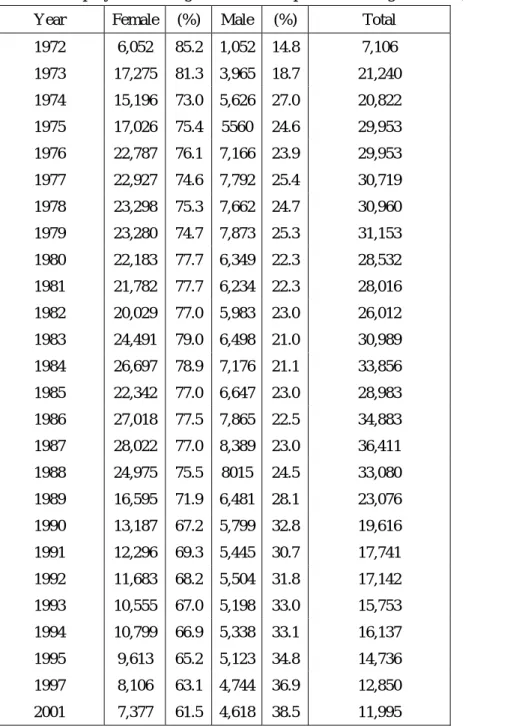
Table 3. Employment Changes in Masan Export Processing Zone (Persons, %)
Year Female (%) Male (%) Total
1972 6,052 85.2 1,052 14.8 7,106
1973 17,275 81.3 3,965 18.7 21,240
1974 15,196 73.0 5,626 27.0 20,822
1975 17,026 75.4 5560 24.6 29,953
1976 22,787 76.1 7,166 23.9 29,953
1977 22,927 74.6 7,792 25.4 30,719
1978 23,298 75.3 7,662 24.7 30,960
1979 23,280 74.7 7,873 25.3 31,153
1980 22,183 77.7 6,349 22.3 28,532
1981 21,782 77.7 6,234 22.3 28,016
1982 20,029 77.0 5,983 23.0 26,012
1983 24,491 79.0 6,498 21.0 30,989
1984 26,697 78.9 7,176 21.1 33,856
1985 22,342 77.0 6,647 23.0 28,983
1986 27,018 77.5 7,865 22.5 34,883
1987 28,022 77.0 8,389 23.0 36,411
1988 24,975 75.5 8015 24.5 33,080
1989 16,595 71.9 6,481 28.1 23,076
1990 13,187 67.2 5,799 32.8 19,616
1991 12,296 69.3 5,445 30.7 17,741
1992 11,683 68.2 5,504 31.8 17,142
1993 10,555 67.0 5,198 33.0 15,753
1994 10,799 66.9 5,338 33.1 16,137
1995 9,613 65.2 5,123 34.8 14,736
1997 8,106 63.1 4,744 36.9 12,850
2001 7,377 61.5 4,618 38.5 11,995
Source: Administration Office, Masan Free Export Zone, The Status of Masan Export Free Zone, 2002.
Table 3 shows the trend of employment by gender in Masan EPZ. Along with the expansion of bonded processing and exports, employment increased rapidly, reaching a peak of 36,411
workers in 1987. It should be noted that throughout the “developmental era” of the 1970s and 1980s, female workers constituted more than 75 percent of total employment and that about 90 percent of them were unmarried young workers under 20 years old [Kang 1986: 36, Kang 1996a:
73]. During the period, the wage levels of female workers were between 41 and 46 percent of those of male workers [Korea Institute for Industrial Economics & Trade 1990: 121] and did not cover minimum living expenses. 10 This clearly demonstrates that the EPZs during the “developmental era” were equivalent to bonded processing and export zones dependent on the cheap labour of young female workers.
Nationwide, the great labour struggle of 1987 was a protest against the primitive labour relations under which workers were not given even basic legal rights of labour, and were paid low wages. The great labour struggle had important repercussions for Masan EPZ. The number of trade unions present in the zone increased from 22 in 1987 to 37 in 1988 to 43 in 1989 and labour disputes frequently erupted between 1987 and 1990. The incidence of labour disputes increased from less than 40 cases in the years up to 1987, to as many as 20 to 30 annually during the three years between 1988 and 1990 [Masan Free Trade Zone Corporate Association 2002: 6]. It is generally considered that the great labour struggle was guided by male production workers engaged in heavy and chemical industries in which the employers were large corporations [Yokota 1994: 64].
But in fact, the main actors in the labour movement in Masan EPZ were young female workers, as is shown by the composition of the workforce.
Labour disputes led to rapid wage increases for all workers, male and female,, and a substantial improvement in working conditions. The average wages of male and female workers were 367,588 won (approximately US$427) and 157,954 won (US$183) respectively in 1986.
They were subsequently raised to 452,000 won (US$571) and 215,000 won (US$271) in 1987 and 734,000 won (US $1,080) and 414,000 won (US$609) in 1989. This meant a 199.7 percent and 262.1 percent increase for males and females respectively over the three years [Korea Institute for Industrial Economics & Trade 1990: 121]. Moreover, the rapid wage increase was accompanied by a decrease in the gender-based wage gap. By 1989, the average wage of women workers had increased to 56 percent of that of male workers.
For Masan EPZ, the change of environment in favour of workers implied a loss of the export competitiveness that had been based on strict government controls over workers and cheap labour costs as incentives. In short, the EPZ was becoming considerably less attractive to foreign investors.
Firms responded to the changed investment environment in a number of ways. These included
10 According to the estimates made by the Federation of Korean Trade Unions, minimum living expenses per female in 1986 amounted to 200,684 won (approximately US$233) whereas the average per capita wage of female manufacturing workers in the Masan EPZ was 157,954 won (US$183) [Cho 1990: 31].
freezing further investment, disinvestment, lay-offs and out-sourcing some of the processing to small and medium units outside the Zone [Kang 1996b: 21]. The decline in employment was further accelerated by the aforementioned upgrading of industrial structure. As Table 3 shows, in the four years between 1987 and 1990, employment in Masan EPZ dropped from 36,411 to 19,616.
The decline was overwhelmingly caused by a sharp decrease in the number of women workers.
Thus female employment decreased from 28,022 in 1987 to 13,187 in 1990. The decline continued in the 1990s among both male and female workers. However, the rate of decline among female was higher than that of male workers and the trend resulted in a fall in the proportion of women workers, from more than 75 percent during the “developmental era” to 65.2 percent in 1995 and 61.5 percent in 2001. Thus, after 1987, Masan EPZ, an earlier bonded processing and exports base drawing on the cheap labour of young women workers was transformed into a production centre that aimed to attract domestic and foreign investment into high-technology and capital-intensive industries.
The above changes are clearly evident in the employment structure of Masan EPZ in 2001.
The average lengths of service of male and female manufacturing workers in Masan EPZ were 12.5 years and 7.8 years respectively. These periods of employment were much longer than the national averages, of 6.4 years and 4.0 years respectively. Moreover, the share of non-regular workers, at 17.9 percent, was also conspicuously lower than the national average of 51 percent [Masan Free Trade Zone Corporate Association 2002:10-11]. These facts are indicative of the employment security and higher skills of workers in Masan EPZ. Accordingly, average monthly wages of male and female workers in 2001 were also higher, at 2,418,000 won (US$1823) and 1,578,000 won (US$1190)respectively, than the national averages of 2,404,000 won (US$1813)and 1,315,000 won (US$992)[Masan Free Trade Zone Corporate Association 2002: 12]. The wage level of women workers in particular, was 20 percent higher than the national average. This reflects the displacement of cheap labour by skilled workers engaged in high-technology and capital-intensive industries producing high value-added goods.
Whereas working conditions in Masan EPZ have improved, the decrease in the number of young women workers, who were main actors in the labour movement, has led to a decline in the number of labour disputes. On average, there were 10 labour disputes per year between 1991 and 1995, but the incidence fell further still, to 4 cases between 1996 and 2000 and 2 cases in 2001 [Masan Free Trade Zone Corporate Association 2002: 6]. The women’s labour movement in Masan EPZ which started with the great labour struggle of 1987 seems to be reaching the brink of extinction.
What has happened to the labour-intensive processes that used to engage young women workers? As already mentioned, some processes are now sub-contracted out to firms that are located outside the Zone. According to some case studies, sub-contracting firms outside the Zone are mostly medium or small scale units with between 10 and 100 workers [Kang 1996b: 22, Cho
1990: 45-46, Masan Free Trade Zone Corporate Association 2002: 12]. In firms such as these, married women are employed at low wages as non-regular workers and their average wages are less than half those of women workers in Masan EPZ. Home-based industries which constitute the urban informal sector are also integrated into the chain of sub-contracting, and pay low wages to married women who make up the core of the labour force. In 2001, there were 258 non-EPZ sub-contacting firms of this kind around Masan, Changwon and Pusan, employing 4,567 workers.
The labour force in these enterprises are not organised at all. We can conclude that since 1987, South Korean export industries that depended on young and low-waged female workers within EPZs during the “developmental era” have created a new low-waged workforce in the medium and small scale sector outside the EPZs. The workforce is comprised of mainly married female workers and because they do not belong to unions, they tend to be left outside legal and institutional jurisdictions.
Some of the domestic as well as foreign companies which pulled out of Masan EPZ have moved to the EPZs of less developed countries that can still offer the comparative advantage of cheap labour. For instance, a Japanese company manufacturing electrical goods, which made an initial investment in Masan EPZ in 1972, shifted its labour-intensive section to Thailand in 1990 and to China in 1999, while retaining the high-technology and capital intensive sections, with its skilled workers, in South Korea. The wage levels of those countries were between a third and one-seventh of those in South Korea [Masan Free Trade Zone Corporate Association 2002: 18].
As globalisation intensifies, the South Korean EPZs are changing in character, and are becoming industrial hubs for capital-intensive and technology-intensive industries. At the same time, they are creating a new structure of sub-contracting and informal sector employment that is beyond the reach of legal and institutional protection. It should be emphasised that in this latter respect, it is mostly women’s labour that sustains low-waged work, and thus a new gender regime has been constructed.
3. EPZs in Bangladesh
3.1 Overview
Bangladesh, which achieved independence in 1971, initially took the course of a public sector-led import-substituting industrial regime. The policy stance towards foreign direct investment was not one of hostility, but FDI was allowed only for joint ventures with public sector units as a minority shareholder. In the mid-1970s, a gradual policy shift began as the result of a worsening economic situation and a change in political leadership. Within a framework of a mixed economic regime that strove to keep the core and strategic sectors in public ownership, greater importance
than before was accorded to the development of the private sector, and an EPZ was established with the aim of inviting foreign direct investment. This initiative was launched as early as in 1976 by the late President Ziaur Rahman at the suggestion of Robert McNamara, the then president of the World Bank [Dowla 1997: 562].11 As Bhattacharya [1998] observes, inception of the EPZ therefore preceded the introduction of policies for liberalising the regulations governing FDI as a whole. In 1980, the Bangladesh Export Processing Zone Authority (BEPZA) Act and the Foreign Direct Investment (Promotion and Protection) Act were passed by Parliament. The first EPZ, established in Chittagong, became operational in 1983 and it was followed by Dhaka EPZ in 1993.
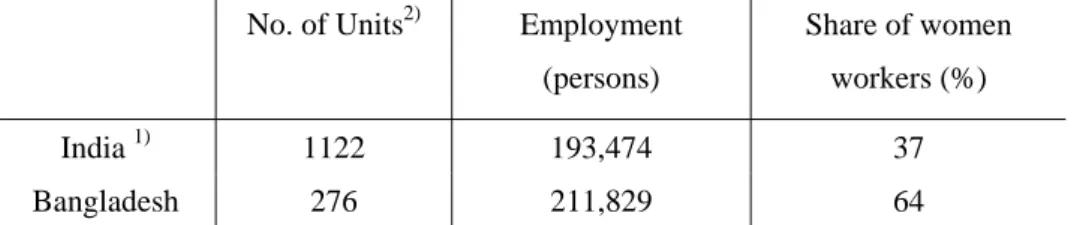
Subsequently six more EPZs were set up and currently two additional EPZs are at the implementation stage.12 While establishing the BEPZA-managed EPZs, the government in 1996 enacted a law allowing the establishment of EPZs by the private sector.13 As of March 2008, some 276 units were located in EPZs and investment and employment figures had reached 1,374.73 million dollars and 211,829 persons respectively. Among the units in operation, 60 percent are wholly foreign-owned while joint ventures and local ventures account for 17 percent and 23 percent respectively. The largest source of investment is South Korea, followed by Bangladesh, Japan and China including Hong Kong. So far as types of manufacturing are concerned, 179 units (64.9 percent) of the EPZ units make garments, textiles and related products, and in terms of investment and employment, this sector accounts for 74.8 percent and 86.0 percent respectively.
The objectives of establishing EPZs in Bangladesh were no different from those that lay behind EPZ formation in other countries and were equally comprehensive. They included promotion of foreign and local investment, promotion of exports, diversification of exports, development of backward and forward linkages, generation of employment, transfer of technology, upgrading of skills, development of management, promotion of international marketing skills and access.14 In order to attract investment, Bangladesh’s EPZs offer generous incentives such as a tax holiday for
11 Actual construction work on the Chittagong EPZ started in 1978, according to a BEPZA source.
12 According to a power-point presentation given by the BEPZA Executive Chairman in May 2008, the 6 EPZs of Mongla, Comilla, Ishwardi, Uttara, Adamjee and Karnaphuli are in operation while 2 more EPZs, Feni and Meghna (Munshiganj), are at the implementation stage.
13 Beginning in 1999, a Korean firm, Youngone Corporation, has invested in the construction of a private EPZ in Chittagong. However, the issuance of an operating licence was suspended until the caretaker government looked into the matter in May 2007 in exchange for signing a Memorandum of Understanding with South Korea regarding manpower exports. In April, 2008, the government granted a 10 years tax holiday to Koran EPZ. Youngone began production in 1978 and has become one of the largest garment manufacturers in Bangladesh.
14 Same source as for note 12.
10 years followed by a reduced tax rate for the next 5 years, duty free imports of construction materials, machinery, spare parts and equipment, duty free exports and imports, relief from double taxation, and exemption from dividend tax. Added to these, firms operating in the EPZs can avail themselves of a Generalised System of Preferences (GSP) facility that Bangladesh enjoys towards several countries and regions. As for the performance of the EPZs, Bhattacharya [1998]
concluded that as of the mid-1990s, although the EPZs were continuing to make a modest contribution to the economy in terms of investment generation, job creation and export earnings, they were definitely demonstrating more dynamism than the rest of the economy. As regards the aforementioned “enclave approach”, Bhattacharya found that the net overall welfare effect of EPZs in Bangladesh was a positive one even after taking into account BEPZA’s loss in terms of capital and administrative costs. At about the same time, Dowla [1997] evaluated the performance of the Bangladesh EPZs in the light of their stated objectives, namely the attraction of foreign exchange earnings, employment generation and technology transfer. He found that the EPZs were successful in terms of the first two criteria.
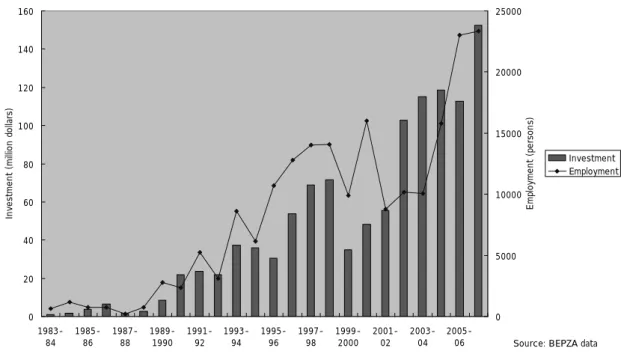
Figure 1. Year-wise investment and employment in Bangladesh EPZs
0 20 40 60 80 100 120 140 160
1983- 84
1985- 86
1987- 88
1989- 1990
1991- 92
1993- 94
1995- 96
1997- 98
1999- 2000
2001- 02
2003- 04
2005- 06
Investment (million dollars)
0 5000 10000 15000 20000 25000
Employment (persons)
Investment Employment
Source: BEPZA data
As the Figure 1 shows, despite some fluctuations, investment and employment in EPZs expanded substantially throughout the 1990s and have continued to grow up to the present time.15 Between 1994/95 and 2006/07, exports from the EPZs increased at an annual rate of 20 percent, or
15 Although there is a need for a more detailed examination, the years in which investment in EPZs dropped coincide with the years preceding general elections. Thus, political uncertainty could be the most plausible of the reasons for lower investment.
almost twice the rate of increase of national exports (11 percent) over the same period. As a result of this trend, the contribution of EPZs to total national exports rose from 6.56 percent in 1994/95 to 17.43 percent in 2006/07. The latest investment figure (US$242.47 million) for the first 9 months of 2007/08 surpasses the amount (US$152.37 million) of the preceding 12 months by almost 60 percent. The government is ever confident that its strategy of promoting EPZs as ‘Asia’s most competitive production base’ is proving to be a successful one. 16
3.2 Labour and Gender Issues in the Bangladesh EPZs
Employment generation is one of the core performance indicators of an EPZ. During the first five years of the 1990s, the rate of job creation in EPZs in Bangladesh was faster than that in organised manufacturing units located in the domestic tariff area (DTA) [Bhattacharya 1998: 11]. The trend continued and even intensified during the latter half of the 1990s. A rough calculation made on the basis of the data from the Census of Manufacturing Industries indicates that formal manufacturing employment including both in the EPZs and the DTA increased at an annual rate of approximately 7.2 percent between 1995/96 and 1999/2000 whereas that within the EPZs expanded at about 21.5 percent per annum. 17 Although there are no comparable recent data available, between 1999/2000 and 2002/03 the annual growth rate of EPZ employment (11.1 percent) was much higher than that of total national manufacturing employment (5.2 percent) [Labour Force Survey 2002-2003].
Female workers currently account for 64 percent of total EPZ employment, a share that is considerably higher than the female share in total manufacturing employment of 39.3 percent, as indicated in the Labour Force Survey of 2002-2003. Thus, in conformity with the pattern that can be observed in EPZs in many other countries, in Bangladesh’s EPZs, female workers predominate.
The high female share in EPZ employment is attributable to a factor that has already been mentioned, namely the primacy of garment manufacturing units in the EPZs. Although using detailed information regarding the gender composition of employment that needs to be updated, Bhattacharya [1998] found that ten years ago, female workers were mostly production workers, and were largely underrepresented among technical and salaried employees. He also found that the share of female workers was higher in fully foreign owned enterprises (75 percent) than in joint ventures (51.7 percent) and local companies (48.6 percent). The preference for female workers
16 Speech made by the Executive Chairman of BEPZA to an investment seminar held in Tokyo, May 2008.
17 The Census of Manufacturing Industries covers manufacturing establishments with ten or more workers. The survey includes all the units registered with the Chief Inspector of Factories under the Factories Act 1934 as well as those that have not yet been registered.
shown by foreign owned units, particularly in the garment industry, was first demonstrated in 1978, prior to the opening of the EPZs, through the case of Desh Garments Ltd., a pioneer garment maker established with South Korean technical collaboration [Rhee 1990]. The successful operation of Desh Garments, which in the socio-cultural context of Bangladesh employed an unprecedented number of females as main production workers, quickly led to the diffusion of the practice among locally owned garment manufacturers.
Although the EPZs have attracted several foreign investors in garment manufacturing, they account for only a small part of the country’s garment industry as a whole. Since the early 1980s, various policy concessions have been given to the export-oriented garment factories. Among the concessions, especially important has been the bonded warehouse facility, which allows duty-free import of inputs relating to the manufacture of fabrics and other garment-related products, and which is said to have created the equivalent of an EPZ at each garment factory location in Bangladesh [Quddus and Rashid 2000: 75]. Presently, there are about 6,000 export-oriented garment factories in Bangladesh, which means that the 65 units that are operating in the EPZs accounts for a mere 1 percent of the total. Nevertheless, the EPZ garment factories do have some distinctive characteristics. First, they are larger than their counterparts outside the EPZs.
Moreover, the EPZ garment manufacturers make a disproportionately large contribution to exports.
According to BEPZA information, garment factories including knitwear in the EPZs contribute 20.40 percent of the total garment and knitwear exports of Bangladesh. Employment in the EPZ clusters of garment-making factories, at 8 percent of total national employment in the sector, is higher than one might expect. Thus, in terms of size of operations, exports and number employed, the EPZ units make a significant contribution.
The second feature of the EPZ garment units is that a high proportion of them are foreign-owned. Among the 119 registered garment enterprises in the EPZs, fully foreign owned companies account for 53.8 percent followed by local firms (27.7 percent) and joint ventures (18.5 percent). Although there is no relevant information available concerning the entire garment sector of Bangladesh, it is commonly acknowledged that the overwhelming majority of the garment firms in Bangladesh are locally owned.18
Comparisons of wages and working conditions between EPZ and non-EPZ garment units show that the employment conditions in the EPZs tend to be far superior [Bhattacharya 1998, Kabeer and Mahmud 2004]. The reasons for this are twofold. First, the EPZ factories tend to be larger and equipped with a better physical infrastructure than the non-EPZ factories. Even though the non-EPZ factories include recently-built establishments that are similar to those in the EPZs, many of the others are smaller enterprises in which employment conditions are relatively backward.
18 Although we were unable to confirm the exact dates, FDI in the garment sector was at one time allowed only within EPZs (The Daily Star, July 5, 2004).
Second, because of the enclave nature of the EPZs, the tasks of BEPZA, which is vested with the responsibility of monitoring labour conditions in all its member firms, can more easily be carried out. As we will see, until recently trade unions were totally banned from operating in Bangladesh’s EPZs. In the absence of collective bargaining, BEPZA operates a minimum wage policy, separate from the one that applies to the rest of the country. Minimum wage rates in the EPZs are higher than the statutory minimum for Bangladesh and higher than those paid by comparable non-EPZ factories.19
The relatively better wages and working conditions in the EPZs, however, should not be taken to imply the absence of labour problems. The BEPZA Act contains a provision whereby the government may, by notification in the official Gazette, exempt an EPZ from the application of all or any of the legal provisions that are in force elsewhere in the country. Most important laws relating to labour and industrial relations were contained within the Employment of Labour (Standing Orders) Act (1965) and the Industrial Relations Ordinance (1969). According to a BEPZA source, in the initial years of EPZ operation, there was no official ban on trade unions, and it was not until a dispute in a Terry Towel factory, in 1986, that the government declared the inapplicability of the 1960s labour laws to the EPZs. 20By offering to provide a union-free environment, this initiative was no doubt taken as an investment incentive. As mentioned earlier, governments in many countries have taken a hostile attitude towards trade union activities being carried out in EPZs, but even so, there have been very few countries that have openly and officially excluded EPZs from national labour legislation and from national systems of labour –management relations [ILO 1998a]. In the absence of trade unions, BEPZA developed an alternative mechanism for the settlement of labour disputes, and the Industrial Relations Department of BEPZA was entrusted with the task of handling disputes. According to Bhattacharya [1998], this procedure worked well, although it left much scope for the kind of improvements that might have created a more congenial environment in the zones, and one that might have been conducive to increasing productivity and a stronger flow of investment. Dowla [1997] took a more critical view of the BEPZA-controlled procedure, and pointed out that BEPZA’s Industrial Relations Department has been accused of creating work-related problems with an aim of collecting bribes from investors.
In his view, the higher wages offered in the EPZ have been offset by weak job security and by
19 The minimum wages in the EPZs, applicable irrespective of sectors, range between US$ 22 and US$ 63 according to different categories. Moreover, other benefits such as conveyance allowance, house rent medical allowance, maternity benefit, festival bonus and overtime benefit have to be paid. On the other hand, the statutory minimum wages for garment workers was raised in October, 2006 for the first time in12 years. These range from Tk.1200 (approximately US$18) to Tk.5140 (US$75) including not only basic salary but also house rent and other allowances.
20 An interview with the then BEPZA executive chairman, August 2005.
inadequate medical benefits at shop-floor level.
External pressure for allowing trade unions into the EPZs came mainly from the United States and the ILO. It was the American government that finally pushed the Bangladesh government to review its policy. In 1991, the United States, the largest single-country market for Bangladesh’s garment exports, granted Bangladesh duty-free access to the American market for certain export items under a GSP. In the same year, the American Federation of Labour and Congress of Industrial Organization (AFL-CIO) filed an initial petition with the U.S. Trade Representative (USTR) concerning the Bangladesh government’s denial of freedom of association and other core ILO standards in the Bangladesh EPZs. In 2001, Bangladesh was granted a three-year extension of the GSP on condition that it allowed trade unions to operate in the EPZs from January 1, 2004.
Meanwhile, major foreign investors including Japanese and South Korean firms protested strongly against the move to allow trade unionism in the EPZs. In January 2004, AFL-CIO called upon the USTR to withdraw the GSP benefits as a result of Bangladesh’s failure to implement the commitments. Caught between two conflicting pressures, in July 2004, the government enacted the EPZ Workers Association and Industrial Relations Act, which allowed the formation of a transitory organ, the Workers Representation and Welfare Committee (WRWC) with elected representatives to interact with management on different issues pertaining to the welfare of the workers. The Act stipulates that the WRWC will cease to exist as soon as a Workers’ Association is formed in that unit after the beginning of November 2006.
In line with the said schedule, in March 2008, “trade unions” in the name of Workers’
Associations were formed in the 69 industrial units in the Dhaka and Chittagong EPZs. The main difference between the WRWC and Workers’ Associations is that the latter can negotiate with the management on wages, hours of work, and other terms and conditions of employment. Whether or not to have a Workers’ Association is a question that is resolved by way of a referendum held among the eligible workers. The workers of 22 units have voted for not having a Workers’
Association at least for another year. It is reported that despite the reluctance of owners, BEPZA pushed for referendums to be held, in response partly to mounting pressure from an American labour group.21 While the government appeased the pro-trade union groups by passing the legislation, the Act nevertheless imposed certain restrictions on the operation of Workers’
Associations. Important among these is to the prohibition of linkages with political parties and a moratorium on strikes or lockouts until October, 2008. In April 2008, the government decided to extend the ban on strikes and lockouts for another two years.
It should be noted that an abhorrence of trade unions, and a reluctance to accept them, are attitudes rooted in a widespread perception that trade unions in Bangladesh are highly politicised.
It is widely believed that the fragmented trade unions affiliated to different political parties do little
21 The Daily Star, March 23, 2008.
to advance the interests of workers and are not concerned with the establishment of sound industrial relations. On the whole, the garment industry has been relatively “free” from conventional trade unions because it is an industry dominated by young and mostly migrant female labour whose bargaining position vis-à-vis management is severely constrained. In that sense, the EPZ experience of having officially endorsed “trade unions”, however limited they may be, will offer an important test case as to whether Bangladesh can develop effective labour activism in the coming years. The increasing incidence of labour unrest in the garment factories began in the Dhaka EPZ in May, 2006. What is now needed is a rigorous examination of how the alternative mechanisms of facilitating industrial relations such as the WRWCs /Workers’ Associations have affected the changed industrial scene.
4. EPZs/SEZs in India
4.1 Overview
India was the first country in Asia to set up an EPZ in the form of the Kandla (Gujarat) EPZ, established in 1965. Despite its early engagement with the EPZ concept, India, unlike South Korea and Taiwan, have not been seen as a notable proponent of ‘successful’ cases of EPZs in Asia.
It is often argued that India failed to attract foreign investment as a result of strict government controls, although the situation improved slightly with the establishment of the Santa Cruz Electronics EPZ (Maharashtra) in 1974, which has contributed to the country’s exports of electronics products [Wong and Chu 1984: 5-7 11, Rondinelli 1987: 94]. 22 The share of the seven EPZs-turned-SEZs (we will discuss the transition to SEZs in due course) in total private investment is still low, and amounted to only 22 percent as of June, 2008. Thus far, the contribution of the EPZs to India’s total exports has remained less than 5 percent.
Kundra [2000: 26, 41, 65] states that the Indian EPZs lacked clear objectives until 1988 when it was decided that their main role was to provide an internationally competitive environment for the manufacture of exports. Until 1986, only two EPZs, Kandla and Mumbai, were in operation.
There were demands from some other states for similar zones. The Cabinet Committee on Economic Policy and Coordination considered the proposals for more EPZs in 1976 but did not favour additional zones as the performance of the zones at Kandla and Mumbai had not been encouraging. In 1980, a Committee, popularly known as the Tandon Committee, was set up to formulate policy measures for accelerating the progress of free trade zones and 100 percent Export
22 Aggarwal [2006] states that Santa Cruz EPZ also laid the foundations for the development of the modern jewellery industry in India.
Oriented Units. By that time, the performance of Kandla and Mumbai EPZs had substantially improved and the Committee recommended establishing six or seven EPZs to provide a fillip to the country’s export promotion efforts. The New Electronics Policy initiated in 1984 under the then Prime Minister India Gandhi also considered the increased use of EPZs to promote electronics exports and technology transfer [Girdner 1987: 1193]. Subsequently four EPZs, namely Cochin, Chennai, Falta and Noida, were approved and became operational during 1985-86. Vishakhapatnam EPZ was approved in 1989 and was commissioned in 1994. Initially, EPZs could be set up and managed only by the central government, and state governments had no role in their administration.
Investment approvals were centralised until 1991 [Kundra 2000: .42]. In 1994, the policy was changed to enable state governments, autonomous agencies and the private sector to develop infrastructure for new zones and strengthen infrastructure in the existing zones. Surat SEZ was established in 2000 as the first private EPZ in India.
India’s renewed interest in EPZs has become more conspicuous in recent years. In 2000, the Special Economic Zones Policy was announced and was followed by the Special Economic Zones Act, 2005, which came into effect on 10th February, 2006. The aforementioned seven EPZs established by the central government were converted into SEZs along with the state/private SEZs notified prior to the enactment of the SEZ Act in 2005. Currently there are 19 of these SEZs. In addition, in line with the Act, 250 new SEZs were notified as of 11th August, 2008.23 At the time of writing (August 2008) some 1,897 units are in operation in the SEZs. Of these, 1,141 units are located in SEZs that were established prior to the Act coming into force. They provide direct employment for nearly 350,000 persons, of whom 199,000 are employed in the seven EPZ-turned-SEZs. The share of female workers is about 30 percent.
India’s seemingly sudden keen enthusiasm for SEZs after a lull of more than three decades has been explained as a manifestation of the neoliberal discourse [Sampat 2008]. A more down-to-earth explanation is given by Aggarwal [2006], who argues that the government reverted to EPZs in the expectation of separating them out from the rest of the economy and making them engines of growth. The “successful” example of China was a major inducement for the change in government policy. The main difference between an SEZ and EPZ is that the former is an integrated township with a fully developed infrastructure, whereas an EPZ is just an industrial enclave.24 This difference has become the subject of heated argument over the SEZs, which by
23 Figures have been obtained from the official website of the Department of Commerce, Ministry of Commerce and Industry (http://sezindia.nic.in/welcome.htm).
24 Additional concessions given to SEZs over EPZs include (1) no requirement of minimum net foreign exchange earnings; (2) no license required for manufacturing items reserved for the small scale sector; (3) sub-contracting of part of the production abroad permitted; (4) unlimited sales to the domestic tariff area on payment of duty; (5) export proceeds may be brought back within 365