Infrastructure development and economic growth in China
著者 Sahoo Pravakar, Dash Ranjan Kumar, Nataraj Geethanjali
権利 Copyrights 日本貿易振興機構(ジェトロ)アジア
経済研究所 / Institute of Developing
Economies, Japan External Trade Organization (IDE‑JETRO) http://www.ide.go.jp
journal or
publication title
IDE Discussion Paper
volume 261
year 2010‑10
URL http://hdl.handle.net/2344/923
1
INSTITUTE OF DEVELOPING ECONOMIES
IDE Discussion Papers are preliminary materials circulated to stimulate discussions and critical comments
Key words: China, Infrastructure development, investment, Output growth.
JEL Classifications: O1, H4, H54, L9.
* Associate Professor, Institute of Economic Growth, Delhi and Visiting Researcher, Institute of Developing Economies, Japan. Email: [email protected]
**Fellow, Indian Council for International Economic Relations (ICRIER), Delhi.
*** Senior Economist, National Council for Applied Economic Research (NCAER), Delhi.
IDE DISCUSSION PAPER No. 261
Infrastructure Development and Economic Growth in China
Pravakar Sahoo*
Ranjan Kumar Dash**
Geethanjali Nataraj***
October 2010
Abstract
China is the fastest growing country in the world for last few decades and one of the defining features of China's growth has been investment-led growth. China's sustained high economic growth and increased competitiveness in manufacturing has been underpinned by a massive development of physical infrastructure. In this context, we investigate the role of infrastructure in promoting economic growth in China for the period 1975 to 2007. Overall, the results reveal that infrastructure stock, labour force, public and private investments have played an important role in economic growth in China. More importantly, we find that Infrastructure development in China has significant positive contribution to growth than both private and public investment. Further, there is unidirectional causality from infrastructure development to output growth justifying China's high spending on infrastructure development since the early nineties. The experience from China suggests that it is necessary to design an economic policy that improves the physical infrastructure as well as human capital formation for sustainable economic growth in developing countries.
2
The Institute of Developing Economies (IDE) is a semi governmental, nonpartisan, nonprofit research institute, founded in 1958. The Institute merged with the Japan External Trade Organization (JETRO) on July 1, 1998.
The Institute conducts basic and comprehensive studies on economic and related affairs in all developing countries and regions, including Asia, the Middle East, Africa, Latin America, Oceania, and Eastern Europe.
The views expressed in this publication are those of the author(s). Publication does not imply endorsement by the Institute of Developing Economies of any of the views expressed within.
INSTITUTE OF DEVELOPING ECONOMIES (IDE), JETRO 3-2-2, WAKABA,MIHAMA-KU,CHIBA-SHI
CHIBA 261-8545, JAPAN
©2010 by Institute of Developing Economies, JETRO
No part of this publication may be reproduced without the prior permission of the IDE-JETRO.
3
I. Introduction
The role of infrastructure for economic development has been well documented in the literature (Aschauer, 1989; Munnell, 1990; World Bank, 1994; Calderon and Serven, 2003; Estache, 2006; Sahoo and Dash; 2008; 2009). Infrastructure development, both economic and social, is one of the major determinants of economic growth, particularly in developing countries. Direct Investment on infrastructure creates (i) production facilities and stimulates economic activities; (ii) reduces transaction costs and trade costs improving competitiveness and (iii) provides employment opportunities to the poor.
In contrast, lack of infrastructure creates bottlenecks for sustainable growth and poverty reduction.
China is the fastest growing country in the world for last few decades and accounts for nearly one fifth of the world population. Economic growth in China increased from 7.5%
from 1970 to 1999 to over 10% per annum between 1999 to 2008 mainly driven by sustained increase in gross domestic capital formation. China has undergone a remarkable transformation and China‟s population living at less than $1 a day drastically reduced to 13.4% in 2003 and further to 8 per cent in 2009 from 60% in 1980.
Over the past two decades, one of the defining features of China‟s growth has been investment led growth supported by domestic savings. China‟s sustained high economic growth and increased competitiveness has been underpinned by a massive development of physical infrastructure (Chatterjee, 2005; Stephane et al. 2007). However, China needs to maintain its growth momentum in a sustainable manner to improve the overall standard of living of poor people and reduce regional inequality.
4
The rural economic reform of the late 1970s and early 1980s led to increases in rural labour productivity and a large surplus labour force to enter the manufacturing and service sectors. The open economic policy made it possible for the inflow of foreign direct investment (FDI) mainly to the manufacturing sector. Cheap labour and better than adequate infrastructure were both required for the export-led growth strategy. With seemingly unlimited supply of cheap labour from the rural sector, public investment in infrastructure became the keystone in the strategy. A major focus by the government at all levels on infrastructure thus ensued1. The functional and fiscal decentralization associated with the 1994 tax administration reform dramatically increased the incentives and financial capacity of the sub-national governments for infrastructure development. A series of institutional reforms significantly helped transform the bureaucratic system to one that is highly pro-business. Other measures, such as the simplification of government review and approval procedures and the introduction of performance criteria, helped increase the government capability for implementation of infrastructure projects 2(Liu, 2005).
Though infrastructure development certainly helped export-led economic growth in China, the Chinese economy started showing signs of overheating in recent years because of basic infrastructure constraints. Clearly, there is a wide gap between the potential demand for infrastructure for high growth and the available supply. Given the importance of infrastructure development for sustainable economic growth and poverty
1 Infrastructure development is one of the major determinants of FDI inflows, see Sahoo (2006).
2 Some problems were also encountered in the process of infrastructure development which included Wasteful investment, abuse of public funds, excessive conversion of agriculture land for urban construction, destruction of environment, neglect of social impact etc. Some of the problems have been looked into and some remain.
5
reduction in China, the present study examines the output elasticity of infrastructure development in China for the period 1970-20083. Unlike cross section or panel data studies on large number of countries where each country may not be a representative sample, the present study is country specific study focusing on China4. Further, previous literature on the growth effects of infrastructure focuses on one single infrastructure sector/indicators5 where as the present study develops a composite index of a stock of leading physical infrastructure indicators to examine the impact of infrastructure development on output growth. The empirical analysis takes care of issues of reverse causation and a spurious correlation due to non-stationarity of the data for robust estimates.
Rest of the paper is structured as follows: In section 2, we briefly discuss infrastructure development in China. Section 3 presents review of literature. Section 4 deals with theoretical framework, construction of the Infrastructure Index and data sources.
Section 5 analyses the empirical results. Finally, conclusions and policy implications are presented in section 6.
II. Infrastructure in China
II.1 Macro-economic overview of China: Since 1978, China has pursued a policy of gradual transition from a centrally planned to a market-based economy coupled with an
3 Our analysis is motivated by seminal work of Aschauer (1989) on the relative productivity of private and public capital.
4 There have been few studies examining different aspects of the role of infrastructure for economic growth in case of China (see the section- review of literature).
5 Some papers do this by design, e.g., Röller and Waverman (2001) evaluate the impact of telecommunications infrastructure on economic development, and Fernald (1999) analyzes the productivity effects of changes in road infrastructure.
6
“open door” policy that has involved substantial liberalization of its international trade and investment regimes. This strategy has delivered sustained and high economic growth averaging about 10 per cent annually between 1978 to 2008, and has seen GDP per capita increase fifteen fold from around US$ 220 to US$ 3,400. In recent years, the Chinese economy has been well placed with high domestic savings; buoyant international trade and surplus in external sector (see table-1). The sustained economic growth in China is mainly driven by a continuous rise in domestic savings and gross domestic capital formation. China‟s savings and investment rates are 50% and 43 % of GDP respectively, highest among the developing countries. However, China‟s dependence on export-led growth has led to decline in its growth rate since 2008 due to in fall external demand owing to the global economic crisis6. However, unlike other WTO members, China in general resisted a protectionist response to the effects of the global economic crisis and maintained its long term strategy of opening up its economy to international trade and FDI. The Chinese government responded to the crisis with a large economic stimulus package designed to boost domestic demand by investing in infrastructure and public services to help sustain economic growth.
Table-1: Select Macro Economic Indicators (2005-2009)
2005 2006 2007 2008 2009 Nominal GDP (US$ billion) 2256.9 2712.9 3494.0 4519.5 4909.0 GDP per capita (US$) 1731.1 2069.3 2651.3 3411.8 - Savings as a percentage of GDP 46.8 47.3 50.7 51.4
Current account balance as % of GDP 7.1 9.2 10.6 9.4 5.8
Growth of exports 28.5 27.2 25.8 17.6 -16.1
6 In 2009, China’s exports fell by 16 per cent and its imports fell by 11 percent, reflecting the high import intensity of its manufacturing export sector. Real GDP growth declined from 9.6 per cent in 2008 to a year-on-year rate of 6.2 per cent in the first quarter of 2009, the lowest rate in more than a decade. (TPR of WTO, China, 2009).
7
Growth of imports 16.2 20.3 29.0 22.1 -
Forex (US$ billion) 818.9 1066.3 1528.2 1946.0 2399.2 Total external debt (US$ billion) 281.0 323.0 373.6 374.7 -
Source: WTO, Trade policy review of China, 2009.
II.2 Infrastructure Development in China: Over the past two decades one of the defining features of China‟s growth has been investment led growth supported by domestic savings and foreign direct investment. It is not investment per say that has been driving the current boom, but the investment in infrastructure, which was around 14 % of GDP in 2006, has played an important role (see Table-1A7). China‟s sustained high economic growth and increased competitiveness has been underpinned by a massive development of infrastructure, particularly in nineties.
The bulk of infrastructure financing in China comes from three broad channels. These are direct budget investment from fiscal resources, borrowing and market based financing. Direct budget expenditures on urban infrastructure include spending at the central, provincial and local levels from fiscal resources. Because urban infrastructure is also a local (sub-provincial) responsibility, a vast majority of spending is done by local governments. A second source of direct public financing is off-budget fees. These fees are generally arbitrary fees levied on such items as construction permits and various authorizations for domestic and international business operations (see Table-2A).
Nonetheless, they provided a source of unrestricted local income that often was challenged into infrastructure investments. Third, the financing gap created by the decline in direct budgetary spending on infrastructure was filled in by borrowing and market based financing. Since most of the banks were state-owned, they were encouraged, as a national policy, to lend for infrastructure projects and urban
7 All tables with suffix A (like Table-1A, Table-2A……) are given in Appendix.
8 infrastructure development.
However, financing of infrastructure in China from the state and central budget has been declining steadily as sub-national governments have gained more and more autonomy in the development decision making process. Provincial and local governments have turned aggressively to alternate ways for raising resources to finance infrastructure development. As a result, the overwhelming proportion of resources for investment comes from the „self raised and other funds‟ of local governments and other allied bodies. These funds comprising largely of a combination of enterprise retained earnings and extra budgetary revenues of different kinds, accounted for 75% of the total investment financing in 2006. The extent of private and foreign investment in infrastructure development has been very little. FDI inflows into infrastructure have been very modest – with the FDI accounting for less than 2% of the capital funds invested in infrastructure in 20068.
Infrastructure service provision is currently dominated by government departments and state owned enterprises in developing countries like China and India. The reason for China‟s better performance is because of its ability to get reasonable returns, profitability, and implementation ability. Unlike in India where bureaucracy operates in a framework that does not encourage risk-taking (Nataraj, 2007), Chinese state owned enterprises are actively encouraged to deliver results and take risks9. A comparative
8 One of the reasons for limited private sector participation in the development of infrastructure is that the NDRC has retained centralized control on planning while decentralizing responsibility for building of infrastructure on local government. The high level of political risk and lack of certainty on tariff regulation has discouraged private infrastructure investment.
9 Further, governments in a representative democracy like India are subject to huge
9
picture of infrastructure development is reported in Table-3A. In China, the incentives between government and bureaucracy, and by extension, the management of state owned enterprises seem aligned – the politicization of the government machinery turns out to be a good thing and effective for delivering results10.
When the East Asian countries were fighting economic crisis in 1997/98, the Chinese government implemented a fiscal stimulus program under which the Central Government provided transfers to local governments and introduced the issuance of state debt to fund infrastructure. This is also in sharp contrast to other East Asian countries where investment infrastructure fell sharply in the aftermath of the Asian Crisis. Infrastructure led fixed capital formation more than doubled from 5.7% of GDP in 1998 to over 14% in 2005, and the share of infrastructure in total investment ballooned to almost one-third of gross capital formation in 2006. The emergence of China as the world factory would not be possible without a range of new economic infrastructure services in place. The open economic policy with infrastructure availability and cheap labour attracted huge inflow of foreign direct investment (FDI) mainly to the manufacturing and service sectors leading to export-led and productivity led growth.
There are a number of players in the infrastructure policy making and planning processes at the central level. The organizational structure for infrastructure development in China is very systematic and dynamic (see Fig.1). The planning system populist pressures often leading to overstaffing or becoming vehicles for political patronage rather than effective suppliers.
10 While in India, the relationship between the government and the bureaucracy seems more contentious. The politicization of the bureaucracy is a corrosive phenomenon that undermines professionalism and performance.
10
for infrastructure development consists of socioeconomic planning and sectoral planning at all levels of government, and urban planning at the municipal level. The time frames for socioeconomic and sectoral plans include long-term, medium-term (i.e. five-year) and annual plans. Urban master plan usually covers a time span of 20 years. The National Development and Reform Commission (NDRC, formerly National Planning Commission) are at the core of the planning machinery and formulate economic development strategies, five-year plans and annual plans. It organizes and coordinates the implementation of plans for infrastructure development across states11.
Overall, China has been successful in developing its infrastructure to improve the competitiveness of its economy in general, particularly in the manufacturing sector and attract huge foreign direct investment. In this backdrop, it would be useful to examine the contribution of infrastructure development and the role of public and private investment in infrastructure to economic growth in China.
III. Brief Review of Literature
The empirical research on role of infrastructure in economic growth started after the seminal work by Aschauer (1989) where he argued that public expenditure is quite productive, and the slowdown of the U.S productivity was related to the decrease in
11 This leadership role in implementation is needed, because the actual implementation functions rest with a number of line ministries and lower level governments and because of the sheer size of China, its institutions pose high risk and things could easily go out of control. In addition to its planning and implementation role, NDRC is part of the top policy making mechanism. Along with the Development Research Center of the State Council, NDRC serves as one of the primary think tanks on development policy issues for the CPC and the State Council. At the same time, it carries out its planning and policy coordination functions under the national policy framework set up by the CPC.
11
public infrastructure investment. Subsequently Munnell (1990), Garcia-Mila and McGuire (1992), Uchimura and Gao (1993), found high output elasticity of public infrastructure investment though comparatively lower than Aschauer. Criticising these earlier studies12, there has been a flurry of empirical tests on the link between infrastructure and economic growth after controlling other variables affecting growth.
For example, Sturm et al. (1998) show that the literature contained a relatively wide range of estimates of output elasticity of public investment in infrastructure viz., with a marginal product of public capital that is much higher than that of private capital (Aschauer, 1989; Khan and Reinhart 1990); roughly equal to that of private capital (Munnell, 1990); well below that of private capital (Eberts, 1986); and negative contribution of public investment (Hulten and Schwab 1991, Deverajan, Swaroop and Zou, 1996 and Prichett, 1996). Another focus in the literature is on optimal and efficient use of infrastructure for economic growth. Hulten (1997) and Canning and Pedroni (2004) emphasize that there is an optimal level of infrastructure maximizing the growth rate and anything above would divert investment from more productive resources, thereby reducing overall growth. The wide range of estimates make the results of these studies almost irrelevant from a policy perspective (see table-4A).
However, the study by Romp and De Haan (2007) which summarizes earlier studies and suggests that public capital may, under specific circumstances, raise income per capita
12 However, most of the early studies were criticized on three grounds: (a) methodological background i.e. reverse causation from productivity to public capital and a spurious correlation due to non-stationarity of the data12 (Gramlich, 1994 and Garcia-Milà et al. 1996), (b) results are mostly based on the studies on developed countries and (c) increases in public capital stocks could be the result of higher public investment caused by higher income levels or by an omitted third variable (Holtz-Eakin, 1995).
12
in general. Although growth-enhancing impact of public capital differs across studies, there is more consensuses that public capital furthers economic growth.
Studies on the role of infrastructure in China‟s success story are few and most of them are at state level using panel data analysis. Démurger (2001) examines the role of infrastructure in growth performance across 24 provinces in China and concludes that infrastructure endowment along with reforms openness, geographical location account significantly for observed differences in growth performance across provinces. Further, the results reveal that transport facilities are a key differentiating factor in explaining the growth gap. Similarly, Jalan and Ravallion (2002) find that increase road density has a significant positive effect on the consumption expenditure of rural farm households in poor regions of China. Fan and Chan-Kang (2004) estimated the effect of quality of roads on growth and poverty reduction in China by using provincial-level data for 1982-1999. Contrary to usual findings, the study finds that the impact of investment in lower quality roads is 4 times higher than that of high quality roads both in rural and urban areas. In terms of poverty reduction, the impact from low quality roads is larger than the corresponding impact from high quality roads in both rural and urban areas.
On the other hand, Ding and Haynes (2004) find a positive and statistically significant impact of telecommunications infrastructure (both fixed and mobile) on regional economic growth in China for the period 1986-2002. The results are robust even after controlling for investment, population growth, past levels of GDP per capita, and lagged growth. Further, Shiu and Lam (2004) found that real GDP and electricity consumption for China have long term equilibrium relations and there is unidirectional Granger causality running from electricity consumption to real GDP.
13
On the issue of human capital, studies by Mankiw, Romer, and Weil, (1992) and Barro (1991) have shown that accumulation of human capital improves economic growth through many channels and externalities. Lucas (1988) was one of the first authors that considered human capital as an alternative to technological process to improve growth.
Social infrastructure such as education, health, and housing is essential to promote better utilization of physical infrastructure and human resources, thereby leading to higher economic growth and improving quality of life (Hall and Jones, 1999).
Overall, the brief review suggests that the effect of public capital or infrastructure differs across countries, regions, and sectors depending upon quantity and quality of the capital stock and infrastructure development. A further source of variation is the theoretical framework used in the analysis13. In this context, we examine the contribution of infrastructure and human capital to economic growth in China at macro level.
IV. Theoretical Framework, Infrastructure Index and Data Sources
Existing empirical studies on the contribution of public and private investment to economic growth are essentially based on the production function framework. Assuming a generalized Cobb-Douglas production and extending the neoclassical growth model to include infrastructure stock/public capital as an additional input of the production function along with private capital and labour, the production function is written as
13 Stephane (2007) observes that a positive effect of infrastructure on growth is more likely to be detected in studies based on a production function than studies using cross-country regressions.
14 follows:
Y
t= f (K
pvt, K
pub,LF
t, I
t) . . . (1)
Where Yt is gross output produced in an economy using inputs such as private (Kpvt) and public capital (Kpub), labour force (LFt) and supporting infrastructure stock (It). The equation (1) specifies that the output growth depends on both private investment and public investment rate. This generalised form of (Eq.1) is open to the possibility of constant returns to scale as suggested by Solow-type models (Solow, 1956). On the other hand, the model also admits the possibility of constant or increasing returns to capital–in this case disaggregated into private and public capital-as suggested by some endogenous growth theorists (Romer, 1987). The possibility of a long-run impact of infrastructure on income depends on whether the data are generated by a neoclassical growth model or an endogenous growth model. In the exogenous growth model wherein technical progress drives long-run growth, shocks to the infrastructure stock can only have transitory effects. However, shocks to infrastructure can raise the steady-state income per capita in an endogenous growth model. Besides, social capital and human capital are also important for economic growth (Lucass, 1988; Barro, 1991)14. Higher public expenditure on social infrastructure induces more literacy, better health and manpower skill, which leads to higher productivity and growth. In order to assess the impact of human capital on growth, we consider public expenditure on health and
14 Mankiw, Romer and Weil (1992) state that: "particularly for the developing countries, investment in human capital also becomes more quantitatively important when a more open trading environment and a better public infrastructure are in place."
15
education15. Finally, we estimate the following equations to empirically examine the impact of infrastructure stock on output in China
Ln GDPt = i + it + 1 ln Kpvtt+ 2ln Kpubt + 3 ln LFt + 4 ln Indext + 5 ln HEexpt + et (2)
where GDP is real gross domestic product, Kpvt
tis domestic private investment; Kpub is domestic public investment, LF is total labour force, Index is infrastructure index and HEexp is per capita real public expenditure on health and education. The expected sign of (
1,
2,
3,and
4) is > 0.
Infrastructure Index: The empirical literature examining the impact of infrastructure on growth uses variety of definitions of infrastructure development such as infrastructure investment or some indicators of physical infrastructure. However, a composite index of major infrastructure indicators has been developed to examine the impact of infrastructure stock on growth. We use Principal Component Analysis to create the infrastructure index by taking six major infrastructure indicators such as (1) Per capita Electricity Power consumption; (2) Per capita Energy use (kg of oil equivalent); (3) Telephone line (both fixed and mobiles) per 1000 population; (4) Rail Density per 1000 Population; (5) Air Transport, freight million tons per kilometer; and (6) Paved road as percentage of total road.
The Eigen values and respective variance of these factors are as given in Table-5A. The first factor or principal component has an Eigen value larger than one and explains over two thirds of the total variance. There is a large difference between the Eigen values and variance explained by the first and the next principal component. Hence, we choose
15 Since it is difficult to get compatible and reliable time series data on social indicators, we have considered public expenditure on health and education.
16
the first principal component for making composite index representing the combined variance of different aspects of infrastructure captured by the six variables. The factor loadings for each of the five original variables are given in Table-6A.
Data Source:
Annual data on Gross Domestic Product, public expenditure on health and education, and total labour force are taken from World Development Indicators CD-ROM, World Bank, 2009. Data on Private and public investment are taken from International Financial Corporation (IFC). These variables have been taken in real terms
by
dividing GDP deflator (base 1999-2000=100)
.Labour force is taken according to the ILO definition of the economically active population that includes both the employed and the unemployed. Six
Infrastructure variables considered for infrastructure index are taken from World Development Indicators, various years. The study period is 1975-2007.V. Econometric Analysis
The empirical research evaluating the impact of infrastructure on output growth always comes across the problem of endogeneity. It has been debatable whether infrastructure development leads to increases in productivity, efficiency and competitiveness and thereby output growth or output growth necessitates overall infrastructure development.
Given this reserve causality and possibility of more than one endogenous variable, we use
16Autoregressive-distributed lag model (ARDL) developed by Pesaran et al. (2001) and Generalised Methods of Moments (GMM) developed by Hansen (1982). The error correction version of the ARDL model of Eq. (2) is formulated as follows:
16 We have not given ARDL and GMM in details as these methodologies have been well established by now. However, we can produce detail methodology section if required.
17 (3) u
HE β ln Index
ln β10
LF β ln GDIp ub βln
GDIp vt β ln
GDP β ln
HE Δln β Index
Δln β
lnGDIp ub Δ
β GDIp vt
Δln β LF
Δln β GDP
Δln β α ΔlnGDP
t i t 11 i t
i t 9 i - t 8
i t 8
i t 7
i t p
1 i
6i i
t p
1 i
5i
t p
1 i
4i i
t p
1 i
3i i
t p
1 i
2i i
t p
1 i
1i 0
t
The existence of the long run relationship is confirmed with the help of an F-test that tests. The null hypothesis (H0) in the equation is β6 = β7 = β8 =β9 = β10 = β11 =0, which means the non-existence of the long run relationship. The ARDL approach compute two sets of critical values for a given significance level. One set assumes that all variables are I(0) and the other set assumes they are all I(1). If the computed F-statistic exceeds the upper critical bounds value, then the H0 (null hypothesis) is rejected. If the F-statistic falls into the bounds, then the test becomes inconclusive.
Granger Causality: The Vector Error Correction (VECM) procedure: Our next step is to ascertain the direction of causality between infrastructure development and output. If all the variables are found to be integrated of order one, vector error correction procedure can be used to see the direction of causality between output and infrastructure development in China. The general model for Granger causality for I (1) (see Engle and Granger, 1987) variables is given as:
t t j
t j p
j i t i p
i
t Y X Y X U
Y
1 11 1
1
)
(
(4)
' 1 1
1 1
1
)
( t t
j t j p
j i t i p
i
t Y X Y X U
X
(5)
where the lagged ECM term (Y-X)t-1 are the lagged residuals from the co-integrating relation between Y and X . As Engle and Granger (1987) have argued, failure to include the ECM term will lead to mis-specified models which can lead to erroneous conclusions about the direction of causality. Thus, if Yt and Xt are I(1) and cointegrated, Granger causality tests can be carried out using (4) and (5). However, there are now two sources of
18
causation of Yt by Xt, either through the lagged dynamic terms Xt if all the i are not equal to zero, or through the lagged ECM term if is non-zero (the latter is also the test of weak exogeneity of Y). Similarly, Xt is Granger caused by Yt either through the lagged dynamic terms Xt if all the i are not equal to zero, or through the lagged ECM term if is non-zero.
VI. Empirical Results
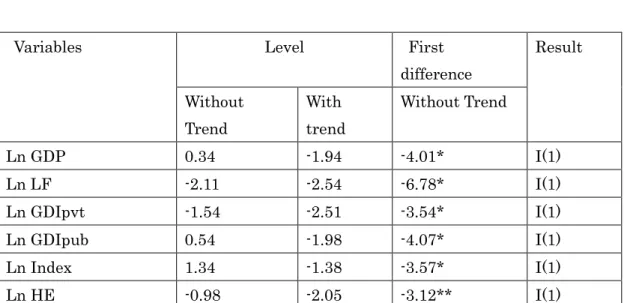
The augmented Dickey-Fuller test is used to test for the existence of unit roots and determine the order of integration of the variables. As reported in Table-7A, all variables are non-stationary in levels but stationary at first difference [integrated of order one, or I(1)]. Since all variables are integrated of same order [ I (1)], next we use autoregressive-distributed lag ARDL method developed by Pesaran et al. (2001) to find out long-run relationship among the relevant variables. The results reveal that F-statistic (F=9.43) exceeds the upper bound critical value (4.35) at the 5% levels17 establishing long-run relationship between GDP (dependent variable) and other relevant variables (independent variables). Similarly, the null of no cointegration is rejected (F=5.87) when infrastructure indexis selected as the dependent variable. Thus, the null of non-existence of stable long-un relationship is rejected.
Next we proceed to estimate long-run elasticites by using ARDL and GMM procedures.
Various specifications of equation (2) were estimated using annual data for China during 1975-2007 and reported in table-2 below. It is clear that all the coefficients show the
17 The relevant critical value bounds are obtained from Table C1.iii (with an unrestricted intercept and no trend; with three regressors) in Pesaran et al. (2001). They are 2.72-3.77 at 90%, and 3.23- 4.35 at 95%. ** denotes above the 95% upper bound. The order of ARDL (2,0,2,0,1) is selected on the basis of Akike Information Criteria (AIC).
19
expected sign and are statistically significant. It can be seen that the various equations have a relatively high degree of explanatory power as measured by their adjusted coefficients of determination, and more importantly, the DW-statistics suggest that serial correlation is not a problem in the sample data.
Table-2: Long-run Coefficients (Dependent log of Real GDP)
Variables Long-run coefficients (ARDL) Long-run coefficients (GMM)
1 2 3 4 5 6
constant 2.20
(1.50)
1.18 (1.68)
6.90*
(2.38)
-4.38**
(-8.64)
-2.18 (-1.28)
-1.90 (-1.38) Ln Index 0.34*
(2.57)
0.31**
(2.92)
0.27*
(1.97)
0.41*
(2.43)
0.36**
(2.92)
0.30*
(2.33) Ln GDIpvt 0.17*
(2.54)
- 0.15**
(3.70)
0.09*
(2.54)
- 0.11*
(2.27)
Ln GDIpub - 0.19*
(2.73)
0.24**
(2.95)
- 0.14*
(2.73)
0.12**
(2.95)
Ln HE 0.55**
(5.20)
0.59**
(7.44)
0.47**
(6.06)
0.62**
(6.81)
0.59**
(5.44)
0.66**
(3.06)
Ln LF 0.51
(1.18)
0.25 (0.52)
0.08 (0.20)
0.51 (1.12)
1.91 (1.48)
1.08 (1.20) Order of ARDL
(AIC)
ARDL (2,0,2,0,1)
ARDL (2,0,0,1,0)
ARDL (1,0,0,1,1,0)
Adj. R2 0.87 0.91 0.94
D-W stat. 1.44 1.76 1.21
F-stat. at first stage
P-value
45.67 (0.00)
43.23 (0.00)
33.7 (0.001)
Hansen J stat.
P-value
0.15 (0.77)
0.11 (0.85)
0.08 (0.92) Notes: The ** and * denotes significance at the 1 and 5 percent level respectively. The optimal lag length of ARDL coefficients are selected by using AIC. Instruments list for GMM estimation: Index (-2), Lf (-1), PHE (-2), GDIpvt (-2) and Infant Mortality rate IM (-1).
20
First, we present ARDL result of estimation of long-run coefficients of individual variables18. In particular, we are interested in whether innovations to infrastructure stocks have a long run effect on GDP. As noted earlier, our strategy involves estimation of an infrastructure-augmented income regression. As expected, the coefficients of private investment, public investment, expenditure on health and education are positive and significant, indicating statistically significant positive impact on GDP. The long-run elasticity of both private investment and public investment varies between 0.09 to 0.24. More importantly, the coefficient of infrastructure varies between 0.27-0.41.
However, the elasticity of infrastructure index is higher than total private investment and public investment which is discussed later in the paper. The coefficient of expenditure on health and education is around 0.60 which is higher than elasticity of infrastructure index. Similarly, the estimated long-run coefficients of variables by GMM methodology indicate a significant positive contribution of infrastructure development to growth. The long-run elasticity of both private investment and public investment are not very different from ARDL estimation. Therefore, it is clear from these results that the output elasticity of infrastructure varies between 0.20-0.41 percent for China.
As mentioned earlier the magnitude of output elasticity of infrastructure is higher than output elasticity of private investment or public investment. This is because all components of public investment or private investment are not expected to affect long-run economic growth in the same way. Some of them are or may be unproductive (Khan and Kumar, 1997; Al-Faris, 2002). In other words, investment in physical capital for instance is far more important for macroeconomic performance than public or
18 Diagnostic test are checked to ensure that it is the best model and there is no misspecification bias in the model. The diagnostic tests include: the test of serial autocorrelation (LM), heteroscedasticity (ARCH test), omitted variables/functional form (Ramsey Reset).
21
private consumption. Apart from the direct multiplier effect, resulting from all types of government expenditure, public infrastructure is an important input in the private sector production process, affecting both output and productivity. They not only enlarge the capital stock of a nation but also enable a more efficient use of the existing stock (Munnell, 1990).
Overall, the results reveal that (i) Infrastructure development in China has significant positive contribution to growth; (ii) human capital such as expenditure on health and education contributes substantially to economic growth. The long-run elasticity of individual infrastructure indicators varies between 0.09 to 0.18. Infrastructure facilities such as energy use, electricity power consumption, rail and air transport are the most important infrastructure having maximum contribution to growth (see Table-8A). Our results are comparable to findings of (Easterly and Rabelo, 1993; Calderón & Servén, 2003; Esfahani and Ramíres, 2003; Kamps, 2006).
Since the problem of reverse causality is discussed in the empirical literature extensively, we look at the direction of feedback between infrastructure and GDP by using Granger causality (Engle and Granger, 1987) methodology. The results are reported in Table-3. The first section of the table, with ℓn GDP (or growth of real output) as the dependent variable tests the null hypothesis that growth of GDP is not caused by lags of ℓn Index (growth of infrastructure stock) in the short run or by the ECM term which tests long run causality. Both the coefficients of lags of ℓn Index and the lagged ECM term are significant at the 5 percent level rejecting the null of no Granger causality from infrastructure to output. On the other hand, both short-run coefficients (ℓn GDP) or of the lagged ECM term are not significant establishing no causality from GDP to infrastructure development (index). Therefore, we conclude that
22
there exists one-way causality from infrastructure stocks to GDP. Similarly, we also test for causality between GDP and private investment and GDP and public investment (lower part of Table-2). The result indicates that there exists two-way causality (mostly through laggard ECM terms) between GDP and investment (private and public).
Therefore, the implication of this result is that infrastructure development has led to economic growth in China. On the other hand higher investment leads to higher output and higher output in turn leads to higher investment.
Table-3: Causality between GDP and Infrastructure and GDP and Investment using VECM
Causality between GDP and Infrastructure Dependent
Variable t j
p
j
INDEX
ln
1
j t p
j
GDP
ln
1
Lagged ECM term
i =0: F-stat (p-value)
i =0: F-stat (p-value)
=0: t-stat (p-value)
ℓn GDP 4.32* (0.045) - -2.55* (0.03)
ℓn INDEX 0.78 (0.57) 0.42
Causality between GDP and Private Investment
j t p
j
GDIpvt
ln
1
j t p
j
GDP
ln
1
Lagged ECM term
ℓn GDP 0.98 (0.43) - -2.47* (0.034)
ℓn GDIpvt 1.45 (0.27) -3.32** (0.00)
Causality between GDP and Public Investment
j t p
j
GDIpub
ln
1
j t p
j
GDP
ln
1
Lagged ECM term
ℓn GDP 2.21 (0.14) -2.21* (0.044)
ℓn GDIpub 7.68** (0.007) -2.58 (0.028) Notes: ** denotes significance a 1 per cent level, * denotes significance a 5 per cent level.
Optimal lag is selected on the basis of Akaike Information Criterion (AIC).
To examine further the role of infrastructure in economic growth, we have also analysed the dynamic relationship among these variables within the vector auto regression (VAR)
23
framework by conducting variance decompositions tests for the forecast errors at different time horizons. The results are presented in Table-4. The results show that the variance of growth of GDP is largely explained by its own shock (33 per cent for time horizon of 10 years) and infrastructure growth (34 per cent). Remaining 32 percent is explained by growth of public and private investment. Therefore, the forecast errors variance decompositions analysis corroborates the previous results.
Table-4: Decomposition of Ten-year Forecast Error Variance (%) Per cent of forecast
error variance in (years)
Growth of GDP
Growth in Infrastructure
Growth of Private Investment
Growth in Public
Investment
% of Forecast Error Variance in Growth GDP Explained by
1 100 0 0.00 0.00
2 62.15 15.10 17.49 5.24
4 44.07 19.00 23.97 12.95
4 41.23 27.48 18.68 12.60
5 42.90 24.20 17.25 14.65
6 41.95 28.34 17.14 12.56
7 40.25 27.47 20.48 11.79
8 38.28 28.19 20.72 12.80
9 37.25 32.17 17.53 13.04
10 33.35 34.30 18.39 13.95
Notes: Order of the VAR is 2 selected on the basis of AIC criteria.
V. Concluding Remarks and Policy Implications
In this study, we investigate the role of infrastructure in promoting economic growth in China after controlling for other important variables such as investment (both private and public), labour force, and human capital using GMM and ARDL techniques for the period 1975 to 2007. Unlike other studies, the present analysis develops a composite index for infrastructure stocks to examine the impact of physical infrastructure on
24
growth. Overall, the results reveal that investment, infrastructure stock, and human capital play an important role in economic growth in China. Further, the causality analysis shows that there is unidirectional causality from infrastructure development to output growth and bi-directional causality between output and investment (public as well as private).
From policy perspective, the study suggests that infrastructure development contributes positively to economic growth in China. In this context, China‟s aggressive investment (around 15% of GDP) on infrastructure is justified to sustain growth and minimise the impact of global financial crisis. The contribution of investment to growth reflects the investment-led growth strategy followed by China. Most importantly the investment in human capital (health and education) is most crucial for growth in China. The results in case of China suggest that it is necessary to design an economic policy that improves the human capital formation as well as physical infrastructure for sustainable economic growth in developing countries. The results justify why China has been heavily spending on infrastructure (both physical and social infrastructure) development since early nineties.
25
References
Al-Faris, A. F. 2002 "Public Expenditure and Economic Growth in the Gulf Cooperation Council Countries" Applied Economics, 34(9): 1187-95.
Aschauer, D.A. 1989. Is public expenditure productive? Journal of Monetary Economics 23: 177-200.
Barro, R. 1991. Economic Growth in a Cross Section of Countries. Quarterly Journal of Economics 106: 407-43.
Calderón, C. and L. Servén. 2003. The Output Cost of Latin America‟s Infrastructure Gap. In Easterly, W., Servén, L., (ed.), The Limits of Stabilization: Infrastructure, Public Deficits, and Growth in Latin America. Stanford University Press.
Canning, D. and P. Pedroni. 2004. The Effect of Infrastructure on Long-Run Economic Growth. Mimeo: Harvard University.
Chatterjee, S. 2005. Poverty Reduction Strategies–Lessons from the Asian and Pacific Region on Inclusive Development, Asian Development Review 22: 12-44.
Demurger, Sylvie, 2001. Infrastructure Development and Economic Growth: An Explanation for Regional Disparities in China?, Journal of Comparative Economics, Elsevier, 29(1), 95-117.
Devarajan, S., V. Swaroop, and H. F. Zou, 1996. The Composition of Public Expenditure and Economic Growth. Journal of Monetary Economics 37:
313-344.
Ding L. and K.E. Haynes, 2006. The role of infrastructure in regional economic growth:
the case of telecommunications in China, Australasian Journal of Regional Studies, 12(3), 165-187.
Easterly, W. and S. Rebelo. 1993. Fiscal Policy and Economic Growth. Journal of Monetary Economics 32: 417-458.
Eberts, R.W., 1986. “Estimating the contribution of urban public infrastructure to regional growth.” Federal Reserve Bank of Cleveland, Working Paper No. 8610.
Engle, R F and C. W .J. Granger, 1987 “Cointegration and Error Correction:
Representation, Estimation and Testing”, Econometrica, 55, 251-276.
Esfahani, H.S., and M. T. Ramirez, 2003. Institutions, Infrastructure and Economic Growth. Journal of Development Economics 70: 443-477.
Estache, A. 2006. Infrastructure: A survey of recent and upcoming issues. Washington D.C.: The World Bank.
Fan, S. and C. Kang-Chan. 2004. Road Development, Economic Growth and Poverty Reduction in China,” IFPRI Mimeo.
Fernald, J. 1999. Assessing the Link between Public Capital and Productivity,
26 American Economic Review 89: 619-638.
Fedderke, J.W., Perkins. P., & Luiz, J.M. 2006. Infrastructural Investment in Long-run Economic Growth: South Africa 1875-2001, World Development, 34, 1037-59.
Garcia-Mila, T., T. J. McGuire, and R.H. Porter. 1996. The Effect of Public Capital in State Level Production Functions Reconsidered. Review of Economics and Statistics 78:177-180.
Garcia-Mila, T., & McGuire, T. J. 1992. The contribution of publicly provided inputs to states' economies, Regional Science and Urban Economics, 22, 229-41.
Gramlich, E., 1994. Infrastructure Investment: A Review Essay. Journal of Economic Literature 32: 1176-1196.
Hall, R., and Jones C. 1999. Why Do Some Countries Produce So Much More Output per Worker than Others?, Quarterly Journal of Economics, 114: 83-116.
Hansen, L. P. 1982. Large sample properties of generalized method of moments estimators, Econometrica, 50, 1029-1054.
Holtz-Eakin, Douglas, and A. E. Schwartz, 1995. Infrastructure in a Structural Model of Economic Growth. Regional Science and Urban Economics 25: 131-151.
Hulten, C.R., and Schwab, R.M. 1991. Is there too little public capital?, Infrastructure and Growth, Conference paper, American Enterprise Institute Conference on infrastructure needs.
Hulten, C.R. 1997. Infrastructure capital & economic growth: How well you use it maybe much more important than how much you have. NBER working paper no.
5847. National Bureau of Economic Research, USA
Jalan, J., and M. Ravallion, 2002. Geographic Poverty Traps? A Micro Model of Consumption Growth in Rural China. Journal of Applied Econometrics 17(4):
329-46.
Kamps, C., 2006. “New estimates of government net capital stocks for 22 OECD countries 1960–2001”. IMF Working Paper No.04/67.
Khan, M. S. and M. S. Kumar 1997. Public and Private Investment and The Growth Process in Developing Countries, Oxford Bulletin of Economics and Statistics, 59, 69-88.
Khan, M. S. and Reinhart, C. M. 1990. Private Investment and Economic Growth in Developing Countries, World Development 18, 19-27.
Liu, Zhi. 2005, " Planning and Policy Coordination in China's Infrastructure Development", A background paper prepared for East Asia and Pacific Infrastructure flagship study commissioned by ADB-JBIC-World Bank, World Bank, Washington DC, USA.
Lucas, Robert 1988. On the Mechanics of Economic Development". Journal of Monetary
27 Economics 22: 3–42.
Mankiw, N. Gregory, David Romer, and David Weil, 1992. A Contribution to the Empirics of Economic Growth” Quarterly Journal of Economics 107:2,407-438.
Munnell, A. H., 1990. Why has productivity growth declined? Productivity and public investment. New England Economic Review, Federal Reserve Bank of Boston. 3-22.
Nataraj, G. 2007. Infrastructure Challenges in South Asia: The Role of Public-Private Partnerships. ADBI Discussion paper No. 80. Tokyo.
Pesaran, M.H., Y. Shin and R.J. Smith, 2001, “Bounds testing approaches to the analysis of level relationships”, Journal of Applied Econometrics, 16, 289–332.
Pritchett, L. 1996. “Mind your P‟s and Q‟s. World Bank Policy Research Paper No. 1660, Washington D.C.: The World Bank.
Roller, L.H. and L. Waverman. 2001. Telecommunications infrastructure and economic development: A simultaneous approach, American Economic Review 91:
909-923.
Romer, P.M. 1987. Crazy Explanations for Productivity Slowdown, in S. Fischer ed., NBER Macroeconomics Annual, MIT Press, Cambridge, pp.163-202.
Romp, W. and J. de Haan 2007. “Public Capital and Economic Growth: A Critical Survey, Perspektiven der Wirtschaftspoliti, 8: 6-52.
Sahoo, P and Dash, R. K, 2008, “Economic Growth in South Asia: Role of Infrastructure with”, Institute of Economic Growth, Working paper, No. 288.
Sahoo, P and Dash, R. K.. 2009. Infrastructure Development and Economic Growth in India, Journal of the Asia Pacific Economy, Rutledge, 14, 4, pp. 351-365.
Sahoo, P. 2006. FDI in South Asia: Trends, Policy, Impact and Determinants, Asian Development Bank Institute, Discussion Paper No.56, Tokyo.
Solow, R. 1956. A Contribution to the Theory of Economic Growth, Quarterly Journal of Economics, 70: 65-94.
Stéphane, Straub, Charles Vellutin and Michael Warlters. 2007. Infrastructure and Economic Growth in East Asia, The World Bank, Policy Research Working Paper, N0. 4589.
Sturm, J.E., Kuper, G.H., and de Haan, J. 1998. Modelling government investment and economic growth on a macro level: A review, in Brakman, S., van Ees, H., and Kuipers, S.K. (eds.), Market Behaviour and Macroeconomic Modelling, MacMillan Press Ltd, London, UK.
Shah, A., 1992. Dynamics of Public Infrastructure and Private Sector Profitability, Review of Economics and Statistics, 74(1), 28-36.
Shiu, A. and Lam, Pun-Lee. 2004. Electricity Consumption and Economic Growth in
28 China, Energy Policy, 32: 47-54
Uchimura, K. and H. Gao. 1993. The Importance of Infrastructure on Economic Development. Latin America and Caribbean Regional Office, World Bank, Washington DC.
World Bank. 1994. World Development Report 1994: Infrastructure for development. New York: Oxford University Press.
World Trade Organisation. 2009. Trade Policy Review, China, Geneva.
Wylie, Peter J. 1996. Infrastructure and Canadian Economic Growth 1946-1991, The Canadian Journal of Economics, 29, S350-S355.
29
Figure-1: Institutional Setup for Planning at the Central Level
Source: Planning and Policy Coordination in China’s Infrastructure Development
Table-1A: Infrastructure Spending in China (in percent of GDP)
Source: China Statistical Yearbook various issues
1998 2006
Power and Gas 2.3 3.6
Transport 2.4 5.2
Drinking Water 0.2 0.3
Irrigation 0.4 3.5
Telecom 0.4 0.8
Other rural infrastructure - 1.0
Total Spending 5.7 14.4
30
Table-2A: Sources of Investment financing (as a percent of total)
1995 2006
State Budget Allocations 3 4
Domestic Loans 20 20
Self-Raised funds & Other 66 72
Foreign Funds 11 4
Total 100 100
Source: China Statistical Yearbook 2007 and State Statistical Bureau 1996
Table-3A: Comparative Analysis of the Physical Indicators of Infrastructure China India
Consumption per capita (KWh 2006) 2041 503
Road Network („000 kms) 2000-2006 3357 3316
Coastal Ports – Port Container Traffic (TEU) 2006 84686 6190 Civil Aviation: Registered carrier departures worldwide („000) 2006 1543 454
Railways („000 kms) 2000-2006 62.2 63.46
Source: China Statistical Yearbook various issues, China Highway and Water Transport Statistics Yearbook, 2006
Table-4A: Estimates of Output Elasticity of Infrastructure Indicators Country/
Region
Author OEI* Infrastructure Measure
USA Aschauer (1989) 0.39 Public Capital
USA Munnell (1990) 0.34 Public Capital
Mexico Shah (1992) 0.05 Transport, Water and com.
Taiwan Uchimura and Gao (1993) 0.24 Transport, Water and com.
Korea Uchimura and Gao (1993) 0.19 Transport, Water and com.
DCs Easterly and Rabelo
(1993)
0.16 Transport and
communication
31
USA Gracia Milla et al. (1996) 0 Public Capital
LDCs Devarajan et al. (1996) negative Transport and communication
Canada Wylie (1996) 0.31 Public Capital
Cross Country
Canning (2004) -0.23 to 0.22 Road, Telephone, and Electricity
Cross country Calderón & Servén (2003) 0.16 Transportation, Communication Cross country Esfahani and Ramíres
(2003)
0.12 Power and Telephones
South Africa Fedderke, Perkinsand Luiz (2006)
-0.06 to 0.20 Physical capital stock
South Asia Sahoo and Dash (2008) 0.18 to 0.22 Physical capital stock Source: Authors compilation. Note: * OEI implies Output Elasticity of Infrastructure
Table-5A: Eigen values and Variance Explained by Principal Components
Principal Components
Eigen Values % of Variance Cumulative Variance
1 4.936 0.836 0.869
2 0.915 0.146 0.958
3 0.110 0.036 0.995
4 0.019 0.003 0.998
5 0.012 0.001 0.999
6 0.002 0.0003 1.00
Table-6A: Factor Loadings of Original Values
Infrastructure Variables Factor Loadings
Electricity Power consumption (per capita) 0.442 Energy use (kg of oil equivalent per capita) 0.439
Telephone Density 0.391
Rail Density (Population) 0.445
32
Air Transport, freight 0.430
Paved road as % of total road 0.277
Table 7A: ADF Unit root Test
Variables Level First
difference
Result
Without Trend
With trend
Without Trend
Ln GDP 0.34 -1.94 -4.01* I(1)
Ln LF -2.11 -2.54 -6.78* I(1)
Ln GDIpvt -1.54 -2.51 -3.54* I(1)
Ln GDIpub 0.54 -1.98 -4.07* I(1)
Ln Index 1.34 -1.38 -3.57* I(1)
Ln HE -0.98 -2.05 -3.12** I(1)
Note: * and ** represent statistical significance at the 1 percent and 5 percent level, respectively.
Akaike method is used to choose the optimal lag length
33
Table-8A: Long-run Elasticities of Individual Infrastructure Indicators
Infrastructure Indicators ARDL GMM
1 4
Electricity Power consumption (per capita) 0.15 0.181 Energy use (kg of oil equivalent per capita) 0.15 0.18
Telephone Density 0.13 0.16
Rail Density (Population) 0.15 0.182
Air Transport, freight 0.15 0.176
Paved road as % of total road 0.09 0.114
Note: The long run coefficient of the individual infrastructure indicators are calculated by multiplying the infrastructure index coefficient in specification 1 of ARDL and 4 of GMM estimations with the factor loading of the individual infrastructure indicator