T itle
C orrelation of the D zyaloshinskii‒Moriya interaction with
Heisenberg exchange and orbital asphericity
A uthor(s )
K im, S anghoon; Ueda, K ohei; Go, Gyungchoon; J ang,
Peong-Hwa; L ee, K yung-J in; B elabbes, A bderrezak; Manchon,
A urelien; S uzuki, Motohiro; K otani, Y oshinori; Nakamura,
T etsuya; Nakamura, K ohji; K oyama, T omohiro; C hiba, D aichi;
Y amada, K ihiro. T .; K im, D uck-Ho; Moriyama, T akahiro;
K im, K ab-J in; Ono, T eruo
C itation
Nature C ommunications (2018), 9
Is s ue D ate
2018-04-25
UR L
http://hdl.handle.net/2433/230940
R ig ht
©
T he A uthor(s) 2018. T his article is licensed under a C reative
C ommons A ttribution 4.0 International L icense, which permits
use, sharing, adaptation, distribution and reproduction in any
medium or format, as long as you give appropriate credit to the
original author(s) and the source, provide a link to the C reative
C ommons license, and indicate if changes were made. T he
images or other third party material in this article are included
in the article’
s C reative C ommons license, unless indicated
otherwise in a credit line to the material. If material is not
included in the article’
s C reative C ommons license and your
intended use is not permitted by statutory regulation or exceeds
the permitted use, you will need to obtain permission directly
from the copyright holder. T o view a copy of this license, visit
http://creativecommons.org/licenses/by/4.0/.
T ype
J ournal A rticle
T extvers ion
publisher
Correlation of the Dzyaloshinskii
–
Moriya
interaction with Heisenberg exchange and orbital
asphericity
Sanghoon Kim
1,2, Kohei Ueda
1,3, Gyungchoon Go
4, Peong-Hwa Jang
4, Kyung-Jin Lee
4,5,
Abderrezak Belabbes
6, Aurelien Manchon
6, Motohiro Suzuki
7, Yoshinori Kotani
7, Tetsuya Nakamura
7,
Kohji Nakamura
8, Tomohiro Koyama
9, Daichi Chiba
9, Kihiro. T. Yamada
1, Duck-Ho Kim
1, Takahiro Moriyama
1,
Kab-Jin Kim
1,10& Teruo Ono
1,11Chiral spin textures of a ferromagnetic layer in contact to a heavy non-magnetic metal, such as Néel-type domain walls and skyrmions, have been studied intensively because of their potential for future nanomagnetic devices. The Dyzaloshinskii–Moriya interaction (DMI) is an essential phenomenon for the formation of such chiral spin textures. In spite of recent theoretical progress aiming at understanding the microscopic origin of the DMI, an experi-mental investigation unravelling the physics at stake is still required. Here we experiexperi-mentally demonstrate the close correlation of the DMI with the anisotropy of the orbital magnetic moment and with the magnetic dipole moment of the ferromagnetic metal in addition to Heisenberg exchange. The density functional theory and the tight-binding model calculations reveal that inversion symmetry breaking with spin–orbit coupling gives rise to the orbital-related correlation. Our study provides the experimental connection between the orbital physics and the spin–orbit-related phenomena, such as DMI.
DOI: 10.1038/s41467-018-04017-x OPEN
1Institute for Chemical Research, Kyoto University, Uji, Kyoto 611-0011, Japan.2Department of Physics, University of Ulsan, Ulsan 44610, Korea. 3Department of Materials Science and Engineering, Massachusetts Institute of Technology, Cambridge, MA 02139, USA.4Department of Materials Science
& Engineering, Korea University, Seoul 02841, Korea.5KU-KIST Graduate School of Converging Science and Technology, Korea University, Seoul 02841, Korea.6Physical Science and Engineering Division (PSE), King Abdullah University of Science and Technology (KAUST), Thuwal 23955-6900, Saudi Arabia. 7Japan Synchrotron Radiation Research Institute (JASRI), Sayo, Hyogo 679-5198, Japan.8Department of Physics Engineering, Mie University, Tsu, Mie
514-8507, Japan.9Department of Applied Physics, The University of Tokyo, Bunkyo, Tokyo 113-8656, Japan.10Department of Physics, Korea Advanced
Institute of Science and Technology, Daejeon 34141, Korea.11Center for Spintronics Research Network (CSRN), Graduate School of Engineering Science,
Osaka University, Osaka 560-8531, Japan. These authors contributed equally: Sanghoon Kim, Kohei Ueda. Correspondence and requests for materials should be addressed to S.K. (email:[email protected]) or to T.O. (email:[email protected])
123456789
C
hiral interaction between two atomic spins owing to a strong spin–orbit coupling (SOC), which is known as the Dzyaloshinskii–Moriya interaction (DMI), has attracted intense interest1,2. In particular, it has been demonstrated that the DMI at the interface between ferromagnetic (FM) and non-magnetic heavy metals (HMs) plays a major role for the forma-tion of chiral spin textures, such as skyrmions3,4and homochiral Néel-type domain walls (DWs)5–7, which are attractive for the development of future information storage technology8. Under-standing the microscopic origin of the DMI is indispensable for the realization of such chiral spin textures9,10. It has been reported that the proximity-induced magnetic moment in HM layers is critical to promote the DMI11. However, this proximity effect is still controversial because it has been also reported that the induced magnetic moment has no direct correlation with the DMI in the case of the Co/Pt system12,13. The scattering of spin-polarized electrons on spin–orbit coupled impurities is known to give rise to the DMI in spin-glass systems as a microscopic viewpoint14,15. However, the orbital hybridization between the spin–orbit coupled ions and the magnetic matrix was explicitly neglected in the theory, which becomes problematic when con-sidering transition metal interfaces. On the other hand, theories have predicted that SOC combined with inversion symmetry breaking (ISB) naturally introduces a chirality to conduction electron spins in equilibrium and the interfacial DMI at an FM/ HM interface is related to this spin chirality16–20. It has also been reported that the spin chirality is a manifestation of the chirality of the orbital magnetism in strongly spin–orbit coupled systems with ISB21,22. These previous studies suggest a possible micro-scopic origin of the interfacial DMI, which has remained experimentally unaddressed so far.Here we discuss the microscopic origin of the interfacial DMI with experimental and theoretical studies as follows: First, we show the temperature dependence of the DMI for a Pt/Co/MgO trilayer, which is one of the standard structures used for the studies of the DMI7,12,23, using the extended droplet model24. We
find that the DMI increases with decreasing temperature in a range from 300 to 100 K. In general, the electron–phonon interaction promotes thermally induced hopping between nearest neighbours when increasing the temperature25. As a result, it is expected that the difference between in-plane and out-of-plane hopping energies is reduced upon temperature increase.
Therefore, changing the temperature of the system allows for charge redistribution between in-plane and out-of-plane orbitals while preserving the integrity of electronic states of the trilayer unlike other interface control methods such as ion irradiation26 or thermal annealing technique27, which may cause a permanent atomic rearrangement and thus induce undesired extrinsic effects. To discuss this temperature dependence of the DMI, that of the spin (ms) and orbital (mo) magnetic moments of Co and Pt is
studied by X-ray magnetic circular dichroism (XMCD) spectro-scopy. We find that ms values of Co and Pt show temperature
dependences due to change in Heisenberg exchange. Further-more, the intra-atomic magnetic dipole moment (mD), which is
due to the asymmetric spin density distribution (fSD)28,29,
dis-plays strong temperature dependence, suggesting a sizable mod-ification of the charge distribution between the in-plane and the out-of-planed-orbitals under temperature variation. We alsofind that the out-of-plane orbital moment (m?o) shows large
tem-perature dependence while in-plane orbital moment (mk
o) does
not, revealing a close connection between the anisotropy of m0
(orbital anisotropy) and the DMI. The ab initio and the tight-binding model calculations suggest that the ISB-dependent elec-tron hopping, which gives rise to the asymmetric charge dis-tribution at the interface of the FM/HM, is a possible microscopic origin of the correlation between the orbital anisotropy and the DMI.
Results
Temperature dependence of the DMI in the Pt/Co/MgO trilayer. The temperature dependence of the DMI-induced effective field (HDMI) of the Pt (2 nm)/Co (0.5 nm)/MgO (2
nm) trilayer is determined by measuring the nucleationfield (Hn)
applied along the in-plane (Hx) and out-of-plane (Hz) direction as
schematically shown in Fig. 1a. The measured Hn values are
analysed with the extended droplet model24. Since Hn is
pro-portional to square of DW energy (σ2DW), theσDW is a crucial
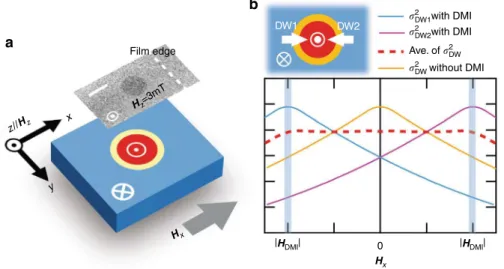
parameter for the nucleation24,30. In case of the droplet with sizable DMI, DW magnetizations are aligned in the radial direction. When we consider the two DW magnetizations with respect toHx, DW1 and DW2 (see the inset of Fig.1b),σ2DWof
the DW1 and the DW2, respectively, follows the blue and the red curves in terms of Hx due to DMI as illustrated in Fig. 1b31.
Film edge
a
b
DW1 DW2
2DW1with DMI
2DW2with DMI
2DW without DMI
Ave. of 2 DW
|HDMI| |HDMI|
H x
0
x
y
z//Hz
Hz=3mT
Hx
Fig. 1Droplet nucleation with DMI.aSchematic image of a magnetic droplet in a ferromagnetic medium underHzandHx. Inset shows a magneto-optical
Kerr effect (MOKE) image to prove the droplet nucleation inside the Pt/Co/MgO microstrip. The white bar is a scale bar of 5μm.bSchematic diagrams of
σ2
DWin terms ofHx. Inset shows the magnetization alignments of the DW1 and DW2 in the DW of the droplet. The thresholds in the curve of averagedσ2DW
are highlighted with blue shades
Assuming that total DW energy mainly depends on the two magnetizations at the DW of a droplet with respect to Hx, the
total σ2DW follows the trend of the purple-dotted line. Note that there is a threshold where the σ2DWstarts to becomeHx
depen-dent. Our previous report showed that the extended droplet model allows us to estimate the DMI-induced field from the threshold field24. In spite of such one-dimensional approxima-tion, we have demonstrated that thefitting gives reliable value of the DMI energy density (D).
The measuredHnas a function ofHxshows a threshold arising
from the DMI as predicted by the extended droplet model24(see also Supplementary Note 1, 2 and Method section for details about the analysis and the measurement). Figures 2a–d show
Hn/HSW(Hx=0) as a function ofHx/HKat various temperatures
(a,T=300 K; b, 200 K; c, 150 K and d, 100 K). HereHnandHxare
normalized by the switchingfield atHx=0 [HSW(Hx=0)] and by the anisotropy field (HK), respectively. Those normalized values
allow us to clearly confirm the DMI-dependent threshold with ruling out the temperature-dependent characteristics of HKand
the HSW(Hx=0). The temperature-dependent HDMI can be
determined from the best fitting using the extended droplet model;HDMIat 300, 200, 150 and 100 K are 166±50, 245±45, 324
±15 and 372±30 mT, respectively (Fig. 2e). The temperature-dependent D is readily calculated from HDMI and Δvia HDMI¼D=μ0Ms, where μ0 is the permeability, Ms is the
saturation magnetization and Δ is the DW width6. Δ and Ms
values in terms of the temperature are listed in Table1. Wefind thatDhas a strong temperature dependence as shown in Fig.2e; Dincreases by a factor of 2.2 as the temperature decreases from
300 to 100 K.
Heisenberg exchange is one of key parameters to understand the microscopic origin of DMI2,32. From the temperature dependence of Ms, the exchange stiffness constant (A) values
were quantitatively obtained as detailed in Supplementary Note3.
As listed in Table1, wefind a clear correlation of the Heisenberg exchange with DMI; the A value increases by 57% when the temperature decreases from 300K to 100 K while DMI shows 100% increase. Based on Moriya’s theory, DMI requires three ingredients: (i) SOC, (ii) magnetic exchange, and (iii) ISB. Therefore, we can consider two parameters in addition to Heisenberg exchange: one is the proximity-induced magnetism of the non-magnetic element, which is related to the source ii, and the other is the hybridization between 3dand 5dorbitals, which is related to the sources i and iii. In order to find how DMI correlated with the induced moment in the Pt layer and the orbital structure of Co, XMCD studies were performed using the soft and hard X-ray as discussed in the following sections.
Temperature dependence of the proximity-induced magnetic moment of Pt. In this section, wefirst investigate the role of the induced magnetic moment in the Pt layer as mentioned in pre-vious section. The temperature dependence of the Pt-induced magnetic moment was measured using the XMCD method, which enables element-specific analyses of spin and orbital magnetism33,34. Figure3a presents the XMCD and integration of XMCD spectra measured at the Pt L2,3edge. The intensities of
XMCD are ~3% of the X-ray absorption spectra (XAS) edge heights. At both theL3andL2edges (around 11.57 keV and 13.28
keV, respectively), the integrated XMCD spectra show tempera-ture dependences. In contrast, there is no temperatempera-ture depen-dence in XAS spectra (see inset of Fig. 3a). The total magnetic moment (mtotal), which is the sum of an effective spin magnetic
moment meff
s ¼msþmDandmo, was estimated by a sum rule
calculation35 (see the details about the sum rule calculation in Supplementary Note4). In this study, we use moment values per single hole rather than those per atom because it is difficult to precisely determine the hole number (nh) of Pt in the Pt/Co/
MgO. The moment values normalized bynhare directly obtained
1.0
Hn
/[
Hc
(
Hx
=0)] (a.u.)
Hn
/[
Hc
(
Hx
=0)] (a.u.)
Hx/HK (a.u.) Hx/HK (a.u.)
HDMI
(mT)
HDMI
0.8
0.6
Mdw Mup
Fitted
Mdw
Mup
Fitted
M
dw
Mup
Fitted
Mdw
D Mup
Fitted 0.4
0.2
0.0
0.0 0.1 0.2 0.3 0.4 0.0 0.1 0.2 0.3 0.4
0.0 0.1 0.2 0.3 0.4 0.0 0.1 0.2 0.3 0.4 1.0
0.8
0.6
0.4
0.2
0.0
1.0
0.8
0.6
0.4
0.2
0.0 1.0
450 1.5
1.2
0.9
0.6 D (mJ/m
2)
0.3
0.0 300
150
0
0 100 200 Temperature (K)
300 400 0.8
0.6
0.4
0.2
0.0
a b
c d
e
Fig. 2HDMImeasurement from theHnof the droplet.a–dTheHn/Hsw(Hx=0) vsHx/HKplots measured at 300, 200, 150 and 100 K, respectively. The grey
solid lines are the bestfitting results using the droplet model. Here the vertical axis is normalized by the nucleationfieldHsw(Hx=0) atHx=0 and the
horizontal axis is normalized by the effective perpendicular anisotropyfieldHK.ePlots ofHDMIandDin terms ofT. The error bars are based on the
from the sum rule formula without considering nh35.
The changes in the induced magnetic moments with temperature are small (~15%) and comparable to the error range of the ana-lysis as shown in Fig. 3b. This suggests that there is a weak correlation between the temperature dependences of the proximity-induced magnetic moments of the Pt layer and the DMI in the Pt/Co/MgO system11.
Correlation between asymmetric orbital structure of the FM layer and the DMI. In this section, we study the correlation of DMI with various physical quantities associated with the magnetism of Co such as ms,mk
o and m?o and the intra-atomic
dipole moment mD. As explained in the previous section, ms,effis the sum of msandmD. ThemsandmDvalues in terms
of temperature were obtained from the relation mDð Þ ¼θ mDð0Þ ð1 3cos2θÞ, thereby ms;effð Þ ¼θ msþmDð0Þ ð1 3cos2θÞ28,34.
Details about the sum rule calculation are explained in Supplementary Note 4. The XAS and XMCD of the film are measured at 100, 200 and 300 K. Two incident angles (θ=0° and 70° with respect to the film normal) were used to separately estimate mk
o and m?o values using the relation
moð Þ ¼θ m?ocos2θþmkosin2θ36. Figure 4a, b are typical XAS
and XMCD spectra at the CoL2,3edges obtained at 0° and 300 K.
The XMCD spectra show a clear temperature dependence of their intensity at both 0° and 70° as shown in Fig.4c–f. In case of the
ms, it increases by 20% (from 0.87 μB/μh to 1.11 μB/nh) as
temperature decreases from 300 to 100 K (see Fig. 4g), which is consistent with the observed temperature dependence ofMs.
In addition toms,mDshows a strong temperature dependence.
ThemDreflects the anisotropy offSDdistorted by the SOC or the
crystal-field effect.28,29. When the electron occupation becomes asymmetric, for instance, more electrons in the in-plane orbitals than the out-of-plane orbitals, the situation gives rise to both non-zeromDterm and asymmetry in the charge distribution. As a
result, asymmetry of the charge distribution naturally implies non-vanishingfSDat transition metals' interfaces. As a result, the
value of mD determined from the sum rule analysis increases
from 0.014μB/nhto 0.094μB/nh(Fig.4g). In addition, the orbital
anisotropy also increases as temperature decreases;m?
o increases from 0.058μB/nh to 0.080μB/nh, whereas mko slightly decreases
from 0.044μB/nhto 0.039μB/nh(Fig.4h). These results imply a
correlation of DMI with mD and orbital anisotropy. Since the
variation of the perpendicular component of themois also related
to magnetocrystalline anisotropy (KU) based on the Bruno
theory37, the correlation between DMI andKUis also reasonable
(see the Supplementary Note 5). Figure 5a shows m?o=mko(=[
m?
oðTÞ=mkoðTÞ]/[m?oð300KÞ=mkoð300KÞ]), andmDðTÞ=mDð300KÞ
plots as a function of the normalized D=D=(T)/D(300K) where T inside of parentheses is the measurement temperature. The ratiom?
o=mkoincreases by 53% asDincreases, andmDalso shows
a clear correlation with the DMI; mDð100KÞ=mDð300KÞ≈6.4.
Because both orbital anisotropy andmDare closely related to the
orbital occupation with ISB28,37,38, these results suggest that the
temperature dependence of DMI is governed by the change in asymmetric electron occupation in orbitals in addition to spin magnetic moments as we discuss with the following theoretical studies. We also note that peak intensity of the XAS spectra reflects the hole number in 3dorbitals. We found small change in the absorption intensity when varying the temperature. Quanti-tatively, difference in the XAS intensity integral (IXAS) between
300 and 100 K is about 4% f½IXASð300KÞ IXASð100KÞ=
IXASð300KÞ ¼0:04g. Hence, this indicates that there is a small
change in the hole number within the temperature range, reflecting temperature dependence of the charge distribution in orbitals. Nonetheless, the value is so small that it does not affect the trend in the respective quantities normalized bynhfrom the
sum rule calculation.
Theoretical consideration about the microscopic origin of the DMI. In order to support the insights obtained from our experimental study, we carry out two types of theoretical calcu-lations: a tight-binding model calculation and ab initio calculation based on density function theory (DFT), and the main result is shown in Fig. 5b, c. The details of these two complementary theoretical studies can be found in Supplementary Notes6and7. For the tight-binding model, we extend the trimer model suggested by Kashid et al.10, which contains two magnetic atoms coupled to a spin–orbit coupled non-magnetic ion. Compared to Kashid’s trimer model, we add one more orbital (dxz) on the non-magnetic site, enabling the computation of the orbital anisotropy (see details in Supplementary Note 6). In order to describe the temperature dependence of parameters in our trimer model, we assume the level broadening increases with the temperature. This broadening can be phenomenologically explained by magnetiza-tion fluctuations and the electron–phonon interaction given by atomic vibrations. As this model calculation is too simple, we do not aim to give a quantitative explanation of the experimental data but provide a qualitative understanding of the experimental result.
Figure 5b shows that the tight-binding model calculation reproduces qualitatively our experimental observations; both the DMI andm?o decrease with temperature, while themkois almost
temperature independent. Note that the m?o and mko cases are
related to electron hopping with and without ISB, respectively (Supplementary Note6). In addition, the ratio of the spin density distribution (f?
SD/fSDk) between the in-plane (xy) and out-of-plane
(yz,xz) orbital states decreases as temperature increases as shown in the inset in Fig. 5b (In our tight-binding model, the spin distribution is defined as SDn=fn,↑−fn,↓, where fn,↑(fn,↓) is the
occupation of spin up (down) state andnrepresents the orbital quantum statedxyA;dBxy;dCxy;dyzC;dCxz.). This result implies that the spin distribution variation of the orbital states with ISB is key to change of the orbital moment and the DMI, which is in line with the following DFT result.
To examine the correlation between the DMI and the orbital anisotropy in realistic structures, we also perform ab initio calculations for Pt(111)/X ultra-thin films, where X is a 3d Table 1 Parameters to estimate the DW energy
Temperature Ms(MA/m) KU(MJ/m3) A(pJ/m) ∆(nm) KD(10 kJ/m3) σ0(mJ/m2)
300 1.06 0.83±0.01 5.85±0.1 2.7±0.1 9.9±0.4 8.80±0.4
200 1.22 1.26±0.01 7.76±0.1 2.5±0.1 9.82±2.0 12.5±0.3
150 1.28 1.37±0.01 8.81±0.1 2.5±0.1 9.82±2.0 13.9±0.2
100 1.33 1.60±0.20 9.22±0.1 2.4±0.2 9.15±2.0 15.4±0.2
∆, the domain wall anisotropy (KD), and the Bloch-type DW energy (σ0) values obtained from the bestfitting ofHn(Hx)/[Hsw(Hx=0)] vsHx/HKplots using the extended droplet model.KDis DW
anisotropy energy, representing the magnetostatic energy difference between Bloch DW and Néel DW41. The values are comparable with previous reported values in ref.28.Msvalues were measured
using a superconducting quantum interference device magnetometer. Details about estimation ofAare given in Supplementary Note3.
transition metal (X=V, Cr, Mn, Fe, Co, Ni). Based on the experimental observation, the microscopic origin of the correla-tion between the DMI and the orbital anisotropy involves the impact of the temperature on 3d-orbital magnetization and their electron filling. In this respect, it is instructive to vary the 3d
transition metals on the Pt substrate and examine the general chemical trend. Details about this study are also discussed in Supplementary Note7. Figure5c shows the summary of the DFT calculation. Here changing the overlayer results in modification of the relative alignment between 3dand 5dorbitals and thereby in a modification of the charge distribution: more hybridization results in less asphericity of the charge distribution between the in-plane and the out-of-plane, as reflected by the change inmD.
Our calculation results provide a physical insight on how the asymmetric charge distribution induces DMI. As we mentioned in the second section, DMI requires three ingredients: (i) SOC, (ii) magnetic exchange, and (iii) symmetry breaking. While the
first two aspects are easily quantifiable, the latter is more difficult to apprehend. It has been reported that the larger the asymmetric spin distribution with symmetry breaking and SOC, the larger intra-dipole spin moment29. Therefore, our experimental and theoretical studies propose a method to address the symmetry breaking term. Figure 5c explains this aspect explicitly. The Mn 3dorbitals and the Pt 5dorbitals provide large magnetic exchange and SOC, respectively. In addition, the dipole moment term becomes maximized with the hybridization between Mn 3dand Pt 5dorbitals. As a result, DMI is maximal. Furthermore, both the DMI and the orbital anisotropy follow the same trend in their signs: Dtotandm?o=mko at the Pt/V interface have negative sign,
while those of other interfaces have positive sign. We alsofind the correlation betweenmsand DMI as confirmed experimentally in
this study and in ref. 32. In contrast, our calculations do not reproduce the experimental correlation reported above between DMI and the induced moment. This may be because of the difference between the actual film stack (~3 monolayers of Co) and the simulated system (1 monolayer of Co). In fact, the total DMI is dominated by the contribution of thefirst Co monolayer at the Co/Pt interface, while the Heisenberg exchange, which is a source of the induced moment, is affected by the total number of Co overlayers. This is why our calculation, limited to one Co overlayer, well reproduces the correlation of DMI with spin and orbital moments, but not with the induced moment.
Now, the remaining question is how the orbital asphericity can give rise to DMI. At the interface, in-plane orbitals of Co and
out-of-plane orbitals of Pt are mixed through inter-atomic hybridiza-tion (in our tight-binding model:dxyof Co anddyzof Pt). In the presence of ISB, this hybridization results in a non-vanishing orbital angular momentum: the hopping trajectory of an electron produces an effective orbital angular momentum as illustrated in Fig.6. Moreover, the large SOC on Pt mixes in-plane and out-of-plane orbitals, which is accompanied by spin canting (in our tight-binding model: dxy and dyz orbitals on Pt site). In other words, the SOC on Pt converts the interfacial orbital angular momentum of hopping electrons into spin canting, resulting in a non-collinear magnetic texture. In spite of its simplicity, this picture intuitively explains how the orbital asphericity generates the spin canting. A similar idea has been reported in ref.21: the interfacial electric dipole induced by the asymmetric charge distribution results in chiral orbital angular momentum, and thereby spin canting via SOC. Although the latter approach is based onp-orbitals, it agrees with the intuitive picture based ond -orbitals.
Discussion
Our experimental study on the temperature dependence of the DMI suggests that the interfacial DMI in FM/HM bilayers ori-ginates from Heisenberg exchange and the asymmetric charge distribution caused by the ISB, as evidenced by the orbital ani-sotropy and magnetic dipole moment (m?o=mko;mD). Our DFT
simulation and tight-binding calculation provide a clear evidence of the close link between the DMI and orbital physics. Based on the theoretical discussions, the temperature-dependent mD and mo indicate that increase in the temperature promotes the
phonon-induced electron hopping between the out-of-plane and in-plane orbitals, thereby resulting in a reduced asphericity (or reduced asymmetry) of fSD over the d-orbitals and thus
quenchingmD.
In our experiment, however, the correlation betweenm?
o=mko
and the DMI is only semi-quantitative, i.e. the temperature-dependent change in the DMI does not perfectly scale with the temperature-dependent change in m?
o=mko. This
semi-quantitative correlation between the DMI and mo demands a
more detailed discussion. In systems with ISB, m?o can be
decomposed into ISB-independent part and ISB-dependent part. Given that ISB is an essential ingredient for the DMI, there should be a direct correlation between the DMI and ISB-dependent mo, as evidenced by our tight-binding model
0.4
a b 0.10
0.08
0.06
0.04
0.02
0.00
XMCD 100 K Int. 100 K Int. 150 K Int. 200 K Int. 300 K XMCD 150 K
XMCD 200 K XMCD 300 K
0.2
0.0
–0.2
–0.4
0.4
0.2
0.0
–0.2
–0.4 11.54 11.56 11.58
Energy (keV)
XAS
XAS
11.57 keV
13.25 13.30
keV
XMCD (×10
–1 a.u.)
Energy (keV)
Int.
XMCD (a.u.)
Magnetic moment (
B
/hole)
11.60 13.26 13.28 13.30 100
Temperature (K)
ms,eff/nh
(ms,eff+mo)/nh
200 300
Fig. 3Temperature dependence of the proximity-induced moment in the Pt layer.aThe XMCD and integrated XMCD spectra at the PtL3andL2edges in terms of temperature. The XMCD spectra werefitted by the Lorentzian function, and thefitted curves were integrated to get the integrated XMCD spectra. The insets are the XAS spectra at the PtL3andL2edges.bTemperature dependence of themeffs andmtotal=meffs +mo. The error bars are based on the
calculation. However, m?o also has an ISB-independent part,
which precludes a direct and quantitative correlation between the DMI andm?o. This statement can be rephrased technically as the
DMI involves only off-diagonal elements of the SOC operator10, whilemoinvolves all of them. We note, however, that even with
this uncertainty, the experimentally observed correlation between the DMI andmoanisotropy for the Pt/Co/MgO structure is rather
clear, implying that the ISB-dependentmowould dominate over
the ISB-independent one in this structure. Therefore, ourfindings based on both experimental and theoretical studies provide a link between orbital physics and spin–orbit-related phenomena such as the DMI, which are essential for spin–orbitronic devices.
Method
Film preparation and device fabrication. Si/Ta (1.5)/Pt (2)/Co (0.5)/MgO (2)/ HfO (5) (in nm)film with perpendicular magnetic anisotropy was deposited on an undoped Si substrate by direct current magnetron sputtering and the atomic layer deposition technique. A 5-μm-wide Hall cross-structure were fabricated using the photo lithography and the Ar ion milling. For the XMCD measurement, the same stackfilm was prepared.
Nucleationfield measurement. Angular-dependent coercivity of the Co/Pt Hall device was measured to estimate theHnof the magnetic droplet at 300, 200, 150 and 100 K. The angle between magneticfield and the sample normal was varied from 0° to 89° rotating the electromagnet. At each angle, magneticfield was swept
with in ±0.5 T to observe the coercivity. Details about this measurement are also discussed in ref.24.
XMCD measurement. Soft X-ray: Soft X-ray absorption spectra were measured using the total electron yield method with 96% circularly polarized incident X-rays at the BL25SU at SPring-8. XMCDs at the CoL3andL2edges (in a range between
770 and 840 keV) were recorded in the helicity-switching mode with an applied magneticfield of 1.9 T. Homogeneity of the magneticfield was better than 99% for
ɸ10 mm at the sample position. The incident light direction was inclined by 10° with respect to the magneticfield direction. Temperature was varied from 300 to 100 K using a continuous liquid Heflow-type cryostat.
Hard X-ray: XMCD experiments using hard X-rays were carried out at BL39XU of SPring-8. A circularly polarized X-ray beam with a high degree of circular polarization (>95%) was produced with a transmission-type diamond X-ray phase retarder of 1.4-mm thickness. XAS of thefilm were observed at a 0.6 T magnetic
field applied parallel to the X-ray propagation direction of which an incident angle was 0° with respect to the surface normal. The X-rayfluorescence yield mode was used to record the spectra. The X-ray energy was scanned around the PtL3andL2
edges in a range between 11.5 and 3.5 keV, reversing the X-ray photon helicity at 0.5 Hz. In this manner, two helicity dependent spectraI+andI−were recorded
simultaneously. HereI+
andI−denote the intensities when the incident photon
momentum and the magnetization vectors are parallel and antiparallel, respectively. The XMCD spectrum,ΔI=I+
−I−, is given by the difference of the
two spectra. Detailed experimental set-ups for the soft and hard X-ray MCD measurements are described elsewhere39,40.
DFT calculation. To understand the behaviour of DMI in 3d/Pt(111) ultrathin
films and its correlation with the orbital moment anisotropy (OMA) and magnetic dipole moment (Tz), we have performed DFT calculations in the local density
1.2 a b c d f g h e 0.00 0.08 100 K 200 K 300 K MCD + – Int. MCD
L3, 0° L2, 0°
L2, 70°
L3, 70°
0.04 0.00 0.08 0.04 0.00 –0.10 –0.20 –0.30 0.00 –0.10 –0.20 –0.30
777 778 779 780
Energy (eV) Energy (eV) 781 782 790 792 794 796 798 0.8
XAS (a.u.)
XMCD (a.u.) XMCD (a.u.)
Int. XMCD (a.u.) XMCD (a.u.) 0.4 0.0 0.1 0.0 –0.1 –0.2 –0.3 1.5 0.10 2.5 0.10 0.08 0.06 0.04 0.02 0.00 2.0 1.5 1.0 0.5 0.0 0.05 mD / nh ( B /hole) mD ms m s / nh ( B /hole) 0.00 1.0 0.5 0.0
0 100 200 300 400 0 100 200 300 400
780 800 Energy (eV)
Temperature (K) Temperature (K) 820 840 0.2 –0.2 –0.4 –0.6 0.0 m o / m o (a.u.) ⊥ II m o / nh & m o / nh ( B /hole) ⊥ II
m⊥o
m⊥o/mIIo II
mo
Fig. 4Temperature dependence of the Co magnetic moments.aXAS spectra for positive (σ+) and negative (σ−) X-ray helicities.bXMCD and integrated
XMCD spectra at 0° with 300 K. The temperature dependence of XMCD spectra at the CoL3andL2edges measured at (c,d) 0° and (e,f) 70°.gPlots of
msandmDvs temperature as a function of the X-ray incident angle.hm?o,mkoandm?o=mkoas functions of temperature. The error bars are based on the
standard deviation of the integral distribution after subtracting the backgrounds of XAS spectra
approximation41to the exchange correlation functional, using the full potential
linearized augmented plane wave method infilm geometry42as implemented in the
Jülich DFT code FLEUR43. Both collinear and non-collinear magnetic states have
been studied employing an asymmetricfilm consisting of six substrate layers of Pt covered by a pseudomorphic 3dmonolayer on one side of thefilm at the distance optimized for the lowest collinear magnetic states. For the non-collinear calcula-tions, we usedp(1x1) unit cell applying the generalized Bloch theorem (http://www. flapw.de). The OMA is obtained at relaxed geometry as total energy difference for two different magnetization directions employing the force theorem (the principle axes point along hard and easy axis). We considered 512 and 1024k-points in the two-dimensional Brillouin zone (2D-BZ) for the scalar relativistic computation and the calculation with SOC treated withinfirst-order perturbation theory, respec-tively. Note that high computational accuracy is required since energy differences between different magnetic configurations are tiny (~meV) in the present case.
In order to investigate the DMI,first we self-consistently calculate the total energy of homogeneous magnetic spin spirals employing the generalized Bloch theorem within the scalar-relativistic approach44. We have considered the energy
dispersionE(q) of planar spin spirals, which are the general solution of the Heisenberg Hamiltonian, i.e. states in which the magnetic moment of an atom site
Riis given byMi=M[cos(q·Ri), sin(q·Ri), 0] whereqis the wave vector propagation of the spin spiral. By imposing the Néel spin spirals along the high symmetry lines of 2D-BZ, we can scan all possible magnetic configurations that can be described by a singleq-vector. So, varying theq-vector with small steps along the paths connecting the high symmetry points, wefind the well-defined magnetic phases of the hexagonal lattice: FM state atΓ-point (q=0), anti-FM state at the M-point, and
periodic 120° Néel state the K-point. When the energyE(q) along the high symmetry lines of 2D-BZ is lower than any of the collinear magnetic phases studied previously, the system most likely adopts an incommensurate spin-spiral magnetic ground state structure.
In a second step, we evaluate the DMI contribution from the energy dispersion of spin spirals by applying the SOC treated withinfirst-order perturbation theory combined with the spin spirals5,42. Phenomenologically, the antisymmetric exchange interaction DMI has the typical formEDM¼P
i;j
Di;j ðSi´SjÞ, whereDi,j
is the DM vector that determine the strength and sign of DMI andSiandSjare magnetic spin moments located on neighbouring atomic sitesiandj, respectively. Considering the Néel-type out-of-plane configuration, theDi,jvector should be
oriented in plane and normal to theq-vector. Note that DMI term must vanish for both configurations Néel-type in-plane and Bloch-type spin spirals due to symmetry arguments44. According to our definition, the vector chirality reads
C¼Cc¼Si´Siþ1, where the direction of the vector spin chiralitycis considered
as spin rotation axis. Thus the left-handed (right-handed) spin spiral correspond to
C= +1 (C=−1)45.
Data availability. The data that support thefindings of this study are available from the corresponding author upon reasonable request.
Received: 05 July 2017 Accepted: 27 March 2018
2.0 a c b 2.0 1.0 0.0 3.0 2.0 1.0 0.0 –1.0 0.8 0.6 0.4 0.2 0.0 4.5 3.0 3d Pt 1.5 0.0
V Cr Mn Fe Co Ni 0.4 0.3 0.2 0.1 0.0 8.0 0.08
100 200 300 0.50 0.45 0.40 0.06 0.04 0.02 0.00 6.0 4.0 2.0 0.0 1.5 1.0 Nor m. m D (a.u.) m o ( B ) mD ( B ) mD ms ( B ) 0.5 0.0 0.0
100 150 200 250 300 0.5 1.0
D (mJ/m2)
D
tot (mJ/m 2)
EDMI
(meV)
EDMI
T (K)
T (K) 1.5 Nor m. m o / m o (a.u.) ⊥ II
m⊥o /moII
m⊥o
II mo fSD / fSD ⊥ II m o / m o (a.u.) ⊥ II
Fig. 5Correlation of DMI withm?
o=mkoandmD, and theoretical calculations based on the tight binding model and DFT.aNormalizedm?o=mkoandmDvsD.
Values ofm?
o=mkoandmDfor all temperatures are normalized by the values measured at 300 K.bCalculatedm?o,mkoandEDMIvalues based on the
tight-binding model as a function of temperature. Inset showsf? SD/f
k
SDas a function of temperature.cPhysical parameters such as totalD(Dtot),m?o=mko,mDand msobtained by DFT calculation. Strength and sign ofDtotare calculated around their magnetic ground state using the combination of the relativistic effect spin–orbit coupling with the spin spirals. A positive sign ofDtotindicates a left-rotational sense or left chirality
˜L
Pt
z
y x
Hso˜L⋅S
Co
Fig. 6Schematic illustration of the spin canting. Explicit illustration of the onset of the orbital angular momentum and how SOC induces spin canting from it. The red and grey spheres represent the top ferromagnetic and bottom normal metal atoms in each layer, while the yellow and blue spheres represent thedxy(top) anddyz(bottom) orbitals, respectively.
References
1. Dzyaloshinskii, I. E. Thermodynamic theory of weak ferromagnetism in antiferromagnetic substances.Sov. Phys. JETP5, 1259–1272 (1957). 2. Moriya, T. Anisotropic superexchange interaction and weak ferromagnetism.
Phys. Rev.120, 91–98 (1960).
3. Mühlbauer, S. et al. Skyrmion lattice in a chiral magnet.Science323, 915–919 (2009).
4. Yu, X. Z. et al. Real-space observation of a two-dimensional skyrmion crystal.
Nature465, 901–904 (2010).
5. Heide, M., Bihlmayer, G. & Blügel, S. Dzyaloshinskii-Moriya interaction accounting for the orientation of magnetic domains in ultrathinfilms: Fe/W (110).Phys. Rev. B78, 140403 (2008). (R).
6. Thiaville, A., Rohart, S., Jué, É., Cros, V. & Fert, A. Dynamics of
Dzyaloshinskii domain walls in ultrathin magneticfilms.Europhys. Lett.100, 57002 (2012).
7. Emori, S., Bauer, U., Ahn, S.-M., Martinez, E. & Beach, G. S. D. Current-driven dynamics of chiral ferromagnetic domain walls.Nat. Mater.12, 611–616 (2013).
8. Fert, A., Cros, V. & Sampaio, J. Skyrmions on the track.Nat. Nanotech.8, 152–156 (2013).
9. Bode, M. et al. Chiral magnetic order at surfaces driven by inversion asymmetry.Nature447, 190–193 (2007).
10. Kashid, V. et al. Dzyaloshinskii-Moriya interaction and chiral magnetism in 3d−5dzigzag chains: tight-binding model andab initiocalculations.Phys.
Rev. B90, 054412 (2014).
11. Ryu, K.-S. et al. Chiral spin torque arising from proximity-induced magnetization.Nat. Commun.5, 3910 (2014).
12. Yang, H., Thiaville, A., Rohart, S., Fert, A. & Chshiev, M. Anatomy of Dzyaloshinskii-Moriya interaction at Co/Pt interfaces.Phys. Rev. Lett.115, 267210 (2015).
13. Belabbes, A., Bihlmayer, G., Bechstedt, F., Blügel, S. & Manchon, A. Hund’s rule-driven Dzyaloshinskii-Moriya interaction at 3d-5dinterfaces.Phys. Rev.
Lett.117, 247202 (2016).
14. Fert, A. & Levy, P. M. Role of anisotropic exchange interactions in determining the properties of spin-glasses.Phys. Rev. Lett.44, 1538 (1980). 15. Fert, A. & Levy, P. M. Anisotropy induced by nonmagnetic impurities in
CuMn spin-glass alloys.Phys. Rev. B23, 4667 (1981).
16. Fert, A. Magnetic and transport properties of metallic multilayers.Mater. Sci.
Forum59, 439–480 (1990).
17. Kundu, A. & Zhang, S. Dzyaloshinskii-Moriya interaction mediated by spin-polarized band with Rashba spin-orbit coupling.Phys. Rev. B92, 094434 (2015).
18. Kim, K.-W. et al. Chirality from interfacial spin-orbit coupling effects in magnetic bilayers.Phys. Rev. Lett.111, 216601 (2013).
19. Kikuchi, T., Koretsune, T., Arita, R. & Tatara, G. Dzyaloshinskii-Moriya interaction as a consequence of a Doppler shift due to spin-orbit-induced intrinsic spin current.Phys. Rev. Lett.116, 247201 (2016).
20. Yamamoto, K. et al. Interfacial Dzyaloshinskii-Moriya interaction and orbital magnetic moments of metallic multilayerfilms.AIP Adv.7, 056302 (2017). 21. Park, S. R. et al. Orbital-angular-momentum based origin of Rashba-type
surface band splitting.Phys. Rev. Lett.107, 156803 (2011).
22. Park, J.-H., Kim, C. H., Lee, H.-W. & Han, J. H. Orbital chirality and Rashba interaction in magnetic bands.Phys. Rev. B87, 041301(R) (2013). 23. Boulle, O. et al. Room temperature chiral magnetic skyrmions in ultrathin
magnetic nanostructures.Nat. Nanotech.11, 449–454 (2016).
24. Kim, S. et al. Magnetic droplet nucleation with a homochiral Néel domain wall.Phys. Rev. B95(22), 220402(R) (2017).
25. Giustino, F. Electron-phonon interactions fromfirst principles.Rev. Mod.
Phys.89, 015003 (2017).
26. Sakamaki, M. et al. Perpendicular magnetic anisotropy in a Pt/Co/Pt ultrathin
film arising from a lattice distortion induced by ion irradiation.Phys. Rev. B
86, 024418 (2012).
27. Kim, M. et al. Contribution of individual interfaces in the MgO/Co/Pd trilayer to perpendicular magnetic anisotropy upon annealing.Appl. Phys. Lett.106, 102404 (2015).
28. Wu, R. & Freeman, A. J. Limitation of the magnetic-circular-dichroism spin sum rule for transition metals and importance of the magnetic dipole term.
Phys. Rev. L73, 1994 (1994).
29. Šipr, O., Minár, J. & Ebert, H. Influence of spin-orbit coupling on the
magnetic dipole term Tα.Phys. Rev. B94, 144406 (2016).
30. Pizzini, S. et al. Chirality-induced asymmetric magnetic nucleation in Pt/Co/ AlOx ultrathin microstructures.Phys. Rev. Lett.113, 047203 (2014). 31. Je, S.-G. et al. Asymmetric magnetic domain-wall motion by the
Dzyaloshinskii-Moriya interaction.Phys. Rev. B88, 214401 (2013). 32. Nembach, H. T., Shaw, J. M., Weiler, M., Jué, E. & Silva, T. J. Linear relation
between Heisenberg exchange and interfacial Dzyaloshinskii-Moriya interaction in metalfilms.Nat. Phys.11, 825–829 (2015).
33. Carra, P., Thole, B. T., Altarelli, M. & Wang, X. X-ray circular dichroism and local magneticfields.Phys. Rev. Lett.70, 694 (1993).
34. Stöhr, J. Exploring the microscopic origin of magnetic anisotropies with X-ray magnetic circular dichroism (XMCD) spectroscopy.J. Magn. Magn. Mater.
200, 470–497 (1999).
35. Chen, C. T. et al. Experimental confirmation of the X-ray magnetic circular dichroism sum rules for iron and cobalt.Phys. Rev. B75, 152 (1995).
36. Stöhr, J. & König, H. Determination of spin- and orbital-moment anisotropies in transition metals by angle-dependent x-ray magnetic circular dichroism.
Phys. Rev. B75, 3748 (1995).
37. Bruno, P. Tight-binding approach to the orbital magnetic moment and magnetocrystalline anisotropy of transition-metal monolayers.Phys. Rev. B
39, 1 (1989).
38. Oguchi, T. & Shishidou, T. Anisotropic property of magnetic dipole in bulk, surface, and overlayer systems.Phys. Rev. B70, 024412 (2004).
39. Nakamura, K. et al. Development of a soft X-ray magnetic circular circular dichroism spectrometer using a 1.9 T electromagnet at BL25SU of SPring-8.J.
Electron. Spectrosc. Relat. Phenom.144, 1035–1038 (2005).
40. Suzuki, M. et al. Depth profile of spin and orbital magnetic moments in a subnanometer Ptfilm on Co.Phys. Rev. B72, 054430 (2005).
41. Jung, S. W. et al. Current-induced domain wall motion in a nanowire with perpendicular magnetic anisotropy.Appl. Phys. Lett.92, 202508 (2008).
42. Perdew, J. P. & Zunger, A. Self-interaction correction to density-functional approximations for many-electron systems.Phys. Rev. B23, 5048 (1981). 43. Wimmer, E., Krakauer, H., Weinert, M. & Freeman, A. J. Full-potential
self-consistent linearized-augmented-plane-wave method for calculating the electronic structure of molecules and surfaces: O2Molecule.Phys. Rev. B24,
864 (1981).
44. Kurz, P., Förster, F., Nordström, L., Bihlmayer, G. & Blügel, S. Ab initio treatment of noncollinear magnets with the full-potential linearized augmented plane wave method.Phys. Rev. B69, 024415 (2004). 45. Heide, M., Bihlmayer, G. & Blügel, S. Describing Dzyaloshinskii–Moriya
spirals fromfirst principles.Phys. B Cond. Matter404, 2678–2683 (2009).
Acknowledgements
We also thank H.-W. Lee for fruitful discussion about the relation between the orbital magnetism and the DMI. This work was partly supported by JSPS KAKENHI Grant Numbers 15H05702, 26870300, 26870304, 26103002 and 25220604; JSPS Postdoctoral Fellowship program (Grant Number 2604316, P16314); Collaborative Research Program of the Institute for Chemical Research, Kyoto University; R & D project for ICT Key Technology of MEXT from the Japan Society for the Promotion of Science (JSPS) and the Cooperative Research Project Program of the Research Institute of Electrical Commu-nication, Tohoku University. This work has also been performed with the approval of the SPring-8 Program Advisory Committee (Proposal Nos. 2015A0117, 2015A0125). A.M. and A.B. acknowledge support from King Abdullah University of Science and Tech-nology (KAUST) and fruitful discussiojns with S. Blügel and G. Bihlmayer. G.G., P.-H.J. and K.-J.L. also acknowledge support from the National Research Foundation of Korea (NRF-2015M3D1A1070465, 2017R1A2B2006119). K.-J.K. was supported by the National Research Foundation of Korea (NRF) grant funded by the Korea Government (MSIP) (Nos. 2017R1C1B2009686, NRF-2016R1A5A1008184) and by the DGIST R&D Program of the Ministry of Science, ICT and Future Planning (17-BT-02). S.K. was supported by Priority Research Centers Program through the National Research Foundation of Korea (NRF) funded by the Ministry of Education (2009-0093818).
Author contributions
S.K., K.U., K.-J.K., T.M. and T.O. conceived and designed the study. S.K., K.U., T.K. and D.C. fabricated the device and performed the nucleationfield measurement. S.K., D.-H. K., P.-H.J., T.M., K.-J.K. and T.O. contributed to determine the DMI-induced effective
field using the droplet model. S.K., M.S., Y.K., T.N. and K.-J.K. designed and performed XMCD experiment and analysed the data. K.U. and K.Y characterizes the magnetic properties offilms. A.B., A.M. and K.N. supported theoretical analyses with ab initio calculation. G.G. and K.-J.L. supported the tight-binding model for the temperature dependence of the DMI and orbital magnetism. All authors discussed the results and wrote the manuscript.
Additional information
Supplementary Informationaccompanies this paper at https://doi.org/10.1038/s41467-018-04017-x.
Competing interests:The authors declare no competing interests.
Reprints and permissioninformation is available online athttp://npg.nature.com/ reprintsandpermissions/
Publisher's note:Springer Nature remains neutral with regard to jurisdictional claims in published maps and institutional affiliations.
Open Access This article is licensed under a Creative Commons Attribution 4.0 International License, which permits use, sharing, adaptation, distribution and reproduction in any medium or format, as long as you give appropriate credit to the original author(s) and the source, provide a link to the Creative Commons license, and indicate if changes were made. The images or other third party
material in this article are included in the article’s Creative Commons license, unless indicated otherwise in a credit line to the material. If material is not included in the article’s Creative Commons license and your intended use is not permitted by statutory regulation or exceeds the permitted use, you will need to obtain permission directly from the copyright holder. To view a copy of this license, visithttp://creativecommons.org/ licenses/by/4.0/.