LETTER
LGCN: Learnable Gabor Convolution Network for Human Gender Recognition in the Wild ∗
Peng CHEN†,††, Weijun LI†,††a),Nonmembers, Linjun SUN†,††,Student Member, Xin NING†,††, Lina YU†,††, andLiping ZHANG†,††,Nonmembers
SUMMARY Human gender recognition in the wild is a challenging task due to complex face variations, such as poses, lighting, occlusions, etc. In this letter, learnable Gabor convolutional network (LGCN), a new neural network computing framework for gender recognition was proposed.
In LGCN, a learnable Gabor filter (LGF) is introduced and combined with the convolutional neural network (CNN). Specifically, the proposed frame- work is constructed by replacing some first layer convolutional kernels of a standard CNN with LGFs. Here, LGFs learn intrinsic parameters by us- ing standard back propagation method, so that the values of those param- eters are no longer fixed by experience as traditional methods, but can be modified by self-learning automatically. In addition, the performance of LGCN in gender recognition is further improved by applying a proposed feature combination strategy. The experimental results demonstrate that, compared to the standard CNNs with identical network architecture, our approach achieves better performance on three challenging public datasets without introducing any sacrifice in parameter size.
key words: gender recognition, learnable Gabor convolutional neural net- work, learnable Gabor filter, back propagation
1. Introduction
The existing gender recognition algorithms can be grouped into three categories: conventional hand-crafted feature- based methods, currently prevalent deep-learning-based methods and new integration-based methods. The hand- crafted feature-based methods generally use a human de- signed feature descriptor to extract the gender-information- related features from the image pixel space[1], [2]. Al- though these hand-crafted feature descriptors are suffi- ciently effective to extract meaningful information for gen- der recognition in controlled settings, their intrinsic param- eters are difficult to set up. In addition, these methods have only passable performance in complex uncontrolled cases because of the limited modeling capacity. The deep- learning-based methods consider using the convolutional neural network (CNN) to extract gender information from large image sets by statistical training[3],[4]. These meth- ods have powerful nonlinear modeling ability and can eas-
Manuscript received November 15, 2018.
Manuscript revised April 27, 2019.
Manuscript publicized June 13, 2019.
†The authors are with the Institute of Semiconductors, CAS, Beijing 100083, China.
††The authors are with the Center of Materials Science and Op- toelectronics Engineering, University of Chinese Academy of Sci- ences, Beijing 100049, China.
∗This work was supported by the National Nature Science Foundation of China (Grant No.61572458).
a) E-mail: [email protected] (Corresponding author) DOI: 10.1587/transinf.2018EDL8239
ily distinguish gender attributes in the training set when the training samples are insufficient. However, they have many parameters and can be easily overfitted when the network becomes increasingly deeper.
Unlike these two types of method, the integration- based methods attempt to combine the steerable hand- crafted features with the powerful CNN. Since gender infor- mation is highly related to facial texture features such as the angle and depth of the wrinkles and existence of beard, the bio-inspired Gabor filters are considered one of the most ef- fective hand-crafted feature extractors. Recently, some stud- ies[5],[6]in general feature extraction have successfully in- tegrated Gabor filters with CNNs. [5]reduces the training complexity of CNNs by replacing certain weight kernels of a CNN with Gabor filters. The learnable convolution fil- ters are modulated by Gabor filters in[6]to improve the ro- bustness of CNN against image transformations. However, such excellent ideas have not been well explored in gender recognition. Though[7] fuses the human-designed Gabor filter features with original image pixels to enhance the per- formance of CNNs for gender recognition, it increases the depth of networks and the number of parameters. Besides, the intrinsic parameters of Gabor filters in all the methods above are fixed and not always optimal.
In this letter, a new LGF is designed for extracting spe- cific local image patterns automatically. We then propose a framework that integrates the LGF with CNN for gender recognition in the wild. We call this framework learnable Gabor convolution network (LGCN). In our framework, par- tial weight kernels of a standard CNN in the first layer are replaced by LGFs. Moreover, the intrinsic parameters of LGFs can be learned automaticly using the back propagation method, which is difficult and time-consuming to manually set up. In addition, we propose a feature-combined strat- egy that further improves the performance of LGCN in gen- der recognition. The extensive experimental results show that our method consistently outperforms the state-of-the- art methods on three challenging benchmarks.
2. The Proposed Approach
2.1 Learnable Gabor Filter
A typical 2D Gabor filter is a Gaussian envelope function modulated by a sinusoidal carrier wave. It has a real and an imaginary component, which can be expressed as:
Copyright c2019 The Institute of Electronics, Information and Communication Engineers
Gi(x,y;λ, θ, ψ, σ, γ)=Ae−
x2+γ2y2
2σ2 sin(2πx
λ +ψ) (2) where
x=xcosθ+ysinθ, y=−xsinθ+ycosθ (3) In these equations,A,λ,θ,ψ,γandσare the magnitude of the Gabor filter, wavelength of the Gabor filter function, orientation of the normal to the parallel stripes of a Gabor filter kernel, phase offset, spatial aspect ratio and standard deviation of the Gaussian envelope, respectively. x andy are the 2D world coordinates. Gr andGi are the real and imaginary parts of the Gabor filter, respectively. By apply- ing the chain rule, we can obtain the partial derivatives ofG with respect to all parameters as follows:
∂Gr
∂λ =Gi2πx λ2 , ∂Gr
∂ψ =−Gi (4)
∂Gr
∂θ =Grxy
σ2 (γ2−1)−Gi2πy
λ (5)
∂Gr
∂σ =Gr
x2+γ2y2 σ3 , ∂Gr
∂γ =−Grγy2
σ2 (6)
Let K(i,j),i ∈ 0,1,2,· · ·,h−1;j ∈ 0,1,2,· · ·,w−1 be a kernel function in the pixel space, whereh andware the height and width, respectively. In general, the height and width are restricted to positive odd numbers. By sampling in the world coordinates, we can generate the Gabor filter kernel as follows:
K(i,j)=Gr(sx(i−h−1
2 ),sy(j−w−1
2 )) (7)
wheresxandsyare the sampling ratios of thexandydimen- sion, respectively, in world coordinates. Giving input image Xand generated Gabor filter kernel K, the feed-forward of the learnable Gabor filter can be written as:
O=X∗K (8)
In this equation, Ois the convolution result ofX and K. Using the standard back propagation algorithm, we can update each parameter of the Gabor filter as follows:
λ:=λ−η
h−1
i=0 w−1
j=0
∂O
∂Ki j
∂Ki j
∂λ (9)
where η is the learning rate, andh andw are scalars.
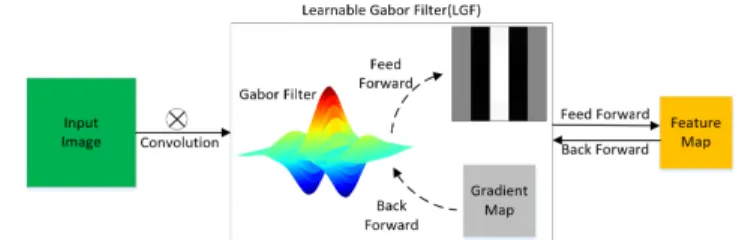
The process of the learnable Gabor filter is shown in Fig. 1.
To prevent the parameters of Gabor filters getting away from the scope of specific physical significance, a simple clamp opreation is used to constrain the parameters in the feed- forward phase. In this study, we focus on the self-learning ability of parameterλ. The proposed method can provide reference for the other parameters adjustment. In order to evaluate the performance, other parameters other thanλin
Fig. 1 Feed-forward and back-forward process of a learnable Gabor fil- ter.
the experiment are determined empirically.
2.2 The Proposed Framework
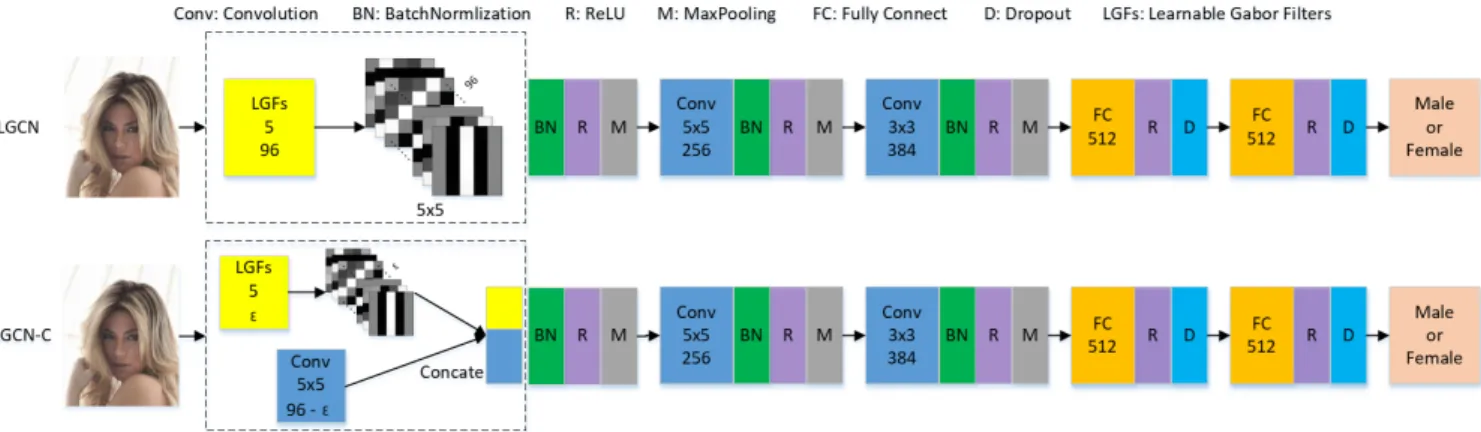
Referenced from Levi’s work[3], an Alexnet-liked network was selected as our basic network structure. The framework of the proposed method (LGCN) is shown in Fig. 2 (top).
The first layer of the framework is a group of LGF modules, which are used to capture different frequency and orienta- tion responses of the color input image. Then, the response maps are fed into the conventional CNN to extract robust and discriminant features of higher vision level for the sub- sequent step. At the end of the framework, the Softmax module is used to produce the final classification probability.
In detail, the proposed framework takes raw pixels of color face images as the input. The first layer of LGCN has 96 LGFs by combining the cases of twelve θ = 0,12π,212π,· · ·,1112π and eightψ = 0,π8,· · ·,78π. The pa- rameters (σandγ) are identical for the 96 filters. We set σ=2 andγ=0.3 referenced from[7], whereasλis learned from the training data. The kernel size of each Gabor fil- ter is 5x5 with stride 1 and padding 2. Then, there are two convolution layer with 256 and 384 channels respectively.
The kernel size of the second convolution layer is 5x5 with stride 1 and padding 2. The kernel size of the third convo- lution layer is 3x3 with stride 1 and padding 1. All the con- volution layer is followed by a BactchNorm normalization layer and a ReLU non-linear unit. Behind the ReLU unit is a max-pooling layer sized 3x3 with stride 2. Finally, two fully connected layers are stacked after the pooling layer. The neurons of the fully connected layer are both 512. Dropout strategy is also adopted by us as it can limit the risk of over- fitting. We set the dropout ratio as 0.5 for all networks.
2.3 Feature-Combined Strategy
As observed in[8], some of the trained filters from shallow layers are similar to Gabor filters while there are still a lot of other unknown types of patterns. Motivated by this, we propose a feature-combined strategy. We constrain part of the filters in the first layer of LGCN as LGFs. We use stan- dard convolutional kernels to learn the remaining unknown patterns as it can fit any kind of functions. The number of LGFs εis a hyperparameter. Here, we set εas 24 by ex- perience. The framework of the feature-combined LGCN is shown in Fig. 2 (bottom). We call this feature-combined
Fig. 2 Frameworks of LGCN and LGCN-C (εis a hyperparameter which represents the number of LGFs).
framework LGCN-C. A little different from LGCN, LGCN- C will concatenate the feature maps extracted by LGFs and standard convolutional kernels along channel dimension. In addition, we reduce the number ofψto two for convenience of calculations, i.e.ψ = 0,π2, while keep other parameter setting the same as LGCN.
3. Experimental Results
The experiments were carried out in PyTorch framework on a Linux machine with Intel Xeon CPUs and Nvidia 1080Ti GPUs. We employ the SGD strategy to train our network.
The initial learning rate of standard convolutional kernels and LGFs are 0.001 and 0.1, respectively, and decayed by 0.1 each 80 epochs. The total training epochs are 200. For a single image of size 227x227x3, the inference time of LGCN and LGCN-C with GPU are 9.7ms and 9.32ms, re- spectively. The model size are 145.094M and 145.098M, respectively.
3.1 Dataset Description
We conduct the experiments on three challenging datasets:
Adience, CelebA and LFW. All these datasets can be consid- ered a type of real-world reflection with extreme variations in head pose and lighting condition quality. We select the in-plane aligned version of Adience for our research, which were originally used in [1]. We report our results using subject-exclusive partitioning for five-fold cross validation referenced from[3]. We select the aligned and cropped ver- sion of CelebA for our research. We use the gender attribute in our experiment. The unaligned dataset of LFW is selected by us. Two protocols are performed on this dataset. The first protocol is randomly selecting the 80% images for training and the remaining images for testing, which was referenced from[2]. The other protocol is half of the images for train- ing and half for testing, which was originally used in[9].
3.2 Effectiveness of LGF
To verify the effectiveness of LGF, we design a variant of LGCN with empirically fixed parameters of Gabor filters
Fig. 3 Comparison of accuracy between Gabor-CNNs and LGCNs on the 5-fold experiments.
in the first layer for comparison. We call this network the Gabor convolutional neural network (Gabor-CNN). Refer- enced from the experimental value of λ = 2.5 in[7], we simply extend the range ofλto 0∼5. We conduct 5 groups of experiments on Adience data set by settingλ=0.5, 1.5, 2.5, 3.5 and 4.5. Each group of experiment is measured by the five-fold cross validation. As shown in Fig. 3, Gabor- CNN with differentλvalues has significantly different per- formances, which further proves that the parameters of Ga- bor filters are hard to set up. For fair comparison, both the values ofλof LGCN and LGCN-C in the following exper- iments are initialized in the interval (0, 5). From Fig. 3, our LGCN methods outperform Gabor-CNN methods on most of the fold experiments. The reason is that LGCN can not only learn suitableλvalues but also find optimal combina- tion way, which are difficult to set up for traditional meth- ods.
To explore other parameters of LGF, we set Gabor- CNN(λ = 2.5, θ = 0,12π,2π12,· · ·,11π12, ψ = 0,π8,· · ·,7π8, σ = 2, γ = 0.3) as the baseline and independently learn θ(LGCN-θ),ψ(LGCN-ψ),γ(LGCN-γ) andσ(LGCN-σ), re- spectively. For example, if we hope to learn the parameterθ, we only update the value ofθwhile keep other parameters fixed as the same as the baseline. We conduct the experi- ments on the Adience dataset. The experimental results are reported as the following table.
LBP[1] 73.4±0.7 LNet+ANet[9] 98.00 Kumaret al.[10] 85.80
FPLBP[1] 72.6±0.9 MOON[11] 98.10 LNet+ANet[9] 94.00
LBP+FPLBP+Dropout 0.5[1] 76.1±0.9 MCNN+AUX[12] 98.17 MCNN+AUX[12] 94.02
Best from Levi[3] 86.8±1.4 DMTL[13] 98.00 Liuet al.[14] 95.80
CNN-ELM+Dropout 0.5[4] 87.3±1.0 AFFACT[15] 98.26 Caoet al.[16] 96.20
CNN-ELM+Dropout 0.7[4] 88.2±1.7 PaW[17] 98.39 PartAdaTrans[2](80% Training) 96.80
GCN**[6] 88.1±1.6 GCN**[6] 97.33 GCN**[6](50%/80% Training) 96.82/97.80
Proposed LGCN 88.4±1.3 Proposed LGCN 98.30 Proposed LGCN (50%/80% Training) 97.22/97.84 Proposed LGCN-C 88.8±1.4 Proposed LGCN-C 98.52 Proposed LGCN-C (50%/80% Training) 97.34/98.06
*Mean±standard error over five folds are reported as the resulting measure of performance.
**We reproduce the results of GCN method by replacing the first layer LGFs in LGCN with GoFs[6]while keep the network architecture same.
Table 1 Learning other parameters of the Gabor filter Method Accuracy(%) Method Accuracy(%) Gabor-CNN(λ=0.5) 87.45±1.9 LGCN-λ1 88.44±1.3 Gabor-CNN(λ=1.5) 86.42±1.9 LGCN-θ 88.41±1.6 Gabor-CNN(λ=2.5) 86.82±2.0 LGCN-ψ 87.05±2.1 Gabor-CNN(λ=3.5) 87.10±1.9 LGCN-γ 87.53±2.0 Gabor-CNN(λ=4.5) 87.41±2.1 LGCN-σ 88.39±1.4
1It is also referred as LGCN in this paper.
Fig. 4 Test accuracy curve: (a) CelebA and (b) LFW dataset.
As shown in Table 1, both ψ andγ have minor im- provement on performance while the learning of other three parameters(λ,θandσ) has improved the performance sig- nificantly. This is because that human face has abundant textural and directional information, which can be easily ex- tracted by Gabor filters with suitable scale and orientation setting. However, ψand γare related to the phase offset and spatial aspect ratio of Gabor filter and intrinsically con- tributes less to this kind of pattern. Due to the best perfor- mance of LGCN-λ(LGCN), it was adopted in the following sections for comparison and feature-combined strategy ex- ploring.
3.3 Evaluation of Proposed Feature-Combined Strategy Figure 4 shows that the test accuracy with proposed feature-combined strategy consistenly outperforms the other method on CelebA and LFW datasets. We owe the improve- ment of performance to the ability of feature-combined method, which can learn more complex patterns.
†The model size of[3]is 145.100M.
††The model size of our reproduced GCN[6]is 145.121M.
3.4 Compared to the State of the Art
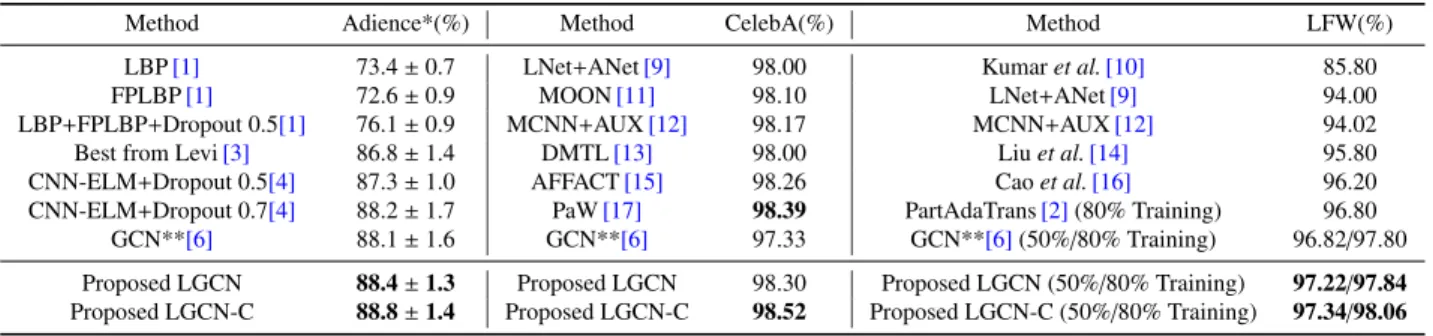
Table 2 reports the comparative results against the state-of- the-art methods on the Adience, CelebA and LFW datasets.
It is very encouraging to see that our proposed method con- sistently outperforms the existing ones on the three datasets.
This confirms the effectiveness of the proposed approach.
Moreover, the proposed method does not introduce any sac- rifice in parameter size. Compared to [3]†, the param- eter size of our network is slightly reduced in two as- pects: smaller kernel size and kernels with fewer parame- ters. Compared to[6]††, the parameter size of our network is slightly reduced due to the replacement of partial standard kernels to LGFs. As we know, the parameters of a single Ga- bor filter are always 5 regardless of the kernel size. Hence, the parameter size of each single standard convolutional ker- nel replaced by LGF is reduced to 20% in our framework.
4. Conclusions
In this letter, a new framework that integrates the proposed LGFs with CNNs is presented. The experimental results demonstrate that our method consistently outperforms the existing methods on three datasets while does not introduce any sacrifice in parameter size compared to standard CNNs with identical network architecture. The future work will focus on the joint learning of multi-parameters of Gabor fil- ters.
References
[1] E. Eidinger, R. Enbar, and T. Hassner, “Age and gender estimation of unfiltered faces,” IEEE Trans. Inform. Forensic Secur., vol.9, no.12, pp.2170–2179, 2014.
[2] Y. Gao, Z. Li, and Y. Qiao, “Adaptive part-level model knowl- edge transfer for gender classification,” IEEE Signal Process. Lett., vol.23, no.6, pp.888–892, 2016.
[3] G. Levi and T. Hassncer, “Age and gender classification using con- volutional neural networks,” 2015 IEEE Conference on Computer Vision and Pattern Recognition Workshops (CVPRW), pp.34–42, 2015.
[4] M. Duan, K. Li, C. Yang, and K. Li, “A hybrid deep learning CNN–ELM for age and gender classification,” Neurocomputing, vol.275, pp.448–461, 2017.
[5] S.S. Sarwar, P. Panda, and K. Roy, “Gabor filter assisted energy effi- cient fast learning convolutional neural networks,” 2017 IEEE/ACM International Symposium on Low Power Electronics and Design (ISLPED), pp.1–6, 2017.
[6] S. Luan, C. Chen, B. Zhang, J. Han, and J. Liu, “Gabor convo- lutional networks,” IEEE Trans. on Image Process., vol.27, no.9, pp.4357–4366, 2018.
[7] S. Hosseini, S.H. Lee, and N.I. Cho, “Feeding hand-crafted features for enhancing the performance of convolutional neural networks,”
arXiv, 2018.
[8] A. Krizhevsky, I. Sutskever, and G.E. Hinton, “Imagenet classifica- tion with deep convolutional neural networks,” International Con- ference on Neural Information Processing Systems, pp.1097–1105, 2012.
[9] Z. Liu, P. Luo, X. Wang, and X. Tang, “Deep learning face attributes in the wild,” 2015 IEEE International Conference on Computer Vi- sion (ICCV), pp.3730–3738, 2015.
[10] N. Kumar, A.C. Berg, P.N. Belhumeur, and S.K. Nayar, “Describ- able visual attributes for face verification and image search.,” IEEE Trans. Pattern Anal. Mach. Intell., vol.33, no.10, pp.1962–1977, 2011.
[11] E.M. Rudd, M. G¨unther, and T.E. Boult, “Moon: A mixed objective optimization network for the recognition of facial attributes,” Euro- pean Conference on Computer Vision, vol.9909, pp.19–35, 2016.
[12] E. Hand and R. Chellappa, “Attributes for improved attributes: A multi-task network utilizing implicit and explicit relationships for facial attribute classification,” 31st AAAI Conference on Artificial Intelligence, AAAI 2017, pp.4068–4074, 2017.
[13] H. Han, A.K. Jain, S. Shan, and X. Chen, “Heterogeneous face attribute estimation: A deep multi-task learning approach,” IEEE Transactions on Pattern Analysis & Machine Intelligence, vol.PP, no.99, pp.1–1, 2017.
[14] H. Liu, Y. Gao, and C. Wang, “Gender identification in un- constrained scenarios using self-similarity of gradients features,”
2014 IEEE International Conference on Image Processing (ICIP), pp.5911–5915, Oct. 2014.
[15] M. G¨unther, A. Rozsa, and T.E. Boult, “Affact: Alignment-free fa- cial attribute classification technique,” 2017 IEEE International Joint Conference on Biometrics (IJCB), pp.90–99, 2017.
[16] D. Cao, R. He, M. Zhang, Z. Sun, and T. Tan, “Real-world gender recognition using multi-order lbp and localized multi-boost learn- ing,” IEEE International Conference on Identity, Security and Be- havior Analysis, pp.1–6, 2015.
[17] H. Ding, H. Zhou, S. Zhou, and R. Chellappa, “A deep cascade net- work for unaligned face attribute classification,” 32nd AAAI Con- ference on Artificial Intelligence, AAAI 2018, pp.6789–6796, 2018.