INVITED PAPER
Special Section on Electronic DisplaysDevelopment of Zinc Oxide Spatial Light Modulator for High-Yield Speckle Modulation
Naoya TATE†a), Tadashi KAWAZOE††, Shunsuke NAKASHIMA†, Wataru NOMURA†,Nonmembers, andMotoichi OHTSU††,Member
SUMMARY In order to realize high-yield speckle modulation, we de- veloped a novel spatial light modulator using zinc oxide single crystal doped with nitrogen ions. The distribution of dopants was optimized to induce characteristic optical functions by applying an annealing method developed by us. The device is driven by a current in the in-plane direc- tion, which induces magnetic fields. These fields strongly interact with the doped material, and the spatial distribution of the refractive index is corre- spondingly modulated via external control. Using this device, we experi- mentally demonstrated speckle modulation, and we discuss the quantitative superiority of our approach.
key words: nanophotonics, spatial light modulator, laser speckle, speckle modulation, oxide semiconductor
1. Introduction
Laser projection systems are advanced display systems with high resolution, high brightness, and good color repro- ducibility. The images displayed by such systems are formed by scanning a laser beam on a screen at high speed to produce an image pixel-by-pixel. However, due to the use of a laser source, observers close to the screen observe unavoidable speckle patterns[1], which drastically reduces the quality of displayed images. To further widen the adop- tion of of laser projection systems and make them suitable for actual environments, there is a strong demand for novel techniques that can alleviate the problems caused by speckle patterns.
Existing techniques for speckle reduction are classified into two categories: One is to apply decoherence to the laser light, and the other is to obtain a time-averaged image of modulated speckle patterns. First, because speckle patterns are the result of interference of scattered light, applying de- coherence to the light source can directly reduce the speckle patterns[2]–[10]. Actually, incoherent light sources, such as solar light and lamps, do not form any speckle patterns.
On the other hand, because the human eye obtains an im- age over a certain exposure time, speckle patterns that are modulated at sufficiently high speed are time-averaged and become uniform. In such a case, the observer cannot rec- ognize any speckle pattern[11]–[25]. In this paper, as the
Manuscript received February 29, 2016.
Manuscript revised June 7, 2016.
†The authors are with Kyushu University, Fukuoka-shi, 819–
0395 Japan.
††The authors are with Research Institute of Nanophotonics, Tokyo, 112–0014 Japan.
a) E-mail: [email protected] DOI: 10.1587/transele.E99.C.1264
earliest stages of the latter approach, we exhibit a novel device, which is developed and operates with an original mechanism based on basics of nano-photonics, to modulate speckle patterns.
Recently, we have been developing a zinc-oxide spatial light modulator (ZnO-SLM) based on techniques that we developed[26]. In experimental demonstrations using our SLM, we obtained extremely large amounts of polarization rotation. In the work described in this paper, to apply this SLM to high-speed speckle modulation, we quantitatively verified the performance of the SLM as an optical switch- ing device. A nitrogen-doped ZnO single crystal that we fabricated reveals a large magnetic susceptibility, and based on this, we expected that it would be possible to demon- strate a novel technique for modulating the refractive index, as well as a corresponding technique for achieving optical switching, which have been required as one of the methods for the speckle modulation. Based on this concept, a quan- titative evaluation of textcolorredspeckle modulation is also described.
2. Device Fabrication
2.1 Optical Annealing
ZnO is one of the most widely used direct-transition-type semiconductors due to its wide band gap, high electron mo- bility, and high transparency to visible light[27]. Although ZnO exhibits such useful properties, it is technically difficult to implement electrically induced optical functions. One of the major reasons for such difficulty is due to the difficulty in fabricating devices. Generally, in order to realize an electro- optical device by using ZnO crystal, it is necessary to add p-type dopants to the n-type crystal, so as to fabricate a p-n junction, which exhibits various electro-optical properties, such as a rectifying property, the photovoltaic effect, and so on[28]–[32]. However, in the case of the ZnO crystal, the sequential generation of donor dopants occurs in the crystal in association with the introduction of acceptor dopants, and they compensate each other[27]. Inevitably, it is technically difficult to fabricate a p-n junction having sufficient quality to be used as a practical electro-optical device.
Recently, a technique known as optical annealing[33]
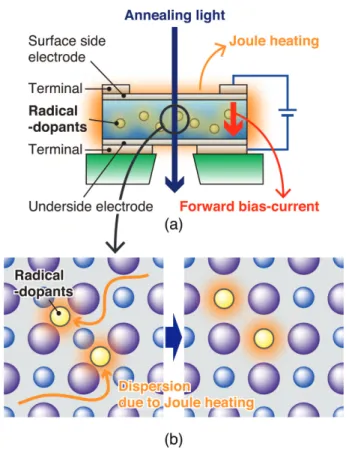
has been proposed by the authors’ group. The basic setup and mechanism of the method are schematically shown in Fig. 1.
Copyright c2016 The Institute of Electronics, Information and Communication Engineers
In the method, in addition to thermal annealing by Joule heating due to the application of a forward bias cur- rent between the surface side and underside electrodes, op- tical energy is also radiated. The base material must be transparent to the optical energy, so that the optical energy can efficiently interact with dopants in the material. In this method, the thermal mobility of dopants is much smaller than in the case of standard thermal annealing using electric furnaces, and the optically-irradiated dopants behave as free radicals. Generally, these unpaired electrons make the free radicals have high chemical-reactivity towards other sub- stances. Especially in the case of optical annealing, this results in more active substitution of dopants with exist- ing substances in the doped material, as shown in Fig. 1 (b).
Moreover, as our colleagues have previously verified[34], the substituted dopants are not randomly distributed but re- veal cluster-like distributions. Based on the fundamentals of molecular chemistry, such materials are expected to re- veal larger magnetic susceptibility, and this is the most crit- ical and fundamental point in the following discussions. By utilizing this method, various electro-optical functions have been successfully demonstrated by using several types of semiconductors[35]–[43].
Fig. 1 Schematic diagram of (a) optical annealing, and (b) the behavior of radical dopants during the process.
2.2 In-Plane Driving Current
One of the most familiar physical manifestations of the magneto-optical effect Faraday rotation, which is rotation of the polarization of linearly polarized incident light dur- ing propagation in a magneto-optical material by applying an external magnetic field. In such a case, a quantitative evaluation of the magneto-optical effect is described by the Verdet constantV =θ·χ/M·l, whereθ,l,Mandχrepresent the Faraday rotation angle, the length of the light path in the material, the intensity of the magnetization vector, and the magnetic susceptibility, respectively. As shown, the mag- netic susceptibility χ is directly related to the intensity of the magneto-optical effect.
Recently, we have proposed an electro-optical device with a novel structure, which reveals characteristic functions by applying a current in the in-plane direction[26]. Figure 2 shows a schematic diagram of the driving mechanism of the device. As shown, the most important aspect of the idea is the use of current-induced magnetic fields.
As described in the previous section, because the mag- netic susceptibility χ of the doped material is improved by the optical annealing, current-induced magnetic fields can be expected to induce sufficient levels of interactions between the materials and a corresponding level of the magneto-optical effect on incident light. While common experiments on the magneto-optical effect require a large setup to apply a strong magnetic field to the target material, an in-plane current and the resulting current-induced mag- netic fields can be achieved with a quite compact setup, as shown in Fig. 2. In particular, because the intensity of the current-induced magnetic field at a point is inversely pro- portional to the distance between the current and the point, a sufficient level of the magneto-optical effect can be induced only at regions close to the surface of the device, less than 5 μm in our setup. Indeed, our group has experimentally demonstrated large amounts of polarization rotation by us- ing current-induced magnetic fields with a setup similar to the one described in this paper[26].
Fig. 2 Schematic diagram of novel electro-optical device driven by in-plane current.
2.3 Device Configuration
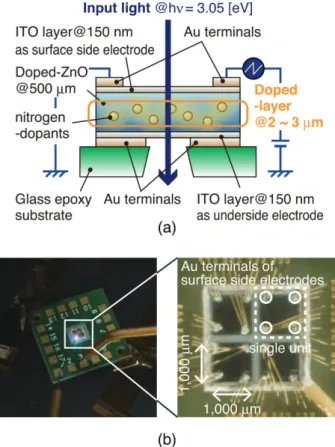
Our previous achievements that revealed giant polarization rotation were demonstrated by using a reflective-type de- vice[26]. In order to improve the practicality of our idea, we newly developed a transmissive-type device. Similar to the previous device, a commercially available ZnO sin- gle crystal, which was prepared by the hydrothermal growth method, was used, and nitrogen ions were doped into the crystal by using multi-step implantation[36]. The implanta- tion is done by sequentially applying N+and N2+with ac- celeration energies in six steps from 20 keV to 600 keV. As a result, the thickness of the doped layer in the ZnO crys- tal became 2∼3μm with a dopant density of 1018 ∼1019 atoms/cm3, and the depth from the surface of the device was less than 1μm. As the surface side and underside electrodes, 150 nm-thick indium tin oxide (ITO) films were deposited by radio frequency (RF) sputtering, and Au terminals were fabricated at each side by deposition and etching processes.
Then, the doped-ZnO was set on a glass epoxy substrate, and an aperture was formed to allow transmission of the in- cident light.
The surface side and underside electrodes were con- nected so as to perform optical annealing. During 16 hours of annealing, a forward bias current with a current density of less than 0.1 A/cm2was applied between the surface side and underside electrodes, which was the highest current that could be applied without causing any thermal destruction of the Au terminals. The photon energy of the annealing light was set at 3.05 eV, which is much lower than the bandgap energy of ZnO (3.40 eV), and the power density of the an- nealing light focused on the device was 1 W/cm2.
After the annealing process, the electrode connection was changed to apply the in-plane current for driving the device, as shown in Fig. 3 (a). Here, the same light source as that used for the annealing light was used as the input light source, and it is linearly-polarized by Glan-Thompson polarizer. Due to phase shifts during the propagation in the device, transmitted light reveals elliptical polarization. Pho- tographs of the device are shown in Fig. 3 (b). As shown, four independent units were prepared on a single device to verify crosstalk between each unit. Each unit has four Au terminals, and the in-plane current was applied by connect- ing two arbitrary terminals of the four terminals.
3. Refractive Index Modulation
Polarization rotation based on the magneto-optical effect is one aspect of the circular-polarization selection rule toward optical transitions in a material with high magnetization. In other words, a difference in refractive index between left- and right-handed circularly polarized light corresponds to rotation of linearly-polarized light. Although giant polar- ization rotation has been previously demonstrated by our group[26], here we focus on modulation of the refractive index and a corresponding beam shift of plane-wave light
Fig. 3 (a) Schematic diagram of transmissive-type ZnO SLM and (b) photograph of the device consisting of 2×2 units.
by using a ZnO-SLM. The basics of the demonstration are described in the following.
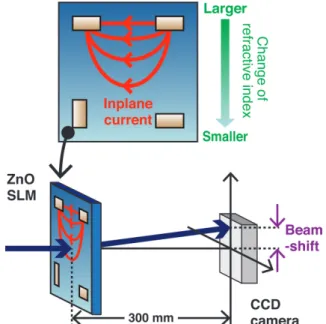
As schematically shown in Fig. 4, because a spatial dis- tribution of in-plane current density and a corresponding magnetic field distribution can be made to occur by using two terminals on the surface side electrodes of the SLM, a corresponding spatial distribution of the refractive index of ZnO is obtained. In such a case, incident plane-wave light is refracted by the SLM. If different pairs of terminals are used, refraction in different directions is induced.
Figure 5 show the results of some demonstrations of the refraction of plane-wave light, where the output light was captured by a CCD camera when voltages of 0 V (left) and 18 V (right) were applied to the SLM. In the experi- ment, only one of the four units was driven, and only the corresponding light, namely, the upper-right light in Fig. 5, was modulated. As shown in Figs. 5 (a) and (b), only the upper-right light was shifted in the vertical and horizontal directions, respectively.
As we have shown, the refraction direction corresponds to the position of the terminals used for injection of the in- plane current. As a result, we verified that the spatial distri- butions of the in-plane current density and the correspond- ing magnetic fields induced a spatial distribution of the re- fractive index in the ZnO. During the demonstration shown in Fig. 5 (a), the change in the refractive index, which is ap- proximately calculated from the amount of shift of the in-
Fig. 4 Schematic diagram of spatial distribution of refractive index due to spatial distribution of in-plane current density (upper), and correspond- ing beam shift of incident plane-wave light (lower).
Fig. 5 Experimental results of refraction of plane-wave light in (a) vertical direction and (b) horizontal direction.
cident light, depends on the voltage applied to the SLM, as shown in Fig. 6.
As shown, a change in refractive index of up to 0.40, which is 5% of the change rate relative to the default refrac- tive index of ZnO crystal (2.00) at room temperature, was obtained by applying a voltage of 20 V. This change is ex- tremely large as compared to that in well-known magneto-
Fig. 6 Change in refractive index.
Fig. 7 Directions and amounts of refraction by using various pairs of terminals with (a) annealed unit and (b), (c), (d) non-annealed units. Ter- minal 2 is used during the optical annealing process.
optical materials, such as yttrium iron garnet (YIG)[44].
Moreover, various directions and amounts of refraction obtained by using various pairs of terminals are shown in Fig. 7. Figure 7(a) shows a case where an annealed unit is used, and Figs. 7 (b), (c), and (d) shows cases where non- annealed units are used. The squares and number in each square represent the positions and serial numbers identify- ing terminals of the surface side electrode, respectively, and the underlined numbers represent the used pairs of termi- nals.
As shown, the amounts of shift and the shift direc- tions with the non-annealed units were more non-uniform,
Fig. 8 (a) Schematic diagram of optical setup for experimental demon- stration of speckle modulation, and (b) the results of speckle modulation.
whereas more uniform refraction was obtained with the an- nealed unit. The results indicate that optical annealing real- izes homogeneously-distributed dopants, so that the spatial distribution of the refractive index is homogeneously modu- lated by using any pairs of terminals.
4. Speckle Modulation
We experimentally demonstrated the speckle modulation base on the beam shifts. Because speckle patterns are partic- ular to the surface roughness at each focal point on a target, beam shifts due to the spatial distribution of the refractive index induce various speckle patterns. By modulating the speckle patterns at sufficiently high speed, the contrast of a time-averaged image of the patterns is lower than that of individual patterns.
Figure 8 (a) shows the experimental setup used for demonstrating speckle modulation. Similarly to the previ- ous demonstrations, plane-wave light from a laser source is input to the SLM and is focused on a frosted diffuser to gen- erate speckle patterns. The surface roughness parameter of the diffuser is1,000.
The focused point of light is shifted by modulation with the SLM, and the speckle patterns generated by the diffuser are correspondingly modulated. The speckle patterns ob- tained by the CCD camera are shown in Fig. 8 (b). The volt- age applied to the SLM as a modulation signal was a saw- tooth wave varying from 12 V to 24 V. A bias voltage of 12 V was applied so as to use the linear region of the modula- tion characteristic shown in Fig. 6.
For quantitative evaluation of our method, the speckle
Fig. 9 Reduction of speckle contrast by using ZnO-SLM.
contrast is calculated from trimmed images obtained from video captured by the CCD camera. Here, we obtained a 30 ms time-averaged image, which can be observed by the human eye. The result is shown in Fig. 9.
As shown, the speckle contrast was successfully re- duced from 0.67 to 0.46. However, the amounts seem to converge to a constant value in the result. This is consid- ered to be due to the polarization selectivity of the magneto- optical effect of the SLM. Namely, because only one direc- tion of circularly polarized light was modulated by the SLM and the other was not, unmodulated speckle patterns re- mained in the time-averaged image. Thus, speckle contrast cannot be reduced to a sufficient value required for actual use as speckle reduction device, namely, less than 0.10. The result indicates that polarization control of the laser source is important for realizing speckle reduction with our SLM.
As a matter of fact, the results in Fig. 9 only indicates relative changes of speckle patterns induced by our specific setup. As further studies, in order to more strictly discuss the speckle reduction, adopting more general methods for the measurement of speckle contrast must be required[45], [46].
5. Conclusion
As shown, we described the development of a specially de- signed SLM, namely, a transmissive-type ZnO-SLM. Sim- ilarly to the authors’ previous approach[26], the SLM is fabricated by using optical annealing and is driven by ap- plying an in-plane current, which induces magnetic fields.
The results of experimental demonstrations revealed large modulation of the spatial distribution of the refractive index.
Moreover, for the future application to the speckle reduc- tion, we focused on high-speed modulation of speckle pat- terns by utilizing beam shifts of incident plane-wave light due to modulation of the spatial distribution of the refractive index. While the conventional approaches[11]–[25]require a mechanical setup to realize high-speed fluctuation of the displayed screen, the main advantage of our idea is the high speed achieved by a compact setup that does not require any mechanical elements, which lower the stability and durabil-
ity of the conventional set-ups.
Moreover, the basic mechanism of our method is the magneto-optical effect brought about by current-induced magnetic fields. As is well-known, the basic geometry of the magneto-optical effect is defined by spin flips of electrons in a nanometric space, which are induced in processing times of less than ps-order. Therefore, a compact, high-speed sys- tem for speckle reduction can be implemented. In future re- search, we are planning to quantitatively verify the response characteristics of the modulation and optimize the specifi- cations of the device so that it can be applied to practical speckle reduction for laser displays in the near future.
This work was supported by a research grant from The Murata Science Foundation and by Kyushu University Inter- disciplinary Programs in Education and Projects in Research Development.
References
[1] J.W. Goodman, Speckle Phenomena in Optics, W.H. Freeman, 2010.
[2] N. George and A. Jain, “Speckle reduction using multiple tones of illumination,” Appl. Opt., vol.12, no.6, pp.1202–1212, 1973.
[3] C. Saloma, S. Kawata, and S. Minami, “Laser-diode microscope that generates weakly speckled images,” Opt. Lett., vol.15, no.4, pp.203–205, 1990.
[4] B. Dingel and S. Kawata, “Laser-diode microscope with fiber illu- mination,” Opt. Comm., vol.93, no.1-2, pp.27–32, 1992.
[5] B. Dingel and S. Kawata, “Speckle-free image in a laser-diode mi- croscope by using the optical feedback effect,” Opt. Lett., vol.18, no.7, pp.549–551, 1993.
[6] A. Furukawa, N. Ohse, Y. Sato, D. Imanishi, K. Wakabayashi, S. Itoh, K. Takamura, and S. Hirata, “Effective speckle reduction in laser projection display,” Proc. SPIE, vol.6911, pp.69110T-1–7, 2008.
[7] F. Riechert, G. Craggs, Y. Meuret, B. van Giel, H. Thienpont, U.
Lemmer, and G. Verschaffelt, “Low-speckle laser projection with a broad-area vertical-cabity surface-emitting laser in the nonmodal emission regime,” Appl. Opt., vol.48, no.4, pp.792–798, 2009.
[8] H. Murata, K. Furushoi, Z. Yamamoto, and Y. Okamura, “New speckle control technique using high-speed electro-optic modulators with resonant electrode and polarization-reversed structures,” Opt.
Rev., vol.19, no.6, pp.436–439, 2012.
[9] J.G. Manni and J.W. Goodman, “Versatile method for achieving 1 % speckle contrast in large-venue laser projection displays us- ing a stationary multimode optical fiber,” Opt. Exp., vol.20, no.10, pp.11288–11315, 2012.
[10] H. Murata, K. Shibasaki, Z. Yamamoto, and Y. Okamura, “Speckle control using high-frequency signal superposition to semiconductor laser,” Opt. Rev., vol.21, no.1, pp.79–82, 2014.
[11] S. Lowenthal and D. Joyeux, “Speckle removal by slowly moving diffuser associated with a motionless diffuser,” J. Opt. Soc. Am., vol.61, no.7, pp.847–851, 1971.
[12] E.G. Rawson, A.B. Nafarrate, R.E. Norton, and J.W. Goodman,
“Speckle-free rear-projection screen using two close screens in slow relative motion,” J. Opt. Soc. Am., vol.66, no.11, pp.1290–1294, 1976.
[13] H. Amber, Y. Aoki, N. Takai, and T. Asakura, “Mechanism of speckle reduction in laser-microscope-images using a rotating op- tical fiber,” Appl. Phys. B, vol.38, no.1, pp.71–78, 1985.
[14] T. Yoshimura and K. Fujiwara, “Statistical properties of doubly scat- tered image speckle,” J. Opt. Soc. Am. A, vol.9, no.1, pp.91–95, 1992.
[15] L. Wang, T. Tschudi, T. Halld´orsson, and P.R. P´etursson, “Speckle reduction in laser projection system by diffractive optical elements,”
Appl. Opt., vol.37, no.10, pp.1770–1775, 1998.
[16] K. Kasazumi, Y. Kitaoka, K. Mizuuchi, and K. Yamamoto, “A prac- tical laser projector with new illumination optics for reduction of speckle noise,” Jpn. J. Appl. Phys., vol.43, no.8B, pp.5904–5906, 2004.
[17] S.C. Shin, S.S. Yoo, S.Y. Lee, C.-Y. Park, S.-Y. Park, J.W. Kwon, and S.-G. Lee, “Removal of hot speckle on rear projection screen using the rotating screen system,” J. Disp. Tech., vol.2, no.1, pp.79–84, 2006.
[18] I. Fujieda, T. Kosugi, and Y. Inaba, “Speckle noise evaluation and reduction of an edge-lit backlight system utilizing laser diodes and an optical fiber,” J. Disp. Tech., vol.5, no.11, pp.414–417, 2009.
[19] S. An, A. Lapchuk, V. Yurlov, J. Song, H. Park, J. Jang, W. Shin, S. Kargapoltsev, and S.K. Yun, “Speckle suppression in laser dis- play using several partially coherent beams,” Opt. Exp., vol.17, no.1, pp.92–103, 2009.
[20] Y. Kuratomi, K. Sekiya, H. Satoh, T. Tomiyama, T. Kawakami, B.
Katagiri, Y. Suzuki, and T. Uchida, “Speckle reduction mechanism in laser rear projection displays using a small diffuser,” J. Opt. Soc.
Am. A, vol.27, no.8, pp.1812–1817, 2010.
[21] G. Ouyang, Z. Tong, M.N. Akram, K. Wang, V. Kartashoc, X. Yan, and X. Chen, “Speckle reduction using a motionless diffractive op- tical element,” Opt. Lett., vol.35, no.17, pp.2852–2854, 2010.
[22] M. Kurashige, K. Ishida, T. Takanokura, Y. Ohyagi, and M.
Watanabe, “The evaluation of speckle contrast with variable speckle generator,” J. Soc. Inf. Display, vol.19, no.9, pp.631–638, 2011.
[23] Z. Tong, X. Xhen, M.N. Akram, and A. Aksnes, “Compound speckle characterization method and reduction by optical design,” J. Disp.
Tech., vol.8, no.3, pp.132–137, 2012.
[24] C.-Y. Chen, W.-C. Su, C.-H. Lin, M.-D. Ke, Q.-L. Deng, and K.-Y.
Chiu, “Reduction of speckles and distortion in projection system by using a rotating diffuser,” Opt. Rev., vol.19, no.6, pp.440–443, 2012.
[25] T.-K.-T. Tran, S. Subramaniam, C.-P. Le, S. Kaur, S. Kalicinski, M. Ekwinska, E. Halvorsen, and M.N. Akram, “Design, modeling, and characterization of a microelectromechanical diffuser device for laser speckle reduction,” J. Microelectromech. Sys., vol.23, no.1, pp.117–127, 2014.
[26] N. Tate, T. Kawazoe, W. Nomura, and M. Ohtsu, “Current-induced giant polarization rotation using a ZnO single crystal doped with ni- trogen ions,” Scientific Reports, vol.5, Article number 12762, 2015.
[27] U. ¨¨ Ozg¨ur, Y.I. Alivov, C. Liu, A. Teke, M.A. Reshchikov, S.
Do˘gan, V. Avrutin, S.-J. Cho, and H. Morkoc¸, “A comprehensive review of ZnO materials and devices,” J. Appl. Phys., vol.98, no.4, pp.041301-1–103, 2005.
[28] N. Yamazoe, “New approaches for improving semiconductor gas sensors,” Sens. Actuators B: Chem., vol.5, no.1-4, pp.7–19, 1991.
[29] K.D. Schierbaum, U. Weimar, and W. G¨opel, “Comparison of ce- ramic, thick film, and thin film chemical sensors based upon SnO2,”
Sens. Actuators B: Chem., vol.7, no.1-3, pp.709–716, 1992.
[30] G. Kiss, Z. Pint´er, I.V. Perczel, Z. Sassi, and F. R´eti, “Study of oxide semiconductor sensor materials by selected methods,” Thin Solid Films, vol.391, no.2, pp.216–223, 2001.
[31] K. Nomura, H. Ohta, A. Takagi, T. Kamiya, M. Hirano, and H. Hosono, “Room-temperature fabrication of transparent flexible thin-film transistors using amorphous oxide semiconductors,” Na- ture, vol.432, no.7016, pp.488–492, 2004.
[32] J.S. Park, W.-J. Maeng, H.-S. Kim, and J.-S. Park, “Review of recent developments in amorphous oxide semiconductor thin-film transis- tor devices,” Thin Solid Films, vol.520, no.6, pp.1679–1693, 2012.
[33] T. Kawazoe, M.A. Mueed, and M. Ohtsu, “Highly efficient and broadband Si homojunction structured near-infrared light emitting diodes based on the phonon-assisted optical near-field process,”
Appl. Phys. B, vol.104, no.4, pp.747–754, 2011.
[34] T. Kawazoe, K. Nishioka, and M. Ohtsu, “Polarization control of an infrared silicon light-emitting diode by dressed photons and analyses of the spatial distribution of doped Boron atoms,” Appl. Phys. A, vol.121, no.4, pp.1409–1415, 2015.
[35] T. Kawazoe, K. Kobayashi, S. Takubo, and M. Ohtsu, “Nonadia- batic photodissociation process using an optical near field,” J. Chem.
Phys., vol.122, no.2, pp.024715-1–5, 2005.
[36] K. Kitamura, T. Kawazoe, and M. Ohtsu, “Homojunction-structured ZnO light-emitting diodes fabricated by dressed-photon assisted an- nealing,” Appl. Phys. B, vol.107, no.2, pp.293–299, 2012.
[37] T. Kawazoe, M. Ohtsu, K. Akahane, and N. Yamamoto, “Si homo- junction structured near-infrared laser based on a phonon-assisted process,” Appl. Phys. B, vol.107, no.3, pp.659–663, 2012.
[38] H. Tanaka, T. Kawazoe, and M. Ohtsu, “Increasing Si photodetector photosensitivity in near-infrared region and manifestation of opti- cal amplification by dressed photons,” Appl. Phys. B, vol.108, no.1, pp.51–56, 2012.
[39] N. Wada, T. Kawazoe, and M. Ohtsu, “An optical and electrical re- laxation oscillator using a Si homojunction structured light emitting diode,” Appl. Phys. B, vol.108, no.1, pp.25–29, 2012.
[40] M.A. Tran, T. Kawazoe, and M. Ohtsu, “Fabrication of a bulk silicon p–n homojunction-structured light-emitting diode showing visible electroluminescence at room temperature,” Appl. Phys. A, vol.115, no.1, pp.105–111, 2014.
[41] N. Wada, M.A. Tran, T. Kawazoe, and M. Ohtsu, “Measure- ment of multimode coherent phonons in nanometric spaces in a homojunction-structured silicon light emitting diode,” Appl. Phys.
A, vol.115, no.1, pp.113–118, 2014.
[42] M. Yamaguchi, T. Kawazoe, and M. Ohtsu, “Evaluating the coupling strength of electron–hole pairs and phonons in a 0.9μm-wavelength silicon light emitting diode using dressed-photon–phonons,” Appl.
Phys. A, vol.115, no.1, pp.119–125, 2014.
[43] T. Kawazoe and M. Ohtsu, “Bulk crystal SiC blue LED with p–n ho- mojunction structure fabricated by dressed-photon-phonon–assisted annealing,” Appl. Phys. A, vol.115, no.1, pp.127–133, 2014.
[44] S. Geller, H.J. Williams, R.C. Sehrwood and G.P. Espinosa, “Bis- muth substitution in Yttrium Iron Aluminum garnets,” J. Appl.
Phys., vol.35, no.6, pp.1754–1756, 1964.
[45] S. Kubota, “Spatial coherence measurement of a scanning laser sys- tem and applicability of the Zernike’s approximation to the exit pupil on the scan mirror,” Opt. Rev., vol.19, no.6, pp.432–435, 2012.
[46] K. Suzuki, T. Fukui, S. Kubota, and Y. Furukawa, “Verification of speckle contrast measurement interrelation with observation dis- tance,” Opt. Rev., vol.21, no.1, pp.94–97, 2014.
Naoya Tate Dr. degree in information science from Osaka Univ. (2006), Project re- searcher at the Japan Science and Technol- ogy Agency (2006), Project assistant professor (2007) and Project researcher (2011) at the Univ.
of Tokyo, Associate professor at Kyushu Univ.
(2014).
Tadashi Kawazoe Dr. E. degrees in physics from Univ. of Tsukuba (1996), Research as- sociate at Yamagata Univ. (1996), Project re- searcher at Japan Science and Technology Cor- poration (2000), Project associated professor (2007) and Project researcher (2011) at the Univ.
of Tokyo, General Manager at Nanophotonics Engineering Organization (2015).
Shunsuke Nakashima B. E. degree in elec- tronics engineering from Kyushu Univ. (2016).
Wataru Nomura Dr. degrees in information science from the Univ. of Tokyo (2007), Project assistant professor (2007) and Project researcher (2011) at the Univ. of Tokyo, Research associate at Kyushu Univ. (2015).
Motoichi Ohtsu Dr. E. degrees in electron- ics engineering from Tokyo Inst. Tech. (1978), Member of Tech. Staff, AT&T Bell Labs.
(1986–1987), Professor at the Tokyo Inst. Tech.
(1991), Professor at the Univ. of Tokyo (2004).
Issac Koga Gold Medal of URSI (1984), Japan Royal Medal with a Purple Ribbon from the Japanese Government (2004), Julius Springer Prize for Applied Physics (2009).