Analysisi of the reduction strategy of air pollutants discharged from emission sources and its effect at the metropolitan area in Korea
著者 Lee Woo‑Keun journal or
publication title
金沢大学21世紀COEプログラム主催国際シンポジ ウム「東アジアの大気環境汚と健 康・生態系への 影響」講演要旨集(金沢)
page range 9‑10
year 2006‑09‑25
URL http://hdl.handle.net/2297/2438
Analysis of the reduction strategy of air pollutants discharged from emission sources and its effect at the metropolitan area
in Korea
Woo-Keun Lee
Vice president of KOSAE, Kangwon University
Abstract
1. Background and Objects
Korea has kept the high economic growth policy since 1970s and become OECD country as a result. But air quality has come to the serious level with the industrial development.
Korean government has tried eagerly to improve air quality using various air management policies such as the regulation of fuel and the strengthening of emission standard. The concentration of TSP, SO
2, and Pb was noticeably lowered in ambient air as these measures.
But the concentration of PM10, NOx and O
3has not been improved. The concentration of PM10 and NOx (Figure 1) was 69໌/m
3and 38ppb at metropolitan area in 2001, respectively. It is equivalent to 1.9-3.6 times the value of OECD countries.
Figure 1. Status of air pollution in Seoul city
And also it is estimated that 1,940 persons are died from PM10-caused disease at Seoul city. The government had enacted “the special law for improving air quality of metropolitan area” in 2003 and planed to lower the concentration of PM10 and NOx to 40
໌/m
3and 22ppb until 2014, respectively. Emissions from point, area and line sources must be reduced to reach this goal.
In this study, we discussed the reduction strategies of emissions from point, area and line sources, especially from area source. And also we evaluated their reduction effect to decide the priority among these measures. The proper reduction strategy can be established only
䎙 䎜
䎖 䎛 䎖 䎚
䎕 䎛
䎕 䎓 䎕 䎘
䎕 䎓 䎕 䎕 䎔 䎜 䎕 䎓
䎓 䎔 䎓 䎕 䎓 䎖 䎓 䎗 䎓 䎘 䎓 䎙 䎓 䎚 䎓
䎶 䏈 䏒 䏘 䏏 䎋 䎅䎓 䎖 䎌 䎷 䏒 䎮 䏜 䏒 䎋 䎅䎓 䎔 䎌 䎯 䏒 䏑 䏇 䏒 䏑 䎋 䎅䎓 䎔 䎌 䎳 䏄 䏕 䏌 䏖 䎋 䎅䎓 䎔 䎌 䎱 䏈 䏚 䎼 䏒 䏕 䏎 䎋 䎅䎓 䎕 䎌
䎳 䎰 䎔 䎓 䎃 䎋 ঋ 䎒 ণ 䎌 䎱 䎲 䎕 䎃 䎋 䏓 䏓 䏅 䎌
- 9 -
on the base of these results.
2. Emission Reduction Strategy
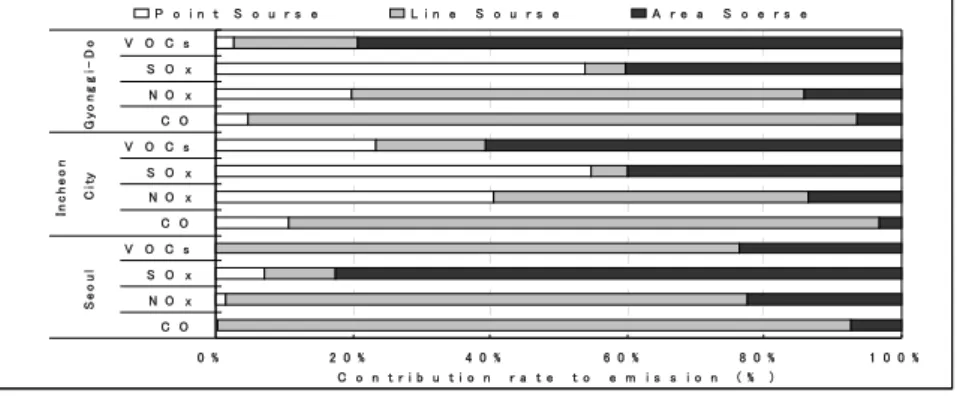
Our target area, or metropolitan area is composed of Seoul city, Incheon city and a part of Gyonggi-Do. The contribution rate to the emissions from point, area, line sources at metropolitan area is shown in Figure. It seems that emissions are affected mainly by line and area sources.
䎓 䎈 䎕 䎓 䎈 䎗 䎓 䎈 䎙 䎓 䎈 䎛 䎓 䎈 䎔 䎓 䎓 䎈
䎦 䎲 䎃 䎱 䎲 䏛 䎃 䎶 䎲 䏛 䎹 䎲 䎦 䏖 䎦 䎲 䎃 䎱 䎲 䏛 䎃 䎶 䎲 䏛 䎹 䎲 䎦 䏖 䎦 䎲 䎃 䎱 䎲 䏛 䎃 䎶 䎲 䏛 䎹 䎲 䎦 䏖
䎶䏈䏒䏘䏏
䎬䏑䏆䏋䏈䏒䏑 䎦䏌䏗䏜䎪䏜䏒䏑䏊䏊䏌䎐䎧䏒
䎦 䏒 䏑 䏗 䏕 䏌 䏅 䏘 䏗 䏌 䏒 䏑 䎃 䏕 䏄 䏗 䏈 䎃 䏗 䏒 䎃 䏈 䏐 䏌 䏖 䏖 䏌 䏒 䏑 䎃 䎋 䎈 䎌 䎳 䏒 䏌 䏑 䏗 䎃 䎶 䏒 䏘 䏕 䏖 䏈 䎯 䏌 䏑 䏈 䎃 䎶 䏒 䏘 䏕 䏖 䏈 䎤 䏕 䏈 䏄 䎃 䎶 䏒 䏈 䏕 䏖 䏈
Figure 2 Contribution to emissions of point, area and line sources at metropolitan area in 2001
Therefore, the reduction strategy to reduce emissions from line and area sources, especiall y area source is considered in our study. The enlargement of supply of low- pollution car, strengthening emission standard and installing control devices, such as DPF, SCR and DOC, are considered as the emission reduction means for line source. It is thou ght that NOx and PM10 are reduced by 77,058 ton/year and 6,052 ton/year, respectively, with the application of these means. Regulation of fuel, local heating and air conditionin g, strengthening NOx management, the management of energy demand, the transportation and storage of energy and the restriction of solvent content are considered as the emissio n reduction measures from area source. NOx, PM10 and VOC are reduced with the applic ation of these measures by 24,613 t/y, 438 t/y and 251,113t/y, respectively. And also vario us scenario for the emission reduction based on these results are suggested.
3. Conclusion
The emission reduction strategies and their effects are analyzed and the scenarios for the reduction are compared in our study. The budget and the decision of the priority for the reduction strategy are needed for obtaining the effect of emission reduction.
- 10 -