Survey of a Protocol to Increase Appropriate Implementation of Dispatcher‑Assisted
Cardiopulmonary Resuscitation for Out‑of‑Hospital Cardiac Arrest
著者 田中 良男
著者別表示 Tanaka Yoshio journal or
publication title
博士論文本文Full 学位授与番号 13301甲第4089号
学位名 博士(医学)
学位授与年月日 2014‑06‑30
URL http://hdl.handle.net/2297/42074
doi: 10.1161/CIRCULATIONAHA.113.004409
Creative Commons : 表示 ‑ 非営利 ‑ 改変禁止 http://creativecommons.org/licenses/by‑nc‑nd/3.0/deed.ja
Survey of a Protocol to Increase Appropriate Implementation of Dispatcher-Assisted Cardiopulmonary Resuscitation for
Out-of-Hospital Cardiac Arrest
Running title: Tanaka et al.; A protocol to increase DA-CPR implementation
Yoshio Tanaka, MD, MSc1; Taiki Nishi, MSc1; Keiko Takase1; Yutaka Yoshita, MD, PhD2; Yukihiro Wato, MD, PhD3; Junro Taniguchi, MD, PhD4; Yoshitaka Hamada, MD, PhD5;
Hideo Inaba, MD, PhD1
1Department of Emergency Medical Science, Kanazawa University Graduate School of Medicine, Kanazawa, Ishikawa, Japan; 2Department of Anesthesia, Komatsu Municipal Hospital, Komatsu, Ishikawa,
Japan; 3Department of Emergency Medicine, Kanazawa Medical University, Kahoku, Ishikawa, Japan;
4Emergency Medical Center, Ishikawa Prefectural Central Hospital, Kanazawa, Ishikawa, Japan;
5Department of Neurosurgery, Suzu General Hospital, Suzu, Ishikawa, Japan
Address for Correspondence:
Hideo Inaba, MD, PhD, Professor and Chair Department of Emergency Medical Science, Kanazawa University Graduate School of Medicine 13-1 Takara-machi, Kanazawa, Ishikawa 920-8641, Japan
Phone: +81-76-265-2825 Fax: +81-76-234-4243
E-mail: [email protected]
Abstract
Background—Dispatcher-assisted cardiopulmonary resuscitation (DA-CPR) attempts to improve the
management of out-of-hospital cardiac arrest (OHCA) by laypersons who are unable to recognize cardiac arrest and are unfamiliar with CPR. Therefore, we investigated the sensitivity and specificity of our new DA-CPR protocol for achieving implementation of bystander CPR in OHCA victims not already receiving bystander CPR.
Methods and Results—Since 2007, we have applied a new DA-CPR protocol that uses supplementary
keywords. Fire departments prospectively collected baseline data regarding DA-CPR from January 2009 to December 2011. DA-CPR was attempted in 2747 patients; of these, 417 (15.2%) did not experience cardiac arrest. The sensitivity and specificity of the 2007 protocol vs. estimated values of the previous standard protocol were 72.9% vs. 50.3% and 99.6% vs. 99.8%, respectively. We identified keywords that may be useful for detecting OHCA. Multiple logistic regression analysis revealed that the occurrence of cardiac arrest after an emergency call (odds ratio = 16.85) and placing an emergency call away from the scene of the arrest (11.04) were potentially associated with failure to provide DA-CPR. Furthermore, at-home cardiac arrest (1.61) and family members as bystanders (1.55) were associated with bystander non-compliance with DA-CPR. No complications were reported in the 417 patients who received DA-CPR but did not have cardiac arrest.
Conclusions—Our 2007 protocol is safe, highly specific, and may be more sensitive than the standard
protocol. Understanding the factors associated with failure of bystanders to provide DA-CPR and implementing public education will be necessary to increase the benefit of DA-CPR.
Keywords: cardiopulmonary resuscitation; dispatcher assisted-CPR; out-of-hospital cardiac arrest
Dispatcher-assisted cardiopulmonary resuscitation (DA-CPR) increases bystander CPR frequency, improving out-of-hospital cardiac arrest (OHCA) outcome.1-4 To ensure a maximally effective DA-CPR, the American Heart Association5 and International Liaison Committee on Resuscitation6 made strong recommendations in the standard DA-CPR protocol, which identify two key questions regarding the patients’ absence of consciousness and quality of breathing (normal/not normal) used during CPR initiation. Various factors interfere with successful implementation of DA-CPR, including the OHCA patient having agonal breathing, anoxic convulsions, or emesis;4 the bystander’s physical limitations or emotional stress,7 the relationship between a caller and the OHCA patient,8and the bystander’s lack of prior CPR training.9 An educational approach improved the ability to accurately detect cardiac arrest by dispatchers and increased the rate of bystander CPR.5
To improve the DA-CPR provision rate and bystander CPR in OHCA cases without a large delay in DA-CPR instruction, the Ishikawa Medical Control Council initiated a continuous quality improvement (CQI) project for DA-CPR attempts on the basis of new indication criteria defined as the 2007 protocol. A major cause for not providing DA-CPR instructions is failure of the dispatcher to recognize the cardiac arrest without definitive information about responsiveness and respiration over the telephone;5 therefore, to improve the dispatchers’ detection rates of a cardiac arrest, dispatchers were encouraged to use supplementary keywords suggestive of cardiac arrest in addition to the standard two key questions. We recently reported that this project improved the rate of bystander CPR and prognosis for OHCA patients in Ishikawa Prefecture.4
This study was conducted as a part of the CQI project. Because the quality of DA-CPR protocol should be evaluated in terms of early and proper recognition of savable cardiac arrests,1-4, 10 we determined
the sensitivity and specificity of our 2007 protocol and compared them with the estimated values obtained by the standard protocol. Sensitivity was defined as the number of transported EMT-unwitnessed OHCA cases, for which DA-CPR was attempted, divided by the number of transported EMT-unwitnessed OHCA cases that did not receive bystander CPR on bystander’s own initiative. Specificity was defined as the number of transported non-OHCA cases, for which DA-CPR was not attempted, divided by the number of total transported non-OHCA cases. Furthermore, to improve DA-CPR protocol and design new
educational approaches for dispatchers and callers, we determined the background and characteristics of OHCA patients and bystanders that were associated with the success of DA-CPR provision and bystander compliance with DA-CPR. For these analyses, we combined the emergency medical dispatch (EMD) database with our extended Utstein database and uniformly analyzed the data.11
Methods Study design
This was a prospective observational study. Data were collected in accordance with national ethics guidelines for epidemiological surveys.12 This study was approved by the review board of the Ishikawa Medical Control Council.
As shown in Figure 1, all fire departments prospectively collected baseline data regarding EMD during the period from January 2009 to December 2011. We instructed the project members in each fire department to review their voice and/or paper dispatch records for DA-CPR that was or was not attempted for OHCAs. Two databases related to DA-CPR were ultimately generated. These databases contained information on factors that interfered with implementing DA-CPR,4, 7-9, 13 keywords suggestive of cardiac
arrest, and background information on bystanders and patients. All fire departments prospectively recorded the medical data of patients who were transported to a hospital and created a database for OHCAs according to Utstein guidelines14 and for non-cardiac arrest patients for whom DA-CPR was attempted. These databases included final information on patients and bystanders that was obtained by emergency medical technicians (EMTs) upon interviewing callers and/or bystanders. In the present study, the four datasets were combined and analyzed for the following items: 1) sensitivity and specificity of DA-CPR protocol for cardiac arrest, 2) keywords specific to cardiac arrest, and 3) factors associated with provision of DA-CPR and bystander compliance with DA-CPR.
Study setting
The Japanese Emergency Medical Service (EMS) is a one-tiered system that responds to all requests for ambulance dispatch. The dispatchers handle numerous cases with varying degrees of severity, most of which are related to mild illnesses and symptoms.
Ishikawa Prefecture encompasses an area of 4185 km2 and has a population of 1,170,000. There are 11 fire departments, of which nine have a centralized dispatch system (dispatch center) from where full-time dispatchers manage all EMDs in their community. In the other two departments, emergency calls are handled by part-time staff members (usually EMTs) in each fire station. This prefecture is divided into four administrative regions: one central/urban region and three semi-rural/rural regions. Sixty-two percent of the residents live in the central region, which covers 34% of the total area (1432 km2). The percentage of residents aged > 65 years is higher in the semi-rural/rural regions than in the urban region (28.5% vs.
20.3%, respectively).
All fire departments implemented DA-CPR at the beginning of 2004. In 2007, the Ishikawa
Medical Control Council initiated a CQI project for DA-CPR that employed the 2007 protocol.4 This project included both educational and practical approaches. The educational approach included education on how to recognize OHCA in subjects with agonal breathing and vomiting and OHCA after convulsions and how to detect an impending cardiac arrest, and feedback from emergency physicians who belonged to the Ishikawa Medical Control Council. The practical approach included instructions on chest
compression-only CPR, communication via a wireless or cellular phone placed beside the patients, recommendations for remaining on the line or reverting back to the caller for requestioning and the subsequent instructions for cases of impending cardiac arrest. The dispatchers were encouraged to initiate DA-CPR according to the new indications using the supplementary keywords suggestive of cardiac arrest, in addition to the standard two key questions regarding the absence of consciousness and the quality of breathing (normal/not normal). With this practical protocol, EMDs were classified into four categories according to the indications for DA-CPR based on the initial information provided by a caller: absolutely indicative, moderately indicative, impending cardiac arrest, and rarely indicative. When an EMD was categorized as moderately indicative for DA-CPR, the dispatchers were instructed to collect keywords suggestive of cardiac arrest and initiate DA-CPR once they received two or more keywords. In this study, all DA-CPR instructions were based on the 2007 protocol.
Statistical analysis
The definition of sensitivity and specificity are shown in above section, and the details of these calculations are shown in Table 1. We calculated 95% confidence intervals (CIs) of the sensitivity and specificity on the basis of constant !2 boundaries.15
We analyzed the outcomes of providing DA-CPR and bystander compliance with DA-CPR for
confirmed OHCAs. We calculated both unadjusted and adjusted odds ratio for selected variables.
Differences across groups for nominal variables were assessed using !2 test with Pearson’s correction and those for continuous variables using the Kruskal–Wallis test. To build the multiple logistic regression model, we first applied multiple logistic regression analyses for those factors that were significant in univariable analyses. Next, we added other factors that were not significant in univariable analysis in a stepwise manner to obtain the lowest Bayesian information criterion. Finally, we assessed the fitness of best-fit model using R-squared measure of goodness-of-fit model. We analyzed all data using JMP ver. 10 (SAS Institute, Cary, NC). For each analysis, the null hypothesis was evaluated at a 2-sided significant level of p < 0.05, with 95% CIs calculated using profile likelihood.
Results
Overview of the two data sets
As shown at the top of Figure 2, DA-CPR was attempted in 2747 patients. Of these, 417 (15.2%) did not experience cardiac arrest on EMT arrival and 508 (18.5%) did not receive resuscitation and were not transported to a hospital because of the presence of post-mortem changes. The major causes of symptoms in the 417 patients who did not experience cardiac arrest at the time of EMT arrival were as follows:
respiratory distress (n = 95; 22.8%), metabolic disorder or poisoning (n = 68; 16.3%), non-cardiac syncope (n = 64; 15.3%), cardiac symptoms (n = 49; 11.8%), and seizures (n = 35; 8.4%). DA-CPR resulted in the successful initiation of bystander CPR in 1382 (75.9%) of the remaining 1822 OHCAs in whom resuscitation was attempted and who were transported to a hospital.
As shown in the middle panel of Figure 2, bystander CPR on bystander’s own initiative was
performed only for 220 (30.9%) of 711 bystander-witnessed OHCAs and only for 207 (18.9%) of 1098 OHCAs that were not witnessed. The lack of bystander CPR was attributable to a failure to provide DA-CPR for 321 (70.4%) of 456 bystander-witnessed OHCAs and 356 (53.9%) of 661 unwitnessed OHCAs. DA-CPR was attempted in 1822 (62.3%) of 2926 EMT-unwitnessed OHCAs that were handled by dispatchers and transported by EMTs. The rate of bystander CPR in our community was 61.8%
(1809/2926).
As shown in the left panel of Figure 2, bystander initiated chest compression-only CPR following DA-CPR in 164 (39.3%) of the 417 patients in whom DA-CPR was attempted but no cardiac arrest was experienced on EMT arrival. However, bystanders performed CPR on EMT arrival in only 93 patients. For 19 (4.6 %) of these 417 patients, cardiac arrest was witnessed by EMTs during transport to the hospital. These 19 patients constituted 8.8% of the 215 EMT-witnessed OHCAs.
Information obtained after EMT arrival
As shown in Figure 3, both unresponsiveness and abnormal respiration, including respiratory arrest (absolutely indicative category), were confirmed by dispatchers in only 1258 (69.0%) of the 1822 patients with confirmed cardiac arrest in whom resuscitation was attempted and 188 (45.1%) of the 417 patients who did not experience cardiac arrest on EMT arrival. Thus 13.0% (188/1446) of patients in whom both unresponsiveness and abnormal respiration were initially indicated by dispatchers did not experience cardiac arrest on EMT arrival. For one patient who was responsive at the time of the first emergency call and fulfilled the criteria for impending cardiac arrest, a dispatcher initiated the instructions after reverting back to the caller and confirming loss of consciousness. In the remaining 792 patients who met the criteria for a moderate indication for DA-CPR, the status of the patient’s responsiveness or respiration was
unknown based on the initial information provided by the caller; however, dispatchers initiated the instructions after repeatedly questioning the caller or obtaining other information (keywords) suggestive of cardiac arrest. The frequency of keywords encountered for the 563 patients with cardiac arrest and the 229 patients without cardiac arrest are shown in Figure 4. Past medical history and age > 70 years were common in both groups. When the frequency of each keyword was compared between the two groups, the frequency of specific location, chest pain, and past medical history were significantly higher, while the frequency of onset while eating, abnormal movement or convulsions, and syncope or dizziness were significantly lower for the 563 patients with cardiac arrest.
Estimated impact of the 2007 DA-CPR protocol
First, the sensitivity and specificity of the 2007 protocol for managing OHCA in our EMD were determined (Table 1). Of 2926 OHCA cases with EMT-unwitnessed cardiac arrest, 1822 received DA-CPR (1258 absolutely indicative cases, 563 moderately indicative cases, and one case of impending cardiac arrest), and 427 received bystander CPR on bystander’s own initiative. Therefore, the sensitivity (95% CI) was 72.9% (71.7–74.1%) [1822/(2926 " 427)]. Of the 108,365 patients who were managed by dispatchers and transported by EMTs, 105,439 (108,365 " 2926) did not experience cardiac arrest on EMT arrival. Of these 105,439 patients, DA-CPR was attempted in 417 (188 absolutely indicative cases and 229 moderately indicative cases). Therefore, the specificity was 99.6% (99.6–99.6%) [(105,439 "
417)/105,439].
Similarly, the sensitivity and specificity of the standard protocol were estimated. The sensitivity was reduced to 50.3% (49.4–51.2%) [1258/(2926 " 427)] because DA-CPR was assumed to be provided only for the 1258 absolutely indicative cases. The specificity was slightly increased to 99.8% (99.8–
99.8%) because DA-CPR was assumed to be attempted only for the 188 absolutely indicative cases.
Factors associated with provision of DA-CPR in EMT-unwitnessed OHCA patients who did not receive bystander CPR on bystander’s own initiative
As shown in Table 2, there were significant differences in patient age (p < 0.0001), male patients [Odds Ratio (OR) by univariable analysis, 95% CI: 1.35, 1.12–1.62], at-home OHCA (0.44, 0.37–0.54), witnessed OHCA (1.72, 1.44–2.06), and OHCA of presumed non-cardiac etiology (1.49, 1.24–1.79) between patients in whom DA-CPR was attempted and those in whom it was not. DA-CPR was attempted less frequently in case of a lower patient age and the male sex, and when cardiac arrest was witnessed or an out-of-home arrest, and had a non-cardiac etiology. The rate of DA-CPR was as low as 54.4%
(136/250) for non-elderly (< 65 years), witnessed OHCAs who were most likely to survive, while it was as high as 80.2% (954/1190) for elderly (# 65 years), unwitnessed OHCAs who were least likely to survive. When univariable analysis was performed in a subgroup of non-elderly (< 65 years) and
witnessed OHCAs, presumed cardiac etiology (2.43, 1.46–4.04), occurrence of arrest after the emergency call (10.58, 3.59–31.15), and placing an emergency call away from the scene of arrest (7.75, 3.68–16.26) were significantly associated with failed provision of DA-CPR.
The rate at which emergency callers reported agonal breathing after collapse, arrest-related emesis, and abnormal movement or convulsions, all of which reportedly interfere with initiating DA-CPR,4, 5, 16 was low. Univariable analyses did not reveal any significant differences in the frequency of these three factors between the two groups. DA-CPR was less frequently attempted when bystanders were not family members and females. Implementing a centralized dispatch system was significantly related to a failure to provide DA-CPR. The frequencies of cardiac arrest after receiving an emergency call and emergency calls
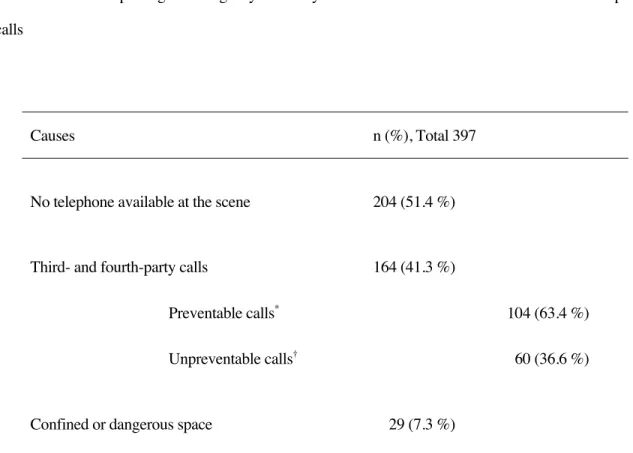
made away from the scene were much higher for patients for whom DA-CPR was not attempted. As shown in Table 3, emergency calls made away from the scene were mostly due to no telephone available at the scene and third- or fourth-party calls. It should be noted, however, that approximately two-thirds of third- or fourth-party calls were preventable; these calls were from other family members, friends, neighbors, family physicians, and police to whom a bystander placed the first call.
We used multiple logistic regression analyses for selected factors. The factors associated with failure to provide DA-CPR were as follows: lesser patient age (1.01, 1.01–1.02); male sex (1.27, 1.03–
1.58); out-of-home arrest (1.49, 1.04–2.13); witnessed cardiac arrest (1.61, 1.30–1.98); a presumed non-cardiac cause of the arrest (1.34, 1.09–1.67); abnormal movements or convulsion (3.39, 1.75–6.42);
placing the emergency call away from the scene of arrest (11.04, 8.07–15.25); occurrence of arrest after the emergency call (16.85, 11.27–25.77); no help from others (3.24, 2.44–4.34); and use of a dispatch center (1.53, 1.21–1.95).
Factors associated with bystander compliance with DA-CPR for OHCA patients in whom DA-CPR was attempted
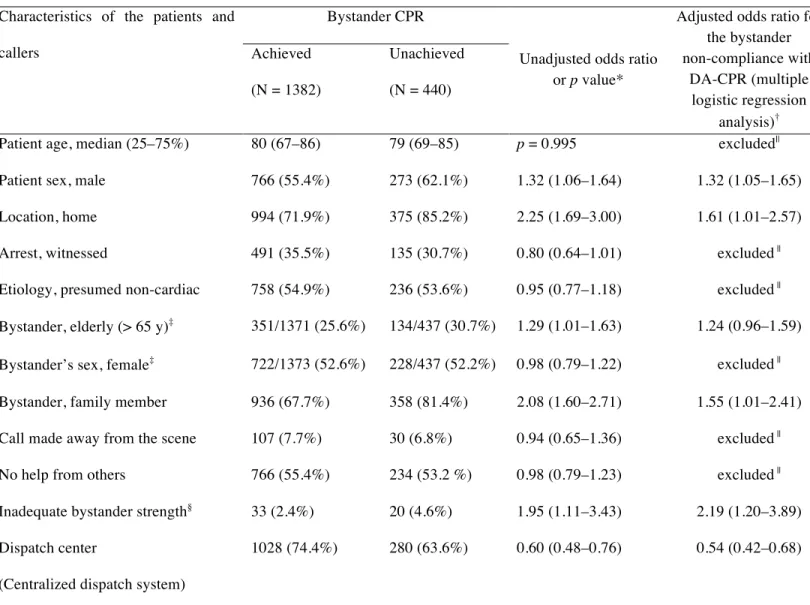
As shown in Table 4, univariable analyses revealed that DA-CPR did not result in initiation of bystander CPR most frequently when the patients were male, when cardiac arrest occurred at home, when the bystanders were elderly and family members, and when the dispatch system was not centralized. The frequency of bystander strength being inadequate to move and reposition the patient was very low;
however, the frequency was significantly higher for those patients who did not receive bystander CPR than for those who did. Multiple logistic regression analysis revealed the following factors that were associated with bystander non-compliance with DA-CPR: male patients (1.32, 1.05–1.65); at-home arrest
(1.61, 1.01–2.57); family member as a bystander (1.55, 1.01–2.41); inadequate bystander strength (2.19, 1.20–3.89); and a non-centralized dispatch system (1.85, 1.47–2.38).
Complications associated with bystander CPR
Since the initiation of DA-CPR by all fire departments at the beginning of 2004, we have requested that the fire departments report all complications associated with bystander CPR. No complications were reported that were associated with bystander CPR administered to OHCA patients who had confirmed arrest and were transported to a hospital as well as patients who did not experience cardiac arrest.
Discussion
In this study, we showed that introducing our 2007 protocol in a Japanese one-tiered EMS that responds to all requests for ambulance dispatch yielded a considerably higher sensitivity for appropriately recognizing cardiac arrest than did preservation of standard protocol. In addition, we identified some keywords that may be useful for provision of DA-CPR and elucidated the characteristics of emergency calls and patients that were significantly associated with a failure to provide DA-CPR and bystander non-compliance with DA-CPR.
The criteria for a DA-CPR attempt included providing instructions on chest compression-only CPR for patients with unknown breathing or responsiveness, for whom standard protocol is rarely attempted. With our 2007 protocol, these patients were categorized as moderately indicative for DA-CPR (Figure 3). The following four findings suggest that this approach to DA-CPR is valid. First, both
abnormal respiration and unresponsiveness were confirmed for only 69.0% (1258) of the 1822 patients in whom DA-CPR was attempted for confirmed cardiac arrest and who were transported to a hospital.
Second, the rate of bystander compliance with DA-CPR (or acceptance rate of DA-CPR) was 75.9%
(1382/1822) in our community and was much higher than the rates previously reported.1, 2, 17, 18 Third, the rate of initiating bystander CPR was largely attributable to an attempt at provision of DA-CPR. Fourth, our 2007 protocol was shown to yield a higher sensitivity for cardiac arrest than the standard protocol (72.9 % vs. 50.3%).
We identified some keywords and symptoms that were useful for detecting cardiac arrest in cases moderately indicative for DA-CPR. The keywords associated with cardiac arrest at EMT arrival were as follows: specific location, chest pain, and medical history. The keywords that were associated with a patient who did not experience cardiac arrest at EMT arrival were as follows: occurrence while eating, abnormal movement or convulsion, and syncope or dizziness. Because dispatchers should rapidly and correctly identify cardiac arrest with a limited number of questions,5 we requested dispatchers to detect most of the keywords in the first information that was provided by callers after the following fundamental questions were asked: “Please tell me exactly what happened”; “How old is she/he?”;
“Where is she/he?” “Does she/he have any history of heart or other problems?”; “Has she/he complained of any symptom before this event?” However, the ability to obtain these keywords may differ among dispatchers and may depend on the quality of communications between a dispatcher and a caller. An educational approach for detecting cardiac arrest should be made not only for dispatchers but also for citizens. Also, further investigations will be needed to elucidate definitive keywords for detecting cardiac arrest.
Two major factors associated with a failure to provide DA-CPR among OHCA patients that did not receive bystander CPR on bystander’s own initiative were identified: placing an emergency call away
from the scene of arrest and cardiac arrest that occurred after the emergency call (impending cardiac arrest). Major causes of an emergency call away from the scene were no available telephone and third- or fourth-party calls. However, approximately two-thirds of third- and fourth-party calls were preventable;
these bystanders placed their first call to their family members and other reliable persons (Table 3).
DA-CPR for impending cardiac arrest has been a major issue in our CQI project. Our CQI project has included recommendations for remaining on the line or calling the caller back to provide requestioning and the subsequent instructions. However, callers rarely responded to these requests or calls.
Most of these callers tried to contact other family members after making their first emergency call, and the telephone line was frequently engaged when the dispatcher tried to call the caller back. Witnessed and young age of OHCA patients who most likely survive4 were other factors associated with a failure to provide DA-CPR. This implied practical difficulties with obtaining exact information from callers who witnessed an unanticipated cardiac arrest, particularly in young or middle-aged individuals, due to poor communications between dispatchers and callers.
Male OHCA patients and elderly bystanders, as expected from previous reports,19–21 at-home cardiac arrest, family members as bystanders, and inadequate bystander strength were associated with bystander non-compliance with DA-CPR. In Japan, the aging population has been increasing, and the number of family members in one household has been decreasing.22 Most at-home OHCAs were witnessed or recognized by aged bystanders, who were frequently the wives of the OHCA patients.
Because both the emotional and physical conditions of bystanders have been reported to influence bystander compliance with DA-CPR,7 it may be very difficult to further improve the acceptance rate of DA-CPR.23
Because the keywords used by dispatchers included specific locations (bathroom, washroom, and bedroom) and because family members were accessible for DA-CPR, at-home cardiac arrest was associated with a high incidence of providing DA-CPR but a low rate of bystander compliance with DA-CPR. These characteristics of at-home arrest suggest that the public perception of DA-CPR in our community should be improved to increase the reliability of this procedure.
It is uncommon for a realistic simulation of DA-CPR to be provided during basic life support training courses, which we recommend should be modified so that all participants are aware that a dispatcher is not merely an individual who sends ambulances.24 In Japan, BLS training courses are most frequently conducted by fire departments. We have requested all the fire departments to include realistic simulations of DA-CPR in their training courses for family members who stay at home and that all participants should be educated of the questionings and the subsequent instructions.
A centralized dispatch system with an organized dispatch center was a factor associated with bystander compliance with DA-CPR, but it was also a factor associated with a failure to provide DA-CPR.
In most small Japanese fire departments, emergency calls are handled as a concurrent duty of EMTs. On the other hand, in large fire departments, dispatchers in dispatch centers are not specially trained during an independent qualification process. Thus, the ability of these dispatchers to detect cardiac arrest may be lower. One of the advantages of a centralized dispatch system is the availability of sufficient resources that permit dispatchers to stay on the line or revert back to a caller to give instructions; this may be a reason why a centralized dispatch system was associated with an increased rate of bystander CPR.
Attempted DA-CPR may be associated with a risk of bystander CPR being administered to subjects who are not in cardiac arrest.25-27 In this survey, DA-CPR was attempted in 417 patients who did
not experience cardiac arrest on EMT arrival (15.2% of 2747 attempted DA-CPR cases). This error rate was lower than that reported for King County.27 To date, no complications associated with DA-CPR have been reported to the Ishikawa Medical Control Council. However, not providing DA-CPR as a means to decrease the overestimation of cardiac arrest may be harmful to patients who actually have OHCA.
Our study had several limitations. First, information on bystanders’ levels of basic life support training was lacking, which may influence their willingness to perform CPR.20, 28 It was difficult for EMTs to obtain this information when patients with OHCA did not receive bystander CPR on bystander’s own initiative (i.e., without prompting by the dispatcher). We assumed that most of the bystanders who did not perform CPR did not remember much of their training because it was in the remote past or they had no training. Second, because we have already reported that our CQI project for DA-CPR improved the outcomes of OHCA patient in our community,4 we did not analyze the effects of attempted DA-CPR on patient outcomes. Third, although our data were derived from a three-year prospective cohort database in Ishikawa Prefecture, which has a population exceeding one million, the number of OHCAs was too small for detailed analyses of specific symptoms or keywords that may improve the accuracy of a diagnosis of cardiac arrest. Finally, the sensitivity and specificity of standard protocol were estimated values.
In conclusion, we demonstrated that introducing our 2007 protocol in a one-tiered EMS is safe, highly specific, and may be more sensitive for OHCA patients than preserving the standard protocol, although further investigations on complications in patients without cardiac arrest who receive bystander CPR are essential. Furthermore, we identified some keywords that may be useful for detecting cardiac arrest. Our three-year survey identified factors that affected dispatchers’ attempts at DA-CPR and the subsequent initiation of bystander CPR. Some of these factors are preventable and amendable. To
understand these factors associated with the success of providing DA-CPR and bystander compliance with DA-CPR, designing a better DA-CPR protocol and systematic education for both dispatchers and citizens are necessary to increase the benefit of DA-CPR.
Acknowledgements
We would like to thank all the fire departments in the Ishikawa Medical Control Council for collection of data.
Funding sources
This research did not receive any specific grant from any funding agency in the public, commercial, or not-for-profit sectors.
Disclosures None.
References
1. Rea TD, Eisenberg MS, Culley LL, Becker L. Dispatcher-assisted cardiopulmonary resuscitation and survival in cardiac arrest. Circulation. 2001; 104: 2513–2516.
2. Vaillancourt C, Verma A, Trickett J, Crete D, Beaudoin T, Nesbitt L, Wells GA, Stiell IG. Evaluating the effectiveness of dispatch-assisted cardiopulmonary resuscitation instructions. Acad Emerg Med. 2007;
14 :877–883.
3. Bohm K, Vaillancourt C, Charette ML, Dunford J, Castrén M. In patients with out-of cardiac arrest, dose the provision of dispatch cardiopulmonary resuscitation instruction as opposed to no instructions improve outcome: a systematic review of the literature. Resuscitation. 2011; 82: 1490–1495.
4. Tanaka Y, Taniguchi J, Wato Y, Yoshida Y, Inaba H. The continuous quality improvement project for telephone-assisted instruction of cardiopulmonary resuscitation increased the incidence of bystander CPR and improved the outcomes of out-of-hospital cardiac arrests. Resuscitation. 2012; 83: 1235–1241.
5. Lerner EB, Rea TD, Bobrow BJ, Acker JE 3rd, Berg RA, Brooks SC, Cone DC, Gay M, Gent LM, Mears G, Nadkarni VM, O'Connor RE, Potts J, Sayre MR, Swor RA, Travers AH. Emergency medical
service dispatch cardiopulmonary resuscitation prearrival instructions to improve survival from
out-of-hospital cardiac arrest: A Scientific statement from the American Heart Association. Circulation.
2012; 125: 648–655.
6. Hazinski MF, Nolan JP, Billi JE, Böttiger BW, Bossaert L, de Caen AR, Deakin CD, Drajer S, Eigel B, Hickey RW, Jacobs I, Kleinman ME, Kloeck W, Koster RW, Lim SH, Mancini ME, Montgomery WH, Morley PT, Morrison LJ, Nadkarni VM, O'Connor RE, Okada K, Perlman JM, Sayre MR, Shuster M, Soar J, Sunde K, Travers AH, Wyllie J, Zideman D. 2010 International consensus on cardiopulmonary resuscitation and emergency cardiovascular care science with treatment recommendations. Circulation.
2010; 122: S250–275.
7. Hauff SR, Rea TD, Culley LL, Kerry F, Becker L, Eisenberg MS. Factors impeding Dispatcher-assisted telephone cardiopulmonary resuscitation. Ann Emerg Med. 2003; 42: 731–737.
8. Meron G, Frantz O, Sterz F, Müllner M, Kaff A, Laggner AN. Analyzing calls by lay persons reporting cardiac arrest. Resuscitation. 1996; 32: 23–26.
9. Kellermann AL, Hackman BB, Somes G. Dispatcher-assisted cardiopulmonary resuscitation. Validation of efficacy. Circulation. 1989; 80: 1231–1239.
10. Lewis M, Stubbs BA, Eisenberg MS. Dispatcher-assisted cardiopulmonary resuscitation: time to identify cardiac arrest and deliver chest compression instructions. Circulation. 2013; 128: 1522–1530.
11. Castrén M, Bohm K, Kvam AM, Bovim E, Christensen EF, Steen-Hansen JE, Karlsten R. Reporting of data from out-of-hospital cardiac arrest has to involve emergency medical dispatching—Taking the recommendations on reporting OHCA the Utstein style a step further. Resuscitation. 2011; 82: 1496–
1500.
12. The Ministry of Health, Labor and Welfare in Japan. (Accessed 4 December, 2013, at http://www.mhlw.go.jp/english/policy/other/research-projects/index.html)
13. Ornato JP. Science of emergency medical dispatch. Circulation. 2009; 119: 2023–2025.
14. Cummins RO, Chamberlain DA, Abramson NS, Allen M, Baskett PJ, Becker L, Bossaert L, Delooz HH, Dick WF, Eisenberg MS. Recommended guidelines for uniform reporting of data from
out-of-hospital cardiac arrest: the Utstein Style. A statement for health professionals from a task force of the American Heart Association, the European Resuscitation Council, the Heart and Stroke Foundation of Canada, and the Australian Resuscitation Council. Circulation. 1991; 84: 960–975.
15. Press W, Teukolsky S, Vetterling W, Flannery B. Numerical Recipes 3rd Edition: The Art of Scientific Computing.Cambridge University Press.Chapter 15: p. 812.
16. Vaillancourt C, Charette ML, Bohm K, Dunford J, Castrén M. In out-of-hospital cardiac arrest patients,
does the description of any specific symptoms to the emergency medical dispatcher improve the accuracy of the diagnosis of cardiac arrest: a systematic review of the literature. Resuscitation. 2011; 82: 1483–
1489.
17. Bohm K, Stålhandske B, Rosenqvist M, Ulfvarson J, Hollenberg J, Svensson L. Tuition of emergency medical dispatchers in the recognition of agonal respiration increases the use of telephone assisted CPR.
Resuscitation. 2009; 80:1025–1028.
18. Rea TD, Eisenberg MS, Becker LJ, Murray JA, Hearne T. Temporal trends in sudden cardiac arrest: a 25-year emergency medical services perspective. Circulation. 2003; 107: 2780–2785.
19. Dorph E, Wik L, Steen PA. Dispatcher-assisted cardiopulmonary resuscitation. An evaluation of efficacy amongst elderly. Resuscitation. 2003; 56: 265–273.
20. Enami M, Takei Y, Inaba H, Yachida T, Ohta K, Maeda T, Goto Y. Differential effects of ageing and BLS training experience on attitude towards basic life support. Resuscitation. 2011; 82: 577–583.
21. Dracup K, Moser DK, Guzy PM, Taylor SE, Marsden C. Is cardiopulmonary resuscitation training deleterious for family members of cardiac patients? Am J Public Health. 1994; 84: 116–118.
22. Ministry of internal affairs and communications Statics bureau, Director-general for
policy planning (statistical standards) & Statistical research and training institute (Accessed 4 December, 2013, http://www.stat.go.jp/english/data/index.htm).
23. Dami F, Carron PN, Praz L, Fuchs V, Yersin B. Why bystanders decline telephone cardiac resuscitation advice. Acad Emerg Med. 2010; 17: 1012–1015.
24. Jacobs IG. Emergency medical dispatch - more than merely sending the ambulance! Resuscitation.
2011; 82: 1473–1474.
25. Krischer JP, Fine EG, Davis JH, Nagel EL. Complications of cardiac resuscitation. Chest. 1987; 92:
287–291.
26. Corbett SW, O’Callaghan T. Detection of traumatic complications of cardiopulmonary resuscitation by ultrasound. Ann Emerg Med. 1997; 29: 317–321.
27. White L, Rogers J, Bloomingdale M, Fahrenbruch C, Culley L, Subido C, Eisenberg M, Rea T.
Dispatcher-assisted cardiopulmonary resuscitation: risks for patients not in cardiac arrest. Circulation.
2010; 121: 91–97.
28. Enami M, Takei Y, Goto Y, Ohta K, Inaba H. The effects of the new CPR guideline on attitude toward basic life support in Japan. Resuscitation. 2010; 81: 562–567.
Figure legends
Figure 1. Database information and analysis of emergency medical dispatch (EMD) records by dispatchers and medical records by emergency medical technicians (EMTs)
CQI, Continuous Quality Improvement; DA-CPR, dispatcher-assisted cardiopulmonary resuscitation;
OHCA, out-of-hospital cardiac arrest.
Figure 2. Overview
Analysis of data related to dispatcher-assisted cardiopulmonary resuscitation begins from the top, and analysis of data pertaining to Utstein-based out-of-hospital cardiac arrest (OHCA) cases starts from the bottom.
DA-CPR, dispatcher-assisted cardiopulmonary resuscitation; EMTs, emergency medical technicians;
EMD, emergency medical dispatch.
Figure 3. Criteria for initiating dispatcher-assisted cardiopulmonary resuscitation and the distribution of 2239 patients who were transported to hospitals
The number of patients is the total number of patients, including those with confirmed cardiac arrest and those without. DA-CPR, dispatcher-assisted cardiopulmonary resuscitation; EMTs, emergency medical technicians.
*Dispatchers were allowed to initiate instructions when they had obtained two or more keywords.
Keywords— Age: elderly; Location: bathroom, washroom, bedroom, care facility; Onset: sudden or acute, while eating; Warning signs or prodromal symptoms: vomiting (emesis), abnormal movements (convulsions), snoring, chest pain, perspiration (cold sweating), shortness of breath, syncope or dizziness;
Past medical histories: on dialysis, heart diseases, severe diabetes, disability.
† For cases with any of these keywords: Request callers to redial emergency numbers when they detect any change in a patient’s condition and remain on the line or periodically call back the caller (when sufficient resources are available). If any change in a patient has been detected, immediately start the DA-CPR instructions without repeat questioning.
Figure 4. Frequency of keywords used to detect cardiac arrest P-values are form !2 test with Pearson’s correction
* Bathroom, washroom, bedroom, or care facility
Black bar: Frequency of keyword (> 5%) encountered for the 563 patients with cardiac arrest
White bar: Frequency of keyword encountered for the 229 patients without cardiac arrest
Table 1. Calculated sensitivities and specificities of the 2007 DA-CPR protocol and the standard DA-CPR protocol
DA-CPR, dispatcher-assisted cardiopulmonary resuscitation; EMTs, emergency medical technicians; OHCA, out-of-hospital cardiac arrest.
* Calculation of 95% confidence intervals (CIs) on the basis of constant !2 boundaries.
† 1258 absolutely indicative cases, 563 moderately indicative cases, and one case of impending cardiac arrest (Figure 3).
‡ 188 absolutely indicative cases and 229 moderately indicative cases (Figure 3).
§ Standard protocol was attempted only when patient was unresponsive and respiration was abnormal or absent.
Type of DA-CPR
protocol Sensitivity (95% CI)* Specificity (95% CI)*
Our 2007 protocol
[Number of transported EMT-unwitnessed OHCA cases for which DA-CPR was attempted according to the 2007 protocol†]/
([Number of transported EMT-unwitnessed OHCA cases] "
[Number of transported EMT-unwitnessed OHCA cases that received bystander CPR on bystander’s own initiative])
(1258 + 563 + 1)/(2926 " 427) = 72.9% (71.7–74.1%)
{([Number of all patients handled by dispatchers and transported by EMTs] " [Number of transported EMT-unwitnessed OHCA cases])
" [Number of transported non-OHCA cases for which DA-CPR was attempted according to the 2007 protocol‡]}/
([Number of all patients handled by dispatchers and transported by EMTs] " [Number of transported EMT-unwitnessed OHCA cases]) [(108,365 " 2926) " (188 + 229)]/(108,365 " 2926) = 99.6%
(99.6–99.6%)
Standard protocol
[Estimated number of transported EMT-unwitnessed OHCA cases for which DA-CPR was attempted according to the standard protocol§]/
([Number of transported EMT-unwitnessed OHCA cases] "
[Number of transported EMT-unwitnessed OHCA cases that received bystander CPR on bystander’s own initiative])
1258/(2926 " 427) = 50.3% (49.4–51.2%)
{([Number of all patients handled by dispatchers and transported by EMTs] " [Number of transported EMT-unwitnessed OHCA cases])
" [Estimated number of transported non-OHCA cases for which DA-CPR was attempted according to the standard protocol§]}/
([Number of all patients handled by dispatchers and transported by EMTs] " [Number of transported EMT-unwitnessed OHCA cases]) [(108,365 " 2926) " 188]/(108,365 " 2926) = 99.8%
(99.8–99.8%)
Table 2. Factors associated with the provision of DA-CPR in 2499 OHCA patientswho did not receive bystander CPR on bystander’s own initiative
OHCA, out-of-hospital cardiac arrest; DA-CPR, dispatcher-assisted cardiopulmonary resuscitation.
* OHCA patients in whom DA-CPR was not attempted despite the lack of bystander CPR on bystander’s own initiative (Figure 2).
† !2 test with the Pearson’s correction or the Kruskal–Wallis test as appropriate.
‡ Analyzed for 2481 patients for whom all characteristics were known (1808 patients in whom DA-CPR was attempted and 670 patients in whom it was not attempted). Three patients who themselves placed the emergency call were excluded. First, we used multiple logistic regression analyses for those factors that were significant in univariable analyses. Then, we added other factors that were not significant in univariable analysis in a stepwise manner to obtain the lowest Bayesian information criterion. Generalized R-square of the final model was 0.326.
§ unknown in some cases.
|| Not included in building of the model.
Backgrounds and characteristics of patients and emergency callers
DA-CPR instruction
Unadjusted odds ratio or p value†
Adjusted odds ratio for the failure to provide DA-CPR (multiple logistic regression analysis)‡ Attempted
(N = 1822)
Not attempted* (N = 677)
Patient age, median (25–75%) 80 (68–86) 73 (30–83) p < 0.0001 0.99 (0.98–0.99) Patient sex, male 1039 (43.0%) 434 (64.1%) 1.35 (1.12–1.62) 1.27 (1.03–1.58)
Location, home 1396 (75.1%) 388 (57.3%) 0.44 (0.37–0.54) 0.67 (0.47–0.96)
Arrest, witnessed 626 (34.4%) 321 (47.4%) 1.72 (1.44–2.06) 1.61 (1.30–1.98)
Etiology, presumed non-cardiac 994 (54.6%) 434 (64.1%) 1.49 (1.24–1.79) 1.34 (1.09–1.67) Symptoms related to cardiac arrest
agonal breathing after collapse 98 (5.4%) 37 (5.4%) 1.02 (0.69–1.50) excluded||
emesis or vomiting 43 (2.4%) 9 (1.3%) 0.52 (0.25–1.07) excluded||
abnormal movements or convulsions 27 (1.5%) 18 (2.7%) 1.82 (0.99–3.32) 3.39 (1.75–6.42) Bystander, elderly (> 65 y)§ 485/1808 (26.8%) 199/673 (29.6%) 1.15 (0.94–1.39) excluded||
Bystander sex, female§ 950/1810 (52.5%) 389/673 (57.8%) 1.24 (1.04–1.48) 1.11 (0.90–1.37) Bystander, family member 1294 (71.0%) 361 (53.3%) 0.47 (0.39–0.56) 0.79 (0.56–1.12) Call made away from the scene 173 (9.5%) 224 (33.1%) 4.72 (3.77–5.90) 11.04 (8.07–15.25) Arrest after the emergency call 39 (2.1%) 135 (19.9%) 11.39 (7.87–16.47) 16.85 (11.27–25.77) No help from others 1171 (64.3%) 449 (66.3%) 1.09 (0.91–1.32) 3.24 (2.44–4.34) Dispatch center
(Centralized dispatch system)
1308 (71.8%) 532 (78.6%) 1.44 (1.17–1.78) 1.53 (1.21–1.95)
Table 3. Causes for placing an emergency call away from the scene and details of third- and fourth-party calls
* Preventable emergency calls from family members, friends, primary care physicians, and police to whom a bystander placed the first call.
† Unpreventable third- and fourth-party calls.
Causes n (%), Total 397
No telephone available at the scene 204 (51.4 %)
Third- and fourth-party calls 164 (41.3 %)
Preventable calls* 104 (63.4 %)
Unpreventable calls† 60 (36.6 %)
Confined or dangerous space 29 (7.3 %)
Table 4. Factors associated with the bystander compliance with DA-CPR in 1822 OHCA patients in whom DA-CPR was attempted
OHCA, out-of-hospital cardiac arrest; DA-CPR, dispatcher-assisted cardiopulmonary resuscitation.
* !2 test with the Pearson’s correction or the Kruskal–Wallis test as appropriate.
† Analyzed for 1808 patients for whom all characteristics were known (1372 patients in whom Bystander CPR was initiated and 436 patients in whom it was not initiated). First, we used multiple logistic regression analyses for those factors that were significant in univariable analyses. Then, we added other factors that were not significant in univariable analysis in a stepwise manner to obtain the lowest Bayesian information criterion. However, no better model was obtained.
Generalized R-square of the final model was 0.061.
‡ unknown in some cases.
§ Bystander (caller) could not move or reposition the patient.
|| Not included in building of the model.
Characteristics of the patients and callers
Bystander CPR
Unadjusted odds ratio or p value*
Adjusted odds ratio for the bystander non-compliance with
DA-CPR (multiple logistic regression
analysis)† Achieved
(N = 1382)
Unachieved (N = 440)
Patient age, median (25–75%) 80 (67–86) 79 (69–85) p = 0.995 excluded||
Patient sex, male 766 (55.4%) 273 (62.1%) 1.32 (1.06–1.64) 1.32 (1.05–1.65)
Location, home 994 (71.9%) 375 (85.2%) 2.25 (1.69–3.00) 1.61 (1.01–2.57)
Arrest, witnessed 491 (35.5%) 135 (30.7%) 0.80 (0.64–1.01) excluded ||
Etiology, presumed non-cardiac 758 (54.9%) 236 (53.6%) 0.95 (0.77–1.18) excluded ||
Bystander, elderly (> 65 y)‡ 351/1371 (25.6%) 134/437 (30.7%) 1.29 (1.01–1.63) 1.24 (0.96–1.59) Bystander’s sex, female‡ 722/1373 (52.6%) 228/437 (52.2%) 0.98 (0.79–1.22) excluded ||
Bystander, family member 936 (67.7%) 358 (81.4%) 2.08 (1.60–2.71) 1.55 (1.01–2.41) Call made away from the scene 107 (7.7%) 30 (6.8%) 0.94 (0.65–1.36) excluded ||
No help from others 766 (55.4%) 234 (53.2 %) 0.98 (0.79–1.23) excluded ||
Inadequate bystander strength§ 33 (2.4%) 20 (4.6%) 1.95 (1.11–3.43) 2.19 (1.20–3.89) Dispatch center
(Centralized dispatch system)
1028 (74.4%) 280 (63.6%) 0.60 (0.48–0.76) 0.54 (0.42–0.68)
!
EMD records by dispatchers (paper records and/or voice recordings)
!
Medical records by EMTs (in a quasi-Utstein style)
Review by CQI members !
(leaders in fire departments and/or emergency physicians in the Ishikawa Medical Control Council)
DA-CPR database for patients with presumed cardiac
arrest Some information about patients and
callers Keywords obtained
from caller
EMD Database for OHCA patients in whom DA-CPR was
not attempted Some information about patients and
callers Keywords and impeding factors detected during the
EMD process
Quasi-Utstein style database for patients who were not in cardiac arrest on EMT arrival but in
whom DA-CPR was attempted Backgrounds of
patients and bystanders Final information
about patient conditions at the time
of emergency call Final diagnosis at
hospital
Utstein-style database for patients with confirmed cardiac
arrest
! Utstein-based classification of
OHCA
!
Backgrounds of patients and
bystanders
!
Final information about patient conditions at the time
of arrest recognition or witness
Overview and calculation of sensitivity and specificity
Database for all patients in whom DA-CPR was attempted and who were transported to
the hospital
Backgrounds of patients and bystanders Keywords for DA-CPR
Cardiac arrest on EMT arrival Final diagnosis at hospital
!
!
!
!
!
Database for all OHCA patients in whom ! DA-CPR was and was not attempted
Utstein-based classification of OHCA Backgrounds of patients and bystanders Keywords and impeding factors for DA-CPR
Analysis of keywords that were
specific to cardiac arrest
Analysis of factors associated with the provision of DA-CPR and
bystander compliance with ! DA-CPR instructions
Figure 1
DA-CPR instruction, N = 2747 based on the EMD records by dispatchers Transported to hospital, N = 2239
EMT-confirmed and -unwitnessed!
cardiac arrest, N = 1822 Individual was not in cardiac arrest at the time of
EMT arrival, N = 417!
Bystander initiated CPR in compliance to the DA-CPR = 164!
Bystander CPR on EMT arrival = 93
Bystander did not initiate CPR despite the DA-CPR, N = 440!
!
Bystander initiated CPR in compliance to the DA-CPR, N = 1382!
!
presence of post-mortem changes,!
N = 508
Cardiac arrest after EMT arrival at the scene (EMT-witnessed cardiac arrest), N = 19
All patients handled by dispatchers and transported by EMTs, N = 108,365 based on the medical records by EMTs EMT-confirmed cardiac arrest, N = 3141
EMT-unwitnessed cardiac arrest, ! N = 2926!
EMT-witnessed cardiac arrest, ! N = 215!
No bystander CPR, ! N = 1117!
Bystander CPR, ! N = 1809!
DA-CPR was not attempted despite the lack of bystander CPR on bystanderʼs own initiative, !
N = 677!
DA-CPR was not attempted because of the presence of bystander CPR on bystanderʼs own initiative, !
N = 427!
Figure 2
unresponsive, 1920
unknown, 474!
Categories
DA-CPR instruction was attempted, 2239
Responsiveness
Respiration
absolutely indicative, 1446! moderately indicative*, 792 impending cardiac arrest!", 1
in arrest, 1258 not in arrest, 188
Confirmation of arrest by EMTs on their arrival at the scene!
!
in arrest, 563 not in arrest, 229 in arrest, 1 not in arrest, 0 absent, 173! abnormal, 61! unknown, 84!
Respiration unknown, 318
absent, 1310! abnormal, 136! absent, 0! abnormal, 1! unknown, 0!
Respiration responsive, 1
rarely indicative, 0 normal, 0!
Figure 3
!"
#!"
$!"
%!"
&!"
'!!"
in cardiac arrest at EMT arrival! not in cardiac arrest at EMT arrival!
p < 0.0001!
p = 0.144!
p = 0.003! ! p = 0.008!
p = 0.091!
p = 0.006!
p = 0.224!
p < 0.0001!
p = 0.509!
p < 0.0001! !