Cooperative MPR Selection to Reduce Topology Control Packets in OLSR
Kenji Yamada, Tsuyoshi Itokawa, Teruaki Kitasuka, and Masayoshi Aritsugi Graduate School of Science and Technology, Kumamoto University
2-39-1 Kurokami, Kumamoto 860-8555, Japan Email:{itokawa, kitasuka, aritsugi}@cs.kumamoto-u.ac.jp
Abstract—In this paper, we try to reduce the amount of control traffic of the optimized link state routing protocol (OLSR). OLSR is a proactive routing protocol for mobile ad- hoc networks (MANETs). OLSR is known well as a low control traffic routing protocol, since it adopts multipoint relays (MPRs).
MPRs concept significantly reduces the number of broadcast messages during the flooding process. Although MPR concept is optimal for each node to transmit its messages to all two hop neighbors, we show there are still redundant control messages which can be piggybacked with other control messages in dense networks. This redundancy is caused by the selection procedure of MPRs, which run on each node independently of its neighbor nodes. In this paper, we propose a cooperative MPR selection procedure, to increase messages which are piggybacked into a single control packet. Through simulation, we demonstrate that the proposed cooperative MPR selection procedure reduces the number of routing packets in high-density network, and network reachability is kept similar to that of the conventional MPR selection procedure.
I. INTRODUCTION
The optimized link state routing protocol (OLSR) [1] is a routing protocol for mobile ad-hoc networks (MANETs).
OLSR is a proactive routing protocol on which each node regularly exchanges topology information with other nodes.
The key concept used in OLSR is the concept of multipoint relays (MPRs). Each node selects a subset of its neighbors as its MPR set. The MPR set has two properties:(1) If a node𝑛𝑖
sends a message, and that message is successfully forwarded by all MPRs of𝑛𝑖, then all (symmetric strict) 2-hop neighbors of𝑛𝑖will receive that message. (2) Keeping the MPR set small ensures that the overhead of the protocol is kept at a minimum [2].
The nodes which have been selected as MPRs have two roles: generating TC messages, and forwarding them. In con- trast, other nodes that no neighbor selects as MPRs never gen- erate or forward TC messages, except for enabling redundancy option by TC_REDUNDANCY of OLSR. Each TC message generated by node 𝑛𝑖 advertises the link state information between generator 𝑛𝑖 and the nodes which select 𝑛𝑖 as an MPR. Since a single TC message can contain information of multiple links, selecting MPRs cooperatively with neighbor nodes increases opportunity to piggyback advertisement of links on each other. Additionally, a single TC packet can contain multiple TC messages.
In this paper, we consider reducing the number of TC message senders to reduce total number of TC packets, without
any changes of the properties(1)and(2)of the MPR set. The set of TC message senders is defined as a union of MPR sets of all nodes in the network. A preliminary consideration was shown in [4].
TC Message Senders Problem:Given a network (i.e. the set of one-hop neighbors for each node), and candidates of MPR set for each node of the network, which combination of MPR set selected from the candidates of each node minimizes the number of TC message senders?
For example, when there are several candidates of MPR set for node𝑛𝑖, the node should select the candidate that has larger number of common nodes with MPR sets of neighbors of 𝑛𝑖 than all the other candidates as its MPR set. This selection will reduce the number of TC message generators.
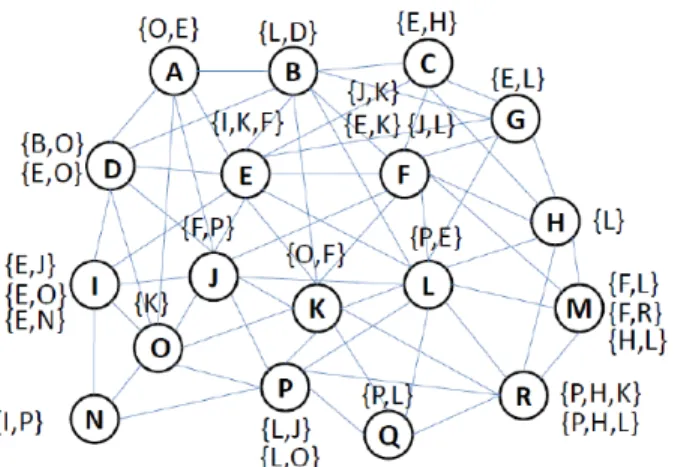
The candidates of MPR set in TC message senders problem are illustrated by an example network shown in Fig. 1. The network contains 18 nodes labeled with𝐴to𝑅. One or several sets are shown as an adjunct to each node in Fig. 1. The sets are the candidates of MPR set for each node, calculated by exhaustive computation. For example, node 𝐴 has only one MPR set {𝑂, 𝐸}, and node 𝐷 has two candidates of MPR set {𝐵, 𝑂} and {𝐸, 𝑂}. By the heuristic of OLSR, which candidate of node𝐷is selected as the MPR set is not depend on MPRs of other nodes.
We consider which candidate of MPR set of node 𝐷 is makes the of TC message senders small. In the case of node 𝐷selects{𝐵, 𝑂}as its MPR set, two nodes𝐵and𝑂become the TC message senders. In another case, nodes 𝐸 and 𝑂 become them. To compare both cases, we consider MPR sets of other nodes. No other node selects node 𝐵 as MPR. It implies that node𝐵 periodically sends TC messages for only one link between nodes 𝐵 and𝐷, in the former case. In the latter case, since no node selects node 𝐵 as an MPR, node 𝐵 never sends TC messages. Meanwhile, node𝐸periodically sends TC messages including link information of nodes𝐷,𝐴, 𝐶, and so on. Each link information in TC message sent by 𝐸 can be piggybacked on each others.
The cooperative MPR selection procedure, proposed in this paper, is designed to increase the opportunity to piggyback advertised link information on each other. The procedure is re- quired to implement as a distributed algorithm which satisfies both low computational complexity and low communication complexity similar to heuristic of OLSR. To achieve these requirements, we adopt an approach similar to the master-
Fig. 1. A network which has alternatives of MPR set
slave architecture, as a very simple approach. Each node is randomly labeled with either independent or cooperative. Each cooperative node refers to MPR set selected by independent nodes when it calculates MPR set of itself.
The rest of this paper is organized as follows. In Sec. II describe related work. In Sec. III, the overview of OLSR is explained. The overhead of TC messages and a solution of TC message sender problem are described in Sec. IV. We propose cooperative MPR selection procedure in Sec. V. Preliminary evaluation through simulation is described in Sec. VI. Finally, we conclude the paper in Sec. VII.
II. RELATEDWORK
Reducing overhead of control traffic is the important is- sue for routing protocols generally. In MANET, flooding of broadcast control messages is required to find a path to the destination, for both proactive and reactive protocols. We focus on OLSR, which is a proactive routing protocol for MANET. In OLSR, TC messages which inform partial link information of network are broadcasted over the network. In this section, we explain important work to reduce broadcasted control traffic.
Qayyum et al. [3] give an analysis and propose a heuristic of MPR set selection algorithm. They prove that the following MPR problem is NP-complete.
MPR Problem: Given a network (i.e. the set of one-hop neighbors for each node), a node 𝑛𝑖 of the network, and an integer k, is there a multipoint relay set for𝑛𝑖of size less than 𝑘?
The heuristic algorithm proposed by Qayyumet al.[3] pro- vides a near-optimal MPR set, and is employed in OLSR [1].
OLSR allows to use other algorithms having improvements.
MPR dramatically reduces retransmission to flood messages, while reception rate of flooded messages is kept high.
A minimum connected dominating set (minimum CDS) is another candidate to reduce the number of forwarding nodes during the flooding process [5]. CDS is defined as: each two nodes in CDS have a path through only nodes in CDS, and every node in the network has at least one node in CDS
as its neighbor. Selection of CDS can be considered as a construction of backbone of the network. CDS also can be used to flooding message to the whole network, instead of MPR. The nodes which are not in CDS do not need to relay messages to flood. CDS will reduce control traffic more than MPR. CDS does not have the property (1) of MPR set described in Sec. I. In other words, one of the differences between MPR and CDS is that MPR guarantees the shortest path but CDS does not. As another difference, both time and message complexities of CDS scheme are slightly higher than MPR scheme. Unfortunately, the concept of CDS is not employed in any routing protocols of MANET currently.
III. OLSR
OLSR is a proactive routing protocol for MANET. OLSR maintains both neighborhood information and topology infor- mation in each node. In this section, we describe these two kind of information and two types of messages briefly. We denote the number of nodes in a MANET and𝑖-th node as 𝑛 and𝑛𝑖(1≤𝑖≤𝑛), respectively.
Neighborhood information of each node is acquired from HELLO messages sent by other nodes. The information is used to disseminate topology information efficiently. As neigh- borhood information, each node 𝑛𝑖 stores sets of one-hop neighbors𝑁(𝑖), strict two-hop neighbors𝑁2(𝑖), MPRs𝑀(𝑖), and MPR selectors 𝑀−1(𝑖). Information of all existing links between each pair of a node in𝑁(𝑖)and a node in𝑁2(𝑖)are also stored as the neighborhood information.
We confirm the properties among these sets in neighborhood information. For all node 𝑛𝑖, the following conditions are satisfied, except for inconsistent period due to message delay or lost. Node𝑛𝑗 is assumed as a neighbor of node𝑛𝑖.
𝑀(𝑖) ⊆ 𝑁(𝑖) 𝑀−1(𝑖) ⊆ 𝑁(𝑖)
𝑛𝑖 ∈ 𝑁(𝑗), iff𝑛𝑗∈𝑁(𝑖) (for symmetricity) 𝑛𝑖 ∈ 𝑀−1(𝑗), iff𝑛𝑗 ∈𝑀(𝑖)
HELLO messages are broadcasted by all nodes periodically, but never be forwarded. The first purpose of HELLO messages is to discover neighbors with symmetric link. As the second purpose, information of𝑁(𝑖)and𝑀(𝑖)included in a HELLO message of𝑛𝑖is used to update𝑁2(𝑗)and𝑀−1(𝑗)when any node 𝑛𝑗 receives it. The MPR set 𝑀(𝑖) is calculated using 𝑁(𝑖), 𝑁2(𝑖), and links between them. Every node should select an MPR set such that each strict two-hop neighbor has at least one link to the node in the MPR set.
Each MPR selectors set 𝑀−1(𝑖) is a subset of neighbors 𝑁(𝑖). Each node in𝑀−1(𝑖)selects𝑛𝑖 as an MPR, i.e.,𝑛𝑗 ∈ 𝑀−1(𝑖) implies𝑛𝑖 ∈𝑀(𝑗)except for the delay of HELLO message delivery. To disseminate topology information, TC messages are flooded into the entire network periodically.
Each TC message informs the links between the TC message generator 𝑛𝑖 and its MPR selectors 𝑀−1(𝑖). Multiple links can be informed by a TC message.
Topology information is acquired from TC messages. The information is used to calculate the routing table. Since all TC messages are generated by MPR selectors and each TC message does not contain all links between the MPR selector and its neighbors, topology information of each node is partial information of actual topology. However, the property (1) of MPR set guarantees that the shortest path from itself to any other node is included in this partial topology information.
The heuristic algorithm [1] is used to calculate MPR set 𝑀(𝑖), whenever the information of 𝑁(𝑖), 𝑁2(𝑖), and links between them is changed by any received HELLO message.
MPR set 𝑀(𝑖)is selected by the algorithm, independently of the MPR selection of other nodes. It is not the matter for the heuristic algorithm that MPR set of the node includes many common nodes with the MPR sets of its neighbors, or less.
Currently OLSR version 2 [2] is discussed at IETF from Aug. 2005, as an update to OLSR [1]. The proposed coop- erative MPR selection procedure is also applicable to OLSR version 2.
IV. OVERHEAD OFTC MESSAGES
In OLSR, nodes cooperatively find their neighbors by ex- changing HELLO messages and cooperatively deliver partial topology information by generating and relaying TC messages.
To reduce the traffic to flood TC messages, OLSR has several mechanisms. The first and most important mechanism is MPR.
Only MPR nodes relay TC messages to neighbors to flood.
Another mechanism is piggyback two or more TC messages into a single packet. (We call the packet as TC packet). If an MPR node receives two TC messages in a short period, these TC messages are piggybacked with each other. In addition, a HELLO message can be included in the packet.
A mechanism to reduce the traffic, on which we focus in this paper, is found in the format of TC message. A single TC message can contain several advertised neighbors addresses.
If several neighbor nodes select the same MPR node, the MPR node generates one TC message which contains several neighbor addresses. On the other case, if several neighbor nodes select other MPR nodes for each, all MPR nodes generate several TC messages separately. Several TC messages will cause higher probability of collision and overhead of packet headers.
For example of a network depicted in Fig. 1, OLSR will select 11 nodes {𝐵, 𝐷, 𝐸, 𝐹, 𝐻, 𝐼, 𝐽, 𝐾, 𝐿, 𝑂, 𝑃}as TC mes- sage senders, since OLSR selects a MPR set{𝐵, 𝑂}for node 𝐷,{𝐽, 𝐾}for𝐹,{𝐸, 𝐽} for𝐼,{𝐹, 𝐿}for𝑀,{𝐿, 𝐽}for 𝑃, and{𝑃, 𝐻, 𝐾}for𝑅, in our simulation. On the other hand, the solution of TC message senders problem described in Sec. I contains 9 nodes{𝐷, 𝐸, 𝐹, 𝐻, 𝐼, 𝐾, 𝐿, 𝑂, 𝑃}, where nodes𝐵 and 𝐽 are excluded. In this case, the selected MPR sets are {𝐸, 𝑂}for node𝐷,{𝐸, 𝐾} for𝐹,{𝐸, 𝑂}for𝐼,{𝐻, 𝐿} for 𝑀,{𝐿, 𝑂}for 𝑃, and{𝑃, 𝐻, 𝐿} for 𝑅.
In the rest of this section, we explain a non-distributed MPR selection algorithm. The algorithm is not sufficient to be implemented in OLSR as an MPR selection scheme, due to its non-distributed nature. It is used to calculate the optimal
solution, which minimizes the number of TC message senders, to compare with the proposed procedure.
This algorithm consists of two parts: at the first part, each node finds all candidates of its MPR set by exhaustive search, and all candidates contain the minimum number of one-hop neighbors which satisfy MPR property described in Sec. I;
at the second part, which is not a distributed manner, a central entity aggregates the list of candidates from all nodes and solves the TC message senders problem described in Sec. I exhaustively. The MPR set selected for each node by the algorithm is announced to its neighbors through HELLO message as same as original OLSR.
To explain strictly, the number of the MPR set candidates of 𝑛𝑖 is denoted as 𝑐(𝑖), and the set of the candidates of 𝑛𝑖
is denoted as𝒞(𝑖) ={𝐶(𝑖,1), 𝐶(𝑖,2), . . . , 𝐶(𝑖, 𝑐(𝑖))}.𝒞()for each node is calculated at the first part of the algorithm. At the second part,Π𝑛𝑖=1𝑐(𝑖)combinations are searched to find a combination(𝑠(1), 𝑠(2), . . . , 𝑠(𝑛))which provides the lowest number of TC message senders. The number of TC message senders for the combination is expressed as
∪𝑛 𝑖=1
𝐶(𝑖, 𝑠(𝑖)) ,
where 𝑠(𝑖) is an index of candidates set of 𝒞(𝑖), and 𝑠(𝑖) satisfies 1 ≤ 𝑠(𝑖) ≤ 𝑐(𝑖) for all 1 ≤ 𝑖 ≤ 𝑛. The candidate 𝐶(𝑖, 𝑠(𝑖))is used as the MPR set𝑀(𝑖), instead of the MPR set calculated by the heuristic of OLSR.
In contrast, the heuristic algorithm of OLSR finds just one of the candidates𝒞()for each node (or other larger MPR set) as the MPR set of the node. Each MPR set 𝑀(𝑖) selected by the heuristic algorithm may be equal to the best candidate 𝐶(𝑖, 𝑠(𝑖)). The redundancy of MPR selection is come from this multiple candidates of the MPR set.
V. COOPERATIVEMPR SELECTION
In this section, we explain the proposed procedure of cooperative MPR selection. As initial setup of the proposed procedure, we divide the set of all nodes into two groups.
Different algorithms of MPR selection are used for nodes in the different groups. Each node in the first group, which is called an independent node, determines its MPR set indepen- dently to all other nodes. On the other hand, each node in the second group, called a cooperative node, determines its MPR set with referring MPRs selected by neighbor nodes. MPR sets of neighbors are known through HELLO messages sent by neighbors.
The ratio between the numbers of independent nodes and cooperative nodes is important factor of the proposed pro- cedure. However, in this paper, we discuss neither the best ratio nor controlling the ratio. We evaluate a particular ratio in Sec. VI to show effectiveness compared with conventional MPR selection.
The MPR selection algorithm running on each independent node is completely the same as the conventional heuristic algorithm described in OLSR [1].
On the other hand, the cooperative MPR selection algorithm for cooperative nodes is also based on the same heuristic of OLSR [1], but slightly different from it. The major modifi- cations are that (1) neighbors’ MPR set, denoted by 𝑀𝑁(𝑖), is an additional input of the algorithm and (2) the algorithm aggressively selects the nodes in𝑀𝑁(𝑖)as MPR.
Before describing cooperative MPR selection algorithm, the procedure to maintain neighbors’ MPR set 𝑀𝑁(𝑖) is explained. When node 𝑛𝑖 receives a HELLO message sent by its neighbor𝑛𝑗,𝑛𝑖 stores MPR set𝑀′(𝑗)picked out from the HELLO message of𝑛𝑗. If𝑛𝑖already has a stored MPR set 𝑀′′(𝑗)of 𝑛𝑗, the previous MPR set𝑀′′(𝑗) is replaced with new MPR set 𝑀′(𝑗). For each time of receiving a HELLO message, neighbors’ MPR set 𝑀𝑁(𝑖) of node 𝑛𝑖 is updated by the following computation.
𝑀𝑁(𝑖)←
⎧⎨
⎩
𝑗∈𝑁∪(𝑖)
𝑀′(𝑗)
⎫⎬
⎭∩𝑁(𝑖)
Note that we use the notation 𝑀′(𝑗) and 𝑀′′(𝑗) instead of 𝑀(𝑗), since delay or lost of HELLO messages, i.e. the temporal changes, can make difference between𝑀(𝑗), which node𝑛𝑗calculates and stores, and𝑀′(𝑗), which node𝑛𝑖stores as a copy of𝑀(𝑗). In ordinary case,𝑀′(𝑗)and𝑀(𝑗)is the same.
In the proposed cooperative MPR selection algorithm, neighbors’ MPR set𝑀𝑁(𝑖)is used to determine that node𝑛𝑖
can select its MPR set either cooperatively or independently, at first. If neighbors’ MPR set 𝑀𝑁(𝑖)is enough to cover all two-hop neighbors𝑁2(𝑖), node𝑛𝑖selects its MPR from nodes in𝑀𝑁(𝑖). Otherwise if𝑀𝑁(𝑖)is not enough, node𝑛𝑖selects its MPR using the same algorithm of independent nodes.
In the following algorithm, step 2) is the part of checking the condition. After this checking, if the condition is satisfied, MPR set 𝑀(𝑖) is selected as a subset of 𝑀𝑁(𝑖). If it is unsatisfied, MPR set 𝑀(𝑖) is selected as a subset of 𝑁(𝑖).
In the unsatisfied condition, 𝑁(𝑖) is used instead of 𝑀𝑁(𝑖) in steps after 2).
The proposed cooperative MPR selection algorithm is as follows:
1) Start with an MPR set made of all members of𝑁(𝑖)with N willingness equal to will_always. This MPR set is referred as𝑀always in the next step.
2) Calculate reachability to all nodes in 𝑁2(𝑖) through the nodes in 𝑀always∪𝑀𝑁(𝑖). If there exists a node in 𝑁2(𝑖) which is not reachable through them, in the following steps𝑁(𝑖)is used instead of𝑀𝑁(𝑖)as same as the heuristic of OLSR [1].
3) Calculate degree 𝑑(𝑗), where 𝑛𝑗 is a node in 𝑀𝑁(𝑖), for all nodes in𝑀𝑁(𝑖).
4) Add to the MPR set those nodes in 𝑀𝑁(𝑖), which are the onlynodes to provide reachability to a node in 𝑁2(𝑖). For example, if node𝑏in𝑁2(𝑖)can be reached only through a symmetric link to node𝑎in𝑀𝑁(𝑖), then add node 𝑎 to the MPR set. Remove the nodes from
𝑁2(𝑖) which are now covered by a node in the MPR set.
5) While there exist nodes in𝑁2(𝑖)which are not covered by at least one node in the MPR set:
a) For each node in𝑀𝑁(𝑖), calculate the reachability, i.e., the number of nodes in𝑁2(𝑖)which are not yet covered by at least one node in the MPR set, and which are reachable through this one-hop neighbor;
b) Select as an MPR the node with highest N willingness among the nodes in 𝑀𝑁(𝑖) with non-zero reachability. In case of multiple choice select the node which provides reachability to the maximum number of nodes in 𝑁2(𝑖). In case of multiple nodes providing the same amount of reachability, select the node as MPR whose 𝑑(𝑗) is greater. Remove the nodes from 𝑁2(𝑖) which are now covered by a node in the MPR set.
To ensure the strictness of the algorithm, there are a few as- sumptions described below. The set of strict two-hop neighbors 𝑁2(𝑖) defined in OLSR [1] is the set of two-hop neighbors reachable from node 𝑛𝑖, but excluding (i) the nodes only reachable by nodes of 𝑁(𝑖)with willingness will_never, (ii) the node𝑛𝑖 itself, and (iii) all the symmetric neighbors in 𝑁(𝑖). The degree 𝑑(𝑗)of node 𝑛𝑗 is defined as the number of symmetric neighbors of node𝑛𝑗, excluding (i) the nodes in 𝑁(𝑖), and (ii) the node𝑛𝑖 itself. We do not mention multiple interface nodes, but it can be extended to handle multiple interface nodes by the same manner of OLSR [1].
VI. PRELIMINARYEVALUATION
A. Metrics and Method
In this section, we evaluate the cooperative MRP selection procedure, in terms of the number of TC packets and connec- tivity of network using 64 bytes ping (ICMP echo request and reply).
In this evaluation, the number of TC packets is measured instead of the number of TC messages. The number is counted not only when a TC message is sent by its generator, but also when a TC message is forwarded. Each TC packet contains one or more TC messages. For example, we count a TC packet as one, whenever the packet contains several TC messages.
As connectivity performance, we measure arrival rate and round trip time (RTT) of ping. Arrival rate of ping is expressed as (the total number of replies received by the ping requester)/ (the total number of requests). The pair of ping nodes is chosen as the pair which has the longest distance between them for each scenario. In mobile scenario, the distance between nodes of a pair is calculated at the beginning of the scenario.
In the simulation, ratio of the number of cooperative nodes to the number of independent nodes is about 2 to 1. The ratio is determined empirically. For example, in a scenario of 10 nodes, there are 7 cooperative nodes (70%). Each 70 nodes scenario has 47 cooperative nodes (67%). Since cooperative nodes are randomly selected from all nodes, we do not consider any geographical bias.
Fig. 2. Control traffic in static scenarios of various density of nodes
We use ns-2 (ver. 2.29) with UM-OLSR v0.8.8 [6] as a simulator. The simulation environment is that each node has an IEEE 802.11 interface, communication radius is 𝑟 = 250 m, all nodes are distributed randomly in a region of 𝑟×4𝑟 m2, the intervals of HELLO messages and TC messages are 2 and 5 seconds, respectively, and willingness is set at will_defaultto all nodes.
An evaluation in static scenarios, in which no node moves, is described in Sec. VI-B. In static scenarios, the number of nodes𝑛is varied, and it is shown that the proposed coopera- tive procedure is effective in high-density networks. Mobile scenarios are discussed in Sec. VI-C. In mobile scenarios, all nodes move in random way point mobility model, and the results show that the proposed cooperative procedure can reduce the number of packets. However, in some scenarios, it is also shown that the proposed cooperative procedure degrade reachability of network.
B. Results of Static Scenarios
We assume that all nodes do not move during the simulation.
We compare the cooperative MPR selection procedure with the conventional procedure of OLSR [1] and the optimal solution described in Sec. IV. The number of nodes 𝑛 in the network is varied from 10 to 70. For each number of nodes, ten different node topologies are simulated, and the average of ten results are shown in the following figures. In these figures, results of cooperative MPR selection procedure is shown as
“cooperative”, and the conventional procedure of OLSR and the optimal solution are referred “olsr” and “opt”, respectively.
In static scenarios, TC message senders are not changed after about 10 seconds from the beginning of the simulation.
Therefore, we omit the result of 20 seconds from the beginning of simulation. We run simulator until 60 seconds and analyze last 40 seconds. For the optimal solution described in Sec. IV, since we need to solve all candidates of MPR sets for each nodes and a smallest TC message senders exhaustively, we solve them only once at the 20 second for each scenario, and all nodes keep the MPR set selected as optimal one until the end of the simulation.
Fig. 2 shows the number of TC packets per second, for each number of nodes. The number of TC packets includes the packets sent by generators of TC message and the packets
Fig. 3. Control traffic in static scenarios with 40 nodes
Fig. 4. Round trip time in static scenarios with 40 nodes
forwarded by MPRs. From Fig. 2, the number of TC pack- ets is reduced by the cooperative MPR selection procedure compared with OLSR, regardless of the number of nodes.
However, optimal solution reduces it more than that of the cooperative MPR selection procedure.
We calculate reduction ratio against conventional OLSR through Fig. 2. Reduction ratio of the cooperative MPR selection is 10% or below in cases of less than 20 nodes, or about 15(±3)% in cases of more than 30 nodes. Therefore we conclude the cooperative MPR selection has much effect in high-density networks. The optimal solution has the same trend in terms of reduction ratio of TC packets. For example of 40 nodes case, reduction ratio of the cooperative MPR selec- tion and the optimal solution are 16% and 42%, respectively.
To focus on the result of high-density network, we show results of every scenario of 40 nodes in Fig. 3 and Fig. 4.
Fig. 3 shows the detail of 40 nodes results of Fig. 2.
Each scenario has different topology from each others. In all scenarios, the cooperative MPR selection reduces the number of TC packets. From “olsr” and “opt” in Fig. 3, we confirm that conventional procedure of OLSR has redundancy in all ten scenarios, and each scenario has the different amount of redundancy. We also confirm that results of the cooperative MPR selection never exceed “olsr” and fall below “opt” in all scenarios. Reduction ratio of the cooperative MPR selection is varied from 3% (of scenario 5) up to 38% (of scenario 1).
As connectivity performance, we measure arrival rate and RTT of ping, for ten scenarios of 40 nodes. Since no node moves, arrival rate of ping is 100%. Average RTT of ping for
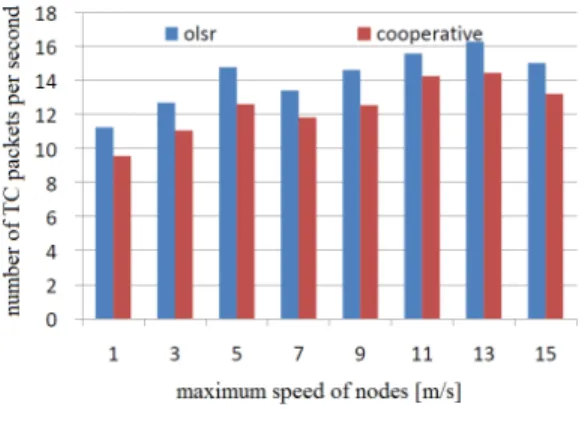
Fig. 5. Control traffic in mobile scenarios
Fig. 6. Arrival rate of ping in mobile scenarios
each scenario is shown in Fig. 4. From Fig. 4, we confirm that the cooperative MPR selection procedure provide same kind of connectivity as conventional OLSR in static network.
From the results of static scenarios, we confirmed that the proposed cooperative MPR selection procedure is effective in dense networks.
C. Results of Mobile Scenarios
In mobile scenarios, all nodes move in random way point mobility model, and max speed of nodes is varied from 1 m/s (3.6 km/h) up to 15 m/s (54 km/h). For each max speed of nodes, ten different node topologies are simulated, and the average of ten results are shown in the following figures.
Totally, we use 80 scenarios as mobile scenarios.
Fig. 5 shows the number of TC packets per second for each max speed. From Fig. 5, we confirm that, nonetheless nodes move, the cooperative MPR selection procedure reduces the number of TC packets. Reduction ratio in each speed is between 11% and 14%, except for 8% of 11 m/s scenario set.
The average of reduction ratio for all 80 scenarios is 12%, varied from 2% to 23%. The reduction ratio is slightly worse than that of static scenarios, but the cooperative MPR selection procedure is effective for mobile scenarios.
As connectivity performance, Fig. 6 shows ping arrival rate for each speed. Except for 11 m/s scenario set, arrival rate is similar between the conventional MPR selection of
OLSR and the cooperative MPR selection. In 11 m/s scenario set, degradation is about 5%. Regardless of MPR selection procedure, arrival rate in high mobility scenarios is too low to use regular applications.
From Fig. 5 and Fig. 6, we confirm effectiveness of the proposed cooperative MPR selection procedure in mobile scenarios.
VII. CONCLUSION
In this paper, we proposed the cooperative MPR selection procedure, to reduce topology control (TC) packets. We ex- plained TC message senders problem as a key idea of our proposed procedure. The problem is find minimal set of gen- erators and forwarders of TC messages, without modification of the properties of multipoint relays. This problem leans on the format of TC message. Since a single TC message can contain several MPR selectors, if neighbor nodes select the same node as their MPRs, the numbers of both TC message senders and TC messages will decreased.
To avoid both computational and communication complex- ities are increased, we adopted an approach like master-slave architecture. Some nodes selected their MPR independently, by the same manner of the conventional MPR selection. Other nodes referred MPR selection of neighbors, to make TC message senders small.
As a preliminary evaluation, we showed the simulation results. We measured the number of TC packets, instead of that of TC messages. In both static and mobile scenarios, the proposed procedure reduced the number of TC packets, 15%
in static scenarios, 8% to 14% in mobile scenarios. We also confirmed reachability of network is almost the same as the conventional MPR selection procedure.
We will consider the assignment of cooperative or indepen- dent nodes, as a future work. The density of nodes is one of the key issues to consider them. The proposed cooperative MPR selection procedure remains more redundancy than the optimal solution, as mentioned in Sec. VI-B. It implies that a future exploration is required to find more sophisticated procedures than this procedure.
REFERENCES
[1] T. Clausen and P. Jacquet, “Optimized link state routing protocol (OLSR),” RFC 3626, IETF, Oct. 2003.
[2] T. Clausen, C. Dearlove, and P. Jacquet, “The optimized link state routing protocol version 2,” draft-ietf-manet-olsrv2-10, IETF, Sep. 2009.
[3] A. Qayyum, L. Viennot, and A. Laouiti, “Multipoint relaying: An efficient technique for flooding in mobile wireless networks,” Research Report, RR-3898, INRIA, Mar. 2000
[4] K. Yamada, T. Itokawa, T. Kitasuka, and M. Aritsugi, “A consideration on the number of TC message sender nodes in OLSR,” IEICE Techni- cal Report, vol.109, no.380, MoMuC2009-67, pp.75–79, Jan. 2010. (in Japanese)
[5] O. Liang, Y.A. S¸ekercio˘glu, and N. Mani, “A survey of multipoint relay based broadcast schemes in wireless ad hoc networks,” IEEE Comm. Surveys, vol.8, no.4, pp.30–46, 2006.
[6] F.J. Ros, UM-OLSR, http://masimum.inf.um.es/?Software:UM-OLSR