有本 茂
1* Massoud Amini 2*
福田信幸3* Joseph E. LeBlanc 4*
村上達也5*
成木勇夫
6* Mark Spivakovsky 7*
竹内 茂8* Keith F. Taylor 9*
山中 聡10*
横谷正明
11* Peter Zizler 12*
Mathematics and Chemistry
Interdisciplinary Joint Research and the Fukui Project XVIII
Shigeru ARIMOTO, Massoud AMINI, Nobuyuki FUKUDA, Joseph E. LEBLANC Tatsuya MURAKAMI, Isao NARUKI, Mark SPIVAKOVSKY, Shigeru TAKEUCHI Keith F. TAYLOR, Satoshi YAMANAKA, Masaaki YOKOTANI and Peter ZIZLER
This is the 18th part of the series of articles that records and further develops essentials of the Mathematics and Chemistry Interdisciplinary Symposium 2013 Tsuyama, whose main themes were symmetry, periodicity, and repetition.
The symposium was held on April 5th and 6th in Tsuyama city, Okayama, Japan, in conjunction with the Fukui Project and was devoted to the memory of the late Professor Kenichi Fukui (1981 Nobel Prize) who initiated the project. The present series also provides challenging cross-disciplinary problems which are directly related to the Fukui conjecture and to recent carbon nanotube research. Some of these problems are formulated using mathematical language not well known among chemists despite the importance of these notions in elucidating additivity and high-speed asymptotic phenomena in molecules having many repeating identical moieties. Some problems are formulated in terms of Fourier analysis connected to the theory of analytic curves, other problems are formulated in connection with the Science-Art Multi-angle Network (SAM Network) Project, which seeks to bridge Science and Art (visual, audial, and conceptual art) for a creative collaboration, and is an important part of the Fukui Project.
Key Words : the Fukui conjecture, Memoir of Prof. K. Fukui, Unique factorization domain (UFD), Carbon nanotube, Fourier analysis
I Introduction
12. A unifying approach to the spectral-symmetry and additivity problems
in carbon nanotubes and related molecular networks via the repeat space theory II
Shigeru Arimoto, Keith F. Taylor , Massoud Amini Nobuyuki Fukuda , Mark Spivakovsky, Satoshi Yamanaka
Masaaki Yokotani and Peter Zizler
1. Formulation of the Problem
Theorem A (functional alpha existence theorem, X Hr (q, 1)-C(I) version). Let { M
N} be a fixed element of
原稿受付 平成28
年9
月29
日1*, 10*, 11*
総合理工学科3*
総合理工学科非常勤講師2* Dept. of Math. Tarbiat Modares University, Iran
4* School of Integrated Studies, Pennsylvania College of Technology USA
5*
富山県立大学 工学部・生物工学科6*
立命館大学 理工学部・数学物理学系・数理科学科7* CNRS and Institute de Mathématiques de Toulouse, France 8*
岐阜大学 教育学部・数学科9* Dept. of Math. and Stat., Dalhousie University, Canada
12* Dept. of Math., Phys., and Eng., Mount Royal University, Canada
X Hr (q, 1), let I be a fixed closed interval compatible with { M
N}. Then, there exists a functional C(I)* = B(C(I), ) such that
Tr ( M
N) N
= o 1 (3.1)
as N , for all C(I).
(This theorem was proved in Part II of ref. [1].)
Theorem B. Let q, q + and let q = q + q. Let { M
N} = { P
N0 Q
0} be a fixed element of X i (q, 1)((q, q)) - X H (q, 1), let I = [-a , a] with a > 0 be a fixed closed interval compatible with { M
N}. Then, for any C o (I), we have
0
Tr Q 0 . (3.2)
Moreover, the spectrum of Q
0(which is contained in the real line) is symmetric around the origin; moreover, the algebraic multiplicities of the pairing eigenvalues coincide.
Theorem C. Let q be a positive integer, let t, s 1 , s 2 , …, s t be positive integers such that q = s 1 + s 2 + …+ s t . Let s = (s 1 , s 2 ,
…, s t ). Let { M
N} = { P
N0 Q
0} be a fixed element of X i (q, 1)(s) - X H (q, 1), let I = [-a , a] with a > 0 be a fixed closed interval compatible with { M
N}. Then, for any
C o (I), we have
0
Tr Q 0 . (3.3)
Moreover, the spectrum of Q
0(which is contained in the real line) is symmetric around the origin; moreover, the algebraic multiplicities of the pairing eigenvalues coincide.
Problem I. To prove theorems B and C via theorem A.
2. Solution of the Problem
In this section, we provide a solution to problem I, by using theorem A.
Solution: Theorem B is an immediate consequence of theorem C. Thus, we shall establish theorem C, by using theorem A. First recall from [3]:
Proposition 2. Let a > 0 and I = [-a , a]. Let C o (I) denote the subset of C(I) of all odd functions and let P o (I) denote the subset of P(I) of all odd polynomial functions. Let C e (I) denote the subset of C(I) of all even functions and let P e (I) denote the subset of P(I) of all even polynomial functions.
Then, we have:
(i) P I
o( ) = C o (I), (4.1)
(ii) P I
e( ) = C e (I). (4.2)
Proof. A proof is given in [3].
Now use theorem A in section 2, and let C(I)* = B(C(I), ) be such that
Tr ( M
N) N
= o 1 (4.3)
as N , for all C(I). Then, by using the argument of section 3 in [3] and proposition 2 above, we can easily get the conclusion via (i) and (ii):
(i) (P o (I)) = {0}, (4.4) (ii) (C o (I)) = {0}. (4.5)
[Note that (ii) directly follows from proposition 2 above and from the continuity of .] Thus, the proof of theorem C is reduced to the proof of (i).
Let P o (I). We have only to show that
Tr M N 0 (4.6)
for all N. But, by the linearity of Tr, it suffices to show that
Tr M
Nk 0 (4.7)
for each positive odd integer k. Note that theorem 2 easily implies that
(X i (q, 1)(s) - ) k X i (q, 1)(s) - , (4.8) for each positive odd integer k.
It then follows that (4.7) is true, therefore we see that (i) is
true. //
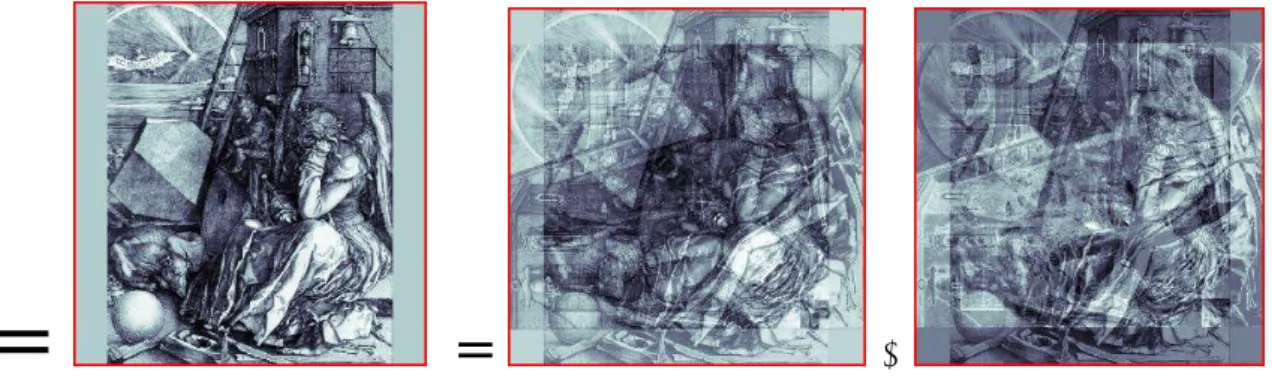
Note: We present in the Appendix some Matrix Art using Albrecht Dürer’s etching ‘Melancholia’. Challenging Problem D given there can be easily answered by using the techniques given in Part XVII and the present part of this series.
References
[1] S. Arimoto, Repeat space theory applied to carbon nanotubes and related molecular networks. I, II J. Math. Chem. 41 (2007) 231-269; J. Math. Chem.
43 (2008) 658-678
[2] S. Arimoto, M. Spivakovsky, M. Amini, E. Yoshida, M. Yokotani, T.
Yamabe, Repeat space theory applied to carbon nanotubes and related molecular networks. III, J. Math. Chem. 50 (2012) 2606-2622.
[3] S. Arimoto and K.F Taylor, Aspects of Form and General Topology: Alpha Space Asymptotic Linearity Theorem and the Spectral Symmetry of Alternants, J. Math. Chem. 13 (1993) 249-264.
[4] S. Arimoto, New proof of the Fukui conjecture by the Functional Asymptotic Linearity Theorem, J. Math. Chem. 34 (2003) 259-285.
[5] S. Arimoto, K. Fukui, P. Zizler, K.F. Taylor, and P.G. Mezey, Structural Analysis of Certain Linear Operators Representing Chemical Network Systems via the Existence and Uniqueness Theorems of Spectral Resolution.
V, Int. J. Quantum Chem. 74 (1999) 633-644.
− 62 −
Appendix:
A =
Fig. 1. Matrix Art Picture of Albrecht Dürer’s etching ‘Melancholia’, created by using MATLAB.
This picture is a visualization of a 648 648 matrix with entries of integers ranging from 101 to 228.
A = = +
Fig. 2. Let A denote this matrix, then A = (1/2)(A + A
T) + (1/2)(A A
T) ; this addition of matrices is shown by pictures above.
Fig. 3. Pictures of M and M
n( n 2,3, 4,5) ,
and the picture of spectrum of M, which is symmetric with respect to the y axis.
− 64 −