Ne.97
Cempetitien between Matching Markets
Koji YOKOTA
May 2ees
Department of EcoRomics Otaru University of Commerce
COMPETMON BETWEEN MAITCHING MARKETS
KOll YOKC}[£A
O[lrARU {LINIVERSr[E'Y OF COwwERCE
Tl}e present paper investiga{es the possibility of domiRa{ien of mediate matching over independeRt search. It is shown te be dithcult altheugh Rot impossible. The domination cai} happen in the case of binary utility, which is consistent with the data ai}d history tha{ mediated match has been dominated in sirrrplejobs.
l. INTRODUCTION
AIofig with historicalIy high rate ofuRemployment in Japan, resolutioA of mismatch between supply and demand oflabour is iRcfeasiRgly demanded. Along with this trend, tke number of private firms which mediate matchiRg in tl;e labeur market is iRcreasing. This papef examines whether there is a room for a mediated matching marke£ to impfove matching efficiency. For it to be possible, not oniy the mediated matchiRg market exceeds the uRmediated matching market in terms of matchiRg efficiency, but also it must provide higher expected utility than unmediated search so that uRemployed workers aRd firms with unfilled vacagcies choose the mediated matching market. We show that the room for mediated matching to emerge is lim‑
ited altho"gh not impossible. For it to be possible, the ggality ofjobs and workers m"st be suthciently homogeneous and aiso the benefit to match mus£ be high enough compared to the benefu ofbeing single. In most ofcases, gRmediated matching dominates mediated matching.
Section 2 describes the assumptions used in the paper. Sectioll 3 shows kow an uRmediated matching market is described by a stable marriage problem. Section 4 describes how match‑
makers wkose objectives are to maximise the number of matches accomplish their objectives.
Section 5 overviews large number results of these markets. Section 6 studies selection of mar‑‑
kets through competitioR. Section 7 overviews data oR the actual matching marketin JapaR. It shovvs diat unmedia{ed search domiRates inthe market ofjob‑seekers with working experteRce, but the share of mediated search significaRtly iRcreases in the matching market of high sckool graduates and that of simplejobs. Section 8 coRcludes.
2
2. MATCHING SESSION
We cal1job‑seekers and firms withjob vacancies searehing agents collectively. They seek for each other to form a pair to undertake production. The quality of a match differs by pairs reflecting the heterogeneity of agents. It is bilaterally measured by utility ofeach agent as a total evaluation of characteristics a given pair brings about, such as productivity, wages and working conditions. Formally, utility of ajob‑seeker and ajob vacancyis simultaneously drawn from a probability distribution on R × ue for ail possible pairs between two groups. The disnibutions of any pairs are all independent and the identicaily distributed. The i.i.d. assumption implies that
thereisilorankingbetweenagentsexante.Weassumethatthereispositivecorrelationofutility within a given pair. This is because monetary transfer between agents in the form of wages is available. If productivity of a worker when he is engaged in a particularjob is sufficiently high but he is reluctant to work, then the firm may want to offer higher wages to compensate his reluctance. On the other hand, if a worker is eager to work but his productivity is low, then he may offer to accept lower wages. Therefore, the original utility profile is transformed {hrough monetary transfer into another utility profile so that bilateral utility is levelled and the number of potential pairs which satisfy individual rationality of agents increases. The utility of staying uumatched is deterministicalIy given. In general, it is a function of unemployment benefit, matching probal)ility and conditionai expected utility upon match in the next period, and discount rate. The lottery of utility is drawn when a matching session begins, but will not be disclosed until a given pair meets each other.
A matching session opens periodically. This is the only place where a searching agent can find a partner. In the matching session, there are various types of matching market and a searching agent can belong to only one of them. Search activities in each market requires devotion of agents and it prohibits them from participating in multiple markets. Matching markets are largely categorised into two types: one is a market which offers only a "place"
to search and each agent must search for a partner by himself, and the other is a market in which a matchmaker acts as a proxy for agents. Wk) cal1 the former type ofsearch independent seareh and the latter mediated matching. In the independent search, there may or may not be an organiser. An independent search market with an organiser may be able to gather more searching agents via advertisement, but autonomous search without an organiser is always Ieft
2
as a choice in hands of a searching agent. Similarly, mediated ma£ching is also an open market fbr matchmakers. A matchmaker does not let searching agents meet by themselves. He agiranges which agents to meet. The choice of agents to allow meeting is g}e matching technology.
Potentially, ai}y matchmaker with any matching techRology can join in a matching sessien.
Hovvever, since the matchiRg technology critically depends on sh"tdown of information shared by searching agents in the market, the implementability of matching techRology depeRds on how well a matchmaker ac£ as a proxy of a matcking agent. We assume that a matchmaker can fiRd out the preference order of an agent, for example asking "which is better" questions without disclosing the name of cai}didates. Howeveg he cannot find out the tevel of an agent's utility.
[IJIierefore, a matchmaker must rely on a matching aigorithm which uses only a preference order. As a degeRerate case, it can briRg the same outcome as the independent search following the algorithm to find stable matchillgs shown in the next section. However, we focus on a case in which a matchmaker brings a different outcome. Another candidate of objectives of a matchmaker is maximisatioR of the Rumber of matckes. We will show that it is achievable only by using the preference orde: We cail a mcwcimum matching the matching in vvhich number of matches is maximised and a mcutimum matching aigorithm the algorithm to maximise it. In short run, a matchmaker indeed has an iRcendve to maximise the Rumber of matches, because he can use its past records fbr advertisement (and as will be showR, gathering more searching agents is crwical fbr him). However, in long run, his viability depeRds on whether he can provide higher expected utility than other matching markets because, as we are now doing, s"periority of his matchiRg algorithm can be judged by an experiment. If his survivability is shown, then it means that growth of those matcha}akers can raise matching efficieflcy of the econopey.
A searching ageBt cheoses a matching mafket when a matching sessien starts, based en ex‑
pectatioR of utility each market brings. Aftef a choice of a matching market, he is matched according to the rule (matching {echnology) the matchnaker uses if it is a mediated matching market. If he chooses independent search, the matching outcome will be oAe of stable equilib‑
ria as will be shown in the next sectioR. After obseiving a final matching outcome, a searching agent has an option to reject it. It is obvious for independent search, but aiso a matchmaker cannot force a searching ageRt to accept someone unacceptable. The standard to choose a
3
matching market is expected utility it brings to a searching agent. It is affected by two factors:
the matching probability and the conditionai expected utility upon match. We assumed that a matctmaker maximises the number of matches. However, such an attempt may result in dete‑‑
rioration of the condnional expected utility upon match, and the overal1 expected utility may not rise. if it is true for the maximum matching aigorithm, only independent search propagates in the economy. On the other hand, if there is such a technology, emergence of matching mo‑
nopoly is possible. As will be seen later, the matching probability and, as a result, the expected utility are both an increasing function of the size of a matching market.
We assumed that utility within a pair is positively correlated. 'IIhis assumption can be justi‑
fied as fbllows. Crawford and Knoer (1981) showed a naturai extension of a stable matching equilibrium when monetary transfer is available, called a bargaining equilibrium, in which monetary transfer is determined so that the total surplus over threats of two agents is equally divided into two. rllhe threat equals the utility the agent receives in a reduced matching market in which the counterpart of a given pair becomes indifferent to being single. NamelM it is the utility he receives from the partner he will be matched, once a given pair becomes unavailable.
Since the reduced matching market requires the threats ofeach agent to be determined again, we have to trace back recursively to a reduced matching marketin which all agents are indiflbr‑
ent to being single. In each recursive market, multiple equilibrium is possible. Different beliefs on equilibrium jn a recursive mailcet bring different level of wages. 'IIhe baigaining equiljb‑
rium is the stable matching equilibrium when utility is transferred between two sides of agents according to the bargaining procedure described above. However, the bargaining procedure is not peculiar to the stable matching process. If insulation of information leads to an unstable matching as an equilibrium, utility is transferred in exactly the same way as bargaining equi‑
librium. Suppose that there are two sets of agents M and W. Denote by iLi (o') the payoff of agenti E M (or G F) when he/she is matched with j E W (or G M) under the condition that monetary transfer is not available. Since the matrix of u completely characterises the matching market, we use the function u : M × W U W × M ‑‑, R to denote the market itself. We denote the payoff of agent i to remain single by ci. Then, the payoff of agent i when matched with 1'
4
in market u, delloted by it (i, zL) is giveR by the rule
ai (j'; zL) = max {ci, min [u, (]') + 2,j (i) nt ,,., iLi (]') + Ztj (i) + gi (]';zL) ‑ t,・ (i; ze)] }
where ti (j ', zL) and t,i (i; u) are the threats of players i and 1' in market 2t. If matched, the total mility of the two over the sum of threats is symmetrically divided and added on each threat.
The rule guarantees individual rationality ai}d that the payoff dees net exceed the amount the givefi paircan collectively achieve however the threat of agegti relative to agent 2' is large. The threats are determined by constructing a Rew market ?L' so £hat
ZL!・(0') ‑= Ci
?LS・(i) ‑ cj
u'k(l) == zLk(l) (k,lotherwise)
Let (f', ti') be a bargai;}iBg equilibrium of market zt'. 'ITheR
ti(2:,zs) ‑ a:・
t,a(i;ze) = aS・
Tb deterinine a;・ and aS・, threats in market 2L' must be fixed. It is done by repeagng the above operation recursive}y until the market reduces to tlie one in which all elemeRts except one pair are replaced by the utility ofbeing single.
PrepositioR 1. lfthe elements of?L are independently distributed, forgiveni G M ando' E W, ai(2') and ft,・(i) are positively correlated.
Proof Let's denote by 2L(a) a reduced matching game constructed from zL in which elements listed in a and its transpose are substitgted by the payoff of being single, where
a rm {(i,j') G M × VV lzci(2') =: ci and 2Lj(i) =: c,J}. AIso, denote the payoffofi when matched with ]' in market 2L(a) by aS・a)(j'). If a me {(l,2)}, then it is set that iLi(2) = ci and zL2(1) == c2 in the market u. Also note that iL(¢) = u. ARy path of recursive reduction of the game is rep‑
resen£ed by an increasing sequeRce of ff. If a reduced game represented by 2L(a') is constructed from a reduced game iL(cr), then a' ) a. The recursive reductioR stops when a lists all the
5
elements in the lower triangle of 2s. Take any reduced game u(a) and consider a match between
mEM andnE W. Then,
(1)
Umn + tm (n) ‑ tn (Tn,)
if ‑ (Uinn rm 2Cm) S tm(n) ‑ tn(M) S U}nn ‑ 2Cn
aina)(n)= 2
cm otherwise
where U}nn := ze.(n) + u.(m) and t.(n) is the equilibrium payoff of agent m in the game u(a') where a' = a + (m, n). Note that if t.(n) ‑ t.(m) > U}.. ‑ 2c., n declines to match and m is forced to stay single. We denote by function f(a') : M U W ‑ M U W the ailocation in the bargaining equilibrium of the game 2L(a'). It has aproperty that for Vm E M, f(d)(m) c W ÷ {m}, Vzv G W, f(a')(w) c M + {w} and f(d) o (f(a'))‑i is an idemity mapping. If the allocation in game u(a') is such that f(d)(m) == s (s f m) and f(a')(n) == r (r # n), then t.(n) = aind)(s) and t.(m) = tiiig')(r). Ifs = m, tm(n) = cm. Ifr = n, tn(m) : cn. Since (m,n) E at and Vatt ) at, (m,n) E a't, t.(n) and t.(m) are not a function of um(n) and u.(m). Since the elements of u are mutuaily independent, u.(n), 2L.(m) and t.(n) ‑ t.(m) are mutuaily independent.
Coming back to the firstlayer of recursive operation and applying equation (1) recursively, the above independence result implies
a,(2.)= !lltL+[i‑}sI71}r if‑(qj‑2ci)sti(i')‑tj(i)sqj‑2cj
ci otherwise
where
Uxy + tx (y) ‑ ty(X) if ‑ (Uly‑ 2cx) S tx(Y) ‑ ty(X) SI Uxy nd 2cy 7}y :=
cx otherwise
SimiIar for aj・(i). 'IIherefore, for any cases in the above equation, conditional covariance of ai(]') and a,・ (i) can be written
v. (qj)
Var ([Z‑},) + Var (CZIIir)
cov(a,(o'),aj(i))==4+ 16 20
6
where we assume Var([T},) == O if CZI. degeRerates to ci for the purpose of concise expositien.
The last inequality holds with strict inequality if eithef ̀[ii(2') or iij(i) does not degeRerate to ci or c,・. Therefore, uncoRditionai covariance is Cov (ai(]'), a,・(i)) > O for all i E M and
In the experiments urideirtaken below, we direody geRefate a randomiy so that it has positive correlation within ai}y pairs ai}d calculate matchillg outcomes as if gtility is Rot transferable.
This is equivalent to generatiRg a in which the bargaining over wages is already embedded, and doing matching experiment for the first layer of the recursive matching process of the Crawford and Knoer's bargaining eqgilibrium. Note that if there are n agents for each side of the market, direct calculation of a bargaiRiRg equilibrium must solve n2! reduced markets (if n == 50, it is more than 1.6 × 1074ii(!)) for a particular belief on multiple eguilibri& which requires gigantic calculation power.
3. INDEPENDENT SSARCH
Major characteristics of indepeRdeRt search is that it has no organiser in the market. We assume perfectinformation so that once searchixg ageRts in this market start searching, profile of each ageRt is perfectiy revealed. Based oR the disclosed informagon, an agent forms a preg erence over all candidates in the market in the form of utility. He aiso has a preference over stayiRg single. He has a rigkt to leave the market vvithout being matcked. Naturally, all agents seeks fbr a best partRer, bu{ £he interests ofeach agent mutually confiict. The bestcandidate he pursues may have one ofhis competitors as her best. Once that person accepts her, ske becomes infeasible fbr him. Namely, his choice is limited to thefeasible candidates who will ltot decline once he pfoposes to them. Being sing}e is always a feasible choice. Gale 2md Shapley (1962) showed that there exists at least one equilibtium in which every ageRt proposes to and actually be accepted by the best feasible candidate (including the status of being single). Other ca!}di‑
dates who are ranked above tlie partner in equilibri"m in his preference list are aiUnj}easible for him in the sense that they are ma£ched with more preferable partnerin equilibrium. Therefore, the equilibrium has a property that they have no inceRtive to ckange from the equilibrium part‑
Rer. in this seRse, such an equilibrtum is called a stable matchiTzg. In geReral, stable matching has multiple equilibria ai}d they are partially ranked by either group of matching agents. In
7
our case, two groups are a group of workers and that of firms. There exists a stable matching in which al1 workers agree as the most preferable one among all stable matchings, which we cal1 a wor:ker‑optimal stable matching. However, this is the worst outcome amoilg al1 the sta‑
ble solutions for firms. SimilarlM there exists afirm‑optimalstable matching. Again, it is the worst stable matching for workers. Between these extreme stable matchings,i al1 other stable outcomes are ordered in lattice structure.
The optimal stable equiIibria can be found by an algorithm used in the constructive proof of the existence of stal)le equilibria by Gale and Shapley (1962). To find a worker‑optimal stable matching, we make workers advance to firms and let firms wait for a propose from a worker.
rllhe algorithm is dividedinto two operationspmposal and rojtzsal. At first, ail firms are engaged with a dummy worker who they unanimously dislike most. In the operatioil pmposal, a worker proposes to a firm who is at the top of his preference among the firms which haven't refused him yet and calls a operation ropsal by the firm proposed. However, the dummy worker never proposes since it is known that he is never accepted by any firms. The dummy worker is used in the algorithm to judge if the first layer of the recursive structure has finished or not. In the operation rejusal, the firm proposed must choose either to engage with the person newly proposed or to refuse him and keep the current "fiance". Subsequently, the refused worker out of the two enters in the operation pmposal. As fat as a firm replaces the fiance with the newcomeg the process enters the deeper Iayer of the recursive structure of the algorithm.2 ObviouslM by swapping the role of workers and firms in the algorithm, we can obtain the firm‑
optimal stable equilibrium. 'Ib find all other stable equilibria, we introduce a breakmarriage operation. It breaks exogenously a pair aiready matched in equilibrium as if the worker in the pairis refused by the firm. Then, he has to search for another firm from a set of firms which is ranked below the current partner.
In a stable matching problem, there remains ambiguity conceming the revelation of prefer‑
ence of agents. In any stable matchings, there must exist at least one agent who has an incentive not to reveal his preference truthfu11y. Therefore, there is difficulty in specifying the matching pattern in equilibrium. Fortunately, the number of matches is not affected by truth revelation.
IThey may degenerate te the same unique stable matching.
2This recursive algorithm is an improved version of the Gale‑Shapley algorithm proposed by McVitie and Wilson (1971). The basic reasoning stays the same as the Gale‑Shapley algorithm.
8
Roth (1984) showed that {he outcome brought by misrepresentation ofpreferexce is also a sta‑
ble ma£ching and the set of ageR{s which stay unmatched femains the same. [ft!e didereRce in expected edlity coRClitional upon match, which is brought by didereRt preference yevelation, may afllect the expected utility of choosing independent search. However, no searchiRg ageAt have information about othef searchiRg agents prior to entrance to the independent search mar‑
ket. A searching ageRt does llot know what kind of stable matchings are pessible, how many stable matchifigs can exist, vvhat kind of prefereRce revelation strategy he skould take, so on.
Therefore, we simply assume that searchigg agents anticipate that all stable matchifigs emerge witli the same probability.
4. MAXIMUM MATCHING MARKET
We are seeking differeRt matchiRg outcome fbf a matchmaker from a stable matching. It implies that a maxiraum matching is aii unstable matchiAg. Therefore, shu£down ofinformation traffics between searching agents is iRevitable. If {liere is someone who envies another matched pair and tke target agrees to elope, the whole matching may break down.
In the maximum matching market, a matchmaker only needs to knew a pairwise preference of each searching agent between staying siRgle and a cai}didate. That is, whether a candidate is acceptable or not. IIJhen, he draws a graph, denoting eac}} ageRt by a dot, or a vertex, and coRgects two ageRts in different groups who are mutually acceptable by an edge. The problem for the matchmaker is to hnd a maximum matching oR this graph. Since a pair connected with an edge represents a pair mgtually acceptable, such a matching is enforceable. Formaily, we denote a set of vertexes by V. In a generai graph, edges can be drawn between any two vertexes and denoted by a pair of the starting vertex and the eRd vertex such as viv2 where vi, v2 E V.
Tliefefore, the set of edges E is E c V × V. A graph G is deboed as G :(Vl E). V and E are sometimes written as V(G) and E(G) to emphasise that they are a set ef vertexes er edges ofgraph G. If V' c V and E' c E, then G' :=:(Y', E') is cailed asubgraph of G. Wli) can use the following theorem by Berge to find a ;i}aximum matckikg, which we show without a proof.
Theerem 1. (Berge) A matching C ofa gmph G is the maximum matchiitg ifand only if there exists no C‑increasing path in G.
9
FIGURE 1. Transformation of the problem
A B c D E
m tl 9
(a) Original matching problem
M
source
F
sink
(b) Transformed problern
M
maximumrfiow
A path is a subgraph H C G in which V(ff) =: {vi,v2,v3,・・・,vn} and
E(H) = {viv2, v2v3, v3v4,・・・, vn‑ivn}. vi and vn are called endvoints. If the path is such that either vivi+i E C fori ! O(mod 2) and vivi+i ¢ C fori i 1(mod 2), or vivi+i ¢ C fori !i! O(mod 2) and vivi+i E C fori ma 1(mod 2), then H is called C‑alternate path. If the end‑points are not saturated by C, i.e. vi, v. ¢ C, the C‑akernate path is called C‑‑increasing path. Indeed, if there exists a C‑increasing path, one can increase the number of matches by one by swapping the edges which belongs to C and those not.
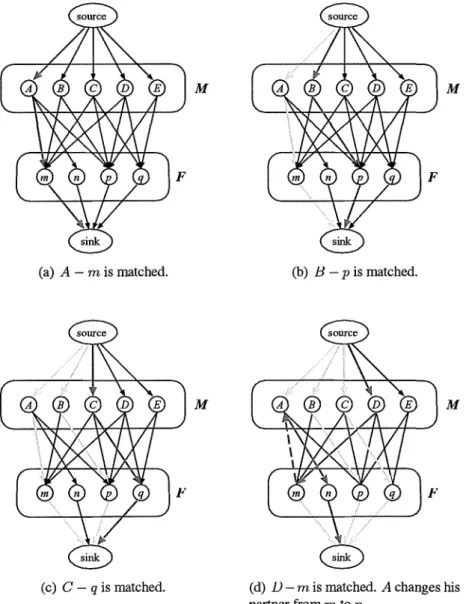
We use this fact to find a maximum matching. We search for a Cincreasing path for all possible edges. If we find one, then we can increase the number of matches by one by swapping C and C. Then, we continue to search for another C‑increasing path fbr new C. If we find out that there is no more C‑increasing path, then C is one of maximum matching. However, this algorithm is a little complicated forimplementation. Therefore, we transform a maximum matching problem into a maximum fiow problem by adding the source upstream of al1 vertexes in M (or F) and the sink downstream of ail vertexes in F (or M) (Figure 1; See Sedgewick (1988)). It gives an ethcient algorithm to find the maximum‑fiow. The algorithm used here is equivaient to finding out a new C‑increasing path recursively unti1 there caimot find any more such a path. We regard Figure 1(b) as a network of water pipes. Each pipe has the same capacity of water current. Also each vertex has the same capacity to pass water through as a pipe. At the upstream end of each pipe, there is a stop cock. We show an example of the
10
algorithm in Figure 2. There are the same number of stopcocks as the fiumber of vertexes in M. We open those stopcocks in order as far as it Ieads water to the siRk (if not, even if you open the ceck, water does not fiow). WkD first open the cock at tke source to A (Figure 2(a)).
From A, there are two pipes avai}able, to m and p. We arbi£rarily choose to open the cock to m. By opeiRng tihe cock from m to the sink, we rr}ade oRe unit of water curreRt fiow from the source to the sink. Nex£, we opeR the cock at the source to B, knowing that the path (source)
‑ B ‑ p ‑ (sink) adds ai}other unit of wa£er current (Figure 2(b)). BegiRning from the ceck to C, we can find a path (seurce) ‑ C ‑ q ‑ (siRk) (Figure 2(c)). In Figure 2(d), we open a ceck to D. 'IIkere are three pipes from D, to m, p and q, and ail of them are aiready occupied by other water currents. However, we can stiII open the cock to D. We open the cock D ‑ m. It does not make addigonal fiow yet siRce vertex m and the pipe m ‑‑, (sink) is aiready at capacity. Wk) additional open cocks A ‑ n. Then, it makes (source) ‑ D ‑ m ‑ (sink) begin to fiow, since water which flows A escapes to n iRstead of m. Therefore, we found four units of water current flow firom lihe source to the sink. No£e {hat {±iis algoritm fiRds out oRly one of all possible matching coverings.
Proposkion 2. Tkere exists at least one matching which contains all vertexes of degree one which achieves the mtzximum matching.
Proof Any paths which includes thg edge that is incideRt te a veftex of degree one must have the vertex as an end point. If the edge is covered by a ma{ching C, there is Ro C‑increasiag path which includes this vertex. By Theorem 1, such a recursive operation to fiRd a C‑increasing path ultimately leads to a maximum inatching. Therefore, this vertex remains matched until the
maximgm matching is reached. U
This propositioR implies that we can start tlie matching algorithm by begiRging from the
"saving lonely people first" principle. By starting to match all agents who have oniy one can‑
didate, we can construct a maximum matching. It shows the 'egaiitarian' property of gie max‑
imum matching algorithm.
Il
FIGURE 2. Algorithm to find maximum‑flow
source
mn
Fsink
(a) A ‑ m is matched.
source
AB
tttt//.tIi,
・.I'pasink
(c) C ‑ g is matched.
M
M
source
t.t
mn
t. Fsink
(b) B ‑ p is matched.
source
'""t l・'l・
tttt''A@CDE'
ttll ttmng
fi'
M
M
<([[iliiil)
(d) D ‑ m is matched. A changes his partner from m to n.
5. LARGE‑NUMBER RESULTS
For the two aigorithm, stable matching and maximum matching, 1arge number results are known. A result for a stable matching is obtained by Dagsvik (2000) for a case that utility of agents are drawn from a special case of an extreme value distribution.
Theerem 2. (Dagsvik) Let 6i (i = 1, 2, 3, 4) be almost surely positive i.i.d. random variable with cumulative distributionjunction
exp(‑1/x) (x>O).
12
Let the utility ofan agent in M when he meets an agent in W be a6i where a > O, and lethis utility when he stays single be e2. SimilarC>l the utility ofan agent in W when she meets an agent in M is be3 where b > O, and her utility when she stays single is e4.
Tlhen, the asymptotic number ojCrealised match is given by
x‑S[it{Ml+lwl‑ (zlit+IMI+lwl)2‑4IMHwl]
Proof See Theorem2and CorollaryliR Dagsvik (2000). []
If we keep IWI xe kIMI(k > e) and }e£ IMI, IWI ‑‑, oo, then X/ min{M, W} ‑ 1. So,
asymptoticaiIy, it ma£ching ail ageRts iR the smalIer group.
A theorem by Bollobas and Thomason (1985) tells gs that the number of matches coRveTges to smalIer number of two groups as the size of groups becomes large in the maximum matchigg market. We defiRe a probability space on a set of graphs of given order n, and we call it a random gfaph. Assume that each edge is drawit with fixed probability p(n),3 and we denote the set ofsuch graphs by 9 (n; p).
Theerem 3. (Bellebds and Thomason) Let
logn+2loglogn+w(n) 2n
where w(n) ‑ oo. I7zen almost every 9 (nl p) has a matching covering all but at most one of the vertexes ofnon‑zero degree.
Proof See Bollobtis and Tkomason (1985). []
ln the theorem, p can be decreasing in n as far as it satisfies (2). From the threshold property of search models, we should assupte that p(n) == p for all n. Thus, the conditien w(n) ‑‑" oo holds. I! means that a maximum ma{chiRg algorithm matches ail agents in the smaller group as the size of market becomes 1arge.
3We allow p to be a function of the parameter n.
i3
4
3.5
3 Z5 2
t,5
1
e.s
e
FIGURE 3. Expected utility ofindependent search and maximum matching
9‑‑
=‑
xgft ur
"""‑"''li''""'i'"''"'i'i""'"il""'""i':'"'''""'}"'
:ttt‑t
t"""'t""":"""':"""÷":::::
..‑.tt.t..t‑tttt.tttt.tttt,ttt.tt.‑‑t.t."t.‑.
'i"'i"tiiiiiib"i"'il'iivuh"iiiij'}iiti"ei'eEi
lndependentsearchmarket
O2468 10 12 14 16 18 20
Marketsize (a) Rejection probability = O.O1
t.x.‑
sg gR
tu
4
3.5
3
2.5
2
1.5
1
e,s
o
ttltt ttitttttttttttltt.ttttttttltttttttttttltttttt.ttltttt
"l'" .,i""..‑,..l'....‑‑i..‑..‑,i"."
llliil
ttttLtt tt‑tt ...‑mu, ...‑..
::::::
::::::
ttittt .t;tttttttttttltttttttttttltttttttttt;ttttttt{::::
:::::'""'IMIItiltTji'kG'I"tt,a,'i'/T,fi'in5'R"m."'g#igl" '
4
3.5
3
2.5
2
1.5
1
O.5
o
ih.‑
se.
89 w
O2468 le 12 14 16
Marketsize
(c) Rejection probability = e.Ie
18 20
t‑‑・・・・・‑‑F‑‑‑‑‑‑+‑‑‑‑・l・・‑‑・・
MaximumiatchtigmaFi'eet' ‑ tnde endentsearch market
M・'‑'
smr.
8ft
w 4
3.5
3
2.5
2
t.5
1
O.5
o
O2468 te 12 14 16 18 20
Mauketsize
(b) Rejection probability = O.05
ttltttttttttt}ttttttttttt:t ttltttttt
・l‑‑‑‑‑・‑・‑‑‑l ・‑‑・‑・・・E・・・1・‑',..l..,....
ttttittttttttttitttttttttltt
"l""''
,x,a.xi:x,m,tr,ztlc:;ig::IIIgl
・‑・l‑
・・
i・・
"i"
O2468 10 12 l4 16 18 20
Marketsize
(d) Rejection probability= O.50
6. COMPETITION BETWEEN MATCHING MARKETS
The results by Dagsvik (2000) and Bollobas and Thomason (1985) imply tliat both indepen‑
dent search and maximum matching match ail agents in the smaller group as the market size goes infinity. In this section, we obtain the smal1 number results. By applying the algorithms argued in Section 3 and 4 to given number of agents who have particular utility profile, we obtain the number of matches and utility ofeach agent that independent search and maximum matching bring. Repeating this procedure fbr randomly generated utility profiles, we can esti‑
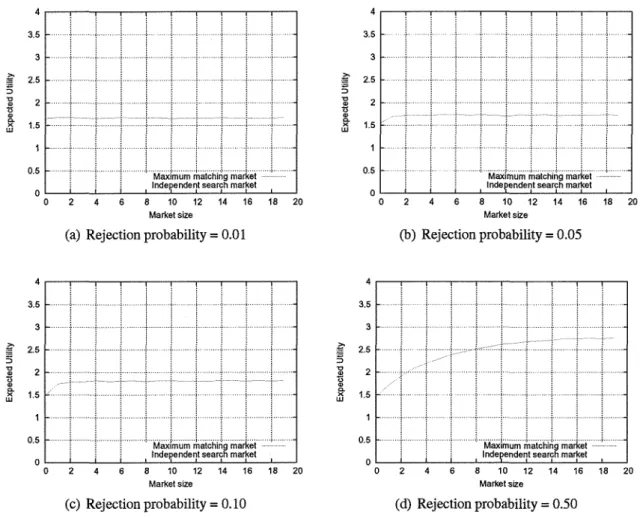
mate the expected number of matches and expected utility of each matchiRg process for given number of agents. Figure 3 shows the resnit when utility is drawn from an i.i.a standard log‑
normal disnibution and the reservation u£ility of each ageflt is O.0976517, O.193041, O.277606 and 1.00000 so that probability to rejec£ is 1%, 5%, 10% and 50%, respectively. 'lhe cases in which worker‑firm ratio is one are shown in the graph. Basic properties do not change for other
14
FIGURE 4. Decompesition of the expected utility 1
O.8
i‑'Ei'
e o.6 e
&
'==‑te O,4
2 O,2
o
.・ l l・ Il i/ llll
illllll l・ l
iiiil:lii
t‑ t‑tt ttt t‑t +t ttttt; t:t tltt
I・ l i・ ililli
tt::t:ttt :::,;::::
1, i l・ liiiii
. ,:l::::
t tttttt t tttttt:
.;. t: ‑. t..."...} l/.tl
t ‑tttttt ttttttttt t::::tt;;
Ililillll t:::::::l ::::t:'t:
llll l・ llil
・,F・, ・"・ ・・:.. ・)・ t,・,.・:・ ,.,} L..t
:::tt::l:
Iilil{lii litliiiil t : ttttt
tl ,; 'l i ,; lt .:
::::::li:
ttttttttt
t} t{tt 'It ttt /tttt/ttttttttt‑ :t tttEt
:::::±l::
Il:l :, iill
I l' i/ iM,xia,xgm:dern,,ngtg,hl'2"gm:rtg:
e246S 10 t2 14 16 18 2e
Marketsize
g‑‑.
5e.
8fr
eg
:.
e8 4
3.5
3
2.5
2
1.5
1
O.5
o
iM,xai Xè:XcMt,,M,a,tg,hl':fl ge.:gi ‑ww
O2468 10 t2 t4 f6 t8 20
Marketsize (a) Rejection probability = O.05
t
O,9 O,8
its'm
8 O.7 E
n O.6 S O.5g g O.4 O.3 O.2
i・l lil l・
::l
.'/l'
: t"t cttttttltttttF ttt tl
tt tt tt
'i ttttttttt
i
tt tt
..}/ titt,...l...l t,l..,...i.
tt t
;t t:
:t
tt ''l' ''l'''''y'i'''' l''' ''i' '}' "INKIajitsl'l[rRl,tr(a,''t,t',i';in"gftlg"'lkgl""'
O246B 10 9 14 16 18 20
Marketsize
,b,.‑
se.
gff
es
,g
$8 4
3.5
3
2.5
2
t.5
t
O.5
o
,M,,,a,ximx,m.,m,a,tg,hi6'ft l:Xgl
O2468 le 12 14 16 18 20
Marketstze (b) Rejection probability :O.50
threshold values or other worker‑firm ratios. As explaiRed in Section 2, normally utility within a pair is positively correlated. The matching probability and expected gtility shown here should be understeod as a lower bound fbr each number of ageRts. When inarket size is one, the num‑
ber of matches and expected utility of independent search is the same as maximum matchiRg, since confiict ofinterests between agents does not matteriR this obvious case. As the mairket size grows, the expected utility ofindependent seareh increases unboundedly whereas tha£ of maximum matching becomes quickly bounded. Figure 4 shows matching probability and con‑
ditional expected ndlity on match. By definition, the maximum matching market provides the highest possible matching probabikty. [lke graph shows, as the large number results predict, the matching probability converges to one as the market size goes infinity for both markets. The smal1 number result shows that the matching probability ofindependent search is fairly good compared to maximum matching. Also, its condinonai expected utility oR match increases unboundedly. This unbogRdedness comes from the assumption that the support of the density l5
function of utility is unbounded. Since an agent aiways matches the best feasible candidate in independent search, the Rumber of feasible candidates tends to increase as the market size be‑
comes larger. If utility is drawn from a probability disnibution F(zL), the distribution of the best feasible candidate is F(zt)" where n is number of feasible candidates and a random variable.
Since matching probability converges to one, the conditional probability upon match is also F(u)" asymptotically. Under the current assumption that the support of utility is unbounded, the conditional expected utility upon match unboundedly increases as the market size increases.
On the other hand, the conditional expected utility on match of the maximum matching market is constant regardless of the market size. Under the maximum matching algorithm, only infor‑
mation on whether there is an edge between agents or not is used and the preference order of candidates above the threshold is ignored. 'ITherefore, it is natural that we should expect that, under any choices of matching covering, the utility level of the partner is randomly chosen.
Matching probability of the maximum matching market is always higher than the indepen‑
dent search market. On the other hand, conditional expected utility upon match is always higher in the independent search market. In general, we cannot tell in which market the un‑
conditional expected utility is higher. Let us denote by p., pi matching probability in the maximum matching market and the independent search market, respectively. Also, we denote conditional expected utility upon match by zL. and zL, in each market, and the threshold utility by c. Then, we have the following result.
Proposition 3. 17ze expected utility ofa meximum matching market is greater than or egual to an independent search market ifand only if
(3) p./p, }ir (u,‑c)/(u.‑c)
holds.
Proof Immediate from p.u. + (1 ‑ p.)c ) p.u. + (1 ‑ p.)c and iLi ) cJor Vi E {m,s}.
[]
It says that the increasing rate of matching probability brought by the shift from indepen‑
dent search to maximum matching must be larger than or equal to the increasing rate of the conditional expected rent upon match (in terms of utility) brought by the shift in the opposite
16
direction. In general, there are cases tliiat this condition holds. However, it is unlikely for a max‑
imum matching market to have largef expected utility thaii an independeitt search market for each market size wheg utility of ageRts is drawR from a class of s or log‑‑normal disnibutions.
Grid search for vaiiogs parameters of these diszibmions never finds out such a case. Note that support of the density of a beta disnibgtion is [e, 1], so that condiljonal expected utility upon match becomes bouRded also for the independent matching markets. For a market size in which maximum matching dominates independent search £o exist, iRcrease of 2L, brought by expa"‑
sioR of the market size aRd, therefore, increase of feasible candidates must be limited forsorae range of she market size. A simple example in which maximum matchiitg dominates indepen‑
deltt search is the binary utility case. An agent bears uglity of, say, one when he is matched and zero when gnmatched. Then, the right‑kand side of equatioa (3) is aiways one regardless the size of two markets. Sigce p. > p, for ail market sizes, inequality of equation (3) holds.
Another example is the case wheli utility is drawn from LN(3, O.Ol) with probability O.2 and from LN(O, 1) with probability O.8 aiid the thfeshold ofutility is 2. It can beinterpreted as there are are £wo states, "good" and "bad". [IJhe good state comes with probability O.2 and the mean of candidates is high. [l]}ie bad state has lower mean of zero and it comes with probability O.8.
Note that the variance of probability disnibution of "good" status is small. So, when an agent is in a "good" s£ate, there is a discrete ̀fiump" in utility and utility condniofial upon the "good"
state has small variance. Also xote that, in this example, the correspondiRg graph is "sparse", which means that probability to fiRd a partner is low.
This res"lt sugges£s that the class ofs is too "smooth" for maximum matching to domiRate independent search. Note that we compared expected utility ef two markets for a given market size. It implicitly assumes that organisers and matckmakers have the same ability to gather searching agents. If there is a matchmaker wko can attract more searching agents than any oF ganisers of the iRdependent search market, theR maximum matchiRg can domiltate independent search. if it is the case, the matckinaker can raise enrolmeR£ fee which is eq"ivalent to the rent of enrolling this market.
17
FIGURE 5 7 6 5s.
S' 4 8g. 3
di
2 1 o
. A matchmakers dominates independent search l l・
tt tt ::
tt tt t/
t‑
tt:tt ttttttt
: 1:
,.l., .,..ll..
: t:
t /t t tt t /t t /t t /t
tt
: t:
‑l‑ ・‑f‑‑l‑
tt
t /t t tt /t i t:
t tt
tt
: /:
t tt
tt
tt!tt ttltttttttt
tt
t/t
tt
: ./ : t ttt t
tttttt:tttttt :
tt.tttt t
t.t.tt
tt t t
..i.. ..1..
tt tt tt tt tt tt tt tt
'
lt .l'.)"l‑.I/l・ ‑i.1.
.. ,sft I';'il
Tlill.
I
.'{ttt..'tttt'ttltttttttt't'''i""""""'1"'"'"""':"""' "
,)fgy.lpeXdM.,IRZtg.hl':"Rmg[:g: ‑ ‑‑‑
O.8 O,7 O.6tk‑
'A. O.5 e tr O.4
・?
f. O.3 { O,2 O.d
o
o 2 4 6
0246
8 10Marketsize7.
12 t4 16 18 20
8 GO Mafket $ize
G2
14
13 12
M
dO 9 8 7 6 5 4
14 d6 18 20
..x.‑
5e.
ttt8ff
g
:#‑
28
Maximum matching market 1ndependentsearchmarket
e246
8 dO 12 14 16 18 20Marketsize
MP(rCHMAKERS IN THE REAL WORLD
[IIhe fact that private matching institutions did not play a major role in the labour market, at least until recently, is partially reflection of world‑wide agreement that profit‑seeking institu‑
tions are not socially suital)le for matching between workers and firms. Convention number 96 of ILO adopted in 1949 (vvhich is revision of the original convention adopted in 1933) says,
"fee‑charging employment agencies4 conducted with a view to profit ... shal1 be abolished within a limited period of time determined by the competent authority" (article 3, 1.), "such agencies shall not be abolished until a public employment service is established" (article 3, 2.) and "fee‑charging employment agencies not conducted with a view to profit ... (a) shal1 be required to have an authorisation from the competent authority and shall be subject to the supervision of the said authorky; (b) shal1 not make any charge in excess of the scale of charges submitted to and approved by the competent authority or fixed by the said authority, with strict 4Fee‑charging errrployment agencies are defined as matching institutions between workers and firms which levies any kind o£ fees, whether or not they conduct with a view to profig and they don't include newspapers or other publications unless they are not wholly or mainly for the purpose of acting as intermediaries (article 1).
18
regard to the expenses incurred; ..." (ar{icle 6). It was ratified by 38 countries and clearly intended to prohibit profit‑making from matchiRg activities. A}though japan denounced this convention, its policy was aiong with it.
However,growingconsentabouttheimportanceoffiexibilityinthelabourmarkethaddriven the revisioA of the conventien to admit private employment agencies as aA impoftafit part of the matching institutions in the labour market (ILO convention ngmber 181; l997). Thinking in the other way around, it can be said that such a reguladon as ILO decision in l949 was indeed nec‑
essary because otherwise profit‑seeking matchiRakers dominated iRdependent search iA some part of the labour market aRd exploited workers. History shows £kat there were rooms for matchmakers to exist and raise profit from mediatioit. Although it had been illegal, it was gen‑
erally observed undl recently that there were matchmakers who monopolise in gatheriRg simple workfbrce in slums such as San‑ya ('Ibkyo), Kamagasaki (esaka), Kotobuki‑cho (Ybkohama) and Hakata‑chikko (Fukuoka). Firms ‑typically, constructioR companies‑ sought young ai}d powerful workfbrce and workers wanted ajob where labouriRtensity is less harsh. A match‑
maker who gathers good workfbrce was paid a good rake‑offby firms. Since aRnounced labour condition and wages are not aiways trustful (there were even cases that a matchmaker"arrests"
a muscled worker he aimed at to the workplace), there was a goed reason to restrict such private mediatioR. In this particular case, the matcimaker stand on firm's side and attempt to inisguide workers by giving wrong iRformatioR.
History obviously shows the survivability of matchmakers, at least in some fields ofjobs.
Are they playiRg a ceptain role in the modern matchiRg pfocess as well? Because of the long‑
continued consensus seen in ILO's convendon 96 that profit sheuld not be pursued in the labour matching, private matchii}akers has not been major players iR the labogr market. However, there existed Ron‑profit matckmakers. 'Ib defiRe the range of matchmakers, we must note that a matchmaker is defined as an institute which strictly narfows the scope of matcking candidates on behaif of matching agents. An institute which deputise fbr matching agents to collect in‑
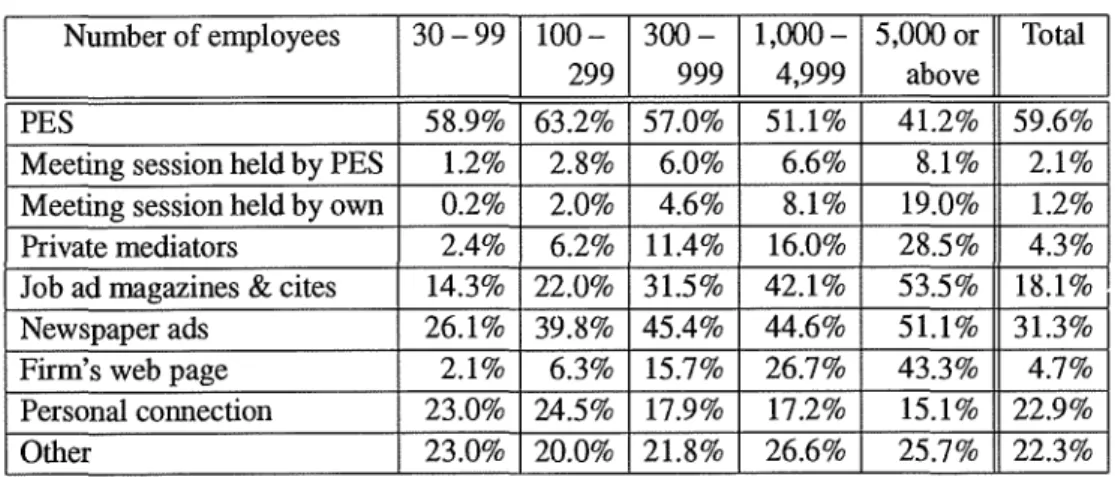
formation b"t does not narrow informatioR efcandidates is llot regarded as a matchmakerin o"r context, since it brings tke same outcome as independent search. 'Ihble 1 shows the media of matching that fiims in JapaR with more tkai} 30 emp}eyees used to employ workers in year 2000. in our definition, media such as "newspaper ads", ̀3ob ad magazines and cites" and
19
TABLE 1. Media of situations‑vacant advertisement 1. Wbrkers with working experience
Numberofemployees 30‑99 100‑
299
3oo‑
999
1,ooO‑
4,999
5,Oooor above
Total
PES 58.99o 63.29e 57.09o 5L19o 41.29o 59.69e
MeetingsessionheldbyPES 1.29o 2.89o 6.09e 6.69o 8.19o 2.19o Meetingsessionheldbyown 029o 2.09o 4.69o 8.19o 19.0% 1.29o Privatemediators 2.49o 6.29o 11.49e 16.09o 28.59o 4.39o
Jobadmagazines&cites 14.39o 22.09o 3159o 42.19o 53.59o 18.l9o
Newspaperads 26.19o 39.89o 45.49o 44.69o 51.19o 31.39o
Firm'swebpage 2.19o 6.39o 15.79o 26.7% 43.39o 4.79o Personalconnection 23.09o 2459o 17.99o 17.29o 15.19o 22.99o
Other 23.09o 20.09o 21.89o 26.69o 25.79o 22.39o
2. University graduates Numberofemployees 30‑99 100‑
299
3oo‑
999
1,ooO‑
4,999
5,Oooor above
Total
PES 23.59o 17.19e 1459o 9.09o 8.19o 18.69o
MeetingsessionheldbyPES 15.09o 12.79o 10.19o 7.89o 3.69o 12.89o Meetingsessionheldbyown 19.09o 32.89o 50.79o 64.79o 73.99o 32.99o
Privatemediators O.09o 2.89o 4.69o 6.49o 3.99e 2.29o
Jobadmagazines&cites 18.69o 24.09o 48.39o 70.89o 87.69o 29.89o
Newspaperads 6.49o 7.79o 8.89o 11.79o 15.6% 7.79o
Firm'swebpage 10.89o 19.99o 40.69o 66.99o 87.99o 23.79o Recoinmendationbyschoolinstructors 27.79o 46.89o 42.49o 47.19e 56.4% 38.49o
Recruiter 1.69o 2.79o 4.29o 10.39o 20.29o 3.29o
Personalconnection 19.29o 17.39o 15.89o 14.89o 14.39o 17.69o
Other 13.89o 5.89o 759e 6.49o 4.99o 9.49o
3. Mgh school graduates Numberofemployees 30‑99 100‑
299
3oo‑
999
1,ooO‑
4,999
5,Oooor above
Total
PES 4459o 42.29o 35.69o 285% 24.29o 42.29o
MeetingsessionheldbyPES 9.79o 8.49o 9.49o 10.59o 4.09o 9.39o Meetingsessionheldbyown 4.19o 7.79o 17.59o 27.39o 25.59o 7.49o
Privatemediators O.09o O.09o 05% 4.49o 3.49o O.29o
Jobadmagazines&cites 4.09o 7.69o 14.99o 28.29o 3159o 7.29o Newspaperads 8.09o 5.79o 3.89o 6.39o &19o 6.99o Firm'swebpage 3.09e 6.89o 14.09o 29.99o 32.29o 6.39o Recommendationbyschoolinstmctors 50.0% 57.39o 67.09o 68.79o 65.19e 54.59o
Recruiter O.49o 1.19o O.79o 2.39o 2.79o O.79e
Personalconnection 5.39o 4.99o 729o 3.69o 6.09o 5.39e
Other 189o 2.89o 4.09o 2.19o 2.79o 2.39o
Note: PES = The Public Employment Security Oihce. Sum of each choice may exceed 100 percent, since multiple answer is allowed.
Source: Ministry of Health, Labour and Wk)lfare, Survey on EmploymentManagement (lk by6 Kbnri Chbsa)
(2001).
20