スロヴェニアにおける多言語主義の 政策と教育に関する考察
園部ニコル ・赤星まゆみ
(健康栄養学部健康栄養学科 ,子ども学部子ども学科 )
(平成 年 月 日受理)
An investigation into plurilingual language policy and education in Slovenia
Nicole S
ONOBE
and Mayumi AKAHOSHI
( )
(Accepted January 24, 2019)
Abstract
The number of languages spoken in the world is in a constant state of flux, but it is estimated at between 7000 and 8000. The right to language is considered a basic human right. Whether a person is monolingual or plurilingual is determined by not only personal preference and competence, but by the language policies and language education in each and every country in the world. The aim of this pa- per is to show the lingual diversity in Slovenia by examining the development of Slovene, the structure of language policy and the implementation of foreign language education and curriculum at the pri- mary level. The paper presents an insight into the ethnic and lingual diversity in Slovenia. The official language is Slovene (spoken by 92% of the 2.8 million population) and in certain regions Italian and Hungarian are also official languages. Through language policy, the language of ethnic minorities, mi- grants, Roma communities and refugees are all acknowledged and respected. Foreign language educa- tion is embraced from an early age at primary school and hence plurilingualism in Slovenia is at one of the highest percentages in the European Community. The analysis of the results of a survey by the European Commission (Special Eurobarometer) reveals that Slovenians believe that knowing multiple languages, especial English promotes personal development and improves job opportunities. The find- ings show that Sloveniaʼs language policies, education and attitudes are an area of interest for coun- tries where language policies need to be reformed and refined for native speakers, migrants and refu- gees.
Key words:Slovenia スロヴェニア language policy 言語政策
foreign language education 外国語教育 bilingual education バイリンガル教育 plurilingualism 多言語主義
論 文
西九州大学子ども学部紀要 第 号 ‐ ( )
スロヴェニアにおける多言語主義の 政策と教育に関する考察
〈和文概要〉
世界中で話されている言語の数は − 千ぐらいと言われる。人がただ一つの言語を話すのか,複 数の言語を話すのかは,単に個人的な選択や能力の問題と思われがちだが,世界的な次元でこの問題 を見ると,実は,国レベルの言語に関する政策や言語教育のあり方によってかなりの部分が決まって いる。しかも今日重要なことは,言語への権利は基本的人権の一つと見なされていることである。そ こで,本稿では,スロヴェニアという小さな国を取りあげ,その民族と言語の多様性に照準を当て,
スロヴェニアの言語政策の歴史とあり方,及び,外国語教育の実施方法と基礎学校( 年制の義務教 育学校)におけるカリキュラムの検討を行うことを目的とする。
スロヴェニアの公用語は,スロヴェニア語(人口 万人のうちの %が話す。)であるが,一部地
域ではイタリア語とハンガリー語も同様に公用語である。また,少数民族,移民,ロマの人,難民の
言語も,言語政策を通じて,すべて認められ,尊重されている。外国語教育が小学校レベルの早い段
階から行われており,スロヴェニアの多言語主義は EU で最も高い達成率を誇る国の一つに数えられ
ている。欧州委員会の調査結果(EU 指標)の分析では,スロヴェニアの人々は,多数の言語,とり
わけ英語を知ることが個人の発達を促し,就業機会を高めるのだと信じていることが明らかにされて
いる。本稿で検討したスロヴェニアの言語政策と教育政策,及びスロヴェニアの人々が言語に対して
持つ態度は,母国語話者に対しても,移民,難民などの少数話者に対しても,言語政策の改善と改革
の必要な国々に深い示唆を与えるものと言えよう。
Other groups 12%
Bosniaks 1%
Croats 2%
Serbs 2%
Slovenes 83%
Introduction
The desire to communicate and be understood is hu- man nature. As globalization brings us closer to our neighboring countries, we find ourselves undertak- ing a second or third language to be able to commu- nicate with others across the globe. Foreign lan- guage education is increasingly in the limelight, es- pecially in countries where English is not the native tongue. All countries implement foreign language education policies and strategies that reflect each countryʼs linguist history, linguistic needs for the fu- ture and attitudes of people towards language for communication and for job opportunities.
Presently in countries within the European Union (herein EU), language policy is based on plurilingual- ism (native language plus two foreign languages).
The Council of Europe has established a common standard for language acquisition and sets clear goals known as Common European Framework of Reference for Languages (herein CEFR). Members of the EU use these guidelines to formulate lan- guage education policies, achievement goals, levels, curriculum, learning materials, evaluation and test- ing for language learning, teaching and assessment in their own country. With increasing spatial and so- cial mobility due to socio-economic and political rea- sons, issues regarding language education policy, foreign language learning, cultural identity and har- mony need to be addressed.
With the above issues set as aspects for considera- tion, the aim of this paper is to present language pol- icy, foreign language education and education for minorities in Slovenia, with a special emphasis on how all of these areas combine by examining the re- sults of a survey about language. Slovenia is a small country in the EU (member since 2004), where eth- nic communities who donʼt share the same first lan- guage or language of identity have coexisted for long periods of time. Slovenia possesses a strong lin- guistic potential due to the fact that its people have indirect experience of plurilingualism throughout its history (Language Education Policy Profile, 2005).
Sloveniansʼ language acquisition success lies in first, second and third languages being introduced at an
early age, while respecting ethnic and geographical diversity. The Constitution of the Republic of Slove- nia protects the human rights and fundamental free- doms of ethnic minorities by giving them the free- dom of language choice as well as respecting their cultural heritage with the aim of integration and harmonious development of society and culture.
In order to fully understand language in Slovenia, this paper proceeds as follows. The first section pre- sents an overview of the history of the Slovene lan- guage and ethnic and lingual diversity. The middle section addresses language policy, language educa- tion (including foreign language, bilingual and minor- ity groups) and the results of a survey about Sloveni- ansʼ attitudes toward language, language learning and support for minorities. Finally, the last section synthesizes the main findings.
Ethnic and Lingual Diversity
This section will firstly look at an overview of the population breakdown and languages spoken. Ac- cording to the United Nations World Population Re- view (2018), the population of Slovenia is 2.08 million.
This is up from 1.9 million recorded at the last popu- lation consensus in 2002. (Statisticni urad Slovenije, 2011) The population density of 101 people per square kilometer ranks as one of the lowest popula- tion densities in Europe.
The population breakdown of Slovenia is 83% Slo- venes, 2% Serbs, 2% Croats, 1% Bosniaks and 12%
other groups. Ethnical specifics, from a historical perspective have encountered great changes in Sloveniaʼs past and due to this reason, resulted in a Graph 1. The population breakdown in Slovenia
Source: Statistical Office (2002)
great sensitivity toward the question of Slovene lan- guage and other languages in this region even be- fore reaching independence in 1991 (Ministry of Education, Science and Sport, 2003).
The languages spoken are 95% Slovene, 1% other of- ficial EU languages (including 0.2% Italian, 0.4%
Hungarian) and 5% other languages (not state lan- guages).
)Italian and Hungarian are also official lan- guages of Slovenia. Romani is also spoken by the Roma Community. The percentage of people speak- ing Slovene is up from 87.7% in 2002 and as such, this makes Slovenia one of the most homogeneous countries in the EU in terms of speakers of a pre- dominant mother tongue. Other homogenous coun- tries include Hungary, Portugal, Greece, Poland, Czech Republic and Cyprus. Countries with the low- est percentages are Slovakia, Latvia and Estonia.
(European Commission, 2006) The percentages of Italian (0.2%) and Hungarian (0.4%) speakers have not changed over the past fifteen or so years, which proves that the constitution, language policy, lan- guage education and the community have all been instrumental in protecting these minority diversities while maintaining the Slovene mother tongue.
In order to facilitate the understanding of language policy in Slovenia, it is important to examine the eth- nic makeup of Slovenia, including the rights of spe- cific ethnic groups living there. There are five pe- riod of history that will be briefly presented here to give a clear picture of how events shaped the his- tory of language and lingual development, in order to understand how language has evolved in Slovenia.
Firstly, Slovene is Slavic language and is closely re- lated to Croatian with 46 dialects. The earliest writ- ten records in Slovene are the Freising Fragments from around 1000 AD and the first printed Slovene books, including a translation of the bible, were pub- lished in the 16
thcentury. (Leopoldina Plut-Pregelj, Gregor Kranjc, Žarko Lazarević, Carole Rogel, 2018, p.303). Up until the 20
thcentury, the Slovene linguis- tic community existed in different multiethnic and multilingual state formations and it had the status of a minority language which was used only in the pri- vate domain with no institutionalized possibilities for wider use. However, the language survived
among ethnic Slovenes as a means of everyday com- munication which began to increase at the end of the 18
thcentury, and at the same time, the corpus of literary texts, the development of the education (partially in Slovene) was prevalent. The linguistic demands continued slowly and persistently through the second half of the 19
thcentury and in the first decade of the 20
thcentury. (Ministry of Education, Science and Sport, 2003)
Secondly, Post-World War 1 saw the establishment of international agreements and the treaties of Ra- pallo and Trianon meant that the Slovene ethnic ter- ritory was divided among different states and hence the Slovene speaking population remained a minor- ity in Hungary, Austria and Italy. After 1918 within the Kingdom of Serbs, Croats, Slovenes (Kingdom of Yugoslavia 1929), Slovene became established in most areas of public life within the Slovene speaking community. The Vidovdan Constitution of 1921 rec- ognized the language and stipulated that the official language of the kingdom was Serbian-Croatian- Slovene; in essence; one language with three vari- ants. (Novak-Lukanovic & Limon, 2012)
Thirdly, Post-World War 2, saw the development of the Slovene statehood and the Republic of Slovenia was created within the framework of the Federal Peopleʼs Republic of Yugoslavia (renamed in 1964 as the Socialist Federation Republic of Yugoslavia). It was at this time, that Slovene formally assured equality with other federal languages, with the ex- ception of its use in certain key areas including the armed forces, custom service and some state institu- tions. (Novak-Lukanovic & Limon, 2012)
The next period is from 1974, when the Socialist
Federal Republic of Yugoslavia become a federal
state and the Socialist Republics consisted of the So-
cialist Republic of Bosnia-Herzegovina, the Socialist
Republic of Croatia, the Socialist Republic of Mace-
donia, the Socialist Republic of Montenegro, the So-
cialist Republic of Serbia, the Socialist Autonomous
Province of Vojvodina and the Socialist Autonomous
Province of Kosovo (constituent parts of the Social-
ist Republic of Serbia) and the Socialist Republic of
Slovenia. The status of Slovene was retained and
strengthened within the constitution. Article 3 of
the Constitution of the Socialist Federal Republic of Yugoslavia
)states:
The Social Republics are states based on the sovereignty of the people and the power of and self-management by the working class and all working people, and are socialist, self- managing democratic communities of the working people and citizens, and of nations and nationalities having equal rights.
From this we can see that Slovenia as one of the so- cialist republic states was defined as one of the sov- ereign states of the nations and along with this came the right to self-management and self-determination.
Another article that contributed to protecting the mother tongue of Slovenia in some ways is the fol- lowing, Article 170 which states:
Citizens shall be guaranteed the right to opt for a nation or nationality and to express their national culture, and also the right to the free use of their language and alphabet.
No citizen shall be obliged to state to which nation or nationality he belongs, nor to opt for any one of the nations or nationalities.
From this we can see that citizens were granted the right of nationality and national culture and the free use of their language and alphabet. It is from this time that the use of Slovene became more wide- spread.
In addition, an article that contributed to Slovene being used in public office is Article 171 which states:
Members of nationalities shall, in conformity with the constitution and statute, have the right to use their language and alphabet in the exercise of their rights and duties, and in proceedings before state agencies and organi- zations exercising public powers. Members of the nations and nationalities of Yugoslavia shall, on the territory of each Republic and/or Autonomous Province, have the right to their own language in conformity with statute.
This article stipulates that the use of the Slovene language was compulsory before the authorities of the Socialist Republic of Slovenia. Equality was largely enforced in the territory of the Republic of
Slovenia (with the exception of certain problematic communication areas i.e. army, media, customs, and some other all-state institutions); on the country level, the status of Slovene was neglected, namely until the dissolution of the federative state in 1991.
(Ministry of Education, Science and Sport, 2003) Finally, the last period to be examined is from when Slovenia gained its independence in 1991, with the break-up of the then Yugoslav federation. This was the start of a new beginning however the previous constitutions created the legal basis for a more deci- sive enforcement of linguistic rights and it also laid the foundations for the legal framework for the use of Slovene by the public. Article 11 states:
The official language in Slovenia is Slovene.
In those municipalities where Italian or Hun- garian national communities reside, Italian or Hungarian shall also be official languages.
It is from this time that Slovenia recognized two of its minorities and made legal provisions in the Con- stitution to protect their languages, cultural identi- ties and freedom of expression. Article 64 (Special Rights of the Autochthonous Italian and Hungarian National Communities in Slovenia) proclaims:
The autochthonous Italian and Hungarian na- tional communities and their members shall be guaranteed the right to use their national symbols freely and, in order to preserve their national identity, the right to establish organi- zations and develop economic, cultural, scien- tific, and research activities, as well as activi- ties in the field of public media and publishing.
In accordance with laws, these two national communities and their members have the right to education and schooling in their own languages, as well as the right to establish and develop such education and schooling.
The geographic areas in which bilingual
schools are compulsory shall be established
by law. These national communities and their
members shall be guaranteed the right to fos-
ter relations with their nations of origins and
their respective countries. The state shall
provide material and moral support for the
exercise of these rights .
The right to Italian and Hungarian minorities to freely use their language, express and develop their native culture and in order to do so, establish organi- zations and use their national symbols was granted in the 1991 Constitution of the Republic of Slovenia.
)In Slovenia, the Roma community is a minority com- munity recognized by the Constitution; it does not have the status of a national minority, but it is a mi- nority community specially mentioned in the Consti- tution and granted special protection by the law. It is recognized as a special community or minority with particular ethnic and cultural characteristics (its own languages, culture and history) that may be preserved in accordance with constitutional provi- sions, taking into consideration the needs of the community itself which it expressively puts forward.
(Lobnikar, Hozjan, Suklje & Banutai, 2013) The legal basis for regulating their status is Article 65 (Status and Special Rights of the Romany Community in Slovenia) which specifies:
The status and special rights of the Romany community living in Slovenia shall be regu- lated by law.
There is diversity within the Roma community
)in Slovenia: the Roma community in the Dolenjska re- gion who came from Bosnia and Herzegovina; the Roma community in the Maribor region who came from Kosovo and the Republic of Macedonia; the Roma Community in the Gorenjska region (also known as Sinti and the Roma community in Prek- murje. Article 65 acknowledges the special rights in the fields of education, employment, culture, health and social care and so on, but not to the extent of the Italian and Hungarian minorities. It can be said that Slovenia is sensitive to minority groups.
In examining the five historical periods we can see that Slovenia was never been a territory that was ethnically homogeneous, hence the present-day per- centage of lingual homogeneity at 95% (as previ- ously mentioned) is outstanding. With shifting na- tional fortunes and changing political boundaries, the number, size and economic and political strength of ethnic minorities has fluctuated through different historical periods, but in the process, Slo- vene has been able to survive.
Language Policy
Slovenia has encountered numerous educational challenges in the first few decades of its political in- dependence. Advances made in education, as a whole, and in particular with regards to language and language learning are highly significant. Ac- cording to Article 62 in Constitution:
Everyone has the right to use his language and script in a manner provided by law in the exercise of his rights and duties and in proce- dures before the state and other authorities performing a public function.
This shows that language rights are considered to be a basic human right, hence the protection of Slo- vene and other languages spoken by ethnic minori- ties. Indigenous minorities, irrespective of their nu- merical size, have extensive rights with regards to state financed activities such as educational, cultural, economic and public activities.
Due to Sloveniaʼs ethnic diversity, the potential for development of plurilingualism-oriented language education is considerable. Plurilingualism is a funda- mental principle of the Council of Europe language education policies and is not just embraced by Slove- nia, but prevalent throughout all of Europe.
Plurilingualism should be understood as:
-the intrinsic capacity of all speakers to use and learn, alone or through teaching, more than one language. The ability to use several languages to varying degrees and for distinct purposes is defined in the Common European Framework for languages as the ability “to use languages for the purposes of communi- cation and to take part in intercultural action, where a person, viewed as a social agent, has proficiency, of varying degrees, in several languages and experience several cultures.
-an educational value that is the basis of lin-
guistic tolerance, in other words, positive ac-
ceptance of diversity: speakersʼ awareness of
their plurilingualism may lead them to give
equal value to each of the varieties they
themselves and other speakers use, even if
they do not have the same functions (private,
professional or official communication, lan- guage of affiliation, etc.). But this awareness should be assisted and structured by the lan- guage of schooling since it is no sense auto- matic (hence the expression: plurilingualism as a value). (Council of Europe, 2007, pp 17-18) Slovenia is rich in plurilingual potential because of the presence of speakers with varied linguistic rep- ertoires, the collective acceptance of linguistic dif- ferences, individualsʼ desire to learn languages as the result of the geopolitical and economic context, substantial collective expertise in the field of lan- guage education and linguistics. (Ministry of Educa- tion and Sport, 2005). As indicated by this view of language education under the auspices of the Coun- cil of Europe: Slovenia boasts high awareness of the importance of learning several widely spoken lan- guages, minority languages, the languages of neigh- boring countries and less taught languages, provid- ing a sound basic for linguistic diversification. (Min- istry of Education and Sport, 2005)
Slovenia is actively involved in European language programs and changes are gradually being intro- duced. International cooperation in the field of edu- cation currently includes bilateral, regional and mul- tilateral cooperation at all levels from pre-school to higher education. In bilateral relationships, Slovenia cooperates with neighboring countries, the minori- ties in Italy and Hungary, 50 bilateral agreements with the EU and other countries and 30 programs and protocols with the EU and other countries. In regional cooperation it cooperates with Alps- Adriatic Working Community, Central European In- itiative and Mediterranean countries. Multilateral cooperation involves working with UNESCO, OECD, Council of Europe and EU. (Stremfel & Lajh, 2012) Language policy in the Republic of Slovenia was for- mulated by the Council of Europe and the Slovenian authorities and a Language Education Policy Profile, 2003-2005 was introduced. This document sets out the policies on language education, reviews of the current situation with regards to languages and teaching, identifies issues requiring further investi- gation and proposes guidelines for the future.
Key issues that have been addressed are:
1. the national language
2. the language teaching situation in the mixed territories
3. language teaching for Roma/Gypsies 4. the question of non native Slovene speak-
ing children and adolescents
5. the positive acceptance of linguistic differ- ences
6. the place accorded to languages at all edu- cation stages and at university
7. language teaching for adults (Ministry of Education and Sport, 2005)
The education system in Slovenia covers pre-school education to higher education, but for the purposes of this paper, compulsory basic education will be ex- amined. Compulsory basic education lasts for nine years and combines primary and lower secondary level of education. It is organized in a single- structure nine-year basic school
)for pupils between the ages 6-15 years. (Ministry of Education, Science and Sport, 2017) Basic education is provided by pub- lic and private schools (less than 1% of students are enrolled in private schools) and educational institu- tions specializing in children with special needs.
(UNESCO, 2015)
The basic school curriculum specifies:
1. number of compulsory and elective sub- jects, as well as days of activities for each year
2. optional subjects
3. number of class discussion periods
4. scope of extra-curricular non-compulsory basic school activities schools have to pro- vide
5. minimum number of lessons required to re- alize the curriculum
Special provisions for members of the Italian and
Hungarian national minorities, the Roma community,
immigrants are one of the main objectives in re-
gards to the legal aspects of the Slovenia language
policy as decided in a new program: Resolution on
the National Program for Language Policy 2014-18,
adopted by the National Assembly of the Republic
of Slovenia in 2013. (European Federation of Na-
tional Institutes for Language, 2017) Bilingual educa-
tion, education for Roma community and migrants will be discussed in a following section.
Foreign Language Education
European societies can be characterized and en- riched by linguistic and cultural diversity, by migra- tion and, also by mobility. The European Centre for Modern Languages of the Council of Europe quotes
“Language education is key: the provision of lifelong, quality education supports not only educational and professional success, but personal growth, demo- cratic citizenship and social cohesion.” Slovenia has been a member of the EU since 2004 and actively participates in EU policies, including the Barcelona Objective
)and Erasmus Plus.
)As specified by the Basic Schools Act, the compul- sory basic school subjects for language include Slo- vene, and Italian or Hungarian in ethnic mixed areas and two foreign languages. The first foreign lan- guage (schools choose English or German) is a com- pulsory subject since the 2016/2017 school year from grade 2. Pupils of grade 4 and onwards can choose a second foreign language as a non- compulsory optional subject (schools choose from English, German, French, Croatian, Italian, and Hun- garian). Pupils of grade 7-9 may learn a compulsory (second) foreign language (schools choose from Eng- lish, German, French, Croatian, Italian, Hungarian, Chinese, Latin, Macedonian, Russian, Serbian, and Spanish). Students may also choose non-compulsory optional foreign language classes (grade 1); second foreign language classes (grade 4-6) and third for- eign language classes (grade 7-9).
When the Barcelona Objective was introduced 16
years ago, most countries started learning a first foreign language as a compulsory subject between 9 and 11 years old. (Eurydice, 2000) In 2016, the situ- ation is markedly different with the age for starting a compulsory foreign language starting as early as the first year of primary school, with some countries, such as Cyprus and Poland introducing reforms which makes language learning compulsory for all children attending pre-primary school (Eurydice, 2017)
At the primary level in Slovenia, the annual hours dedicated to foreign language teaching is more than 75 hours, which corresponds to more than 2 hours per week, based on an average of 34 weeks in a school year. (Eurydice, 2017) It is interesting to note that in Slovenia the number of hours spent learning mathematics, Slovene and English are exactly the same amount of time and these three subjects are tested on the national examination (matura) in the 6
thgrade of primary school and in the 9
thgrade of middle school. (UNESCO, 2011) (see Table 1)
In 2016, in a majority of countries in the EU, all stu- dents must start learning a second foreign language before the end of compulsory (basic) education.
Countries that have adopted these reforms include the Czech Republic, France and Poland. In Slovenia as shown in the table below, a second foreign lan- guage is compulsory from grade 7-9 but it is optional from grade 4. School in Slovenia offer a second lan- guage as an optional subject and classes are held soon after school finishes. Other countries who offer the same optional second language education in- clude Spain, Croatia, Sweden and Norway. Statistics show that in Spain, Croatia and Slovenia about half of the students in lower secondary education study Table 1: Foreign Language Education in Slovenia
Foreign language Age Grade Choice of language Total hours
1
stOptional 6 1
English, German 1/week
Compulsory 7 2 2/week
2
ndOptional 9-11 4-6 English, German, French, Croatian, Italian, and Hungarian
2/week
Compulsory 12-15 7-9 3/week
3
rdOptional 12-15 7-9 English, German, French, Croatian, Italian, Hungarian, Chinese, Latin, Macedonian, Russian, Serbian, and Spanish
N/A
Compulsory
Source: adapted from UNESCO,World Data on Education, pp 11-12
at least two foreign languages. In Sweden and Nor- way this percentage amounts to over 70% of stu- dents.
The levels of attainment in foreign languages are measured using CEFR and above is a table of the scale that supports the evaluation of the outcomes of foreign language learning in a comparable way.
There are six levels of proficiency: A1 and A2 (basic users), B1 and B2 (independent users), C1 and C2 (proficient users). (see Table 2)
In a survey First European Survey on Language Competences conducted by the European Commis- sion in 2012, 14 EU countries participated: Belgium (3 linguistic communities), Bulgaria, Croatia, Estonia, France, Greece, Malta, Netherlands, Poland, Portu- gal, Slovenia, Spain, Sweden and UK-England. The ESLC collected information about the foreign lan- guage proficiency for the two most taught lan- guages (out of English, French, German, Italian and Spanish) of 54,000 European pupils in the last year of lower secondary education (ISCED 2) or the second year of upper secondary education (ISCED 3). In Slovenia these two languages are English and Ger- man.
The results for English as a first foreign language in
Slovenia show that 54% of the pupils attained a level of an independent user (B1 and B 2). The top score for English was 82% in Malta and Sweden; and the lowest being 14% in France. The results for German as a second foreign language show that 63% of the pupils attained a level of basic user (A1 and A 2).
The top score for German was 48% in the Nether- lands.
The findings of the survey prove that ʻan early onset is related to a higher proficiency in the foreign lan- guage being tested, as is learning a larger number of foreign language and of ancient languages. Slovenia ranked 5
thfor English and 9
thfor German which shows that the standard of education of first and second languages is high in the EU.
Bilingual Education- Italian and Hungarian Slovenia is an important case study of how bilingual language policies have been successfully applied, in slightly different ways, in the two ethnic areas of Slovene Istria and Prekmurje (Novak-Lukanovic, S.
& Limon, D, 2012). Language policy accounts for pro- tecting the rights of these ethnic communities and bilingual education involves education in the mother Table 2: CEFR proficiency levels (Global Scale)
C2
Can understand with ease virtually everything heard or read. Can summarise information from different spoken and writ- ten sources, reconstructing arguments and accounts in a coherent presentation. Can express him/herself spontaneously, very fluently and precisely, differentiating finer shades of meaning even in more complex situations.
C1
Can understand a wide range of demanding, longer texts, and recognise implicit meaning. Can express him/herself flu- ently and spontaneously without much obvious searching for expressions. Can use language flexibly and effectively for so- cial, academic and professional purposes. Can produce clear, well-structured, detailed text on complex subjects, showing controlled use of organisational patterns, connectors and cohesive devices.
B2
Can understand the main ideas of complex text on both concrete and abstract topics, including technical discussions in his/
her field of specialisation. Can interact with a degree of fluency and spontaneity that makes regular interaction with native speakers quite possible without strain for either party. Can produce clear, detailed text on a wide range of subjects and ex- plain a viewpoint on a topical issue giving the advantages and disadvantages of various options.
B1
Can understand the main points of clear standard input on familiar matters regularly encountered in work, school, leisure, etc. Can deal with most situations likely to arise whilst travelling in an area where the language is spoken. Can produce simple connected text on topics, which are familiar, or of personal interest. Can describe experiences and events, dreams, hopes & ambitions and briefly give reasons and explanations for opinions and plans.
A2
Can understand sentences and frequently used expressions related to areas of most immediate relevance (e.g. very basic personal and family information, shopping, local geography, employment). Can communicate in simple and routine tasks re- quiring a simple and direct exchange of information on familiar and routine matters. Can describe in simple terms aspects of his/her background, immediate environment and matters in areas of immediate need.
A1
Can understand and use familiar everyday expressions and very basic phrases aimed at the satisfaction of needs of a con- crete type. Can introduce him/herself and others and can ask and answer questions about personal details such as where he/she lives, people he/she knows and things he/she has. Can interact in a simple way provided the other person talks slowly and clearly and is prepared to help.
Source: Council of Europe (2001). Common European Framework of Reference for languages: Learning, teaching, assessment, p 5
ProficientUserIndependentUserBasicUser
tongue and second language acquisition (majority or minority language), as well as becoming acquainted with and preserving both cultures.
The school system in accordance to legislation en- able members of ethnic communities to maintain and develop their own language and culture, imple- ments one of the basic human rights and is a practi- cal realization of Sloveniaʼs constitution and attitude towards its minorities.
In the first model of bilingual education, the mother tongue is the first language at school and the second language is a compulsory subject. This model has been practiced in Slovene Istria on the Slovene coast since 1959 at primary school and in 1980 for pre-school and secondary education. It can be la- belled as a maintenance model (Baker, 1988, 1993) that offers language and culture classes to pupils from the majority community. Pre-school, primary and secondary school education is offered in either Slovene or Italian with the second language being compulsory. In schools where Italian is the language of instruction, teaching staff are native Italian speak- ers and the language of communication with par- ents and society is also Italian. Slovene is taught as a compulsory subject and is taught for at least three periods per week. In schools where Slovene is the language of instruction, Italian is a compulsory sub- ject. The inter-cultural education strategies and the didactic premises of early second foreign language acquisition around the world lead to a renewal of this model. Efforts for a didactic renewal have yielded empirical and practical results. (Cok, 2001) The second model of bilingual education has been practiced in the ethnically mixed Slovene-Hungarian region of Premurje. This model also dates back to 1959 and is one where both languages are languages of instruction and school subjects. This is a two-way model an example of how two languages as pre- served and acquired (Mackey, 1970). Bilingual classes are attended by students of both Slovene and Hungary and both mother tongues: Slovene and Hungarian. This model employs the concurrent method in all aspects of school life. Language switch- ing takes place and both languages are subjects as well as languages of instruction, so either can be
used during any lesson, except in second language classes. Both languages have equal status in all sub- jects. This model is designed to offer students an op- portunity to develop communicative abilities in the two languages present in the environment for com- munication and education needs. It is supported by the system of institutional bilingualism, whereby by law all teachers and personnel must be bilingual and all signs, announcements, documents and communi- cation with parents must be bilingual. By studying and monitoring this model in Prekmurje, it was found that it was necessary to introduce the ʻdidac- tics of languagesʼ approach
)to accommodate for both mother-tongue and second language speakers learning together in the same classroom.
Both models of bilingualism include cultural plural- ism and intercultural dialogue with aspects of Italian or Hungarian history, geography and culture being added to the usual syllabus. Legislation gives na- tional minority members rights at all levels to de- sign the school curricula. Ties with the mother na- tion of the minority in matters of textbook prepara- tion, field trips and in-service teacher training as- sures the quality of education.
In the international context, Slovenia cooperates with minorities in Italy and Hungary and neighbor- ing countries on the education of Slovenes abroad.
Since 1992, more than 50 international bilateral agreements have been signed by Slovenia on educa- tion, culture and science, as well as more than 30 programs and some protocols. (Eurydice, 2009)
Other Minorities: Roma people and refugees
The special status of Roma people promotes prefer-
ential treatment of Roma problematic and their lan-
guage. Next to the projects for strengthening com-
prehensive competencies in Slovenian language by
Roma people the main concern goes to language
codification and systemization of Roma language
and creativity in Roma language. In 2007, Slovenia
adopted the Roma Community Act which defines
the role of state bodies and self-governing in realiz-
ing the rights of the Roma Community. It ensures
that immigrant children have the right to compul-
sory education under the same conditions as citi- zens of Slovenia. Schools also offer additional teach- ing of the Slovene language to those that need it (Ka- lin, 2015).
In the past few years, more attention is being paid to the languages of immigrants and support to crea- tive and media projects by inhabitants and organiza- tions from ex-Yugoslav countries. Public television has special programmed intended for all officially recognized minorities. (Compendium of Cultural Policies and Trends in Europe, 2018) However, the speakers of other minority languages (besides Ital- ian and Hungarian), are mostly immigrants or second-generation speakers from the former Yugo- slav republics. This shows that there is a hierarchy of languages with the Italian, Hungarian and Rom- any speakers being acknowledged but the speakers of language of the former Yugoslavia receiving little or no official support. (Medvesek & Bester, 2010) That having been said, education and schooling play an important role in the integration of migrant chil- dren into their new environment. The Slovenian education has demonstrated solidarity and proved to be inclusive and successful at sheltering people who fled war in the former Yugoslavia. In Septem- ber and October 1992, temporary refugee children from Bosnia and Herzegovina reached a total of 17,000 and the Slovenian government organized education in basic schools pursuant to the Bosnian and Herzegovinian curriculum. In the following years the numbers decreased so in 1995/1996 school year their gradual integration into the Slovenian ba- sic schools began. (Ministry of Education, Science and Sport, 2017)
In 2007, the Ministry introduced the Strategy for in- tegration of migrant children, basic school and up- per secondary students into the Education System of the Republic of Slovenia. This document high- lights the right of migrant children to free teaching, in particular, instruction in the Slovene language, with a focus on the promoting learning of the mother tongue and culture of the country of origin, as well as access to the education system under the same conditions that apply to citizens of Slovenia.
(Ministry of Education, Science and Sport, 2007)
Other special treatment for migrant children in- clude the following. In the first year of education for migrant children, they are entitled to expert help in learning Slovenian (since 2006). In the second year of education, migrant children can be unassessed in in- dividual subjects and proceed to the next year (since 2010/2011). In addition, if migrant children enter Year 6 or Year 9 and Slovene is not their mother tongue then they can take the national exams on a voluntary basis.
Survey about languages/foreign languages and Sloveniaʼs ranking in EU 25
Language policy is decided by the government, fol- lowed by educators and is studied by children through the curriculum at schools. Language policy and language education do not function in a vacuum, so that socio-political and economic factors many easily outweigh the efforts of language planners and educationalists (Novak-Lukanovic & Limon, 2012).
The general public tend to opt for language choices that they believe will have a clear socio-economic benefit, so it is important to know what the general public is thinking and feeling. The questions of inter- est for this paper are listed below, starting with an overview of the survey, the number of languages spoken, the range of languages, place of learning, usefulness of foreign languages, target languages, age of acquisition, reason for acquisition, and minor- ity support.
1. Overview: A survey about experiences and per-
ceptions of multilingualism was carried out in the 25
EU countries (as well as Bulgaria (BR), Romania
(RO), Croatia (HR) and Turkey (TR)). 28 694 citizens
responded to this survey on multilingualism as part
of the wave 64.3 of the Eurobarometer. It was car-
ried out by Special Eurobarometer of the European
Commission and the results were collated in a docu-
ment ʻEuropeans and their languagesʼ (2006). This
survey covers many aspects of language, including
languages spoken and number, how languages were
acquired, which languages are useful for personal
development and which languages are necessary for
job opportunities. 1,030 Slovenians responded to this
0% 10% 20% 30% 40% 50% 60% 70%
English French German Croatian
Slovenia EU25
Table 3: Which languages do you know well enough to have a conversation, excluding your mother tongue? (in percentages)
at least one language
at least two languages
at least three languages
None
EU 25 56 28 11 44
Luxembourg 99 92 69 1
Slovakia 97 48 22 3
Latvia 95 51 14 5
Lithuania 92 51 16 8
Malta 92 68 23 8
Netherlands 91 75 34 9
Slovenia 91 71 40 9
Sweden 90 48 17 9
Estonia 89 58 24 11
Denmark 88 66 30 12
Source:European Commission, Special EUROBAROMETER 243, p 9
survey.
2. Number of Languages spoken: According to the results when asked ʻWhich languages do you speak well enough in order to be able to have a conversa- tion, excluding your mother tongue? The average for the EU 25 is 56%. 91% of Slovenians can speak at least one language well enough in order to be able to have a conversation. Slovenia ranks in 6
thplace in EU 25. As for bilingualism, 71% of Slovenians speak at least two languages well enough in order to be able to have a conversation, with the EU average at 28%. Slovenia ranks at 3
rdplace in EU 25.
As for trilingualism or plurilingualism, 40% of Slove- nians can speak at least three languages well enough in order to be able to have a conversation.
The EU average is 11% and Slovenia ranks 2
ndplace with 40% of people being tri- or plurilingual. In 2002, the EU heads of state and government set a long- term objective for all EU citizens to speak two lan- guages in addition to their mother tongue.
A)This data indicates that Slovenia has implemented and executed policies and guidelines to be followed at schools and institutions to be successful in plurilin- gual education. The table below summarizes the above in percentages for one, two and three lan- guages besides the native tongue that can be spoken at a conversational level.
3. Range of languages: Next, in addition to the distri- bution of language skills, the range of languages spo-
ken is given here. The five most spoken foreign lan- guages over the continent are: English, French, Ger- man, Spanish and Russian. In 2005, the average in EU 25 for knowing English well enough to have a conversation was 38%. The other two most widely known languages are French and German. The three most widely known languages in Slovenia are Croatian (59%), English (57%) and German (50%).
This shows that for both English and German, the percentage of Slovenians who can speak them well enough for a conversation is higher than the Euro- pean averages.
Next, in addition to the distribution of language skills, the range of languages spoken is given here.
The five most spoken foreign languages over the continent are: English, French, German, Spanish and Russian. In 2005, the average in EU 25 for knowing English well enough to have a conversation was 38%. The other two most widely known languages are French and German. The three most widely known languages in Slovenia are Croatian (59%), English (57%) and German (50%). This shows that for both English and German, the percentage of Slovenians who can speak them well enough for a conversation is higher than the European averages.
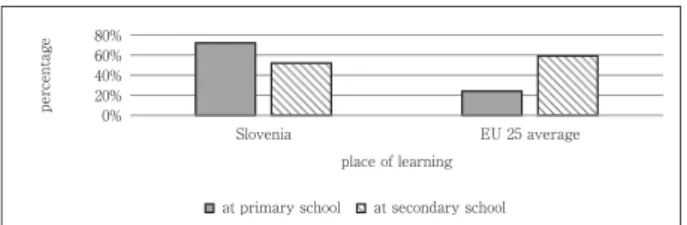
4. Place of learning: In this survey, respondents were asked several questions with regards to their foreign language learning experience. ʻHow did you learn or improve your first foreign language? To this question, 72% responded at primary school and 52% responded at secondary school. This data shows that in Slovenia, learning a first foreign lan- guage is particularly concentrated on in primary Table 4: Which languages do you know well enough to have a conversation, excluding your mother tongue?
Source:European Commission, Special EUROBAROMETER 243, p 13
Slovenia 80%
60%
40%
20%
percentage 0%
at primary school at secondary school place of learning
EU 25 average
0%
10%
20%
30%
40%
50%
60%
70%
80%
90%
Slovenia EU 25 average
English French German Spanish Russian
schools. The average is low at 24% and Slovenia ranks at number 4 with the top countries being Lux- embourg (82%), Malta (80%) and Latvia (74%).
5. Target languages: ʻWhich two languages apart from your mother- tongue are useful for personal development and your career?ʼ The top five lan- guages believed to be useful in Slovenia are English 78%, German 61%, Italian 12%, French 4%, Spanish 2% and Russian 1%. The top five languages in the EU 25 are English, French, German, Spanish, Rus- sian and Italian with the percentages being shown in the table above.
6. Usefulness of foreign languages: ʻDo you think knowing other languages other than your native tongue is or could be useful for you personally?ʼ 84
% gave a positive response. In every country polled, a distinct majority acknowledge the advantages of foreign language skills, with scores ranging from 73% in Portugal to 99% in Sweden. This shows how
important learning foreign languages is to all coun- tries in the EU 25.
7. Age of acquisition: ʻAt what age do you think chil- dren should start learning their first foreign lan- guage?ʼ 71% of Slovenians responded with between the ages of 6 and 12 and 72% responded with be- tween the ages of 6 and 12 for the age children should start learning their second foreign language.
The majority of Europeans believe that the best age to start learning a foreign language is between 6-12 years. When it comes to learning a second foreign language, the majority in every country thinks that children should not start learning it before the age of six. This shows that while Europeans believe that plurilingualism is important for personal growth and development, they are not pushing for studying too many languages at an early age.
8. Reason for acquisition: As for the reason why peo- ple might think foreign languages should be studied, 82% of Slovenians answered that it would improve their opportunities to gain employment. They in- cluded such reasons as being able to use foreign lan- guages at work and being able to work overseas as the ways of improving these opportunities. Other reasons for acquisition in the EU include being able to use foreign languages when traveling abroad and also for personal satisfaction.
9. Minority support: As to ʻTo what extent do you agree or disagree that ʻregional and minority lan- guages should receive greater support?ʼ, 80% of re- spondents replied that they agree. The average for this answer in Europe is 63% with Malta having the highest percentage (87%), Slovenia second with 80%
and Cyprus third with 79%.
10. Summary: From the results of this survey we can get a feel for how Slovenians think about foreign languages and how the language policies have fil- tered down through education and everyday life.
The percentage of Slovenians who can speak a first foreign language well even to carry out a conversa- tion is very high and in the EU 25, Slovenia ranks in 6
thplace. The percentage of Slovenians who can speak two foreign languages is also high, ranking in 3
rdplace in the EU 25. Furthermore, the percentage of Slovenians who can speak a third foreign lan- Table 5: How did you learn your first foreign lan-
guage?
Source:European Commission, Special EUROBAROMETER 243, p 22
Table 6: The two most useful languages to know for your personal career and development
Source:European Commission, Special EUROBAROMETER 243, p 32