Dynamic Entity Representation with Max-pooling Improves Machine Reading
Sosuke Kobayashi and Ran Tian and Naoaki Okazaki and Kentaro Inui Tohoku University, Japan
{sosuke.k, tianran, okazaki, inui}@ecei.tohoku.ac.jp
Abstract
We propose a novel neural network model for machine reading, DER Network, which ex- plicitly implements a reader building dynamic meaning representations for entities by gath- ering and accumulating information around the entities as it reads a document. Eval- uated on a recent large scale dataset (Her- mann et al., 2015), our model exhibits bet- ter results than previous research, and we find that max-pooling is suited for model- ing the accumulation of information on enti- ties. Further analysis suggests that our model can put together multiple pieces of informa- tion encoded in different sentences to an- swer complicated questions. Our code for the model is available at https://github.
com/soskek/der-network
1 Introduction
Machine reading systems (Poon et al., 2010;
Richardson et al., 2013) can be tested on their ability to answer queries about contents of doc- uments that they read, thus a central problem is how the information of documents should be orga- nized in the system and retrieved by the queries.
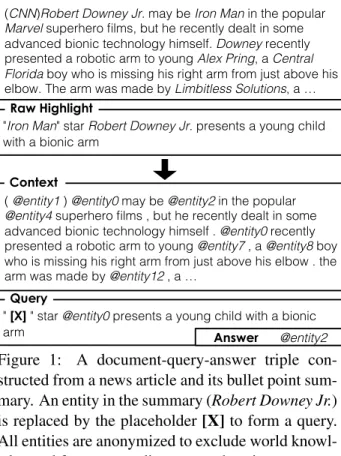
Recently, large scale datasets of document-query- answer triples have been constructed from online newspaper articles and their summaries (Hermann et al., 2015), by replacing named entities in the summaries with placeholders to form Cloze (Tay- lor, 1953) style questions (Figure 1). These datasets have enabled training and testing of complicated neural network models of hypothesized machine readers (Hermann et al., 2015; Hill et al., 2015).
( @entity1 ) @entity0 may be @entity2 in the popular
@entity4 superhero films , but he recently dealt in some advanced bionic technology himself . @entity0 recently presented a robotic arm to young @entity7 , a @entity8 boy who is missing his right arm from just above his elbow . the arm was made by @entity12 , a …!
" [X] " star @entity0 presents a young child with a bionic arm!
Query ! Context !
(CNN)Robert Downey Jr. may be Iron Man in the popular Marvel superhero films, but he recently dealt in some advanced bionic technology himself. Downey recently presented a robotic arm to young Alex Pring, a Central Florida boy who is missing his right arm from just above his elbow. The arm was made by Limbitless Solutions, a … !
"Iron Man" star Robert Downey Jr. presents a young child with a bionic arm!
Raw Highlight ! Raw Article !
Answer @entity2 !
Figure 1: A document-query-answer triple con- structed from a news article and its bullet point sum- mary. An entity in the summary (Robert Downey Jr.) is replaced by the placeholder [X] to form a query.
All entities are anonymized to exclude world knowl- edge and focus on reading comprehension.
In this paper, we hypothesize that a reader without
world knowledge can only understand a named en-
tity by dynamically constructing its meaning from
the contexts. For example, in Figure 1, a reader
reading the sentence “Robert Downey Jr. may be
Iron Man . . . ” can only understand “Robert Downey
Jr.” as something that “may be Iron Man” at this
stage, given that it does not know Robert Downey
Jr. a priori. Information about this entity can only
850
be accumulated by its subsequent occurrence, such as “Downey recently presented a robotic arm . . . ”.
Thus, named entities basically serve as anchors to link multiple pieces of information encoded in dif- ferent sentences. This insight has been reflected by the anonymization process in construction of the dataset, in which coreferent entities (e.g. “Robert Downey Jr.” and “Downey”) are replaced by ran- domly permuted abstract entity markers (e.g. “@en- tity0”), in order to prevent additional world knowl- edge from being attached to the surface form of the entities (Hermann et al., 2015). We, however, take it as a strong motivation to implement a reader that dy- namically builds meaning representations for each entity, by gathering and accumulating information on that entity as it reads a document (Section 2).
Evaluation of our model, DER Network, exhibits better results than previous research (Section 3). In particular, we find that max-pooling of entity rep- resentations, which is intended to model the accu- mulation of information on entities, can drastically improve performance. Further analysis suggests that max-pooling can help our model draw multiple pieces of information from different sentences.
2 Model
Following Hermann et al. (2015), our model esti- mates the conditional probability p(e|D, q), where q is a query and D is a document. A candidate answer for the query is denoted by e, which in this paper is any named entity. Our model can be factorized as:
p(e|D, q) ∝ exp(v(e; D, q) T u(q)) (1) in which u(q) is the learned meaning for the query and v(e; D, q) the dynamically constructed mean- ing for an entity, depending on the document D and the query q. We note that (1) is in contrast to the factorization used by Hermann et al. (2015):
p(a|D, q) ∝ exp(v(a) T u(D, q)) (2) in which a vector u(D, q) is learned to represent the status of a reader after reading a document and a query, and this vector is used to retrieve an answer by coupling with the answer vector v(a). 1
1
Hermann et al. (2015) models p(a|D, q) for every word to- ken a in a document. While the approach could be more general
Factorization (2) relies on the hypothesis that there exists a fixed vector for each candidate an- swer representing its meaning. However, as we ar- gued in Section 1, an entity surface does not possess meaning; rather, it serves as an anchor to link pieces of information about it. Therefore, we hypothesize that the meaning representation v(e; D, q) of an en- tity e should be dynamically constructed from its surrounding contexts, and the meanings are “accu- mulated” through the reader reading the document D. We explain the construction of v(e; D, q) in Section 2.1, and propose a max-pooling process for modeling information accumulation in Section 2.2.
2.1 Dynamic Entity Representation
For any entity e, we take its context c as any sentence that includes a token of e. Then, we use bidirectional single-layer LSTMs (Hochreiter and Schmidhuber, 1997; Graves et al., 2005) to encode c into vectors.
LSTM is a neural cell that outputs a vector h c,t for each token t in the sentence c; taking the word vector x c,t of the token as input, each h c,t is calculated re- currently from its precedent vector h c,t−1 or h c,t+1 , depending on the direction of the encoding. For- mally, we write forward and backward LSTMs as:
~ h c,t = −−−−→ LST M (x c,t , ~ h c,t−1 ) (forward) (3) h ~ c,t = ←−−−−
LST M (x c,t , ~ h c,t+1 ) (backward) (4) Then, denoting the length of the sentence c as T and the index of the entity e token as τ , we define the dynamic entity representation d e,c as the concatena- tion of the vectors [ ~ h c,T , ~ h c,1 , ~ h c,τ , ~ h c,τ ] encoded by a feed-forward layer (Figure 2):
d e,c = tanh(W hd [ ~ h c,T , ~ h c,1 , ~ h c,τ , ~ h c,τ ]+b d ) in which W hd and b d respectively stand for the learned weight matrix and bias vector of that feed- forward layer. Index hd denotes that W hd is a matrix mapping h-vectors to d-vectors. Index d shows that b d has the same dimension as d-vectors. We use this convention throughout this paper.
Having d e,c as the dynamic representation of an entity e occurring in context c, we define vector
because it has the potential to answer other types of questions
given appropriate training data, our approach is arguably suit-
able for the specific task and natural for testing our hypothesis.
[bos] @ent0 may be ... [eos]!
h !
c,τ! h
c,τh !
c,1! h
c,Tx
c,1x
c,2x
c,3x
c,4x
c,Td
e0,c= −−−−→ LST M
←−−−−
= −−−−→ LST M (
= ←−−−− LST M ( Figure 2: Dynamic entity representa- tion d e,c encodes LSTM outputs, mod- eling surrounding context.
... know something about , accused in a string of shootings ... ! used to have tatoos indicating … ! On Thursday morning , made his first court appearance ... !
d e,1
d e,2
d e,3 dx max-pooling
c
′≺c (
Figure 3: Max-pooling takes the max value of each dimension of dynamic entity representations, modeling accumulation of con- text information. It is then fed to x c,τ as input to LSTMs.
v(e; D, q) for each entity as a weighted sum 2 : v(e; D, q) = W dv X
c∈D
s e,c (q)d e,c
+ b v (5) in which s e,c (q) is calculated by the attention mech- anism (Bahdanau et al., 2015), modeling the degree to which our reader should attend to a particular oc- currence of an entity, given the query q. More pre- cisely, s e,c (q) is defined as the following:
s e,c (q) = exp(s 0 e,c (q)) P
c
0exp(s 0 e,c
0(q)) (6) s 0 e,c
0(q) = m T tanh(W dm d e,c
0+ q) + b s (7) where s e,c (q) is calculated by taking the softmax of s 0 e,c
0(q), which is calculated from the dynamic entity representation d e,c
0and the query vector q. The vec- tor m, matrix W dm , and the bias b s in (7) are learned parameters in the attention mechanism. Vector m is used here to map a vector value to a scalar.
The query vector 3 u(q) is constructed similarly as dynamic entity representations, using bidirectional LSTMs 4 to encode the query and then encoding the output vectors. More precisely, if we denote the length of the query as T and the index of the place- holder as τ , the query vector is calculated as:
u(q) = W hq [ ~ h q,T , ~ h q,1 , ~ h q,τ , ~ h q,τ ]+b q (8) Then, v(e; D, q) and u(q) are used in (1) to calcu- late probability p(e|D, q).
2
Following a heuristic used in Hill et al. (2015), we add a secondary bias b
0vto v (e; D, q) if the entity e already appears in the query q.
3
u(q) and another query vector q, are calculated respec- tively, in the same way (8) with unshared model parameters, while sharing the parameters is also promising.
4
The parameters of the bi-LSTM for queries are not shared with the ones for entity contexts.
2.2 Max-pooling
We expect the dynamic entity representation to cap- ture information about an entity mentioned in a sen- tence. However, as an entity occurs multiple times in a document, information is accumulated as sub- sequent occurrences of the entity draw information from previous mentions. For example, in Figure 1, the first sentence mentioning “Robert Downey Jr.”
relates Downey to Iron Man, whereas a subsequent mention of “Downey” also relates him to a robotic arm. Both of the two pieces of information are necessary to answer the query “Iron Man star [X]
presents . . . with a bionic arm”. Therefore, the dy- namic entity representations as constructed individ- ually from single sentences may not provide enough information for our reader model. We thus propose the use of max-pooling to model information accu- mulation of dynamic entity representations.
More precisely, for each entity e, max-pooling takes the max value of each dimension of the vec- tors d e,c
0from all preceding contexts c 0 (Figure 3).
Then, in a subsequent sentence c where the entity occurs again at index τ , we use the vector
x c,τ = W dx max-pooling
c
0≺c (d e,c
0) + b x
as input for the LSTMs in (3) and (4) for encod-
ing the context. This vector x c,τ draws informa-
tion from preceding contexts, and is regarded as the
meaning of the entity e that the reader understands
so far, before reading the sentence c. It is used in
place of a vector previously randomly initialized as
a notion of e, in the construction of the new dynamic
entity representation d e,c .
3 Evaluation
We use the CNN-QA dataset (Hermann et al., 2015) for evaluating our model’s ability to answer ques- tions about named entities. The dataset consists of (D, q, e)-triples, where the document D is taken from online news articles, and the query q is formed by hiding a named entity e in a summarizing bullet point of the document (Figure 1). The training set has 90k articles and 380k queries, and both valida- tion and test sets have 1k articles and 3k queries. An average article has about 25 entities and 700 word tokens. One trains a machine reading system on the data by maximizing likelihood of correct answers.
We use Chainer 5 (Tokui et al., 2015) to implement our model 6 .
Experimental Settings Named entities in CNN- QA are already recognized. For preprocessing, we segment sentences at punctuation marks “.”, “!”, and
“?”. 7 We train our model 8 with hyper-parameters lightly tuned on the validation set 9 , and we conduct ablation test on several techniques that improve our basic model.
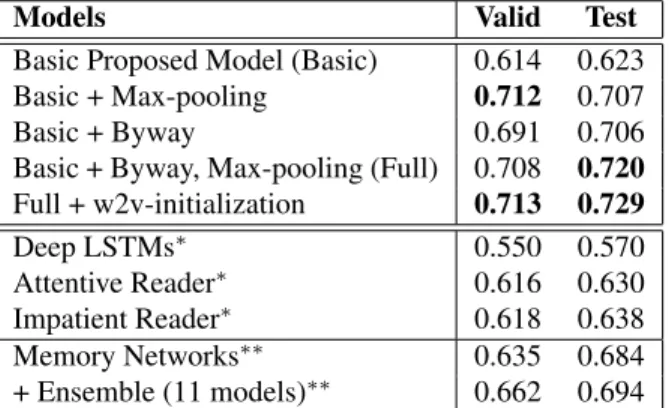
Results As shown in Table 1, Max-pooling de- scribed in Section 2.2 drastically improves perfor- mance, showing the effect of accumulating informa- tion on entities. Another technique, called “Byway”, is based on the observation that the attention mech- anism (5) must always promote some entity occur- rences (since all weights sum to 1), which could be difficult if the entity does not answer the query. To counter this, we make an artificial occurrence for each entity with no contexts, which serves as a by- way to attend when no other occurrences can be rea- sonably related to the query. This simple trick shows
5
http://chainer.org/
6
The implementation is available at https://github.
com/soskek/der-network.
7
Text in CNN-QA are tokenized without any sentence seg- mentations.
8
Training process takes roughly a week (3-5 passes of the training data) on a 6-core 2.4GHz Xeon CPU.
9
Vector dimension: 300, Dropout: 0.3, Batch: 50, Optimiza- tion: RMSProp with momentum (Tieleman and Hinton, 2012;
Graves, 2013) (momentum: 0.9, decay: 0.95), Learning rate:
1e-4 divided by 2.0 per epoch, Gradient clipping factor: 10. We initialize word vectors by uniform distribution [-0.05, 0.05], and other matrix parameters by Gaussians of mean 0 and variance 2/(# rows + # columns).
Models Valid Test
Basic Proposed Model (Basic) 0.614 0.623
Basic + Max-pooling 0.712 0.707
Basic + Byway 0.691 0.706
Basic + Byway, Max-pooling (Full) 0.708 0.720 Full + w2v-initialization 0.713 0.729
Deep LSTMs
∗0.550 0.570
Attentive Reader
∗0.616 0.630
Impatient Reader
∗0.618 0.638
Memory Networks
∗∗0.635 0.684
+ Ensemble (11 models)
∗∗0.662 0.694 Table 1: Accuracy on CNN-QA dataset. Results marked by ∗ are cited from Hermann et al. (2015) and ∗∗ from Hill et al. (2015).
( @entity1 ) @entity0 may be @entity2 in the popular @entity4 superhero films , but he recently dealt in some advanced bionic technology himself .!
…!
@entity7 received his robotic arm in the summer , then later had it upgraded to resemble a " @entity26 " arm .!
this past saturday , @entity7 received an even more impressive gift , from " @entity2 " himself .!
…!
the actor showed the child two arms , one from @entity0 's movies and one for @entity7 : a real , working robotic @entity2 arm .!
…!
" [X] " star @entity0 presents a young child with a bionic arm!
e2 e2 / e7!
Max Basic!
.58!
!!!!!
.31!! !
.11!
!!!!
1.00!
!
.75!
!!!!!
.25!! !
.00!
Figure 4: A correct answer found by max-pooling.
Attention to each entity occurrence shown on left.
clear effects, suggesting that the attention mecha- nism plays a key role in our model. Combining these two techniques helps more. Further, we note that initializing our model with pre-trained word vec- tors 10 is helpful, though world knowledge of enti- ties has been prevented by the anonymization pro- cess. This suggests that pre-trained word vectors may still bring extra linguistic knowledge encoded in ordinary words. Finally, we note that our model, full DER Network, shows the best results compared to several previous reader models (Hermann et al., 2015; Hill et al., 2015), endorsing our approach as promising. The 99% confidence intervals of the re- sults of full DER Network and the one initialized by word2vec on the test set were [0.700, 0.740] and [0.708, 0.749], respectively (measured by bootstrap tests).
10