chronic hepatitis B-patients with higher alanine aminotransferase elevation
0
1 2
Analysis of full-length hepatitis B virus genome from chronic hepatitis B-patients with higher alanine aminotransferase elevation
Hiroshi Takahashi1, Tatsuo Kanda*,1 , Naoki Matsumoto1, Toshikatsu Shibata1, Kazushige Nirei1, Akinori Tamura1, Shunichi Matsuoka1, Kazumichi Kuroda1& Mitsuhiko Moriyama1
1Division of Gastroenterology & Hepatology, Department of Medicine, Nihon University School of Medicine, 30–1 Oyaguchi-kamicho, Itabashi-ku, Tokyo 173-8610, Japan
*Author for correspondence: Tel.: +81 3 3972 8111 (Ext. 2424); Fax: +81 3 3956 8496; [email protected]
Background & aim:Higher elevation of alanine aminotransferase (ALT) occasionally leads to severe out- comes in hepatitis B virus (HBV)-infected patients. Our aim is to investigate the HBV sequence mutations associated with higher ALT elevation.Materials & methods:We analyzed full-length HBV sequences from patients with or without higher ALT elevation.Results:Nucleotide mutations in precore and core regions, which are associated with severe hepatitis B, were found in two HBV-infected patients with higher ALT elevation. Amino acid mutations within the pre-S1, pre-S2 and S regions were also found in a patient with HBV virologic breakthrough during the use of nucleoside analogs.Conclusion:It may be useful for HBV-infected patients with higher ALT elevation to analyze full-length HBV genome.
First draft submitted: 22 April 2020; Accepted for publication: 15 June 2020; Published online:
2 July 2020
Keywords: acute exacerbation•ALT•full-length HBV sequence•HBV•HCC•reactivation•virologic breakthrough Hepatitis B virus (HBV) infection causes acute hepatitis, chronic hepatitis, cirrhosis and hepatocellular carcinoma (HCC)[1,2]. Among chronic hepatitis B patients treated with or without nucleos(t)ide analogs (NUCs), elevation of both serum alanine aminotransferase (ALT) and HBV DNA levels occasionally occurs with or without triggers such as the use of immunosuppressants or anti-cancer drugs[2–5]. These conditions were called acute exacerbation of HBV, HBV reactivation and virologic breakthrough.
In the Asian Pacific Association for the Study of the Liver (APASL) HBV guidelines [2], they define acute exacerbation as the condition of patients with intermittent elevations of aminotransferase to more than five-times the upper limit of normal and more than twice the baseline value. They also define the reactivation of HBV as the reappearance of active necroinflammatory diseases of the liver in a patient who has an inactive chronic HBV infection state or resolved HBV infection[2].
In the American Association for the Study of Liver Diseases (AASLD) HBV guidelines[3], HBV reactivation is defined as loss of HBV immune control in HBV surface antigen (HBsAg)-positive, anti-HBV core antibody (anti-HBc)-positive or HBsAg-negative, anti-HBc-positive patients receiving immunosuppressive therapy for a concomitant medical condition; a rise in HBV DNA compared with baseline (or an absolute HBV DNA level when a baseline is unavailable); and reverse seroconversion (seroreversion) from HBsAg-negative to HBsAg-positive for HBsAg-negative, anti-HBc–positive patients. They also define the virologic breakthrough as a>1 log10 (tenfold) increase in serum HBV DNA levels from nadir during treatment in a patient who had an initial virologic response and who is adherent[3].
HBV reactivation is one of multiple life-threatening conditions during chronic HBV infection[6], and NUCs are effective for these conditions[7]. Immunosuppressants such as corticosteroids and anticancer drugs occasionally induce HBV reactivation [4,5], but HBV reactivation is often observed in patients without inducing factors [8]. Chronic hepatitis B patients receiving NUCs and achieving virologic suppression occasionally experienced virologic
Table 1. Characteristics of patients at the collection of sera in this study.
Patients Points of serum collection
Age (years) Sex Cirrhosis HCC ALT (IU/l) HBV DNA
(LIU/ml)
HBeAg NUCs
C1 Point 1 35 F – – 22 7.9 + –
C2 Point 1 54 F – – 340 7.1 + ETV
C3 Point 1 48 F – – 81 4.2 – ETV
Case 1 Point 1 43 M – – 350 7.1 – –
Case 2 Point 1 52 M Unknown – 31 4.3 + –
Case 2 Point 2 58 M + + 35 5.2 – LAM
Case 2 Point 3 69 M + + 1232 6.7 – ETV
+/–: With/without; ALT: Alanine aminotransaminase; C: Control; ETV: Entecavir (0.5 mg daily); F: Female; HBeAg: HBV e antigen; HBV: Hepatitis B virus; HCC: Hepatocellular carcinoma;
LAM: Lamivudine (100 mg daily); LIU/ml: Log International Unit (IU)/ml; M: Male; NUC: Nucleos(t)ide analog.
breakthrough and higher ALT elevation, which are usually associated with NUC-resistance mutations of the HBV polymerase region[9].
It is possible that HBV reactivation may be associated with other host and virologic factors. In the present study, we analyzed full-length HBV sequences from HBV-infected patients with higher ALT elevation, who were treated with or without NUCs. Our aim is to examine the nucleotide and amino acid mutations that have responsibility for higher ALT elevation in HBV-infected patients. The present study will provide invaluable information on the mechanism of HBV reactivation.
Materials & methods
Definition of HBV reactivation & virologic breakthrough
In patients chronically infected with HBV, acute exacerbation is defined as intermittent elevations of aminotrans- ferase to more than five-times the upper limit of normal and more than twice the baseline value[2]. HBV reactivation is defined as the reappearance of active necroinflammatory disease of the liver in a patient known to have an inactive chronic HBV infection state or resolved HBV infection[2]. Virologic breakthrough is defined as an increase in serum HBV DNA>1 log IU/ml from the nadir of the initial response during therapy, as confirmed 1 month later in HBV-infected patients who are treated with NUCs[2].
Patients
A total of five patients infected with HBV genotype C (GT-C) were analyzed. Three patients (C1, C2 and C3) chronically infected with HBV were used as controls (Table 1). Case 1 experienced acute exacerbation in the course of his chronic active hepatitis B before the use of NUCs. Case 2 had experienced virologic breakthrough after the use of NUCs. This patient was serially analyzed (Table 1). All five patients were positive for HBV DNA at the points of examination and negative for anti-HCV or anti-HIV.
This study was approved by the ethics committee of Nihon University School of Medicine Itabashi Hospital (No. RK-180911-13). For participation in the study, written informed consent was obtained from all patients. This study protocol conformed to the ethical guidelines of the Declaration of Helsinki (1964).
Serological markers
All biochemical tests were performed in the clinical laboratories of Nihon University School of Medicine Itabashi Hospital with routine automated techniques. HBsAg, HBV e antigen (HBeAg) and anti-HBV e antigen antibody (anti-HBe) were determined by chemiluminescent enzyme immunoassay (CLEIA) (Lumipulse Presto, Fujirebio, Tokyo, Japan), electrochemiluminescence immunoassay (ECLIA) (Roche Diagnostics, Tokyo, Japan) and ECLIA (Roche Diagnostics), respectively. Serum HBV DNA levels were determined with TaqMan PCR (Roche Diagnos- tics). HBV GTs were determined by enzyme-linked immunosorbent assay (ELISA)-based assay[10].
Extraction of serum DNA & amplification of HBV DNA by polymerase chain reaction
Sera collected from all patients were stored at –80◦C until analysis. DNA was extracted from 200µl sera with the Qiagen DNA Blood Mini Kit (Qiagen, Hilden, Germany). These DNA templates were amplified by long range single step PCR using Taq polymerase (KOD FX NEO, Toyobo Life Science, Osaka, Japan) under the following
01 2 34 56 7
Time course (years)
HBV DNA (LIU/ml)
1 2
0 3 4 5 6
98
010 2030 4050 6070 100 8090
ALT (IU/l)
0 1 2 3 4 5 6
Time course (years)
HBV DNA (LIU/ml) ALT (IU/l)
1 2
0 3 4 5
8 7
010 20 3040 50 60 90 70 80
6 ETV 0.5 mg daily
0 1 2 3 5 6 7
Time course (years)
HBV DNA (LIU/ml) ALT (IU/l)
1 2
0 3
8
4
0 50 100 150 200 400 350 250 300 ETV 0.5 mg daily
01 23 45 67
Time course (years)
HBV DNA (LIU/ml) ALT (IU/l)
1 2
0 3 4 5 7
98
0 50 100 250
150 200
6 ETV 0.5 mg daily
0 1 2 4 6 7
Time course (years)
HBV DNA (LIU/ml) ALT (IU/l)
5 9
0 12
8
5 3
0 200 400 600 800 1000 1400 1200
1 2 3 4 6 7 8 10 11 13 14 1516 17 ETV 0.5 mg daily LAM 100 mg daily
Point 1
Point 2
Point 3 TDF 300 mg daily
Figure 1. Clinical course of three control patients and two patients with hepatitis B virus reactivation or virologic breakthrough. (A), C1;
(B), C2;(C), C3;(D), case 1, patient with HBV reactivation; and(E), case 2, patient with virologic breakthrough during the use of LAM or ETV. Dotted line: ALT; solid line: HBV DNA; LIU/ml; IU/ml; TDF. The arrow indicates the points of collection of sera.
ALT: Alanine aminotransaminase; C1: Control 1; C2: Control 2; C3: Control 3; ETV: Entecavir; HBV: Hepatitis B virus; IU/ml: International unit/ml; LAM: Lamivudinel; LIU/ml: Log international unit/ml; TDF: Tenofovir disoproxil fumarate.
conditions: activation at 94◦C for 2 min, 45 cycles with denaturation at 98◦C for 10 s, annealing at 50◦C for 10 s and extension at 68◦C for 120 s in a DNA thermal cycler (GeneAtlas 322/324, Astec, Fukuoka, Japan).
The primers used for PCR were 5′-GGTTTTTCACCTCTGCCTARTCATCTCWTGTWCATGT-3′(HBV- full P1C: sense, nt 1821-1855) and 5′-GGAAAAAGTTGCATGGTGCTGGTGMRCAGACCAATTT-3′(HBV- full-P2C: antisense, nt 1826-1791)[11]. These two sets of amplification primers were made at the position of the HBV X region based on the sequences of HBV GT-C (AB014376)[12]. HBV DNA amplified by PCR resulted in an∼3,200 bp fragment, which contained the full-length HBV genome[13]. The PCR products were separated on 1.0% agarose gels and visualized with ethidium bromide and ultraviolet light.
Direct sequencing of PCR products by Sanger methods
After the PCR products were purified with the QIA-quick Spin Kit (Qiagen), PCR products (60–150 ng for each reaction) were directly sequenced to determine their nucleotide sequences using the BigDye Terminator v3.1 Cycle Sequencing Kit (Thermo Fisher Scientific, Tokyo, Japan) and the ABI 3730xl DNA Genetic Analyzer (Thermo Fisher Scientific), according to the manufacturer’s instructions. Primers for sequencing have been previously described [14]. All nucleotide sequences from this study have been deposited in the DNA Data Bank of Japan (DDBJ) under accession numbers LC516604 – LC516610. Nucleotide and amino acid sequences were analyzed with GENETYX 10 (GENETYX Corp., Tokyo, Japan).
Statistical analysis
Statistical analysis was conducted using theχ2 test with or without Yates correction and Student’s t-test where appropriate.
Results
Patient characteristics
Table 1demonstrates the characteristics of the patients in the present study. Among control patients, C1 did not take any NUCs until analysis, and C2 and C3 had entecavir when they were analyzed (Figure 1A-1C). We diagnosed C1 as a HBeAg-positive asymptomatic carrier and NUC treatment-naive patient, and her sera were collected at 1 year after starting follow-up. We also diagnosed C2 and C3 as HBeAg-positive and negative chronic hepatitis,
respectively, and their sera were collected at 1.5 years after starting entecavir. At the collection of sera, ALT levels were 22, 340 and 81 IU/l and HBV DNA were 7.1, 4.2 and 7.1 LIU/ml, in patients C1, C2 and C3, respectively (Table 1). C1 was NUC treatment-naive although C2 and C3 were treated by entecavir at the collection of their sera. These three control patients have not experienced higher ALT elevation after sera was collected.
Case 1 is an NUC treatment-naive patient who experienced naturally occurring acute exacerbation (Figure 1D).
Case 2 experienced virologic breakthrough at points 2 or 3 during the course of disease after the use of lamivudine or entecavir, respectively, following lamivudine treatment. Case 2 had HCC at points 2 and 3 (Figure 1E).
Nucleotide sequence & deduced amino acid residue of full-length HBV
We amplified the full-length HBV genome in all samples in the present study. By using full-length PCR-based direct sequencing, we determined the sequence of the HBV genomes in seven serum samples (Supplementary Table 1). We also deduced full-length HBV amino acid sequences (Supplementary Table 2).
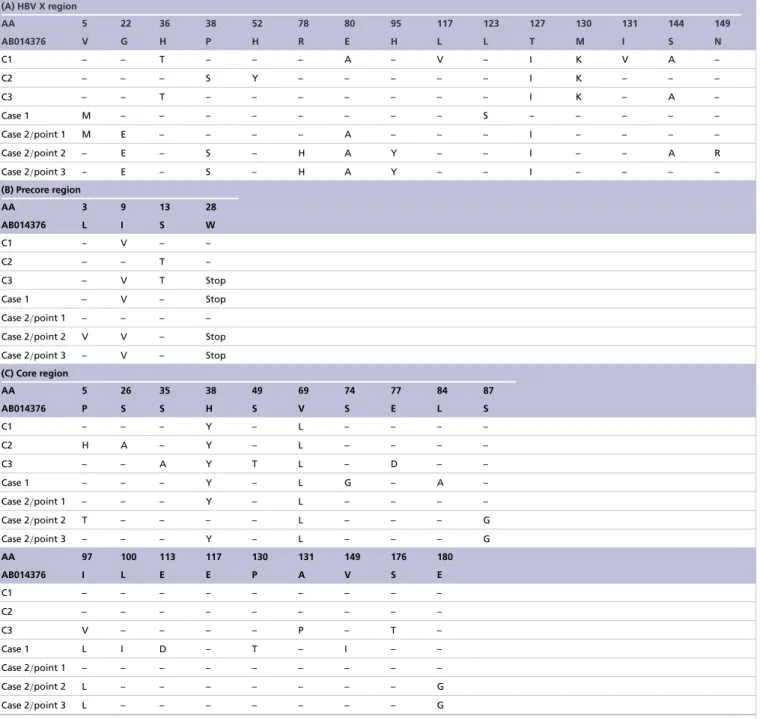
Although basal core promoter (BCP) mutations also lead to mutations at HBx protein codons 130/131[15,16], double mutations (130M/131I) of HBx were found in cases 1 and 2 (Table 2A). Although 131I was found in four patients, 130M was found in cases 1 and 2. Of note, 130M was observed at points 1, 2 and 3 in case 2. Among HBx region, 123S and 22E were found in cases 1 and 2, respectively.
Precore stop codon were observed in all HBeAg-negative patients in the present study (Table 2B). Of interest, precore stop codons were observed at the acute exacerbation in patients with or without NUCs (Table 2B). In the core region, amino acid mutations (35A, 49T, 77D, 97V, 131P and 176T) were observed in patient C3. In case 1, amino acid mutations of the core region (74G, 84A, 97L, 100I, 113D, 130T and 149I) were distinct from those of others (Table 2C). In case 2 (at points 2 and 3), 87G and 180G were observed. In both cases 1 and 2 (at points 2 and 3), 97L was found in the core region. Thus, HBV sequence mutations associated with severe hepatitis B[16–18]were observed in patients with higher ALT elevation in the present study.
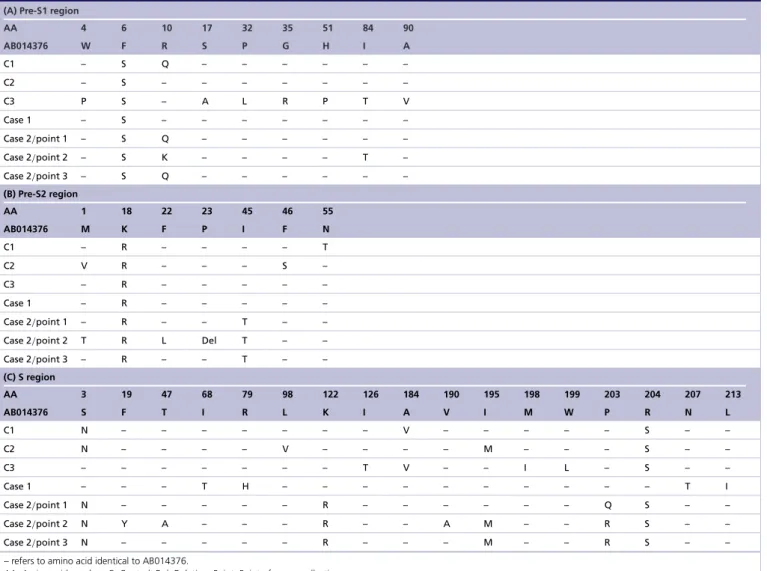
In patient C3, amino acid mutations of the pre-S1 (4P, 17A, 32L, 35R, 51P and 90V) and S (126T, 198I and 199L) were observed (Table 3). In case 2 (at point 2), amino acid mutations of the pre-S1 (10K), pre-S2 (1T, 22L, 23Del, and 45T) and S (19Y, 47A, 122R, 190A and 203R) were distinct from those of the other subjects (Table 3).
NUC resistance mutations of the HBV polymerase region
Amino acid mutations of HBV polymerase region were shown inTable 4. Lamivudine resistance mutations (L180M and M204V) were observed in patient C2 and at points 2 and 3 in case 2, although we did not confirm whether patient C2 had previously taken lamivudine (Table 4D). Entecavir resistance mutations (L180M, M204V, T184I and S202G) were also seen at point three in case 2 (Table 4D), suggesting that these mutations contributed to HBV virologic breakthrough. We successfully treated this case by the introduction of tenofovir disoproxil fumarate.
Patient C2 did not take any NUCs or experience HBV virologic breakthrough. In general, NUC-associated resistance mutations resulted in HBV virologic breakthrough.
Discussion
In the present study, we analyzed full-length HBV sequences from chronic HBV infected patients (one was naturally occurring acute HBV exacerbation (Table 1,Figure 1D) and the other was HBV virologic breakthrough (Table 1,Figure 1E), and compared them with those of the controls and characterized them. The prognosis of acute exacerbation of HBV infection to acute liver failure (ALF) demonstrated a poor prognosis[19]. We found nucleotide mutations in precore and core regions, which are associated with severe hepatitis B, in two patients with chronic HBV infection and higher ALT elevation with or without NUCs. Amino acid mutations within the pre-S1, pre-S2 and S regions were also found in a patient with HBV virologic breakthrough.
Both the patient with acute exacerbation and the patient with HBV virologic breakthrough during the treatment of NUCs were negative for HBeAg at the higher elevation of ALT. In general, HBV reactivation is observed in both HBeAg-positive and HBeAg-negative patients. HBeAg-positive status is usually observed in patients with an immune-tolerant phase or immune-reactive phase during the natural history of chronic HBV infection[2]. In general, HBeAg-positivity indicates higher HBV replication status and higher HBV DNA levels in sera[2]. As ALF occasionally occurs in persons who are negative for HBeAg[17], careful attention should also be paid to the HBeAg-negative patients with ALT elevation.
For nucleotide mutation of the HBV genome, double point mutations in the BCP, from A to T at nt 1762 and from G to A at nt 1764, were found in cases 1 and 2, although a single mutation was observed in three controls.
Table 2. Amino acid changes of hepatitis B virus X, precore and core regions in the present study.
(A) HBV X region
AA 5 22 36 38 52 78 80 95 117 123 127 130 131 144 149
AB014376 V G H P H R E H L L T M I S N
C1 – – T – – – A – V – I K V A –
C2 – – – S Y – – – – – I K – – –
C3 – – T – – – – – – – I K – A –
Case 1 M – – – – – – – – S – – – – –
Case 2/point 1 M E – – – – A – – – I – – – –
Case 2/point 2 – E – S – H A Y – – I – – A R
Case 2/point 3 – E – S – H A Y – – I – – – –
(B) Precore region
AA 3 9 13 28
AB014376 L I S W
C1 – V – –
C2 – – T –
C3 – V T Stop
Case 1 – V – Stop
Case 2/point 1 – – – –
Case 2/point 2 V V – Stop
Case 2/point 3 – V – Stop
(C) Core region
AA 5 26 35 38 49 69 74 77 84 87
AB014376 P S S H S V S E L S
C1 – – – Y – L – – – –
C2 H A – Y – L – – – –
C3 – – A Y T L – D – –
Case 1 – – – Y – L G – A –
Case 2/point 1 – – – Y – L – – – –
Case 2/point 2 T – – – – L – – – G
Case 2/point 3 – – – Y – L – – – G
AA 97 100 113 117 130 131 149 176 180
AB014376 I L E E P A V S E
C1 – – – – – – – – –
C2 – – – – – – – – –
C3 V – – – – P – T –
Case 1 L I D – T – I – –
Case 2/point 1 – – – – – – – – –
Case 2/point 2 L – – – – – – – G
Case 2/point 3 L – – – – – – – G
– refers to amino acid identical to AB014376.
AA: Amino acid number; C: Control; HBV: Hepatitis B virus; Point: Point of serum collection; Stop: Stop codon.
These mutations are occasionally observed in HBV strains from patients with fulminant hepatitis B in Japan[20], although BCP mutations at positions 1762 and 1764 are rarely observed in those in USA[21]. These mutations in BCP affect the transcription of the HBeAg coding region[16]. Takahashiet al.observed that the most common mutations observed in their 40 HBV isolates from HCC patients in Japan were double point mutations in the BCP (frequency was∼90%)[12]. HCC occurred during the course of case 2, but HCC did not occur in case 1.
A point mutation from G to A at nucleotide 1896 in the precore region, which introduces a precore stop codon and prevents HBV from producing HBeAg, was observed in both cases 1 and 2 (at points 2 and 3). Of note, the patient with acute exacerbation and the patient with HBV virologic breakthrough during the treatment of NUCs have severe hepatitis-associated nucleotide mutations in their HBV genomes. Takahashiet al.observed this mutation from G to A at nucleotide 1896 in the precore region in 45% of their 40 HBV isolates from HCC
Table 3. Amino acid changes in the pre-S1, pre-S2 and S regions in the present study.
(A) Pre-S1 region
AA 4 6 10 17 32 35 51 84 90
AB014376 W F R S P G H I A
C1 – S Q – – – – – –
C2 – S – – – – – – –
C3 P S – A L R P T V
Case 1 – S – – – – – – –
Case 2/point 1 – S Q – – – – – –
Case 2/point 2 – S K – – – – T –
Case 2/point 3 – S Q – – – – – –
(B) Pre-S2 region
AA 1 18 22 23 45 46 55
AB014376 M K F P I F N
C1 – R – – – – T
C2 V R – – – S –
C3 – R – – – – –
Case 1 – R – – – – –
Case 2/point 1 – R – – T – –
Case 2/point 2 T R L Del T – –
Case 2/point 3 – R – – T – –
(C) S region
AA 3 19 47 68 79 98 122 126 184 190 195 198 199 203 204 207 213
AB014376 S F T I R L K I A V I M W P R N L
C1 N – – – – – – – V – – – – – S – –
C2 N – – – – V – – – – M – – – S – –
C3 – – – – – – – T V – – I L – S – –
Case 1 – – – T H – – – – – – – – – – T I
Case 2/point 1 N – – – – – R – – – – – – Q S – –
Case 2/point 2 N Y A – – – R – – A M – – R S – –
Case 2/point 3 N – – – – – R – – – M – – R S – –
– refers to amino acid identical to AB014376.
AA: Amino acid number; C: Control; Del: Deletion; Point: Point of serum collection.
patients in Japan[12]. This mutation, as well as the BCP and HBx mutations, may play an important role in the disease progression of severe hepatitis B[22].
Ehataet al.found that clustering substitutions (codon 48–60 from the start of the core gene) in 7 of 8 HBV subtype adw (mainly GT-C)-infected patients with fulminant and severe exacerbation in Japan[18]. We found the several substitutions in different parts of core region in cases 1 and 2 (Table 2C). HBV core antigen could be one of the immunological targets of cytotoxic T cells[23–25].
HBV S gene overlaps polymerase gene. Therefore, S gene mutations could be introduced by the administration of NUCs[26]. NUCs could also help the introduction of HBV vaccine escape mutations[27]. We also observed amino acid mutations of the pre-S1, pre-S2 and S regions of patients with virologic breakthrough during the treatment of NUCs. Of interest, in case 2 (at point 2), amino acid mutations within the pre-S2 and S regions as well as the spacer domain of the polymerase region were found (Table 3). Suekiet al.also reported the presence of amino acid substitutions in HBV pre-S1 and pre-S2, may be related to the emergence of lamivudine resistance during chronic HBV infection[28]. In HBeAg-negative and HBV GT-D carriers, pre-S/S heterogeneity increases with severity of liver disease[29]. Next generation sequencing-based platform may provide an improvement of the clinical application of pre-S mutants in serving as predictive and prognostic markers for HBV-related HCC[30]. HBV pre-S/S variants may be associated with the development of progressive liver damage, hepatocarcinogenesis and the NUC-resistance.
Recently, NUC-resistance mutations of HBV polymerase region may exist in NUC-naive patients[31–34]. In the case of ALF patients who have consciousness disturbance, it is too difficult for us to take information of their
Table 4. Amino acid changes in the hepatitis B virus polymerase region in the present study.
(A) Terminal protein domain
AA 40 45 46 81 90
AB014376 D N L N N
C1 – – – H –
C2 – – – – –
C3 E – – H –
Case 1 – – P – D
Case 2/point 1 – – – – D
Case 2/point 2 – D – – –
Case 2/point 3 – D – – –
(B) RNase H domain
AA 2 23 89 93 107 113 117 136 138 149 151
AB014376 S R Y A I H Q L D A K
C1 A Q – – L – R – – – R
C2 – – – – L R R – – – R
C3 – – – – L R R – – – R
Case 1 – – – – L – – – G – –
Case 2/point 1 – Q – K L – R P – – R
Case 2/point 2 – Q – K L – R P – T R
Case 2/point 3 – Q S K L – R P – T R
(C) Spacer domain
AA 1 7 12 13 14 15 16 30 31 32 49 66 71
AB014376 L R E S F C S C V R L P S
C1 – – – – – – – – – – – – –
C2 – – – – – – – – F – – – P
C3 S – K – C – – – – Q M – –
Case 1 – – – – – G – G – – – – –
Case 2/point 1 – – – – – – – – – – – – –
Case 2/point 2 – K – P – – A G – – – – –
Case 2/point 3 – – – – – – – G – – – T –
AA 78 83 87 89 100 110 117 123 131 138 157 160
AB014376 G D S A K K H N S F T V
C1 – – – T – – – – – – – –
C2 – N – T – – R – – – – I
C3 – – – T – – – – P L – –
Case 1 S – G S – – – – – – – –
Case 2/point 1 – – – – E – – H – – A –
Case 2/point 2 – – C – E – – H – Del A –
Case 2/point 3 – – – – E E – H – – A –
(D) Reverse transcriptase domain
AA 8 55 75 106 109 122 123 124 180 184
AB014376 E H S S P I N Y L T
C1 D – – – – L H – – –
C2 – – – C – – – – M –
C3 – – T – – – – N – –
Case 1 – – – – S – – – – –
Case 2/point 1 – – – – – – – H – –
Case 2/point 2 – R – – – – – H M –
Case 2/point 3 – – – – – – – H M I
– refers to amino acid identical to AB014376.
AA: Amino acid number; C: Control; Del: Deletion; Point: Point of serum collection.
Table 4. Amino acid changes in the hepatitis B virus polymerase region in the present study (cont.).
AA 202 204 207 215 221 238 266 267 271
AB014376 S M V Q F N V H Q
C1 – – – – – – – – –
C2 G V – – – – I – –
C3 – – I – – – – – –
Case 1 – – – H Y – – S –
Case 2/point 1 – – – – – – – – R
Case 2/point 2 – V – – – – – – –
Case 2/point 3 G V – – – H – – –
– refers to amino acid identical to AB014376.
AA: Amino acid number; C: Control; Del: Deletion; Point: Point of serum collection.
previous use of NUCs. In these situations, attention should be paid to the existence of NUC-resistance mutations of the HBV polymerase region, providing useful information for their treatment. As virologic breakthroughs are also dependent on adherence to NUCs, attention should be paid to the adherence to medication[35].
Sequencing of reverse transcriptase (RT) domain may be enough to know the details of drug-resistance mutations.
However, the cost of RT domain and that of full-length HBV genome by Sanger’s direct sequencing methods are 800 JPY (∼7.00 USD) and 2000 JPY (∼18.5 USD), respectively. Therefore, full-length HBV genome analysis may be better if HBV-infected patient with higher ALT elevation, wants to have these tests.
The rate of HBV evolution in HBeAg-positive subjects has been estimated to be 1.4× 10⁻⁵ ∼3.2×10⁻⁵ nucleotide substitutions/site/year[36]. In HBeAg-negative subjects including asymptomatic carriers, the calculated mean number of nucleotide substitutions/site/year was∼7.9×10⁻⁵, and nucleotide hypervariability was observed in the polymerase and pre-S/S overlap region and core region[37]. We did not examine the sequence changes from the baseline where there was no ALT elevation in patient C1 with no use of NUCs, according to patient’s will.
However, Fujiwaraet al.demonstrated that 10 HBeAg-positive asymptomatic carriers did not show any amino acid substitutions in the precure and core regions[38]. Zhanget al.also demonstrated that HBeAg-positive asymptomatic carriers had less amino acid substitutions in full genome than those of HBV-infected patients with chronic liver diseases[39].
Conclusion & future perspective
We compared full-length HBV sequences from patients with acute exacerbation and virologic breakthrough. Of interest, at the ALT elevation, NUC-resistance mutations of the HBV polymerase region were observed only in the patient with virologic breakthrough during the use of NUCs. We found nucleotide mutations in precore and core regions, which are associated with severe hepatitis B, in two HBV-infected patients with higher ALT elevation.
Amino acid mutations within the pre-S1, pre-S2 and S regions were also found in a patient with HBV virologic breakthrough. Number of subjects was too small to generalize the result. But it is the beginning of our project.
These limitations could be addressed in future prospective study. Our work could shed light again on full-length HBV genome analysis and treatment strategy of HBV infection. Next-generation sequencing approach could also provide a new information in this area.
Supplementary data
To view the supplementary data that accompany this paper please visit the journal website at: www.futuremedicine.com/doi/sup pl/10.2217/fvl-2020-0104
Author contributions
H Takahashi, T Kanda, K Kuroda and M Moriyama contributed to the study conception and design, data acquisition, data analysis and interpretation. H Takahashi, T Kanda, T Shibata and A Tamura performed the experiments. H Takahashi, T Kanda, N Matsumoto, K Nirei, S Matsuoka and M Moriyama saw the patients. H Takahashi and T Kanda drafted the manuscript. All authors contributed to making critical revisions and contributed to thefinal approval of the version of the article to be published.
Financial & competing interests disclosure
T Kanda and M Moriyama perform joint research with Towa Pharmaceutical Co., Ltd., Kyoto, Japan. The funders had no role in the designing the study in the collecting, analyzing or interpreting the data; in writing of the manuscript, or in deciding to publish the results. The authors have no other relevant affiliations orfinancial involvement with any organization or entity with afinancial interest in orfinancial conflict with the subject matter or materials discussed in the manuscript apart from those disclosed.
No writing assistance was utilized in the production of this manuscript.
Ethical conduct of research
This study was approved by the ethics committee of Nihon University School of Medicine Itabashi Hospital (No. RK-180911-13). For participation in the study, written informed consent was obtained from all patients. This study protocol conformed to the ethical guidelines of the Declaration of Helsinki (1964).
Open access
This work is licensed under the Attribution-NonCommercial-NoDerivatives 4.0 Unported License. To view a copy of this license, visit http://creativecommons.org/licenses/by-nc-nd/4.0/
Summary points
• Higher alanine aminotransferase (ALT) elevation is associated with critical condition in hepatitis B virus (HBV)-infected patients.
• These conditions include acute exacerbation, reactivation and virologic breakthrough.
• Nucleotide mutations in precore and core regions, which are associated with severe hepatitis B, were observed in two patients with chronic HBV infection and higher ALT elevation.
• Amino acid mutations within the pre-S1, pre-S2 and S regions were also found in a patient with HBV virologic breakthrough.
• Clinicians should pay a careful attention to HBV mutations in daily clinical practice.
• It should be useful for HBV-infected patients with higher ALT elevation to analysis full-length HBV genome.
References
Papers of special note have been highlighted as:•of interest
1. Yokosuka O, Kurosaki M, Imazeki Fet al.Management of hepatitis B: Consensus of the Japan Society of Hepatology 2009.Hepatol. Res.
41(1), 1–21 (2011).
2. Sarin SK, Kumar M, Lau GKet al.Asian-Pacific clinical practice guidelines on the management of hepatitis B: a 2015 update.Hepatol.
Int.10(1), 1–98 (2016).
• Demonstrates the Asian Pacific Association for the Study of the Liver (APASL) Guidelines for hepatitis B virus (HBV) infection.
3. Terrault NA, Lok ASF, McMahon BJet al.Update on prevention, diagnosis, and treatment of chronic hepatitis B: AASLD 2018 hepatitis B guidance.Hepatology67(4), 1560–1599 (2018).
• Demonstrates the AASLD Guidelines for the treatment of chronic hepatitis B.
4. Takahashi H, Ikeda M, Kumada Tet al.Multicenter cooperative case survey of hepatitis B virus reactivation by chemotherapeutic agents.
Hepatol. Res.45(12), 1220–1227 (2015).
5. Fujita M, Sugiyama M, Sato Yet al.Hepatitis B virus reactivation in patients with rheumatoid arthritis: analysis of the National Database of Japan.J. Viral Hepat.25(11), 1312–1320 (2018).
6. Oketani M, Ido A, Nakayama Net al.Etiology and prognosis of fulminant hepatitis and late-onset hepatic failure in Japan: summary of the annual nationwide survey between 2004 and 2009.Hepatol. Res.43(2), 97–105 (2013).
7. Harigai M, Mochida S, Mimura T, Koike T, Miyasaka N. A proposal for management of rheumatic disease patients with hepatitis B virus infection receiving immunosuppressive therapy.Mod. Rheumatol.24(1), 1–7 (2014).
8. Mori N, Suzuki F, Kawamura Yet al.Determinants of the clinical outcome of patients with severe acute exacerbation of chronic hepatitis B virus infection.J. Gastroenterol.47(9), 1022–1029 (2012).
9. Sheppard-Law S, Zablotska-Manos I, Kermeen Met al.Factors associated with HBV virological breakthrough.Antivir. Ther.22(1), 53–60 (2017).
10. Usuda S, Okamoto H, Iwanari Het al.Serological detection of hepatitis B virus genotypes by ELISA with monoclonal antibodies to type-specific epitopes in the preS2-region product.J. Virol. Methods80(1), 97–112 (1999).
11. Ogawa M, Kamimura S, Kanda Tet al.Long-term follow-up of a Japanese patient with hepatitis B virus genotype H and human immunodeficiency virus coinfection.Future Virol.14(10), 633–639 (2019).
12. Takahashi K, Akahane Y, Hino K, Ohta Y, Mishiro S. Hepatitis B virus genomic sequence in the circulation of hepatocellular carcinoma patients: comparative analysis of 40 full-length isolates.Arch. Virol.143(12), 2313–2326 (1998).
13. G¨unther S, Li BC, Miska S, Kr¨uger DH, Meisel H, Will H. A novel method for efficient amplification of whole hepatitis B virus genomes permits rapid functional analysis and reveals deletion mutants in immunosuppressed patients.J. Virol.69(9), 5437–5444 (1995).
14. Zhang KY, Imazeki F, Fukai Ket al.Analysis of the complete hepatitis B virus genome in patients with genotype C chronic hepatitis and hepatocellular carcinoma.Cancer Sci.98(12), 1921–1929 (2007).
15. Kanda T, Yokosuka O, Imazeki Fet al.Hepatitis B virus X protein (HBx)-induced apoptosis in HuH-7 cells: influence of HBV genotype and basal core promoter mutations.Scand. J. Gastroenterol.39(5), 478–485 (2004).
16. Okamoto H, Tsuda F, Akahane Yet al.Hepatitis B virus with mutations in the core promoter for an e antigen-negative phenotype in carriers with antibody to e antigen.J. Virol.68(12), 8102–8110 (1994).
17. Omata M, Ehata T, Yokosuka O, Hosoda K, Ohto M. Mutations in the precore region of hepatitis B virus DNA in patients with fulminant and severe hepatitis.N. Engl. J. Med.324(24), 1699–1704 (1991).
• Describes the association between HBV precure mutation and fulminant hepatitis B.
18. Ehata T, Omata M, Chuang WLet al.Mutations in core nucleotide sequence of hepatitis B virus correlate with fulminant and severe hepatitis.J. Clin. Invest.91(3), 1206–1213 (1993).
19. Kakisaka K, Suzuki Y, Jinnouchi Yet al.Unfavorable prognosis of patients with acute liver injury due to drug-induced liver injury and acute exacerbation of hepatitis B virus infection.Hepatol. Res.49(11), 1286–1293 (2019).
20. Sato S, Suzuki K, Akahane Yet al.Hepatitis B virus strains with mutations in the core promoter in patients with fulminant hepatitis.
Ann. Intern. Med.122(4), 241–248 (1995).
21. Laskus T, Rakela J, Nowicki MJ, Persing DH. Hepatitis B virus core promoter sequence analysis in fulminant and chronic hepatitis B.
Gastroenterology109(5), 1618–1623 (1995).
22. Kaneko M, Uchida T, Moriyama Met al.Probable implication of mutations of the X open reading frame in the onset of fulminant hepatitis B.J. Med. Virol.47(3), 204–208 (1995).
23. Mina T, Amini Bavil Olyaee S, Tacke Fet al.Genomic diversity of hepatitis B virus infection associated with fulminant hepatitis B development.Hepat. Mon.15(6), e29477 (2015).
24. Zhang Y, Wu Y, Deng Met al.CD8(+) T-cell response-associated evolution of hepatitis B virus core protein and disease progress.J.
Virol.92(17), e02120–17 (2018).
25. Khakpoor A, Ni Y, Chen Aet al.Spatiotemporal Differences in Presentation of CD8 T Cell Epitopes During Hepatitis B Virus Infection.J. Virol.93(4), e01457–18 (2019).
26. Shan M, Shen Z, Sun H, Zheng J, Zhang M. The enrichment of HBV immune-escape mutations during nucleoside/nucleotide analogue therapy.Antivir. Ther.22(8), 717–720 (2017).
27. Pal A, Sarker N, Saha Det al.High incidence of lamivudine-resistance-associated vaccine-escape HBV mutants among HIV-coinfected patients on prolonged antiretroviral therapy.Antivir. Ther.20(5), 545–554 (2015).
28. Sueki R, Maekawa S, Miura Met al.Correlation between pretreatment viral sequences and the emergence of lamivudine resistance in hepatitis B virus infection.J. Med. Virol.84(9), 1360–1368 (2012).
29. Cavallone D, Ricco G, Oliveri Fet al.Do the circulating pre-S/S quasispecies influence hepatitis B virus surface antigen levels in the HBeAg negative phase of HBV infection?Aliment. Pharmacol. Ther.51(12), 1406–1416 (2020).
30. Teng CF, Huang HY, Li TCet al.A next-generation sequencing-based platform for quantitative detection of hepatitis B virus pre-S mutants in plasma of hepatocellular carcinoma patients.Sci. Rep.8(1), 14816 (2018).
31. Kobayashi S, Ide T, Sata M. Detection of YMDD motif mutations in some lamivudine-untreated asymptomatic hepatitis B virus carriers.J. Hepatol.34(4), 584–586 (2001).
32. Hayashi K, Katano Y, Ishigami Met al.Prevalence and clinical characterization of patients with acute hepatitis B induced by lamivudine-resistant strains.J. Gastroenterol. Hepatol.25(4), 745–749 (2010).
33. Baxa DM, Thekdi AD, Golembieski Aet al.Evaluation of anti-HBV drug resistant mutations among patients with acute symptomatic hepatitis B in the United States.J. Hepatol.58(2), 212–216 (2013).
34. Fan J, Zhang Y, Xiong Het al.Nucleotide analogue-resistant mutations in hepatitis B viral genomes found in hepatitis B patients.J. Gen.
Virol.96(Pt 3), 663–670 (2015).
35. Kamezaki H, Kanda T, Wu Set al.Emergence of entecavir-resistant mutations in nucleos(t)ide-naive Japanese patients infected with hepatitis B virus: virological breakthrough is also dependent on adherence to medication.Scand. J. Gastroenterol.46(9), 1111–1117 (2011).
36. Okamoto H, Imai M, Kametani M, Nakamura T, Mayumi M. Genomic heterogeneity of hepatitis B virus in a 54-year-old woman who contracted the infection through materno-fetal transmission.Jpn J. Exp. Med.57(4), 231–236 (1987).
37. Osiowy C, Giles E, Tanaka Y, Mizokami M, Minuk GY. Molecular evolution of hepatitis B virus over 25 years.J. Virol.80(21), 10307–10314 (2006).
38. Fujiwara K, Yokosuka O, Ehata Tet al.The two different states of hepatitis B virus DNA in asymptomatic carriers: HBe-antigen-positive versus anti-HBe-positive asymptomatic carriers.Dig. Dis. Sci.43(2), 368–376 (1998).
39. Zhang K, Imazeki F, Fukai Ket al.Analysis of the complete hepatitis B virus genome in patients with genotype C chronic hepatitis in relation to HBeAg and anti-HBe.J. Med. Virol.79(6), 683–693 (2007).
f c 2 g b 1 D 82F 4 1 q
lf b82F g c
o 82F l m lf q g lb l n
u q f c o g b
l uh cq kb
h cq v lf b 2 k
v f c b t 2 t 82F 4 1
g gb g v q t c
d J N RJT UN QWMe
g
b l , f ) l
t c k
l t t c b (
t b82F 4 1 l t ( 9E&U t c
g
t 2 3( 3) 3 b n t (
3J N( b l u ( 3J N) , g
cv 7NVW XN 3 f c
82 b82N b 82L 3 591 b53 91 g c 82F 4 1 DJYUJV 3B g c7NVW XN 5 9C1 t c
4 1 3B
b / a t c A91UX 4 1 2TWWM RVR R ARJPNV
8RTMNV 7N UJV g 4 1 gb 3B 0 a ()
b0/a ( , a ( -/a () , b a c tb82F
H t cDJY XWT UN J N 4 6H NW DW WKW RON CLRNVLN JSJ JXJV
g c3B 3B ( f ( r c3B (
g c
3B A91 Y RLS CXRV R ARJPNV g t c
tb2RP4 N DN URVJ W N RWV %( 3 LTN CNY NVLRVP R DQN UW 6R QN CLRNV RORL DWS W
JXJV g c 4 1 4J J 2JVS WO JXJV
tb75 5DIH ( 75 5DIH 3W X% DWS W JXJV t t c b7NV2JVS r g 12 ( .- 82F 7NVW XN 3 t c
b u c
dBN T e
3( r g g 82N f c3)
r g 82N b3 r g 82N
f cgw 1 D g gc3J N(
o wb n t f c3J N) b
lf b qt f
c
H g b ( &( (9 () Cb))5 3J N( 3J N) c3W N
f c . 7b/ 1b( 9b(( 4b( Db( 09 3J N( b /.7b(/ 7 3J N) cC g X N C( ( bX N C) (Db)) b) 4NTb ,D bC (0Ib .1b())Bb(0 1b) B l 3J N) c
WT UN J N
f (/ b) F 3) 3J N) c f (/ b
) FbD(/ 9bC) )7 3J N) c d4R L RWVe
82F q f f c b
kb82 b b b82F 4 1 l t i
g c7NVWUN RMN 1 WLRJ RWV M 2 8 1 4 l r b
8 1 4 8 1 4A t g lf c82F b
g D D 9 B l c b9 - 9 /bD 6 JTXQJb96 KN J l
v q r g c q 82F 82F 4 1
gb t cq 3W N bC
l g f c 2J JT LW N X WUW N NLW N
3J N( 3J N) t c b NLW N
b82N l r b82N lb g l
c o b ( ) b
b, / b ( ( b ( b, (%) b ( b
b, r g cC WT UN J N t b
WT UN J N l q bC l uh c
C l u q lf b l 3J N)
c3W N C D b k
lf c l u g bX N C) bC
k WT UN J N CXJLN c
d3WVLT RWV O N XN XNL R Ne
82F t g b 82F 4 1 tb 3B g 82F
c NLW N b3W N bX N C( X N C) C l
t g lf i c g b X N C(bX N C)b
C l t bq l
lf c g b b NLW N g )/G k
WX g c b 2 NJS Q W PQ
WT UN J N k b N C(b N C)bC y t
q l p ctkt v l g b tb
q h gmb t gc