International Symposium Future of the Museum : An Anthropological Perspective
著者(英) James Clifford, Atsunori Ito, Reiko Saito, Kenji Yoshida, Isao Hayashi, Taku Iida journal or
publication title
Bulletin of the National Museum of Ethnology
volume 45
number 1
page range 115‑176
year 2020‑08‑31
URL http://doi.org/10.15021/00009580
*National Museum of Ethnology
Key Words: ethnological museum, anthropology, indigenous peoples, source community, collaboration
キーワード:民族学博物館,人類学,先住民,ソース・コミュニティ,協働
International Symposium
“Future of the Museum: An Anthropological Perspective”
国際シンポジウム「ミュージアムの未来―人類学的パースペクティヴ」
Introduction Part I
Keynote Lecture
(Post) Ethnological Museums: People and Things in Motion Part II
Panel Discussion
Report 1 Reconnecting Source Communities with Museum Collections: Perspective and Challenges on the Info-Forum Museum Project
Report 2 Ethnography and Agency: Collaboration with the Ainu People in Museums
Introduction
Isao Hayashi* and Taku Iida*
This is a record of the international symposium “Future of the Museum: An Anthropological Perspective,” with distinguished guest lecturer Professor James Clifford, held on September 28, 2018 at the Knowledge Theater, Grand Front Osaka.
The symposium opened with an address by the Deputy Director-General, Yuji Seki of the National Museum of Ethnology (Minpaku), who spoke about the his- tory of ethnological museums. Ethnology originated in the era of colonialism and
Research Resource
was developed based on Western theories and concepts rooted in one-sided descrip- tions and analyses of other cultures and societies. Such West-centric attitudes and perspectives have been questioned since the 1980s, when criticism was raised at both ethnology as a discipline and the exhibitions at the ethnological museums. In some cases, demands were made by members of source communities for the return of items in the museums. In response to these objections from members of the source communities, the museums have made gradual adjustments through, for example, inviting people from the source communities to help plan and manage the exhibitions. The Info-Forum Museum, a flagship project in progress at Minpaku, is an example of such a collaborative research project, working with members of the source communities the artifacts in the collections originate from to improve the quality of database information, reflecting the results of research for both parties.
Minpaku has been seeking actively to uncover new knowledge based on such col- laborative projects with people from the source communities. To conclude his opening remarks, Seki introduced Clifford as a leading cultural critic and
“post-modern” anthropologist whose work has challenged conventional academic norms and methods. It therefore contributed to postcolonial critiques of West- centric epistemologies.
The symposium consisted of two parts. In the first half, James Clifford gave a keynote lecture with the title “(Post) Ethnological Museums: People and Things in Motion.” He began by describing the history of what is called the “art–artifact sys- tem.” The role it played in maintaining cultural dichotomy during the imperial period, such as in “us/them,” “civilized/primitive,” and “dynamic/static.” Then he explained why this classificatory regime had begun to disintegrate in recent decades, placing emphasis on the present as a moment of both crisis and opportu- nity. Clifford identified an increased mobility and diversity of museum audiences in former imperial centers as a critical factor of this change because of wider connec- tivity and travel links to distant places. Furthermore, resurgent indigenous groups and diasporic communities challenge ethnological museums’ traditional functions of gathering, exhibiting, and interpreting other cultures. In our global society, objects and people constantly move among places. Their travels are never ending.
Drawing on examples from several ethnological museums in Europe and North America, Clifford described the present situation as a volatile historical moment, paving the way for new narratives and altering our relation with ethnological muse- ums and their collections.
In the second half of the symposium, Kenji Yoshida, the Director-General of
Minpaku, facilitated a dialogue between Clifford and Minpaku research staff mem-
bers, represented by two associate professors: Atsunori Ito and Reiko Saito. They
discussed their respective collaborations, through museum activities, with the Hopi
people of North America and the Ainu people of Japan. The points made by
Clifford in his keynote lecture were shown to have been put into practice by the
work of Minpaku as they reconsider and reestablish their role in this age of global- ism and in the turning point of human civilization. Reconsideration of their activities in the context of Clifford’s proclamation was expected to clarify the rele- vance of Minpaku’s role in the globalizing world and in the turning point of human civilization.
Ito, who supervises one of the Info-Forum Museum projects, titled
“Documenting and Sharing Information on Ethnological Materials: Working with Native American Tribes,” put together a team of museums, researchers, and source community members to ensure more comprehensive documentation of museum objects. The project specifically examined about 2,500 items owned by 14 muse- ums and individuals in Japan, the United States, and the United Kingdom, as well as objects stored at Minpaku. For this project, the moments at which the source communities were reconnected with items from the museum collections were all video-recorded. These recordings also included stories and narratives related to cer- tain items. However, in some cases, the communities requested that the museums holding particular objects refrain from showing them or their images at exhibitions or through other means of publication. In advancing the project, Ito reported that it created opportunities for the members of the source community to hand down their memory and experience to the next and future generations and to restore the cul- tural life force of museum collections. It is the source community that proposed a new usage of ethnological museums for mutual understanding between different cultures and societies.
Saito talked about the relationships between the Ainu people and museums.
First, she explained the context of museums in Hokkaido that exhibit the Ainu materials. In the 1970s, many displays of old tools and other items were used to recreate traditional Ainu culture. Since the late 1980s, such exhibitions have been questioned and criticized, not only by the Ainu but also by researchers. In recent years, the Ainu have begun, increasingly, to examine, pass on, and promote their own culture. Saito went on to explain the history of the relationship between the Ainu people and Minpaku. In 1979, when Minpaku opened an exhibit of the Ainu culture with a reconstructed traditional house, cise, the Ainu people began celebrat- ing what is known as the annual ceremony kamuynomi. Additionally, Minpaku has been accepting Ainu artisans as visiting researchers for training and further studies.
When the exhibition on Ainu culture was reopened in 2016, Saito enlisted the help of young Ainu people to work together to plan, design, and supervise the exhibi- tion. It was an opportunity for these young individuals to re-evaluate their Ainu heritage and modern life style and to think about what they want to tell visitors about their culture and themselves. In addition to their relationship with Minpaku, the Ainu are now actively involved in various other exhibitions of their culture.
In the following panel discussion, Yoshida, expanding on Clifford’s definition
of the ethnological museum as a contact zone, described the museum as a forum. It
was regarded as a space to accommodate objects, people, and information and cre- ate new knowledge for future generations through collaboration between the subjects, who are the ethnological researchers, and the objects of their research, which are the peoples, materials, cultures, etc. This collaboration is necessary and indispensable to ensure an active exchange of ideas with the people from source communities. Fortunately, Minpaku is initiating many projects, including Ito’s and Saito’s, under the umbrella of the Info-Forum Museum, whose aims to include col- laborative documentation of museum materials with assistance from members of the source communities. Although we cannot assume that these communities are monolithic, Minpaku should undertake active efforts to overcome such difficulties as the many conflicting opinions and complexities to fulfill the museum’s social role and to empower minorities through cultural matters.
During closing remarks, Professor Hiromu Shimizu, the former president of
the Japanese Society of Cultural Anthropology, sincerely praised Ito’s and Saito’s
efforts on museum collections and exhibitions and their collaborative work with
people from source communities. Their activities, Shimizu said, are also a response
to criticisms of the neo-colonial hegemony and represent a perspective that is
shared with some museums in the United States and Europe which Clifford
described in his keynote lecture.
Part I
Keynote Lecture
(Post) Ethnological Museums: People and Things in Motion
James Clifford*
I will begin by recalling a moment of discovery that I discussed in my book,
Routes. It was when I began to think of museums as “contact zones” (Clifford1997: 188–219).
In 1989, in the basement storage area of the Portland, Oregon, Museum of Art, a group of museum professionals and anthropologists gathered to discuss a remark- able collection of Northwest Coast and Alaskan tribal artifacts. The collection, purchased by the museum, was the work of an amateur collector named Axel Rasmussen who, in the early 20
thcentury, had acquired more than eight hundred objects, including masks, carvings, blankets, rattles, bowls, hats, most of which dated from the late 19
thcentury.
What made the Portland meeting special was an invited delegation of Tlingit tribal members from southern Alaska. The indigenous group included knowledge- able Elders who were able to recall the days when the artifacts were new. They remembered who had made them.
To the museum curators and anthropologists, myself included, this seemed like an invaluable opportunity to complete our knowledge of the objects’ traditional uses and meanings. How had they functioned in ceremonies and in everyday life?
What was their traditional symbolism? What clans did they represent, with what systems of prestige and reciprocity? We wondered, too, what these tribal authorities might wish to say about the technical and aesthetic quality of the artifacts.
To our surprise, the Elders and their younger companions seemed to show only limited interest in the old objects once they had been unwrapped and laid on the table before them. Most of the time during the several days that they spent in the museum basement was devoted to telling stories and singing songs, all with elabo- rate attention to clan ownership and tribal protocols. The performances were accompanied by tears, by joking, and by reminiscing. Claims were made about tribal sovereignty: its loss in the past and renewal in the present, claims which implicated the museum in ongoing relations.
The Tlingit visitors to Portland had their own agenda. What was important for them was not the material objects and their past functions. The objects were aides
memoires (tools for remembering) and provocations for fresh discourse. What mat-*Professor Emeritus, University of California, Santa Cruz
tered was their performativity: the stories, songs, and histories they released.
I describe this moment of encounter because it taught me the limitations of the ethnographic and aesthetic categories we commonly use to understand, to stabilize, and contain, unfamiliar cultural creations. The objects which came to life in the Portland Museum basement were neither cultural artifacts nor works of tribal art.
They were something different, something for which we lacked adequate terms.
Today I will begin by briefly exploring the terms “art” and “artifact,” ways of conceiving creative cultural productions: classifications that are increasingly prob- lematic. For more than a century, they functioned to keep things and people separate in their proper times and places. Then, I will discuss the ways that people and things today are in motion, escaping and subverting the categories that have supported modernizing, Western-centered conceptions of historical reality and possibility.
The distinction between art and artifact, since the early 19
thcentury, has orga- nized practices of collecting and the creation of separate museums of art and of ethnology. However, in recent decades, this classificatory regime has begun to dis- integrate. My emphasis today will be on ethnological museums and their successor institutions, particularly in Europe and North America. These are places where non-Western, especially tribal, “cultural artifacts” have long been stored. As ethno- logical institutions search for new social roles and audiences, alternative narratives, performances, and indeed, futures, are emerging for their collections. I just used the phrase “non-Western.” My perspective today originates from Europe and North America. Important corrections and translations will be necessary to accommodate diverse Asian histories and practices. I hope you can help me with this.
As I discovered in the Portland Museum storage area, the careers, the life-his- tories, of tribal objects in Western places are unfinished. New communities have become interested in the collections scattered all over Europe, the US, and Canada.
This brings important changes. At the Portland Museum, the objects acquired by Axel Rasmussen a century ago now anchor a large exhibition of traditional and contemporary Native American and Canadian works. A full-time indigenous curator has expanded the collection, collaborating actively with tribes in the region.
In a development that is beginning to be seen more widely, newly made art and artifacts are being acquired. The National Museum of Ethnology (Minpaku) has, of course, been a leader in this area: pursuing not merely the conservation, but simul- taneously the transmission and renewal of heritage.
How did the concepts “art” and “artifact” become separated? I will sketch a * brief history, told from the perspective of “Western” institutions.
The British cultural theorist Raymond Williams has traced the emergence of a modern concept of “art” and its relation to social, economic, and cultural change.
The relevant books,
Culture and Society (1958) and Keywords (1976) focus onBritish developments, but the trends they describe are widespread. Williams observes
that, in the 18
thcentury, the primary meaning of the word “art” was simply “skill.”
There was no fundamental difference between an artist and an artisan or craftsper- son. During the 19
thcentury, more specialized definitions of “art” and “artist” would emerge, as Williams puts it, “under the stress of events” (1958: 47).
By the early 1800s, industrialism, with its class and democratic revolutions, had undermined the aristocratic patronage systems which supported artistic and artisanal productivity. A new figure, the autonomous, creative “artist,” was taking shape, associated with romantic rebelliousness and the idea of genius. A special aesthetic sensibility would be embodied in works of art. Art was regarded as a defense against anarchy, vulgarity and materialism, threats associated with mass society and the relentless disruptions of capitalism. The artist, now sharply distinct from the skilled artisan, would become a familiar figure of modernity.
By the end of the 19
thcentury art had been institutionalized in national muse- ums, inheritors of aristocratic or monarchical private collections. A commercialized art market was emerging. I need not trace this familiar story about which much has been written. Today I want to emphasize the growing separation of art from other forms of skilled work, its elevation to a higher, creative, spiritual, or rebellious, sensibility. In Europe, artisanal or utilitarian products would henceforth be under- stood and valued in museums of folklore or national heritage. A capacious, secular category, “artifact,” accommodated objects from baskets and wagon wheels to clothing and weapons.
Similarly to “art,” the word “artifact” was acquiring a more specialized sense.
In the 18
thcentury, it meant anything produced using human skill. In its modern uses it referred to everyday material objects and archaeological relics salvaged from the past. As “art” was acquiring more dynamic, creative and universal conno- tations, “artifact” became more mundane, object-like and inert.
The concept was also reserved for exotic, non-Western things. Over three cen- turies of trade, colonization, and empire, countless objects arrived in Europe, brought by explorers, traders, scientists, and missionaries. These collections of
“treasures,” “curiosities,” “specimens,” or “antiquities,” found initial homes in aris- tocratic or royal “cabinets of curiosity.” In the mid-18
thcentury, the many followers of Linnaeus were amassing private scientific collections, precursors of the next century’s great public museums of natural history, based on evolutionary principles.
Exotic, non-Western objects such as weapons, tools, adornments, and religious par- aphernalia (“idols” or “fetishes”) found their way into ethnological institutions.
These museums, of Volkerkunde, of Ethnography, of the Tropics, of Man, were pre- sided over by the emerging science of anthropology. Their purview was the non- West. The French historian Benoît de L’Estoile has called them simply “musées des autres”: museums of the others (de L’Estoile 2007: 11).
The art–artifact system, with its separate art and ethnology museums, func-
tioned to separate “us” from “them.” 19
thcentury museums of anthropology
understood their role as preserving the remnants of “barbaric,” “primitive,” or
“savage” societies. In the more relativist 20
thcentury, these same objects would be renamed, more neutrally, as “cultural artifacts,” specimens representing a very wide range of social and cultural functions. Until recently, however, they were not regarded as art, at least not art in the advanced, Western sense.
There were exceptions to the denial of “art” status to non-western creations.
Works from the so-called “civilizations” of Asia or of Mediterranean and Levantine
“antiquity” were sometimes included in major art collections. Nevertheless, such treasures were confined to the past, as witnesses to the faded glory of lost civiliza- tions, or at best, precursors of a more advanced Occident.
The “savage” or “tribal” objects housed in ethnological collections shared this assumed lack of a future. They too were going nowhere in history. Colonial col- lecting, over three centuries, proceeded under Euro-centric assumptions of historical inevitability. Small indigenous societies, especially, were destined to dis- appear. Only the West was dynamic.
In fact, many small societies did disappear in the face of imperial conquest and especially the devastating epidemics that accompanied culture contacts. However, others survived, inventively responding to bad situations, preserving what they could from their heritage. It has become clear that cultural transformation should not be equated with cultural death.
During the late 19
thand early 20
thcenturies, tribal societies on several conti- nents were experiencing a time of acute disruption and demographic emergency.
Some of the most extensive collections of tribal material culture were amassed during this period. For many scientific and amateur collectors, if the last remnants of tribal material cultures were to be preserved, the time was now or never.
This “salvage collecting” would be understood as a kind of sacred duty, the preservation of a common patrimony. The acquired artifacts would find their appro- priate final resting places in Western museums. Here they could be valued, understood, and cared for by knowledgeable curators. The collections contributed to a universal human patrimony. In this spirit, Clifford Geertz once defined the fun- damental task of anthropology as creating “the consultable record of what man has said” (Geertz 1973: 30).
In 2018, all of this still sounds familiar, but dated. For indigenous peoples did not disappear. They changed. Furthermore, today they are alive, politically active, and seeking access to the works from their tradition which have been preserved in Western museums. In changing times, the life-course of tribal artifacts is not fin- ished. They have new roles to play as treasures of a recovered heritage and inspirations for contemporary tribal art.
The 20
thcentury has seen occasional challenges to the art–artifact distinction, *
challenges that have accelerated in recent decades. The first and most famous
breach occurred in 1907 when Pablo Picasso visited the Trocadero Ethnographic Museum in Paris, just as he was completing his iconic proto-cubist masterpiece
“Les Demoiselles d’Avignon.” The African masks he encountered at the Trocadero were, he recalled, a shock, and a revelation. “I realized what painting is all about.”
Picasso affixed mask-inspired heads to two of the five figures in his painting. He would henceforth become an avid collector of African carvings, as seen in photo- graphs of his studios, over the years. They were, he said, constant “witnesses” to his developing art (Photo 1).
The recognition of non-western artifacts as art was the work of a generation of avant-garde artists and writers. André Derain, Maurice de Vlaminck and Henri Matisse had begun collecting African objects before Picasso’s epiphany in the eth- nographic museum. By the 1920s, the surrealists’ interest in Native American, Oceanian, and Arctic works was well established (Photo 2). Andre Breton’s apart-
Photo 1 Pablo Picasso in his studio, 1908. Photo by Gelette Burgess.
(Unless otherwise specified, all photos are by the author.)
Photo 2 Tribal “art” that inspired the Surrealists. A Yup’ik mask, from the Berlin Ethnologisches Museum, destined for the new Humboldt Forum.
ment was filled with non-Western artifacts, in promiscuous company with European artworks (Photo 3).
The 1920s vogue for
l’art nègre was an important breach in the ideologicaland institutional walls that kept “primitive” creations separate from “fine art.” But the opening was limited and ethno-centric. European modernism tended to recog- nize its own preconceptions and desires, showing little interest in the complexities of cultural translation or in the existence of divergent aesthetic systems. For many years, the “modernist primitivism” of Picasso and his generation would remain a circumscribed, avant-garde phenomenon.
It was not until the early 1980s that African and Oceanian galleries opened at New York’s Metropolitan Museum of Art, and it would be two more decades before France followed suit. The
Pavilion des Sessions, at the Louvre, relentlesslyformalist, still locates its “masterpieces” firmly in the past. As the former artifacts from ethnological collections gain entry to major museums, it is often on terms dictated by the dominant category: art.
A full deconstruction of the art–artifact distinction requires more than elite recognition or changes in art connoisseurship. It is rooted in profound political and cultural shifts after 1945. I am referring to decolonization, an unevenly developing, unfinished historical process, always accompanied by neo-colonial forms of con- tainment and reaction.
Decolonization, from the national liberation movements of the 1950s to the proliferating indigenous social movements today, is a contradictory process. On every continent today, we encounter both neo-colonial hegemony and post-colonial emergence. Neo-liberal forms of government support, and are subverted by, the volatile politics of identity and heritage. These dialectical forces, in struggle and synergy, are active in contemporary museums of ethnology and art, challenging the taxonomic systems they embody.
The two museums art and ethnology are still with us. However, their difference is less absolute: the coming and going between them is more frequent. It is no lon-
Photo 3 Reconstruction of André Breton’s apartment, in the Paris Musée d’Art Moderne.
ger surprising to find contemporary art on display in ethnography museums, or tribal objects in institutions such as the Louvre.
An illuminating essay in the MINPAKU Anthropology Newsletter by Yukiya Kawaguchi (2013) reveals both the subversion and the persistence of the art–arti- fact distinction. The essay discusses an exhibition of works by the Nigerian artist El Anatsui, who has become prominent in the world of global arts. Resistance to showing such work in an ethnological museum came primarily from the “art” side of the classificatory boundary. Significantly, non-Western creators seeking recogni- tion as “artists” were part of the resistance. While understanding the historical justification for this ambition, Kawaguchi rejects what is increasingly a false choice. He makes a convincing case for crossing the art–artifact borderline, making possible more complex, multilayered contextualizations.
Crucially, works from the non-West can no longer be confined to a vanished past: a condition of non-modernity. As I learned in the Portland Museum basement, the stories carried by these traveling objects are being retold, curated anew, by diverse authorities in new circumstances.
My remaining comments will evoke sites of struggle and creativity in the new * spaces that are opening up between art and artifact, between the West and its “oth- ers.” I’ll report on recent research, visits and conversations I’ve been conducting in European and North American museums, institutions that can be called, with appropriate hesitation, “post-ethnological.”
“Post” does not mean “after,” not a whole new stage or development. Rather it suggests “following from,” evoking something new that we do not yet have a name for. Of course, the changes that are underway reflect particular articulations of local, national, and global power. In places such as Canada, the United States, and also New Zealand, Australia, and Alaska, post-ethnological museums are located where native communities can exert direct pressure. Museums in Europe are more distant, and therefore more insulated. However, in a globally connected world, dis- tance is not what it used to be. More than a few European museums, I’ve discovered to my surprise, are responding to the pressures and possibilities created by indigenous dynamism.
Post-ethnological museums throughout Europe find themselves challenged to do something new with the collections that complex and often violent histories have deposited in their storage areas. Many aspire to transcend colonial pasts, to become post-colonial: a necessary, but ambivalent and perhaps impossible task.
Given material and ideological constraints, well-meaning curators have limited room to maneuver.
Funding is a constant struggle, except in a few prominent, state-supported
cases. Ethnology museums today must justify their existence in ways that prolifer-
ating art museums need not. Neo-liberal accountability, rigid demands for a
quantifiable “return on investment,” threats of reducing curating to marketing, and the search for crowd-pleasing projects: to these structural pressures we can add a widespread climate of hostility to multiculturalism and so-called “political correct- ness.” As renewed forms of nationalism, ethnocentrism, and racism gain ground (and not only on the extreme Right) cultural diversity is under suspicion. Yet what can ethnology museums be about, if not cultural diversity?
I have participated in discussions with museum managers who argue that we have gone too far with cultural differences and should be communicating universal- ist, unifying messages. This might mean returning to museums of humankind, or of national culture. Diversity, yes, but with a clear understanding that underneath we’re all alike. This is the reassuring message the public wants to hear.
Confronting these new arguments for universalism, which often reflect nostal- gic desires for a simpler time of humanistic or national unity, I’ve concluded that post-ethnological museums cannot give up on diversity. However, they must recon- ceive cultural differences radically, abandoning the essentializing strategies of older displays. The cultures of the world, both distant and proximate, can be grasped as historical productions. Diversity, never pre-given, arises from specific relationships and dialogues. It is not a quality of taxonomic otherness but a product of exchange and translation.
Given limited time, I will pursue just one area of translation and exchange: the new relations and forms of knowledge being created in Western museums through engagement with indigenous societies.
Recently, I encountered a surprising sculpture in the Amsterdam * Tropenmuseum, standing on a stairway between exhibit levels: a work by the Dutch artist Roy Villevoye.
A black man wears shorts and a t-shirt. Life-sized and hyper-real, he is gently holding a white baby. The title, “Madonna (Omomá and Céline),” commemorates a visit to Amsterdam from West Papua (New Guinea) and the friendship which devel- oped between Omomá and the artist, whose daughter he cradles in his hands. It is a work designed to provoke questions: about Dutch colonial histories in Papua and their post-colonial aftermath, about inter-cultural contacts today, about immigration and otherness, and about breaking down dichotomies of us and them (Photo 4).
The fact of indigenous dynamism, and pressure, is inescapable in nations such as Canada, Australia, and New Zealand/Aotearoa, where today no museum can represent aboriginal or First Nations arts and cultures without serious collaboration and shared authority. I was surprised to find the new indigenous presence and pres- sure in European museums, where native communities are not next-door. Airplane travel and the internet have changed the map which sustained the “permanence” of their collections.
The Pitt Rivers Museum, at Oxford University, is an iconic 19
th-century
museum. Its founder, General Pitt Rivers, was an influential figure in archaeology and evolutionary anthropology. He organized a vast collection of artifacts in a typological manner designed to show progressive development. The museum has not changed its name or abandoned its idiosyncratic style of display. It has become a kind of historical artifact (Photo 5). The result is not, however, immobility.
Unobtrusive, but significant modifications have been made in the traditional dis- plays (Photo 6). Moreover, a research annex has been added. The staff have encouraged visits, consultations and ritual performances, by Blackfoot Indians from Canada, whose old painted shirts, still of great spiritual power, are preserved there.
Responding to the tribe’s request, conservators recently took a deep breath and loaned two of the very fragile shirts for use in a ceremony. In Oxford, visitors now look differently at the Blackfoot shirts, aware of their past, present and future sig- nificance (Peers and Brown 2015) (Photo 7).
Photo 4 “Madonna.” Sculpture by Roy Villevoye, in the Tropenmuseum, Amsterdam.
Photo 5 Pitt Rivers Museum, Oxford. Photo 6 Pitt Rivers Museum, traditional display, modified with t-shirt.
A few more examples of collaboration: the Cambridge University Museum of Ethnology and Archaeology encourages ongoing contacts with Australian Aboriginal groups: consultations that are becoming increasingly routine. At the Leiden Volkenkunde Museum in the Netherlands, ongoing cooperative relationships are being developed with indigenous East Greenland and Surinam. Furthermore, at the Musée du Quai Branly Jacques Chirac in Paris a Wayana delegation from French Guiana recently spent a month in Paris as part of an ongoing collaboration.
The young and old visitors worked with many heritage artifacts from the museum’s storage. For a conservative institution, this was a significant first step (Photos 8, 9).
Photo 8 Wayana delegation at Quai Branly,
Elders. Photo 9 Wayana at Quai Branly, Young tribal
members.
Photo 7 Pitt Rivers Museum: Blackfoot painted shirts.
Another prominent institution, the Berlin Ethnologische Museum, is embarked
*on an exciting, but also troubling, post-ethnological path (Photo 10).
In 1997, Yup’ik Eskimo Elders and activists arrived at the Museum to spend
several weeks with objects from their tradition collected in the 19
thcentury (Photo
11). Anne Fienup-Riordan, an anthropologist who facilitated the visit along with the Berlin museum’s curator, Peter Bolz, calls the Yup’ik experience, indigenous research at First World institutions, “fieldwork turned on its head.” Published accounts of the visit record encounters and performances similar to those I described in Portland (Fienup-Riordan 2005).
With the new millennium, the Ethnologische Museum received an offer it could not refuse. Its location in a remote suburb had long been a severe liability.
Few made the journey. Now a large portion of its unvisited collection might move to a grandiose new exhibition and research center on the “museum island” at the very center of Berlin.
The Humboldt Forum opens soon on the site of the old Hohenzollern city hall from the 1890s (familiarly called the “schloss”), a large baroque structure destroyed in World War Two. In appearance, the new Forum evokes a return of lost grandeur (Photo 12). Its name recalls the cosmopolitan science of the Humboldt brothers.
Photo 10 Berlin, Ethnologisches Museum.
Photo 11 Berlin, Ethnologisches Museum, storage.
Contrasted to the horrors of the 20
thcentury, the imperial 19
thcentury seems almost innocent. To counteract any suspicions of reactionary nationalism, the new Forum’s guiding theme is “Germany in the world.” The whole project is anchored by the ethnology and Asian collections from the Ethnologische Museum.
The project raises important questions: What kind of cosmopolitanism is being imagined? How is it entangled with contemporary globalization? Will “Germany in the World” be just another way to collect the world’s cultures? A new kind of cen- tering? The Humboldt Forum will, of course, be a major tourist destination. A complex commercial and scientific operation, it is planned to include, also, a research center (a “laboratory”). Research for whom? Can there be real participa- tion from outside Europe, at a time when borders are increasingly policed?
The Ethnologische Museum, a venerable, but marginal, underfunded institu- tion, will be given new life. However, rebirth will come at a cost. Only the “best”
objects are to be moved to the Museum Island. There are plans to renovate the old museum building and storage area as a “research campus.” But there is no funding yet. For now, the objects that do not travel to central Berlin will be mostly sealed in storage, with some pre-selected for potential visits from source communities.
Time will tell how this critical aspect of the post-ethnological museum’s work can be supported. There is certainly no guarantee. The Humboldt Forum, by giving new life and centrality to the Ethnology Museum might amount to its destruction.
In May 2018, I encountered African sculptures that were
en route from theEthnology Museum to the Museum Island. Entering the world of “art,” they were temporarily cohabiting with medieval religious art, an original translation experi- ment, given the more common practice of comparing African forms with European modernism (Photo 13).
In a contradictory development from Berlin: during the past several years, the question of “provenance” for the Humboldt Forum collection, connected necessar- ily to “repatriation,” has emerged in the public debate. Benedicte Savoie, a
Photo 12 Humboldt Forum under construction.
distinguished French scholar caused a stir by resigning from the Forum advisory board to protest its neglect of provenance research. She is now an advisor to the French president, Emmanuel Macron, who has publicly promised the restitution of African collections from French museums. Such discussions would have been unthinkable in Europe, even five years ago.
October 2017 in Vienna, the venerable *
Völkerkunde museum, now a “world-museum” (Weltmuseum Wein) re-opened after extensive renovations. Its overarching theme is Vienna in the world: a broad purview including imperial his- tory, collections reflexivity, and current art interventions (Photo 14). The museum holds precious Amazonian artifacts from the early 19
thcentury. Relationships with Brazilian institutions and long-term collaborations with relevant Indian groups have begun and will certainly remain a part of the collection’s future. Indigenous cura- tors have visited the museum and worked with staff on an exhibition. How far, one
Photo 13 African sculptures temporarily at the Bode Museum, Berlin.
Photo 14 Welt Museum Wein Attaching the logo.
wonders, can innovations such as this go to create genuinely post-colonial relation- ships? It’s an important question, with no definitive answer. Some African critics have already dismissed the widespread turn to “world arts and cultures,” seeing only a new way of appropriating otherness in a globalized environment. A process of re-centering, not de-centering the West. There is certainly force to their argu- ment.
But I am more inclined to keep an open mind in an ambiguous, post/neo-colo- nial reality, where changes are underway for which outcomes cannot be presumed in advance. In practice, the opening up of European collections, to the extent it occurs, will be a result of small shifts and the making of new relationships.
Just one quick example of what is becoming possible in the former exoticist ethnology museums: One of the first special exhibitions at the Vienna World Cultures Museum was called “Out of the Box” (Antonio et al. 2018) (Photo 15).
Members of Vienna’s diasporic populations (Indonesians, Filipinos, American Indians, Chinese, Mexicans, Iranians, and others) were invited to discover objects in the collection that spoke to them about their heritage. A page from the catalogue
Photo 15 “Out of the Box” catalogue.
Photo 16 “Out of the Box” catalogue: Two Viennese women, originally from Romania and Slovakia.
is presented above (Photo 16).
The objects were literally taken out of the box in which they had been stored, but also out of their classificatory “boxes.” By extension, the museum itself was moving outside the box of its own history. The project’s participants discussed their choices and wrote interesting, sometimes moving reflections. These expressed not nostalgia for a homeland, but how the museum’s displaced objects helped them to be Viennese, with a difference.
Objects that had formerly been associated with “others” and “elsewhere” were now resources for being diasporically “here,” in Vienna, a city of crossing histories.
They were objects and people in motion.
The contacts I have been reviewing challenge not only the concept of “cultural * artifact,” but also that of “primitive art.” I will conclude with an exemplary part- nership that now links two formerly distant museums: The Chateau Musée in Boulogne sur Mer (a small French city on the English Channel) and the Native- administered Alutiiq Museum (on Kodiak Island, Alaska).
When I last spoke at Minpaku, in 2010, I told the story of this alliance (Clifford 2013: 261–314). In the 1870s, a unique collection of old Alutiiq masks found its way to a provincial French museum in Boulogne sur Mer, donated by a young French scholar-adventurer named Alphonse Pinart. Pinart acquired the masks just as the indigenous society on Kodiak was passing through a period of acute cri- sis. Without his “salvage collecting,” there would be hardly any well-preserved old masks left. After 1870, the craft of mask-carving disappeared for several genera- tions. It is now being revived. The Pinart collection, long ignored, became a destination for Alutiiq activists and artists. Over the past two decades, a series of visits and negotiations brought a large selection of the Pinart masks home on a return visit to Kodiak.
Ongoing cooperation between the two small museums is redefining the Pinart Collection of Kodiak materials as an unfinished “shared heritage.” In the process, both partners loosen absolute, all-or-nothing, concepts of ownership and repatria- tion. Old collections have the power to inspire new arts and rituals, becoming integral to a living culture. In 2016, the Chateau Musée displayed new works from Alaska in an exhibition that was co-curated with Alutiiq artists (Ramio 2016) (Photo 17). The French museum has now begun an acquisitions program for con- temporary Alaska Native art, a project that had to overcome resistance from the national museum authorities. Just last month, I learned from the Alutiiq Museum’s newsletter that more masks and regalia from the Pinart Collection had arrived in Kodiak, part of the ongoing program of loans and exchanges (Photos 18, 19, 20, 21).
It is becoming increasingly common for curators to think of their work as not
only conserving and interpreting artifacts from the past, but also as encouraging
cultural transmission and renewal.
Photo 18 Alaska Passé/Présent catalogue page: old and new masks.
Photo 19 19th century mask from the Pinart Collection.
Photo 17 Alaska Passé/Présent catalogue cover, 2016.
The Smithsonian Institution in Washington DC has permanently relocated a portion of its Alaska collection to a new wing of the Anchorage Museum. The installation is designed to facilitate Native visits and hands-on consultations. Here and at several European post-ethnological establishments, curators, tribal Elders, artists and activists are participating in what might be called “collaborative conser- vation” (a phrase I first heard at the Leiden Volkenkunde Museum). Interacting with patience and listening with respect, they are discovering considerable common ground between the priorities of science and heritage renewal.
These are just a few cases of the decolonizing work going on in post-ethnolog- ical museums. Of course, progress can be slow. Old attitudes die hard.
Communication is not always easy in the emerging contact zones. Suspicion and unequal power subvert reciprocity. Many museums today continue to regard collaboration as a threat to their mission, with access to collections remaining
Photo 20 Contemporary carving by Alutiiq artist Perry Eaton.
Photo 21 Neither “art” nor “artifact:” a mask inspired by the Pinart Collection worn in a Kodiak ceremony.
severely limited. Demands for physical repatriation, whether made by tribes or nation-states, can be intransigent.
We are not in an age of post-colonial innocence. However, little by little, through the development of long-term relationships, historical legacies of mistrust, by both natives and curators, can be overcome. Post-ethnological museums are becoming places for the co-creation of new knowledge, sites of negotiated, collabo- rative conservation. The objects in their care are in motion. Some return, permanently or on loan, to their societies of origin. Others remain in the former colonial capitals, where they tell new stories.
The times are changing: the conceptual and institutional spaces once occupied by non-Western “artifacts” and “artworks” are more volatile and more interesting.
The art–artifact distinction no longer functions as it did in the 19
thcentury and for much of the twentieth. It cannot support an autonomous realm of sensibility and expression, whether this belongs to artists distinct from craft-makers, or to advanced westerners holding primitive others at a distance. The categories are moving, along with the people and things in museums.
References
Antonio, C., J. Kuhnt-Saptodewo, and D. Prlić.
2018 Out of the Box: Moving Worlds. Vienna: Weltmuseum Wein.
Clifford, J.
1997 Routes: Travel and Translation in the Late Twentieth Century. Cambridge: Harvard University press.
2013 Returns: Becoming Indigenous in the Twenty-First Century. Cambridge: Harvard University press.
de L’Estoile, B.
2007 Le Goût des autres: De l’exposition colonial aux arts premiers. Paris: Flammarion.
Fienup-Riordan, A.
2005 Yup’ik Elders at the Ethnologisches Museum Berlin: Fieldwork Turned on Its Head. Seattle:
University of Washington Press.
Geertz, C.
1973 The Interpretation of Cultures. New York: Basic Books.
Kawaguchi, Y.
2013 Searching for Another Way of Representing Art: ‘A Fateful Journey: Africa in the Works of El Anatsui’, MINPAKU Anthropology Newsletter 37: 9–10.
Peers, L. and A. Brown (eds.)
2015 Visiting with the Ancestors: Blackfoot Shirts in Museum Spaces. Edmonton: AU Press.
Ramio, C. (ed.)
2016 Alaska Passé/Présent. Boulogne-sur-Mer: Chateau Musée.
Williams, R.
1958 Culture and Society 1780–1950. New York: Harper and Row.
1976 Keywords: A Vocabulary of Culture and Society. New York: Oxford University Press.
Part II
Panel Discussion (1)
Kenji Yoshida*, Atsunori Ito*, Reiko Saito*, and James Clifford**
Yoshida: Hello, everyone. I am Kenji Yoshida, Director-General of the National Museum of Ethnology (Minpaku). I will serve as the facilitator for today’s panel discussion. Today, we were able to hear the terrific presentation on “post-eth- nological museums” by Professor James Clifford at the outset. Again, thank you very much for the wonderful lecture. I believe that we were able to gain many new insights into the ongoing moves at museums in the United States and Europe, with specific examination of their relationships with indigenous peoples in particular. Of particular note is that what consistently formed an undercurrent of Prof. Clifford’s lecture was the deep-rooted distinction between art and artifact, which has been around for half a century. He described the background in front of which this dis- tinction has been institutionalized and has led to that between art museums and ethnological museums. I assume that this issue is more deep-rooted in Japan than in either Europe or the U.S. The Japanese purposely translated the single English word “museum” into two terms:
bijutsukan (art museum) and hakubutsukan (cul-tural or historical museum). In the case of a cup or a china bowl, for instance, it is called a piece of art if it is in a bijutsukan and an artifact if it is in a hakubutsukan.
The same object is handled differently at museums of two types. This difference, I presume shows that neither bijutsukan nor hakubutsukan necessarily provides an objective knowledge of a thing but approaches it from their respective standpoints.
Furthermore, as I have just described, the distinction between bijutsukan and
hakubutsukan only pertains to a distinction between one approach and another toan object.
Hakubutsukan tries to speak about the background culture and historywhich produced the object. As opposed to this,
bijutsukan leads a person to con-front directly or at least come into contact with the object by placing the culture and history which produced the object as the background. In other words, the direction of the relation between an object and its background culture or history for
bijutsukan is simply the opposite of that for hakubutsukan.I assume that no way of distinguishing objects exists, per se, between the museums of two types. Having said that, however, yet another odd distinction has begun hanging over the distinction, i.e., between art and artifact, between art his- tory and anthropology, between Western and non-Western. In addition, between
*National Museum of Ethnology
**Professor Emeritus, University of California, Santa Cruz
oneself and the other. In other words, whereas you would want to house objects that belong to your own culture in an art museum, you would want to house those belonging to others’ culture in an ethnological museum in particular. As a result of these moves, while one is in either one of them, i.e., an art museum or an ethno- logical museum, I have always wondered if you are seeing only half of the world.
With these thoughts in mind, I have planned a good number of exhibitions over the past 20 years or more. One exhibition in the earliest years was an attempt entitled
“Image of Other Cultures: Re-viewing Ethnographic Collections of the British Museum and the National Museum of Ethnology, Osaka” which was organized at Minpaku to look back on the operations of ethnological museums through their collections as the initial step. This exhibition was later brought to a museum of art called the Setagaya Art Museum, in Tokyo. As the next step, I organized an exhibi- tion entitled “Self And Other: Portraits From Asia And Europe” from 2008–2009. This was an adventurous attempt of holding exhibitions simultaneously at two venues: an art museum and an ethnological or historical museum under the same title. Our most recent attempt was to exhibit Minpaku’s collection at the National Art Center, Tokyo, an art museum, with the title “The Power of Images:
The National Museum of Ethnology Collection.” The whole set of objects was then transferred back to Minpaku, and exhibited there. Through these attempts, I tried to highlight the issue of distinction between art museums and ethnological museums so that the distinction per se or the “yoke,” as it were, that it possesses might be somehow eliminated. With this point in mind, I have been working toward this goal up until now. In Prof. Clifford’s presentation today, he noted that this distinc- tion has been blurring gradually nowadays and what prompted such a trend was
“indigenous dynamism”: the term that he used. In other words, the relation between indigenous peoples and museums was one of the main factors, of the change of museums in general. What Prof. Clifford described in his lecture was linked directly with our Museum’s activities. In response to the key note, two researchers of Minpaku are going to report on their respective activities.
First Dr. Atsunori Ito, who is raising his hand now, has been engaged in anthropological field work targeting the Native American communities in North America. He is a researcher who launched a pioneering pilot project called the Info-Forum Museum, which is a flagship project that Minpaku is currently con- ducting, as Deputy Director-General Seki described in his opening address. I assume that Dr. Ito is going to report on his activities in relation to the collections housed in Minpaku and other museums of ethnology of the world in cooperation with Hopi and Zuni peoples.
Dr. Ito’s presentation will be followed by another presentation by Ms. Reiko
Saito entitled “Ethnography and Agency: Collaboration with the Ainu People in
Museums.” Ms. Saito has conducted ethnological studies of the Ainu and other
peoples in northern Asia and America over many years. I understand that she will
report on her collaborative work with Ainu people among others. Based on these
two activities which Minpaku has been carrying out, we would like to continue our
discussion with Prof. Clifford. Now, I would like Dr. Ito to take the podium and
give a presentation.
Report 1
Reconnecting Source Communities with Museum Collections: Perspective and Challenges on the Info-Forum Museum Project
Atsunori Ito*
Since its founding in 1974, the National Museum of Ethnology (hereinafter Minpaku, opened to the public in 1977) has been working to support understanding of different cultures and to support promotion of the understanding of cultural diversity and multicultural coexistence through collection, exhibition, and analysis of ethnographic objects. At the symposium
How Can We Represent Other Cultures?: Anthropology, and Ethnographic Museums in the 21st Century held in1994 to commemorate twenty years following the foundation of Minpaku, Kenji Yoshida introduced the concept of the “Museum as a Forum,” which was advo- cated originally by Duncan Cameron in 1971, to Japan for the first time (Yoshida 1995; 2013: 2; 2017: 18). Since the 2000s, it has been incorporated gradually into the Minpaku system in the form of forums exchanging opinions of three parties of
“the exhibitor,” “the exhibited,” and “the audience,” each related to exhibition of ethnographic material, as an ideal foundation for promoting the understanding of cultural diversity and multicultural coexistence (Yoshida 1999). Subsequently, although the concept of the “Museum as a Forum” tended to be discussed as being specialized to museum activity in the form of exhibitions (Ito 2015), it encountered a new phase in 2014, forty years after foundation.
A new international collaborative project designated as the Info-Forum Museum was launched in which the concept of “Museum as a Forum” is expanded in museum activities other than exhibition such as accumulation, documentation, management, and transmission of information related to all material possessed, and ethics and consideration related to research activities handling ethnographic arti- facts (objects of material culture), stories, songs, and other “data.” The objective is, briefly, to form international collaborative research teams consisting of Minpaku, ethnology museums and research institutes worldwide, and representatives of the source community: those people who created materials or used them and their descendants (Peers and Brown 2003: 2). With the efforts of those teams, one can simultaneously achieve (1) advanced sophistication of ethnographic data (additional information related to materials) and (2) establishment of a collaborative environ- ment for information disclosure and sharing access with the source communities as the primary users (Kishigami 2015; Sudo 2016; Ito 2018, 2020a, 2020b; Hays-
*National Museum of Ethnology
Gilpin, Ito, and Breunig 2020). Under this framework, as of September 2018, eighteen individual projects have already begun.
1)I had an opportunity to represent one project among them. The individual * project “Documenting and Sharing Information on Ethnological Materials: Working with Native American Tribes” continued from June 2014 through March 2018 is designated as a “Reconnecting Project” for this presentation. This project empha- sized the meaning of reconnection with the objects collected in the past and now possessed by the museum in the form of ethnographic material and the representa- tives of the source community meeting again, as intermediated by the task of collections review. “Reconnection” in this context means participation in a research-directed collection review by presenting comments while ethnographic object related to one’s own culture are examined: 1) tradition inherited by a local community, 2) experiences and memory of individual reviewer, and 3) item docu- mentation held by institutions checked by handling. Today, I will present a digital archive developed as the “Reconnecting Project.” The database named
“RECONNECTING Source Communities with Museum Collections (http://ifm.
minpaku.ac.jp/hopi/)” is currently neither complete nor sophisticated. However, based on the experiences our teammates gained from this project, I explore the possibilities of an ethnological museum and develop anew a vision of how it should be in the future.
The source community we chose as our teammate is the Hopi, a Native American Tribe of the Southwestern United States. With a population of about 12,000, the Hopi are agricultural people who live in a high desert near the Grand Canyon, a World Heritage site. They are well known for arts and crafts. Japan par- ticularly is a major importer of their silver jewelry (Ito 2005). Carved wooden dolls modeled after supernatural beings called “katsina” influenced artists, such as dada- ists, cubists, and surrealists, in the first half of the 20th century. Religious ceremonies that feature katsina and other spiritual beings have not become a tourist attraction. Recording them on camera or videotape is prohibited.
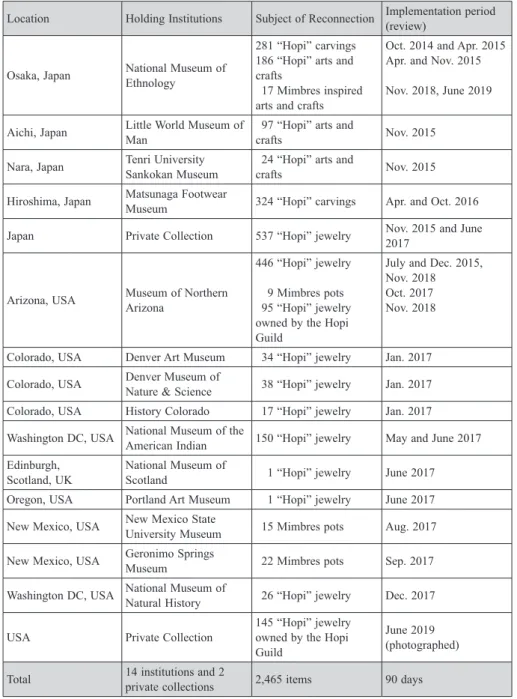
A total of 14 museums in Japan, the United States, and the United Kingdom
have joined the project as teammates (Table 1). The digital archive covers some
2,450 objects curated by museums, including art museums, in the various places
described above and a private collection, such as silver jewelry and
katsina dollslabeled “made by Hopi.”
Table 1 Teammate Institutions participating in our “Reconnecting Project” (as of June, 2020) Location Holding Institutions Subject of Reconnection Implementation period
(review) Osaka, Japan National Museum of
Ethnology
281 “Hopi” carvings 186 “Hopi” arts and crafts
17 Mimbres inspired arts and crafts
Oct. 2014 and Apr. 2015 Apr. and Nov. 2015 Nov. 2018, June 2019 Aichi, Japan Little World Museum of
Man 97 “Hopi” arts and
crafts Nov. 2015
Nara, Japan Tenri University
Sankokan Museum 24 “Hopi” arts and
crafts Nov. 2015
Hiroshima, Japan Matsunaga Footwear
Museum 324 “Hopi” carvings Apr. and Oct. 2016 Japan Private Collection 537 “Hopi” jewelry Nov. 2015 and June
2017
Arizona, USA Museum of Northern Arizona
446 “Hopi” jewelry 9 Mimbres pots 95 “Hopi” jewelry owned by the Hopi Guild
July and Dec. 2015, Nov. 2018 Oct. 2017 Nov. 2018
Colorado, USA Denver Art Museum 34 “Hopi” jewelry Jan. 2017 Colorado, USA Denver Museum of
Nature & Science 38 “Hopi” jewelry Jan. 2017 Colorado, USA History Colorado 17 “Hopi” jewelry Jan. 2017 Washington DC, USA National Museum of the American Indian 150 “Hopi” jewelry May and June 2017 Edinburgh,
Scotland, UK National Museum of
Scotland 1 “Hopi” jewelry June 2017 Oregon, USA Portland Art Museum 1 “Hopi” jewelry June 2017 New Mexico, USA New Mexico State
University Museum 15 Mimbres pots Aug. 2017 New Mexico, USA Geronimo Springs
Museum 22 Mimbres pots Sep. 2017 Washington DC, USA National Museum of Natural History 26 “Hopi” jewelry Dec. 2017 USA Private Collection 145 “Hopi” jewelry
owned by the Hopi Guild
June 2019 (photographed)
Total 14 institutions and 2
private collections 2,465 items 90 days
Now I will explain how the project has been conducted. “Input” was gathered
through a collections review. Collections review, a technical term used by muse-
ums, refers to the process of observing materials by examining them in person and
Photo 1 “Physical review” on the item number G45298 and G45299 of the Matsunaga Footwear Museum. At the Matsunaga Footwear Museum, Hiroshima, Japan on April 24, 2016.
(Unless otherwise specified, all photos are by the author.)
Photo 2 “Digital review” on the item number 25/7672 of the National Museum of the American Indians. At Lomaventema’s studio in the Hopi Reservation, Arizona, USA on May 29, 2017.
comparing them with information written by the museum for close examination.
Fundamentally, we invited people from the source community to the museums in the various places (Photo 1), but if they were unable to leave home because of reli- gious activities, farming, health condition, or some other reason, I visited the museum myself or with my colleagues to do photography and to measure every object at the storage, and later conducted the collection review digitally by project- ing the images of those objects on a monitor installed at an artist’s studio in the Hopi reservation (Photo 2).
A total of 22 participants from the Hopi community have taken part in collec-
tions reviews, including physical reviews at eight museums including Minpaku, and
digital review for five museums in the US and one in Scotland. After spending
much time confirming the materials, they presented an explanation of each object.
It took several minutes to one hour for one reviewer to do so. All reviewers talked about the objects. What the collection review participants from the source commu- nity say about the objects varies depending on their gender, age, how much they were involved in the production processes, how often they used them, and place of residence as well as the environment in which they were raised. Major comments included methods to procure materials, points to note during production, design interpretations, the way materials and end product were called in the local lan- guage, the personality of the makers and their surviving family members, and the past and present of the community.
For example, a reviewer Mr. Ramson Lomatewama from the village of
Hotevilla described his impressions when reviewing a katsina doll (H0115028 ofMinpaku), making comments on whether the descriptions of doll production were correct or wrong, and the diversity of the styles of the
katsina among the threemesas of the Hopi reservation (Photo 3).
This is a doll carving that was carved by Leonard Poola. I’m not familiar with the carver or where they’re from. But, this is a cricket, that’s what is labeled on the docu- mentation. But, the Cricket katsina that I’m familiar with is very different from this one.
So, this might be the way it appears in another village but not in the Third Mesa area.
This one has a yellow head with the black dots for the eyes and the mouth. It’s kind of what it looks like over at Third Mesa area as well, but everything else is different. For example, the antennas here on this doll are carved; they’re painted black. The fuzz that’s coming off the side of the head is commercial black yarn that’s been frayed. It’s wear- ing, again, yarn around the neck. It has a black yarn for the armbands and for the wrists and for the knees. Over at our village it looks different. It does have a yellow head. It does have the two eyes and mouth like this. But, on top of each eye, are small dots, four at the bottom; then three on top and then two and then finally one. So, it kind of has this triangular shape up here; the dots make like a triangular shape. They use a grass mate-
Photo 3 Hopi reviewer Ramson Lomatewama reviewing a doll (H0115028 of Minpaku) at Minpaku on April 21, 2015.
rial for the antenna, songòosivu [songòotala]. And, this would be white. As I recall, they have a qaa’ö, the woven cotton corn from the wedding robe: that’s here. Then the tas- sels of the corn are the ones which come down like this. At Hoatvela I’ve seen them with yellow, all yellow, all over. But, over there I’ve seen them with leather fringed armbands with, sometimes it got shells on there, on both upper arms. They’ve got a black yarn bandolier that goes all the way around the back and then coming back under here. I believe they have the two scratch marks, kind of like an “X,” a double “X” on both forearms as well as the legs. However, they do not wear this, sakwavitkuna, over in our village. They wear kwikwilhoya, or the checkered kilt for the kilt. And, the hopik- wewa coming down across like this and down. I do not recall if they have a fox pelt hanging down the back. So, I’m not too sure. I do not quite remember that small detail.
But, they do have the yarn anklets. When they danced, when I saw them, they wore bells on both legs. They were barefoot like this. But, they also had the fringed leather anklet down here on both legs. They did not have a rattle or they didn’t have anything in either hand, just didn’t have anything in their hands. That’s this doll.” (Ito (ed.) 2017:
1243–1244)
One piece of silver jewelry was described as “Maker: unknown” in the infor- mation of the museum catalog, but its maker was estimated by confirming its style and signature or comparing it with information related to the material held by other institutions whose maker was documented (p048 of private collection and E5440 of Museum of Northern Arizona). In another case, the reviewer was a bereaved rela- tive of the maker’s family (Photo 4). By handling a piece of silver jewelry made by her late grandfather, Ms. Clinessia Lucas, the reviewer from the village of
Musangnuvi, who had not been able to see her grandfather when he was alive, feltcloseness with her grandfather and found how unique her grandfather’s techniques
Photo 4 Hopi reviewer Clinessia Lucas (left) is holding a silver bracelet made by her late grandfather Glenn B. Lucas (E11060 of Museum of Northern Arizona). At the Museum of Northern Arizona, Flagstaff, Arizona, USA on July 22, 2015.