Vernacular Names for Taro in the Indo‑Pacific Region : Implications for Centres of
Diversification and Spread
著者(英) Roger M. Blench
journal or
publication title
Senri Ethnological Studies
volume 78
page range 21‑43
year 2012‑03‑30
URL http://doi.org/10.15021/00002508
21
Edited by Matthew Spriggs, David Addison, and Peter J. Matthews
Vernacular Names for Taro in the Indo-Pacifi c Region:
Implications for Centres of Diversifi cation and Spread
R
OGERM. B
LENCH Kay Williamson Educational FoundationThe question of the original location of taro domestication and whether this took place once or several times is far from resolved. Vernacular names for taro are surveyed here with a view to exploring this question. The results suggest that there are two important lexical nuclei:#trawʔ, characteristic of Mainland SE Asia, but apparently adopted in the Western Austronesian world, and #mV, developed in the island of New Guinea and borrowed into VV adjacent Austronesian languages. There is a further zone of high lexical diversity in NE India, which is unexplained, but which may point to a separate centre of domestication. The paper also suggests a relationship between the terms for Alocasia sp. in Austronesian lan- guages of Taiwan and the Philippines, and the terms for taro in Tai-Kadai languages.
1. I
NTRODUCTIONTaro (Colocasia esculenta) is one of oldest and most important cultigens in the Indo-Pacifi c region. On the SE Asian mainland, it remains a signifi cant element in the staple diet in humid areas where rice is now dominant. Dating and locating the domestication of taro remains controversial; the wild ancestors of lowland taro occur across an extensive tract from the island of New Guinea through to the foothills of the Himalayas, so biogeography alone cannot answer this question. (Genetic approaches are being developed, see Tahara et al. 1999; Yoshino 2002; Lebot et al. 2004 for example). Matthews (1991, 1995) suggested that the origins of domesticated taros are to be found in the ‘wildtype’ C. esculenta not aquatilis, a natural form of the species in NE India and SE Asia. However, he noted the occurrence of apparent wild- type taros over a broader geographical range, as far east as Australia and New Guinea, and suggested that domestication could have taken place within this area. Moreover, a cold- climate domesticated form, characterised by the production of many small side-corms, is found at higher altitudes, for example in the Himalayas, and spreading across northern China through to Japan. Yoshino (2002) has described a possible cold-adapted wildtype taro in the Himalayas, and Yunnan in particular is an area rich in taro diversity, which remains barely described (Eyzaguirre 2000). It is widely held that there was another, perhaps earlier, domesti- cation in the Melanesian area (Lebot and Aradhya 1991; Lebot et al. 2004). Evidence for
Acronyms: #, quasi-reconstruction; BP, Before present; *, regular reconstruction; C, consonant; AD, Anno Domini;
Kya, ‘000 years ago; BC, Before Christ; mtDNA, mitochondrial DNA; V, vowel
ancient cultivation has been reported at Kuk Swamp in New Guinea (Denham
et al. 2003;Fullagar et al. 2006), beginning around 10,200–9,910
cal. BP, and associated with a palaeo-surface of pits, runnels, stake and post holes. In the Andaman Islands, there is a strong pos- sibility of wild taro being native but unreported, due to the bias of botanists against reporting wild forms of this cultivated species.
The use of vernacular names to interpret patterns of diversifi cation and spread of major staples has so far been of limited importance in SE Asia, and most attention has been given to rice (e.g., Revel 1988). For the Pacifi c, there has been more effort in relating linguistic data to attested archaeology and Ross
et al. (2008) presented an important compilation of reconstruc-tions for plant names relating to the Oceanic languages. Hays (2005) compiled a substantial database of vernacular names for tubers in Irian Jaya, apparently the precursor of a more complete work. Unfortunately, his analysis does not cite actual forms, except in passing. But to date, the implications of vernacular names for taro have been little explored. This paper
1makes a preliminary attempt to bring together the scattered evidence and to speculate on the signifi cance of its patterns for our understanding of taro diversifi cation. It is important to emphasise the linguistics is not biology; the existence of widespread names cannot itself pro- vide evidence for centres of domestication. But it does provide pointers to likely regions to explore and it can certainly sustain a narrative for the spread of the cultivated taros. In addi- tion, the analysis of vernacular names can provide evidence for semantic switching, in other words, the re-application of names for other plants to taro, or alternatively, the transfer of taro terms to other staples such as rice. This in turn provides broader evidence for regional crop history. In addition to this, it is often possible to make concrete the sometimes imprecise assignations of linguists; for example, a reconstruction of ‘potato’ (an Andean crop) for proto- Tibeto-Burman (Matisoff 2003) almost certainly applies to taro. It must be added that our knowledge of vernacular names for wild taros and their relatives remains extremely weak;
there has surely been a long history of transfer of terms back and forth as populations colonise new ecological and biotic regions.
The English word ‘taro’ is derived from Polynesian languages, and has become the domi- nant reference term in Pacifi c literature. More globally, Colocasia esculenta has a number of names used in the English literature and it is important to reconcile these to ensure that the entire range of sources is captured. Taro is usually known as ‘cocoyam’ in publications on Africa, a name combining koko, a common vernacular term, and ‘yam’ (Burkill 1985). In older Indian literature, taro is often identifi ed as ‘Caladium’ or ‘Arum’, based on the out- moded scientifi c names, Caladium esculentum and Arum colocasia. These are the common names used to refer to them in important compilations such as Watt’s (1889–93)
Dictionary of the Economic Products of India. Both of these names are repeated in quite recent publi-cations such as the Burrow and Emeneau (1984)
Dravidian Etymological Dictionary. InNorth east India, taro is still often referred to as ‘Caladium’ or ‘the arum’ even in modern publications.
There are no very comprehensive sources for taro names in the Indo-Pacifi c region.
Honourable mention may be made of Arnaud (1997), Ross
et al. (2008) and Rensch andWhistler (2009), sources that cover principally Austronesian
2. Madulid (2001) represents a
major source for the Philippines, and other national botanical texts provide additional material
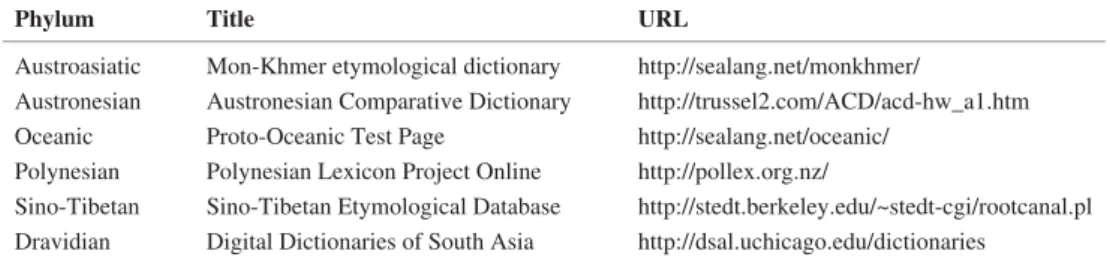
for mainland SE Asia. There are now a number of important online resources for comparative lexical data for individual phyla or branches. These are shown in Table 1.
The Mon-Khmer etymological dictionary available on the SEALANG site allows researchers to sort through a wide variety of sources for Austroasiatic languages, although Muṇḍā is not represented, except where Muṇḍā cognates are noted in Shorto (2006).
2. L
ANGUAGEP
HYLAOFTHEI
NDO-P
ACIFICThe Indo-Pacifi c region, depending on how broadly it is defi ned, encompasses a number of distinct language phyla and geographically named groups (Table 2). For this discussion, NE Asia, Japonic, Koreanic and Ainu are excluded.
As noted in the comments (Table 2), the genetic unity of some phyla is doubtful and their internal structure (especially Sino-Tibetan) is highly contested (Blench and Post in press).
Claims abound in the literature for the existence of macrophyla (for example Austric, which would unite Austroasiatic and Austronesian, or Sino-Austronesian). Mongolic is excluded from further discussion for lack of data, and the Andamanese are, or were until recently, foragers with no cultivated plants.
Table 2 Language phyla in the Indo-Pacifi c region
Phylum/Group Extension Comment
Andamanese Andaman islands Not a genetic group
Austroasiatic NE India to Việt Nam, Nicobars, Malay Peninsula Austronesian Taiwan to New Zealand, Việt Nam
Daic South China, Thailand, Laos, Việt Nam, NE India Hmong-Mien South China, Thailand, Laos, Việt Nam
Mongolic Yunnan Only Mongolic occurs in the region
Papuan Melanesia, with western extension in Indonesia Not a genetic group Sino-Tibetan China to Nepal, Thailand, Laos, Việt Nam
Table 1 Online lexical resources for Asia-Pacifi c languages
Phylum Title URL
Austroasiatic Mon-Khmer etymological dictionary http://sealang.net/monkhmer/
Austronesian Austronesian Comparative Dictionary http://trussel2.com/ACD/acd-hw_a1.htm Oceanic Proto-Oceanic Test Page http://sealang.net/oceanic/
Polynesian Polynesian Lexicon Project Online http://pollex.org.nz/
Sino-Tibetan Sino-Tibetan Etymological Database http://stedt.berkeley.edu/~stedt-cgi/rootcanal.pl Dravidian Digital Dictionaries of South Asia http://dsal.uchicago.edu/dictionaries
3. T
HEP
ATTERNSOFV
ERNACULARN
AMES3.1 General
Vernacular names for taro appear to fall into a pattern, with four (or fi ve) widespread regional terms which occur across many countries and jump language phylum boundaries, in contrast to nuclei of diversity where the names appear to be very distinct even within a small geo- graphical area. The most characteristic such areas are Northeast India and the Philippines.
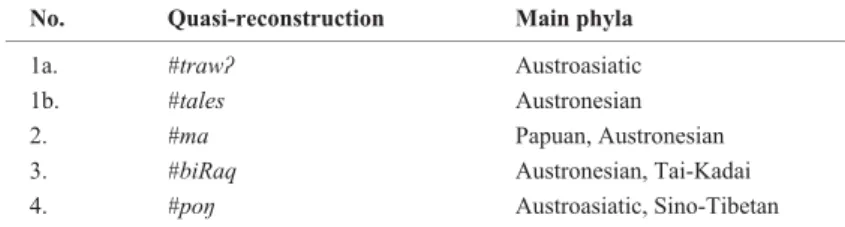
Papuan remains rather diffi cult to analyse, as the languages are so numerous and many are almost undocumented. The major roots for ‘taro’ are;
Forms 1a and 1b are listed in this way to show that I consider them part of the same set, for reasons given in §3.2. These reconstructed forms are marked with the hache (#) to indi- cate that they should not be considered defi
tnitive. Such quasi-reconstructions should be considered rather as hypothetical reference forms, awaiting more comprehensive historical linguistics. The sections below discuss each of these reconstructions in turn. Apart from these, there are a large number of ‘stray’ names, which form no evident pattern. These are collected in Table 9, since they may well have implications for early adoption of wild taros.
Kikusawa (2000) focuses on an additional root, *suli(q), which is attested across the Austronesian world. This usually has the meaning of ‘sucker, runner, shoot’, which is the meaning Blust (n.d.) attributes to proto-Austronesian. However, it has the meaning ‘generic taro’ in a wide range of Austronesian languages from Yami to Fijian, and clearly has been long co-associated with the Austronesian taro lexicon. Kikusawa notes that word forms with the generic meaning are all recorded within the zone where swamp-taro, Cyrtosperma chamissonis, is both wild and cultivated. The proposal is thus that this plant was original referent of the
*suli(q) root, which came to encompass plants in the taro family (Araceae) generally.
3.2 #trawʔ /#tales
The most important lexical cluster in SE Asia focuses on the widespread term, #trawʔ
ʔwhich has refl exes throughout Austroasiatic, and which Shorto (2006: 475) reconstructed to proto- Mon-Khmer. It is claimed here that #trawʔ is related to the Proto-Malayo-Polynesian #
ʔ taleswhich is widespread in Austronesian. Table 4 shows a sample of typical refl exes of #trawʔ for mainland SE Asia; further forms in individual languages can be found in Ferlus (1996).
Austronesian forms are very numerous so only a sample is included. The gloss is given sepa- rately where ‘taro’ is not the defi nition in the source.
Table 3 Common Indo-Pacifi c roots for ‘taro’
No. Quasi-reconstruction Main phyla
1a. #trawʔ Austroasiatic
1b. #tales Austronesian
2. #ma Papuan, Austronesian
3. #biRaq Austronesian, Tai-Kadai
4. #poŋ Austroasiatic, Sino-Tibetan
Some of the changes in initial consonant make cognacy uncertain. For example, Mon
kraolooks as if it is cognate with Nyah Kur traw, but k→t is not a regular sound-shift; the root has been conserved but the initial minor syllable has been replaced. By contrast, the t→s changes observable in many Austroasiatic languages are attested across the lexicon. It may well be that many of the *tales forms found in ISEA are early borrowings from Malay. Reid (1973) points out that the typology of Philippines languages vowel systems can help detect loanwords. For example, the normal refl ex of PMP /ə/ should be /ə/ in Palawan, not /a/ and it
Table 4 Refl exes of #trawʔ ‘taro’ in SE Asian languagesʔ
Phylum Branch Language Attestation Gloss Source
Sino-Tibetan Naga Garo tariŋ arum Burling (2003)
Austroasiatic PMK *t2rawʔ Shorto (2006: 475)
Austroasiatic Monic Mon krao Shorto (2006)
Austroasiatic Monic Nyah Kur traw Thongkum (1984)
Austroasiatic Vietic Thavung tʰoo3 Ferlus (1996)
Austroasiatic Vietic Vietnamese sọ Ferlus (1996)
Austroasiatic Vietic Proto-Vietic *sroʔ Ferlus (1996)
Austroasiatic Khmeric Old Khmer trav Ferlus (1996)
Austroasiatic Khmeric Khmer tra:v Ferlus (1996)
Austroasiatic Khmuic Khmu sroʔ Ferlus (1996)
Austroasiatic Pearic Chong kʰre:A Ploykaew (2001)
Austroasiatic Bahnaric PSB *təraw Sidwell (2000)
Austroasiatic Bahnaric East Bahnar trɔɔu amaranth Sidwell (2000)
Austroasiatic Katuic PK *craw Ferlus (1996)
Austroasiatic Katuic Bru ʔaräw Sidwell (2005)
Austroasiatic Katuic Kuy ʔaaràaw Sidwell (2005)
Austroasiatic Katuic Sre traw Sidwell (2005)
Austroasiatic Katuic Mlabri kwaaj Rischel (1995)
Austroasiatic Katuic Ong raw Ferlus (1996)
Austroasiatic Palaungic Riang sroʔ Ferlus (1996)
Austroasiatic Palaungic Palaung tɔh Ferlus (1996)
Austroasiatic Palaungic Danaw kăro1 Ferlus (1996)
Austroasiatic Palaungic Proto-Wa kroʔ Diffl oth (1980)
Austroasiatic Palaungic Lamet ruəʔ Ferlus (1996)
Austroasiatic Palaungic Khang hɔ Ferlus (1996)
Austroasiatic Khasian Khasi shriew arum Singh (1906)
Austroasiatic Muṇḍā Sora ‘saro Caladium esculentum Zide & Zide (1976) Austroasiatic Muṇḍā Mundari saɽuɽɽ edible root Zide & Zide (1976)
Austroasiatic Muṇḍā Santal saru Zide & Zide (1976)
Austronesian PMP *talət taro Dempwolff (1938)
Austronesian Philippines Palawan talas taro Arnaud (1997)
Austronesian Philippines Taot Bato talus-talus taro Madulid (2001)
Austronesian Barito Dusun tadis kaladi Hudson (1967)
Austronesian Malayic Indonesian talas taro Arnaud (1997)
Austronesian Oceanic P-Oceanic *talo(s) taro Rosset al. (2008)
thus likely to be a loan. Similarly with the back vowel /u/ in Taot Bato. Tagalog taro is so improbably like the Oceanic forms that it is probably a late borrowing from English.
The near-universal distribution of this root in Austroasiatic suggests that taro played an important role in its early expansion. Diffl oth (2005) has pointed out the strong geographical correlation between subgroups of Austroasiatic and river valleys. Although wild taros do generally occupy wet places, including river valleys and lowlands, this is not proof of the locus of domestication. This conjunction of linguistics and ecology suggests that Austroasiatic speakers were either the original domesticators of taro, or ‘early adopters’ at least as far as mainland SE Asia is concerned. Beyond this, reasonable linguistic conjecture cannot go.
The terms in Austroasiatic and Austronesian are too similar for there not to be a relation- ship between them, whether through borrowing or an ancient genetic connection. Dempwolff (1938: 128–9) reconstructed *talǝ
ll ttfor proto-Austronesian, but his evidence includes neither Formosan nor indeed any languages near Taiwan. Wolff (2010: 7, 993) gives evidence that
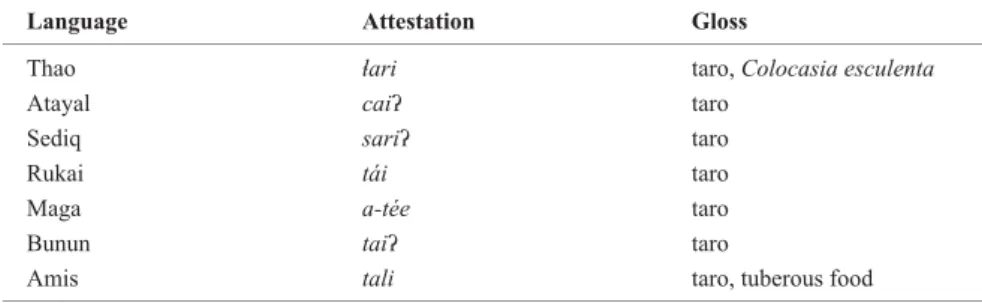
*tali is widespread in Austronesian languages of Taiwan (Table 5). However, he regards these forms as a secondary loan due to their irregular relationship.
Wolff regards the reconstructed Proto-Malayo-Polynesian with the fi nal affricate (talec in his transcription) as a regular reconstruction. Yet he cannot cite evidence from any lan- guage north of Palawan, and this term is virtually absent from the Philippines. Indeed, if the argument presented here is correct, it is misleading to consider this term reconstructible in the earlier stages of Austronesian dispersal; it is most likely a widespread borrowing. The absence of this term in Philippines languages also argues against inheritance from a supposed ‘Austric’
phylum. If Austric did exist, the forms attested in Taiwan should not look like secondary loans. Moreover, given current views on the rapid dispersal of Austronesian speakers follow- ing their departure from Taiwan, refl exes of *tales should surely be attested in the Philip- pines.
If the *tales refl exes in Austronesian are borrowings from Austroasiatic, when and where would such a transfer have taken place? Speakers must have borrowed it during an early phase of contact, with Borneo the most likely zone, as this is where there is evidence for con- tact with the Vietnamese mainland and where the refl exes of
*tales appear, assuming theAustronesian expansion is modelled as spreading south and east from the Philippines.
Phonological irregularities suggest that apparently cognate forms from languages of the
Table 5 ‘Taro’ in Formosan languages
Language Attestation Gloss
Thao ɬari taro, Colocasia esculenta
Atayal caiʔ taro
Sediq sariʔ taro
Rukai tái taro
Maga a-tée taro
Bunun taiʔ taro
Amis tali taro, tuberous food
Source: adapted from Wolff (2010)
southern Philippines are borrowings.
Cereals were almost certainly the basis of Austronesian subsistence on Taiwan (e.g., Bellwood 2004), but during their expansion Austronesian speakers switched to vegeculture.
Since this is unlikely to have been a consequence of contact with Negrito foragers, one pos- sibility is that Austroasiatic speakers were previously resident in insular SE Asia (Blench 2011a). In this model, taro and other elements of vegeculture had spread east from the main- land, and the expanding Austronesians adopted it from the Austroasiatic speakers whom they subsequently assimilated, but not before borrowing their term for the plant. Cultivated taro would have been carried back to Taiwan apparently via a language where the form did not include a fi nal fricative. Indeed initial fricatives (s-) and lateral fricatives (ɬ-) in some Formosan languages point strongly to an Austroasiatic source. The mixed vocabulary in Philippines languages (e.g., Table 10) presumably indicates that taro was introduced multiple times from different regions, and that names were also transferred from indigenous wild taros (cf. Matthews
et al.this volume).
Evidence for the diffusion of cognates to the north and west is limited, but nonetheless, Matisoff (2003: 173) proffers *sr(y)a as proto-Tibeto-Burman for ‘yam/potato’ and *grwa for taro. Table 9 compiles vernacular names for ‘taro’ in Tibeto-Burman languages; it is very hard to see how these support such a reconstructed form. The few known occurrences un- doubtedly refl ect borrowing from Austroasiatic.
3.3 #ma
Many Oceanic languages attest a root for taro which has been reconstructed as *mʷapo(q)
ʷ(Ross
et al. 2008). However, the reflexes in many actual Austronesian languages are much shorter forms. Table 6 shows some examples of these given in Ross
et al.;These terms closely resemble those in Papuan languages. Pawley (2005: 101) quotes a Trans-New Guinea phylum (TNG) reconstructed form *mV for taro. Hays (2005: Map 3)
Vshows the distribution of this root in Irian Jaya. The Trans-New Guinea phylum, a previously somewhat controversial grouping, is now accepted by many linguists. The TNG includes a large number of Papuan languages along the central spine of the island of New Guinea and has outliers on Timor and other offshore islands. Unaffi liated Papuan languages are found all around its fringes, especially in the lowlands, and this geographical patterning leads us to think it expanded from the highlands. The lexical diversity of the TNG suggests that it is signifi cantly older than Austronesian, so it may have originated as much as 10,000 years ago
Table 6 Oceanic names for ‘taro’
Language Attestation
Lou mʷa
Titan ma
Mangseng mʷa
Dawawa mavu
Arosi mʷa
(Pawley 2005: 97). The stimulus for the expansion of the TNG is unknown but the proposal is that it was some sort of vegeculture. Taro is naturally a lowland plant, but Denham
et al.(2003) have argued that it would have spread early to the highlands, hence its identifi cation at Kuk swamp. It is thus credible that this reconstruction is linked to a Melanesian centre of domestication and that TNG speakers spread the earliest cultivated taro in this region.
However, there is no evidence for the
mV- root for taro west of Timor. RossVV et al.(2008: 266) point out that refl exes of this root are rather scattered in Western Oceanic and that they are possibly borrowings from Eastern Oceanic, where the term is widespread. The Papuan and Austronesian terms are surely related, and Pawley (2005: 101) states unambiguously that Austronesian borrowed the TNG term.
3.4 #biRaq
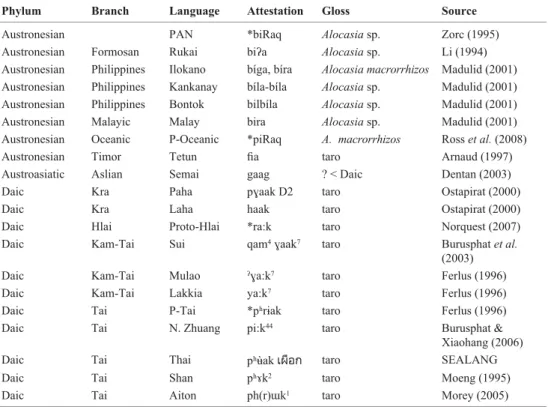
The source of the third widespread root for ‘taro’ is a semantic shift. Table 7 shows a root originally applied to Alocasia sp. in Taiwan and Alocasia macrorrhizos in the Philippines.
Originally wild in the Philippines (cf. Nauheimer et al. in press),
Alocasia macrorrhizos, laterbecame a cultigen in the Austronesian world and the name persisted. Based on numerous attestations in Oceanic, this plant is reconstructible to proto-Oceanic (Ross
et al. 2008: 272).However, forms for ‘taro’ in the Daic (= Tai-Kadai) languages are strikingly similar to the Austronesian reconstruction. It has long been accepted that there is some sort of link between
Table 7 The*biRaq root for ‘aroid’ in SE Asian language phyla
Phylum Branch Language Attestation Gloss Source
Austronesian PAN *biRaq Alocasiasp. Zorc (1995)
Austronesian Formosan Rukai biʔa Alocasiasp. Li (1994)
Austronesian Philippines Ilokano bíga, bíra Alocasia macrorrhizos Madulid (2001) Austronesian Philippines Kankanay bíla-bíla Alocasiasp. Madulid (2001) Austronesian Philippines Bontok bilbíla Alocasiasp. Madulid (2001)
Austronesian Malayic Malay bira Alocasiasp. Madulid (2001)
Austronesian Oceanic P-Oceanic *piRaq A. macrorrhizos Rosset al.(2008)
Austronesian Timor Tetun fi a taro Arnaud (1997)
Austroasiatic Aslian Semai gaag ? < Daic Dentan (2003)
Daic Kra Paha pɣaak D2 taro Ostapirat (2000)
Daic Kra Laha haak taro Ostapirat (2000)
Daic Hlai Proto-Hlai *ra:k taro Norquest (2007)
Daic Kam-Tai Sui qam4ɣaak7 taro Burusphat et al.
(2003)
Daic Kam-Tai Mulao ʔɣa:k7 taro Ferlus (1996)
Daic Kam-Tai Lakkia ya:k7 taro Ferlus (1996)
Daic Tai P-Tai *pʰrɨak taro Ferlus (1996)
Daic Tai N. Zhuang pi:k44 taro Burusphat &
Xiaohang (2006)
Daic Tai Thai pʰùak เผือก taro SEALANG
Daic Tai Shan pʰɤk2 taro Moeng (1995)
Daic Tai Aiton ph(r)ɯk1 taro Morey (2005)
Daic (= Tai-Kadai) and Austronesian (Benedict 1942). In recent times, the notion that Daic is simply a branch of Austronesian, possibly at the Malayo-Polynesian stage, is becoming more widely accepted (Ostapirat 2005; Sagart 2005; Norquest 2007; Blench in press). The assumption is that one branch of the Austronesians who left Taiwan returned to the mainland, mig rated inland and became Daic speakers. The Austronesian name for Alocasia macrorrhizos was applied by proto-Daic speakers to Colocasia esculenta. Table 7 shows the refl exes of this root, consistently applied to Alocasia macrorrhizos in Austronesian, but restricted to taro in Daic.
The Daic refl exes with a fi nal velar (-k/-g) show that the Austronesian fi nal uvular was present when the term was adapted. Daic versions of Austronesian words typically delete the
first syllable (Ostapirat 2005) but forms like Paha pɣaak
ɣɣ kstill retain this. Interestingly, the full CVCVC structure must still have been present during the evolution of Tai proper, since Tai languages delete the middle segment (Austro nesian -R-, still realised as such in proto-Hlai) probably through a process of metathesis, if the proto-Tai reconstruction is accurate. The historical interpretation of this would seem to be that Daic speakers were unfamiliar with cultivated taro in Taiwan, and only encountered the cultivated plant on the mainland. Rather than borrowing a name from a resident group, they adapted the name from a plant they already knew.
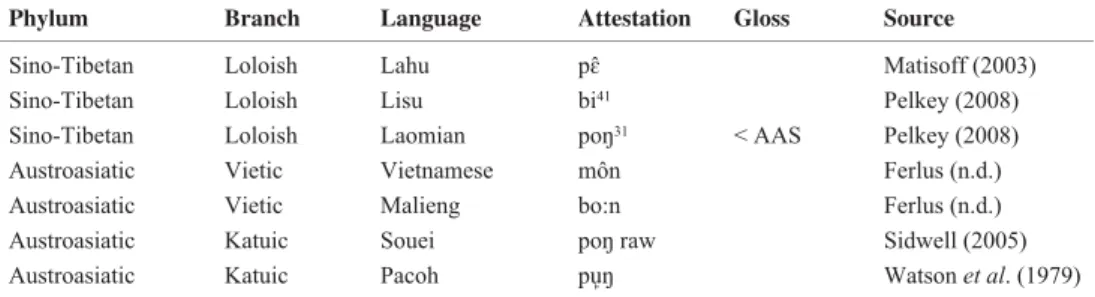
3.5 #poŋ
Another widespread etymon is
#poŋ, which has been subject to multiple borrowing. Thesource of this is a widespread Austroasiatic term for ‘yam’ (Dioscorea spp.) which can be transferred to taro within Austroasiatic but which is also borrowed into Sino-Tibetan. In much of Sino-Tibetan the back vowel is fronted to e/i but the fi nal velar nasal is retained in many languages including Burmese. It is quite likely spoken Burmese was a secondary source of loanwords, since many languages resemble Burmese with a loss of nasalisation. Some languages, for example Marma prwíŋ
íí, insert -r- after C
1which may be a result of palatalisa- tion coming from the fronting process. Naga languages such as Meluri add an a- prefi x to the root, giving
api. If C1is deleted this yields forms such as Sema ai which do not at fi rst sight look cognate. Table 8 shows all the refl exes of #poŋ so far identifi ed in SE Asia.
Languages such as Loloish Laomain have probably borrowed this word directly, as it is phonologically unaltered. It seems that Sino-Tibetan refl exes generally represent an early
Table 8 Refl exes of the root #poŋ in SE Asian language phyla
Phylum Branch Language Attestation Gloss Source
Sino-Tibetan Loloish Lahu pɛ Matisoff (2003)
Sino-Tibetan Loloish Lisu bi41 Pelkey (2008)
Sino-Tibetan Loloish Laomian poŋ31 < AAS Pelkey (2008)
Austroasiatic Vietic Vietnamese môn Ferlus (n.d.)
Austroasiatic Vietic Malieng bo:n Ferlus (n.d.)
Austroasiatic Katuic Souei poŋ raw Sidwell (2005)
Austroasiatic Katuic Pacoh pûŋ Watsonet al. (1979)
borrowing from Austroasiatic, which has diversifi ed within Sino-Tibetan.
3.6 Other Names
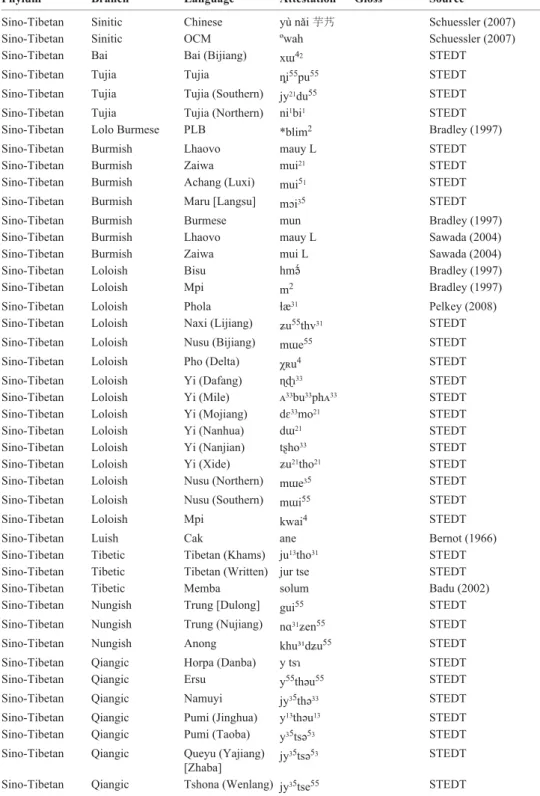
Table 9 sets out other terms for ‘taro’ in SE Asian languages, with etymological suggestions.
Reconstructions can be proposed for individual Sino-Tibetan subgroups. For example, Karenic, Qiangic and Kuki-Chin all have common forms that suggest taro was known to speakers of their proto-languages. However, this does not give any signifi cant time-depth and the overall impression is of great diversity.
Table 9 illustrates well the diversity of terms in the NE India/Myanmar borderland. The most likely interpretation of this is that many of these names are originally terms for wild aroids or yams and that cultivated taro spread slowly through farmer-to-farmer diffusion in this area, allowing for the mosaic of adapted names to evolve. There are defi nite similarities between some of the Loloish forms and Vietnamese, although these languages are not in con- tact. It is interesting that a term for ‘taro’ can be reconstructed in proto-Hmong-Mien and that it does not resemble the Austroasiatic forms. This word has no history within Sino-Tibetan, so it is a likely borrowing from Hmong-Mien
intoChinese. Schuessler (2007: 589) also points to Written Burmese wa
CC‘a kind of potato’, probably a late borrowing from Old Chinese.
The exact date and location of proto-Hmong-Mien is still uncertain (see e.g., the speculations of Ratliff 2004, 2010). But it is quite possible that Hmong-Mien speakers were not far north of the Austroasiatic homeland during the period of taro domestication, and indeed that they were the resident cultivators encountered by expanding Daic speakers.
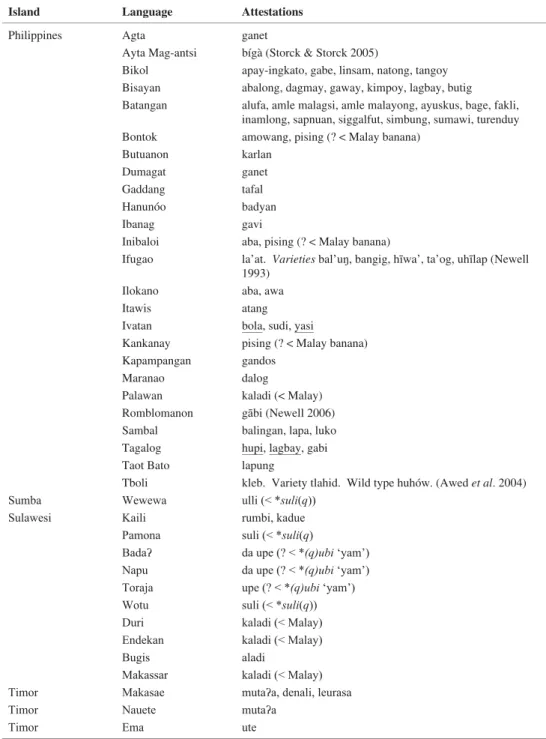
The other great region of diversity is in island SE Asia. Table 10 shows some of the terms that have been recorded in accessible sources. A more thorough search of the literature would undoubtedly reveal others. This diversity clearly does not point to taro forming part of the cultigen repertoire of the expanding Austronesians. Such an effl orescence of names more credibly refl ects borrowing from
in situvegeculturalists or adaptations from the names of indigenous wild aroids.
The term
gábi occurs in many languages, possibly as a secondary loan from Tagalog.However, this is unlikely to be its origin. Reid (pers.comm.) observes that it looks suspiciously similar to the refl exes of widespread root *biRaq applied to
Alocasia macrorrhizos(Table 7) which are bíga in languages in which *R>g (Northern Cordilleran, Greater Central Philippines, etc.).
Gábi could well be a metathesis of thisbíga, applied to the incoming cultivated taro.The name in Ibanag has given rise to the name of an important trading port in northern Luzon. The town of Vigan, fi rst a Chinese merchant’s entrepôt and later a base for the Spanish rulers of the Philippines is a metathesis of the name for ‘taro’ (Fig. 1).
4. U
NG
LISSEMENTS
ÉMANTIQUE: T
HES
WITCHFROMT
AROTOR
ICEThe idea that the original agricultural system of SE Asia was tuber-based has long history
among agricultural ethnographers and Spriggs (1982: 12) collected references to this idea
going back to the 1940s. However, there has been no linguistic support for this idea, partly
because the usual words for ‘rice’ and ‘taro’ in Austroasiatic and Sino-Tibetan appear to be
unrelated. For example, ‘rice’ in Austroasiatic is prefi x + ko/kaw, as opposed to ‘taro’
#trawʔ.Table 9 Miscellaneous terms for ‘taro’ in SE Asian language phyla
Phylum Branch Language Attestation Gloss Source
Sino-Tibetan Sinitic Chinese yù nǎi 芋艿 Schuessler (2007)
Sino-Tibetan Sinitic OCM ºwah Schuessler (2007)
Sino-Tibetan Bai Bai (Bijiang) xɯ42 STEDT
Sino-Tibetan Tujia Tujia ȵiȵȵ55pu55 STEDT
Sino-Tibetan Tujia Tujia (Southern) jy21du55 STEDT
Sino-Tibetan Tujia Tujia (Northern) ni1bi1 STEDT
Sino-Tibetan Lolo Burmese PLB *blim2 Bradley (1997)
Sino-Tibetan Burmish Lhaovo mauy L STEDT
Sino-Tibetan Burmish Zaiwa mui21 STEDT
Sino-Tibetan Burmish Achang (Luxi) mui51 STEDT
Sino-Tibetan Burmish Maru [Langsu] mɔi35 STEDT
Sino-Tibetan Burmish Burmese mun Bradley (1997)
Sino-Tibetan Burmish Lhaovo mauy L Sawada (2004)
Sino-Tibetan Burmish Zaiwa mui L Sawada (2004)
Sino-Tibetan Loloish Bisu hmə Bradley (1997)
Sino-Tibetan Loloish Mpi m2 Bradley (1997)
Sino-Tibetan Loloish Phola ɬæ31 Pelkey (2008)
Sino-Tibetan Loloish Naxi (Lijiang) ʑu55thv31 STEDT
Sino-Tibetan Loloish Nusu (Bijiang) mɯe55 STEDT
Sino-Tibetan Loloish Pho (Delta) χʀχχ u4 STEDT
Sino-Tibetan Loloish Yi (Dafang) ɳɖɿ33 STEDT
Sino-Tibetan Loloish Yi (Mile) ᴀ33bu33phᴀ33 STEDT
Sino-Tibetan Loloish Yi (Mojiang) dɛ33mo21 STEDT
Sino-Tibetan Loloish Yi (Nanhua) dɯ21 STEDT
Sino-Tibetan Loloish Yi (Nanjian) tʂho33 STEDT
Sino-Tibetan Loloish Yi (Xide) ʑu21tho21 STEDT
Sino-Tibetan Loloish Nusu (Northern) mɯe35 STEDT
Sino-Tibetan Loloish Nusu (Southern) mɯi55 STEDT
Sino-Tibetan Loloish Mpi kwai4 STEDT
Sino-Tibetan Luish Cak ane Bernot (1966)
Sino-Tibetan Tibetic Tibetan (Khams) ju13tho31 STEDT
Sino-Tibetan Tibetic Tibetan (Written) jur tse STEDT
Sino-Tibetan Tibetic Memba solum Badu (2002)
Sino-Tibetan Nungish Trung [Dulong] gui55 STEDT
Sino-Tibetan Nungish Trung (Nujiang) nɑ31ʑen55 STEDT
Sino-Tibetan Nungish Anong khu³¹dʑu55 STEDT
Sino-Tibetan Qiangic Horpa (Danba) y tsɿ STEDT
Sino-Tibetan Qiangic Ersu y55thəu55 STEDT
Sino-Tibetan Qiangic Namuyi jy35thə33 STEDT
Sino-Tibetan Qiangic Pumi (Jinghua) y13thəu13 STEDT
Sino-Tibetan Qiangic Pumi (Taoba) y35tsə53 STEDT
Sino-Tibetan Qiangic Queyu (Yajiang)
[Zhaba] jy35tsə53 STEDT
Sino-Tibetan Qiangic Tshona (Wenlang) jy35tse55 STEDT
Phylum Branch Language Attestation Gloss Source Sino-Tibetan Karenic Bwe (Western) kʻu2, ʃuʃʃ 2 STEDT
Sino-Tibetan Karenic Geba ʃuʃʃ 2 STEDT
Sino-Tibetan Karenic Paku kʻɤ3 STEDT
Sino-Tibetan Karenic Pa-O (Northern) sʻu1 STEDT
Sino-Tibetan Karenic Sgaw kʻɤ4 STEDT
Sino-Tibetan Jingpho-Konyak Jingpho nai31 STEDT
Sino-Tibetan Jingpho-Konyak Konyak tiang STEDT
Sino-Tibetan Konyak Tangsa tuŋ arum Bandyopadhyay (1989)
Sino-Tibetan Tani Apatani i-ŋe STEDT
Sino-Tibetan Tani Adi Gallong eŋye STEDT
Sino-Tibetan Tani Adi Bengni ra-ɲ- in STEDT
Sino-Tibetan Tani Bokar ɲi-ruk STEDT
Sino-Tibetan Tani Idu ji55tsi53 STEDT
Sino-Tibetan Kuki-Chin PKC *ɓaal VanBik (2007)
Sino-Tibetan Kuki-Chin Angami (Kohima) dzünuo STEDT
Sino-Tibetan Kuki-Chin Ao (Chungli) yi STEDT
Sino-Tibetan Kuki-Chin Ao (Mongsen) ami STEDT
Sino-Tibetan Kuki-Chin Tiddim ba:l1 STEDT
Sino-Tibetan Kuki-Chin Tiddim loŋ1 STEDT
Sino-Tibetan Kuki-Chin Lushai [Mizo] bǎal STEDT
Sino-Tibetan Kuki-Chin Thado bâal STEDT
Sino-Tibetan Naga Lotha mani STEDT
Sino-Tibetan Naga Maring bal STEDT
Sino-Tibetan Naga Yacham-Tengsa niʧaʧʧ ŋ STEDT
Sino-Tibetan Mishmi Miju gal arum Boro (1978)
Sino-Tibetan Mishmi Idu sona arum Pulu (2002)
Sino-Tibetan Bugun Bugun chiyauk arum Dondrup (1990)
Sino-Tibetan Puroik Puroik cuwa, tɕua53 Tayeng (1990)
Sino-Tibetan Kham-Magar Bahing kagasi STEDT
Sino-Tibetan Kham-Magar Hayu ram STEDT
Sino-Tibetan Kiranti Dumi khoksi STEDT
Sino-Tibetan Kiranti Limbu jak STEDT
Sino-Tibetan Kiranti Thulung liukke STEDT
Sino-Tibetan Kiranti Thulung ŋoːsi STEDT
Hmong-Mien PHM *wouH Ratliff (2010)
Hmong-Mien Mien Mun of Hainan hou Shintani (1990)
Hmong-Mien Mien Mun of Funing hou31 Shintani (2008)
Austroasiatic Pearic Samre duunA Ploykaew (2001)
Daic Kra Gelao vɚD2* Ostapirat (2000)
Daic Kra Lachi vɦoC2* Ostapirat (2000)
Daic Kra Biao roo C2 Ostapirat (2000)
Daic Kam-Tai Kam mo212ȶi5 Burusphat et al. (2003)
Daic Be-Tai Be mak5 saŋ4 foreign tuber Hashimoto (1980)
Daic Tai Bouyei ʨaŋ4 ŋɯ2 Ratanakul et al. (2001)
Daic Tai Central Thai chim1 Guoyan & Burusphat
(1996) º ? < Hmong-Mien
Table 10 Taro in Austronesian languages of Island SE Asia
Island Language Attestations
Philippines Agta ganet
Ayta Mag-antsi bígà (Storck & Storck 2005)
Bikol apay-ingkato, gabe, linsam, natong, tangoy Bisayan abalong, dagmay, gaway, kimpoy, lagbay, butig Batangan alufa, amle malagsi, amle malayong, ayuskus, bage, fakli,
inamlong, sapnuan, siggalfut, simbung, sumawi, turenduy Bontok amowang, pising (? < Malay banana)
Butuanon karlan
Dumagat ganet
Gaddang tafal
Hanunóo badyan
Ibanag gavi
Inibaloi aba, pising (? < Malay banana)
Ifugao la’at. Varietiesbal’uŋ, bangig, hīh wa’, ta’og, uhīh lap (Newell 1993)
Ilokano aba, awa
Itawis atang
Ivatan bola, sudi, yasi
Kankanay pising (? < Malay banana)
Kapampangan gandos
Maranao dalog
Palawan kaladi (< Malay) Romblomanon gābi (Newell 2006)
Sambal balingan, lapa, luko
Tagalog hupi, lagbay, gabi
Taot Bato lapung
Tboli kleb. Variety tlahid. Wild type huhów. (Awedet al. 2004)
Sumba Wewewa ulli (< *suli(q))
Sulawesi Kaili rumbi, kadue
Pamona suli (< *suli(q)
Badaʔ da upe (? < *(q)ubi‘yam’) Napu da upe (? < *(q)ubi‘yam’) Toraja upe (? < *(q)ubi ‘yam’) Wotu suli (< *suli(q))
Duri kaladi (< Malay)
Endekan kaladi (< Malay)
Bugis aladi
Makassar kaladi (< Malay)
Timor Makasae mutaʔa, denali, leurasa
Timor Nauete mutaʔa
Timor Ema ute
Sources: Philippines languages, Madulid (2001); others, Arnaud (1997)
N.B. Vernacular names underlined are given in botanical texts, but are not reported in dictionaries of the language.
In these cases, the dictionaries may be inadequate, or the records in botanical texts may be diffi cult to recognise in dictionaries, due to poor transcription from the vernacular spoken form to a written form.
However, Ferlus (1996) compared ‘taro’ with ‘paddy rice’ and makes the argument that taro names were transferred to paddy rice within Austroasiatic. The connection was presumably that both were culti- vated in similar fi elds, whereas basic terms for rice were developed through familiarity with upland rice. Table 11 shows a sample of Ferlus’ data
3which illustrates the process he analyses.
Ferlus notes the possible cognacy of Old Written Mon
sŋu‘rice’ with the term for paddy. If this is correct, then Wa names for ‘paddy’ such as
ʰǹoʔ may well also be cognate and thus in turn ʔeroded forms such as Lamet ŋɔ:ʔ. Not all Austro- asiatic specialists agree with his views; Diffl oth (pers.comm.) has argued that the irregular corre- spondences create a problem for some of the shifts proposed. Blench (2011b) argues that the incom- plete process of borrowing and shift would inevita- bly create irregularities, and that the similarities are too striking to be dismissed.
Ferlus was publishing at a period when rice was thought to be considerably older in SE Asia than current archaeology suggests. The evidence that rice replaced a predominantly vegecultural sys- tem based on taro
fits with the other observations quoted above. Syntheses of the prehistory of SE Asia have yet to incorporate Ferlus’ observations into their narrative.
5. W
HATABOUTI
NDIA?
It has been suggested, on the basis of some entries in the Dravidian Etymological Dictionary (Burrow and Emeneau 1984) that Dravidian vernacular names point to a third centre of
Figure 1 Origin of the name of Vigan, and a specimen of Alocasia macrorrhizos(Vigan town, author’s photo)
Table 11 Terms for ‘taro’ and ‘paddy’ in some branches of Austroasiatic
Subgroup Language taro paddy
Vietic Proto-Vietic *srɔʔ *slɔʔ
Katuic Proto-Katuic craw srɔ
Katuic So araw trɔ
Katuic Ong raw crɔ
Khmeric spoken Khmer tra:v srɤrr v
Monic written Mon krau sro’
domestication in South India. These names are collated in Table 12.
Some of these names resemble Austronesian terms, for example, Manḍa
hūpuagainst Tagalog hupi, Toraja upe. This might be indicative of cultural contact, but equally could be chance resemblance. There is no good reason to consider these names form any kind of coherent set and cultivated taro is thus likely to have been a series of somewhat scattered introductions into the Dravidian area.
6. I
RRIGATIONT
ECHNIQUESAn aspect of linguistic methodology to explore the diffusion of taro cultivation that has so far been little exploited is the reconstruction of term related to agricultural technologies, in par- ticular irrigation. If, as has been argued, there was a switch from taro to rice in various locales where the two coincide, then taro fi elds may well
have been converted to rice production. Taro is often still cultivated along the edges of rice terraces, as for example in the Cordillera of Luzon.
Fig. 2 shows taro planted along the edge of a rice terrace in Mayoyao, an Ifugao-speaking area of Luzon. If it is possible to reconstruct the lexicon of irrigation techniques to a presumed proto- language, this may be evidence for the antiquity of these techniques. Attempts to do this have so far been limited, but Reid (1994) examined the termi- nology of wet rice production systems in the
Table 12 Dravidian names for taro Language Vernacular name Original defi nition
Tamil cēmpu, cēmpai Colocasia antiquorum; a garden plant, C. indica
Malayalam cēmpu, cēmpa Caladium esculentum
Kannada kēsave, kësu, kesa, kesavu taro Colocasia antiquorum, Arum colocasia L.
Tulu cēvu, tēvu a kind of yam,A. colocasia; Caladium esculentum
Telugu cēma Colocasia antiquorum
Parji kībi (pl. kībul) Arum colocasia
Gadba kiyub Colocasia antiquorum
Kurux kisgō yam
Pengo hom kūṇi Arum colocasia
Manḍa hūpu Arum colocasia
Kui sōmbu (pl. sōpka) species of tuberous plant somewhat like a yam or cassava
Kuvi (Ṭ.) hōpa kuna A. colocasia
Kuvi (Ḍongria) hop’o A. colocasia
Sanskrit kemuka-, kecuka-, kevūka, kacu-, kacvī- A. colocasia, Colocasia antiquorum Burrow and Emeneau (1984)
Source: Author photo Figure 2 Taro at the edge of rice terraces,
Mayoyao, Luzon
Northern Philippines. He concludes that a wide range of terms related to pondfi eld systems and cultivation can be reconstructed to Proto-Nuclear Cordilleran, the ancestor of the Austronesian languages of the highland areas. Speakers of Cordilleran were clearly familiar with the rice-plant, because not only rice itself but various stages of its growth are recon- structible. Nevertheless, irregularities in terms such as ‘cooked rice’ allow consideration of the possibility that rice replaced prior vegetative crops. On the basis of agricultural ethnog- raphy, Bodner (1986) had already proposed that the original agricultural system of the high- lands included pseudo-grains such as Job’s tears, and root crops.
Reid (1994: 375) concludes from the linguistic evidence that the terraces cannot be recent as has been sometimes claimed by archaeologists. For example, it has been suggested that the famous rice terraces of the Cordillera of Luzon were originally constructed for taro (see Acabado, this volume). Reid also considers it likely the terraces were used for taro. His approach was pioneering but so far has not had successors. Spriggs (1982: 9) mentions some of the scattered lexical evidence in Oceanic languages, but until vocabulary is systematically collected and compared with the known phonological regularities of any given language family, it will be diffi cult to discriminate between borrowing and reconstructible forms. The consideration of agricultural techniques is essential, if we are to go beyond the plant names themselves, with all the problems they bring, such as dis tinguishing between wild and domestic forms, and semantic shifts between staples.
7. W
HATC
ONCLUSIONSC
ANB
ED
RAWNFROMT
HESEP
ATTERNS?
There appear to be three major reconstructions for ‘taro’ in SE Asia and Oceania; two of these probably represent not only centres for domestication but also engines of language phylum expansion. If the Daic-Austronesian connection is accepted, the migrating Austronesians who reached Hainan island and the mainland of Guangzhou were already familiar with
Alocasia macrorrhizos. Encountering domestic taro, presumably in the hands of Austroasiaticspeakers, they re-assigned the existing term to domesticated
Colocasia. The map in Fig. 3shows the hypothetical centres of lexical nuclei and their expansion in prehistory.
The map also marks regions such as northeast India and the Philippines where there is a complex of apparently unrelated terms. In NE India, these names are likely to represent origi- nal terms for wild aroids, which have been locally transferred to taro. Many populations in this region seem to have been hunter-gatherers until recently, and indeed some languages remain diffi cult to classify.
The data tables are far from complete. More wide-ranging and in-depth lexicons are needed to discover the botanical equivalents of many recorded vernacular names. For example, the cultivated yams on the SE Asian mainland remain extremely poorly known, both botani- cally and lexically, yet there is clear evidence for semantic shifting between ‘taro’ and ‘yam’.
Further material on island SE Asia and in Sino-Tibetan languages might establish more clearly
the routes of diffusion of the cultivated taros. However, the evidence presented here does
point to intriguing correlations between our present understanding of taro domestication and
widespread lexemes.
N
OTES1) This version has benefi ted from comments and corrections by Laurie Reid, Matthew Spriggs and an anonymous referee. My thanks to them. I have tried to respond to all their comments, but occasionally have preferred my original interpretation.
2) Astonishingly, the Comparative Austronesian Dictionary (Tryonet al.1995) omits taro, although it compiles names for ‘potato’.
3) Ferlus’ original forms are given, although for some languages alternative transcriptions are now available. However, these do not affect the underlying argument.
Figure 3 Suggested centers of origin for the lexical roots (#traw,*biRaq, *mV) of the most common names for VV
‘taro’ (Colocasia esculenta) in the Indo-Pacifi c region Arrows indicate some early directions of movement. Two areas of high lexical diversity (HLD) in the naming of taro are shaded. An ‘Alocasiacenter’ is indicated in the vicinity of Taiwan because the lexical root is be1ieved to have been used as a name for Alocasiasp. before names derived from the lexical root were applied to taro.
R
EFERENCESArnaud, V. ed.
1997 Lexique Thématique Plurilingue de Trente-Six Langues et Dialectes d’Asie du Sud-Est Insulaire. Paris: L’Harmattan.
Awed, S. A., L. B. Underwood, and V. M. Van Wynen 2004 Tboli Dictionary. Manila: SIL, Philippines.
Badu, T.
2002 Memba Language Guide. Itanagar: Arunachal Pradesh State Government Directorate of Research.
Bandyopadhyay, S. K.
1989 A Tangsa Wordlist. Linguistics of the Tibeto-Burman Area, 12(2): 79–91.
Bellwood, P.
2004 The Origins and Dispersals Of Agricultural Communities in Southeast Asia. In I. Glover and P. Bellwood (eds.) Southeast Asia: From Prehistory to History. pp. 21–40. Abingdon:
RoutledgeCurzon.
Benedict, P. K.
1942 Thai, BCadai, and Indonesian: a new alignment in Southeastern Asia. American Anthro- pologistt44: 576–601.
Bernot, L.
1966 Eléments de Vocabulaire Cak Recueilli dans le Pakistan Oriental. In: Ba Shin, J. Boisselier, and A. B. Griswold (eds.) Papers on Asian History, Religion, Languages, Literature, Music Folklore, and Anthropology: Essays Offered to G. H. Luce by His Colleagues and Friends in Honour of His Seventy-Fifth Birthday. I: 67–91. Ascona, Switzerland: Artibus Asiæ Publishers.
Blench, R. M.
2011a Were There Austroasiatic Speakers in Insular SE Asia Prior to the Austronesian Expansion?
Bulletin of the Indo-Pacifi c Prehistory Association30: 133–144.
2011b The role of agriculture in the evolution of Southeast Asian language phyla. In N. Enfi eld (ed.) Dynamics of Human Diversity in Mainland SE Asia.Canberra: Pacifi c Linguistics.
In press The Prehistory of the Daic (Tai-Kadai) Speaking Peoples and the Hypothesis of an Austronesian Connection. Selected Papers from the XIIth EuraSEAA Meeting, Leiden September 2009.
Blench, R. M. and M. Post
In press Rethinking Sino-Tibetan Phylogeny from the Perspective of Northeast Indian Languages.
In Nathan Hill (ed.)Selected Papers from the 16th Himalayan Languages Symposium, September 2010. New York: John Benjamins.
Blust, R. M.
n.d. Austronesian Comparative Dictionary. Online version. URL: http://www.trussel2.com/
ACD/acd-hw_a1.htm Bodner, C. C.
1986 On the Evolution of Agriculture in Central Bontok (Doctoral dissertation). University of k Missouri, Columbia.
Boro, A.
1978 Miju Dictionary. Shillong: Director of Research, Arunachal Pradesh Government.
Bradley, D.
1997 What Did They Eat? Grain Crops of the Burmic Peoples. Mon-Khmer Studies, 27:
161–170.
Burkill, H. M.
1985 The Useful Plants of West Tropical Africa, Families A–D. Surrey: Kew, Royal Botanic Gardens.
Burling, R
2003 The Tibeto-Burman languages of Northern India. In T. Gtaham and R. LaPolla (eds.) The Sino-Tibetan languages, 169–191. London and New York: Routledge.
Burrow, T. and M. B. Emeneau
1984 A Dravidian Etymological Dictionary. (second edition) Oxford: Clarendon Press.
Burusphat, S., W. Xuecun, and J. A. Edmondson (eds.)
2003 Sui Chinese English Thai Dictionary.Salaya: Mahidol University, Institute of Language and Culture for Rural Development and Kam-Tai Institute, Central University for Nationalities, PRC.
Burusphat, S. and Q. Xiaohang (eds.)
2006 Northern Zhuang Chinese English Thai Dictionary.Salaya: Mahidol University, Institute of Language and Culture for Rural Development and Kam-Tai Institute, Central University for Nationalities, PRC.
Dempwolff, O.
1938 Vergleichende Lautlehre des Austronesischen Wortschatzes, Vol. 3: Austronesisches Wör- terver zeichnis(Zeitschrift für Eingeborenen-Sprachen, Supplement 19). Berlin: Reimer.
Denham, T. P., S. G. Haberle, C. Lentfer, R. Fullagar, J. Field, M. Therin, N. Porch, and B. Winsborough 2003 Origins of Agriculture at Kuk Swamp in the Highlands of New Guinea. Science 301:
189–93.
Dentan, R. K.
2003 Preliminary Field Notes on the Semai Language.Thomas Doyle (ed.) Manuscript.
Diffl oth, G.
1980 The Wa Languages.Linguistics of the Tibeto-Burman Area. Vol. 5/2. Berkeley: University of California.
2005 The Contribution of Linguistic Palaeontology and Austroasiatic. In Laurent Sagart, Roger Blench and Alicia Sanchez-Mazas (eds.) The Peopling of East Asia: Putting Together Archaeology, Linguistics and Genetics.pp. 77–80. London: Routledge Curzon.
Dondrup, R.
1990 A Handbook on Bugun Language. Itanagar: Director of Research, Arunachal Pradesh Government.
Eyzaguirre, P.
2000 Ethnobotanical Indicators for Assessing the Distribution and Maintenance of Genetic Diversity: Example of Taro in Yunnan. In D. Zhu, P. B. Eyzaguirre, M. Zhou, L. Sears, and G. Liu (eds.)Ethnobotany and Genetic Resources of Asian Taro: Focus on China. pp. 46–50.
IPGRI/CSHS: Rome and Beijing.
Ferlus, M.
1996 Du Taro au Riz en Asie du Sud-Est, Petite Histoire d’un Glissement Sémantique. Mon- Khmer Studies, 25: 39–49.
n.d. Lexique de Racines Proto Viet-Muong (Proto Vietic).Manuscript.
Fullagar, R., J. Field, T. P. Denham, and C. Lentfer
2006 Early and Mid-Holocene Processing of Taro (Colocasia esculenta) and Yam (Dioscorea sp.) at Kuk Swamp in the Highlands of Papua New Guinea.Journal of Archaeological Science, 33: 595–614.
Guoyan, Z. and S. Burusphat
1996 Languages and Cultures of the Kam-Tai (Zhuang-Dong) Group: A Word List.Bangkok:
Mahidol University.
Hashimoto, M. J.
1980 The Be Language: A Classifi ed Lexicon of Its Limkow Dialect. Tokyo: Institute for the Study of the Languages and Cultures of Asia and Africa.
Hays, T. E.
2005 Vernacular Names for Tubers in Irian Jaya: Implications for Agricultural Prehistory. In A.
Pawley, R. Attenborough, J. Golson, and R. Hide (eds.)Papuan Pasts: Cultural, Linguistic and Biological Histories of Papuan-Speaking Peoples, pp. 625–670. PL 572. Canberra: ANU.
Hudson, A. B.
1967 The Barito Isolects of Borneo.Southeast Asia Program (Dept. of Asian Studies), Data Paper No. 68, Ithaca (NY): Cornell U.P.
Kikusawa, R.
2000 Where Did Suli Come From? A Study of Words Connected to Taro Plants in Oceanic Languages. In B. Palmer and P. Geraghty (eds.) SICOL, Proceedings of the Second International Conference on Oceanic Linguistics: Vol. 2, Historical and Descriptive Studies.
pp. 37–47. Canberra: Pacifi c Linguistics.
Lebot, V. and Aradhya, K. M.
1991 Isozyme Variation in Taro, Colocasia esculenta (L.) Schott, from Asia and Oceania.
Euphytica56: 55–66.
Lebot, V., M. S. Prana, N. Kreike, H. van Heck, J. Pardales, T. Okpul, T. Gendua, M. Thongjiem, H. Hue, N. Viet, and T. C. Yap
2004 Characterisation of Taro (Colocasia esculenta(L.) Schott) Genetic Resources in Southeast Asia and Oceania. Genetic Resources and Crop Evolution51: 381–392.
Li, P. J.
1994 Some Plant Names in Formosan Languages. In A. K. Pawley and M. D. Ross (eds.)Austro- nesian Terminologies: Continuity and Change, pp. 241–266. Pacifi c Linguistics C-127.
Canberra: ANU.
Madulid, D. A.
2001 A Dictionary of Philippine Plant Names, Vols. 1–2. Makati City: The Bookmark.
Matisoff, J. A.
2003 Handbook of Proto-Tibeto-Burman. Berkeley: University of California Press.
Matthews, P. J.
1991 A Possible Tropical Wildtype Taro: Colocasia Esculenta var. Aquatilis. Bulletin of the Indo-
Pacifi c Prehistory Association, 11: 69–81.
1995 Aroids and the Austronesians. Tropics, 4(2): 105–126.
Moeng, S. T.
1995 Shan-English Dictionary. Maryland: Dunwoody Press.
Morey, S. D.
2005 The Tai Languages of Assam: A Grammar and Texts. Canberra: Pacifi c Linguistics.
Nauheimer, L., P. C. Boyce and S. S. Renner
In press Giant taro and its relatives: A phylogeny of the large genusAlocasia(Araceae) sheds light on Miocene fl oristic exchange in the Malesian region. Molecular Phylogenetics and Evolution.
Newell, L. E.
1993 Batad Ifugao Dictionary with Ethnographic Notes. Manila: SIL, Philippines.
2006 Romblomanon Dictionary. Manila: SIL, Philippines.
Norquest, P. K.
2007 A Phonological Reconstruction of Proto-Hlai(Doctoral dissertation). Department Of Anthro- pology, University of Arizona.
Ostapirat, W.
2000 Proto-Kra. Linguistics of the Tibeto-Burman Area, 23(1): 1–251.
2005 Kra-Dai and Austronesian: Notes on Phonological Correspondences and Vocabulary Dis- tribution. In L. Sagart, R. Blench, and A. Sanchez-Mazas (eds.) The Peopling of East Asia:
Putting Together Archaeology, Linguistics and Genetics. pp. 107–131. London: Routledge Curzon.
Pawley, A.
2005 The Chequered Career of the Trans New Guinea Hypothesis: Recent Research and Its Implications. In A. Pawley, R. Attenborough, J. Golson, and R. Hide (eds.) Papuan Pasts:
Cultural, Linguistic and Biological Histories of Papuan-Speaking Peoples, pp. 67–108.
Canberra: ANU.
Pelkey, J. R.
2008 The Phula Languages in Synchronic and Diachronic Perspective (Doctoral dissertation).
La Trobe University, Victoria.
Ploykaew, P.
2001 Samre Grammarr(Doctoral dissertation). Mahidol University.
Pulu, S. J.
2002 A Handbook on Idu Mishmi Language. Itanagar: Arunachal Pradesh State Government Directorate of Research.
Ratanakul, S., S. Burusphat, S. Suraratdecha, and Z. Guoyan
2001 Bouyei Chinese English Thai dictionary.Salaya: Mahidol University, Institute of Language and Culture for Rural Development and Kam-Tai Institute, Central University for Nation- alities, PRC.
Ratliff, M.
2004 Vocabulary of Environment and Subsistence in the Hmong-Mien Proto-Language. In N.
Tapp, J. Michaud, C. Culas, and G. Y. Lee (eds.) Hmong/Miao in Asia. pp. 147–166.
Bangkok: Silkworm Books.
2010 Hmong–Mien Language History. Canberra, Australia: Pacifi c Linguistics.
Reid, L. A.
1973 Diachronic Typology of Philippine Vowel Systems. In T. A. Sebeok (ed.)Current Trends in Linguistics 11: Diachronic, Areal, and Typological Linguistics. pp. 485–506. The Hague and Paris: Mouton and Co.
1994 Terms for Rice Agriculture and Terrace-Building in Some Cordilleran Languages of the Philippines. In A. K. Pawley and M. D. Ross (eds.)Austronesian Terminologies: Continuity and Change, pp. 363–399. Pacifi c Linguistics C-127. Canberra: ANU.
Rensch, K. H. and A. W. Whistler
2009 Dictionary of Polynesian Plant Names. Canberra: Archipelago Press.
Revel, N. (ed.)
1988 Le riz en Asie du Sud-Est, Vols. 1–3. Paris: EHESS.
Rischel, Jørgen
1995 Minor Mlabri: A Hunter-Gatherer Language of Northern Indochina. Copenhagen: Museum Tusculanum Press.
Ross, M., A. Pawley, and M. Osmond (eds.)
2008 The Lexicon of Proto-Oceanic: The Culture and Society of Ancestral Oceanic Society. 3:
Plants(Pacifi c Linguistics 599). Canberra: ANU.
Sagart, L.
2005 Tai-Kadai as a Subgroup of Austronesian. In L. Sagart, R. Blench, and A. Sanchez-Mazas (eds.) The Peopling of East Asia: Putting Together Archaeology, Linguistics and Genetics.
pp. 177–181. London: Routledge Curzon.
Sawada, H.
2004 A Tentative Etymological Wordlist of Lhaovo (Maru) Language. In F., Setsu (ed.)Approaches to Eurasian Linguistic Areas, pp. 61–122. Kobe: Department of Communication Studies, Kobe City College of Nursing.
Schuessler, A.
2007 ABC Etymological Dictionary of Old Chinese. Honolulu: Hawai‘i University Press.
Shintani, T. L. A.
1990 The Mun Language of Hainan Island, Its Classifi ed Lexicon.Tokyo: ILCAA.
2008 The Mun Language of Funing County, Its Classifi ed Lexicon.Tokyo: ILCAA.
Shorto, H. L. (edited by P. Sidwell, D. Cooper, and C. Bauer)
2006 A Mon-Khmer Comparative Dictionary(Pacifi c Linguistics 579). Canberra: ANU.
Sidwell, P.
2000 Proto South Bahnaric: A Reconstruction of a Mon-Khmer Language of Indo-China(Pacifi c Linguistics 501). Canberra: ANU.
2005 Katuic Languages: Classifi cation, Reconstruction and Comparative Lexicon. Munich:
LINCOM.
Singh, U. N.
1906 [1983]. Khasi-English Dictionary. Shillong, Eastern Bengal, and Assam.
Spriggs, M.
1982 Taro Cropping Systems in the S. E. Asian-Pacifi c Region: Archaeological Evidence.
Archaeology in Oceania17(1): 7–15.
Storck, K. and M. Storck
2005 Ayta Mag-Antsi Dictionary. Manila: SIL, Philippines.
Tahara, M., S. Suefuji, T. Ochiai, and H. Yoshino
1999 Phylogenetic Relationships of Taro, Colocasia esculenta(L.) Schott and Related Taxa by Non-Coding Chloroplast DNA Sequence Analysis. Aroideana, 22: 79–89.
Tayeng, A.
1990 Sulung Language Guide. Itanagar: Government of Arunachal Pradesh.
Thongkum, T. L.
1984 Nyah Kur (Chao Bon): Thai–English Dictionary. Bangkok: Chulalongkorn University Printing House.
Tryon, D. (ed.)
1995 Comparative Austronesian Dictionary, Vols. 1–5. Berlin/New York: Mouton de Gruyter.
VanBik, K.
2007 Proto-Kuki-Chin (Doctoral dissertation). University of California, Berkeley.
Watson, R., S. K. Watson, and Cubuat
1979 Pacoh Dictionary: Pacoh-Vietnamese-English (Trilingual Language Lessons, No. 25, Part 1). Manila: Summer Institute of Linguistics.
Watt, G. (ed.)
1889-93 A Dictionary of the Economic Products of India, Vols. 1–6. Calcutta: Govern ment of India.
Wolff, J.
2010 Proto-Austronesian Phonology, Vols. 1–2. Ithaca, NY: Cornell Southeast Asia Program Publications.
Yoshino, H.
2002 Morphological and Genetic Variation in Cultivated and Wild Taro. In S. Yoshida and P. J.
Matthews (eds.)Vegeculture in Eastern Asia and Oceania. pp. 95–116 (JCAS Symposium Series 16). Osaka: National Museum of Ethnology.
Zide, A. R. K. and N. H. Zide
1976 Proto-Munda Cultural Vocabulary: Evidence for Early Agriculture. In P. N. Jenner, L. C.
Thompson and S. Starosta (eds.) Austro-Asiatic Studies, Part II, pp. 1295–1334. Honolulu:
University of Hawai’i.
Zorc, R. D.
1995 A Glossary of Austronesian Reconstructions. In D. Tryon (ed.) Comparative Austronesian Dictionary. Part I Fascicule 2, pp. 1105–1197. Berlin and New York: Mouton de Gruyter.