Review
Current State and Perspective for Artificial Turf as Sport Environment
・ Focusing on Third-generation Artificial Turf as Football Playing Surface
Toyoaki Aoki
1)Abstract
The third generation of artificial turf which has a longer fiber (60-65 mm in length) than those of the first and second generations, and a 40mm layer of rubber and sand infill instead of pure sand, was developed in 1998. Surface temperature on the artificial turf peaked around 65 ℃ by daytime in the summertime, and at the same time the surface temperature of the natural turf was around 40 ℃ . The albedo seems to be one of the main factors in estimating the surface temperatures of outdoor sport surfaces. If the materials and the vertical structure of surfaces remain the same, we might comparatively estimate the surface temperature by using the albedo.
Granulated rubber is commonly used as the rubber infill and provides the right level of shock absorbency and deformability. It was the same level on the natural turf and the artificial turf for the force reduction, which was effective in estimating the impact of the sports surfaces. There was no difference in the overall risk of injury on the third-generation artificial turf compared with natural turf. Most of the artificial turfs were sand-based and used rubber (SBR) infills that were derived from recycled used car tires. The concentrations of leaching heavy metals increased with an increase in the acidity of the acid solutions as acid rain. The concentrations of zinc (Zn) at less than 4.0 of pH, exceeded the Japanese effluent standard. The concentrations of Zn decreased with the aging of the SBR infills. The concentrations of Zn leached from SBR coated with polyurethane, ethylene-propylene rubber , Eco-fill, and cedar tree bark as an alternative of SBR were less than the Zn effluent standard in Japan.
1) Biwako Seikei Sport College, 1204 Kitahira, Otsu-shi, 520-0503 Japan
Keywords ; artificial turf, temperature, hardness, injury, chemicals
1. Introduction
Artificial turf has been widely used on athletic and recreational fields because of its durability and low maintenance. These artificial turfs facilitate the extension of time for play, regardless of the weather.
Caldow (2003) and Aoki (2007) offer historical development for the artificial turf.
The first use of artificial turf for athletic fields was at the Houston Astrodome
Baseball Arena in 1966. This first generation of artificial turf was essentially a short pile carpet, made of nylon fibers. At the end of the 1970’s, the second generation product made of polypropylene was developed, and the fibers were twice as long as previously used and were tufted into strands, spaced wider apart than before. The bulk of installations were sand-filled surfaces, which were often installed
unsuitably and not properly maintained. The first and second generation turfs were a far harder surface than grass, and produced an unrealistic feel to the surface. The third generation of artificial turf which has a longer fiber (60-65 mm in length) than those of the first and second generations, and a 40mm layer of rubber and sand infill instead of pure sand, was developed in 1998. Granulated rubber is commonly used as the rubber infill and provides the right level of shock absorbency and deformability.
In 2001, FIFA has developed the quality standard of artificial turf. The FIFA is in favor of the use of long pile artificial turf, and recommends the installation on the basis of the “FIFA Quality Concept for Football Turf”. Since then, JFA (Japan Football Association) implemented the “JFA Standard of Long Pile Artificial Turf” and
certified pitch in September, 2003. Kolitzus (2007) reported mainly that the long pile artificial turf from point of use was an aid to owners who are installing new or
updated pitches. Also, the aspects such as design of artificial surfaces, assessment by players, assessment according to FIFA or EN criteria, long-term behavior, and
maintenance were dealt with.
Katz (2007) reported that out of the 850 or so artificial fields in the U.S.,
Connecticut has around 50; New York, 150; and New Jersey, 150. In Japan, the
number of football pitches consist of the long pile artificial turf (the third generation
product) installed by March 2004, 2005, 2006, 2007, 2008, and 2009, were
approximately 180, 360,550, 740, 930, and 1130, respectively (Monthly Sports Facilities Magazine, 2009). Like these, the installation of the long pile artificial turf has increased with time world wide.
The objective of this paper is the current state and perspective for artificial turf as sport environment, especially focusing on the long pile artificial turf (third
generation).
2. Surface Temperature
Most of the long pile artificial turfs were sand-based and granulated rubber (styrene-butadiene rubber; SBR) infills that were derived from recycled used car tires.
The tremendous growth in the use of polymeric surfaces for an increasingly wide range of sports has made us aware of the serious lack of objective technical
information on the nature and behaviour of these systems. The number of reports (Tipp and Watson,1982; Andreasson et al., 1986; Valiant, 1990) relating to the performance of a range of plastics and rubbers in these situations to their physical and chemical characteristics have been increasing year by year. Unfortunately, limited research has been carried out on the issue of high surface temperatures of polymeric surfaces for outdoor sports. Under the condition of high surface
temperature, sports people may be endangered in extremes of heat and at risk of hyperthermia.
Buskirk et al. (1971) reported that the surface temperature of the artificial turf peaked at 60°C on September 11 and 15, 1970 at 14:00. At the same time, on
September 11, the surface temperature of the natural turf was 35°C. Subsequently, a comparison of the surface temperatures of natural turf and artificial turf measured for 21days from late September to early October was reported by Kandelin et
al.(1976). The maximum surface temperature of the artificial turf reached 59°C while that of natural turf reached 45°C. These readings were taken on the respective
surfaces at the same time. Also, Culpepper (1986) reported the high surface
temperature of artificial turf. Buskirk et al. (1971), Kandelin et al.(1976), and
Culpepper (1986) reported for the first generation of artificial turf , being with no
intermediate filling of sand or rubber. For the third generation of artificial turf being intermediate filling of sand and granulated rubber, Aoki et al.(2005) reported the change in the surface temperatures of artificial turf on the outdoor futsal field and the natural turf from September to December 2003. The surface temperatures of the artificial and natural turfs on September 18, were 58.5 °C and 42.1 °C, respectively.
The difference of the surface temperatures between both the turfs decreased from 16.4 °C on September 18 to 4.5 °C on December 25. Thus far, comparisons of the surface temperatures of other polymeric surfaces for outdoor sports have not been considered with the exception of the paper by Aoki (2005a), who measured from February 2004 to January 2005. On August 11, 2004 at 11:00 in the summer, the surface temperatures of the artificial turf, the natural turf, the artificial track (upper layer of polyurethane : 3 mm in thickness), the clay track, and the tennis court
(artificial turf of 19 mm made from polypropylene, infilled with sand of 17 mm in thickness) were 67.0, 42.2, 63.9, 45.1 and 59.3 °C, respectively. On January 20, 2005 at 11:00 in the winter, the surface temperatures of the same fields were 19.6, 11.5, 21.8, 10.8, and 11.8 °C, respectively.
Undoubtedly, the increase in surface temperature is due to the absorption of solar radiation. Relationship between the surface temperatures and the absorption of solar radiation has not been systematically studied. Hartmann (1994) reported that the solar radiation that is adsorbed and emitted, largely affects the surface
temperature over land. Some fraction of the sunlight is reflected without being adsorbed. This reflectivity is termed as the albedo, which is derived from the Latin word for “whiteness”. The surface albedo (Bonfils et al.,2001) is highly variable, depending on the type and condition of the surface material. Therefore, the surface albedos seem to directly affect the surface temperatures of materials. Studies
involving the measurement of the outdoor sports surfaces by using solar energy and albedo, were not reported until recently with the exception (Honshik et al.,2007) which considered ambient UV exposure related to albedo in the alpine skiing field.
However, they did not study the surface temperature.
Aoki (2009a) reported the relationship between the solar illuminance, the
albedo, and the surface temperature of outdoor sport surfaces. The surface
temperatures of all the sport surfaces increased with the solar illuminance intensity to around 110 kLx. The solar illuminance intensity began to level off around 110 kLx.
The albedos of the sport surfaces were related to the surface temperatures. The surface temperature had a qualitative relationship to the albedo.
0 10 20 30 40 50 60 70
0 10 20 30 40
albedo, %
sur.temp., ℃
Fig. 1 Correlationship between albedos and surface temperatures of outdoor sport surfaces (Aug.24,2006).
AT: artificial turf, AR: artificial track, CT: clay track, NT: natural turf, TC: tennis court.
AT TC AR
NT CT
The albedos of outdoor sports surfaces are shown with the surface temperatures in Figure 1. According to these data, the artificial turf (AT) with the smallest albedo, had the highest surface temperature. However, the clay track (CT) covered with a thin layer of sand which had the largest albedo, had the lowest surface temperature.
The tennis court (TC) which has a mixture of artificial turf and sand, had middle values of the albedo and the surface temperature. From these results, the albedo (Aoki, 2005b) seems to be one of the main factors in estimating the surface
temperatures of outdoor sport surfaces. If the materials and the vertical structure of
surfaces remain the same, we might comparatively estimate the surface temperature
by using the albedo.
Watering can be applied to artificial turf in order to reduce the surface temperatures on sunny days. Williams and Pulley (2009) briefly reported surface heat studies on artificial turf installed at Brigham Young University’s football practice field. Watering the artificial turf had a significant result by cooling the surface from 78.9 ℃ to 29.4 ℃ but after five minutes the temperature rebounded to 48.9 ℃ . The temperature rebuilt to 73.3 ℃ after only twenty minutes. Cooling with water could be a good strategy but the volume of water needed to dissipate the heat must be estimated. Aoki and Wakao (2008) reported the relationship between the surface temperature and the volume of water. Test areas of 0.16 m
2at four locations were set on artificial turf. Measurements were taken on sunny days from August to October in 2006. After 0, 4.8, 6.4, and 8 L of watering at 9:00 on each test area, the surface temperature and average of water content from the surface to 10mm in depth were measured at 10:00, 13:00, and 16:00. The relationships between the decrease in surface temperature and the water content at 10:00 and 13:00, were according to linear regression equations as follows;
10:00 Y = 0.89 X ― 5.54 (r : 0.987) (1) 13:00 Y = 0.91 X ― 4.35 (r : 0.916) (2)
in which Y is the decrease in surface temperature ( ℃ ) and X is the water content.
The correlation coefficients were shown in parentheses. However, the relationship at 16:00 was not clear due to approximately the same surface temperature measures at four test areas. While watering artificial turf may reduce surface temperatures, other factors such as infill material, wind speed, and so on, are likely to influence its effectiveness. In order to estimate quantitative reduction, it is necessary to investigate those influences systematically.
3. Hardness and Stiffness of Surface
In the FIFA quality concept for artificial turf (FIFA, 2009), various test methods
such as shock absorbency, deformation, slip resistance, traction, and skin abrasion
for artificial turf surface of football pitches are required in introducing the artificial turf. It is described that a hard surface can lead to injuries to the body by causing the joints to compress which results in damage to the cartilage between the bones on the joints. Orchard (2002) reported that injury incidence in football played on
artificial turf had often been higher than in games played on natural grass. He examined the relationship between playing condition (weather and ground conditions) and football injury, to determine the extent to which injury may be potentially reduced by making changes to the playing surface. It is concluded that the most plausible explanation for all reports involves variations in playing surface characteristics. Shoe-surface traction for player is generally the specific relevant variable that is most likely to correlate with injury incidence in a given game of football. Shoe-surface traction will usually have a positive correlation with ground hardness, dryness, grass cover and root density, length of cleats on player boots and relative speed of the game. McNitt et al. (2004) reported that infill media (sand and granulated rubber) depth on the infilled artificial turf did not affect surface
hardness under dry conditions. Under wet conditions, the 38mm infill media depth resulted in lower surface hardness than the 25mm depth. The mixing of sand and granulated rubber infill media resulted in lower surface hardness value than sand or granulated rubber alone. In the case mixed with granulated rubber, finer sands were measured higher in surface hardness than coarser sands. Aoki (2006)
measured the surface hardness with impact hammer equipment and estimated the surface impacts on outdoor sports surfaces. The values of impact acceleration(Ia) which were outputs from the detector with the impact hammer, were the same within one day at the same site of the tested sports surfaces. The values of Ia on the outdoor sports surfaces were as follows ; tennis court(artificial turf made from polypropylene, infilled with sand )>artificial athletic track(upper layer of
polyurethane )>clay track>natural turf>artificial turf (made from polyethylene,
infilled with granulated rubber and sand). The force reduction ratio(Fr; DIN18032,
1991) derived from the value of Ia was effective in estimating the impact of the
sports surfaces as shown in Table 1. It was the same level on the natural turf and
the artificial turf for the force reduction.
Table 1 Force reduction ratio (Fr) on sports surfaces Fr material mean range artificial track 0.561 0.033 clay track 0.767 0.017 natural turf 0.792 0.025
artificial turf 0.822 0.028 tennis court 0.523 0.021 asphalt road (fine) 0.059 0.037 asphalt road (rough) 0.444 0.225 concrete road 0 range=Fr(maximum) – Fr(minimum)
Popke (2002) reported that hardness and shock absorption are not
interchangeable terms. Hardness refers more to surface compaction of the soil or infill material, which does not always equate to safety. Meanwhile, shock absorption which is the dissipation of the impact’s energy, correlates directly to injury prevention.
If the dissipation is quicker, the surface is more shock-absorbent. A field that is too shock-absorbent, can lead to early leg-muscle fatigue, while a harder field can result in cartilage damage.
It is generally accepted that excessive rotational traction may precipitate ankle and knee injuries. Livesay et al.,(2006) measured the torque developed at the
shoe-surface interface as a function of rotation angle for shoes types on different playing surfaces. They constructed a device to measure the torque versus applied rotation developed between different shoe-surface combinations. The data were
collected on 5 different playing surfaces (natural grass, Astroturf, 2 types of Astroplay,
and FieldTurf), using 2 types of shoes (grass and turf), under a compression load of
333 N. The highest peak torques were developed in the case of the grass
shoe-FieldTurf tray and the turf shoe-Astroturf field combinations. The lowest peak torques were developed on the grass field. The turf shoe-Astroturf combination exhibited a rotational stiffness nearly double that of any other shoe-surface
combinations. The differences in the rotational stiffness across all ten shoe-surface combinations were greater than those of the peak torques. It is possible that
rotational stiffness may provide a new criterion for the evaluation of shoe-surface interface. Limited data are available with regard to the rotational traction of cleated football shoes on recent synthetic infill surfaces. Villwock et al.,(2009) investigated the rotational shoe-surface interactions using a variety of shoes and surfaces currently employed in football. A mobile testing apparatus with a compliant ankle was used to apply rotations and measure the torque at the shoe-surface interface. The mechanical surrogate was used to compare five football cleat patterns and four
football surfaces on site at actual surface installations. Both artificial surfaces yielded significantly higher peak torque and rotational stiffness than the natural grass surfaces. The only cleat pattern that produced a peak torque significantly different than all others was the turf-style cleat, and it yielded the lowest torque. The model of shoe had a significant effect on rotational stiffness. The infill artificial
surfaces exhibited greater rotational traction characteristics than natural grass. The cleat pattern did not predetermine a shoe’s peak torque or rotational stiffness. A potential shoe design factor that may influence rotational stiffness is the material used to construct the shoe’s upper.
As football shoe and surface designs continue to be updated, new evaluations of their performance must be assessed under simulated loading conditions to ensure that player performance needs are met while minimizing injury risk.
4. Comparison of Injury
Many factors influence sports injuries. Injury surveillance in competitions such as football, has usually reported high rates of injury to the lower limb and an
increased incidence of injuries early in the season, Orchard (2002). This ‘early-season’
bias has not usually been reported in summer football competitions, or in sports
played indoors, such as basketball. Although easily compared rates have not often been published, there has also been a reported trend towards a greater injury
incidence in football played in warmer and/or drier conditions. However, a report of Major League Soccer (MLS) in the US (Morgan and Oberlander, 2001) showed a late-season rather than early-season injury bias, and the injuries in games were found to occur at a rate 12 times that of practice. Fuller et al., (2006) reported that variations in definitions and methodologies have created differences in the results and conclusions obtained from studies of football injuries, making interstudy comparisons difficult.
Comparative data about the incidence and nature of injuries sustained on artificial and natural turfs in football are limited. Fuller et al., (2007a) compared the incidence, nature, severity and cause of match injuries sustained on natural and artificial turfs by male and female footballers. The two-season study in 2005 and 2006 (August to December) was performed in American college and university football teams (2005 season: men 52 teams, women 64 teams; 2006 season: men 54 teams, women 72 teams). The overall incidence of match injuries for men was 25.43
injuries/1000 player hours on artificial turf and 23.92 on natural turf, and for women
was 19.15 injuries/1000 player hours on artificial turf and 21.79 on natural turf. They
reported that there were no major differences in the incidence, severity, nature or
cause of match injuries sustained on artificial and natural turfs by either male or
female players. A similar comparative study for the match injuries has been
reported separately for training injuries during the same seasons and teams by
Fuller et al., (2007b). The overall incidence of training injuries for men was 3.34
injuries/1000 player hours on artificial turf and 3.01 on natural turf, and for women
was 2.60 injuries/1000 player hours on artificial turf and 2.79 on natural turf. The
overall incidence of match injuries on artificial turf and natural turf for men was
found to occur at a rate 7.6 and 7.9 times that of training, respectively. On the other
hand, the overall incidence of match injuries on artificial turf and natural turf for
women was found to occur at a rate 7.4 and 7.8 times that of training, respectively. In
the case of training injuries as the same as the match injuries, there were no major
differences in the incidence, severity, nature or cause of training injuries sustained on artificial and natural turfs by either male or female players.
Ekstrand et al.,(2006) compared injury risk in elite football played on artificial turf compared with natural grass. Male players are 290 from 10 elite European clubs that had installed third-generation artificial turf surfaces in 2003-4, and 202 from the Swedish Premier League acting as a control group. The incidence of injury during training and match play did not differ between surfaces for the teams in the artificial turf cohort; 2.42 vs 2.94 injuries/1000 training hours and 19.60 vs 21.48 injuries/1000 match hours for artificial turf and grass, respectively. No evidence of a greater risk of injury was found when football was played on artificial turf compared with natural grass.
Fuller et al., (2007a,b) and Ekstrand et al.,(2006) used the protocols consistent with the international consensus statement on injury definitions and procedure according to Fuller et al.,( 2006). They reported that there was no difference in the overall risk of injury on the third-generation artificial turf compared with natural turf.
5. Chemicals Leached from Artificial Turf
Most of the artificial turfs were sand-based and used rubber infills that were derived from recycled used car tires. There are concerns produced from the rubber infills, such as the leaching of chemicals from infills (KEMI, 2006). Birkholz et al., (2003) designed a comprehensive hazard assessment to evaluate and address
potential human health and environmental concerns associated with the use of tire
rubber in playgrounds. Hazard to children appears to be minimal, but toxicity to all
aquatic organisms was observed. Claudio (2008) reported that the most common
types of synthetic rubber used in tires are composed of ethylene-propylene and
styrene-butadiene combined with vulcanizing agents, fillers, plasticizers,
antioxidands and metals. Tire rubber also contains polyaromatic hydrocarbons
(PAHs), phthalates, and volatile organic compounds (VOCs). Since new tires contain
vastly different amounts of the toxic materials, it is impossible to ensure players and
others that their personal exposure is within safe limits.
The authors in a report (Norwegian Institute of Public Health, 2006) calculated health risk in an indoor stadium assuming the use of recycled rubber, which releases the lowest amounts of those chemicals of any type of rubber infill. The report
concluded that the use of synthetic turf indoors does not cause any elevated health risk. However , it should also be noted that little or no toxicological information is available for many of the VOCs in the indoor stadium. Furthermore, not all organic compounds in the stadium air have been identified.
KEMI (2006) also reported that rubber infill contained various kinds of heavy metals such as zinc, lead, and cadmium. Zinc is the metal that is present at highest levels and is spread to the environment in greatest amounts. Zinc oxide is added as an activator during the vulcanizing process in the manufacture of car tires (Smolders and Degryse, 2002). Verschoor (2007) reported the possibility of leaching zinc from rubber infills under various conditions . Zinc can pose significant environmental risks, particularly for aquatic life. Since the solubility and adsorption of zinc is very
dependent on the pH, this can be of great significance to the transport rate and distribution over environmental compartments. However, little or no information about pH dependence of leaching zinc from rubber infills is available.
Generally, heavy metals in materials are soluble in acid solution. As of 2000, most of the acid rainwater in the U.S.A. had a pH of about 4.3 (U.S.EPA , 2008). The results of surveys in Japan from 2000-2002 showed that the pH of about 5% of the acid rainwater was less than pH4.0 (Ministry of Environment in Japan, 2006a). In Japan, the concentration of zinc in effluents is regulated to be less than 2 mg/ℓ (Ministry of Environment in Japan , 2006b). Untill now, there is insufficient
information on the quantitative leaching of heavy metals containing zinc from rubber infills other than SBR under the condition of various low pH values.
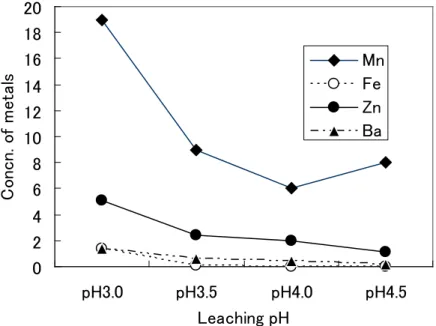
Aoki (2008a) reported the concentration of heavy metals containing zinc leached
from rubber infills such as SBR that are filled in the long-pile artificial turf by using
acid solution as the representative of acid rain. Zinc (Zn), Iron (Fe), Barium (Ba), and
Manganese (Mn) in the SBR infills were leached in acid solutions.
Figure 2 Leaching heavy metals from SBR infills.
Unit of concentration : Fe,Zn,Ba mg/L; Mn μg/L.
0 2 4 6 8 10 12 14 16 18 20
pH3.0 pH3.5 pH4.0 pH4.5
Leaching pH
C o ncn. o f m et a ls
Mn Fe Zn Ba
The concentrations of leaching heavy metals increased with an increase in the acidity of the acid solutions, as shown in Figure 2. The concentrations of Zn at less than 4.0 of pH, exceeded the Japanese effluent standard (2 mg/ℓ) (Ministry of Environment in Japan, 2006). The concentrations of Zn decreased with the aging of the SBR infills, and in the case of aging time greater than 1.25 years, the
concentrations of Zn were less than the effluent standard in Japan, as shown in Table 2. The leaching of Zn appeared to decrease with time and not to decrease to zero.
Table 2 Concentration of Zn leached from SBR infills with aging.
year pH3.0 pH3.50 pH4.0 pH4.5 0 5.1 2.4 2.0 1.1
0.67 3.0 1.4 0.74 0.38
1.25 1.1 1.0 0.83 0.57
4.0 1. 2 0.97 0.62 0.42
unit of concentration : mg/ ℓ
Aoki (2009b) reported the treatment methods for suppression of leaching zinc from SBR infills on artificial turf. The chemical and the physical treatments were investigated in order to remove zinc from the SBR : sulfuric acid, sodium hydroxide, and EDTA were used for the chemical treatment, and the super sonic method and the conventional heating were used for the physical treatment. In the case of the SBR infills without the treatments, the leaching concentration of zinc at pH3 exceeded the effluent standard (2 mg/L) in Japan. However, concentration from the SBR infills receiving treatments did not exceed the effluent standard.
6. Perspectives
This review outlined the artificial turf as sport environment, especially long pile artificial turf (third generation) as the football playing surface. Most third generation turfs consist of a carpet with tufted polyethylene yarns, with an infill of ground SBR in combination with silica sand. There are many concerns for the third generation such as high surface temperature, chemical leaching, and so on. Allgeuer et al. (2008) reported that the current trend is to use non-SBR infills to replace the current
SBR-based. They employed an energy absorption layer, called a shockpad underneath the carpet in place of SBR. Aoki (2008a) reported that the concentrations of Zn
leached from SBR coated with polyurethane (PU-SBR), ethylene-propylene rubber (EPDM), Eco-fill, and cedar tree bark as an alternative to SBR were less than the effluent standard of Zn in Japan. Also, Aoki (2008b) reported suppression of high surface temperature on artificial turf by using cedar tree bark as infill. By day time in the summer season (July 27, 2007), the surface temperatures on artificial turf with SBR and bark were 68 and 46 ℃ , respectively. This phenomenon is explained whereby the bark contains more water content than SBR, since bark is hydrophilic but SBR is hydrophobic. We should take into consideration hybrid of artificial materials with natural ones, and compatibility with the environment.
Acknowledgement
The author would like to thank Steve Jugovic (associate professor in Biwako
Seikei Sport College) for proof reading the present paper.
References
Allgeuer, T., Torres, E., Bensason, S., Chang, A., and Martin, J.(2008). Study of shockpads as energy absorption layer in artificial turf surfaces. Sports Technol.1(1):29-33.
Andreasson, G., Lindenberger, U., Renstrom, P., and Peterson, T.(1986). Torque developed at simulated sliding between sport shoes and an artificial turf. The American Journal of Sports Medicine,14:225-230.
Aoki, T. (2005a). Outdoor sports surfaces made from organic polymer were hot. Training Journal, No.312:38-39: (in Japanese).
Aoki, T. (2005b). Relationship between albedo and surface temperature of outdoor sport surfaces ,. Bulletin of Biwako Seikei Sport College, 4:105-111:(in Japanese).
Aoki, T., Matsuda, T., and Toyoda, K. (2005). Sport environments for children – Focusing on surface layer temperature of artificial turf . Bulletin of Biwako Seikei Sport College, 2:93-98: (in Japanese).
Aoki, T. (2006). Comparison of hardness on outdoor sport surfaces. Training Journal, No.320:32-34: (in Japanese).
Aoki, T. (2007). Gentle artificial turf to body. Encyclopedia of Sport Science, edited by Taguchi,S.:103-104: (in Japanese).
Aoki, T. (2008a). Leaching of heavy metals from infills on artificial turf by using acid solution. Football Science, 5:51-53.(http://www.jssf.net/home.html).
Aoki, T. (2008b). Suppression of high surface temperature on artificial turf by using the bark of a cedar tree. Monthly Sports Facilities Magazine, 37(13):44-48: (in Japanese).
Aoki, T., and Wakao, K. (2008). The relationship between the surface temperature and the volume of water ・・・ Comparison of artificial turf with natural turf.
Monthly Sports Facilities Magazine, 37(11):42-45: (in Japanese).
Aoki, T. (2009a). Effect of solar illuminance and albedo on surface temperature of outdoor sport surfaces. Nature and its Environment, 11:40-48.
Aoki, T. (2009b). Treatment methods for suppression of leaching zinc from SBR infills
on artificial turf. J. Environmental Conservation Engineering, 38(9):52-55: (in
Japanese).
Birkholz, A.D., Belton, L.K., and Guidotti, L.T. (2003). Toxicological Evaluation for the Hazard Assessment of Tire Crumb for Use in Public Playgrounds. J. Air &
Waste Manage. Assoc., 53: 903-907.
Bonfils, C. , Noblet-Ducoudre, N., Braconnot, P. and Joussaume, S. (2001). Hot desert albedo and climate change : Mid-holocene monsoon in North Africa. Journal of Climate, 14(7):3724-3737.
Buskirk, E.R., Loomis, J.L. and Mc Laughlin, E.R. (1971). Microclimate over artificial turf, National Assoc. Coaches and Directors of Athletics, 5(3):22-24.
Caldow, B. (2003). The Future of football fields. Sorts Law Administration & Practice, February:9-13.
Claudio, L. (2008). Synthetic turf---Health debate takes root. Environmental Health Perspectives, 116(3):A116-A122.
Culpepper, M.I. (1986). Thermal characteristic and temperature prediction of a selected artificial turf. Journal of the Alabama Academy of Science, 57(1):19-23.
Deutsche Norm (1991). DIN 18032, Teil 2.
Ekstrand, J., Timpka, T. and H a
・・gglund, M. (2006). Risk of injury in elite football played on artificial turf versus natural grass: a prospective two-cohort study. Br. J.
Sports Med., 40:975-980.
FIFA (2009). FIFA Quality Concept for Football Turf,
http:// www.FIFA.com/footballturf. (Accessed on 8/18/2009).
Fuller, C.W., Ekstrand, J., Junge, A., Anderson, T.E., Bahr, R., Dvorak, J., H a
・・gglund, M., McCrory, P., and Meeuwisse, W.H. (2006). Consensus statement on injury definitions and data collection procedures in studies of football (soccer) injuries.
Br. J. Sports Med., 40:193-201.
Fuller, C.W., Randal, R.W., Corlette, J. and Schmalz, R. (2007a). Comparison of the incidence, nature and cause of injuries sustained on grass and new generation artificial turf by male and female football players,Part 1: match injuries. Br. J.
Sports Med., 41:i20-i26.
Fuller, C.W., Randal, R.W., Corlette, J. and Schmalz, R. (2007b). Comparison of the
incidence, nature and cause of injuries sustained on grass and new generation artificial turf by male and female football players,Part 2: training injuries. Br. J.
Sports Med., 41:i27-i32.
Hartmann, L.D. (1994). Global Physical Climatology. Academic Press,New York, :24-28.
Honshik, K.A., Romeo, M.W., Hawley, C.J., Romeo, S.J. and Romeo, J.P. (2007).
Sideline skin and wound care for acute injuries. Current Sports Medicine Reports, 6(3):147-154.
Kandelin,W.W., Krahenbuhl,G.S. and Schacht, C.A. (1976). Athletic field microclimates and heat stress. Journal of Safety Research,8(3):106-111.
Katz, A. (2007). Artificial turf full of toxins that can cause cancer. University of Connecticut Health Center News, Nov. 11.
http:// www.uchc.edu/ocomm/newsarchive/news07/nov07/toxins.html. (Accessed on 8/14/2009).
KEMI (2006). Synthetic Turf from a Chemical Perspective. A Status Report, PM 3/06.
Kolitzus,J.H. (2007). Artificial turf surfaces for soccer. Study KR 6943, IST Switzerland (USSL), version Jun. 8, 2007.
Livesay, A.G., Reda,R.D., and Nauman,A.E. (2006). Peak torque and rotational stiffness developed at the shoe-surface interface. The American Journal of Sports Medicine, 34(3):415-422.
McNitt, S.A., Landschoot, J.P. and Petrukak, M.D. (2004). Evaluation of the playing surface hardness of an infilled synthetic turf system. Proceedings of International Conference on Turfgrass Management and Science for Sports Fields:74-84.
Ministry of Environment in Japan (2006a). Annual report for acid rain:67-68 :(in Japanese).
Ministry of Environment in Japan (2006b). Effluent Standards for Hazardous Substances :(in Japanese).
Monthly Sports Facilities Magazine staffs (2009). The merit of long pile artificial turf in multiple sport athletic fields. Monthly Sports Facilities Magazine,
38(5):4-9: (in Japanese).
Morgan, B. and Oberlander, M. (2001). An examination of injuries in Major League Soccer. The American Journal of Sports Medicine, 29(4):426-430.
Norwegian Institute of Public Health and the Radium Hospital (2006). Artifitial turf pitches ― an assessment of the health risks for football players, January 2006.
Orchard, J. (2002). Is there a relationship between ground and climatic conditions and injuries in football ?. Sports Med., 32(7):419-432.
Popke,M. (2002). The process of determining the forgiveness factor of athletic fields – both natural and synthetic – is packed with variables. Athletic Business Magazine, Sept. :54-66.
Smolders, E. and Degryse, F. (2002). Fate and Effect of Zinc from Tire Debris in Soil.
Environ. Sci. & Technol., 36: 3706-3710.
Tipp, G. and Watson, V.J. (1982). Polymeric Surfaces for Sports and Recreation.
Applied Science Publishers Ltd.,New Jersey,USA.: 9-259.
U.S.EPA (2008). Acid rain in U.S.EPA ; http://www.epa.gov/acidrain/index.html . (Accessed on 2/24/2010).
Valiant, A.G. (1990). Traction characteristics of outsoles for use on artificial playing surfaces, “Natural and Artificial Playing Fields: Characteristics and Safety Features”. Schmidt,R.C..edited, ASTM, Philadelphia USA.:61-68.
Verschoor, A. (2007). Leaching of Zinc from Rubber Infill on Artificial Turf. RIVM report, 601774001/2007.
Villwock, R.M., Meyer, G.E., Powell., W.J., Fouty, J.A., and Haut, C.R. (2009).
Football playing surface and shoe design affect rotational traction. The American Journal of Sports Medicine, 37(3):518-525.
Williams, F.C., and Pulley,G.E. (2009) Synthetic surface heat studies.
http://aces.nmsu.edu/programs/turf/documents/brigham-young-study.pdf
(Accessed on 8/21/2009).
総説
スポーツ環境場としての屋外スポーツサーフェスの現況
・ 主にサッカー場第三世代人工芝に焦点を当てて
青木 豊明
びわこ成蹊スポーツ大学 〒