Gathering and Releasing Animals : Reindeer Herd Control Activities of the Indigenous Peoples of the Verkhoyansky Region, Siberia
著者(英) Hiroki Takakura
journal or
publication title
Bulletin of the National Museum of Ethnology
volume 29
number 1
page range 43‑70
year 2004‑09‑30
URL http://doi.org/10.15021/00004008
Bulletin of National Museum of Ethnology 29(1): 43-70 (2004)
Gathering and Releasing Animals: Reindeer Herd Control Activities of the Indigenous Peoples of the
Verkhoyansky Region, Siberia
Hiroki Takakura*
追 集 と解 放
シベ リ ア ・ ベ ル ホヤ ンス ク地 域 にお け る 先 住 民 の トナ カ イ の群 れ管 理 の 実態
高 倉 浩 樹
Arctic Anthropologists have conducted theoretical studies in order to understand methods of reindeer herd control in Siberia. However, little
is known about how herders actually manage herds of reindeer in pasture
on a day-to-day basis. Based on data collected through fieldwork in North-
ern Yakutia, Siberia from 1994-1997, this paper examines the concrete pro-
cesses and distinctive features of reindeer herding activities as a case study.
The object of analysis is the professional herding brigade of a former State
farm. The rhythms of the seasonal migrations and their relationship to hus-
bandry activities are described quantitatively. I also outline the day-to-day
herding activities. Herding involves human-animal interaction: the herders'
interventions are gathering, catching, placing and releasing. Animal behav-
iours corresponding to the human activities are moving-in, grazing, resting,
and leaving. Taking into account the nature of the herd, I describe how the
day-to-day herding pattern is related to the seasonal migrations. The gen- eral principle of herd control in this case study is that herders allow a part
of the herd (riding reindeer) to supervise and lead (drive) the other animals.
* Center for Northeast Asian Studies, Tohoku University
(東北 大 学 東 北 ア ジ ア研 究 セ ン ター,国 立 民 族 学 博 物 館 共 同研 究 員)
Key Words : human-animal relationships, herd control, appropriation of space, dual struc- ture of herd, reindeer, Even, Sakha (Yakut)
キ ー ワ ー ド=ヒ トー 動 物 関 係,群 れ 管 理,空 間 の 領 有,群 れ の 二 重 構 造,ト ナ カ イ, エ ヴ ェ ン ,サ ハ(ヤ ク ー ト)
43
The different human attitudes to animals in herding activities result in a dual structure of the herd, which appears to maintain a homeostatic spatial exten- sion between animals and humans. It also corresponds to the herders' system of reindeer classification. Herders' gathering and releasing are crucial herd- ing activities which enable a space to be appropriated where livestock can be freely pastured.
シ ベ リア先 住 民 に み られ る トナ カ イ飼 育 の 群 れ 管 理 を理 解 す るた め 様 々 な理 論 的考 察 が極 北 人類 学 研 究 にお い て な され て きた 。 しか し なが ら,放 牧 地 にお い て毎 日実 際 に どの よ う に家 畜 の群 れが 管 理 され て い るの か そ の こ と につ い て の記 述 は少 な い。 本 稿 は,1994‑1997年 の シ ベ リア ・北 部 ヤ ク ー チ ア に お け る現 地 調 査 で 得 られ た 民 族 誌 資 料 に基 づ き,群 れ管 理 活 動 の 具体 的 な過 程 とそ こ に み られ る 顕 著 な 特 徴 を事 例 研 究 と して検 討 す る もの で あ る。 分 析 の 対 象 は,職 業 と して 牧 夫 が 雇 用 され て い た 旧 国営 農 場(ソ フ ホ ー ズ)の トナ カ イ飼 育 作 業 班(ブ リガ ー ダ)で あ る。 まず 季 節 移 動 の周 期 性 そ して そ れ ら と生 殖 管 理 活 動 との 関係 が 定 量 的 に 記 述 され る。 つ い で一 日を単 位 とす る 放 牧 活 動 につ い て 明 らか に され る。 そ こ で は ヒ ト側 に よ る追 集 ・捕 獲 ・配 置 ・ 解 放 とい う介 入 活 動 と, 対 応 す る動 物 側 の 移 動 ・採 食 ・休 息 ・離 散 とい う行 動 か らな る ヒ トー 動 物 問 の 相 互 作 用 が 伴 っ て い る。 さ ら に トナ カ イ の群 の性 質 に つ い て 考 慮 しなが ら,い か に一 日を単 位 とす る放 牧 活 動 パ タ ー ンが 季 節 移 動 と絡 み 合 って い る のか 記 述 す る 。 この事 例 研 究 にお い てみ られ る群 れ管 理 の 基 本 的 な 原 則 は,牧 夫 が 群 れ の一 部(騎 乗 トナ カ イな ど)に,残 りの家 畜 の 監督 と誘 導 を担 わ せ る と い う点 に あ る。放 牧 活動 に お い て様 々 な家 畜 へ の 関 わ りが組 み合 わ さ れ る こ とに よ り, 群 れ は二 重 構 造 とな り,そ れ は 人 と家 畜 の 問 のi亘常 的 な 空 間 の 維 持 と な っ て 出 現 す る 。 同 時 に そ れ らは トナ カ イ の分 類 体 系 と も一 致 して い る。 追 集 と解 放 と い う活 動 は,家 畜 が 自 由 に放 牧 さ れ る空 間 の領 有 を可 能 にす る根 幹 な の だ。
1 Introduction
2 The Verkhoyansky Reindeer Herders 3 Seasonal Migration and Related Labour 4 The Day-to-Day Pattern of Reindeer Herding
5 Two Groups of Reindeer
6 In Between Gathering and Releasing Herds:
A Way of Appropriating Nature 7 Conclusion
1 Introduction
Reindeer breeding° is an important topic in Arctic anthropology. Research areas
include the genealogy and typology of reindeer breeding (Sasaki 1985; Vainshtein
1970; 1971, Vasilevich and Levin 1951), reconstruction studies of traditional meth-
ods of subsistence (Krupnik 1993), and current issues regarding modifications to
Takakura Gathering and Releasing Animals
reindeer breeding under political and economic transition. To date, ethnographic studies have devoted many pages to describing scales of herds, herders' strategies of herd control, seasonal migration patterns, and local reindeer sex and age clas- sification systems related to husbandry activities (Bogoras 1975; Jochelson 1975;
Paine 1994; Popov 1966; Shirokogoroff 1933; Zhigunov 1968). Recently studies have emerged of post-socialist reindeer breeding practices centered on social and ecological issues (Anderson 2000; Fondahl 1989; Gray 2000; Ikeya 1999; Klokov 2000; Konstantinov 1997; Krupnik 2000; Stammler 2002; Takakura 1998; Vitebsky 1992; Yoshida 1997).
Whether studying traditional or modern settings, many anthropologists have presented theories to explain reindeer herd management methods. The reason for this is that reindeer are generally labeled as "half-tame," "half-wild," or "half- domesticated" animals in comparative research studies on nomadic pastoralism.
Such animals are allowed to graze freely with less human intervention than fully domesticated animals. Reindeer herding is therefore usually regarded as more simi- lar to hunting than other approaches to livestock husbandry, or as a form of free- range management or protective herding (Baskin 1991; Harris 1996; Ingold 1980).
Krupnik (1988; 1993) proposed two types of reindeer management: semi- nomadic hunting and herding in the taiga zone, and intensive reindeer herding in the tundra zone. Relating the tameness of the animals to the style of management, Ingold developed the symmetrical concepts of "milch pastoralism" in the taiga, in which humans and reindeer have an intimate relationship, and "carnivorous pasto- ralism" in the tundra, in which people and reindeer are unfamiliar with each other.
In milch pastoralism reindeer are not "herded": the animals are encouraged to roam in the vicinity of humans through the deployment of attractants such as salt, human urine and smudges. In carnivorous pastoralism the reindeer are unfamiliar with humans and "may avoid human contact for years" (Ingold 1980: 97, 238). Herders exterminate predators, such as wolves, and select individual reindeer for slaughter.
In neither case is daily herding necessary, and reindeer require less supervision in the pasture than domesticated animals (Ingold 1980).
In an overview of reindeer hunting and breeding in the Soviet/Russian North, Baskin outlined three systems of management used during the 20th century: (1)
"close herding
, defined as keeping reindeer in big herds" in the tundra and forest- tundra zones; (2) the "free-camp system, in which reindeer are kept in the vicinity of human settlements or camps"; (3) "loose herding, in which herders only periodi- cally gather scattered animals and move them to fresh pastures" (Baskin 2000: 24).
To account for these different systems, Baskin focused on differences between eth- nic groups, ecological-geographical conditions, and regional (administrative) set- tings. To some extent, other researchers adopted a similar classification of systems of herd management (Preobrazhenskij 1968; Syrovatskij 2000: 17-23; Zabrodin 1979: 172-177).
45
Many typological studies devote relatively little attention to detailed descrip- tions of herd control practices. The purpose of this paper is to examine the concrete processes of reindeer herding activities as a case study by conceptualizing some dis- tinctive features about that herding. The subjects of research are the current reindeer herders of the Even and the Sakha, two indigenous peoples who live in the Eveno- Bytantaysky District of the Sakha Republic in eastern Siberia.The term "herding"
refers to the day-to-day activities that are performed while the herd is in a seasonal pasture and during seasonal migrations, which are different from husbandry activi- ties related to the reproduction of the herd (Paine 1964). Herd control refers to how herders actually manage to manipulate aggregations of reindeer in pasture based on the relationship between human activities and animal behaviours (Tani 1986: 4). In particular, the term "herd control" emphasizes cultural aspects: the herders' under- standing, practice, and verbal expressions of herd management, rather than that of behavioural science.
What I describe is a principle of human-animal relationships that will quantify the behavioral interactions between herders and reindeer. This principle will take into account the relationship between external interactions and systems of manage- ment. Birch's idea of "follow the herds" (1991: 440) could be borrowed with some modifications. The herders in my field study obviously attempted to keep up with particular sets of reindeer, and therefore moved in a timely manner from the spring to the winter pasture. The core of this paper is to present and examine the herders' principle of "follow the herds" which maintains seasonal rhythms and patterns as its foundation. To this end, I will examine the observed behavioral data reflecting the herders' ecological knowledge and their attitudes toward the animals. During my field observations in Northern Yakutia, reindeer herders rarely undertook the day (or night) trip herding seen with other livestock raising systems involving fully domesticated animals3). However, they did have a kind of day-to-day herding pat- tern of their livestock. To examine the herders' principle of "follow the herd" is to define the day-to-day herding pattern. It may form a distinct pattern or it may, at first glance, seem to be merely a series of inconsistent actions. To my mind, under- standing their pattern of day-to-day herding will integrate complex and seemingly contradictory activities into one complete process.
2 The Verkhoyansky Reindeer Herders Methods of Research
Data were collected during my fieldwork in the administrative area belonging
to the village of Batagay-Alyta in the Eveno-Bytantaysky District4) in the north-
ern part of the Sakha Republic (Yakutia) in Russia. Fieldwork was carried out from
August to October 1994, from May 1995 to April 1996, and in August 1997. The
primary field data were gathered through participant observation and interviews in
Takakura Gathering and Releasing Animals
the herders' camp of the No. 3 reindeer breeding brigade of the former state farm.
My direct participant observation of that brigade lasted 170 days. The field surveys at the camp of the No. 3 brigade took place from August 28 to October 10, 1994;
May 26 to September 12, 1995; November 4 to 12, 1995; November 29, 1995;
December 3 to 4, 1995; February 28, 1996; and March 5 to 7, 1996. At that time six officially employed herders and one professional housewife worked in the brigade, and some families of herders occasionally came to and left the brigade camp. I also interviewed herders in other brigades, as well as villagers.
My focus is on herders' collective activities toward the herd of livestock that belonged to their brigade. A herder is, essentially, an independent individual who can work alone; each herder might engage in different herding activities and approaches to the individual animals. We recognize the herder's independence both in herding and, in particular, husbandry activities because they are directly related to individual property relations. The collective performance of herding can be con- ceptualized in a similar way.
People and history
In 1995 the village of Batagay-Alyta had a population of 1,734. The Even and the Sakha, two indigenous peoples, made up more than 90 percent of the population in a ratio of two to three respectively. Both speak Sakha as their mother tongue. At the time of my field research it was difficult to find fluent speakers of the Even lan- guage even among the older generations. It is said that the Sakha and the Even lived in separate communities in this region before the Socialist revolution. According to aged informants, the Sakha, at that time known as horse and cattle breeders, lived in semi-nomadic settlements along the Bytantay River. At the same time the Even lived a nomadic way of life with reindeer herds and some hunting in the mountains.
There were, however, a number of intimate cultural and social relations between the Sakha and the Even. For example, some of the former were reindeer herders and many of the latter could understand the Sakha language at the end of the 19th cen- tury. The Socialist regime changed traditional life in the latter half of the 1930s. The regime established collectivization, Cultural Revolution and resettlement policies.
These changes brought the two ethnic groups together into administrative villages.
These policies were introduced both in Sakha and Russian and brought about the contemporary language situation (Amosov 1997; Alekseev 1994a. See also Turaev 1997; Popova 1981).
The herders and villagers regard reindeer breeding as part of the culture of the Even. They also insist that the reindeer breeding terminology is in the language of the Even. In fact, it is a mixed vocabulary of the Sakha and the Even languages.
It is easier to identify the meanings of the terminology in a Sakha dictionary than in an Even one (Ugarova 1993; Dutkin 1990). Russian terms are also included in their idioms. In short, herders speak such a mixture in the context of the local
47
Sakha language.
The Even and the Sakha together have been engaged in meat production ori- ented reindeer breeding since collectivization was implemented in the early 1940s (See Kuriliuk 1969, 1982). Most reindeer breeding in this region is now managed by a profit oriented agricultural enterprise, which used to be the state farms). In 1995, 42 people were employed by the enterprise as reindeer herders. Work organization, and property relations of animal stocks and pasture basically follow the former state farm system. Reindeer herders usually have a residence in the village. Most of their families also live in the village, but herders set out to the pastures on long-term journeys to manage their livestock°.
Reindeer herding in this region corresponds to a "loose herding" type of man- agement (Baskin 2000). The herders belong to brigades (brigada/r/)7), working teams of reindeer breeders of six to seven male adults each, supervising reindeer herds owned by the enterprise. Each brigade usually includes a woman to serve as a
"professional housewife" (chuinrabotnitsa/r/)
, carrying out domestic activities and milking the does. There were six brigades, which were each insipidly designated by a ordinal number in the enterprise at the time of my field study, and each team man- aged approximately 1,500 head of reindeer. Brigada/r/ is an official term and people instead use the expression stado/r/ in conversation, a general term meaning herd or flock in Russian.
Not all reindeer are owned by the enterprise. Individuals own a small percent- age of the herd. According to herders, even in the Socialist period herders had per- sonal livestock. In the correct legal terms, however, during the socialist period this was called individual possession (lichnoe vladenie/r/), which meant only the right of use (Kuriliuk 1969: 20), while during the post-socialist period it is called private property (chastnaia sobstvennost'/r/). The herders took both of these legal terms to mean that the reindeer were their own property (sobstvennost'/r/). The individual herder's own livestock' were mixed into the state herd. This practice continues today. There are no individual/private herds as separate groups or any individual/
private plots of pasture in the territory of the state farm/enterprise. The system insti- tuted by the former government, where each territory had working teams outside the village and specified pasture usage was still in use at the time of my fieldwork.
Village and pasture
The Verkhoyansky Mountains are located in the western part of the Eveno-
Bytantaysky District. Taiga covers the hills and mountains, as well as the plateaus
in between. The altitude ranges from about 500 m to 1,500 m. Pastures are located
in the area of plateaus and mountains, while the villages are on a plain. The annual
mean temperature in this region in 1995 was 13.4 degree below zero and the annual
precipitation was 173.9 mm. The monthly mean temperature and precipitation in the
same year were —47.3C. / 6.1 mm in January and 16.8C. / 44.3 mm in July (these data
Takakura Gathering and Releasing Animals
were observed at the Verkhoyansk station, 67.6° N 133.4° E, which are provided by All-Russian Research Institute of Hydro-meteorological Information—WDC).
The village of Batagay-Alyta, which literally means the long narrow valley of the Batagay9), is located on a river terrace. The local population regards the settle- ment as embodying the modern material culture of Soviet civilization as evidenced by its central heating system and the House of Culture. The pastoral landscape sur- rounding the village is referred to as ojuur, which literally translates as "dense for- est." According to the vice-director of the agricultural enterprise (the head of the department of reindeer breeding), the pastoral landscape in the administrative area of the village was divided in the 1960s into six pastures, with boundaries corre- sponding to each brigade. A "Map of Reindeer Herders' Routes" (Karta marshrutov olenevodov/r/), drawn up by the institution "ROSGIPROZEM" in the 1970s, contained information on the seasonally-divided parcels for animal grazing, and the area, grazing capacity, desirable period of use, and so forth for each of the six pastures (See also Kuriliuk 1969: 47-51). The leader (brigadir/r/) of each brigade decides the annual route of his team and submits his plan to the vice-director and the office of the enterprise, as was also done during the Soviet period. The plan usu- ally consists of a list of names of rivers or place names with the anticipated length of stay. Each brigade, however, can change its route inside the boundaries of its pasture.
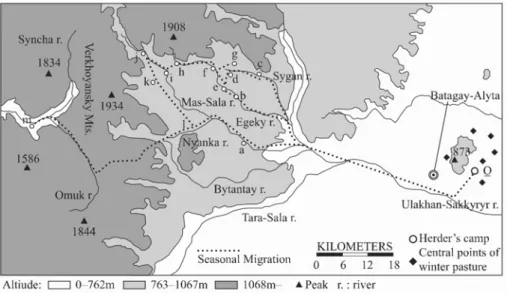
Figure 1 shows a map and Table 1 a list of the pastures for the seasonal migra- tion plan of a brigade from April 1995 to March 1996. It is the 3rd brigade whose herders I stayed with. The Verkhoyansky Mountains form a boundary between two types of pastoral terrain. The first type ranges over most of the area at the eastern foot of the Verkhoyansky Mountains. People call this type of pasture d'uonde, that is a bottomland with bushes, hills with grassland and small mountains. Herders can use it in all seasons. On the other hand the term edjgeen refers to a landscape of bot- tomland with larches and high mountains, such as we find at the western foot of the Verkhoyansky Mountains. According to A. Alekseev (1994b: 43), who conducted research on the Southern Verkhoyansky Even, their local terms differ slightly: they use d'uond'e and mein, respectively. Herders usually use this edjgeen or mein area in the summer. The herders' seasonal migration lies in east-west extensions, and the summer pasture is at a higher altitude than the other pastures. It resembles trans- humance in a narrow sense, as a seasonal migration between lower and higher lati- tudes. However, this summer-winter migration pattern can only be applied to some brigades. Other brigades move seasonally only inside the first type, d'uonde. The difference depends on the location of the pasture of each brigade.
When herding outside the village, herders set up camps along a river and usually refer to them by the river or stream name, or a particular place name. A camp consists of the living-quarters, an area called surt where the tents (palatka/r/, chuora, ylymy) are assembled, and the yard for domestic animals, called tiergen.
49
Figure 1 The pasture and seasonal migration of the 3rd reindeer working team of the agricultural enterprise in Eveno-Bytantaysky district of Sakha Republic from April 1995 to March 1996:
The herder's camps are the circle marked with letters of the alphabet, and there are fifteen
or sixteen campsites used in the course of the year (Table 1). The dotted line signifies a
seasonal nomadic migration route to the herders' camps.
The yard is a small plot for livestock that may or may not be enclosed. The two terms, surt and tiergen are not distinguished by location but rather are functional divisions in camp.
3 Seasonal Migration and its Related Labour
While the average size of the herd per brigade was 1,500 head, the number managed by the 3rd brigade was 1,416 head as of 15 October 1995. In addition, there were about 170 head owned privately by herders and villagers. At the time of the "Map of Reindeer Herders' Routes", the pasture allotted to the 3rd brigade covered an area of 84,063 hectares. It was divided into a winter pasture east of the village and a pasture for the other seasons west of the village. The length of the route through all the 15-16 camps used in the course of the year (Table 1) is about 340 km". The herders start the year's herding activities in a place known as Mongol at the beginning of April. They then move westward and climb over the Verkhoyansky Mountains in summer. They return the other way around in autumn, and stay in the winter pasture until the end of March.
When the herders migrate seasonally, members of the brigade travel together.
Some ride reindeer (uuchakh, a riding reindeer) and others harness animals
(n 'ougguhut or khos, a sledding reindeer) to a passenger-sledge (olokh syargga) or a
cargo-sledge (kotol syargga). In addition, some draft reindeer (undyy) with baggage
Table 1 Seasonal migrations of reindeer herders
Note: Day with * represents the date acquired from my interview to herders and the rest is the one from my observation. The Egeky 1 signi- fies the first camp at the Egeky River. Even though the campsites may be established at several different points along a river, herders do
not verbally distinguish between the camps but, instead, refer to them using the same river name. In order to make it clear which camp
I was referring to in camps of the same name, I named each camp with the river name and a number indicating the order of the stay.
are harnessed to riding reindeer or to a sledge. Even during the warmer seasons without snow, the cargo-sledge is used for carrying the herders' belongings and equipment. The type of domestic reindeer featured in this paper is the "Evenskie"
type (Zabrodin 1979: 89). The indigenous people in my research area also use this term. They distinguish it from the "Khargin" type saying that the Khargin type is smaller and has a darker colour on the back than their own Evenskie type.
Figure 2 shows the length of stay at each camp from April 1995 to March 1996.
The length of stay varies widely. Looking closely at the second phase, which lasts from the beginning of June to the end of July, it can be seen that there were many campsites in that period, signifying that herders moved quite often. They changed their campsites an average of every 6.4 days and the average distance between the camps was 7.2 km. The other phases of annual activity, with fewer camps, indicate less moving: herders stayed at camps in the first phase for an average of 33 days, 45 days in the third, 26 days in the fourth, and 145 days in the fifth. The frequency of changing campsites signifies the tempo of migrations, which is shaped by the seasonal herding and husbandry activities being performed.
Figure 2 Campsites and the length of the stay
The Roman numerals along the bottom of the graph divide the year and camps into the types of seasonal labor performed: I) counting and spring fawning; II) moving to summer pasture;
III) releasing to graze in summer pasture; IV) counting and slaughter; V) releasing to graze
in winter pasture.
Takakura Gathering and Releasing Animals
At the beginning of spring, herders first count the number of livestock in every sex-age grade and they divide the fawning females (suuma vazhenka) from the other reindeer (suuma muojka). This occurred at the Mongol campsite, which is equipped with a huge complex corral. The fawning females were driven on reindeer-back to the campsite, Egeky 1, separate from the main herd. The herders keep watch to protect the reindeer during fawning, and when it is over, they drive the unit to the campsite, Egeky 2, and merge it with the others, suuma muojka. While frequently changing campsites during this second phase of reindeer herding, members of the brigade worked during day and night shifts to keep all the livestock together until they drove the herd into the Omokchan campsite, from which the summer pasture extends. The third phase of the annual cycle is characterized by less livestock supervision. The herders released all the reindeer out to pasture and animals grazed, freely, without human intervention, except for some minimal riding reindeer. From early September, herders started to gather the reindeer which had scattered in all directions during the summer, collecting them into a single herd.
The fourth phase of the seasonal migration begins in the middle of September.
The herders staying at the Omokchan campsite drove the herd to the Nyanka camp- site. Moving the campsite from Omokchan to Nyanka, herders began searching for the animals which they had not been able to collect earlier. This continued until the end of October. Herders then drove their single herd to the Mongol campsites, where there is a corral. Livestock were counted again and some animals were selected for slaughter. Finally, in the fifth phrase, herders moved the herd to the winter pasture at the Chay-Yuria campsite, where the reindeer and herders spend the winter. While herders stayed at one lodge, they designated six winter pastures. The reindeer are driven to each pasture, one after another, during winter.
Herders' moving with livestock between the winter pasture and the summer pasture is, needless to say, a seasonal migration. They drive a single reindeer herd into different pastures. It is fairly easy to understand how herders keep the herd together during the drives. On the other hand, it is difficult to imagine how herders control the herd of reindeer when they are allowed to graze freely. During spring fawning, the selection for slaughter in the autumn, and summer/winter grazing, the herd is at the same campsite for an extended time. The question is, how do herders supervise or intervene to control the animals at these times? The reindeer number about 1,500 head. Do they try to keep them together as a single unit? Or is there an alternative herd control technique for such a large herd of reindeer? To ask the ques- tion is to examine a basic principle of day-to-day herd control on which seasonal herding and husbandry are based. In previous studies this pattern of herd control has been referred to only as a method needing less supervision, or as a method without day-trip herding, but a few illustrative examples will clarify the issue.
53
4 The Day-to-Day Pattern of Reindeer Herding
When the herders wake up in the morning, one or two of them go out from the camp in order to look for (kordoo) their herd. Herders find their animals grazing not far from the camp and drive (uur) them to gather (khomuj) in camp. Riding reindeer, herders drive them to camp (kel). Upon arrival, the animals rest or begin grazing in the unfenced yard (tiergen) of the camp. After a period all the herders leave their tents with lassos to catch (tut) their riding, draft and sledge reindeer (henceforth refer to as vehicle reindeer) and milkers (tyhy)"). Captured animals are brought from the yard to the living-quarters. Herders use these animals to conduct their tasks for the day, which vary depending on the day, the month and the season.
The rest of the animals are left (khaal) to rest or graze (mechchij) around the yard.
Herders sometimes walk around the animals to surround them and prevent them from leaving (khaaj). While the animals are in the yard, the milkers are returned to the herd after milking. Later on the animals are allowed to leave (bar) the yard, usually in the evening. When the animals are moving, they sometimes disperse in all directions or head in what herders believe is an undesirable direction. In that event, the men surround the animals on foot or on reindeer to lead (salaj) them into a desirable direction. Except for this kind of intervention, the reindeer are allowed to go their own way from the camp. When the vehicle reindeer return to the camp after working with the herders, they are also released (yyt) in the direction the herd has taken.
When herders leave camp to gather the herd in the morning they use riding reindeer, but even these reindeer are not tied in camp at night. Herders catch some riding reindeer on Monday, for example, for work both for that day and the next day, Tuesday. After finishing the day's work, herders lead reindeer both for that day and the next from camp in the direction in which the rest of the herd was released. A few kilometers from camp, herders release animals that were used on that day. However, those that were caught for the next morning may be tethered to a tree, bush or stones there. Herders sometimes fetter them with a tool called a chenki, or if there are more than three head, they tie a rope around the neck of each animal and then tie all the ends of the ropes together. According to herders, animals cannot move far with the use of such devices. The next morning herders retrieve those riding reindeer from the night before and then set about the daily gathering of the herd.
These herding activities are repeated, in general, throughout every season. The fundamental feature of this system of reindeer herding is that the herd is driven to a place in the vicinity of humans in the morning and then released from that place in the evening.
I will try to put some of these concepts in order so that the herders' activities
are more easily understood. In the order that they are performed they are (a) "gath-
Takakura Gathering and Releasing Animals