Fluid simulation is attractive because it is much faster than the kinetic simulation. However, it is known that classical fluid models, for example, two fluid model, cannot give accurate physical quantities such as transport level, as is also understood from the fact that the model includes viscosity coefficients as parameters.
In order to develop a fluid model with high accuracy, Beer et al. [1] developed a closure model, which is so called gyrofluid model. They concentrated on the unstable modes, and the closure coefficients are determined to satisfy the linear dispersion relation. However, Rosenbluth-Hinton [2]
pointed out that the transport level by this model is not accurate because zonal flow is not correctly treated. In order to correctly treat zonal flow (ZF) modes in the long time limit, Sugama et al. [3] developed a fluid closure.
In this study we develop new fluid code for the fluid simulation of tokamaks based on a mixture of above fluid closure models. That is, for unstable modes (finite k), we use a gyrofluid model [1], on the other hand, we use a closure model [3] for zonal modes (k=0). The models include physically valid coefficients so that it is expected that the simulation results such as transport level are comparable to those of kinetic result.
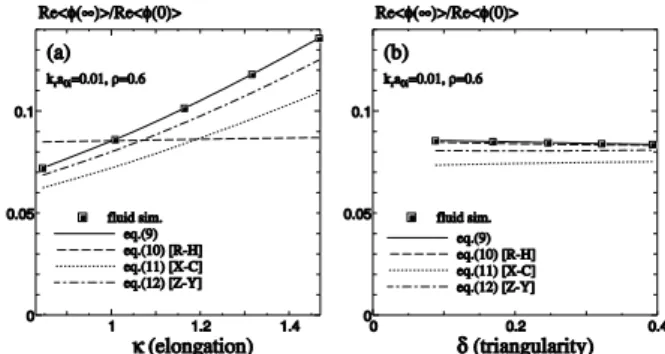
First linear benchmark is done for ZF and unstable modes respectively. In Fig. 1, residual ZF in the long time limit is plotted as a function of (a)elongation and (b) triangularity. It is shown that our fluid simulation result agrees well with a theory (sold line), and reasonably with theories (X-C and Z-Y). The elongation strongly affects the residual ZF while the triangluarity does not. Next, we show the bench mark for the unstable part with the Beer's closure model. In Fig.2, the linear growth rate of our linear simulation results are over-plotting in fig.5 of Beer et al.[1].
Here 3+1 model (4 field) is considered, and the results (dashed lines) agree well with open marks. The detailed results and other linear properties such as effects on the residual ZF of finite initial parallel flow and type of instabilities (ITG/TEM/ETG) are also found in Ref. 4.
From above, the linear bench mark works well for both closure parts of ZF and unstable modes. Then it is time to try nonlinear simulation by using a mixture of two closure models. However, there are some problems. One is that the high wave number region is not ideal for fluid model, and we need some models to avoid unphysical behavior in the high wave number region (ki~2-3).
Another problem is that the model does not include explicit viscosity terms so that the system is likely to become numerically unstable. Initial simulation result is shown in fig.3. Here the results with and without ZF closure [3] are compared. Although simulation time is not so long, the difference of two simulations is found just after the nonlinear saturation. Clearly the transport level is lower
with ZF closure. The detailed investigation such as comparison with typical kinetic results and numerical refinement for numerical instabilities will be needed in the next step.
Fig. 1. Residual ZF as functions of (a)elongation and (b) triangularity
Fig. 2. Bench mark of linear growth rate from fig. 5 of Beer et al.[1] and our resluts (sick dashed lines)
Fig.3. Energy flux with and without ZF closure.
1)M.A.Beer and G.W.Hammett, Phys.Plasmas 3,4046 (1996)
2) M. N. Rosenbluth and F. L. Hinton: Phys. Rev. Lett. 80 (1998)
3) H. Sugama, T.-H. Watanabe, and W. Horton: Phys.
Plasmas14 (2007) 022502
4) O.Yamagishi and H.Sugama, Phys. Plasmas 19, 092504 (2012)
389
§13. Fluid Simulation Study of Kinetic-fluid Closure Models
Yamagishi, O., Sugama, H.