Acta Med. Nagasaki 35:225-227
Graft Function Associated with Oxygen Free Radicals Immediately after Transplantation
Katsunobu KAWAHARA, Masao TOMITA, Hiroyoshi AYABE Takao TAKAHASHI, Seiji HONJOU, Hideki IKARI
Hiroshi HISANO and Santiago AKOSKIN
The First Department of Surgery, Nagasaki University School of Medicine.
Received for publication, June 25, 1990
ABSTRACT : Free radical formation on lung allografts was estimated in macrophages of the bronchoalveolar space, and monocytes of the pulmonary artery and pulmonary vein in terms of the different immunosuppressive drugs of cyclosporine and azathioprine.
It is elucidated that free radical formation is facilitated by macrophages of the bronchoalveolar space.
It is of interest to emphasize that cyclosporine plays a cytoprotective role in prevention of free radical formation.
INTRODUCTION
Since cyclosporine (CsA), a hydrophobic, fungal endecapetide of novel chemical structure, has been introduced over the past few years as
a potent immunosuppressive agent in the field of various organ allotrans plantations, the re- sults of organ allotransplantations were im- proved to get the long survivors with satisfac- tory graft function.
The purpose of this study is to clarify the reasons for improving the results of lung allografts by using cyclosporine and to elucidate the validity of the use of cyclosporine.
MATERIALS AND METHODS
Mongrel dogs were used for this study. A pair of dogs with almost the same body weight were selected at random. The dogs were given twenty- five mg/kg of nembutal sodium intravenously, endotracheally intubated and connected with a Havard respirator (10ml/kg in tidal volume and 16/min in respiratory cycle).
Each dog underwent thoractomy at the 5th intercostal space. The donor lung was prepared to pose the atrial cuff, where the pulmonary veins anchored.
A lung graft was orthotopically transplanted in the following order, first suturing the left atrial wall, anastomosing the bronchial stumps and then the left main pulmonary artery edges.
The dogs that underwent left lung allotrans- plantation were divided into two groups. One received 20mg/kg/day of cyclosporine every day group, the other of 5 dogs 5mg/kg/day of azathioprine every day.
Oxygen free radicals were measured as a mean values 6 hours following transplation as compared with those prior to transplantation by using DCFHDH according to Bass' Method').
Blood samples from the pulmonary artery and
vein were collected from the catheters
intraoperatively introduced to the pulmonary
artery and vein. At the same time as drawing
blood samples from each catheter, bronchial
alveolar lavage (BAL) was made with 100ml
saline, pumping 3 times to allow the collecting
rate of over 70 per cent.
RESULTS
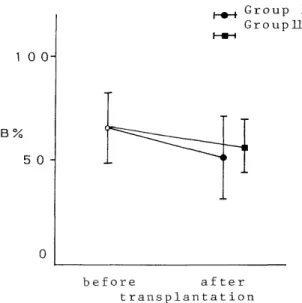
Oxygen free radical formation in macrophages was compared in accordance with the immuno- suppressive agents of cyclosporine (Group I) and azathioprin (Group II) as shown in Fig. 1.
The generation of oxygen free radicals after transplactation in BALF was enhanced as compared to that prior to transplatntation.
Oxygen radicals in Group II was inhibited rather than that in Group I, reflecting the action of cyclosporine.
Meanwhile oxygen free radical formation in monocytes of the pulmonary artery after trans- plantation did not vary as compared with that before transplantation and was almost the same between Goup I and II as shown in Fig. 2.
On the other hand, oxygen free radical formation in monocytes of the pulmonary vein following transplantion was apparently and suppressed as compared with that before and it was prominent in Group I as shown in Fig.
3.
Fig. 2. 02 production in neutrophiles of PA
Fig. 3. 02 production in neutrophiles of PV
Fig. 1. 02 production in macrophages of BALF
DISCUSSION
A graft function is mainly associated with a shortage of preservation time and warming ischemic time. Furthermore, it is well known that reperfusion injury is one of the main causes
to lead to a failure of graft function. The present investigation focuses on the injury to a graft at the time of restarting blood circulation 2). The
blood urgently perfused into cells at ischemic
state makes it possible to facilitate cell mem-
brane permeability'). Eventually it is accepted
that rapid influx of calcium into the cell is
induced'). Recent studies indicate that oxygen
free radical plays an important role in the injury
.