Acta Med. Nagasaki 26:9-14
Experimental Evaluation of Tumor Inhibitory Effect of Induced Infection on Tumor Growth
Yasunori KOGA, Masao TOMITA, Koichiro SHIBATA, Kazuhisa MATSUMOTO, Toshio ONITSUKA, Koichiro SAKODA,
Takami MAEDA, Shigehito HAMASUNA, Norio WAKE,
Masato SAKIHAMA, Hikaru TASHIRO, Yoshikazu MINE,
Susumu CHIYOTANDA, Yasunori MATSUZAKI,
Tsutomu YONEZAWA, Makoto YOSHIOKA
The Second Department of Surgery Miyazaki Medical College Received for publication, April 26, 1981
To evaluate as to whether coexisting infection is helpful to achieve the tumor regression, the inhibitory effect was experimentally assessed from the view point of sur- vival, the degrees of reticuloendothelial activation (Congo-red clearance test) and immune response (Jerne' plaque forming cell test and macrophage migration inhibition test).
A 3×10⁷ to 2×10⁸ of β‑streptococcus inoculated in C3H mice of 6 week‑old were
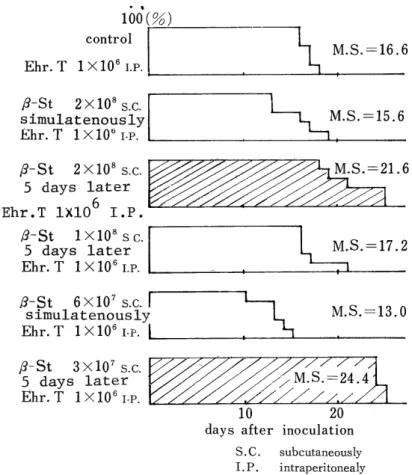
prepared for producing a varying models of infection. As a control study, survival chal- lenging for a 1X10⁶ of Ehrlich tumor inoculation was surveyed. It averaged 16.6 days, whereas it increased when added infection. The most longest survival was 24.4 days
when infection was provoked when a 3×10⁷ β‑streptococcus were inoculated subcutane‑
ously 5 days prior to Ehrlich tumor cell implantation. Phagocytic activity in the recticu- loendothelial system was found to be consequent of stimulation by the varying variety of infection.
To assess the inhibitory effect of induced infection on tumor growth, a directly weighing method was applied for inoculated methylcholantrene tumor at interval of 5 days. It is proved that infection is more effective in depressing tumor growth. Further- more, our experiment indicated that infection enabled the host to enhance the immune response to various antigen, which might be originated from the reticuloendothelial hy- peractivity.
As the result of this study, we concluded that a mild and long-standing infection might play a key role in inhibiting tumor growth to some extent.
古 賀 保範,富 田 正 雄,柴 田紘 一 郎,松 本 和 久,鬼 塚 敏 男,迫 田耕 一 朗,前 田 隆 美 浜 砂 重 仁,和 気 典 雄,崎 浜 正 人,田 代 光,峰 義 和,千 代 反 田 晋,松 崎 泰 憲 米 沢 勤,吉 岡 誠
INTRODUCTION
An effective treatments for various cancer comprise surgery, irradiation, chemo- therapy and immunotherapy in common. Recently immunotherapy has become an in- creasingly popular in the treatment of cancer. Based on far advancing immunology, it is certified that the enhancement of the immune response to tumor-bearing host plays an important role in enhancing cancer therapy.
In 1958, BUSCH'> had reported the facts that erysipelas might be possible either to reduce the coexisting cancer tumor in size or to completely eradicate it on occasion.
And also these results are considered to be based on the subsequent immunological en- hancement to some kinds of infection.
It is logical to assume that bacterial or viral infection are possible to carry the inhibitoy status against coexisting tumor growth. As previously described')') even in the surgical treatment of lung cancer, the incidence of an accidental pyothorax during a postoperative period of time may be beneficial in producing an inhibitory effect on a growing recurrent tumor. On this basis, it is desirable to identify the role of concomi- tant infection against the tumor in the tumor-bearing host.
The aim of this study is to evaluate as to whether concomitant infection to tumor- bearing host is capable for preventing tumor growth or not.
MATERIAL AND METHOD
Animal used for this experiment were C3H mice of 6 week old. Ehrlich ascites tumor cells supplied from Shionogi Research Lab. were inoculated intraperitoneally with a rate of one x 106 viable cells.
As a control study, the survival after inoculation of Ehrlich tumor were observed in comparison of those of induced infection.
Infection induced experimentally in this series were prepared with 1 x 10⁶, 3 x 10⁷, 1 x 10⁸ or 2 x 10⁸ o f ,S-streptococcus inoculation in every 10 mice given either subcutane- ously or intraperitoneally. The severity as well as the existing timing of infection were evaluated as to the inhibitory effects on tumor growth.
In assessing the reticuloendothelial activity, its ability of the Congo-red clearance was tested according to almost the same with Halpern' method4) except for the use of Congo- red as an indicator. A 0.2ml of 1% Congo-red was injected intravenously from the tail and blood samples were correctly taken at intervals of 5 and 30 minutes after Congo-red in- jection. The containing Congo-red concentration in each samples were measured with the electrospectrophotometry (540m,u), followed by the treatment of hemolysis with 4 ml of 0.83 % NH4C1. Corrected granulopectic index was calculated as the following formula
a= W W a : Corrected granulopectic index, W : body weight, WL+S .
L+S
weight of the liver and spleen, K : granulopectic index.
The tumor growth rate was indicated by means of weighing tumor mass at interval of every 5 day followed by a 3 mm' methylcholantrene inoculation in comparison of a growing tumor inhibitory effects with the induced infected and not infected mice.
The attitudes of immunocompetency of the infected mice were evaluated by the techniques of Jern's plaque forming cell modified by Cunningham 5) and macrophage migration inhibition6).
RESULTS
The inhibitory effect on Ehrlich' tumor growth were compared to a variety of in- fection modes produced by Q-Streptococcus inoculation with the different timing and routes in origins o f its induction.
Survival rates were presented in Fig 1. In the control group with 1 x 10⁶ Ehrlich cells of inoculation intraperitoneally, a mean survival showed 16.6 days. The longest survival was 24.4 days of 3 x 10⁶ 8-Streptococcus inoculation given subcutaneously prior
Fig 1. Comparison of survivals in a 1 x 10⁶ Ehrlich tumor-bearing mice infected with n-streptococcus S23 in relation to either its timing or mode.
to 5 days preceding to Ehrlich tumor cell inoculation. The next longer survival was of subcutaneous 2 x 10⁸ S-Streptococcus inoculated 5 days before tumor inoculation and a mean survival was 21.6 days. On the contrary, the shortest survival was 13 days which was far short as compared to the controls. The most inhibitory effects against tumor growth was observed when 3-Streptococcal infection was evoked 5 days prior to tumor inoculation.
During a period of 5 or 7 days after completion of 3-Streptococcal infection through either the subcutaneous or the intraperitoneal routes, their phagocytic activities were obviously activated as indicated in Fig 2. When compared to the two routes of in- duced infection, they showed the considerable difference from the activating period of time. The subcutaneous route was superior to the intraperitoneal one and it continuted to keep it longer for a period of 15 days. It was approximately concord with the results of survival study against tumor growth.
The tumor growth rate was measured by weighing the tumor mass excised at every 5 days interval after a 3 mm' of methylecholantrene inoculation. The tumor growth rate obtained from this technique was noted to be proportional to the elapse of time. When pretreated with a 108 S-Streptococcus inoculation, the tumor growth was appearently in-
hibited during a period of 10 to 15 days following tumor inoculation. This comparision resulted in a 25% reduction of tumor weight on day 10 and a 27% on day 15 in the infected mice as presented in Fig 3.
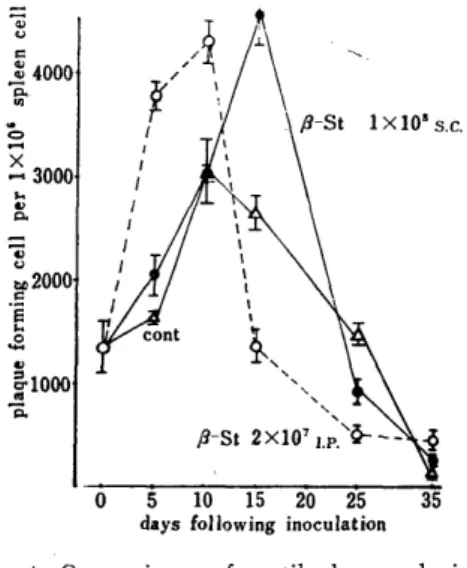
As the result of Jerne' plaque forming cell test, the immune responses of the host was clearly enhanced in the infected mice. A maximum of the immune response was not similar between intraperitoneal and subcutaneous routes as shown in Fig 4. When infection was induced through subcutaneous S-Streptococcus inoculation, the immune response of mice was slowly enhanced rather than used intraperitoneal route. The maximum of its responses appeared on day 10 in
intraperitoneal route and on day 15 in subcutaneous route respectively.
Viewed from macrophage migration inhibition test, the responses assessed by it corresponded with those by plaque forming cell test with significant enhan-
Fig 2. Changes in phagocytic activity in C3H mice infected with a-streptococcus S23
Fig 3.. Comparison of the methylcholantren
tumor growth rate (3 x 3 x 3mm inoculation)
Fig. 4. Comparison of antibody producing spleen cells (Jerne' plaque forming
cell test) between intraperitoneal and
subcutaneous j3-streptococcus S23 in-
fection
Fig 5. Comparison of % inhibition of macro- phage migration between intraperitoneal
and subcutaneous a-streptococcus S23 infection
cement when compared to the controls and the subcutaneous route was more pronounceable rather than the intraperitoneal one as indicated in Fig 5.
COMMENT
When infection exists in tumor-bearing host, the attitudes of the host resistance against tumor growth were experimentally evaluated. On the survival study using Ehr- lich' tumor inoculation to mice, the severity of infection in relation to infectious routes and its timing directly influenced survival rate.
The favorable survival of tumor-bearing mice was obtained from preexisting infec- tion prior to tumor inoculation as well as from subcutaneously induced infection.
It is suggesting that mild degree of infection may be of some benefit in enhanc- ing the immune response and also the preceding infection is necessitated, moreover, a long-standing and weak acting infection are assumed to be necessary for anticipation of tumor growth inhibition as the result of this study. Phagocytic activity of the reticulo- endothelial system was representative as the congo-red clearance ability. As a conse- quence it was proved to be in proportion to survival rate. This result clearly indicated that reticuloendothelial hyperactivity afforded the enhanced immune reaction. As to validity of infection to enhance the immune response, we can reasonably attribute it to the stimulation in reticuloendothelial system. Furthermore, it is interest to note that subcutaneous route for infection cause for prolonged and vigorous stimulation rather than intraperitoneal one and its route is effective in giving a potential inhibition of tumor
growth.
On observation in tumor growth curve of methylcholantrene, the inhibitory effects of infection on tumor experimentally were presented during an interval of 15 days.
And the immune responses induced by infection were propagated during a period of the similar time interval as previously observated. From the result described here, it is con- cluded that infection allows tumor-bearing host to enhance the immune response to tu- mor growth as well as to stimulate the reticuloendothelial system activity. It, moreover, is our conviction that infection must be mild and long-standing. These findings were consistent with the concepts that bacterial toxins or extracts might serve as an enhance- ment of host immune response, suggesting a modified Schwarzman reaction').
REFERENCE
1) BUSCH, W: Niederrheinische gesellschaft fur Natur and Heilkuncle in Bonn. Sitzung der Med Section 13: 1867, 1958.
2) SENSENING, DM: Result of the surgical treatment of bronchogenic carcinoma. Surg.
gynec and Obst. 116: 279, 1963.
3) Le Roux B. T: Empyema Thoracis. Brif. J. Surg., 52: 89, 1963.
4) HALPERN, B. N : Quantitative study of the granulopectictic activity of the reticulo- endothelial system. Brit, J. Exp. Path. 34: 426-440, 1953.
5) CUNNINGHAM, AJ and SZENBERG, A: Further improvements in the plaque technique for detecting single antibodyforming cell, Immunology 14: 599-600, 1968.
6) GEORGE, M. and VANGHAN, JH: In vitro cell migration as a model for delayed hypersensitivity. Proc. Soc. Exp. Biol. Med., 111: 514, 1962.
7) HAVAS, H. F.: Mixed bacterial toxin in the treatment of tumors. Cancer research 18:1141, 1958.