2
Trends and Issues in Research on Context Awareness Technologies for a Ubiquitous Network Society
Akihirio Fujii Information and Communications Research Unit
1 Introduction
The coming years may see the creation of the environment referred to as a “ubiquitous network society” or “ubiquitous information society,” in which an inconspicuous system of computers provides diverse types of information to users in various everyday surroundings. The u-Japan Strategy, which is being promoted under the leadership of Japan’s Ministry of Internal Affairs and Communications (MIC), describes efforts to realize this kind of environment in the following terms[1]:
• Utilization of ICT without the user’s awareness, e v e n t h o u g h t h e n e t w o r k i s p r e s e n t everywhere around the user (in other words,
“ubiquitous”).
• Realization of person-to-object (P2O) and object-to-object (O2O) communication by linkage of various objects.
Although the technologies for realizing this k ind of environment span a diverse range, in par ticular, “use of ICT (information and communication technolog y) without user’s awareness” is realized by the field of technology referred to as “context awareness technology.”
Wit h t h i s tech nolog y, a s y s tem obt a i n s information from numerous sensors arranged in the home, workplace, cities, and other spaces where people engage in everyday activities. This is used to determine the details of the user’s actions and the constantly-changing condition of the environment, that is, “context.” The system then performs the service of providing useful information to the user at appropriate times. To
realize this kind of system, the user’s actions must be recorded in detail in a computer or by third parties, and in some cases, background information on the user is also registered in the computer. The computer infers the user’s current condition, intentions, and so on by comparison with this accumulated information and creates various kinds of convenient communications.
H o w e v e r , b e c a u s e c o n t e x t a w a r e n e s s technologies are preconditioned on the fact that details of the user’s actions which are intimately related to his or her everyday life are constantly registered in the computer, there is also a danger that the user’s personal information may be processed “without the user’s awareness.”
Several vendors in Japan have already begun to propose packaging of services based on context awareness technology. These technologies are frequently marketing using comfortable-sounding expressions like “mimamori” (watch over and protect), but from the viewpoint of R&D, the word that describes this process of continuously obtaining information on a person’s behavior is “surveillance,” which does not include any nuance of “protection.” When discussing the potential of a technology, it is perhaps natural from the standpoint of R&D to emphasize the positive in this manner. However, in order to realize “use of ICT without the user’s awareness,”
it is necessar y to accumulate, manage, and m a n ipu l a t e t h e i n fo r m a t i o n o b t a i n e d by mimamori. Thus, this technology can contribute to information management for the purpose of
“monitoring” users. Moreover, if this information is misused by third-parties, the damage may be more serious than a simple leak of information.
When considering this technology, this point will
require increased study in the future as a factor which may be an obstacle to enjoy the potential convenience provided by this technology.
This paper presents an outline of context awareness technology, and describes the research issues which will be key to the future progress and social acceptance of the technology and the creation of new applications. This is currently a f ield of i ntense R & D activ it y, a nd some technologies are already on the path to practical appl ication. However, the most i mpor tant challenge in this field is considered to be the implementation of a safe, secure infrastructure for distribution of “context,” which reflects the behavior history of individuals. In R&D in this area, study from diverse viewpoints will be necessary, including system design.
It should be noted that this paper is not the result of a comprehensive survey of research activities. In the following, first, how the context of behavior is treated by computers will be explained to help the reader understand the field under discussion. Next, typical examples of system implementation will be presented and research trends in this field will be introduced.
Based on this, the importance of the context operation infrastructure will be described from the viewpoint of creating an environment for realizing a ubiquitous network society.
2 Outline of context awareness technology
2-1 Definition of “context” and context information processing
Dictionaries generally define “context” as related ci rcu mst a nces or backg rou nd a nd
“awareness” as knowledge, self-consciousness, recognition, conscious, consideration, or the like. On the other hand, for research purposes,
“context awareness technology” is frequently defined by citing the definition proposed by the pioneering researcher Dey et al., namely,
“Context is any information that can be used to characterize the situation of an entity. An entity is a person, place, or object that is considered relevant to the interaction between a user and an application, including the user and applications themselves.”[8]
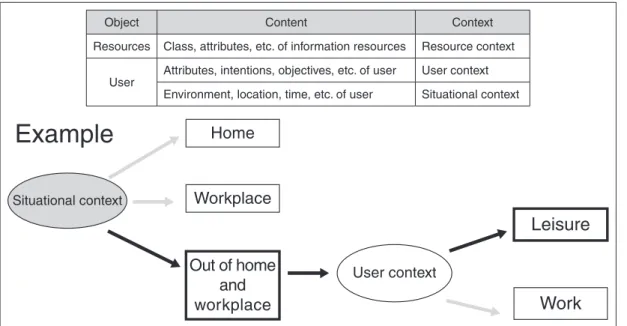
Figure 1 shows an example of the classification of context. Context can be broadly classified into “resource context,” which is related to information resources such as image contents, as represented by motion pictures, and the user’s context. The user’s context can be further divided into “user context,” which expresses the attributes of the user’s intentions, the intention of current behavior, and the like, and “situational context,” which concerns the situation in which the user is placed, weather and location, time, and so on.
Object Content Context
Resources Class, attributes, etc. of information resources Resource context
User Attributes, intentions, objectives, etc. of user User context Environment, location, time, etc. of user Situational context
Example
Situational context
Home
Out of home and workplace Workplace
User context
Leisure
Work
Figure 1 : Classification and examples of context
Resource context expresses, for example, the classification of a movie as horror or love story, the status of the copyright of the contents, etc., while examples of user context might express whether a certain user is currently working or not, in a meeting or not, or similar information.
Examples of situational context include the user’s location and the weather at that location.
In the example in Figure 1, using the two items of information showing the situational context and the user context, the user’s situation can be interpreted as currently being out of the house or workplace on “leisure” and engaged in shopping or some similar activity. Generally, context is expressed by a “state transition diagram”
showing transitions between states with defined limits, and software is created on this basis.
Contexts are then accumulated and processed as successively changing data within the limits prescribed by the software. The above is an extremely simplified example, but if each context is further subdivided, it would be possible to provide a variety of services corresponding to the diverse states which the user can take. Recent years have seen intensive R&D on this subject. At present, the main targets are behavior modeling, development of context extraction methods and state transition software, and packaging of these functions in actual mobile devices and other equipment. [2,4,10]
2-2 System overview
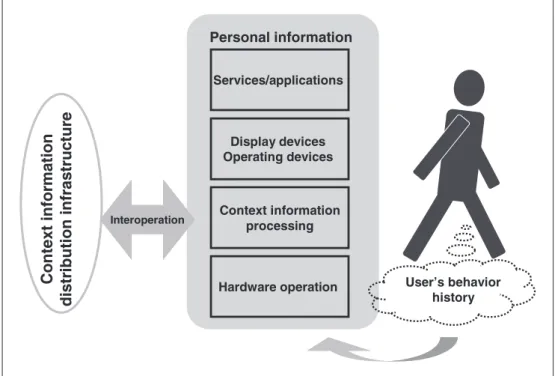
Figure 2 is a conceptual diagram showing an overview of the configuration of a system which provides information ser vices based on the user’s behavior history using context awareness technology. The lowest level in this hierarchical structure is “hardware operation,” meaning control of the large number of sensors located in the user’s home, office, and elsewhere, the mobile device carried by the user, etc. Based on the raw physical data obtained from this hardware and other sources, the information which forms the basis for the state transitions of constantly-changing contexts is supplied to
“context information processing,” which is the next highest level.
The next level above this is “display device/
operating device,” meaning the devices which actually provide information services and other functions. Conceivable display devices include the user’s mobile device, monitors installed in the environment, information display devices, and others. Services and applications, which are assumed to be the highest level, go beyond simple information display and also envision services accompanied by operation, for example, of home appliances. Future possibilities include remote operation of robots and autonomous operation in response to context. The function of these operating devices is termed “information
Figure 2 : System overview
actuation,” and is considered one key technical trend when describing the future direction of a ubiquitous network society.[18]
The information treated through the system as a whole cor responds al most enti rely to
“individual information.” For this reason, the most important issue for R&D is improvement of functions for dealing with information leaks and unauthorized use by outside parties. This will be discussed in the following section.
2-3 Distribution infrastructure for context information
Cases in which third parties such as internet service providers supply a certain service having some type of added value using the user’s context are conceivable. In this, as shown in Figure 2, interoperation of context information with the external “context information distribution infrastructure” is performed via a public network, local area network, or other communications network. What kind of social infrastructure will be necessary in order to provide various services for the user utilizing context in formation ? Because this field is still in the research stage, it is not possible to draw up a definitive blueprint.
Generally speaking, however, it is considered possible to rea l i ze a model of a tech n ica l infrastructure which enables distribution of context information by dividing the system into three functional levels, as shown in Figure 3,
“Conceptual diagram of a context information distribution infrastructure.”[3,17]
Fi rst, at the “user i nter face tech nolog y”
level, applications of some type are provided
to the user. To configure these applications, it is necessary to combine the different contexts shown i n Fig. 1, that is, resou rce context, user context, situational context, etc. This combination is called a “view.” Views specialized to designated users are configured in each application, and are used to call the designated functions.
Next, at the level which provides “middleware technology,” functions for creating various kinds of contexts, functions for storing those contexts and retrieving them when necessary, and others are provided. To materialize this functional level as social infrastructure, common international standards for methods of configuring contexts will be necessary. International standards have still not been clearly specified for this area. At present, however, it is considered possible that the technical infrastructures called “Web Service”
and “Semantic Web” will play the main role in the provision of services using context awareness technologies.[20]
As technologies which provide functions for interoperation of information resources, technical systems are already available in the form of the above-mentioned “Web service” and “Semantic web.”
Web Service is a technical framework for linkage and interoperation, in which software applications which have been constructed in accordance with certain rules are made available on a network. Browsing of application functions i s descr ibed i n a m a rk up l a ng u age ca l led XML (eXtensible Markup Language), enabling automatic processing by computers.
User interface technology Middleware technology Network technology
Composition of views for each application
Creation of context Storage/retrieval
Context distribution Data distribution
Context information distribution infrastructure Figure 3 : Conceptual diagram of context information distribution infrastructure
S e m a nt i c We b, o n t he o t he r h a nd , i s a framework for efficient information processing which treats the entire web as a giant database.
T he contents a nd processi ng methods for individual databases are described as “metadata,”
and this is used in interoperation of DB.
Fi n a l ly, t he “net work tech nolog y” level provides a function which distributes the “data”
and “contexts” obtained from the sensor network, etc. as physical signals. In this, an existing communications infrastructure such as the internet is used.
M a t u r i t y o f t h e c o n t e x t d i s t r i b u t i o n infrastructure shown in Figure 3 will enable interoperation of contexts between the database which stores user context, and the ser vices required by users and databases of various types of resource context, which are the elements of applications. Improvement of this infrastructure also has the potential for the development of new ser vices and applications. Accordingly, i mpr ove me nt of t he contex t d i s t r i but ion infrastructure is also considered extremely important for a ubiquitous network society.
Howe ve r, i n i mple me nt i ng t h i s t y p e of information distribution infrastructure, failsafe handling of personal information must be a key consideration. At present, the international st a nd a rd i zation or ga n i zation for i nter net- related technologies, W3C (World Wide Web Consor tium), is studying a standard called P3P (Platform for Privacy Preferences) as a standard for handling personal information on networks. At present, this is the main standard internationally. This standard describes policy related to privacy in XML, and is available on networks in a form which can be processed by computers. In systems which follow the P3P standard, this policy is interpreted automatically, and restrictions are placed on the extent of use of personal information.[15]
In recent years, the recommendations of W3C alone have been considered inadequate, a nd f u r ther development of th is has been p r o p o s e d .[ 7,11 ] A s o n e a s p e c t o f R & D o n information security, there is pressure for a solution to the problem of newly-registered threats, which sometimes appear to be a endless game of “whack-a-mole.” A large number of
research and development problems in this connection must be solved in the future.
2-4 Possibility of creating new services
Nex t, let u s con side r t he po s sibi l it y of developing the existing context awareness technology to new ser vices. In cell phones, services using user context have already begun.
For example, the author’s cell phone screen has a permanent cartoon character personifying an animal and displays messages based on local topics during trips. It also gives comments, depending on the number of times used and the timing of use. At present, these are only trivial functions intended to create a feeling of psychological bonding with the car toon character, and have no functions that make more detailed use of context than this. Nevertheless, this example highlights the fact that continuous operation of sof t ware on a cel l phone and mon itor i ng of the user’s position a nd use information is quite easy. Technically speaking, it would be a simple matter to use this kind of information in more advanced information processing for marketing and others.
The potential conveniences which can be realized by using context can be outlined as follows. First, from the user’s viewpoint, the following support functions are possible: (1)
“Memory-related support,” for example, in jogging the user’s memor y and urging attention, (2)
“Judgment support,” by providing information to support the user’s judgments when faced with a choice of actions, and (3) “Support for action,” by providing information for assistance or cooperation in the user’s current action when the user is actually involved in some action. On the other hand, from the viewpoint of services, context awareness systems have potential for the following services: (1) Services responding to changes in location accompanying the user’s movements, (2) Services involving acquisition of t he u ser’s beh av ior h i stor y a nd supply of corresponding information, (3) Ser vices responding to changes in the environment, such as weather and temperature, and (4) Services involving autonomous calling of other services based on the context state.[11,14]
3 Examples of research on context awareness technologies
As examples of research on context awareness technologies, the author visited and conducted a survey at the Media Lab at Massachusetts Institute of Tech nolog y ( M IT ) i n the Un ited States, which is conducting advanced research. The following describes research being carried out as integrated research combining architecture and computer science under the name “Home of the Future.”[9,10,16]
(1) Example of research on office environments In the future, our mobile devices may be used to send an increasingly large number of messages to users. In addition to voice mail and email sent by persons, messages also include those generated automatically by computers and other sources. These messages pressure the user to make a rely or some other response, increasing the load on the user. Therefore, research applying context awareness technologies is being carried out in connection with messages which arrive frequently at mobile devices with the aim of alleviating the psychological load on the users who must process these messages.[9]
F o r e x a m p l e , w h e n a u s e r i s s t u d y i n g the content of work with colleagues in the workplace, he or she wou ld not want that conversation to be interrupted by a telephone call from a friend about leisure plans for the weekend.
However, if a message with the same content can be displayed on a terminal at an appropriate break in work, the same person would feel no reluctance to reply. This research is attempting to provide a function which will analyze the context of the user’s activities during work and adjust the timing at which messages are displayed.
(2) Example from the living environment
T he nex t example is par t of a long-ter m research project which integrates architecture and computer science in a similar way. Assuming a living environment with an extensive sensor system, the work focuses on the development of a mobile device for use in that environment.
The aim of this research is to support healthier ever yday l i fe of users by applyi ng context awareness technology to a terminal (mobile device) in order to control home appliances such as televisions and the like. The terminal includes multiple functions on a single operating screen by adding an email display function and others to an operating screen for television channels, stereo equipment for enjoying music, and similar devices. Figure 4 shows a terminal and a scene in which the terminal is being used in the kitchen.
Particularly in the United States, physical exercise is recommended as an alternative to television viewing because increased time viewing television is thought to contribute to obesity and adult diseases. On the other hand, from the viewpoint of personal freedom of action, a certain amount of time for entertainment is also necessary in everyday life. This terminal is intended to promote natural calorie consumption by encouraging actions other than television watching by an unobtrusive method which users find acceptable. Examples of calorie-consuming activities which are possible with this system include exercising with music and cooking, cleaning, or other housework.
In this environment, as shown in Figure 5, diverse kinds of sensors are installed in the indoor living area, for example, on furniture doors, and actions such as “opened cabinet door”
are recorded successively. However, because this record of actions is only a simple enumeration of data, processing at the next highest level is necessary. One research target is to create meaningful user context from this accumulation of data. In addition to this example, active research of this type is being carried out in Japan Figure 4 : Terminal for operation of home appliances and
scene of use (see also color illustration on cover) Source: MIT Media Lab. Home_n: house of the future
and other countries.
In the examples of research and development at MIT, the potential for significant changes in conventional lifestyle patterns supported by new technologies has attracted considerable attention.
One motive for R&D is a new way of thinking that anticipates the following changes in attitudes towa rd hea lt h ma nagement. T h is is bei ng reflected in system design concepts.
(1) From treatment to prevention: Change in the purpose of medicine.
(2) From patient to healthy (asymptomatic) person: Response to elderly persons and presymptomatic persons, etc.
(3) From hospital to home: Change in the location of health care.
(4) From periodic examination to real time:
C h a n ge i n t h e m e t h o d o f o b t a i n i n g information on diseases.
I n o t h e r wo r d s , t h e s e v a r i ou s c h a n ge s represent a shift in focus from treatment of disease after it has occurred to constant efforts in ever yday life to prevent disease. This is considered effective, particularly with adult diseases. To express the response to these changes, the MIT project has proposed the concept “proactive.” As the word suggests, this is a way of thinking that anticipates conditions.
This is also a keyword that accurately expresses the image of the new living environment made possible by context awareness technology. Where medicine is concerned, the need for this kind of change has been pointed out for some time, and actual technological support will become possible with the prog ress i n i n for mation processing technology, as represented by context awareness technology.
4 Issues for context awareness technology
Ubiquitous network-related technologies span a diverse range. However, the context awareness technology described up to this point is the basic technology for ubiquitous networks. Accordingly, the issues in this technical field correspond directly to numerous topics in research related to ubiqu itous net works. A mong the issues for R& D on context awareness technology, the following discussion focuses on the two viewpoints of “protection of privacy” and “design of applications,” which are the most important of these issues.
4-1 Protection of personal information (privacy)
Because context awareness tech nologies h a nd le d e t a i le d i n for m at ion on p e r s on a l behavior, measures to prevent leaks are an essential consideration. Users may willingly provide some personal i n for mation to the system if this will make it possible to realize a better living environment for themselves.
Because the purpose of this technology is to create a better environment, the major premise is that monitoring of personal behavior and the environment will basically be performed with benevolent intentions. Needless to say, however, a system which is based on this premise will be extremely vulnerable to unauthorized intrusions for ma levolent pu r poses. For t h is rea son, innovation aimed at minimizing leaks of personal information is necessary.
Naturally, study from this viewpoint has already Figure 5 : Examples of sensors installed throughout the home
Source: MIT Media Lab. Home_n: house of the future
begun. For example, at minimum, reliability at the physical level is demanded in sensors and mobile terminal devices. Under conditions in which an information network is used in the home or an organization, it is necessary to prevent eavesdropping or other theft of personal information by third parties using wireless or electromagnetic environ ment detection technologies. Thus, research on encryption of transmitted information is important.
M e a s u r e s a r e a l s o n e c e s s a r y a t h i g h e r functional levels of the system configuration.
Dev ices wh ich mon itor the user’s actions may collect more information than necessary.
Therefore, the system must be designed to achieve its purposes with the minimum possible i n for m at io n. For ex a mpl e, pr o ce s s i ng of context information should be performed only by authorized devices, with sensor functions and hardware placed in a “disabled” condition.
Theft of information from sensors and other devices can be prevented by this measure. As another example, in video cameras with an advanced image recognition function, a measure limiting output to primary image information before context analysis is now being studied.
To minimize risk, the capacity to recognize objects and persons would be authorized only in other hardware under strict control, and storage of information related to the identification of persons and the content of their actions would be limited to only certain locations. [12]
4-2 Design of applications
Even though applications and services are discussed i n research projects on contex t awareness, these may end in idle speculation.
To avoid this, in many cases, applications are being studied predicated on implementation of an actual sensor network. When discussing technologies in this field, the following problems are considered possible.
First, there are issues related to the utility of applications. The actual demand for the applications now under study in various research projects is open to question. In particular, if the method of configuring the sensor network is considered to be the central issue for research, the ideal form of applications will be no more
than an auxiliary element. This tendency can also hinder general recognition of the importance of the technical field. The feeling that it is necessary to use comfortable words like “watch over and protect” in connection with context awareness may be a psychological response to the low social acceptance of this field of technology.
Because the psychological threshold for context awareness technology generally rises and its social acceptance decreases as the services and applications which this technology envisions become more intimately involved in everyday life, a system design concept which goes beyond this is necessary in the design of applications.
The concept expressed by the word “proactive”
in the example from MIT corresponds to this.
The creation of this concept or design concept is, in actuality, equally or more important than the development of element technologies related to network technology. Describing this kind of new vision of the living environment of the future is not necessarily easy, but it is nevertheless extremely important for the management of research and development in this field, in which the creation of applications is required.
A second issue concerns standardization of the technology. In the future, it is likely that highly effective services will be created by repeating various repeated trial-and-error efforts after implementation of the infrastructure for context distribution. By analogy with the evolution of today’s internet, this kind of practical trial-and- error experimentation occurs in response to financial incentives after common technical specifications have been materialized up to some level. One example of this is competition among venture companies providing services.
The long-term strategic policy “Innovation 25”
adopted by the Japanese Cabinet in June 2007 mentions research topics which require “strategic promotion of research and development” by field. One of these topics in the Information and Telecommunications Field is “Construction of the world’s most advanced safe/secure ICT infrastructure.” As objectives which contributed to the drafting of this policy, the report[17] of a study carried out in FY2006 by NISTEP pointed out the importance of creating four types of
“infrastructure” related to ubiquitous networks as
social infrastructure which must be constructed in order to realize a “mature ubiquitous society.”
A lthough the details of this in frastr ucture will be omitted here, the research area for context awareness technology corresponds to
“middleware technology,” as discussed in section 2-3 of this paper.
In order to encourage implementation of infrastructure, management of R&D projects precond itioned on t he est abl ish ment of a common infrastructure is necessary. It would be wasteful for ever y project to attempt to cover all the levels of network technology, middleware, and applications shown in Figure 3.
For this reason, early establishment of common specifications on which most researchers can agree is necessary for the lower two levels, that is,
“network technology” and “middleware.” Beyond this, it is necessary to create the conditions for selecting and discarding diverse applications through a trial-and-error process which leaves only desirable applications, and thereby refining the content of services.
5 Conclusion
In promoting context awareness technology, it is necessary simultaneously to use and protect the personal information referred to as “context.”
Th is is an ex tremely chal lengi ng issue for research, both from the technical viewpoint and from the viewpoint of system design.
Moreover, even assuming that an adequate environment for handling personal information can be created, good services will not necessarily exist from the initial stage. There are also cases in which such services are newly devised for the first time in the process of popularization and actual use of the technology. In other words, this is a type of chicken-and-egg paradox, in that evolution of the technology and maturation of the social system must progress together.
For this reason, while carrying out research and development on individual element technologies, a vision of the kind of society which we wish to create, and a system design concept based on that vision, are also necessary. In an example from work at MIT, concepts for the living environment surrounding medical care in the future were
p r e s e n t e d b a s e d o n t h e d e s i g n c o n c e p t
“proactive.” This is an example of the kind of design concept proposed here. In research and development in this field, discussion aimed at creating this kind of new vision is essential.
References
[1] I n f o r m a t i o n a n d C o m m u n i c a t i o n s Council, “The Ideal Form of Research and Development for a Ubiquitous Society,” July 2005. (Japanese)
[2] E . K a m i o k a , “ R e s e a r c h T r e n d s i n Applications using Context Awareness,”
Jou r nal of the In for mation Processi ng Society of Japan, Vol. 44, No. 3, pp. 265-269 (2003). (Japanese)
[3] Y. Yokohata, “Context Awareness-t ype Information Provision Application Systems using a Ubiquitous Service Composition F u n c t i o n ,” r e s e a r c h r e p o r t o f t h e Information Processing Society of Japan, 2007-DPS-130. (Japanese)
[4] K . M a t s u o k a , “ I n f o r m a t i o n S c i e n c e Analysis in Everyday Life,” Journal of the Institute of Electronics, Information and Communication Engineers, Vol. 88, No. 12 (2005). (Japanese)
[5] K. Sakamura, “Global Standards and National Strategy,” NTT Publishing Co., Ltd. October, 2005. (Japanese)
[6] K. Sakamura, “Encounters with Ubiquitous a nd T RON,” N T T P ubl ish i ng Co., Ltd.
October 2004. (Japanese)
[7] K. Sakamura, “Ubiquitous Computers,”
Kadokawa Group Publishing Co., Ltd., June 2002
[8] A. Dey and G. D. Abowd, “Towards a Better Understanding of Context and Context- Awareness,” Technical Report 99-22, Georgia Institute of Technology, 1999.
[9] J. Ho, S. Inti l le, “Usi ng Context-Aware C o mpu t i n g t o Re d u ce t h e B u r d e n o f I nt e r r upt io n s f r o m Mo b i l e D e v ice s ,”
Proceedi ngs of CH I 20 05, Apr i l 20 05, Portland, USA.
[10] S. Meyer, A Rakotonirainy, “A Sur vey of Re s e a r c h o n C o nt e x t- Aw a r e Ho me s ,”
Proceedings of Conference on Research and Practice in Information Technology, Vol. 21
(2003).
[11] S. W. Loke, “Context-Aware Artifacts: Two Development Approaches,” IEEE Pervasive Computing, April-June 2006.
[12] M. Kirsh-Pinheiro, et al., “Context-Aware Filtering for Collaborative Web Systems:
Adopting the Awareness Information to the User’s Context,” Proceedings of ACM Symposium on Applied Computing, SAC ’05, March 2005.
[13] D. Raptis, et al., “Context-based Design of Mobile Applications for Museums: A Survey of Existing Practices,” Proceedings of Mobile HCI ’05, September 2005.
[14] M. Zuidweg, et al., “Using P3P in a Web Service-based Context-aware Application Platform,” thesis, The University of Twente, Netherlands, 2003.
[15] W3C: http://www.w3c.org/TR/P3P, The Platform for Privacy Preferences 1.0 (P3P 1.0) Specification, April 2002.
[16] Massachusetts Institute of Technology Place
Lab: http://www.media.mit.edu/
[17] NISTEP Report No. 101, “An Image of an Ideal Society in 2025 —A Study Based on the Science and Technology Foresight Survey—”
National Institute of Science and Technology Policy, March 2007. (Japanese)
[18] NISTEP Report No. 96, “Foresight Survey of M id - to L ong-Ter m Development of Science and Technology —Scenario Analysis of Development of Priority Science and Technology Areas,” National Institute of Science and Technology Policy, May 2005.
(Japanese)
[19] Ubiquitous Home: http://w w w2.nict.
go.jp, National Institute of Information and Communications Technology. (Japanese) [20] A. Fujii, “Semantic Web-related Technologies
for Service Description and Information Processing,” No. 17, Science and Technology Tr e nd s — Q u a r te rl y Re v ie w, Nat ion a l Institute of Science and Technology Policy, October 2005.
Akihiro FUJII, PhD
Information and Communications Research Unit, Science and Technology Foresight Center Doctor of Engineering. After working in research on distributed computing and communications protocols, Dr. Fujii implemented a project to construct an e-commerce system. His current area of interest is the impacts that innovations in information and communications technology can have on business administration and national policy.
(Original Japanese version: published in August 2007)