
Thermal Hall Effects of Spins and Phonons in Kagome Antiferromagnet Cd‑Kapellasite
Author Masatoshi Akazawa, Masaaki Shimozawa, Shunichiro Kittaka, Toshiro Sakakibara, Ryutaro Okuma, Zenji Hiroi, Hyun‑Yong Lee, Naoki Kawashima, Jung Hoon Han, Minoru Yamashita
journal or
publication title
Physical Review X
volume 10
number 4
page range 041059
year 2020‑12‑23
Publisher American Physical Society.
Rights (C) 2020 American Physical Society.
Author's flag publisher
URL http://id.nii.ac.jp/1394/00001696/
doi: info:doi/10.1103/PhysRevX.10.041059
Creative Commons Attribution 4.0 International(https://creativecommons.org/licenses/by/4.0/)
Thermal Hall Effects of Spins and Phonons in Kagome Antiferromagnet Cd-Kapellasite
Masatoshi Akazawa,
1Masaaki Shimozawa,
1,2Shunichiro Kittaka,
1,3Toshiro Sakakibara,
1Ryutaro Okuma ,
1,4Zenji Hiroi,
1Hyun-Yong Lee ,
1,5,6,7Naoki Kawashima,
1Jung Hoon Han,
8and Minoru Yamashita
1,*1
The Institute for Solid State Physics, The University of Tokyo, Kashiwa, 277-8581, Japan
2
Graduate School of Engineering Science, Osaka University, Toyonaka, 560-8531, Japan
3
Department of Physics, Chuo University, Kasuga, Bunkyo-ku, Tokyo 112-8551, Japan
4
Okinawa Institute of Science and Technology Graduate University, Kunigami-gun, 904-0495, Japan
5
Department of Applied Physics, Graduate School, Korea University, Sejong 30019, Korea
6
Division of Display and Semiconductor Physics, Korea University, Sejong, 30019, Korea
7
Interdisciplinary Program in E·ICT-Culture-Sports Convergence, Korea University, Sejong 30019, Korea
8
Department of Physics, Sungkyunkwan University, Suwon 16419, Korea
(Received 11 May 2020; revised 24 September 2020; accepted 29 October 2020; published 23 December 2020) We investigate the thermal-transport properties of the kagome antiferromagnet Cd-kapellasite (Cd-K).
We find that a field-suppression effect on the longitudinal thermal conductivity
κxxsets in below approximately 25 K. This field-suppression effect at 15 T becomes as large as 80% at low temperatures, suggesting a large spin contribution
κspxxin
κxx. We also find clear thermal Hall signals in the spin liquid phase in all Cd-K samples. The magnitude of the thermal Hall conductivity
κxyshows a significant dependence on the sample
’s scattering time, as seen in the rise of the peak
κxyvalue in almost linear fashion with the magnitude of
κxx. On the other hand, the temperature dependence of
κxyis similar in all Cd-K samples;
κxyshows a peak at almost the same temperature of the peak of the phonon thermal conductivity
κphxxwhich is estimated by
κxxat 15 T. These results indicate the presence of a dominant phonon thermal Hall
κphxyat 15 T. In addition to
κphxy, we find that the field dependence of
κxyat low fields turns out to be nonlinear at low temperatures, concomitantly with the appearance of the field suppression of
κxx, indicating the presence of a spin thermal Hall
κspxyat low fields. Remarkably, by assembling the
κxxdependence of
κspxydata of other kagome antiferromagnets, we find that, whereas
κspxystays a constant in the low-
κxxregion,
κspxystarts to increase as
κxxdoes in the high-
κxxregion. This
κxxdependence of
κspxyindicates the presence of both intrinsic and extrinsic mechanisms in the spin thermal Hall effect in kagome antiferromagnets.
Furthermore, both
κphxyand
κspxydisappear in the antiferromagnetic ordered phase at low fields, showing that phonons alone do not exhibit the thermal Hall effect. A high field above approximately 7 T induces
κphxy, concomitantly with a field-induced increase of
κxxand the specific heat, suggesting a coupling of the phonons to the field-induced spin excitations as the origin of
κphxy.
DOI:10.1103/PhysRevX.10.041059 Subject Areas: Condensed Matter Physics, Magnetism, Strongly Correlated Materials
I. INTRODUCTION
The magnetic ground state of a two-dimensional (2D) kagome structure has been attracting tremendous attention, because the strong frustration effect caused by the corner- sharing network of the triangles has been expected to suppress the magnetic order even at absolute zero temper- ature. Instead of a long-range ordered state, the emergence
of a quantum disordered state of spins, termed as a quantum spin liquid (QSL), is shown in the kagome Heisenberg antiferromagnet (KHA) by various numerical calculations [1–8]. A lot of QSLs are theoretically suggested as the ground state of the KHA such as Z
2spin liquids [2,9,10], topological spin liquids [3], Dirac spin liquids [4,6–8], and chiral spin liquids [11]. These different QSLs are charac- terized by different elementary excitations. It is, thus, an experimental challenge to pin down the QSL realized in the KHA by clarifying the elementary excitation.
Thermal-transport measurement is a powerful probe to study the elementary excitations in QSLs, because it has the advantage of detecting only the itinerant excitations.
Therefore, one can avoid effects of localized excitations caused by impurities which are often inevitable in
*
[email protected]
Published by the American Physical Society under the terms of the
Creative Commons Attribution 4.0 Internationallicense.
Further distribution of this work must maintain attribution to
the author(s) and the published article
’s title, journal citation,
and DOI.
candidate materials [12]. Moreover, further details of the elementary excitation can be studied by investigating the thermal Hall effect. It is shown that the thermal Hall effect in an insulator is given by the Berry curvature of the elementary excitation as
κ
xy¼ k
BT ℏV
X
k
X
n
c
2½gðϵ
nkÞΩ
nk; ð1Þ
where c
2½gðϵ
nkÞ is a distribution function given by the elementary excitations of energy ϵ
nkand Ω
nkis the Berry curvature of the elementary excitations [13,14]. Therefore, from κ
xymeasurements, one can study the statics of the elementary excitations (fermions or bosons) as well as the Berry curvature of the corresponding energy bands [15 – 21].
The thermal Hall effect of spins ( κ
spxy) is observed in ferromagnetic insulators, which is well understood as a magnon thermal Hall effect [22,23]. The spin thermal Hall effect is also reported in paramagnetic states of kagome [24 – 27], spin ice [28], and Kitaev compounds [29 – 31]. In these frustrated magnets, the paramagnetic phase extends well below the temperatures determined by the interaction energy J, realizing a spin liquid phase in a wide temperature range T
N≤ T ≪ J=k
B. For κ
xyobserved in the spin liquid phase of kagome antiferromagnets volborthite and Ca- kapellasite (Ca-K), it is shown that the Schwinger-boson mean-field theory (SBMFT) [32] can well reproduce both the temperature dependence and the magnitude of κ
xyby tuning the two fitting parameters of the spin interaction energy J and the Dzyaloshinskii-Moriya (DM) interaction D (Ref. [26]). Remarkably, the fitting results of J and D, obtained by the SBMFT fitting to κ
xyof both kagome compounds, are close to the values estimated by the temperature dependence of the magnetic susceptibility and that by the deviation of the g factor, respectively.
This excellent agreement suggests that the elementary spin excitations in the KHA can be well described by the bosonic spinons of SBMFT.
In addition to the spin thermal Hall effects, the thermal Hall effects of phonons (κ
phxy) are reported in various compounds [33 – 37]. The origin of the phonon thermal Hall is also extensively studied theoretically [38 – 46].
However, the understanding of the phonon thermal Hall effect is left out in the consideration of the spin thermal Hall effect, because the nature of the coupling between phonons and spin fluctuations remains unclear.
In this article, we report our thermal-transport measure- ments of a new kagome antiferromagnet Cd-kapellasite (Cd-K). Previous studies [47,48] show that the spin Hamiltonian of Cd-K is well approximated to a KHA with the spin interaction energy of J=k
B∼ 45 K. The frustration effect of the kagome structure suppresses the ordering temperature (T
N∼ 4 K) well below J=k
B, realizing a spin liquid phase in a wide temperature range. We find a large spin contribution in κ
xxwhich can be strongly suppressed by applying a magnetic field. This field-suppression effect
on κ
spxxallows us to identify both κ
spxyand κ
phxyin Cd-K. Most remarkably, we find the κ
xxdependence of κ
spxyindicates the presence of both intrinsic and extrinsic mechanisms depending on the strength of the impurity scatterings for the spin thermal Hall effect. Furthermore, we find that both κ
spxyand κ
phxydisappear in the AFM phase at low fields.
Applying a high field in the AFM phase induces κ
phxy, concomitantly with the appearance of additional excitations probed by the specific heat and κ
xx. We conclude that Cd-K is a prominent frustrated magnet in which the spin liquid state shows thermal Hall effects of both spins and phonons.
The dual nature of the thermal conductivities prompts us to speculate that a spin-phonon coupling gives rise to both κ
spxyand κ
phxyin this compound.
II. MATERIALS AND METHODS
Cd-kapellasite CdCu
3ðOHÞ
6ðNO
3Þ
2· H
2O is a trigonal compound with space group P ¯3 m 1 and lattice constants a ¼ 6 . 5449 Å and c ¼ 7 . 0328 Å [47], in which the mag- netic Cu
2þions form an undistorted kagome lattice [Fig. 1(a)]. Cd-kapellasite is isostructural to Zn-kapellasite
LiF heat bath B//c//z
Q
TL1
Thigh
Heater TL2
b
a
1 mm
x y z
(a) (b)
(c) (d)
FIG. 1. (a) Crystal structure and (b) top view of a kagome layer of Cd-K [48]. The magnetic interactions between nearest- neighbor, next-nearest-neighbor, and diagonal Cu
2þspins are denoted by
J(solid black line),
J2(dotted line), and
Jd(dashed line), respectively. (c) Schematic illustration of
κxxand
κxymeasurements. A heater and three thermometers (T
high,
TL1, and
TL2) are attached to the sample fixed on the LiF heat bath. A heat current
Qis applied within the kagome layer, and a magnetic field
Bis applied along the
caxis. (d) A typical crystal of Cd-K.
The direction of the heat current for samples 1, 2, and 3-1 (3-2) is
shown by arrow 1 (2).
ZnCu
3ðOHÞ
6Cl
2, which is a polymorph of herbertsmithite [49]. In herbertsmithite, the Zn ions located between the kagome layer and the site mixings between the Zn and Cu ions [12] allow an interlayer coupling between the kagome layers. In contrast, in Cd-K, the nonmagnetic Cd ions are located at the center of the hexagon of the kagome lattice and there are no site mixings in Cd-K because of the larger ionic radii of Cd
2þ(0.95 Å) than that of Cu
2þ(0.73 Å) [50], realizing a more ideal KHA in Cd-K.
Three magnetic interactions in Cd-K are suggested by the fitting of the magnetic susceptibility as J=k
B¼ 45 . 44 K, J
2=J ¼ −0 . 1 , and J
d=J ¼ 0 . 18 , where J is the nearest- neighbor interaction, J
2the next-nearest-neighbor interac- tion, and J
dthe diagonal interaction via the nonmagnetic Cd ion [see Fig. 1(b)]. The development of a short-range antiferromagnetic correlation is shown by the decrease of the magnetic susceptibility below 30 K [47]. The g factors are estimated as g
a¼ 2.28 and g
c¼ 2.37 [48]. The lack of inversion symmetry allows both the in-plane and out-of- plane DM interactions, which is suggested to cause a negative vector chiral order below the N´eel temperature of T
N∼ 4 K [47].
The thermal-transport measurements are performed by the steady-state method as described in Refs. [25–27]. One heater and three thermometers are attached to the sample, and then the temperature differences Δ T
x( Δ T
x¼ T
high− T
L1) and Δ T
y( Δ T
y¼ T
L1− T
L2) are measured by applying the heat current Q in the kagome plane [Fig. 1(c)]. The longitudinal thermal conductivity κ
xxand the thermal Hall conductivity κ
xyare derived by
Q=wt 0
¼
κ
xxκ
xy−κ
xyκ
xxΔ T
x=L Δ T
asymy=w
0; ð2Þ
where t is the thickness of the sample, L is the length between T
highand T
L1, w is the averaged sample width between T
L1and T
L2, w
0is the length between T
L1and T
L2, and Δ T
asymyis the antisymmetrized Δ T
ywith respect to the field direction as Δ T
asymyðBÞ ¼ ½Δ T
yðþBÞ − Δ T
yð− BÞ= 2 .
We measure κ
xxand κ
xyof three Cd-K samples (samples 1, 2, and 3) by using a variable temperature insert (VTI) (2 – 60 K, 0 – 15 T). Measurements of sample 2 are also done in a dilution refrigerator (DR) (0.1 – 4 K, 0 – 14 T). The magnetic field is applied along the c axis of the sample. A typical sample is shown in Fig. 1(d). Because of the nonrectangular shape of the sample, there is an ambiguity up to about 40% in estimating the absolute value of κ
xxand κ
xy(see Supplemental Material [51] for more details). A heat current Q is applied along direction 1 [ ⊥ a axis; see Fig. 1(d)] in samples 1 and 2 and the first run of sample 3 (denoted as sample 3-1). In the second run of sample 3 (sample 3-2), the direction of Q is changed to direction 2 [ka axis; see Fig. 1(d)]. For each κ
xxand κ
xymeasurement, we confirm the linear Q dependence of both Δ T
xand
ΔT
asymy(see Fig. S1 in Supplemental Material [51]). We also check that the temperature stability during the mea- surements is good enough to resolve Δ T
asymy(Fig. S2 in Supplemental Material [51]).
The specific heat measurements are performed for two sets of multiple single crystals by a thermal relaxation method by using a physical property measurement system (PPMS, Quantum Design) and a DR. The PPMS measure- ments (2 – 10 K, 0 – 10 T) are performed for the same set of single crystals used in Ref. [47]. The DR measurements (0.1 – 2 K, 0 – 14 T) are performed for another set of single crystals. The magnetic field is applied along the c axis of the samples in all the measurements.
III. RESULTS
A. Longitudinal thermal conductivity
Figure 2(a) shows the temperature dependence of κ
xxof all Cd-K samples at zero magnetic field. For reference, κ
xxof Ca-K [26] is also shown. As shown in Fig. 2(a), κ
xxof all Cd-K samples is about one order of magnitude larger than that of Ca-K. Although the magnitudes of κ
xxin different Cd-K samples are different by a factor of approximately 2, κ
xxof all Cd-K samples show a similar temperature dependence. The temperature dependence of κ
xxshows a shoulderlike enhancement around 15 K, which is followed by a hump near T
Nand a rapid decrease for T < T
N.
The temperature dependence of κ
xxat different magnetic fields is shown in Figs. 2(b) – 2(f). In all Cd-K samples, a decrease of κ
xxby applying the magnetic field is observed below approximately 25 K. This field-suppression effect is larger for a sample with a large κ
xx. In sample 2, additional lower-temperature measurements are performed by using a DR [open circles in Figs. 2(c) and 2(d)]. As shown in Fig. 2(d), a large field-suppression effect is observed at approximately 1 K.
Figure 3 shows the magnetic field dependence of κ
xxof sample 2. The vertical axis is normalized by the zero-field value as ½κ
xxðBÞ − κ
xxð0Þ= κ
xxð0Þ. The field dependence of κ
xxof other samples is essentially the same. Above 40 K, κ
xxincreases linearly by applying the magnetic field [Fig. 3(a)].
On the other hand, below approximately 25 K, the sup- pression of κ
xxby the magnetic field is observed [Fig. 3(b)].
The field-suppression effect becomes larger at lower temper- atures and reaches the maximum reduction of approximately 80% by 15 T at 1 K. Below 0.3 K, a new peak is observed in the field dependence of κ
xxat 6–7 T [Fig. 3(c)].
B. Thermal Hall conductivity
Figure 4(a) shows the magnetic field dependence of
Δ T
y=Q of sample 2 in the spin liquid phase. As shown in
Fig. 4(a), the field dependence of Δ T
y=Q is dominated by
the symmetric longitudinal component caused by the
misalignment effect. To extract the asymmetric thermal
Hall effect, the field dependence of Δ T
y=Q is
antisymmetrized with respect to the field direction as Δ T
asymyðBÞ ¼ ½Δ T
yðþBÞ − Δ T
yð− BÞ= 2 . The field depend- ence of Δ T
asymyðBÞ of sample 2 is shown in Fig. 4(b). As shown in Fig. 4(b), ΔT
asymy=Q shows a linear magnetic field dependence at high temperatures.
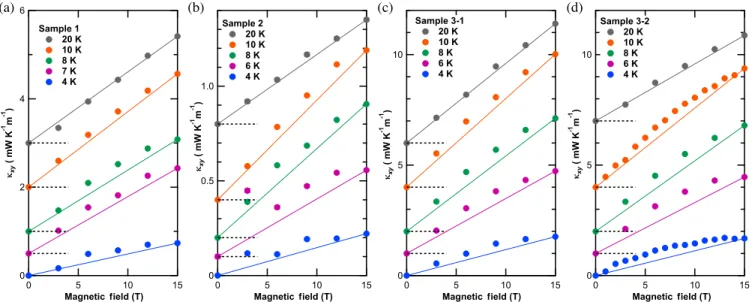
The field dependence of κ
xyis determined by Δ T
asymyin accordance with Eq. (2) and is plotted in Fig. 5. As shown in Fig. 5, the linear field dependence of κ
xy(solid lines in Fig. 5) is observed at 20 K, which becomes nonlinear at lower temperatures.
This thermal Hall signal disappears in the AFM phase at low fields. Figure 4(c) shows the field dependence of Δ T
asymyof sample 2 measured in a dilution refrigerator. As shown in Fig. 4(c), the thermal Hall effect is absent at low fields, which is followed by an increase above approx- imately 7 T. A similar nonlinear field dependence is confirmed in all Cd-K samples done at the lowest temper- ature of the VTI measurement (2 K) as shown in Fig. 6.
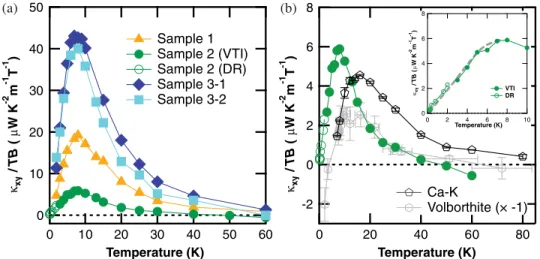
Figure 7(a) shows the temperature dependence of κ
xy=TB of all Cd-K samples at 15 (14) T for the VTI
0.001 0.01 0.1 1
0.1
2 3 4 5 6 7
1
2 3
3
2
1
0
xx(WK-1 m-1 )
60 40
20 0
Temperature (K) Cd-K
Sample 1 Sample 2 Sample 3-1 Sample 3-2
Ca-K
1.5
1.0
0.5
0
xx(WK-1 m-1 )
40 30 20 10 0
Temperature (K) Sample 1
0 T 5 T 10 T 15 T
1.5
1.0
0.5
0
xx(WK-1 m-1 )
40 30 20 10 0
Temperature (K) Sample 2
DR 0 T 5 T 10 T 14 T
VTI 0 T 5 T 10 T 15 T
Temperature (K)
(a) (b) (c)
(d) (e) (f)
2
1
0
xx(WK-1 m-1 )
40 30 20 10 0
Temperature (K) Sample 3-2
0 T 5 T 10 T 15 T
40 2
1
0
xx(WK-1 m-1 )
xx(WK-1 m-1 )
30 20 10 0
Temperature (K) Sample 3-1 0 T 5 T 10 T 15 T
FIG. 2. (a) Temperature dependence of the longitudinal thermal conductivity (
κxx) of all samples of Cd-kapellasite (Cd-K) and that of Ca-kapellasite (Ca-K) at 0 T. The longitudinal thermal conductivity of Ca-K is taken from Ref. [26]. (b)
–(f) The data of each sample under magnetic fields. In sample 2,
κxxis measured down to 0.1 K. An enlarged view of the low-temperature region (0.1
–3 K) of (c) is shown in (d). The filled and open circles in (c) and (d) show
κxxmeasured by a VTI (
2K
< T) and a DR (0.
1< T <4K), respectively.
The slight difference between the two data might be caused by a thermal cycle effect and/or different setups between the VTI and the DR measurements.
0.015
0.010
0.005
0
-0.005 [xx(B)-xx(0)]/xx(0)
15 10
5 0
Magnetic field (T) Sample 2
60 K 50 K 40 K 30 K
-0.8 -0.6 -0.4 -0.2 0
[xx(B)-xx(0)]/xx(0)
15 10
5 0
Magnetic field (T) Sample 2
20 K 10 K 8 K 4 K
2 K -0.8
-0.6 -0.4 -0.2 0 0.2
[xx(B)-xx(0)]/xx(0)
15 10
5 0
Magnetic field (T) Sample 2
0.15 K 0.2 K 0.3 K 0.4 K 0.8 K
(a) (b) (c)
FIG. 3. Magnetic field dependence of the longitudinal thermal conductivity normalized by the zero-field value
f½κxxðBÞ− κxxð0Þ=κxxð0Þgof sample 2 above 30 K (a), for 2
–20 K (b), and below 2 K (c).
(DR) measurements. As shown in Fig. 7(a), κ
xy=TB of all Cd-K samples shows a similar temperature dependence with a peak around 8 K. In sample 2, κ
xy=TB obtained in the ordered phase at 14 T done by the DR measurements is also shown by open symbols, which seems to be smoothly connected to the VTI data shown by filled symbols [see the inset in Fig. 7(b)].
This temperature dependence is also similar to that of Ca-K [26] and volborthite [25] [Fig. 7(b)]. On the other hand, as shown in Fig. 7(b), the peak temperature of κ
xy=TB is clearly shifted to a lower temperature in Cd-K.
C. Specific heat
Figure 8(a) shows the temperature dependence of the specific heat divided by the temperature (C=T) measured in
PPMS. As shown in Fig. 8(a), although the peak in C=T by the AFM transition becomes broader at higher fields, the peak temperature does not depend on the magnetic field up to 5 T, which is followed by a slight increase of T
N.
Because of the absence of a nonmagnetic compound isostructural to Cd-K, we estimate the phonon specific heat C
ph=T by fitting the data at high temperatures (see Supplemental Material [51] for details). As shown by the dashed line in Fig. 8(a), C
ph=T is considerably smaller than C=T below 10 K, showing that the specific heat is dominated by the magnetic contribution.
Figure 8(b) shows the temperature dependence of C=T of another set of multiple single crystals measured in DR. The zero-field data show good agreement with the previous data
40
30
20
10
0
15 10
5 0
Sample 2 5 K 10 K 20 K
Ty/Q(KW-1 )
Magnetic field (T)
40
30
20
Ty 10
asym /Q(KW-1 )
Magnetic field (T)
Ty asym (K)
Magnetic field (T)
(a) (b) (c)
600
400
200
0
15 10
5 0
Sample 2 0.8 K 1.6 K 2 K 1000
500
0
-10 0 10
Sample 2 5 K 10 K 20 K
FIG. 4. (a) Magnetic field dependence of the transverse temperature difference divided by the heat current
ðΔTy=QÞ. The zero-fieldvalue of
ΔTy=Q, which is caused by the misalignment effect, is subtracted for clarity. (b) Magnetic field dependence of theasymmetrized
ΔTy=Qof (a) with respect to the field direction. See the text for details. The solid lines represent a linear fitting to
ΔTasymy =Qfor each temperature. (c) Magnetic field dependence of
ΔTasymybelow 2 K. Error bars represent the standard error of the data, which are smaller than the symbol size except for the 5 K data in (b).
(a) (b) (c) (d)
FIG. 5. (a
–d) The field dependence of
κxyof all Cd-K samples for 4
–20 K. The data above 4 K are shifted for clarity. The offsets for the shifted data are indicated by the dashed lines. The solid lines are drawn to show a deviation from the linear increase of
κxyto that at 15 T.
Error bars estimated by the standard error are smaller than the symbol size for all the measurements.
[47] shown as open circles in Fig. 8(b). Below 0.5 K, C=T under magnetic fields increases rapidly as lowering temper- ature owing to the nuclear Schottky anomaly (C
ncl). The magnetic field dependence of the specific heat at 0.5 K is shown in Fig. 8(c). After the specific heat is decreased by applying the magnetic field, the specific heat is increased by applying the magnetic field above 7 T. We note that this field increase of C above 7 T is much larger than that expected by C
ncl[dotted line in Fig. 8(c)], which is estimated as approximately 2 mJ K
−1mol
−1at 0.5 K and 10 T from the fit of C
ncl∝ H
2=T
2for the data shown in Fig. 8(b).
D. B-T phase diagram of Cd-K
From the specific heat measurements at different mag- netic fields [Fig. 8(a)] and the field dependence of Δ T
asymy[Fig. 4(c)], we determine the B-T phase diagram of Cd-K (Fig. 9). As shown in Fig. 9, T
Ndetermined by the peak temperature of C=T slightly increases above 5 T. A similar increase of T
Nis observed in kapellasite [52] and Ca-K [53]. The threshold field of Δ T
asymy(gray circles) seems to gradually decrease to zero as T increases to T
N.
IV. DISCUSSION
A. Longitudinal thermal conductivity
First, we discuss the sample dependence of κ
xx[Fig. 2(a)]
in terms of the sample quality. The longitudinal thermal conductivity of an insulator is given by the sum of the contribution of the phonons κ
phxxand that of the spins κ
spxx[54].
Considering J=k
B∼ 45 K, it can be expected that κ
xxabove 45 K is almost given by κ
phxx, which is consistent with the field dependence of κ
xx. It is known that κ
phxxincreases in the magnetic field, because the spin-phonon scatterings are reduced under the magnetic field by suppressing spin fluctuations [55]. In fact, as shown in Fig. 3(a), the increase of κ
xxby applying the magnetic field is observed above 40 K, showing a dominant κ
phxxin κ
xxat high temperatures.
The phonon thermal conductivity κ
phxxis given by a product of the specific heat C
ph, the mean free path l
ph, and the velocity v
phof phonons, as κ
phxx¼ ð1 = 3ÞC
phl
phv
ph. Since C
phand v
phare common in all Cd-K samples, the differ- ence in the magnitude of κ
xxshown in Fig. 2(a) reflects the difference in l
phof each sample. Therefore, a sample with a larger κ
xxis a better crystal with fewer impurities. Also, the
8
6
4
2
0
-2
80 60 40
20 0
xy/TB(WK-2 m-1 T-1 )
Temperature (K) (b)
xy/TB(WK-2 m-1 T-1 )
Temperature (K) (a) 50
40
30
20
10
0
60 50 40 30 20 10 0
Sample 1 Sample 2 (VTI) Sample 2 (DR) Sample 3-1 Sample 3-2
Ca-K
Volborthite (× -1)
xy/TB(WK-2m-1T-1)
Temperature (K) 8
6
4
2
0
10 8 6 4 2 0
VTI DR
FIG. 7. Temperature dependence of
κxy=TB. (a) Comparison ofκxy=TBof three Cd-K samples. The filled (open) symbols represent
κxy=TBat 15 T in the VTI measurements (14 T in the DR measurements). (b) Comparison of
κxy=TBof Cd-K sample 2 (green circles), Ca-K [26] (open gray pentagon), and volborthite [25] (open gray hexagon). For clarity,
κxy=TBof volborthite is multiplied by
−1. The inset shows an enlarged view of the low-temperature data of
κxy=TBof sample 2. The dashed line is a guide to the eye.
Tyasym /Q(KW-1 )
Magnetic field (T) 60
40
20
0
15 10
5 0
T= 2 K Sample 1 Sample 3-1 Sample 3-2
FIG. 6. Magnetic field dependence of the asymmetrized trans-
verse temperature difference divided by the heat current
ðΔTasymy =QÞat 2 K. Error bars represent the standard error of
the measurements.
larger κ
xxof Cd-K than that of Ca-K shows that l
phof Cd-K is much longer than that of Ca-K, because C
phand v
phof Cd-K are similar to those of the isostructural Ca-K. This longer l
phof Cd-K than that of Ca-K [26] indicates that Cd-K has a more ideal kagome structure without the randomness of ions or the lattice defects found in Ca-K [56]. We note that the difference of κ
xxof sample 3-1 and that of sample 3-2 might be caused by the ambiguity in estimating the sample size (up to 10%) owing to the irregular shape of the sample [see Fig. 1(d)].
Next, we discuss the field-suppression effect on κ
xxobserved below approximately 25 K [Fig. 3(b)]. One of the field-suppression mechanisms of κ
phxx, which normally increases in the magnetic field, is a resonance scattering of phonons being absorbed by impurity free spins [55].
This resonant scattering is most effective when the spin Zeeman gap (gμ
BH) coincides with the phonon peak (approximately 4 k
BT) given by the Debye distribution, where μ
Bis the Bohr magneton. Therefore, this resonance scattering produces a suppression peak of κ
xxat 5.4 T for 2 K as observed in volborthite [25]. However, as shown in Fig. 3(b), κ
xxat 2 K decreases monotonically with increasing magnetic field up to 15 T without the expected suppression peak. Therefore, the field-suppression effect of κ
xxcannot be explained by the resonance scattering effect on κ
phxx. Therefore, the field-suppression effect is caused by the decrease of κ
spxxunder magnetic fields. A similar field- suppression effect on κ
spxxis also observed in the spin liquid state of the one-dimensional (1D) spin-chain compound [57], volborthite [25,27], and Ca-K [26]. In volborthite, a field-suppression effect up to approximately 30% at 15 T is observed [27] together with the resonance scattering effect [25]. Compared to the field-suppression effects in volbor- thite and Ca-K, the field suppression of κ
xxin Cd-K is much larger (approximately 80% at approximately 1 K), showing a dominant contribution of κ
spxxin κ
xxat low temperatures.
The thermal conduction of spin is also given by κ
spxx¼ C
spv
spl
sp= 3 , where C
sp, v
sp, and l
spare the specific heat, the velocity, and the mean free path of the spin excitations, respectively. As shown in Fig. 8(a), the specific heat does not show a large field suppression at 10 T compared to that observed in κ
xx, excluding a possibility of suppressing the number of spin excitations by a field- induced gap. Also, l
spis known to become longer under a magnetic field, because spin fluctuations are suppressed under a magnetic field. Therefore, the field suppression of κ
spxxis caused by a field-suppression effect on v
sp. A similar field-suppression effect on v
spis shown in the 1D spin- chain compound [57]. Compared to the 1D spin-chain case, where the elementary excitations are well understood by
20
18
16
14
12
10 C(mJK-1 Cu-mol-1 )
10 8 6 4 2 0
Magnetic field (T) 0.5 K 0.3
0.2
0.1
0 C/T(JK-2 Cu-mol-1 )
5 4 3 2 1 0
Temperature (K) 0 T
5 T 10 T 14 T
0 T (Ref. [47])
(b)
(a) (c)
C/T(JK-2 Cu-mol-1 )
Temperature (K) 0.25
0.20 0.15 0.10 0.05
0
10 8 6 4 2 0
0 T 2 T 4 T 6 T 8 T 10 T Phonon
FIG. 8. (a) Temperature dependence of the specific heat divided by the temperature (C=T) measured in PPMS. The measurements are done for the same set of multiple single crystals used in Ref. [47]. The peak around 4 K corresponds to the AFM transition. The dashed line shows the phonon contribution
Cph=Testimated by a fitting for the data at high temperatures (see Supplemental Material [51] for details). (b) Temperature dependence of
C=Tof another set of multiple single crystals measured in DR. The zero-field data from the previous report [47] are also shown by open circles. (b) Magnetic field dependence of
Cat 0.5 K. The red dotted line shows an estimation of the magnetic field dependence of the nuclear Schottky specific heat (C
ncl) at 0.5 K. The data of
Cnclare shifted to compare the amount of the field increase.
15
10
5
0
10 8 6 4 2 0
Magneticfield(T)
Temperature (K) Paramagnetic
AFM (q = 0, NVC)
AFM + Field-induced
excitation
FIG. 9.
B-Tphase diagram of Cd-K. The boundary of the AFM phase is determined by the peak temperature of
C=T(black diamonds) shown in Fig. 8. The threshold fields where the onset of the finite
ΔTasymyis observed in the field dependence [Fig. 4(c)]
are shown by gray circles.
the Bethe ansatz, the spin excitations in a spin liquid state of a 2D kagome are an extremely nontrivial issue. However, from the very similar field-suppression effect on v
sp, we suggest the presence of a similar field-suppression effect in Cd-K as that in the 1D spin-chain case.
Here, we consider the humplike increase of κ
xxobserved near T
N. This increase is caused by the increase of κ
phxxby a reduction of spin fluctuations [58] and/or the appearance of a magnon contribution in the ordered state [27]. In the former case, as observed in α -RuCl
3(Ref. [58]), the increase of κ
xxat T
Nshould be larger under higher fields, because the spin fluctuations are more strongly suppressed under higher fields. However, as shown in Fig. 2, the increase becomes smaller at higher fields. This result is consistent with the field-suppression effect on κ
spxx. In addition, the large field suppression of κ
xxat low temper- atures suggests a dominant contribution of κ
spxx. Therefore, the increase of κ
xxbelow T
Nis likely attributed to the magnon contribution. The increase of κ
xxbelow T
Nis observed larger in a better crystal with a larger κ
xx. We note that a similar sample dependence of magnon thermal conduction is observed in volborthite [27], which also supports the presence of a magnon contribution below T
N. A new field-induced peak is observed in the magnetic field dependence of κ
xxaround 7 T below 0.3 K [Fig. 3(c)]. The resonance scattering effect on phonons is excluded to explain the magnetic field dependence, because the resonance scattering effect at 0.3 K is saturated above approximately 2 T. Also, an increase of κ
phxxby suppressing the AFM phase can be excluded, because T
Ndoes not depend on the field up to 10 T [Fig. 8(a)]. The magnon contribution, which is observed as the humplike increase in κ
xxbelow T
N, is also excluded for the field-induced increase, because the magnon contribution is suppressed by fields (Fig. 2). Therefore, this increase of κ
xxaround 7 T indicates an appearance of some field-induced spin excitations by closing a spin gap. As shown in Fig. 8(c), the increase of C
spat 0.5 K is also observed around 7 T. This increase also supports the appearance of the field-induced spin excitations.
Furthermore, in the ordered phase, a finite thermal Hall effect is observed only above 7 T [Fig. 4(c)], implying that the thermal Hall effect is caused by the field-induced spin excitations observed in the field dependence of κ
xxand C.
One possible origin of this spin gap is an anisotropy of the interactions. In fact, the energy scale caused by J
d=J ¼ 0 . 18 is comparable to 7 T. The temperature dependence of the threshold field of Δ T
asymy(gray circles in Fig. 9) further supports that the emergence of the field-induced excitations is related to the closing of the spin gap.
B. Thermal Hall conductivity 1. Failure of the spin-only model for Cd-K We first discuss the temperature dependence of κ
xy=TB of all three kagome compounds of Cd-K, Ca-K [26], and
volborthite [25] in terms of the spin thermal Hall effect calculated by the SBMFT [32,59]. As shown in Fig. 7(b), κ
xy=TB of these kagome antiferromagnets shows a similar temperature dependence. As reported in Ref. [26], both the temperature dependence and the magnitude of κ
xy=TB of Ca-K and volborthite show good agreement with a simu- lation based on the SBMFT. In the SBMFT framework, the kagome Heisenberg Hamiltonian with a Zeeman term and a DM interaction is diagonalized by taking a mean-field value of the bond operator of Schwinger bosons. From the energy bands and the Berry curvature calculated by the SBMFT, κ
SBMFTxyis calculated by Eq. (1) and is expressed by a dimensionless function f
SBMFTas
κ
SBMFTxyT ¼ k
2Bℏ
Dgμ
BB J
2f
SBMFTk
BT J
: ð3Þ
To compare this SBMFT calculation, the thermal Hall conductivity per one 2D kagome layer is estimated from the experimental data by κ
2Dxy¼ κ
xyd, where d (d ¼ 7.0328 Å for Cd-K [47]) is the distance between the kagome layers.
We then compare κ
2Dxywith f
SBMFTby normalizing κ
2Dxyas
κ
2DxyT ¼ k
2Bℏ
Dgμ
BB
J
2f
exp; ð4Þ
where J and D are the fitting parameters.
By adopting this SBMFT analysis, we fit κ
2Dxyof Cd-K by tuning the fitting parameters of J and D. Although all the κ
2Dxydata of Cd-K well converge to one single curve given by the SBMFT (solid line in Fig. 10) by the fitting parameters listed in Table I, these fittings result in unphys- ical fitting parameters for Cd-K. First, J ¼ 30 K used for
fSBMFT,fexp
kBT / J SBMFT Cd-K
Sample 1 Sample 2 Sample 3-1 Sample 3-2 Ca-K Volborthite 0.6
0.4
0.2
0
-0.2
2.0 1.5
1.0 0.5
0
FIG. 10. Normalized thermal Hall conductivity
fexpof kagome lattice antiferromagnets fitted by the parameters listed in Table I.
The solid line shows a numerical calculation of
fSBMFTat
D=J¼ 0.
1by the SBMFT [26]. The data of Ca-K and those of
volborthite are taken from Refs. [26,25], respectively.
the fit of Cd-K is considerably smaller than that estimated by the temperature dependence of χ (J ¼ 45 K) [48]. More importantly, the magnitude of D used to the fit of κ
xyof Cd-K differs by a factor of 7 among the Cd-K samples owing to the very different magnitudes of κ
xy. This large difference of D in Cd-K samples is too large to explain it by the ambiguity in estimating the sample dimensions. In addition, the largest value of D=J ¼ 0 . 65 is more than 3 times larger than the value of D=J ∼ 0 . 19 estimated from the deviation of the g factor from 2 [48]. This large mismatch is in sharp contrast to the good agreement found in Ca-K [26] in which both J and D determined by the
SBMFT fit of κ
xywell coincide with the value estimated from the temperature dependence of χ and that from the deviation of the g factor, respectively. These results indicate that the origin of the thermal Hall effect in Cd-K is different from the spin thermal Hall effect observed in Ca-K [26].
2. Phonon thermal Hall effect in Cd-K
As discussed in Sec. IVA, κ
xxof Cd-K is given by a sum of κ
phxxand κ
spxx. Therefore, κ
xyof Cd-K can also contain a phonon contribution κ
phxyin addition to a spin contribu- tion κ
spxy.
Thermal Hall effects of phonons are reported in various compounds [33 – 37]. In the nonmagnetic insulator SrTiO
3, in which only phonons are responsible for the thermal transport, κ
xyof phonons is found to show a peak at the same temperature of the peak in κ
xx. We thus check this relation for Cd-K. In Cd-K, κ
xxof Cd-K contains a spin contribution κ
spxxwhich becomes dominant at lower temper- atures. On the other hand, as shown in Fig. 3, a magnetic field suppresses a large portion of κ
spxx, whereas it slightly increases κ
phxx. Therefore, κ
phxxcan be estimated by κ
xxat 15 T.
Figure 11 shows the temperature dependence of κ
xx=T (left axis) and that of κ
xy=TB (right axis) at 15 T of all Cd-K TABLE I. Values of
Jand
jD=Jjused to fit
κ2Dxyto the SBMFT
simulation (Fig. 10) for kagome lattice antiferromagnets. The data of Ca-K and those of volborthite are taken from Refs. [26,25], respectively.
Material Sample number
J=kB(K)
D=JCd-kapellasite 1 30 0.28
2 30 0.09
3-1 29 0.65
3-2 28 0.6
Ca-kapellasite [26] 66 0.12
Volborthite [25] 60
−0.
07FIG. 11. Temperature dependence of
κxx=T(left axis) and that of
κxy=TB(right axis) at 15 T of all Cd-K samples (a)
–(d) and Ca-K
(e),(f). The data of Ca-K are taken from Ref. [26].
samples, together with those of Ca-K [26]. As shown in Figs. 11(a) – 11(d), κ
xx=T at 15 T shows a peak at almost the same temperature of the peak of κ
xy=TB, which resembles the case of the phonon thermal Hall effect observed in SrTiO
3(Ref. [36]). Furthermore, the maximum of κ
xy=TB almost linearly increases with κ
xx=T, resulting in the estimation of the Hall angle (κ
xy=κ
xx) at the peak temperature as approx- imately 4 × 10
−3at 15 T. This Hall angle is close to that observed in the phonon thermal Hall effects in SrTiO
3[36]
and cuprates [37], supporting the phonon origin of κ
xyin Cd- K at 15 T. Therefore, we conclude that κ
xyof Cd-K at 15 T contains a dominant phonon contribution.
We also find that this conclusion is clearly not the case for Ca-K [26]. As shown in Figs. 11(e) and 11(f), κ
xx=T at 15 T peaks at a much lower temperature than that of κ
xy=TB, which is consistent with the spin origin of κ
xyin Ca-K.
3. Spin thermal Hall effect in Cd-K
The energy scale of the phonon thermal Hall effect should be given by the Debye temperature, which is estimated as 220 K for Cd-K from the temperature dependence of the specific heat at high temperatures [51]. Since this energy scale is an order of magnitude larger than that of the magnetic field of 15 T, κ
phxyis expected to have a linear field dependence, which is indeed con- firmed in the field dependence of κ
xyat high temperatures (Fig. 5). On the other hand, the field dependence of κ
xybecomes nonlinear as lowering temperature. As shown in Fig. 5, the slope of κ
xy=B below 20 K becomes larger at lower fields, suggesting an emergence of an additional thermal Hall effect. In this temperature range, κ
xxalso starts to show the field-suppression effect as discussed in Sec. IVA, which is given by the field-suppression effect on κ
spxx. Therefore, this nonlinear field dependence of κ
xyat low temperatures suggests an emergence of a spin contribution κ
spxywhich is related to κ
spxx.
We estimate this additional spin component δκ
xyðBÞ at each temperature by
δκ
xyðBÞ ¼ κ
xyðBÞ − B
15 κ
xyð15TÞ: ð5Þ Note that δκ
xyðBÞ gives a lower bound of κ
spxy, because the spin contribution in κ
xyis not fully quenched at 15 T.
We investigate the temperature dependence of δκ
xy=TB at 6 T (Fig. 12), where the field dependence of δκ
xyðBÞ shows a peak (see Fig. 5). As shown in Fig. 12, δκ
xy=TB of all the Cd-K samples starts to appear below approximately 25 K, much lower than that of κ
phxy=TB at 15 T which persists up to approximately 60 K (Fig. 7). This appearance of δκ
xy=TB coincides with the field-suppression effect on κ
spxx(Fig. 2), indicating that the spin contribution κ
spxyis given by δκ
xy=TB.
Figure 12 shows that the magnitude of δκ
xy=TB depends on the sample, implying that the magnitude of κ
spxydepends on κ
spxx. As shown by the field-suppression effect on κ
spxx(Fig. 2), κ
xxat the peak temperature of δκ
xy=TB contains a significant spin contribution at 0 T. We therefore investigate the dependence of the maximum of δκ
xy=TB on κ
xx=T at 0 T at the peak temperature of δκ
xy=TB for each Cd-K sample (4 – 6 K). We also check this relation for Ca-K [26]
and volborthite [25]. To compare the results in different samples, we estimate κ
sp;2Dxy¼ κ
spxy× d and assemble all data in Fig. 13 by plotting jκ
sp;2Dxyj=TB as a function of κ
xx=T.
Most remarkably, as shown in Fig. 13, jκ
sp;2Dxyj data of three different kagome materials appear to show a smooth function of κ
xx=T; jκ
sp;2Dxyj stays a constant in the low- κ
xxregion, whereas jκ
sp;2Dxyj increases as κ
xxdoes. Given that all these compounds share a similar kagome structure (espe- cially for Ca-K and Cd-K), κ
xx( ∝ Cv
2τ ) directly reflects the scattering time τ determined by disorder scattering.
Therefore, Fig. 13 shows τ dependence of jκ
sp;2Dxyj.
As discussed in Ref. [26], jκ
sp;2Dxyj=TB of Ca-K and volborthite can be well explained by the SBMFT calcu- lation κ
SBMFTxy=TB of which the magnitude is given only by D=J and does not depend on κ
xx. We denote this as the
“intrinsic” contribution (the blue dashed line in Fig. 13).
On the other hand, jκ
sp;2Dxyj=TB of Cd-K samples clearly exceeds the intrinsic contribution and increases as κ
xxdoes, which should be denoted as an “ extrinsic ” contribution (the pink dashed line in Fig. 13).
This κ
xxdependence of jκ
sp;2Dxyj=TB bears similarity to
that of the anomalous Hall effect (AHE) in ferromagnetic
metals. In the AHE, it is known that the dominant
mechanism of AHE depends on the magnitude of the
longitudinal conductivity [60,61]; the intrinsic mechanism
by the Berry curvature of the energy bands is dominant in a
FIG. 12. Temperature dependence of
δκxy=TBat 6 T of all
Cd-K samples.
moderate dirty metal, whereas the extrinsic mechanism by skew scatterings is dominant for a superclean metal. This good analogy between the spin thermal Hall effect in the kagome materials and the AHE in ferromagnetic metals indicates the presence of a similar duality of intrinsic- extrinsic mechanisms for the spin thermal Hall effect of an insulator.
4. Spin-phonon coupling and reemergence of κ
phxyin the AFM phase
In the AFM phase of Cd-K, no thermal Hall effect is observed below approximately 7 T [Fig. 4(c)], showing that both κ
phxyand κ
spxydisappear in the AFM phase at low fields.
This absence of κ
spxyin the AFM phase is consistent with the theoretical prediction [62]. On the other hand, κ
xy=TB in the AFM phase reemerges above approximately 7 T [Fig. 4(c)]. The temperature dependence of κ
xy=TB at 14 T below T
Nwell follows that at the spin liquid phase at 15 T in which the phonon contribution is dominant [see the inset in Fig. 7(b)]. This smooth connection of κ
xy=TB above and below T
Nat high fields implies that this high- field κ
xybelow T
Nis mostly given by phonons. This result is also consistent with that κ
spxyabove T
Nis observed at low fields and the strong field-suppression effect on κ
spxx. Therefore, the appearance of κ
xyin the AFM phase above
approximately 7 T [Figs. 4(c) and 6] shows a reemergence of κ
phxywhich disappears at low fields. This absence of κ
phxyin the low-field AFM phase demonstrates that the phonons cannot alone exhibit the thermal Hall effect, putting a strong constraint on the origin of the phonon Hall effect. In other words, κ
phxyneeds to be triggered by the field-induced excitations observed in the field dependence of κ
xx[Fig. 3(c)] and that of C [Fig. 8(b)] through a spin-phonon coupling.
Thermal Hall effects by phonons have been theoretically studied with respect to various aspects [38 – 46]. The absence of the stand-alone phonon thermal Hall effect in Cd-K is inconsistent with an intrinsic mechanism but rather points to extrinsic origins with microscopic couplings between phonons and the field-induced excitations. Such microscopic coupling is also suggested to play an important role in the thermal Hall effect observed in multiferroics [63], where a large thermal Hall effect is observed in the ferrimagnetic phase despite the absence of the conventional magnon Hall effect. Also, it has been pointed out that a magnon-phonon coupling induces a thermal Hall effect even in the system where neither phonons nor magnons alone show a thermal Hall effect [45]. Therefore, the absence and the presence of κ
phxyin the AFM phase of Cd-K suggests that the phonon thermal Hall effect in Cd-K has an extrinsic origin requiring a spin-phonon coupling with the field-induced spin excitations. At present, the details of the magnetic structure of Cd-K are not known.
Further studies, including NMR or neutron scattering experiments to clarify the magnetic excitations in the AFM phase under the low and the high magnetic fields, will be important to reveal the origins of the thermal Hall effects in Cd-K.
One clearly has to wonder why, despite the dual origin (spins and phonons) of the thermal Hall effects in the Cd-K compounds, the scaling fit derived entirely from the SBMFT works so well as shown in Fig. 10. This conclusion is not unreasonable, however, provided we further assume that κ
spxyis proportional to κ
phxy, due to the fact that the two excitations are microscopically coupled.
We note that the field dependence of the thermal Hall effect in the ordered phase of Cd-K is in sharp contrast to that observed in Ca-K. In the ordered phase in Ca-K, a finite κ
xyis observed only in a low field and is absent above approximately 6 T [26], whereas the ordered state in Ca-K is suggested to be the same q ¼ 0 negative chiral state [53,64]. In the two compounds, the magnitude of κ
xxis quite different (Fig. 2) owing to the different crystal quality.
Moreover, according to the theoretical study [62], κ
spxyin the negative chiral state is suggested to depend on the rotation angle of the spin in the kagome plane. Therefore, this different field dependence of κ
xycould be attributed to the different magnitude of κ
xxand the spin angle in the AFM state (see Supplemental Material [51] for details).
20x10-15
15
10
5
0
0.4 0.3
0.2 0.1
0 Cd-K
Sample 1 Sample 2 Sample 3-1 Sample 3-2 Volborthite Ca-K
Sample 1 Sample 2
|xysp,2D |/TB(WK-2 T-1 )
xx/T( W K-2m-1) Intrinsic
Ext rinsic
FIG. 13. The spin thermal Hall conductivity per the 2D kagome layer
jκsp;2Dxy j=TBof Cd-K, Ca-K [26], and volborthite [25]
plotted as a function of the longitudinal thermal conductivity
κxx=Tat 0 T. The value of
κxx=Tis taken at the peak temperature
of
δκxy=TBfor Cd-K (4
–6 K; see Fig. 12) and that of
jκ2Dxyj=TBfor
Ca-K and volborthite (16 K). The error bars represent the
ambiguity in estimating the absolute value of
κxxand
κxyowing
to the nonrectangular shape of the samples (see Supplemental
Material [51] for details). The blue and pink dashed lines are
guides to the eye for the intrinsic and extrinsic contributions,
respectively (see the main text).
V. SUMMARY
We have investigated κ
xxand κ
xyof three Cd-K samples.
From the field-suppression effect on κ
xx, we find that the spin contribution κ
spxxsets in κ
xxbelow approximately 25 K, which becomes dominant at lower temperatures. Below T
N, we find a new peak in the field dependence of κ
xxat approximately 7 T. Above 7 T, we also find a field-induced increase both in the specific heat and in the thermal Hall effect.
Clear thermal Hall effects have been observed in the spin liquid states of all Cd-K samples. We find that κ
xyof all Cd- K samples shows a virtually identical temperature depend- ence with a peak at almost the same temperature. On the other hand, the magnitude of κ
xyof samples with high κ
xxsubstantially exceeds that expected for the intrinsic spin thermal Hall effect determined by D=J in the SBMFT framework. We conclude that a phonon thermal Hall κ
phxycontributes to κ
xyof all Cd-K, deduced from the similar temperature dependence of κ
xyand κ
xxat 15 T and the positive correlation between them (Fig. 11).
We further find that the nonlinear field dependence of κ
xyat low temperatures (Fig. 5) shows the emergence of a spin thermal Hall effect κ
spxyat low fields (Fig. 12). Moreover, the appearance of κ
spxycoincides in its temperature range with the region where the field-suppression effect on κ
spxxis being observed (Fig. 2). Most remarkably, whereas κ
spxydoes not depend on κ
xxand is well explained by the intrinsic thermal Hall effect given by the SBMFT framework in the low- κ
xxregion, κ
spxyexceeds the intrinsic contribution with a positive correlation to κ
xxfor the high-κ
xxregion (Fig. 13). This κ
xxdependence of κ
spxypoints to the presence of both intrinsic and extrinsic mechanisms for the spin thermal Hall effect in the kagome materials, as was the case for the anomalous Hall effects in ferromagnetic metals.
In addition, we find that both κ
phxyand κ
spxydisappear in the AFM phase at low fields. At high fields above 7 T, we find that κ
phxyis induced concomitantly with the field-induced spin excitations observed in the field dependence of κ
xxand C.
These results suggest that field-induced spin excitations give rise to a recovery of the phonon thermal Hall effect of Cd-K.
We conclude that the phonons alone do not exhibit the thermal Hall effect and require to merge with the field- induced spin excitations through a spin-phonon coupling to appear.
ACKNOWLEDGMENTS
We would like to express our sincere gratitude to the anonymous referees for their valuable comments that helped us to deepen our understanding of the results. H.- Y. L. was supported by a Korea University Grant and National Research Foundation of Korea (NRF- 2020R1I1A3074769). This work was supported by Grants-in-Aid for Scientific Research (KAKENHI) (No. 19H01809, No. 19H01848, and No. 19K21842).
[1] S. Yan, D. A. Huse, and S. R. White, Spin-Liquid Ground State of the
S¼1=2Kagome Heisenberg Antiferromagnet, Science
332, 1173 (2011).[2] S. Depenbrock, I. P. McCulloch, and U. Schollwöck, Nature of the Spin-Liquid Ground State of the
S¼1=2Heisenberg Model on the Kagome Lattice, Phys. Rev. Lett.
109, 067201(2012).
[3] H.-C. Jiang, Z. Wang, and L. Balents, Identifying Topo- logical Order by Entanglement Entropy, Nat. Phys.
8, 902(2012).
[4] Y. Iqbal, F. Becca, S. Sorella, and D. Poilblanc, Gapless Spin-Liquid Phase in the Kagome Spin-
12Heisenberg Anti- ferromagnet, Phys. Rev. B
87, 060405(R) (2013).[5] S. Nishimoto, N. Shibata, and C. Hotta, Controlling Frustrated Liquids and Solids with an Applied Field in a Kagome Heisenberg Antiferromagnet, Nat. Commun.
4,2287 (2013).
[6] H. J. Liao, Z. Y. Xie, J. Chen, Z. Y. Liu, H. D. Xie, R. Z.
Huang, B. Normand, and T. Xiang, Gapless Spin-Liquid Ground State in the
S¼1=2Kagome Antiferromagnet, Phys. Rev. Lett.
118, 137202 (2017).[7] Y.-C. He, M. P. Zaletel, M. Oshikawa, and F. Pollmann, Signatures of Dirac Cones in a DMRG Study of the Kagome Heisenberg Model, Phys. Rev. X
7, 031020 (2017).[8] S. Jiang, P. Kim, J. H. Han, and Y. Ran, Competing Spin Liquid Phases in the S=
12Heisenberg Model on the Kagome Lattice, SciPost Phys.
7, 6 (2019).[9] S. Sachdev, Kagom´e- and Triangular-Lattice Heisenberg Antiferromagnets: Ordering from Quantum Fluctuations and Quantum-Disordered Ground States with Unconfined Bosonic Spinons, Phys. Rev. B
45, 12377 (1992).[10] F. Wang and A. Vishwanath, Spin-Liquid States on the Triangular and Kagom´e Lattices: A Projective-Symmetry- Group Analysis of Schwinger Boson States, Phys. Rev. B
74, 174423 (2006).[11] L. Messio, S. Bieri, C. Lhuillier, and B. Bernu, Chiral Spin Liquid on a Kagome Antiferromagnet Induced by the Dzyaloshinskii-Moriya Interaction, Phys. Rev. Lett.
118,267201 (2017).
[12] D. E. Freedman, T. H. Han, A. Prodi, P. Müller, Q.-Z.
Huang, Yu.-S. Chen, S. M. Webb, Y. S. Lee, T. M.
McQueen, and D. G. Nocera, Site Specific X-Ray Anoma- lous Dispersion of the Geometrically Frustrated Kagom´e Magnet, Herbertsmithite, ZnCu
3ðOHÞ6Cl
2, J. Am. Chem.
Soc.
132, 16185 (2010).[13] H. Katsura, N. Nagaosa, and P. A. Lee, Theory of the Thermal Hall Effect in Quantum Magnets, Phys. Rev. Lett.
104, 066403 (2010).
[14] R. Matsumoto, R. Shindou, and S. Murakami, Thermal Hall Effect of Magnons in Magnets with Dipolar Interaction, Phys. Rev. B
89, 054420 (2014).[15] J. Romhányi, K. Penc, and R. Ganesh, Hall Effect of Triplons in a Dimerized Quantum Magnet, Nat. Commun.
6, 6805 (2015).
![FIG. 1. (a) Crystal structure and (b) top view of a kagome layer of Cd-K [48]. The magnetic interactions between nearest-neighbor, next-nearest-nearest-neighbor, and diagonal Cu 2þ spins are denoted by J (solid black line), J 2 (dotted line), and J d (das](https://thumb-ap.123doks.com/thumbv2/123deta/6950422.2271715/3.918.475.836.512.871/crystal-structure-magnetic-interactions-nearest-neighbor-neighbor-diagonal.webp)



![FIG. 13. The spin thermal Hall conductivity per the 2D kagome layer j κ sp;2Dxy j=TB of Cd-K, Ca-K [26], and volborthite [25]](https://thumb-ap.123doks.com/thumbv2/123deta/6950422.2271715/12.918.122.405.67.346/fig-spin-thermal-hall-conductivity-kagome-layer-volborthite.webp)
