Firm Strategy in Alliance Formation in the Bio-Pharma Industry
'Celia L. Umali
Abstract
This paper analyzes the strategic alliances in the emerging bio-phar- rna industry in Asia as bio-pharma companies pursue multiple sources of competitive advantage in an industry that has become more global and where competition· has become more fierce and pressure for cost, time and innovation is high. How these firms form alliances that bring together complementary competences and assets, facilitate entry into a foreign market and increase market presence, and spread and reduce costs of innovation in order to survive in the domestic and international market will likewise be presented.
Keywords: Firm strategy, strategic alliances, bio-pharma, biotechnol- ogy, Asia
Introduction
Biotechnology is now revolutionizing the health care industry as more phar- maceutical companies are deriving novel products from the biotech sector.
Moreover, the emergence of bioinformatics and bioservices have brought medical diagnosis and delivery to a higher level. In Asia, biotech companies are trying to thrive in niche markets in drug screening and manufacturing, bioinformatics and genomics (Economist b, 2004). Therapeutics for the treatment of diseases common in Asia such as respiratory and infectious dis-
70 KEIEI TO KEIZAI
ease, and cardiovascular ailments are the focus of many biotech firms in Asia. India, for example, manufactures vaccines, therapeutics, and diagnos- tics most of which are to meet the domestic health needs (such as hepatitis B, typhoid, diabetes, cancer, cardiovascular, malaria, cholera, encephalitis, HIV) of the 1 Billion population.. Although China is intensifying its efforts in genomics and stem cells, biotech companies have also developed biomedical products for the treatment of hepatitis Band C, SARS, cancer, anemia, and cardiovascular ailments, the more common diseases in the country (Zhen- zhen et.al., 2004). Against this background, this chapter will study how pharmaceutical companies in the region are pursuing multiple sources of competitive advantage in an industry that has become more global and where competition has become more fierce and pressure for cost, time and novel drugs are high.
Fledgling Biotech Industry in Asia
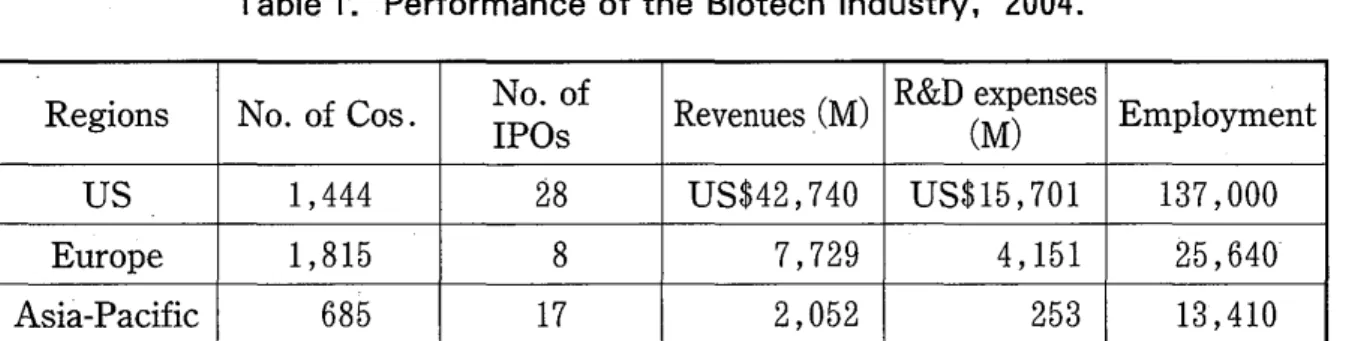
The biotech industry in Asia as compared to that in the US and Europe is still in the emerging stage and relatively small in terms of size, revenues and expenditures on research. But governments of some Asian countries like Japan, Singapore, South Korea, India and China expect that the biotech sec- tor would be the next engine of growth of their economies.
Table 1. Performance of the Biotech Industry, 2004.
Regions No. of Cos. No. of
Revenues (M) R&D expenses
Employment
IPOs (M)
US 1,444 28 US$42,740 US$15,701 137,000
Europe 1,815 8 7,729 4,151 25,640
Asia-Pacific 685 17 2,052 253 13,410
Source: Ernest & Young, Beyond Borders: Global Biotechnology Report 2005.
The sector, however, has performed remarkably well in Asia in 2002-2003, better than in Europe where negative growth rates have been registered in terms of number of companies, revenues and R&D expenditures. The 11%
increase in the number of companies is an indication of the fast pace of growth of the biotech sector. Similarly the substantial surge in investments in research and development reflects the drive in Asia to innovate which is the lifeline of companies in the industry (Table 2). Evidently, the industry is growing in the Asia Pacific. and many see the region as the next biotech hub.
Table 2. Percentage Growth of Global Biotech Sector, 2002-2003.
Region Revenues No. of companies R&D
Expenditures
Asia 9.0% 11.0% 10.0%
US 22.5% 0.1% -13.3%
Europe -12.0% -1.0% -17.0%
Source: Louet, Sabine (2004) E&Y Report Backs Asia Pacific Biotech, Nature Biotechnology, Vol. 22 No.7.
In the early 1980s, Japanese big companies but non-pharmaceuticals compa- nies in Japan for that matter had been involved in biotech research in col- laboration with foreign companies. In spite of this, however the biotech sec- tor did not grow as expected. For example Mitsubishi Kasei (which merged with Mitsubishi PetroChemical Corporation to form the Mitsubishi Chemical Corporation in 1994) was already engaged in biotechnology research and in 1982 allied with Genentech. Under license from Genentech, Mitsubishi Chemical brought into the market two rDNA drugs: tissue plasminogen ac- tivator for coronary thrombosis and hepatitis-B vaccine. Likewise they have
72 KEIEI TO KEIZAI
collaborated with IDEC, a US biotech company for the development of ther- apeutic monoclonal antibodies for auto-immunity and transplant rejection (Heissler, 1995). Kirin Brewery, the largest beer company in Japan, estab- lished in 1982 a drug division and did research on anti-cancer, cardiovascular and immuno/allergic medications. At that time Kirin launched its first gene recombinant drug erythropoietin (EPO) , sold as Espo (EPO) , used to treat anemia of patients undergoing' analysis with technology from US Am- gen. Kirin and Amgen also co-developed G-CSF (granulocyte colony stimulating factor), commercialized as Gran. G-CSF promotes the produc- tion of white blood cells and is used to treat cancer patients that are suffer- ing from leucopenia caused by chemotherapy and bone marrow transplants.
Kirin successfully marketed EPO and G-CSF in Japan as well as in Taiwan and South Korea in the early 1990s. The small homegrown dedicated biotech firms (DBFs) in Japan however such as AnGes MG, Trans Genic, Medinet and Onco Therapy Science have to work on their own with their limited capi- tal since unlike in the US and Europe, the big Japanese pharmaceutical com- panies would rather do R&D by themselves than form alliances with oar ac- quire small local biotech companies China on the other hand has strong tradi- tional indigenous and herbal based, products and the biotech sector specially biopharma industry started to emerge in the 1980s.. Until the mid-1980s, most of the drug companies in China were publicly funded, state-owned or spin-offs of public research institutions that produced imitation drugs (Jia- he, 2002). In China, the best high standard researches are done by scien- tists in public laboratories and universities which hold 80 %of the patents of therapeutics and vaccines (Zhenzhen, et. aL 2004). Venture capital in China is lacking and this then limits venture creation and retrains the con- version' of public research institutions and their R&D results into
entrepreneurial business activities.
Although biotechnology in Asia started decades ago, it has remained lagging vis a vis their Western counterparts. Most R&D in biotech in Asia are done in public laboratories and national universities that are staffed by world class scientists that have access to world class research facilities and infrastruc- tures and these institutions often owned the patents. However, there were no sufficient incentives to commercialize biotechnology output not to men- tion the lack of a structure to connect academic research with business hence limiting the transfer of technology to the industrial sector. Moreover due to the lack of entrepreneurial spirit and venture capital, start ups were minimal. Few bioventure spin-offs from universities and public research in- stitutions existed. Venture capitalist shied away from the more risky biotech sector since the rate of R&D results successfully reaching the commerciali- zation stage after huge R&D and clinical trials costs is comparatively low compared to other industries. But recently with bioventure funds established by the Japanese government, there has been an increase in spin-off compa- nies that are nurtured in the government-run biocenters and finally offered as IPOs. From 2002-2004, there were 11 biotech IPOs in Japan two years af- ter the government allowed university professors to join the biotech indus- try. As of 2005, there were 387 biotech startups half of which are in medical R&D, not to mention the 300 already established biotech firms. The Chinese government meanwhile cognizant of the undeveloped venture capital market in the country wants to develop home grown biotech firms through more state and local governments financing quasi-venture capital companies, pri- vate sector investments as well as investments by multinational biotech firms in the country with cost as the main investment incentive.
74 KEIEI TO KEIZAI
Government Initiatives in Biotechnology
In many Asian nations, the government's role to develop the biotech sector comes in many forms. For one, the South Korean government has invested around US$4. 4 B from 2000-2007 into the biotechnology sector. Funding goes to the country's best universities and public laboratories to do adult and embryonic stem cell research whereas the Ministry of Commerce, Industry and Energy subsidizes and provides fiscal incentives to the private sector to indulge in the applications of biotechnology R&D output. One good example is Macrogen which is a spin-off business venture of a Seoul National Univer- sity laboratory in 1997. The company designs DNA sequencing and is map- ping the "Korean" genome structure. It has mapped 100,000 bacterial ar- tificial chromosomes of Koreans containing the whole genome of a Korean person which it utilizes to develop DNA genome arrays (Wong, et.al., 2004).
In Asia, public research institutions, laboratories and universities are known for their leading roles in R&D in biotech usually in line with the gover- nment's overarching goal of safeguarding the basic needs and health of the local people. Some of the research centers are arms of the government ministries and some small biotech companies are spin offs from these public and university laboratories. The main purpose of the collaboration between the public institutions and the biotech companies is to find solution to dis- eases prevalent in the country/region'. An example of this public-private alli- ance is the Novartis Institute for Tropical Diseases (NTD) situated in Singa- pore which Novartis is pursuing in partnership with the Singapore Economic Development Board with a US$122M budget to discover medicines for the treatment of tropical diseases like malaria, dengue and tuberculosis. Medion
Pharma, Singapore's first homegrown enterprise, was founded in 2002 with the privatization of the Center for Natural Product Research (CNPR) in par- tnership with Fujisawa Pharmaceutical Co. Ltd (Japan), John Hopkins Pte.
Ltd (Singapore) and the ,National Cancer Center to discover and develop new therapeutic drugs from natural sources. Merlion boasts of the following assets and capabilities of CNPR which it is capitalizing on : advanced drug discovery techniques, efficient screening of natural product samples in search of various new bioactive compounds, and the biggest and most diverse collection of natural product samples in the world. (Biomed, 2002).
In China meanwhile, Novartis recently formed a partnership in 2004 with the national Shanghai Institute for Materia Medica which has the expertise to identify compounds derived from traditional Chinese medicine that Novartis may be able to develop into new drugs. (Santini. 2004). SINOVAC Biotech Ltd. of China is also actively engaged in the research and develop- ment of vaccines for the Avian flu which is a recent phenomenon in Asia together with the Center for Disease Control of China (Business Wire, 2005).
Genomics and Stem Cell Research
Genomics and stem cell research are areas where Asia, with its heterogene- ous gene resources is trying to find a niche market. The stem cells can be directed to form different kinds of specialized cells from which organs can be created and used in therapeutic cloning which means replacing cells des- troyed due to Parkinsons and type 1 diabetes (Economist a, 2004) or even to generate replacement tissues or organs lost due to some ailments (Economist c, 2005). These cells have the healing potentials by forming cells which replace cells that do not function due to disease or accident
76 KElEl TO KElZAl
(Stem Cell Research Foundation, 2005). For stem-cell researchers, Singa- pore offers one of the world's most liberal legal environment. The law per- mits stem cells to be taken from aborted fetuses, .and human embryos to be cloned and kept for up to 14 days to produce stem cells. This is one field the Biomedical Research Council (BMRC)wants the city state to have a niche market. The government thus provided US$600 M to fund startups in stem cell and life science researches, US$22M of which has been put intoES Cell International. Its chief scientist is the world famous English scientist, Alan Colman. Stem cell research in Singapore was pioneered by Prof. Ariff Bon- gso who was the first to successfully isolate stem cells from a five day old embryo in 1994. Eight years later, again he was the first to culture human embryonic stem cell lines without the assistance of mouse feeder cells (In- ternational Stem Cell Forum, 2005). ES Cell International is a spin-off of this work of Bongso. The company now owns 6 of the human embryonic cell lines that are supplied worldwide. The use of stem cells as cure for diabetes is the current research focus of ES Cell International. According to the Stem Cell Research Foundation, embryos are the source of the most versatile stems cells. Due to ethical consideration, research has been directed on cord blood as the source of stem cells. In this regard, Cell Research Corporation in Singapore has successfully differentiated the outer amniotic lining of the umbilical cord into specific cells such as skin bone and fat. Stem cell research results are now being tested for their applicability in Singapore.
Leukemia patients at the Singapore General Hospital are being treated with haematopoietic stems cells taken from the umbilical cord blood CInternation- alStem Cell Forum, 2005). Cognizant of the market potentials of the stem cell research results, CyGenics was established in 2004 in Singapore CShan~
ley" 2005). The company markets adult stem cell related products, serv-
ices and technology with the assurance that they will make the technology safe for human use. The company has a blood bank that stores the frozen umbilical cord blood for possible use for lymphoma, anemia and bone mar- row cancer (Shanley, 2005).
After the series of political and economic reforms in China, the country has started to develop its health biotech industry only in the 1980s. One sector where China is making a mark globally is in the area of genomics. It is the only developing country to join the Human Genome Project and thereby paved the way to the establishment of the Beijing Genomics Institute and the Chinese National Genome Center. In no time was 1% of the human genome sequenced with a 99% accuracy (Zhenzhen, et.al., 2004). The country is also gaining headway in gene therapy. At a cost of US$9. 6 M, Shenzhen Sibono GenTech was able to develop Gendicine, a recombinant ad-p53 gene therapy type for the treatment of head and neck cell carcinoma. Moreover, Chinese researchers were the first to research on adult stem cells from blood and umbilical cord. One advantage China has is its many homogenous sub- populations which are important for clinical trials and good for functional genomics and disease gene identification (Zhenzhen, et.al., 2004).
Interindustry convergence: Bioinformatics and Nanomedicine
Various high tech industries are converging and intersecting and have diverse applications (Barlett and GhoshaL 2002). The technology and skill demands of many high tech firms at the present time go beyond the firm's capability. The better option they pursue amid the fast changing demands of the times and global business environment is to collaborate and exchange technology. Biotechnology has become so advanced that it has become an
78 KEIEI TO KEIZAI
interdisciplinary industry. The convergence of complementary industries is warranted due to the pressure of time, risk and costs. Bioinformatics is one case in point. The levels of information technology and expertise in Japan, Singapore, Korea, Taiwan, and India are very high. These countries have world class and highly competitive information technology (IT) companies.
This gives them leverage in areas where IT and biotechnology converges, e.g., bioinformatics which is the interface between experimentation and computation (BioSino, 2003) specially in the field of gene sequencing and stem cell research. Wooley of the University of California-San Diego men- tioned the important role of bioinformatics from now on due to the complex computations needed in basic research and experimentation as more R&D results are applied. Japanese IT firms are forming partnerships on their own with domestic and international biotech firms to combine their complementa- ry expertise. Hitachi formed a synergy with Yamanouchi Pharmaceuticals in genomic research. Itochu using its discovery platform for high level protein research has allied with USProteomics, a. bioinformatics firm (BioSino 2003). Japan's advanced development of nanotechnology could always give it competitive edge in the application of nanotechnology in pharmaceutical research. Unlike in Japan where the highly competitive IT firms seek their partners at home and abroad, in Singapore where the biotechnology sector is still in its nascent stage, the government leads the initiative to develop bioin- formatics in the country by creating the Center of Systems Biology and together with Eli Lilly apply bioinformatics in the study of biological systems (BioSino, 2003). Japanese companies are now gaining headway in putting into practical use nanotechnology as a new drug delivery system targeting cancer cells. This new drug delivery system was developed by NanoCarrier Co, a biotech start-up and Nippon Kayaku, a chemical and pharmaceutical
company. Japan is also making a lot of progress in nanotechnology and its functionality in terms of nanomedicine and bio-imaging. A group of resear- chers from Kyoto University, Terumo Corporation and Nippon Shinyaku Co.
are developing a technology to treat malignant tumors by injecting patients with peptides (an amino acid compound) that have light emitting particles for identification, and cancer cell killing therapy for cure, attached to it.
(Kato, K., 2005) .
Firm strategy in Alliance Formation
Firms form strategic alliances to achieve the following objectives: bring together complementary competences and assets which each of the company lacks ; facilitate entry into a foreign market and increase market presence ; and spread and reduce costs and risks in the costly development of new drugs. In the next section, case studies of how biotechnology companies in Asia build strategic alliances to fulfill these objectives will be presented.
Economies of Scale and Scope
Strategic alliance also refers to the cooperative agreement between actual competitors and companies in the same line of business. Companies resort to this strategy to have more market power and new economies of scale and scope which are very evident in the Japanese pharmaceutical sector. Japan is the second biggest drug market in the world worth US$58B hence is an at- tractive market for the big and well-established pharmaceutical companies in the West such as Pfizer, Novartis-Pharma KK and AstraZeneca. In Japan survival of the pharmaceutical sector depends on its financial strength and global reach which most Japanese firms lack. During the time when the Japanese market was protected from multinational drug makers, domestic
80 KElEl TO KElZAl
pharmaceutical firms relied on the domestic market and enjoyed high profitability mostly from licensing deals with foreign companies. In 2003, Datamonitor reported sales from drugs that have been developed a decade ago and many whose patents will expire (referred to as long-listed drugs) and are subject to price reductions are the main sources of revenues of 60%
of drug companies in Japan (Mayer,' ·2005). With sales growth remaining stagnant or declining for these mature and disappearing pipelines, compa- nies then had to resort to in-licensing. With not much capital to develop new drugs but with the core competence in the invention of new chemical com- pound Kyorin is linking up with multinational drug makers to develop
"global scale medicines" (Kato. T., 2005) and uses the partner's global distribution channels. Kyorin in effect is an example ofa royalty income pharmaceutical company (RIPCO) that licensed out its Norfloxacin and Gantifloxacin to large American pharmaceutical companies, Merck and Co.
and Bristol-Myers Squibb, respectively, both for pioneering new quinolone antibacterial agents. The Japanese pharmaceutical market has been tradi- tionally closed to foreign drug manufacturers, and Japanese companies have gotten a big percentage of their incomes from producing in-licensed drugs and not from novel drugs. As of 2004, Takeda has been the licensee for the following drugs: in 2004, Sucampo Pharmaceuticals In.c., for constipation;
in 2004, BioNumerik Pharmaceuticals for preventing neuropathy caused by chemotherapy; in 2001, Andrx for diabetes, in 2003, Eli Lilly for diabetes, in 2002, Ajinomoto for' osteoporosis; in 2001, Mitsubishi Pharma for dia- betic neuropathy; and in 2001, Dainippon Pharmaceuticals for gastro- esophageal reflux disease (Takeda Chemicals, 2005).
Recently, the Japanese government has been cutting drug prices and non-
Japanese pharmaceutical companies Can easily get drug approvals. With the aging population in Japan, the government under the national insurance sys- tem would like to scale down the increasing medical expenses, hence drug prices are being reduced almost every 2 years. This will have bigger reper- cussions on the revenues of small and medium sized pharmaceutical compa- nies such as Tanabe, and Shionogi since 92%and 90% of their sales, respec- tively, are from the domestic market unlike the big pharmaceutical compa- nies like Takeda and Astellas that derive 40-50% of their sales from over- seas markets. The recent revisions in the Pharmaceutical Affairs Law which took effect on AprilL 2005made it easier for foreign pharmaceutical com- panies to do business in Japan with regard to product registration, industry standards, clinical trials, labeling, advertising, product classification, and in- tellectual property (Hill, R., 2005). From now on the foreign multinationals can market the imported drugs themselves and can use contract manufactur- ing instead of having to build their own manufacturing facilities in Japan.
(Hill, R., 2005). The increasing presence of multinational pharmaceutical firms in Japan is evident by the rise in the market share they hold from 18%
in 2002 to 27% in 2003. GSK, Pfizer, Novartis and AstraZeneca now market their products using their own sales forces. These companies are offering their local rivals in Japan tough competition with the adoption of aggressive marketing strategies and more importantly the continuous introduction of novel drugs that these international drug companies have sold successfully in other overseas markets like the cholesterol lowering drug, Lipitor, than license their products to Japanese pharmaceutical companies (Kato, T., 2005). The Japanese drug companies are now faced with two dilemmas: no new drugs in the pipeline and no resources to have international reach., Hence the Japanese companies have to come up with their own innovative
82 KEIEI TO KEIZAI
drugs that require as much as Yen 100 B in R&D costs. The US drug makers dwarfs the sales and R&D expenditures of Japanese drug companies;
around Yen 800 B is spent on R&D by Pfizer alone. To counter the size of these big pharmaceutical firms in the US and Europe and the cut in drug prices on the domestic front which impacts on their profits, pharmaceutical firms in Japan are consolidating their operations through mergers:
Yamanouchi Pharmaceuticals Co. and Fujisawa Pharmaceuticals (April 2005), Sankyo Co. and Daiichi Pharmaceuticals (October 2005) and Dainippon Pharmaceutical Co. and Sumitomo Pharmaceuticals (October 2005). These mergers have three goals: to improve their products in the pipeline; to bolster their R&D and expand their sales force. But the real pur- pose of these actions boils down to being able to compete with the well- established firms in the West amid the stagnant domestic market, and to in- crease their global competitiveness (Mayer, 2005).
In April 2005 Yamanouchi Pharmaceuticals Co., the fourth largest phar- maceutical company in Japan and Fujisawa Pharmaceuticals, the fifth lar- gest pharmaceutical company merged under a new name, Astellas Pharma Inc. This symbiotic alliance will broaden their product offerings. Each of the Astellas partner offers complementary products: Harnal, a urinary disorder drug and Gaster, a peptic ulcer drug of. Yamanouchi Pharmaceuticals and Prograf, a immunosuppressant sold by Fujisawa. To compete with the major pharma companies worldwide, Astellas would build a global R&D through better coordination of its R&D facilities and 1,200 scientists and researchers in the US and Europe. Astellas's R&D costs for 2004 amounted to US&l.
2B. The senior officer of Astellas, Masao Shimizu said that the integrated R&D which divides the work into basic research and development will allow
mutual use of data on clinical tests as well as optimization of the global oper- ations (Shimoda, 2005).
Sankyo Co. and Daiichi Pharmaceuticals, the second and sixth biggest drug companies in Japan, respectively, integrated their operations in October 2005, making the merged company the second biggest pharmaceutical com- pany in Japan. The changing business environment in the domestic market as well as the stagnant growth of the two firms led to the consolidation of their operations. The business integration of Sankyo Co. and Daiichi Phar- maceutical Co. will bring together the drugs for the treatment of Alzheimers, urology and infectious diseases which Daiichi is well-known for and Sankyo's drugs for cardiovascular diseases (e.g. Mevalotin). This merger will complement each alliance partner's strength not only in the manufactur- ing but also in R&D. It will strengthen their global business presence be- cause using both companies' sales forces abroad will maximize the scope of their drugs for inflammation and immune disorder, arthritis, cardiovascular and infectious diseases (Bioportfolio, 2005). The Sankyo-Daiichi merger will have a pipeline of products such as Avandia for type 2 diabetes; Xolair for allergic asthma, Memantine for Alzheimer; Plavis, a platelet anti-ag- gregant that the new company can bank on for increased sales. The merger hopes to spur R&D output portfolio as well as undergo pipeline consolidation with a R&D budget of US$l.l B in 2004 (Mayer, 2005). The new Dainip- pon Sumitomo Pharma Co. (merger of Dainippon Pharmaceutical Co, and Sumitomo Pharmaceuticals Co.) will have a R&D budget of Y40-50B (U$
366-456 M). Patents of Dainippon on its anti-hypertension medication and other drugs will expire in 2010 and will have negative effect on its revenues.
Hence the merger will consolidate production facilities and personnel as well
84 .KEIEI TO KEIZAI
streamline the products they will produce from 200 drugs to four drugs, con- centrating in the manufacture and distribution of 2 drugs from each of the merged companies, e.g., Gasmotin (Dainippon), a gastroprokinetic agent and Amlodin (Sumitomo), a hypertension and angina pectoris drug. They would like to focus their R&D on drugs for. diabetes and central nervous sys- tem (Matsuzaki, 2005). As such, duplication of functions will be avoided in this highly competitive and costly industry. The impressive performance of Chugai. is manifested in its sales of Yen 315 B (US$2. 8B) and net profit of Y 51. 5 B (US$ 468M) in 2005. For the past decade, Chugai relied successfully on two of its products: Epogin for renal anemia and Neutrogin, for blood dis- order and Tamiflu for influenza (Hosaka, 2005) in spite of competition from Kirin Brewery's Espo for Espogin and Kyowa Hakko Kogyo' s Neu-up for Neutrogin. Its alliance partner, Roche which owns 51% of Chugai brings several advantages: expand its product line and drugs in the pipeline, share R&D costs, marketing tie-up and boost its international presence. Now the company's product line includes anti-cancer agents and antiemetics, influen- za treatment, etc.
Horizontal alliances in Biotech Industry: Biotechnology Across Borders
Learning by doing economics. suggests that the more the firm produces it can exploit the benefits of the accumulated knowledge as it moves down the experience curve resulting to more efficiency and cost reduction. There will be more specialization and creation of dedicated assets and systems giving the firm competitive advantage (Bartlett and Ghoshal, 1992). Hence, firms specially small biotech firms who are at doldrums but want to develop global scale medicines, can share and leverage on their unique strengths and capabilities or core competences with other firms by forming horizontal alli-
ances. Merlion Pharmaceutical Pte. Ltd is a small home-grown pharmaceuti- cal company in Singapore which was a spin off from a public institution, Centre for Natural Product Research (CNPR) a unit of Singapore's In- stitute of Molecular Biology. The core assets of Merlion include the world's largest and most diverse natural. product sample library.with potential phar- maceutical applications not to mention the high throughput (HTP) screen- ing of natural product samples to discover an array of new bioactive com- pounds and natural product chemistry, skills for which reason many biotech foreign companies would like to collaborate with Merlion. Banking on these prime competences Merlion has formed strategic alliances with the following big international biotech companies capitalizing on its collection of natural compounds: (0Sankyo (Japan) 2005: Discovery, clinical development and commercialization of new therapeutic drugs from the natural product che- mistry, Sankyo's expertise: Selected high throughput screens and addition- al assays ( Biospace c, 2005); (i0British Biotech (PIc) (UK) 2003: Discov- ery and development of anti-bacterial ribosomal inhibitors from natural sources, British Biotech's (PIc) expertise: Ribosomal biology and structure based drug design, assays, crystallography and NMR technology (Merlion- pharma b, 2003); Ciii)NovImmune S.A. (Switzerland) 2003: Discovery and development of drugs for immunosuppression and immunomodulation using natural products, NovImmune S.A.'s expertise: Identification, validation and development of new therapeutic agents for inflammation, autoimmune diseases, immunosuppression and immunomodulation (Merlionpharma c, 2003); Civ) Athelas (Switzerland) 2003: Discovery and pre-clinical research of a new class of anti virus and anti infection drugs from natural product samples, Athelas' expertise: Platform DiVi technology which can be used to identify new target genes that lead to the appearance of virulence factors in
86 KElEl TO KElZAl
many disease causing bacteria (Merlionpharma a, 2003); (v) Genome Ther- apeutics (US) 2003: Discovery of anti infectives using natural occurring compounds, Genome Therapeutics' expertise: Use Genomics to identify genes essential for the growth of bacteria, fungi and other pathogens (Biospace b, 2003); (vi)Abbott Laboratories (US) 2002: Drug discovery for therapeutics in the fields of oncology,antivirus, immunology and nell'"
roscience using natural compounds, Abbott Laboratory's expertise: Capabil- ity to identify potential therapeutic targets (Biospacea, 2003).
Way back in 1995, biomedicine technology has already been a mainstay product of Japanese drug companies (e.g. rDNA insulin produced by Shiono- gi, erythropoietin by Chugai, ·Kirin and Sankyo, human growth hormones by Sumitomo and Yamanouchi and human growth hormones by Sumitomo Chemicals and Yamanouchi). However, they relied more on the sale of drugs licensed from multinational drug companies such as Pfizer, Novartis and AstraZeneca. But ironically they would rather invest in foreign biotech firms abroad to invigorate their dwindling pipeline of new drugs. Takeda Pharmaceuticals through its venture capital subsidiary in the US, Takeda Research Investment, has invested in biotech firms in the US and Lectus Therapeutics in the UK. For another Kirin Brewery has invested in Merix Bioscience of the US, to do jointly activities from research to commercializa- tion of dendritic cell vaccines. With competition in the home market getting severe with foreign multinationals' market share in the increase due to the deregulation of the pharmaceutical market as well as their aggressive mar- keting strategies Japanese companies are collaborating with Western biotech companies. In 2003, Yamanouchi has inked an agreement with Phytopharm, UK, and Takeda with Evotech, Germany for drug discovery
alliance for Alzheimer. And in 2004, Mitsubishi Pharma signed deals with Vertex Pharmaceuticals to develop and commercialize Oral HCV Protease Inhibitor VX-950 for Hepatitis C in Japan and the Far East, and Takeda with Andrx Corporation for Type 2 diabetes.
Outsourcing
In 1996, the global sales of recombinant pharmaceutical products were ap- proximately US$607B. In India, the commercialization of nine recombinant products-insulin (diabetes drug), alpha interferon (cancer drug), hepatitis B vaccine, GMCSF,G-CSF, blood clotting factor 7, erythropoietin (drug used in kidney failure), streptokinase (drug administered in heart attacks) and human growth hormone have been approved. All these products except Hepatitis-B are being imported at a cost of Rs 237 crores (US$53M). The four major recombinant products with high market potentials in India are hu- man insulin, alpha interferon, and erythropoietin (EPO). Domestic and for- eign pharmaceutical companies are vying for the rising niche market for recombinant DNA Erythropoietin (EPO) in India. With the prevalence of kidney failure and anemia in India, there is a big market for EPOs in the country estimated at Rs 75 crores (US$17M) in 2005, an increase of 25%
from the previous year. The first to develop EPO was Wockhardt in 2001 un- der the brand name, EPOX. In 2005, after spending Rs20 crores (US$4. 4M) Shanta Biotechnics launched its own version under the name, Shanpoietin.
Other competitors in the EPO market are: LG Life Sciences, India, Ranbax- y, Johnson and Johnson, Emcure Pharamceuticals Zydus Cadila, and Hin- dustan Antibiotics. All these pharmaceutical companies however have licensed the manufacturing and marketing of EPOs to multinational drug companies in India (Kulkarni, 2005). For example the government-owned
88 KEIEI TO KEIZAI
drug manufacturer Hindustan's EPO, Hemax is outsourced to and marketed in India by an American company, Elanex Pharmaceuticals. Since 5 years ago, Emcure Pharmaceuticals of India has licensed out the marketing of its EPO in the domestic market as well as in Southeast Asia to Dragon Phar- maceuticals of the US. Since most of the r-EPOs sold in India are imported they are rather expensive hence their usages are limited. To make the drug more available to treat cancer and kidney ailments, Wockhardt is now sell- ing it at a lower cost of Rs 798 (US$18) /2000iu/ml.·For its part, to compete in the EPO market, Janssen-Cilag CRF, the Indian division of J&J success-
fully introduced, Eprex by stag in hospitals and scientific marketing. Other domestic players are still interested in entering the EPO market such as In- tas, Hindustan BioSciences Ltd (HBSL) as well as Kee Pharma Limited.
Cognizant of how expensive the EPOs are priced, HBSL will import them from China's Shandong Kexing Bio Products Company Ltd. and sell them at affordable prices.
Vertical Alliances in Biotechnology: Fast Access to Local and International Markets
The reason behind the formation of across the border vertical alliances among biotech specially biopharma firms is to secure fast and reliable access to the global market or to previously closed markets utilizing the partners distribution expertise and established network. LG Life Sciences of South Korea develops and commercializes new anti-infection drugs, medicines for cancer, diabetes, etc. Some of its well-known drugs are Euvax-B for the treatment of Hepatitis B, LG HCD3. 0 for Hepatitis C and Factive (Gemifloxacin), an antibiotic of the quinolone family which LG Life Sciences jointly developed with GSK. In 2005, Sinovac Biotech Ltd. of
China and LG Life Sciences of Korea have agreed on a sales and distribution alliance. LG Science's known prowess is its knowledge of overseas market development and its international marketing network. It already has well- developed global sales and distribution networks for its HepB vaccine, in- cluding UNICEF programs and distribution to 67 countries (Business Wire, 2005). Given this, LG Science will sell Sinovac's Hepatitis A vaccine (Hea- live (tm)) and for its part of the deal Sinovac will introduce LG's HepB vac- cines in the Chinese market. They will also work together on Sinovac's in- fluenza vaccine (Anflu (tm) ). Sinovac and LG believe that there is tremen- dous potential for selling LG's HepB vaccine in China hence LG will register its HepB vaccine in China through Sinovac. Sinovac Biotech Ltd. specializes in the research, development, commercialization, and sale of human vac- cines for infectious illnesses such as hepatitis A and hepatitis B, influenza,
"SARS", and avian flu. The two vaccines of SINOVAC approved for com- mercialization are: Healive (tm) for Hepatitis A and Bilive (tm) for Hepati- tis A and B combined; both seen to have big market potentials in China.
SINOVAC is the global forerunner in the research and development of SARS vaccine which is already awaiting approval. LG thus seeks to col- laborate with SINOVAC in the development of the vaccine cognizant that it is a novel drug with worldwide medical application.
Clinical Trials and Cost Advantage
Firms perform value creation in optimal locations to achieve location econo- mies. Thus firms will locate in areas where there are relatively cheap and high quality factor inputs to reduce the cost of value creation. One advantage of Asia aside from the skilled manpower relates to cost. It costs around US$
800 M to develop a drug (CDSS 2002). The innovation and manufacturing
90 KElEl TO KElZAl
costs as well as biotech services in India are less costly by international stan- dards. For example, the price of Shanvac B, a hepatitis B vaccine produced by a local company, Shantha Biotechnics costs only 50 cents/dose while the imported vaccine costs US$16/dose. Biotech services are being outsourced to biotech companies such as Syngene and SIRO Clinpharm in India which can offer cheap and yet highly skilled labor force. Clinical test in the US costs US$300-350 M whereas in India it will amount to only US$25M (San- dhya, 2004). Costs in R&D in India for Streptokinase is US$ 1M whereas in the US it is over US$20 M; clinical trials (Phase 1-111) for Rotavirus cost US$ 5 M in India and over US$ 150 M in the US; development and produc- tion of 3-Gmp tablets of new molecule-malaria cost US$l M in India and more than US$ 20 M in the US (Bharat, 2004). Chinese scientists with doc- toral degrees get a yearly salary of US$25 ,000, a mere 10 percent of what scientists earn in the West. Hence complicated R&D such as biological test- ing can be performed less expensively in China since salaries account for 80
%of total R&D costs. The savings then can be used to expand their pipeline of potential blockbusters. "Doing research in a low-cost setting should allow drug companies to deploy the dollars" they spend in the U.S. and Europe more effectively, says Drew Senyei, a health-care venture capitalist at Enter- prise Partners (Santini, 2004). The screening process of compounds with medical application to novel drugs which has to be verified many times over is very labor intensive. Roche has inaugurated an US$ 11 M laboratory in Shanghai to screen different compounds that have potential use in anti-virus and cancer drugs, to save on cost and to have access to the big Chinese mar- ket. For labor intensive services and yet requiring high level skills, China can offer low cost bioservices such as necleotide sequencing and synthesis, protein expression and library construction (Chervenak, 2005). Multina-
tional pharmaceutical companies conduct clinical tests in China where recruitment of patients is not difficult and the related hospital fees are cheaper. For these reasons, Germany's Mologen Inc. is having Starvax Inc.
of Beijing test the efficacy of a certain compound for a colon cancer drug now undergoing clinical trials in Europe for the treatment of other forms of cancer. WuXi Pharma Tech Co. (China) was approached by TargeGen, a US pharmaceutical company that is developing small-molecule drugs for cardiovascular ailments to perform chemical screening of various com- pounds that can be used for further development (Santini, 2004).
Conclusion
The growth and development of the biotech sector in Asia have been quite u- nique in a way. For one, government support and initiatives were imperative for it to develop to where it is now. Many R&D were done in universities and public laboratories the results of which could not be commercialized rapidly.
An efficient system to transfer technology to industry is not well in place and venture capital was not as popular as in the West. Asians in general are risk averse so they were hesitant to invest in risky bioventures. Hence the government had to establish bioventure funds to compensate for the lack of private venture capitalists. Since most of the researches have been done in public institutions and laboratories, researches were focused on the treat- ment of local/regional diseases due to immense political, social and econom- ic implications of not doing so. Due to the globalization of pharmaceutical in- dustry, firms have to rethink their strategies. For example pharmaceutical companies are merging to rationalize their operations and product lines and cut R&D costs. Some drug companies banking on their core competences are forming strategic horizontal alliances with American and other Western
92 KElEl TO KElZAl
biotech companies while others form cross border vertical alliances for clini- cal trials and commercialization of the drugs. Having said this however, biotech companies are now actively involved in new technology like genom- ics and stem cell research. The advantage of Asia in this regard is its diverse population which is vital to clinical testing and relatively cheap cost of doing clinical trials. Other areas of biotechnology where Asia can have a niche is in bioinformatics and nanotechnology. The recent increase in the number of venture capitalists, bioventures and IPOs is a good indication that more peo- ple now see that thebioeconomy can be a potential driver of economic growth.
Asia is seen to be the next biotech hub for value creation activities such as drug screening and drug manufacturing, bioinformatics and genomics.
Biotech companies in Asia are small in size and capitalization compared to their Western counterparts and are still in the nascent stage. Amid the ever increasing global competition pharmaceutical companies in the region are strengthening their R&D activities to develop innovative drugs derived from the biotech sector and pursuing global medicines for the maintenance of the company rather than count on the manufacture of generics for most of their revenues. To survive the competition and takeover from the more powerful Western pharmaceutical companies and given the fact that after the costly R&D only 15% of the drugs developed reach the commercialization stage (CDSS, 2002), they form synergies using each partner's strengths and share the R&D costs. Alliances can lead to increased market (international) presence that will bring about economies of scale and scope. Biopharmaceu- tical products and services have big market potentials in Asia specially for novel drugs for the treatment of diseases common in the region such as
respiratory and infectious disease and cardiovascular ailments which have been the focus of many biotech firms in Asia, aside of course from the other therapeutical medicines that have already been tested in the West for com- mon ailments and licensed to drug companies in Asia. Moreover, Singapore, South Korea and China hope to have an important niche in genomics and stem cell research as well as their applications. Japan, India and South Korea meanwhile can leverage on their strengths in IT and emerge as strong in bioinformatics. Japan now puts its know-how in nanotechnology into prac- tical use (nanomedicine) considered as the next generation drug delivery system. Overall, local and international biotech and pharmaceutical firms can bank on Asia in terms of market, location economies, economies of scale and scope and innovation in genomics, stem cell research, bioinformatics and nanomedicine in order to be competitive.
References:
Bartlett, Christopher and Sumatra Ghoshal (1992) Transnational Management, Irwin.
Bharat Krishna (2004) 'Innovation and Renovation in Public Health', www.bharat.com.
Biomed (2002) 'Newly Privatized Company, Medion Pharmaceuticals, Builds on Sin- gapore's Leadership in Biomedical Sciences', July, http://www .biomed-singapore.
com.
Bioportfolio (2005) 'Sankyo and Daiichi Plans Show Japanese Consolidation Goes On', http://www.bioportfolio.com .
BioSino (2003) 'Asian Bioinformatics: A New Import-Export Industry' .
Biospace News (2002) 'Abbott Laboratories (ABT) And Median Pharmaceuticals Pte Ltd Announce Drug Discovery Collaboration', November,
http://www.biospace.com.
Biospace News (2003) 'Genome Therapeutics (GENE) And MerLion Pharmaceuticals Pte Ltd Establish Drug Discovery Collaboration For The Development Of Broad Spec- trum Anti-Infectives', January,
http://www.biospace.com .
94 KElEl TO KElZAl
BiospaceNews (2005) 'Merlion Pharmaceuticals Pte Ltd. Today Announces a Three Years Drug Discovery and Development Collaborations with Sankyo Co. Ltd.', April 2, http://www.biospace.com.
Business Wire (2005), 'Sinovac Biotech Ltd and LG Life Sciences Ltd Announce their Let- ter of Intent for Collaboration in Global Marketing and Vaccine Supply', May 18, www.lgls.co.kr/eng .
CDSS (2002) 'Outlook 2002', Tufts Center for the study of Drug Development, www.
cdss .tufts. edu.
Chervenak,' Matthew (2005) 'An Emerging Biotech Giant? Opportunities for Well-in- formed Foreign Investors Abound in China's Growing Biotech Sector', The China Business online, May 27, http://www.iiconferences.com.
Economist a (2004), 'A Big Breakthrough Form South Korea', February 24 ..
Economist b (2004) 'Biotechnology On the Mend', May 13.
Economist c (2005) 'More Progress In The Study Of Human Stem Cells', May 19.
Ernest & Young (2005) 'Beyond Borders: Global Biotechnology Report' .
Heissler, M. (1995), 'Mitsubishi', Biotechnology and Development Monitor, No. 22, p.
7-8, http://www.biotech-monitor.nl/2204.htm.
Hill, Ray (2005) 'The Japanese Pharmaceutical Industry-On the Road to Change', Ex- cerpts from Thin on Magazine-Altana AG, May 27.
Hosaka, Shinji (2005) Chugai Profiting On Roche Alliance, Nikkei Weekly, September 5.
Jiahe, W. (2002) 'The Internal and External Environment Facing the Domestic Phar- maceutical Industry', http://www.tdctrade.com
International Stem Cell Forum (2005), http: / / /www.stemcellforum.org.
Kato, Koji (2005) The Nikkei Weekly, 'Nanoscale Research Finds Way To Light Up Can- cer Cells', April 18 .
Kato, Takayuki (2005) Nikkei Weekly, 'Drugmakers Seek Global Tie-ups', Feb. 21- Kermani Faiz and Rebecca Gittins (2004) 'Finding the Next Asian Pharma Sensation.
Contract Pharma', May, http://www.contractpharma.com
Kulkarni, Narayan (2005) 'Companies Eyeing EPa Market in India', March 9, http://www.biospectrumindia.com .
Louet, Sabine (2004) E&Y Report Backs Asia Pacific Biotech, Nature Biotechnology, Vol.
22 No.7, July, pp. 789-790.
Mayer, Rebecca (2005) 'Yen For Mergers', Med Adnews, May.
MerlionPharma Press Release a (2003) 'Asthelas and Merlion Pharmaceuticals Establish Drug Discovery Collaboration for the Discover and Development of a New Class of Anti-infectives', May, http://www.merlionpharma.com.
MerlionPharma Press Release b (2003) 'British Biotech and Merlion Pharmaceuticals Es- tablish Collaboration for Discovery and Development of Anti bacterial Drugs' May, http://www.merlionpharma.com .
MerlionPharma Press Release c (2003) 'Merlion Pharmacetuicals and NovImmune An- nounce Drug Discovery Collaboration', May http://www.merlionpharma.com . Sandhya, Tewari (2004) Confederation Of Indian Industry, India-Knowledge Powerhouse,
Presentation on the Biotechnology Industry, Conference on New Business Opportuni- ties in the Indian Biotechnology Sector, Zurich, October.
Santini, Laura (2004) 'Drug Companies Look to China For Cheap R&D' Wall Street Jour- nal, November 22.
Shanley, Mia (2005) 'Singapore Carves Niche in Stem Cell Research', August 25, http: / / go. reuters. com.
Shimoda, Eiichiro (2005) Nikkei Weekly, 'Global R&D Next Step For Drug Firms', Au- gust 8.
Stem Cell Research Foundation (2005,) News, July http: / / /www.stemcellresearchfoun- dation. org.
Takeda Chemicals (2005) R&D https:/ /www.takeda.co.jp.
Zhenzhen, L., Jiuchun, Z., Ke, W., Thorsteindottir, H., Quach,V., Singer, P. A., and Daar A.S. (2004), 'Health Biotechnology in China-Reawakening of a Giant', Nature Biotechnology, Supplement, Vo. 22, Dec, pp .13-18.