Introduction
Over the last few years I have noticed a change in the types of dictionaries that stu- dents are using in-class. Among those students who use a dictionary, I have seldom seen a printed paper dictionary. Where once students primarily used printed paper dictionaries, I have observed that more and more students are using electronic diction- aries and cell phone dictionary apps. I conducted informal show-of-hands surveys in my various universities to confirm my observation, and then at Meisei University I conducted a written survey with some of the Thursday English B Program students to find out what the students
’choices were regarding in-class dictionaries. I believe that this information can help instructors to better understand these choices and how instructors can deal with these choices to facilitate classroom language learning.
Literature Review
Some of the more distant past articles regarding student dictionary choice focused on the use of mono-lingual versus bi-lingual dictionaries such as Baxter (1980) and Stein (1989). A brief survey of some of the more recent articles shows that Asian college students of English prefer to use bi-lingual electronic dictionaries (Loucky 2008, Loucky 2010, Hauser 2014). In 2007, Robert C. Meurant conducted two on-line surveys in English with Korean students at Hyejeon College to determine how the students used their cellphones, electronic dictionaries, SMS, computers, and the Internet, and if they used these resources in their language learning strategies.
Meurant concluded that these new electronic resources have a great potential for second language learning both on-line and in the classroom (Meurant 2007a, Meurant
Alan Bergman
Survey of Student Dictionary Choice in the English B Program
《資料》
The Written Survey
The English B Program is a two-year long required English program for Meisei University students making it one of the larger programs in the University.
The enrollment is primarily freshmen and sophomores. According to the program coordinator, James Prior, at the beginning of the 2015 Fall term, the program
’s enroll- ment consisted of 2,035 first year students, 1,835 second year students, 207 third year students, and 44 fourth year students. I received responses from 366 students. This is about 8.8% of the total student enrollment in the program. The students surveyed were overwhelmingly freshmen and sophomores, 365 of the 366, approximately 9.4%
of all the first and second year students.
With the help of three other native speaker English instructors at Meisei University, I conducted a bi-lingual written survey with some of the Thursday classes in the school
’s English B Program in January 2016 at the end of the second semester of the 2015-2016 academic year. The focus of the questionnaire was rather mun- dane and ordinary, but I believe useful for the classroom teacher. It was to find out what type of dictionaries students in the English B Program were using and why they favored that particular type of dictionary. Questions 1, 2, and 3 asked background information about the students: grade, major, and textbook. Questions 4, 5, 6, 7, and 8 were about the dictionaries that the students used (see Appendix A). The answers were converted into percentages and then examined.
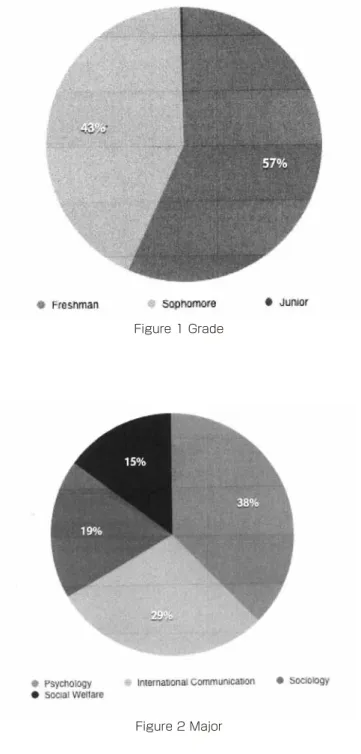
The first question of the written survey asked the students their year in school.
Of the 366 students who responded to the questionnaire: 208 were freshmen (57%), 157 were sophomores (43%), and one was a junior. See Figure 1.
The second question asked the students their majors. The largest number of respondents, 38%, were Psychology majors. International Communications were 29%. Sociology majors were 19%. The smallest group of respondents, 15%, were Social Welfare majors. See Figure 2.
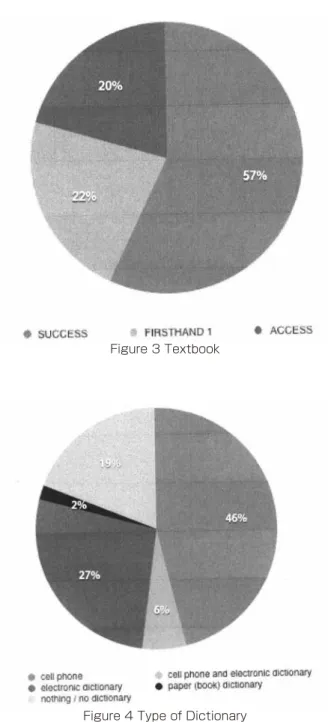
The third question was about the student classroom textbook. All students in the English B Program used textbooks from the English Firsthand series. Lower level first year students used English Firsthand Access. Higher level first year students and lower level second year students used English Firsthand Success. Upper level second year students used English Firsthand 1. Of those students responding to the survey:
20% used English Firsthand Access, 57% used English Firsthand Success, and 22%
used English Firsthand 1. See Figure 3.
The fourth question asked the students which type of dictionary they used in- class. There were three hundred and seventy-one student responses to this question because some students use more than one type of dictionary. The largest group, 46%
of the students, used a cell phone as their dictionary. Electronic dictionaries were
used by 27% of the students. Both cell phones and an electronic dictionary were used by 6% of the students. Only 2% of the students used a paper (book) dictionary.
Almost a fifth of the students surveyed, 19%, said that they did not use any type of dictionary. See Figure 4.
The fifth question asked those students who used an electronic dictionary about the cost of their dictionaries. One hundred twenty-six students responded to this sec- tion. Forty percent of the students who used electronic dictionaries said that they did not know the price. Of the students who did know the cost of their dictionaries: 17%
said that the cost was less than ¥10,000, 23% responded ¥10,000 to ¥19,999, 12%
answered ¥20.000 to ¥29,999, and 8% replied that their dictionaries cost ¥30,000 to
¥35,000. See Figure 5.
The sixth question asked those students who used cell phones, which cell phones they used. One hundred and twenty-three students responded: 82% of them used iPhones, 17% used Android. The iPhone and the Android are both types of smart phones which have a wide variety of apps available. Only 1% of the students said that they used other types of phones. See Figure 6.
The seventh question asked the students who used cell phones as their dic- tionaries, which apps they used. The largest group, 40%, used Line. The next most popular app, Google, was used by 29.% of the respondents. Weblio was used by 28%
of the responding students. Only 3% of those who answered this section said that they used apps other than Line, Google, or Weblio. See Figure 7.
The final question of the survey asked students why they like their dictionaries.
Multiple responses were acceptable. There were 439 responses: 41% of these said that their dictionaries were easy to use, 14% said that their dictionaries had a sound/
pronunciation function, 13% said that their dictionaries were not heavy, 12% said
that they already had their dictionaries, 11% said their dictionaries provided detailed
information, 5% said that their dictionaries were not expensive, 3% said that their
dictionaries were hard to break, 2% (four students) replied other, and one student said
that his dictionary could be written on. See Figure 8.
Figure 1 Grade
Figure 2 Major
Figure 3 Textbook
Figure 4 Type of Dictionary
Figure 5 Price of Electronic Dictionary
Figure 6 Type of Cell Phone
Figure 7 Type of Dictionary App used
Figure 8 Why I lile my dictionary
Implications and Conclusion
During the 2015 school year, I taught at five different universities. At two of the schools I taught foreign language majors. In these classes, I did an informal survey by show of hands asking which type of dictionaries these students used, and 79% of the students used electronic dictionaries. Only 1% of them used cell phones as their classroom dictionaries. However, among the students at Meisei University about a third of those responding to the questionnaire used an electronic dictionary alone or in combination with another dictionary, while almost half of them used a cell phone dictionary alone or in combination with another dictionary. I believe that foreign lan- guage majors are willing to buy an electronic dictionary because they plan to use it for their entire four years at university and possibly beyond. Many non-language major students who are just fulfilling their two year English requirement seem to prefer not to invest additional funds in an electronic dictionary when they can meet their needs with a device that they already own, a cell phone.
The results of the survey show that students are not choosing to use paper dictionaries. They are opting for hand held electronic devices such electronic diction- aries or cell phones. What does this changing preference for dictionaries mean for the classroom teacher?
Some teachers regard cell phones as disruptive to learning and the class atmosphere, so they do not allow their students to use cell phones in the class- room. However, as shown by this survey, a significant number of students at Meisei University used cell phones as their classroom dictionaries. For many young people, the cell phone has become a key component of their lives. I believe that the number of students who prefer to use cell phones as their dictionaries will continue to increase for the foreseeable future. Cell phones can be an important aid to language learn- ing rather than a disruption (Rahimi & Miri 2014). Teachers need to decide if they are going to swim against this growing tide, or if they will allow students to use cell phones in their classes. If the teacher allows students to use cell phones, it is neces- sary to establish clear classroom rules for the use of these devices.
My own experience with students using cell phones in the classroom has been mixed. Years ago, I did not allow them to be used in my class, but my opinion has changed. I want my students to use dictionaries because I believe that it will help them learn. If letting students use cell phone dictionaries will get more students to use dictionaries, I encourage them to do so.
In addition to using their cell phones as dictionaries, my students have used
their phones for doing web searches, for photographing board work and home-
work assignments, to relay messages to the teacher that they will be late because of
train delays, and to show notifications of train delays when they arrive late to class.
However, I have also caught students texting their friends, reading cell phone novels, and playing video games instead of doing class activities. Because of this, I have set up some guidelines for using cell phones in my classes.
・
Cell phones maybe used for legitimate classroom activities such as using them as dictionaries, doing web searches, and photographing board work or homework assignments
・
If students wish to use cell phones as dictionaries or for other legitimate class room uses, the phones should be kept in plain view on top of their desks.
・
Students who use their phones inappropriately will lose the use of their phone for that class period, and may be marked absent for the day.
The classroom environment continues to evolve. The tools students opt to use are changing. Hand held electronic devices such as electronic dictionaries, tablet and notebook computers, and cell phones are becoming more and more common in the classroom. While cell phones in particular can cause problems, when used in an appropriate manner, they can be extremely useful tools for students studying English.
I believe that by managing cell phone use in the classroom, teachers can increase their students
’learning opportunities.
References
Baxter, J. (1980). The Dictionary and Vocabulary Behavior: a single word or a handful?.TESOL Quarterly. XIV, 3, 25-336.
Hauser, E. (2014). Embodied Uses of Electronic Bilingual Dictionaries. JALT Journal 36,1, 5-24.
Helgesen, M., Brown, S., Wiltshire, J., & Rost, M. (Ed.). (2009). English Firsthand 1. Hong Kong: Pearson Longman Asia ELT.
Helgesen, M., Brown, S., Wiltshire, J., & Rost, M. (Ed.). (2010 a). English Firsthand Access.
Hong Kong: Pearson Longman Asia ELT.
Helgesen, M., Brown, S., Wiltshire, J., & Rost, M. (Ed.). (2010b). English Firsthand Success.
Hong Kong: Pearson Longman Asia ELT.
Loucky, J.P. (2008). May I Borrow Your Computerized Dictionary(ies)?: Integrating Portable Devices, Translation Software and Web Dictionaries to Maximize Language Learning. The Language Teacher, 32.11, 22-24.
Loucky, J.P. (2010). Comparing Electronic Dictionary Functions and Use. CALICO Journal, 28, 156-174.
Meurant, R.C. (2007a). A Preliminary Survey of the Use of Cell Phones, Electronic Dictionaries, SMS, Email, Computers and the Internet by Korean EFL Students with Respect to Patterns of L1:L2 Language Use and the Associated Language Learning Strategies Used in Accessing Online Resources.Multimedia and Ubiquitous Engineering, 2007. MUE ’07, 767-772.
Meurant, R.C. (2007b). Second Survey of Korean College EFL Student Use of Cell Phones, Electronic Dictionaries, SMS, Email, Computers and the Internet to Address L!:L2
Proceedings of the International Conference on Current Trends in ELT, 98, 1469-1474.
Stein, G. (1989). EFL Dictionaries, The Teacher and The Student. JALT Journal, 11.1, 36-45.
Appendix A
Circle your answer. ○をつけてください。「その他」は記入をお願いします。
1) Grade 学校年:
A. freshman 1 年生 B. sophomore 2年生 C. junior 3年生 D. senior 4年生 2) Major 大学の主要な専攻
A. Sociology 社会学 B. Psychology 心理学 C. Education 教育 D. Social Welfare 社会福祉 E. International Communications 国際コミュニケーション F. other 別の __________________________________________________
3) Classroom textbook 使用している教科書は?:
A. English Firsthand 1 (green) B. English Firsthand Success (yellow) C. English Firsthand Access (red)
4) What type of dictionary do you use in class? 授業中どんな辞書を使っていますか。
A. nothing なし B. a paper dictionary (a book) 紙の辞書
C. an electronic dictionary 電子辞書 D. a cellphone dictionary 携帯電話の辞書 5) If you answered C (electronic dictionary) in 4, how much did it cost? 電子辞書を使用ならその
価は?
A. I don’t know 不明 B. less than ¥10,000 1万円未満 C. ¥10,000 -¥19,999 D. ¥20,000 - ¥29,999 E. ¥30,000 - ¥35,000 F. more than ¥35,000 35000円以上 6) If you answered D in 4 (cellphone dictionary), what type of cellphone do you use?
あなたはどのような携帯電話を使いますか?
A. iPhone B. Android
C. other cellphone: ______________________________________
7) If you answered D in 4 (cellphone dictionary), what type of App do you use?
あなたはどのようなアプリを使いますか?
A. Google B. Line C. JED D. Weblio
E. other その他 ______________________________________________________________
8) Why do you like your dictionary? なぜあなたは、あなたの辞書が好きですか?(該当項目いくつでも 選択してください。)
A. easy to use 使いやすい B. not heavy 重くない
C. sound function 発音(音声)機能がついている D. hard to break 壊れにくい E. can write notes on it その上にノートが書ける F. detailed information 情報が詳細
G. not expensive 高くない H. I already have it 以前から所有している
I. other reason その他の理由 ______________________________________________________